Within Discovery
When Does an AI Assistant Become a Scientist?
The real leap comes when AI can propose, test, revise and retest hypotheses rather than merely generate plausible suggestions.
On this page
- From hypothesis generation to experimental feedback
- Why interpretation matters as much as automation
- Where human judgement still enters the loop
Page outline Jump by section
Introduction
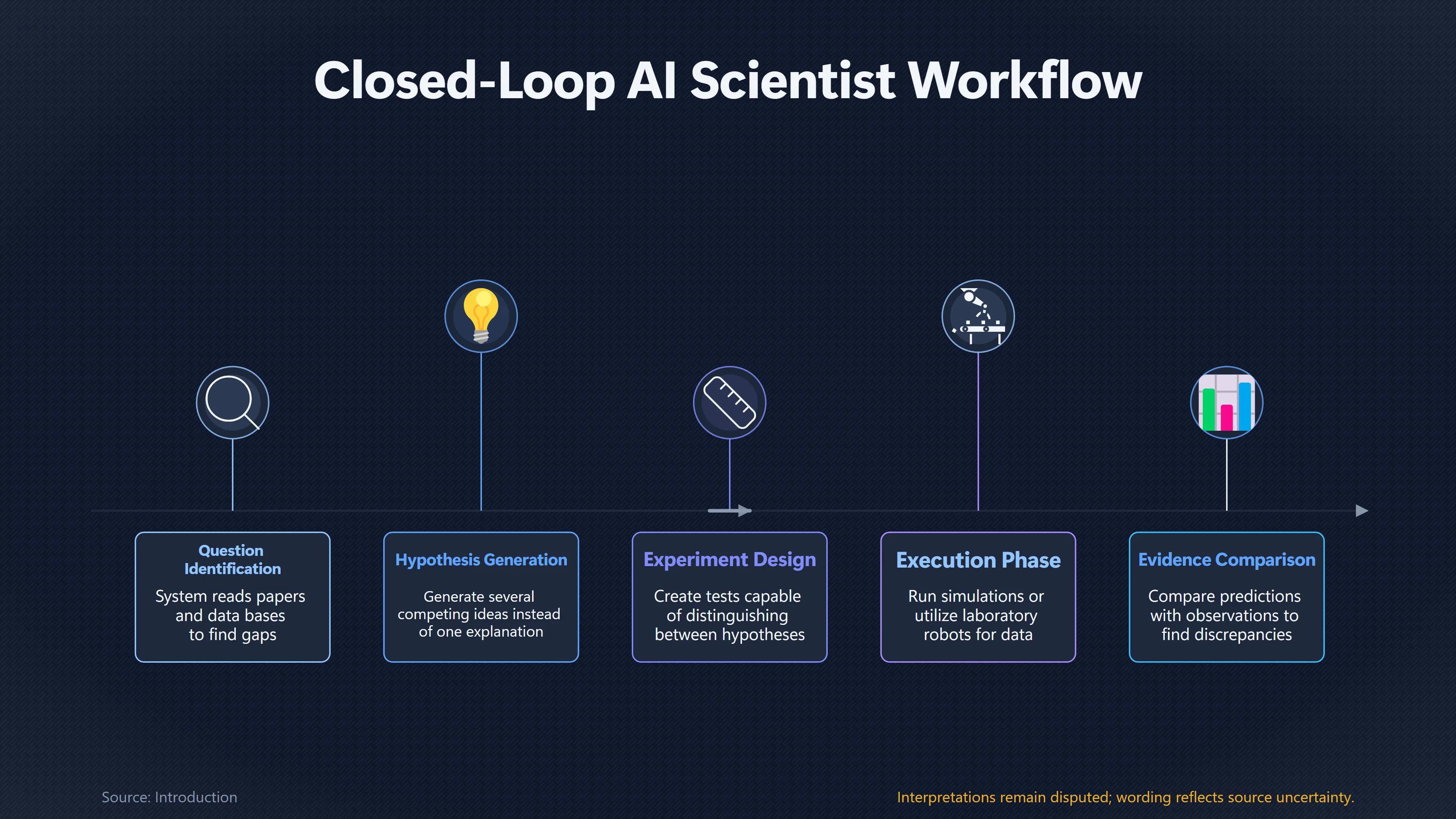
The difference between an AI assistant and an AI scientist is not simply that one is more knowledgeable. It is that an AI scientist can complete a closed loop: it generates a hypothesis, designs a way to test it, carries out or delegates the experiment, interprets the results, revises its ideas, and begins the next cycle. Rather than producing a single plausible answer, it learns from evidence generated during the research process itself.
This shift matters because scientific progress depends less on isolated flashes of insight than on thousands of iterations between ideas and evidence. If AI can reliably shorten those cycles while maintaining scientific standards, it could become one of the most important drivers of the broader vision of AI-enabled human flourishing. However, today’s systems remain far from autonomous scientists. They can automate large parts of the research process, but they still struggle with experimental robustness, genuine interpretation and knowing when evidence should overturn their own assumptions.[nature.com]nature.comAccelerating scientific discovery with Co-Scientist | NatureMay 19, 2026…
From Hypothesis Generation to Experimental Feedback
A scientific discovery rarely comes from generating one clever idea. Instead, researchers repeatedly move between theory and observation until a hypothesis either survives or fails.
A closed-loop AI scientist aims to automate much of this cycle:
- Identify a research question by reading papers, databases and previous experimental results.
- Generate several competing hypotheses rather than committing immediately to one explanation.
- Design experiments capable of distinguishing between those hypotheses.
- Execute experiments, whether through computer simulations, laboratory robots or existing datasets.
- Compare predictions with observations instead of simply reporting whether the experiment “worked”.
- Update the hypotheses based on new evidence.
- Launch another experimental round with refined questions.
The crucial feature is that every experimental result changes what the system attempts next. A genuine closed loop therefore resembles continuous scientific reasoning rather than one-off automation.
Modern systems increasingly separate these responsibilities across specialised AI agents. Google’s Co-Scientist, for example, includes dedicated agents responsible for idea generation, reflection, ranking, literature analysis, hypothesis evolution and meta-review. These agents critique one another before proposing experiments, making the process closer to scientific debate than simple text generation. As additional computational effort is invested, hypotheses are repeatedly refined instead of being accepted after their first draft.[nature.com]nature.comAccelerating scientific discovery with Co-Scientist | NatureMay 19, 2026…
Why Interpretation Matters as Much as Automation
Running experiments automatically is only half of scientific reasoning.
Many laboratory tasks are already highly automated. Robots can pipette liquids, prepare samples, run chemical reactions or screen thousands of compounds with little human intervention. Those capabilities increase throughput but do not necessarily increase understanding.
The harder challenge comes afterwards.
When an experiment produces unexpected findings, researchers must decide questions such as:
- Was the experiment flawed?
- Does the result contradict the hypothesis?
- Does it reveal an entirely new mechanism?
- Should another variable now become the focus?
- Is the apparent discovery merely statistical noise?
Answering these questions requires reasoning under uncertainty rather than simply processing data.
Google’s Co-Scientist attempts to address this by giving its reflection agents several distinct evaluation roles. They review novelty against existing literature, simulate proposed mechanisms, search for contradictory evidence, assess whether experimental observations genuinely support a hypothesis and provide feedback that modifies future proposals. Rather than treating experiments as isolated outputs, the architecture attempts to convert every result into improved future reasoning.[nature.com]nature.comAccelerating scientific discovery with Co-Scientist | NatureMay 19, 2026…
This emphasis on interpretation reflects an important lesson from scientific history. Most failed experiments are still informative if researchers understand why they failed. An AI system that simply discards unsuccessful tests would miss much of the information that drives scientific progress.
Closed Loops Create Compound Learning
The power of closed-loop research comes from accumulation rather than any single breakthrough.
Every completed cycle potentially improves several components simultaneously:
- understanding of the literature;
- estimates of which hypotheses remain plausible;
- experimental design choices;
- confidence in competing explanations;
- prioritisation of future work.
Instead of treating each experiment independently, the system gradually builds an increasingly accurate internal model of the research problem.
This differs from traditional large language models, whose answers primarily depend on information learned during training. Closed-loop systems incorporate new experimental evidence generated after deployment, allowing today’s observations to influence tomorrow’s hypotheses.
In principle, this creates a form of continuous scientific learning. Rather than repeatedly answering the same question from static knowledge, the system continually changes its understanding as fresh evidence arrives.
That capability is particularly attractive in fields with enormous search spaces, such as molecular biology, materials science or drug discovery, where millions or billions of candidate solutions cannot be examined manually.
Early Examples Show the Promise—and the Limits
Several recent systems demonstrate parts of the closed-loop approach, although none yet operates as an entirely independent scientist.
Google’s Co-Scientist focuses primarily on structured hypothesis generation. In biomedical demonstrations, researchers reported that it proposed experimentally testable ideas related to liver fibrosis, antimicrobial resistance and drug repurposing. The emphasis was not on replacing laboratory work but on improving which experiments humans chose to perform next. Google presents these findings as early demonstrations that still require broader validation.[nature.com]nature.comAccelerating scientific discovery with Co-Scientist | NatureMay 19, 2026…
Sakana AI’s AI Scientist pursues a broader goal: automating much of the machine-learning research pipeline from idea generation through coding, experimentation, analysis and manuscript preparation. Its developers have shown that the system can iteratively conduct computational experiments and refine research papers with minimal human intervention, and later versions achieved notable peer-review milestones in controlled settings.[nature.com]nature.comTowards end-to-end automation of AI research | NatureTowards end-to-end automation of AI research | Nature
These systems illustrate an important distinction.
An AI scientist does not become scientifically valuable because it writes papers automatically. It becomes valuable if experimental outcomes genuinely improve the quality of its next decisions.
Evidence That Feedback Really Matters
Whether AI systems actually learn from experimental feedback remains an active research question.
Recent laboratory studies provide encouraging but qualified evidence. One investigation involving hundreds of replicated biological experiments found that an AI agent with access to experimental feedback discovered substantially more useful perturbations than a comparable zero-shot system relying only on prior knowledge. When researchers deliberately randomised the feedback signals, the improvement disappeared, suggesting that the gains depended on genuine information from experiments rather than memorised patterns. The authors also found that stronger language models made much better use of feedback than earlier generations.[arXiv]arxiv.orgCan AI Scientist Agents Learn from Lab-in-the-Loop Feedback? Evidence from Iterative Perturbation DiscoveryMarch 27, 2026…
This does not mean today’s systems possess human-style scientific understanding. It does suggest that sufficiently capable models can begin adapting their search strategy when experiments reveal something unexpected, moving beyond static prediction toward evidence-guided exploration.
Where Human Judgement Still Enters the Loop
Despite rapid progress, current AI scientists remain heavily dependent on human oversight.
Researchers still make crucial decisions about:
- selecting meaningful scientific questions;
- defining acceptable evidence standards;
- checking experimental quality;
- recognising misleading correlations;
- evaluating ethical and safety considerations;
- deciding whether surprising results justify changing an entire research programme.
Human scientists also contribute something difficult to automate: recognising when established assumptions themselves should be questioned.
Many important discoveries initially looked like experimental mistakes. Distinguishing genuine anomalies from laboratory error often requires domain knowledge, intuition and contextual understanding that current AI systems only partially possess.
For this reason, leading research groups increasingly describe these systems as co-scientists rather than replacements. Their goal is to accelerate scientific reasoning while leaving strategic judgement and responsibility with human researchers.[nature.com]nature.comAccelerating scientific discovery with Co-Scientist | NatureMay 19, 2026…
Why Reliability Is Still the Hard Problem
A closed loop can also amplify mistakes.
If an AI repeatedly builds new experiments on incorrect assumptions, faulty code or hallucinated literature, errors may compound instead of being corrected. Independent evaluations of early autonomous research systems have highlighted several weaknesses, including unreliable novelty assessments, coding failures, hallucinated results, poor citation quality and limited adaptation after failed experiments. These shortcomings illustrate that automating the research cycle is easier than ensuring the cycle produces trustworthy knowledge.[arXiv]arxiv.orgEvaluating Sakana's AI Scientist for Autonomous Research: Wishful Thinking or an Emerging Reality Towards 'Artificial Research Intel…
The challenge therefore shifts from simply increasing research speed to maintaining scientific reliability. Better verification, reproducibility, independent replication and careful human review become even more important as AI systems perform larger fractions of the research process.
Why Closed Loops Matter for AI Bloom
Within the broader idea of AI-driven human flourishing, closed-loop AI scientists matter because they change the economics of discovery rather than merely accelerating paperwork.
If future systems can reliably generate hypotheses, test them, learn from failures and continually improve their own research strategies, the pace of scientific progress could increase across medicine, materials science, energy, agriculture and many other fields simultaneously. The benefit would come not from replacing human creativity but from allowing vastly more scientific ideas to be explored, rejected or confirmed than today’s research system can manage.
That possibility remains conditional. Scientific acceleration depends on trustworthy experiments, rigorous interpretation, transparent validation and effective human oversight. Closed loops can multiply both insight and error. The long-term promise therefore lies not in autonomous laboratories operating without people, but in research systems where AI continuously expands the number of high-quality experiments humans are able to conceive, evaluate and learn from.[nature.com]nature.comAccelerating scientific discovery with Co-Scientist | NatureMay 19, 2026…
Amazon book picks
Further Reading
Books and field guides related to When Does an AI Assistant Become a Scientist?. Use these as the next step if you want deeper reading beyond the article.
Artificial Intelligence: A Modern Approach
Rating: 4.5/5 from 10 Google Books ratings
Artificial intelligence: A Modern Approach, 3e,is ideal for one or two-semester, undergraduate or graduate-level courses in Artificial In...
The Book of Why
The hugely influential book on how the understanding of causality revolutionized science and the world, by the pioneer of artificial inte...
Deep Learning
Rating: 3.5/5 from 6 Google Books ratings
An introduction to a broad range of topics in deep learning, covering mathematical and conceptual background, deep learning techniques us...
Reinventing Discovery
A pioneer of quantum computing describes how the Internet and powerful new online tools are democratising and accelerating scientific dis...
eBay marketplace picks
Marketplace Samples
Live-tested eBay searches with available results related to this page.
Selected fromrobotics kit oneBay.co.uk.
Endnotes
1.
Source: nature.com
Title: Accelerating scientific discovery with Co-Scientist | Nature
Link:https://www.nature.com/articles/s41586-026-10644-y
Source snippet
May 19, 2026...
Published: May 19, 2026
2.
Source: nature.com
Title: Towards end-to-end automation of AI research | Nature
Link:https://www.nature.com/articles/s41586-026-10265-5
3.
Source: arxiv.org
Link:https://arxiv.org/abs/2502.14297
Source snippet
Evaluating Sakana's AI Scientist for Autonomous Research: Wishful Thinking or an Emerging Reality Towards 'Artificial Research Intel...
4.
Source: arxiv.org
Title: arXiv Towards an AI co-scientist
Link:https://arxiv.org/abs/2502.18864
5.
Source: sakana.ai
Link:https://sakana.ai/ai-scientist-nature/
Source snippet
The AI Scientist: Towards Fully Automated AI Research, Now Published in <i>Nature</i>...
6.
Source: arxiv.org
Link:https://arxiv.org/abs/2603.26177
Source snippet
Can AI Scientist Agents Learn from Lab-in-the-Loop Feedback? Evidence from Iterative Perturbation DiscoveryMarch 27, 2026...
Published: March 27, 2026
7.
Source: nature.com
Link:https://www.nature.com/articles/d41586-026-00899-w
8.
Source: nature.com
Link:https://www.nature.com/articles/d41586-026-00934-w
9.
Source: sakana.ai
Title: The AI Scientist: Towards Fully Automated Open-Ended Scientific Discovery
Link:https://sakana.ai/ai-scientist/?trk=public_post_comment-text
Additional References
10.
Source: ft.com
Link:https://www.ft.com/content/6e53cc55-9031-4ba4-9e7c-e5e9c02b3203
Source snippet
This tool helps scientists identify gaps in their knowledge and propose new ideas, potentially revolutionizing the pace of scientific dis...
11.
Source: modelcurrent.com
Title: A I scientists are entering the experimental loop — Model Current
Link:https://modelcurrent.com/article/ai-scientists-are-entering-the-experimental-loop
Source snippet
AI scientists are entering the experimental loop — Model CurrentJuly 12, 2026 — Research12 July 2026 7 min read AI SCIENTISTS ARE ENTERIN...
Published: July 12, 2026
12.
Source: youtube.com
Title: The AI Scientist | Fully Automated Open-Ended Scientific Discovery
Link:https://www.youtube.com/watch?v=_3o3U5qBPJM
Source snippet
Sakana AI Scientist fully automated scientific discovery The AI Scientist: Can Research Be Fully Automated?...
13.
Source: claudescientist.com
Title: Start with the definitio
Link:https://claudescientist.com/
Source snippet
Claude ScientistJuly 6, 2026 — CLAUDE SCIENTIST A sourced guide to autonomous science agents: systems that turn research questions into p...
Published: July 6, 2026
14.
Source: youtube.com
Title: The AI Scientist: Towards Fully Automated Open-Ended Scientific Discovery
Link:https://www.youtube.com/watch?v=CFewReJ1Eyo
Source snippet
The Future of Chemistry is [Self-Driving]({{ 'lab-access/' | relative_url }}) | Alán Aspuru-Guzik...
15.
Source: youtube.com
Title: Generating novel scientific hypotheses with Co-Scientist
Link:https://www.youtube.com/watch?v=aSY_vFFmkW0
Source snippet
The AI Scientist: Towards Fully Automated Open-Ended Scientific Discovery...
16.
Source: youtube.com
Title: Closed-loop optimization with self-driving lab demo!
Link:https://www.youtube.com/watch?v=xiQ2IygSZ_k
Source snippet
The AI Scientist | Fully Automated Open-Ended Scientific Discovery...
17.
Source: youtube.com
Title: The Future of Chemistry is Self-Driving | Alán Aspuru-Guzik
Link:https://www.youtube.com/watch?v=AWf6y1Q2dF4
Source snippet
Closed-loop optimization with self-driving lab demo...
18.
Source: paperswithcode.com
Link:https://paperswithcode.com/paper/an-evaluation-of-sakana-s-ai-scientist-for
19.
Source: techcrunch.com
Link:https://techcrunch.com/2025/03/12/sakana-claims-its-ai-paper-passed-peer-review-but-its-a-bit-more-nuanced-than-that/