Within Skill Gaps
Does AI help workers learn or lean?
AI can make workers perform better while also raising the risk that they learn less about why their choices work.
On this page
- Borrowed competence versus genuine skill
- How entry level work can lose its apprenticeship role
- Ways to design assistance that still builds judgement
Page outline Jump by section
Introduction
AI workplace assistants can make people more capable, more productive, and less dependent on scarce expert help. That is one reason they matter within the wider idea of AI-enabled abundance. If useful judgement can be distributed through software, more people may gain access to skills that were previously locked inside elite institutions, experienced professionals, or expensive training systems.
 But there is a tension inside that optimistic story. Better performance is not always the same thing as deeper understanding. Workers can become faster without becoming wiser. In some settings, AI may help people learn by providing explanations, feedback, and examples. In others, it may quietly replace the mental effort through which expertise is normally built. The key question is not whether AI assistance raises output in the short term. It is whether workers are developing durable judgement or merely borrowing competence from a machine.
This matters especially because many professions rely on apprenticeship. People become good doctors, engineers, analysts, managers, lawyers, technicians, and researchers partly by handling routine work, making mistakes, and gradually learning why decisions succeed or fail. If AI systems increasingly perform those learning-stage tasks, organisations may gain efficiency while weakening the process that produces future experts.
Does AI help workers learn or lean?
The evidence so far points in both directions.
The strongest workplace studies show that AI assistance can help less experienced workers close performance gaps. In the well-known customer support research by Erik Brynjolfsson, Danielle Li, and Lindsey Raymond, lower-skilled workers improved substantially when given AI guidance, while expert workers gained less. The researchers argued that the system appeared to transfer some of the practices of top performers to newer employees.[arXiv]arxiv.orgarXiv Generative AI at WorkGenerative AI at WorkApril 24, 2023…
On one interpretation, this is exactly what a healthy knowledge tool should do. It makes expertise less scarce. Instead of waiting months or years to absorb lessons from colleagues, workers receive guidance during the task itself.
Yet there is another possibility. The worker may learn how to follow recommendations without fully understanding why those recommendations are correct.
This distinction matters because many forms of expertise involve invisible judgement. A customer support agent does not merely recite successful phrases. A good agent learns when rules apply, when they do not, how to detect unusual situations, and how to balance competing priorities. Similar patterns exist in medicine, engineering, software development, finance, education, and management.
If workers increasingly interact with the world through AI-generated recommendations, they may become highly effective at executing decisions while remaining less capable of generating them independently.
Several recent studies outside the workplace point toward this risk. Research examining AI-assisted writing found signs of lower cognitive effort, weaker memory retention, and reduced engagement when participants relied heavily on large language models from the start of a task. Researchers stressed that these findings remain early and context-specific, but they raise a broader concern: cognitive work that is repeatedly outsourced may not produce the same learning effects as cognitive work performed directly.[arXiv]arxiv.orgarXiv Generative AI at WorkGenerative AI at WorkApril 24, 2023…[PMC]pmc.ncbi.nlm.nih.govof generative artificial intelligence on cognitive effort…by Y Chen · 2025 · Cited by 31 — We will examine the effect of using generat…
The central challenge is therefore not whether AI raises performance. It is whether the route to that performance still develops understanding.
Borrowed competence versus genuine skill
A useful way to think about the issue is the difference between borrowed competence and genuine skill.
Borrowed competence means a person can produce a good result while assistance remains available. Genuine skill means they understand enough to adapt when conditions change.
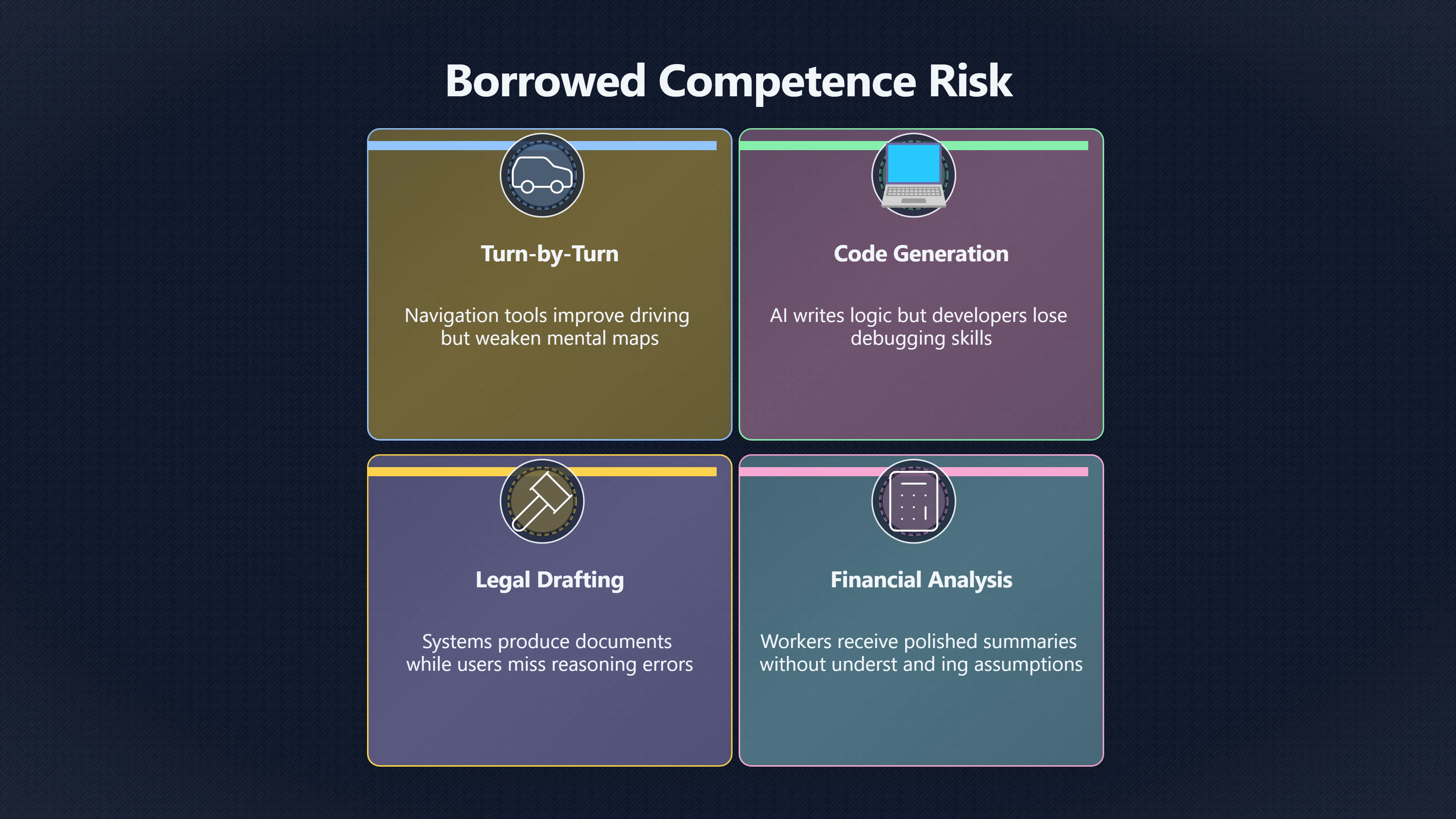
Navigation software provides a familiar example. Many people can drive efficiently using turn-by-turn directions. Yet some become noticeably worse at forming mental maps of places. The tool improves immediate performance while reducing incentives to learn underlying geography.
Workplace AI may create similar effects.
A junior software developer using AI can often generate functioning code faster than previous generations of beginners. But if the system writes most of the architecture, debugging logic, and implementation details, the developer may struggle to explain why the code works or identify hidden failures. The output looks professional, yet the understanding underneath may remain shallow.
The same pattern can appear in:
- Legal drafting, where AI generates convincing documents while users miss subtle reasoning errors.
- Financial analysis, where workers receive polished summaries without understanding assumptions.
- Marketing, where staff learn to refine AI outputs without learning audience psychology.
- Data analysis, where people obtain answers without mastering statistical reasoning.
- Management, where AI suggests responses to personnel problems without developing interpersonal judgement.
Critics sometimes call this deskilling, but that term can be misleading because the process is rarely total. Workers often gain new skills even as they lose others.
The more precise concern is skill substitution. Human effort shifts from generating knowledge to supervising generated knowledge. The question becomes whether workers are acquiring enough understanding to supervise effectively.
Research on workplace AI increasingly suggests that supervision itself becomes a new skill. Employees must learn how to evaluate outputs, identify hallucinations, recognise hidden assumptions, and decide when AI advice should be ignored. Yet those abilities often require substantial prior expertise. The danger is a circular problem: people need judgement to evaluate AI guidance, but judgement is precisely what many entry-level roles are supposed to build.[arXiv]arxiv.orgarXiv Generative AI at WorkGenerative AI at WorkApril 24, 2023…
How entry-level work can lose its apprenticeship role
Many organisations are discovering that AI is especially good at tasks traditionally assigned to beginners.
That is economically attractive. Firms can automate documentation, first drafts, routine coding, administrative processing, basic research, customer communications, and other repetitive activities that previously consumed junior workers’ time.
The difficulty is that these tasks often served a second purpose beyond productivity. They functioned as training.
A young lawyer reviewing contracts was not merely producing billable work. They were learning how experienced lawyers think.
A junior analyst preparing reports was not merely creating spreadsheets. They were learning how decisions are made under uncertainty.
A trainee journalist researching background material was not merely gathering facts. They were developing news judgement.
Historically, many professions depended on this apprenticeship structure. Newcomers handled lower-value work while gradually absorbing tacit knowledge from experts.
If AI systems increasingly absorb the lower layers of professional work, organisations may face what some researchers describe as an apprenticeship problem. The immediate output remains high, but fewer opportunities exist for workers to accumulate experience through repetition.[SSRN]papers.ssrn.comGenerative AI and the Collapse of Apprenticeship Labor…22 May 2026 — When AI automates the entry-level tasks traditionally used fo…[stanford]digitaleconomy.stanford.eduStanford Digital Economy LabTask Expansion with Generative AI: The Case of…Our research examines whether generative AI enables middle… Recent concerns about graduate hiring reflect part of this issue. Some researchers and labour-market analysts argue that AI may affect career entry before it affects senior leadership. The concern is not simply job displacement. It is disruption of the pipeline through which future expertise is created.[Yale Insights]insights.som.yale.eduthe real job destruction from ai is hitting before careers can startYale InsightsThe Real Job Destruction from AI Is Hitting Before Careers…4 May 2026 — Experts have been predicting that AI will decimat…
This challenge becomes particularly important in an AI bloom scenario. If intelligence becomes abundant and highly capable systems can perform many routine cognitive tasks, society will need new mechanisms for producing human judgement. A civilisation that automates learning opportunities faster than it develops alternatives could become richer while also becoming less capable in important ways.

Why dependence may be hard to notice
One reason the problem is difficult to manage is that dependence often feels like improvement.
Workers receive faster answers.
Managers observe higher productivity.
Customers experience shorter waiting times.
Reports are completed more quickly.
Mistakes initially decline.
All of these outcomes can be real.
The risk emerges gradually because expertise is a stock, not merely a flow. A worker may appear effective today because the AI system supplies missing knowledge. The organisation only discovers the weakness later when unusual circumstances arise, systems fail, or independent judgement becomes necessary.
Several observers have described this as a form of cognitive debt. The worker gains immediate efficiency while postponing the effort that would normally build understanding. Like financial debt, the costs remain hidden until conditions change.[LinkedIn]linkedin.comWhat the MIT Study on AI and Cognitive Debt May Have…The study observed that when previously unassisted learners gained access…
The effect may be strongest when workers receive answers before they have attempted to reason through problems themselves. Human learning often depends on struggle, error correction, and active retrieval. If AI consistently provides conclusions before workers construct their own explanations, some of those learning mechanisms may weaken.[arXiv]arxiv.orgarXiv Generative AI at WorkGenerative AI at WorkApril 24, 2023…
That does not mean AI inevitably harms learning. The same research also suggests a more nuanced picture. People who already possess some understanding often use AI differently. Rather than replacing thought, they use it to challenge assumptions, test alternatives, and expand their thinking. In these cases AI can act more like a cognitive amplifier than a substitute.[LinkedIn]linkedin.comWhat the MIT Study on AI and Cognitive Debt May Have…The study observed that when previously unassisted learners gained access…
The distinction is not simply between AI use and non-use. It is between passive reliance and active engagement.
Ways to design assistance that still builds judgement
The dependence risk is not necessarily an argument against workplace AI. It is an argument about design.
The same technology can either strengthen or weaken human capability depending on how organisations use it.
Several approaches are emerging.
Show reasoning, not just answers
Workers learn more when systems explain recommendations, display alternatives, and reveal uncertainty.
A tool that simply produces an answer encourages acceptance. A tool that exposes the reasoning process encourages evaluation.
This is especially important in fields where professional judgement matters more than routine execution.
Require prediction before assistance
One promising approach is forcing workers to make an initial judgement before seeing AI recommendations.
The person commits to an answer, forecast, diagnosis, or draft first. AI feedback arrives afterwards.
This preserves the learning value of active reasoning while still providing assistance.
Educational research has long found that attempted retrieval and problem-solving improve learning. Similar principles may apply in professional environments.[arXiv]arxiv.orgarXiv Generative AI at WorkGenerative AI at WorkApril 24, 2023…
Preserve some unassisted practice
Pilots still train for equipment failures. Surgeons still practise procedures directly. Professional expertise often requires maintaining skills that automation rarely demands.
Organisations may increasingly need protected spaces where workers operate with limited AI assistance in order to preserve competence and confidence.
Some researchers have proposed creating structured environments specifically designed to protect human skill development even as AI becomes more capable.[University of Bath]bath.ac.ukStudy flags AI failings, urges creationUniversity of BathUniversity of Bath study warns AI could erode human…1 Apr 2026 — University of Bath study warns AI could erode human…
Measure learning, not just output
Many firms currently evaluate AI success through productivity metrics.
Yet if long-term capability matters, organisations may need additional measures:
- Can workers explain their decisions?
- Can they handle unusual cases?
- Can they perform without assistance when necessary?
- Are junior staff developing independent judgement?
These questions matter because the value of a workforce is not only today’s output but tomorrow’s expertise.
A deeper challenge for an age of abundant intelligence
The dependence question points toward a larger issue within the AI bloom vision.
If advanced AI eventually makes intelligence far cheaper and more available, humanity may gain extraordinary new capabilities. Scientific discovery could accelerate. Expertise could become accessible on demand. Education could become more personalised and effective. Many barriers created by knowledge scarcity might weaken.
Yet abundance alone does not guarantee flourishing.
A society that can access intelligence everywhere must still decide which forms of human capability it wants to preserve and develop. If machines become increasingly capable of providing answers, human value may shift toward judgement, creativity, goal-setting, moral reasoning, coordination, and the ability to decide what should be done rather than merely how to do it.
The optimistic version of AI-enabled abundance is not one where humans become passive users of superior systems. It is one where AI expands human capacity while leaving people more capable than before. The dependence risk matters because it highlights a failure mode of that vision: a world in which performance rises while understanding quietly falls.
Whether AI workplace assistants become tools for empowerment or systems of dependence may depend less on the models themselves than on the institutions built around them. The critical question is not whether workers can do more with AI. It is whether, year after year, they are becoming more capable humans as well.
eBay marketplace picks
Marketplace Samples
Example marketplace items related to this page. Use the search link to explore similar finds on eBay.


Endnotes
1.
Source: arxiv.org
Title: arXiv Generative AI at Work
Link:https://arxiv.org/abs/2304.11771
Source snippet
Generative AI at WorkApril 24, 2023...
Published: April 24, 2023
2.
Source: arxiv.org
Link:https://arxiv.org/pdf/2506.08872
Source snippet
Your Brain on ChatGPTJune 10, 2025 — Jun 8, 2025 — This study focuses on finding out the cognitive cost of using an LLM in the educa...
Published: June 10, 2025
3.
Source: pmc.ncbi.nlm.nih.gov
Link:https://pmc.ncbi.nlm.nih.gov/articles/PMC12255134/
Source snippet
of generative artificial intelligence on cognitive effort...by Y Chen · 2025 · Cited by 31 — We will examine the effect of using generat...
4.
Source: time.com
Title: ai chatgpt google learning school
Link:https://time.com/7295195/ai-chatgpt-google-learning-school/
Source snippet
ChatGPT's Impact On Our Brains According to an MIT StudyJun 17, 2025 — The study, from MIT Lab scholars, measured the brain activity of s...
5.
Source: arxiv.org
Link:https://arxiv.org/abs/2502.08854
Source snippet
Generative AI & Changing Work: Systematic Review of Practitioner-led Work Transformations through the Lens of Job CraftingFebruary 1...
6.
Source: papers.ssrn.com
Link:https://papers.ssrn.com/sol3/Delivery.cfm/6779239.pdf?abstractid=6779239&mirid=1&type=2
Source snippet
Generative AI and the Collapse of Apprenticeship Labor...22 May 2026 — When AI automates the entry-level tasks traditionally used fo...
Published: May 2026
7.
Source: digitaleconomy.stanford.edu
Link:https://digitaleconomy.stanford.edu/project/task-expansion-with-generative-ai-the-case-of-apprenticeships/
Source snippet
Stanford Digital Economy LabTask Expansion with Generative AI: The Case of...Our research examines whether generative AI enables middle...
8.
Source: insights.som.yale.edu
Title: the real job destruction from ai is hitting before careers can start
Link:https://insights.som.yale.edu/insights/the-real-job-destruction-from-ai-is-hitting-before-careers-can-start
Source snippet
Yale InsightsThe Real Job Destruction from AI Is Hitting Before Careers...4 May 2026 — Experts have been predicting that AI will decimat...
Published: May 2026
9.
Source: linkedin.com
Link:https://www.linkedin.com/pulse/what-mit-study-ai-cognitive-debt-may-have-missed-ted-kaouk-phd-bjfye
Source snippet
What the MIT Study on AI and Cognitive Debt May Have...The study observed that when previously unassisted learners gained access...
10.
Source: linkedin.com
Link:https://www.linkedin.com/posts/jacobmorgan8_the-old-apprenticeship-model-is-breaking-activity-7462688118257860608-qbTT
Source snippet
AI's Impact on Entry-Level Jobs and Human JudgmentRemove low-value work, but redesign how people learn. Keep humans close to judgment. Bu...
11.
Source: linkedin.com
Link:https://www.linkedin.com/posts/robertguidi_the-impact-of-gen-ai-on-human-learning-a-activity-7288554769516822528-cUiW
Source snippet
The Impact of Gen AI on Human LearningAI gives flexible access to content, personalized feedback, and quick assistance in problem-solving...
12.
Source: linkedin.com
Link:https://www.linkedin.com/pulse/mit-study-83-chatgpt-users-cant-remember-own-writing-alex-goryachev-4supc
13.
Source: news.mit.edu
Title: study finds chatgpt boosts worker productivity writing 0714
Link:https://news.mit.edu/2023/study-finds-chatgpt-boosts-worker-productivity-writing-0714
Source snippet
MIT NewsStudy finds ChatGPT boosts worker productivity for some...14 Jul 2023 — A new report by MIT researchers highlights the potential...
14.
Source: bath.ac.uk
Title: Study flags AI failings, urges creation
Link:https://www.bath.ac.uk/announcements/university-of-bath-study-warns-ai-could-erode-human-capital-thinking-and-expertise-in-the-workplace/
Source snippet
University of BathUniversity of Bath study warns AI could erode human...1 Apr 2026 — University of Bath study warns AI could erode human...
15.
Source: mitsloan.mit.edu
Title: how generative ai can boost highly skilled workers productivity
Link:https://mitsloan.mit.edu/ideas-made-to-matter/how-generative-ai-can-boost-highly-skilled-workers-productivity
Source snippet
MIT SloanHow generative AI can boost highly skilled workers...19 Oct 2023 — Generative AI can boost worker productivity, but organizatio...
16.
Source: mitsloan.mit.edu
Title: workers less experience gain most generative ai
Link:https://mitsloan.mit.edu/ideas-made-to-matter/workers-less-experience-gain-most-generative-ai
Source snippet
with less experience gain the most from...26 Jun 2023 — Workers with the least experience can quickly improve at their jobs with the hel...
Additional References
17.
Source: researchgate.net
Link:https://www.researchgate.net/publication/380894768_When_Generative_AI_Meets_Workplace_Learning_Creating_A_Realistic_Motivating_Learning_Experience_With_A_Generative_PCA
Source snippet
(PDF) When Generative AI Meets Workplace LearningThis paper describes an organizational communication training with a Generative PCA (Gen...
18.
Source: medium.com
Link:https://medium.com/data-science-collective/a-47-collapse-in-brain-activity-9cdf352f349e
Source snippet
A 47% Collapse in Brain ActivityThe MIT study found that participants who first used the LLM and were then asked to write independently s...
19.
Source: thebrighterside.news
Link:https://www.thebrighterside.news/post/ai-will-not-displace-jobs-it-will-radically-transform-them-research-finds/
Source snippet
AI will not displace jobs, it will radically transform them...7 days ago — New research finds generative AI can boost work engagement a...
20.
Source: businessinsider.com
Link:https://www.businessinsider.com/ai-deskilling-impact-on-worker-skills-productivity
Source snippet
It uses the example of Josh Anderson, a seasoned software consultant, who relied heavily on AI to build an app without coding himself. Wh...
21.
Source: techradar.com
Link:https://www.techradar.com/pro/how-else-are-people-going-to-learn-to-do-the-job-mit-ai-expert-warns-against-automating-gen-z-entry-level-jobs
Source snippet
He emphasized that entry-level roles provide essential on-the-job training and apprenticeship-style learning, which help young profession...
22.
Source: aei.org
Link:https://www.aei.org/wp-content/uploads/2025/07/The-Expertise-Upheaval-How-GenAI-Will-Reshape-the-Workplace-25.07.09.pdf
Source snippet
AI (GenAI) is set to reshape the workforce, redefining career pathways a...
23.
Source: edtechinnovationhub.com
Link:https://www.edtechinnovationhub.com/news/mit-study-shows-chatgpt-reshapes-student-brain-function-and-reduces-creativity-when-used-from-the-start
Source snippet
MIT study shows ChatGPT reshapes student brain function...Jun 18, 2025 — A new study by MIT researchers finds that relying on generative...
24.
Source: assets.publishing.service.gov.uk
Link:https://assets.publishing.service.gov.uk/media/656856b8cc1ec500138eef49/Gov.UK_Impact_of_AI_on_UK_Jobs_and_Training.pdf
Source snippet
impact of AI on UK jobs and trainingIt has been estimated that 10-30% of jobs are automatable with AI having the potential to increase pr...
25.
Source: researchgate.net
Link:https://www.researchgate.net/publication/389742059_Deskilling_and_upskilling_with_AI_systems
26.
Source: uvac.ac.uk
Link:https://uvac.ac.uk/wp-content/uploads/2026/03/1603-Generative-AI.pdf
Topic Tree