Within Civilisation backup
Can Off Earth Settlements Truly Operate Independently?
Explores how life-support systems, energy production, and resource processing could allow space colonies to operate independently from Earth.
On this page
- Closed loop life support systems
- In situ resource utilisation technologies
- Energy and manufacturing independence
Page outline Jump by section
Introduction
For an off‑Earth community to serve as a genuine civilisation backup, it must not only put humans beyond our planet but also support life and society independently of regular resupply from Earth. At its core, this means developing technological mechanisms that can produce essentials such as air, water, energy and materials from the settlement environment itself, and then use them to sustain and grow a community over years, decades or longer.
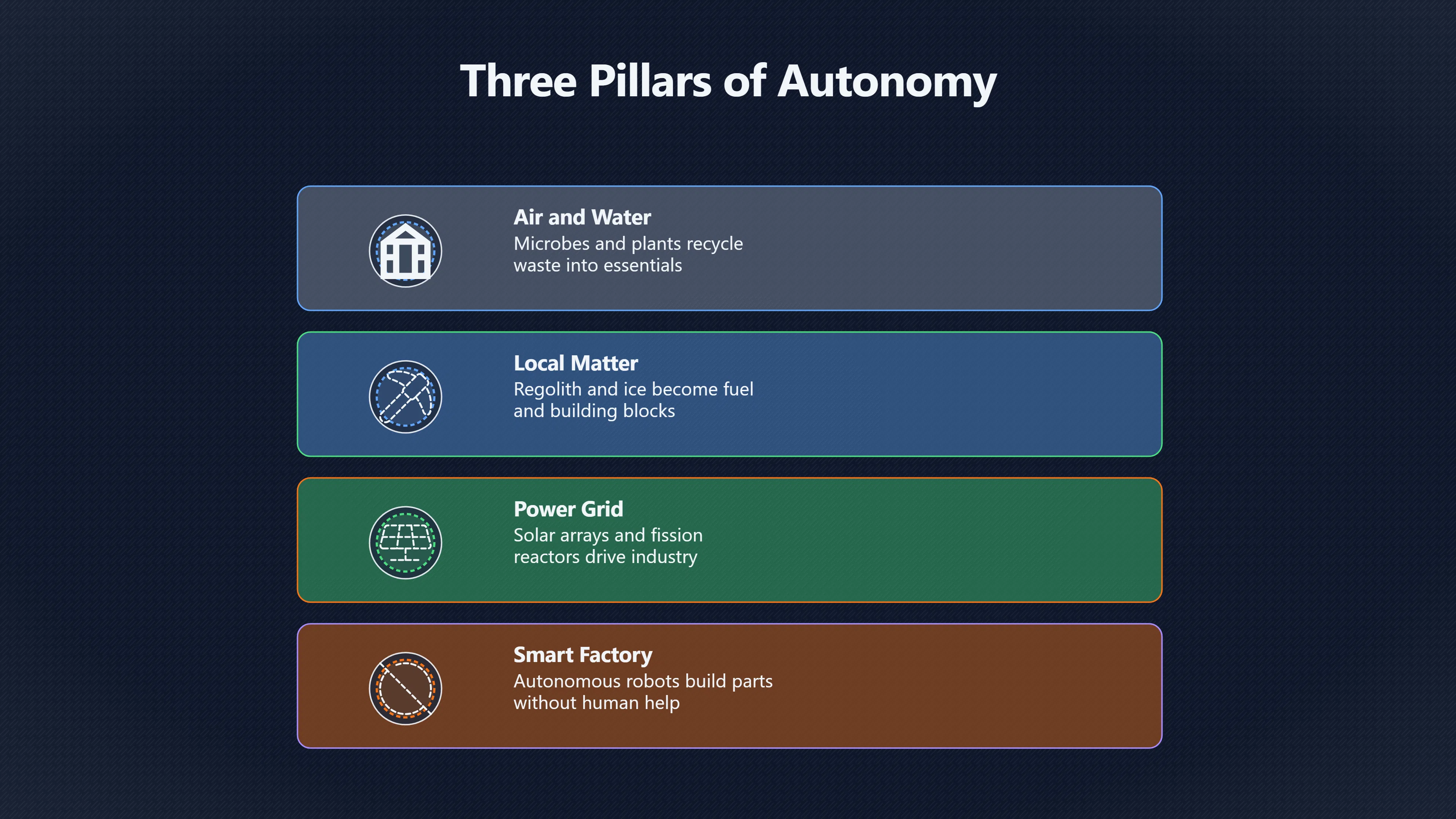
 Technologies to achieve this focus on three interlocking capabilities: closed‑loop life‑support that recycles and regenerates vital consumables; in‑situ resource utilisation (ISRU) that turns local planetary or asteroidal resources into usable substances; and energy generation and manufacturing systems capable of operating with minimal Earth‑derived inputs. These mechanisms are essential to shift settlements from being costly, Earth‑dependent outposts to autonomous hubs that could anchor a multi‑planetary civilisation.[NASA]nasa.govOverview: In-Situ Resource UtilizationOverview: In-Situ Resource Utilization - NASAJuly 26, 2023…
Closed‑Loop Life Support: Cycling Air, Water and Food
One of the most foundational technological barriers to self‑sufficiency is life support—keeping humans alive without regular deliveries of oxygen, water or food from Earth. Current space habitats such as the International Space Station rely on partially closed systems that still need regular resupply. For true independence, engineers aim to dramatically increase the degree of closure in these systems so that waste streams are recycled and consumables are regenerated on site.[NASA]nasa.govNext Generation Life Support (NGLSNext Generation Life Support (NGLS) - NASADecember 2, 2020…
- Bioregenerative cycling: Projects such as the Micro‑Ecological Life Support System Alternative (MELiSSA) by the European Space Agency are designing compact ecosystems where microbes, plants and chemical processes continuously recycle air, water and waste. These systems mimic Earth’s own biosphere in miniature, turning carbon dioxide back into oxygen, purifying water, and enabling food production in controlled environments.[European Space Agency]esa.intEuropean Space Agency ESAEuropean Space AgencyESA - Life support…
- Advanced recycling technologies: Beyond biological loops, engineered treatments—such as membrane‑based water and air processing embedded into habitat structures—are under development to handle water, solids and gases more efficiently than current portable systems. These approaches aim to reduce mass and power needs while increasing reliability.[technology.nasa.gov]technology.nasa.govAdvancing Commercial Space | T2 PortalAdvancing Commercial Space | T2 Portal
- Crop production and food: Growing crops in controlled habitats not only supplies food but also contributes to atmosphere revitalisation and water recycling via plant processes. While still early stage, crop systems help close the loop between consumption and production of essentials.[NASA]technology.nasa.govAdvancing Commercial Space | T2 PortalAdvancing Commercial Space | T2 Portal
Closed‑loop life support is a long‑term goal, but even partial systems that drastically reduce resupply dependence would be a major step towards settlement autonomy.
In Situ Resource Utilisation: Turning Local Matter into Essentials
Even the most efficient recycling cannot produce resources that aren’t already present. That’s where In Situ Resource Utilisation (ISRU) comes in: technologies that extract, process and use local planetary or small‑body materials to create water, oxygen, propellant, building materials and more.[NASA]nasa.govHuman Spaceflight Technologies Benefitting EarthHuman Spaceflight Technologies Benefitting Earth - NASAApril 22, 2022…
- Harvesting water and volatiles: Robotic missions and orbital data show that lunar regolith and polar ice deposits, as well as Martian soil and underground ice, contain water and other volatile compounds that can be mined, purified and used as drinking water, plant hydration or split into hydrogen and oxygen for fuel or breathing.[NASA]ntrs.nasa.govMinimized Technological Approach towards Human Self Sufficiency off Earth - NASA Technical Reports Server (NTRS)January 1, 2007 — A Minim…
- Oxygen and propellant production: Experiments like MOXIE on Mars aim to turn the carbon dioxide‑rich Martian atmosphere into oxygen—both for crew breathing and as an oxidiser in rocket propellant. Similar approaches for lunar regolith aim to liberate oxygen and produce propellant feedstocks on the Moon.[European Space Agency]esa.intEuropean Space Agency ESAEuropean Space AgencyESA - Life support…
- Construction materials: Regolith can also become structural feedstock using additive manufacturing (3D printing) and other processing techniques. Studies have explored turning lunar soil into fibres, bricks or construction blocks, reducing the need to haul heavy building materials from Earth.[European Space Agency]esa.intEuropean Space Agency ESAEuropean Space AgencyESA - Life support…
- Propellant and chemical feedstocks: Integrated systems that combine local energy with chemical reactors (sometimes referenced as power‑to‑X systems) could produce not just oxygen and water but methane, hydrogen, polymers or even fertilisers, enabling broader manufacturing and life‑support functions.[ScienceDirect]sciencedirect.comImagining sustainable human ecosystems with power-to-x in-situ resource utilisation technology - ScienceDirectMarch 1, 2022…
As ISRU technologies mature, they could transform raw extraterrestrial resources into a broad suite of essentials that underpin settlement sustainability. They also reduce launch costs and logistical complexity by vastly cutting the amount of consumables that must be uplifted from Earth.
Energy Generation and Manufacturing Independence
Self‑sufficient settlements require robust power systems and the ability to manufacture and repair tools, machines and infrastructure locally.
- Energy systems: Solar arrays and photovoltaic systems are the most established form of space power generation, used since the earliest satellites. For off‑Earth settlements, larger arrays or alternative systems such as fission surface power are under consideration to provide continuous, high‑density energy beyond Earth orbit or in shadowed regions. Energy must support life‑support recycling, ISRU processing, manufacturing and habitat temperature control.[NASA]technology.nasa.govin situ resource utilization isru systemsCommercial Space | T2 PortalADVANCING COMMERCIAL SPACE Autonomous Systems & Robotics Communications and Positioning, Navigation and Timin…
- Additive manufacturing: 3D printing and related manufacturing technologies allow habitats and parts to be built from local materials or minimal Earth‑derived feedstock. NASA’s additive construction initiatives aim to demonstrate habitat fabrication technologies that use processed extraterrestrial materials.[NASA]nasa.govOverview: In-Situ Resource UtilizationOverview: In-Situ Resource Utilization - NASAJuly 26, 2023…
- Autonomous systems and smart manufacturing: Concepts from Earth’s Industry 4.0—embedded sensors, Internet of Manufacturing Things and autonomous control—are being studied to manage manufacturing and resource systems in remote settlements with minimal human intervention, improving efficiency and resilience.[nebula.esa.int]nebula.esa.intic Library…
Developing reliable manufacturing and power systems is not just technical; it is a scalability challenge. On Earth, industrial complexes evolved over centuries; replicating even a fraction of that capability off‑planet calls for staged advances and integration between energy, resource processing, robotics and automation.
Trade‑offs and Challenges in Self‑Sufficiency
While promising, these technological mechanisms face formidable challenges:
- Complexity of industrial replication: A fully independent industrial base—capable of producing advanced electronics, medical supplies or complex machinery—remains far beyond near‑term technology. Early settlements will likely depend on Earth for specialised tools and components even as they produce basics locally.[NSS]nss.orgspace settlement roadmap 9 self sufficiencyNSS Roadmap to Space Settlement Milestone 9: Technology for Adequate Self-Sufficiency – NSSMay 18, 2021…
- Resource variability: The abundance and accessibility of usable water, minerals and volatiles vary greatly by location. Identifying and exploiting these resources efficiently will require extensive remote sensing and reconnaissance before large‑scale settlement.[NASA]nasa.govNext Generation Life Support (NGLSNext Generation Life Support (NGLS) - NASADecember 2, 2020…
- Reliability and redundancy: Life‑support and energy systems must function reliably in hostile environments with limited repair opportunities. Redundancy, robust design and maintenance approaches—including local manufacturing of spare parts—are essential but add complexity and mass.[NASA]technology.nasa.govAdvancing Commercial Space | T2 PortalAdvancing Commercial Space | T2 Portal
Despite these hurdles, incremental advances in life‑support loops, resource processing and manufacturing lay the groundwork for settlements that reduce dependency on Earth step by step. In a broader AI bloom context, advanced autonomous systems (including AI‑driven robotics) could accelerate discovery, optimise operations and sustain far more complex systems with less human oversight, bringing self‑sufficient off‑Earth settlements closer to reality.[arXiv]arxiv.orgSpace AI: Leveraging Artificial Intelligence for Space to Improve Life on EarthDecember 26, 2025…

Looking Forward: From Mechanisms to Autonomous Settlements
The technological mechanisms outlined here—closed‑loop life support, ISRU, energy systems and manufacturing infrastructure—form the architectural backbone for autonomous off‑Earth communities. Each represents a deep engineering challenge and a pathway to reducing reliance on Earth.
Efforts today are largely demonstrations and prototypes, but they establish a roadmap: begin with partial recycling and resource processing, integrate local energy supply, prove manufacturing capabilities, and iteratively expand autonomy. Over decades, these mechanisms could transition settlements from Earth‑supported outposts to self‑sustaining habitats, making the idea of civilisation continuation off Earth more than speculative hope and turning a distant possibility into an unfolding human technological achievement.[NASA]nasa.govHuman Spaceflight Technologies Benefitting EarthHuman Spaceflight Technologies Benefitting Earth - NASAApril 22, 2022…
Amazon book picks
Further Reading
Books and field guides related to Can Off Earth Settlements Truly Operate Independently?. Use these as the next step if you want deeper reading beyond the article.
A City on Mars
Directly addresses whether off-Earth settlements can become independent.
The Case for Mars
Argues for local resource use and practical Mars settlement pathways.
The Case for Space
Covers the infrastructure and economic case for self-sufficient space activity.
How We'll Live on Mars
Discusses survival, resources and infrastructure for living on Mars.
eBay marketplace picks
Marketplace Samples
Example marketplace items related to this page. Use the search link to explore similar finds on eBay.


Endnotes
1.
Source: nasa.gov
Title: Overview: In-Situ Resource Utilization
Link:https://www.nasa.gov/overview-in-situ-resource-utilization/
Source snippet
Overview: In-Situ Resource Utilization - NASAJuly 26, 2023...
Published: July 26, 2023
2.
Source: esa.int
Title: European Space Agency ESA
Link:https://www.esa.int/Science_Exploration/Human_and_Robotic_Exploration/Research/Life_support
Source snippet
European Space AgencyESA - Life support...
3.
Source: nasa.gov
Title: Next Generation Life Support (NGLS)
Link:https://www.nasa.gov/directorates/stmd/game-changing-development-program/next-generation-life-support-ngls/
Source snippet
Next Generation Life Support (NGLS) - NASADecember 2, 2020...
Published: December 2, 2020
4.
Source: technology.nasa.gov
Title: Advancing Commercial Space | T2 Portal
Link:https://technology.nasa.gov/advancing-commercial-space/habitation_systems
5.
Source: esa.int
Title: European Space Agency ESA
Link:https://www.esa.int/Enabling_Support/Preparing_for_the_Future/Discovery_and_Preparation/Off-Earth_manufacturing_using_local_resources_to_build_a_new_home
Source snippet
European Space AgencyESA - Off-Earth manufacturing: using local resources to build a new homeAugust 17, 2023...
Published: August 17, 2023
6.
Source: sciencedirect.com
Link:https://www.sciencedirect.com/science/article/abs/pii/S0094576521006664
Source snippet
Imagining sustainable human ecosystems with power-to-x in-situ resource utilisation technology - ScienceDirectMarch 1, 2022...
Published: March 1, 2022
7.
Source: nasa.gov
Title: Human Spaceflight Technologies Benefitting Earth
Link:https://www.nasa.gov/missions/station/iss-research/human-spaceflight-technologies-benefitting-earth
Source snippet
Human Spaceflight Technologies Benefitting Earth - NASAApril 22, 2022...
Published: April 22, 2022
8.
Source: nebula.esa.int
Link:https://nebula.esa.int/content/smart-resource-management-based-internet-things-support-earth-manufacturing-lunar
Source snippet
ic Library...
9.
Source: nss.org
Title: space settlement roadmap 9 self sufficiency
Link:https://nss.org/space-settlement-roadmap-9-self-sufficiency/
Source snippet
NSS Roadmap to Space Settlement Milestone 9: Technology for Adequate Self-Sufficiency – NSSMay 18, 2021...
Published: May 18, 2021
10.
Source: arxiv.org
Link:https://arxiv.org/abs/2512.22399
Source snippet
Space AI: Leveraging Artificial [Intelligence]({{ 'intelligence/' | relative_url }}) for Space to Improve Life on EarthDecember 26, 2025...
Published: December 26, 2025
11.
Source: sciencedirect.com
Title: Advances in in-situ resources utilization for extraterrestrial construction
Link:https://www.sciencedirect.com/science/article/pii/S0273117724005891
Source snippet
October 1, 2024 — ADVANCES IN SPACE RESEARCH Volume 74, Issue 7, 1 October 2024, Pages 3297-3325 ADVANCES IN IN-SITU RESOURC...
Published: October 1, 2024
12.
Source: exploration.esa.int
Link:https://exploration.esa.int/web/moon/-/60126-in-situ-resource-utilisation
Source snippet
Exploration of the Moon - In-Situ Resource UtilisationSeptember 1, 2019 — ESA - EXPLORATION OF THE MOON - IN-SITU RESOURCE UTILISATION AS...
Published: September 1, 2019
13.
Source: esa.int
Link:https://www.esa.int/Science_Exploration/Human_and_Robotic_Exploration/International_Space_Station/Next-generation_life-support_system_heading_to_Space_Station
Source snippet
Next-generation life-support system heading to Space StationSeptember 24, 2018 — Science & Exploration NEXT-GENERATION LIFE-SUPPORT...
Published: September 24, 2018
14.
Source: nss.org
Title: milestones to space settlement an nss roadmap part 2
Link:https://nss.org/milestones-to-space-settlement-an-nss-roadmap-part-2/
Source snippet
People leaving Earth with the technology and tools needed to settle, survive and prosper without needing constant resupply from Earth. Fo...
15.
Source: ntrs.nasa.gov
Link:https://ntrs.nasa.gov/citations/20070018800
Source snippet
Minimized Technological Approach towards Human Self Sufficiency off Earth - NASA Technical Reports Server (NTRS)January 1, 2007 — A Minim...
Published: January 1, 2007
16.
Source: esa.int
Link:https://www.esa.int/Science_Exploration/Human_and_Robotic_Exploration/Exploration/Preparation_for_human_exploration
Source snippet
Preparation is done in several areas such as system design, technology development and...
17.
Source: space-economy.esa.int
Title: int ES A Technology Transfer Success Story
Link:https://space-economy.esa.int/article/144/esa-technology-transfer-success-story-closing-the-loop-how-space-technology-could-relieve-water-scarcity-on-earth
Source snippet
Technology Transfer Success Story - Closing the loop: how space technology could relieve water scarcity on EarthESA TECHNOLOGY TRANSFER S...
18.
Source: technology.nasa.gov
Title: in situ resource utilization isru systems
Link:https://technology.nasa.gov/advancing-commercial-space/in_situ_resource_utilization_isru_systems
Source snippet
Commercial Space | T2 PortalADVANCING COMMERCIAL SPACE Autonomous Systems & Robotics Communications and Positioning, Navigation and Timin...
Additional References
19.
Source: nature.com
Link:https://www.nature.com/articles/s41526-023-00274-3
Source snippet
March 25, 2023 — Toward the utilisation of resources in space: knowledge gaps, open questions, and priorities Download PDF Download PDF *...
Published: March 25, 2023
20.
Source: envisioning.com
Link:https://www.envisioning.com/research/horizons/in-situ-resource-utilization
Source snippet
In-Situ Resource Utilization | Horizons | EnvisioningIN-SITU RESOURCE UTILIZATION Extracting and processing materials from the Moon, Mars...
21.
Source: frontiersin.org
Title: In situ resource utilization (ISRU) represents a sustainable approach t
Link:https://www.frontiersin.org/journals/microbiology/articles/10.3389/fmicb.2026.1837116/full
Source snippet
Frontiers | Integrating resource utilization and bioregenerative life support systems for sustainable space explorationMay 26, 2026 — ABS...
Published: May 26, 2026
22.
Source: mdpi.com
Title: They aim to reduce reliance on E
Link:https://www.mdpi.com/2227-7080/14/4/220
Source snippet
ISRU and ISFR Science and Technology—A Review of the Last 15 YearsApril 10, 2026 — ABSTRACT In situ resource utilization (ISRU) and in si...
Published: April 10, 2026
23.
Source: youtube.com
Link:https://www.youtube.com/watch?v=6TcDlP-CfWg
Source snippet
Asteroid City States – Living in Mobile Habitats Powered by Resource Extraction...
24.
Source: link.springer.com
Link:https://link.springer.com/article/10.1007/s00792-021-01253-w
Source snippet
smallest space miners: principles of space biomining | Extremophiles | Springer Nature LinkJanuary 6, 2022 — THE SMALLEST SPACE MINERS: P...
Published: January 6, 2022
25.
Source: youtube.com
Title: 5 Life Support Systems That Sound Solved But Aren’t
Link:https://www.youtube.com/watch?v=KoI2d7MMOv0
Source snippet
AI on the Moon: 2027's Self-Driving Rovers & Habitats...
26.
Source: youtube.com
Title: 60% Cheaper Moon Landings? Blue Origin’s ISRU Plan
Link:https://www.youtube.com/watch?v=lsukR5gFU_4
Source snippet
5 Life Support Systems That Sound Solved But Aren't...
27.
Source: youtube.com
Title: Asteroid City States – Living in Mobile Habitats Powered by Resource Extraction
Link:https://www.youtube.com/watch?v=2RZWm1-1U6A
Source snippet
NEO An artificial ecosystem in space...
28.
Source: Wikipedia
Title: In situ resource utilization
Link:https://en.wikipedia.org/wiki/In_situ_resource_utilization
Topic Tree