Within Anticipatory Gov
Why Institutional Fragmentation Blocks Preventive Measures
Fragmented agencies and unclear accountability often prevent early warning systems from producing coordinated policy responses.
On this page
- Early warning system structures
- Agency responsibility overlaps
- Case studies of failed coordination
Page outline Jump by section
Introduction
Forecasting systems have improved dramatically. Governments, international organisations and research networks can now model pandemics, track climate risks, monitor conflict indicators and identify emerging technological threats with far greater precision than in previous decades. Yet accurate warnings often fail to produce preventive action. The problem is frequently not a lack of information but a gap in institutional design.
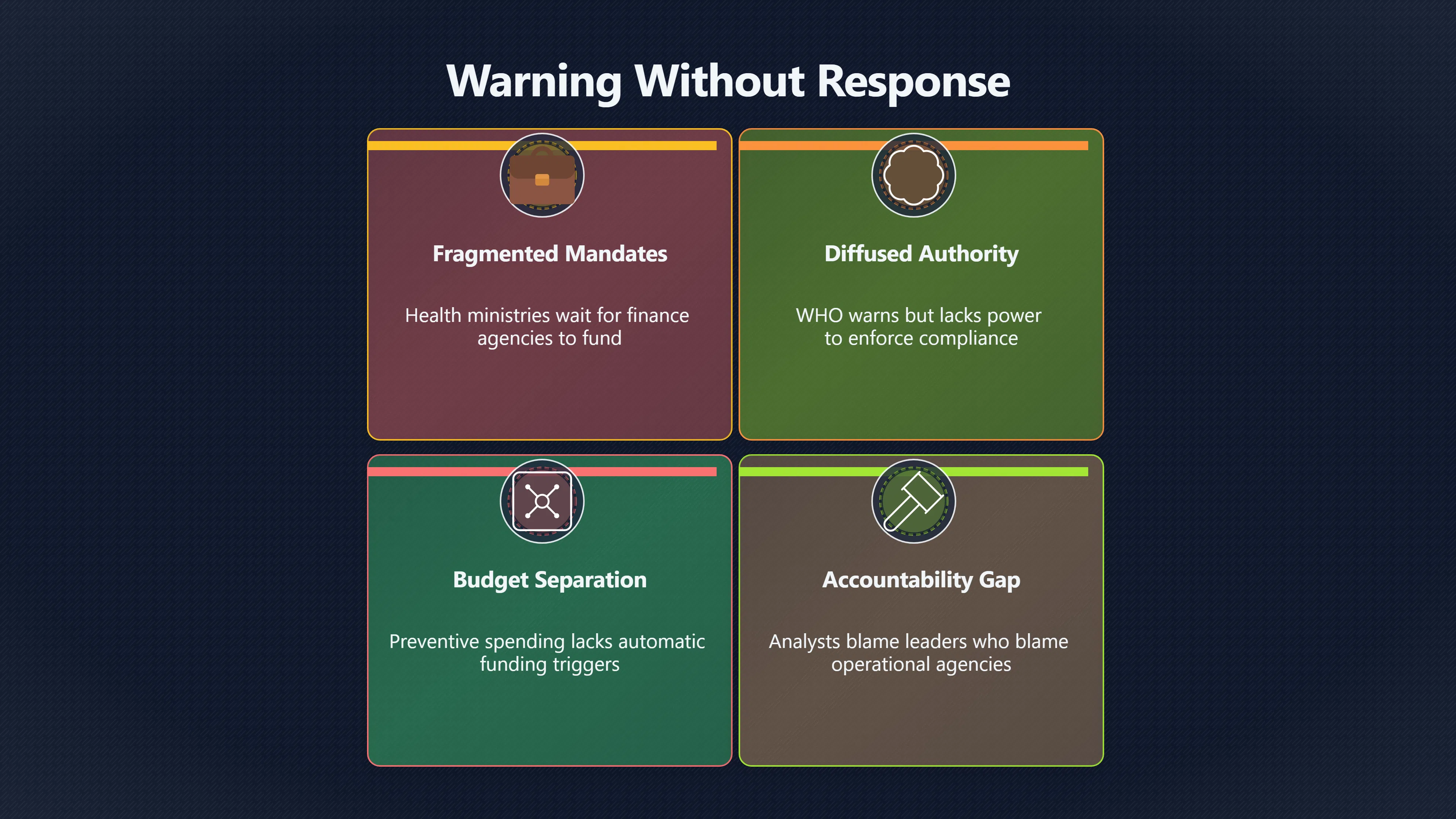
 When responsibilities are fragmented across agencies, ministries and levels of government, forecasts can circulate without triggering clear decisions. One office produces warnings, another controls budgets, a third has legal authority, and none feels fully accountable for acting. As a result, societies repeatedly experience a pattern of “warning without response”: risks are identified early, but action arrives late, after costs have multiplied. This matters not only for present crises but also for the larger question of whether advanced AI and improved forecasting systems could help humanity govern itself more wisely. Better prediction alone cannot create an AI-enabled future of resilience, abundance and long-term flourishing if institutions remain unable to convert foresight into coordinated action.[Center on International Cooperation]cic.nyu.eduCenter on International CooperationWarning Without Response: Why Early Warning Fails, and…13 Aug 2025 — Indeed, early warnings often f…
Why Better Forecasts Often Change Less Than Expected
A common assumption in technology and policy debates is that better information naturally produces better decisions. Real institutions rarely work that way.
Forecasts enter organisations that already have established chains of command, budget constraints, political incentives and competing priorities. An early warning system may identify a serious threat, but the institution receiving that warning often lacks either the authority or the incentive to respond. In practice, forecasting and action are frequently separated into different bureaucratic domains.
Many early warning systems were originally designed as information systems rather than decision systems. They excel at collecting data, producing analyses and distributing alerts. They are often much weaker at specifying who must act, under what conditions, with what resources and on what timetable. Research on conflict prevention repeatedly finds that the technical side of warning has improved faster than the political and organisational side of response.[Stability Journal]stabilityjournal.orgStability JournalReflections on the Evolution of Conflict Early Warningby R Muggah · 2022 · Cited by 33 — This article offers a descripti…[LSE]lse.ac.ukwp49.2conflict early warning and response mechanismsConflict Early Warning and Response Mechanismsby E AU · 2009 · Cited by 152 — Regional organisations often fail to respond in time to…
This creates a recurring institutional paradox: organisations invest heavily in prediction while leaving responsibility for preventive action diffuse and uncertain.
How Fragmentation Breaks the Chain From Warning to Action
The warning-action gap
The most important institutional design failure is the separation between those who identify risks and those who possess the power to respond.
Forecasting units often sit inside specialised agencies, scientific advisory bodies or intelligence organisations. Their outputs may then travel through multiple departments before reaching decision-makers. At each stage information can be delayed, reinterpreted or deprioritised.
The result is a chain in which every actor can plausibly claim that someone else was responsible for acting. Analysts may argue they issued sufficient warnings. Political leaders may argue that the warnings lacked certainty. Operational agencies may argue they lacked authority or funding. Accountability becomes distributed so widely that it effectively disappears.[Center on International Cooperation]cic.nyu.eduCenter on International CooperationWarning Without Response: Why Early Warning Fails, and…13 Aug 2025 — Indeed, early warnings often f…[LSE]lse.ac.ukwp49.2conflict early warning and response mechanismsConflict Early Warning and Response Mechanismsby E AU · 2009 · Cited by 152 — Regional organisations often fail to respond in time to…
Overlapping mandates
Many modern risks cut across bureaucratic boundaries.
Pandemics involve health ministries, border agencies, finance ministries, hospitals, local governments and international organisations. Climate adaptation involves infrastructure agencies, emergency services, environmental regulators, insurers and local authorities. AI governance increasingly spans science policy, national security, competition regulation, labour policy, education and international diplomacy.
When multiple institutions share partial responsibility, preventive measures often stall because each organisation waits for another to move first. No single body possesses enough authority to coordinate the whole response.
Studies of conflict early warning systems have repeatedly identified overlapping responsibilities and competitive institutional mandates as major barriers to prevention. Regional organisations, governments and international bodies may possess fragments of authority without possessing a unified mechanism for action.[LSE]lse.ac.ukwp49.2conflict early warning and response mechanismsConflict Early Warning and Response Mechanismsby E AU · 2009 · Cited by 152 — Regional organisations often fail to respond in time to…
Budget authority and operational authority are separated
Another common design flaw is the separation of forecasting authority from resource authority.
An agency may identify a serious risk but lack the budget to address it. Meanwhile the organisation controlling resources may not prioritise preventive spending because the crisis has not yet materialised.
This problem is especially severe for low-probability, high-impact risks. Preventive investments often appear expensive before a disaster occurs and obvious only afterwards. Without institutional mechanisms that automatically connect warnings to funding decisions, forecasts remain advisory rather than operational. Research on climate and disaster preparedness increasingly emphasises the need to integrate warning systems with predefined financing mechanisms rather than treating forecasting and funding as separate processes.[ScienceDirect]sciencedirect.comA framework for addressing the interconnectedness of…by EM Attoh · 2025 · Cited by 15 — This paper introduces a digitally…
Early Warning Systems Often Work Technically but Fail Organisationally
Many discussions of forecasting failures focus on prediction accuracy. Yet some of the most consequential failures occurred despite substantial warning signals.
The conflict prevention literature has long noted that the challenge is not merely generating forecasts but ensuring that information reaches the right actors in a form that enables action. Effective systems require data collection, risk analysis, communication channels, predefined response options and institutions capable of implementing them. Weakness at any stage can break the chain.[GOV.UK]assets.publishing.service.gov.ukearly warning and early responseby B Rohwerder · 2015 · Cited by 17 — Early warning systems should monitor human security indicators that…
This distinction matters because advances in AI could dramatically improve forecasting capabilities. Machine learning systems may detect patterns in disease outbreaks, infrastructure stress, cyber threats or geopolitical instability earlier than current systems. But if institutional structures remain fragmented, improved prediction could simply produce larger volumes of ignored warnings.
The challenge therefore becomes organisational as much as technological. Anticipatory governance requires institutions designed to absorb forecasts and convert them into decisions, not merely institutions capable of generating predictions.[OECD]oecd.orga5203d0b enTowards anticipatory governance guidelines for public…20 May 2025 — OECD research indicates that systematic use of strategic fores…[OECD]oecd.orgose experience illustrates how private sector participation can expand the…Read more…

Pandemic Preparedness: A Case Study in Diffused Responsibility
The COVID-19 pandemic became one of the clearest demonstrations of how institutional fragmentation can undermine prevention.
Numerous reviews concluded that warnings about pandemic risk existed long before 2020. Previous outbreaks, preparedness exercises and expert reports had repeatedly highlighted the possibility of a severe global pandemic. Yet preparedness remained uneven and often underfunded. The Independent Panel for Pandemic Preparedness and Response concluded that the world had largely ignored these warnings and that failures occurred across multiple levels of governance.[Pandemic Preparedness Panel]theindependentpanel.orgPandemic Preparedness Panel COVID-19: Make it the Last PandemicPandemic Preparedness PanelCOVID-19: Make it the Last PandemicMay 18, 2021 — 2 May 2021 — It is clear to the Panel that the world was not…[Pandemic Preparedness Panel]theindependentpanel.orgPandemic Preparedness Panel COVID-19: Make it the Last PandemicPandemic Preparedness PanelCOVID-19: Make it the Last PandemicMay 18, 2021 — 2 May 2021 — It is clear to the Panel that the world was not…
Part of the problem was institutional fragmentation.
Responsibility for preparedness was distributed across national governments, public health agencies, international organisations, healthcare systems and political leaders. Many institutions possessed partial authority but lacked the power to compel broader action. The World Health Organization could issue warnings but not enforce compliance. National public health experts could recommend preparedness measures but often lacked direct control over budgets and political priorities.[Pandemic Preparedness Panel]theindependentpanel.orgPandemic Preparedness Panel COVID-19: Make it the Last PandemicPandemic Preparedness PanelCOVID-19: Make it the Last PandemicMay 18, 2021 — 2 May 2021 — It is clear to the Panel that the world was not…
The pandemic exposed how a system can contain extensive expertise and warning capacity while still lacking a coherent structure for collective action. Information flowed, but responsibility remained fragmented.
Conflict Prevention and the Problem of “Warning Without Response”
Conflict prevention provides another revealing example because the warning-response gap has been studied for decades.
Researchers have repeatedly observed that many violent conflicts are preceded by detectable signals: rising political tensions, demographic pressures, hate speech, armed mobilisation or governance breakdowns. Early warning systems were developed to identify these indicators before violence escalates.
Yet forecasts frequently fail to produce timely intervention. Analysts studying conflict early warning systems describe a persistent pattern in which warnings are generated but preventive responses remain inadequate. Political disagreements, institutional inertia, fragmented accountability and unclear mandates all contribute to the problem. Center on International Cooperation[Stability Journal]stabilityjournal.orgStability JournalReflections on the Evolution of Conflict Early Warningby R Muggah · 2022 · Cited by 33 — This article offers a descripti…
In some cases multiple organisations monitor the same risks while assuming others will take responsibility for responding. In others, institutions possess warning capabilities but lack operational tools. The result is not necessarily ignorance but organisational paralysis.
This experience is particularly relevant to future AI-enabled governance systems. Better predictive models will not automatically solve coordination failures if institutions still lack mechanisms that assign responsibility for action.
What More Successful Designs Tend to Have in Common
While no system eliminates political failure, several institutional patterns appear repeatedly in more effective anticipatory governance efforts.
Clear ownership of risks
Successful systems usually assign responsibility explicitly.
Rather than treating foresight as a diffuse activity spread across many organisations, they designate offices or coordinating bodies responsible for ensuring that warnings produce decisions. OECD research highlights the importance of integrating foresight into core policymaking processes rather than leaving it isolated within specialist units.[OECD]oecd.orgging practice around anticipatory innovation governance as a broad-based capacity…Read more…
Links between foresight and planning
Forecasts become more influential when connected directly to budgeting, strategic planning and operational procedures.
Finland’s experiments with anticipatory innovation governance, for example, have focused on embedding foresight into broader governance structures rather than treating it as a standalone exercise. OECD work on anticipatory governance similarly emphasises connecting foresight outputs to planning and implementation processes.[Reforms and Investments]reforms-investments.ec.europa.euReforms and Investments Anticipatory Innovation Governance Model in FinlandFinland and the European Commission to examine how the Finland's governance processes and mechanisms need to…Read more…

Pre-agreed triggers
Many disaster and climate-response systems increasingly use predefined triggers that automatically activate funding or response measures when indicators cross specified thresholds.
Such mechanisms reduce the need for ad hoc political bargaining during emerging crises. Instead of debating whether a warning deserves attention, institutions can move through previously agreed procedures. Research on integrated warning-action-finance frameworks argues that these links are critical for turning forecasts into anticipatory action.[ScienceDirect]sciencedirect.comA framework for addressing the interconnectedness of…by EM Attoh · 2025 · Cited by 15 — This paper introduces a digitally…
Cross-agency coordination structures
Risks that span multiple domains require structures that span multiple institutions.
Several OECD studies on anticipatory governance note that foresight capabilities remain fragmented in many governments and that effective systems require mechanisms for coordination across departments, sectors and levels of government. Without these links, insights remain trapped within organisational silos.[OECD]oecd.orgd7eb0bb6 enBuilding Anticipatory Capacity with Strategic Foresight in…5 May 2025 — This report examines factors influencing anticipatory governan…[OECD]oecd.orgoverview 6d1e680aBuilding Anticipatory Capacity with Strategic Foresight in…9 May 2025 — At the initiation of the project, anticipatory innovation…
Why This Matters for an AI-Enabled Future
The institutional challenge becomes more significant as forecasting capabilities improve.
Advanced AI systems may eventually monitor epidemiological data, economic signals, environmental indicators, infrastructure networks and geopolitical developments continuously. They could identify emerging risks earlier and with greater precision than existing forecasting systems. In principle, this could help societies prevent disasters, allocate resources more effectively and strengthen long-term resilience.
But institutional fragmentation creates a hard limit on the value of prediction. If no organisation possesses the authority, incentives or responsibility to act, more accurate forecasts may simply reveal failures sooner.
For advocates of an AI-enabled future of abundance and civilisational flourishing, this is a central governance question. A society capable of producing superhuman forecasts but incapable of coordinated action may gain surprisingly little from its predictive power. The bottleneck shifts from intelligence to institutions.
The long-term promise of AI therefore depends not only on better models, simulations and forecasting systems, but also on organisational structures capable of turning foresight into prevention. The history of pandemics, conflict prevention and disaster preparedness suggests that one of the most difficult challenges is not seeing the future more clearly. It is deciding who is responsible for acting when the future becomes visible.[Center on International Cooperation]cic.nyu.eduCenter on International CooperationWarning Without Response: Why Early Warning Fails, and…13 Aug 2025 — Indeed, early warnings often f… [3OECD 3OECD]
Amazon book picks
Further Reading
Books and field guides related to Why Institutional Fragmentation Blocks Preventive Measures. Use these as the next step if you want deeper reading beyond the article.
Superforecasting
Directly addresses how better prediction can improve decisions and institutions.
The Black Swan
Rating: 4.0/5 from 25 Google Books ratings
Explains why institutions often fail to respond effectively to risks.
Thinking, Fast and Slow
Shows how cognitive and institutional biases obstruct preventive action.
eBay marketplace picks
Marketplace Samples
Example marketplace items related to this page. Use the search link to explore similar finds on eBay.


Endnotes
1.
Source: oecd.org
Title: a5203d0b en
Link:https://www.oecd.org/content/dam/oecd/en/publications/reports/2025/05/towards-anticipatory-governance-guidelines-for-public-sector-organisations_c1a40090/a5203d0b-en.pdf
Source snippet
Towards anticipatory governance guidelines for public...20 May 2025 — OECD research indicates that systematic use of strategic fores...
Published: May 2025
2.
Source: lse.ac.uk
Title: wp49.2conflict early warning and response mechanisms
Link:https://www.lse.ac.uk/international-development/Assets/Documents/PDFs/csrc-working-papers-phase-two/wp49.2conflict-early-warning-and-response-mechanisms.pdf
Source snippet
Conflict Early Warning and Response Mechanismsby E AU · 2009 · Cited by 152 — Regional organisations often fail to respond in time to...
3.
Source: assets.publishing.service.gov.uk
Link:https://assets.publishing.service.gov.uk/media/57a08965ed915d622c0001cb/hdq1195.pdf
Source snippet
early warning and early responseby B Rohwerder · 2015 · Cited by 17 — Early warning systems should monitor human security indicators that...
4.
Source: sciencedirect.com
Link:https://www.sciencedirect.com/science/article/pii/S2212096325000038
Source snippet
A framework for addressing the interconnectedness of...by EM Attoh · 2025 · Cited by 15 — This paper introduces a digitally...
5.
Source: oecd.org
Link:https://www.oecd.org/content/dam/oecd/en/publications/reports/2025/11/disaster-early-warning-systems-and-private-sector-participation-in-asean_4a161409/bc282563-en.pdf
Source snippet
ose experience illustrates how private sector participation can expand the...Read more...
6.
Source: oecd.org
Link:https://www.oecd.org/content/dam/oecd/en/publications/reports/2020/12/anticipatory-innovation-governance_d1aded4e/cce14d80-en.pdf
Source snippet
ging practice around anticipatory innovation governance as a broad-based capacity...Read more...
7.
Source: apps.who.int
Link:https://apps.who.int/gb/inb/pdf_files/INB9-written-statements/Independent-Panel-PPR.pdf
Source snippet
WHO AppsWritten statement, RH Helen Clark, Chair of The...The objective must be to prevent, prepare for, and respond to pandemics, in or...
8.
Source: oecd.org
Title: d7eb0bb6 en
Link:https://www.oecd.org/content/dam/oecd/en/publications/reports/2025/05/building-anticipatory-capacity-with-strategic-foresight-in-government_ed581d05/d7eb0bb6-en.pdf
Source snippet
Building Anticipatory Capacity with Strategic Foresight in...5 May 2025 — This report examines factors influencing anticipatory governan...
Published: May 2025
9.
Source: oecd.org
Title: overview 6d1e680a
Link:https://www.oecd.org/en/publications/building-anticipatory-capacity-with-strategic-foresight-in-government_d7eb0bb6-en/full-report/overview_6d1e680a.html
Source snippet
Building Anticipatory Capacity with Strategic Foresight in...9 May 2025 — At the initiation of the project, anticipatory innovation...
Published: May 2025
10.
Source: sciencedirect.com
Link:https://www.sciencedirect.com/science/article/pii/S0016328725001697
Source snippet
The traps and pitfalls of anticipatory governanceby K Heo · 2025 · Cited by 6 — This article examines anticipatory governance (AG) in Sou...
11.
Source: cic.nyu.edu
Link:https://cic.nyu.edu/resources/warning-without-response-why-early-warning-fails-and-how-to-turn-foresight-into-prevention/
Source snippet
Center on International CooperationWarning Without Response: Why Early Warning Fails, and...13 Aug 2025 — Indeed, [early warnings]({{ 'early-warning/' | relative_url }}) often f...
12.
Source: stabilityjournal.org
Link:https://stabilityjournal.org/articles/10.5334/sta.857
Source snippet
Stability JournalReflections on the Evolution of Conflict Early Warningby R Muggah · 2022 · Cited by 33 — This article offers a descripti...
13.
Source: theindependentpanel.org
Title: Pandemic Preparedness Panel COVID-19: Make it the Last Pandemic
Link:https://theindependentpanel.org/wp-content/uploads/2021/05/COVID-19-Make-it-the-Last-Pandemic_final.pdf
Source snippet
Pandemic Preparedness PanelCOVID-19: Make it the Last PandemicMay 18, 2021 — 2 May 2021 — It is clear to the Panel that the world was not...
Published: May 18, 2021
14.
Source: theindependentpanel.org
Title: Independent Panel Second Report on Progress Final 15 Jan 2021
Link:https://theindependentpanel.org/wp-content/uploads/2021/01/Independent-Panel_Second-Report-on-Progress_Final-15-Jan-2021.pdf
Source snippet
Pandemic Preparedness PanelSecond Report on Progress30 Jan 2021 — The Independent Panel for Pandemic Preparedness and Response is tasked...
15.
Source: reforms-investments.ec.europa.eu
Title: Reforms and Investments Anticipatory Innovation Governance Model in Finland
Link:https://reforms-investments.ec.europa.eu/system/files/2022-11/Anticipatory%20Innovation%20Governance%20Model%20in%20Finland.pdf
Source snippet
Finland and the European Commission to examine how the Finland's governance processes and mechanisms need to...Read more...
16.
Source: preventionweb.net
Title: pandemic preparedness panel slams collective failure heed warnings
Link:https://www.preventionweb.net/news/pandemic-preparedness-panel-slams-collective-failure-heed-warnings
Source snippet
Pandemic preparedness panel slams collective failure to...14 Sept 2020 — A collective failure by political leaders to heed warnings and...
Additional References
17.
Source: oecd-opsi.org
Link:https://oecd-opsi.org/wp-content/uploads/2020/11/AnticipatoryInnovationGovernance-Note-Nov2020.pdf
Source snippet
Observatory of Public Sector InnovationAnticipatory Innovation GovernanceThis sandbox builds on anticipatory governance mechanisms for al...
18.
Source: linkedin.com
Link:https://www.linkedin.com/posts/robert-muggah-00965285_warning-without-response-why-early-warning-activity-7363170313754292224-NZ-R
Source snippet
Why early warning systems fail to prevent conflictsObviously there are major obstacles to learning the lessons and applying them - flaws...
19.
Source: youtube.com
Link:https://www.youtube.com/watch?v=F6Tppali9EY
Source snippet
"Early warning" "early action" institutional gaps Africa Multi-Hazard Early Warning and Early Action System Situation Room CIMA Research...
20.
Source: pmc.ncbi.nlm.nih.gov
Title: PMCThe Independent Panel Pandemic Report
Link:https://pmc.ncbi.nlm.nih.gov/articles/PMC8413263/
Source snippet
Independent Panel Pandemic Report - PMC - NIHby EY Adashi · 2021 · Cited by 1 — The IPPPR report singles out inadequate preparedness and...
21.
Source: linkedin.com
Link:https://www.linkedin.com/pulse/anticipatory-governance-guidelines-how-get-started-your-t%C3%B5nurist-kz6gf
Source snippet
foresight, experimentation, and innovation into the core of policymaking.Read more...
22.
Source: ycsg.yale.edu
Title: independent panel pandemic preparedness and response
Link:https://ycsg.yale.edu/independent-panel-pandemic-preparedness-and-response
Source snippet
Panel for Pandemic Preparedness and ResponseThe Independent Panel for Pandemic Preparedness and Response (IPPPR) presented its findings a...
23.
Source: gppac.net
Link:https://gppac.net/files/2018-12/Early%20Warning%20and%20Early%20Response.pdf
Source snippet
Early Warning and Early Response: Conceptual and...by A Matveeva · Cited by 80 — The US-led military operation in Iraq is a glaring exam...
24.
Source: hcss.nl
Title: Conflict Early Warning Systems HCSS 2022
Link:https://hcss.nl/wp-content/uploads/2022/02/Conflict-Early-Warning-Systems-HCSS-2022.pdf
Source snippet
Practices, Principles and Promises of Conflict Early...by T Sweijs · 2022 · Cited by 9 — This report examines practices, principles and...
25.
Source: facebook.com
Link:https://www.facebook.com/nationalheraldindia/posts/the-scale-of-the-coronavirus-pandemic-could-have-been-prevented-an-independent-g/1200472593728763/
Source snippet
ent global panel has said. A "toxic cocktail" of waiting and...
26.
Source: saferworld-global.org
Title: early warning and response to violent conflict eng
Link:https://www.saferworld-global.org/downloads/pubdocs/early-warning-and-response-to-violent-conflict—eng.pdf
Source snippet
It functions to predict conflict trends, alert communities of risk, inform decision- making...Read more...
Topic Tree