Within AI Benefits
Could AI Tutors Become a Public Good?
Public AI tutors could widen educational opportunity, but only if access, quality, safety, and local accountability are designed in from the start.
On this page
- What universal AI tutoring would mean
- Access, quality, and safeguarding risks
- Policy choices for fair deployment
Page outline Jump by section
Introduction
Universal AI tutors — AI systems that can provide personalised, one‑to‑one educational support — are emerging at the intersection of advanced generative intelligence and public policy. They promise to transform how learning is delivered, potentially breaking down long‑standing barriers of cost, geography and teacher availability that have kept high‑quality tutoring out of reach for many learners. With governments in countries like the UK exploring plans to co‑create and deploy safe, curriculum‑aligned AI tutoring tools for large numbers of pupils, the idea of “AI tutors as a public good” has moved from speculation to an active policy question. This shift matters because education is a cornerstone of human flourishing: it shapes cognitive development, opportunity and long‑term life chances. But realising broad benefits from AI tutors — such that they help expand educational access rather than entrench existing inequalities — depends on design choices, safeguards, and public policy decisions made today.[GOV.UK]GOV.UK450,000 disadvantaged pupils could benefit from AI tutoring tools26, 2026…
What Universal AI Tutoring Would Mean
At its core, an AI tutor is an intelligent educational agent that interacts with a learner, understanding their needs, tailoring explanations, offering practice and feedback, and adapting pacing to individual improvement. Unlike static digital resources, these systems aim for adaptive dialogue — much like a human tutor who notices misunderstandings and adjusts accordingly — but at scale and low per‑user cost. Research reviews find that AI‑driven intelligent tutoring systems can improve access to quality learning, personalise experiences based on performance data, and support sustainable education by making tailored support a scalable element of schooling.[Springer Link]link.springer.comSpringer LinkArtificial intelligence in intelligent tutoring systems toward sustainable education: a systematic review | Smart Learning E…
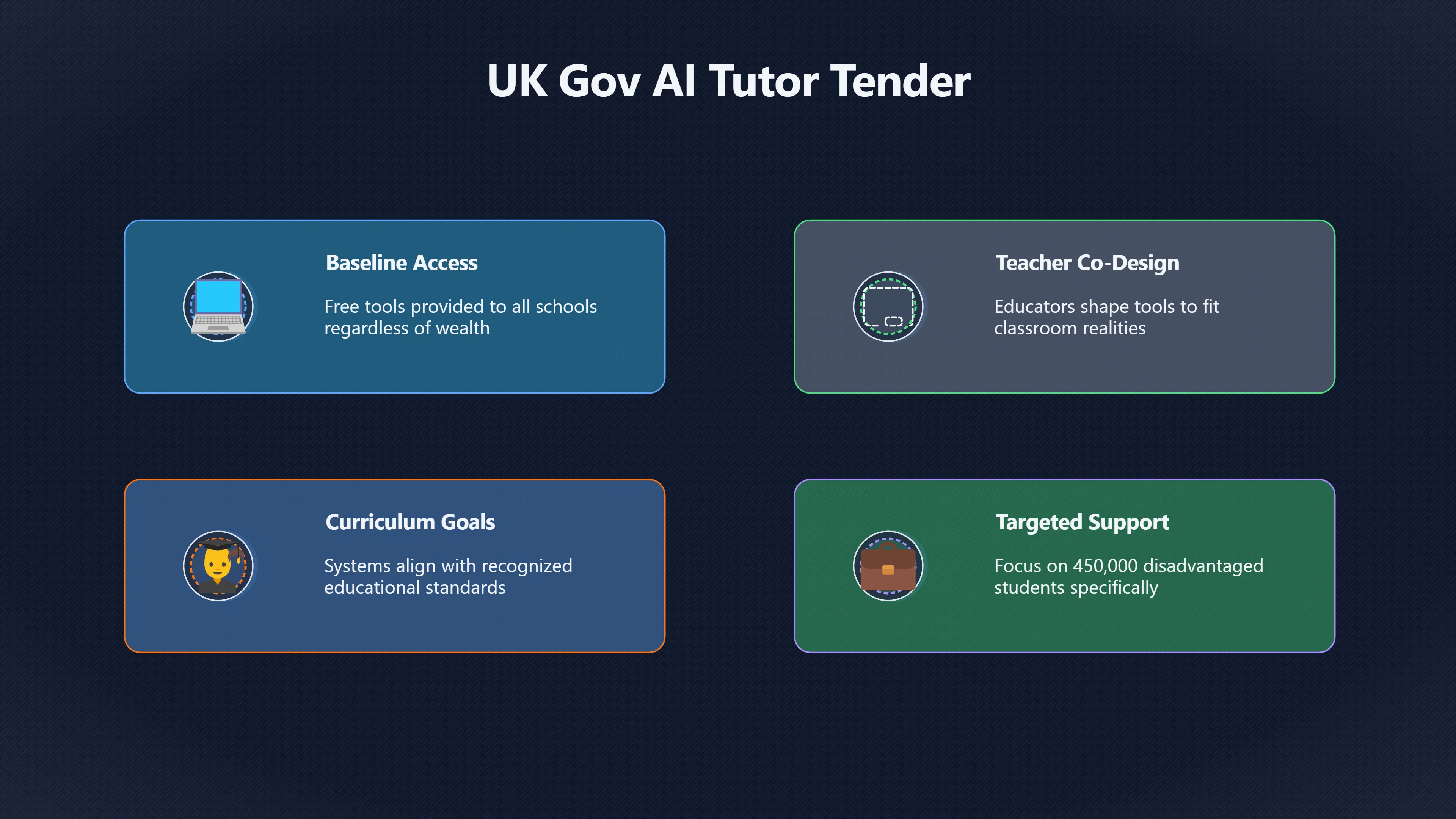
From a policy perspective, public AI tutors as a baseline public education access could mean that all students, regardless of family income or school resources, have access to high‑quality personalised learning support. In England, for example, the government has launched a tender inviting EdTech companies and AI labs to co‑design AI tutoring tools with teachers, with the explicit goal of supporting up to 450,000 disadvantaged pupils — the equivalent of making one‑to‑one tutoring widely available instead of leaving it to families who can afford private sessions.[GOV.UK]GOV.UKGenerative artificial intelligence (AI) in educationGenerative artificial intelligence (AI) in education
Such a public provisioning would not just be about putting an app on a device. It would involve anchoring the AI tutor to recognised curricular goals, ensuring it complements teacher‑led instruction rather than replacing it, and integrating it into the educational ecosystem with training and oversight to support effective use.[GOV.UK]GOV.UK16, 2026…
Access, Quality, and Safeguarding Risks
Universal AI tutors offer big potential, but realising equitable benefits hinges on addressing several risks and limitations.
Inequitable digital access: The benefits of any AI educational tool depend on devices, connectivity and supportive learning environments. Without investment in hardware and broadband, students in under‑resourced areas may be left behind, even if AI tutors are nominally free.[OpenAI Solutions]openai-so.comOpenAI SolutionsChatGPT as Tutor: Impacts on Educational Equity in the UK | OpenAIOctober 8, 2025…
Learning quality versus dependency: Evidence from the OECD’s Digital Education Outlook 2026 and other reviews suggests that generative AI can enhance personalised learning when integrated with strong pedagogical guidance, but simply outsourcing cognitive tasks to AI does not guarantee genuine learning gains. Without careful design, AI tutors might improve performance on tasks while not fostering deep understanding or critical thinking.[OECD]oecd.orgoecd digital education outlook 2026 940e0dd8OECD Digital Education Outlook 2026 | OECDJanuary 19, 2026…
Parental and teacher concerns: Research on public attitudes reveals mixed feelings. Many parents and pupils see tailored AI support as promising, especially for interactive engagement, but there is caution about direct pupil use without supervision. Concerns include quality, loss of human interaction, and suitability for certain subjects.[GOV.UK]GOV.UKResearch on public attitudes towards the use of AI in education28, 2024…
Workforce impact and teacher roles: Early adopters recognise AI’s potential to aid formative assessment and provide feedback, but also warn that over‑reliance could hinder development of essential skills like problem‑solving, creativity, and critical thinking. Autonomous AI use may unintentionally reinforce a “quick answer” culture rather than nurturing independent learning skills.[GOV.UK]GOV.UK27, 2025…
Finally, safeguarding issues — including data privacy, student profiling, and the risk that AI might replicate or amplify biases — demand explicit policy safeguards and independent oversight rather than ad hoc deployment.[National Education Union]neu.org.ukNational Education UnionTrials of AI tutoring tools to support disadvantaged children must be regulated and credible | National Education…
Policy Choices for Fair Deployment
Designing universal AI tutors as a public education resource requires deliberate policy choices that shape how benefits are distributed and risks mitigated.
Public commissioning and open baseline tools: One approach is public commissioning or hosting of baseline AI tutors that are freely available to all schools, with clear standards for fairness, safety and regular updates. This prevents a purely market‑driven ecosystem in which only wealthier schools or families can afford premium solutions.[OpenAI Solutions]openai-so.comOpenAI SolutionsChatGPT as Tutor: Impacts on Educational Equity in the UK | OpenAIOctober 8, 2025…
Co‑creation with educators: Involving teachers in the design and testing of AI tutors, as the UK initiative proposes, helps ensure that tools align with classroom realities, pedagogical standards and safeguarding frameworks. Teachers’ expertise can guide what the AI suggests and how it interacts with learners.[GOV.UK]GOV.UKAI training for all, as government and industry programme expands to provide 10 million workers with key AI skills by 2030 - GOV.UKJanuar…
Integration with pedagogy and staff training: AI should augment, not replace, human instruction. Effective policy frameworks will include professional training for educators so they can integrate AI tutors into lesson plans, interpret AI feedback, and maintain pedagogical quality.[GOV.UK]GOV.UK450,000 disadvantaged pupils could benefit from AI tutoring tools26, 2026…
Independent evaluation and regulation: Continuous, transparent evaluation is vital. Trials of AI tutors must be responsibly regulated and rooted in independent research, tracking not just short‑term outcomes but broader impacts on skills, engagement and wellbeing.[National Education Union]neu.org.ukNational Education UnionTrials of AI tutoring tools to support disadvantaged children must be regulated and credible | National Education…
Supporting equity beyond tools: Ensuring equitable impact means pairing AI tutor deployment with broader investments — in connectivity, device access, inclusive curriculum design and learner support services — so that the digital divide does not translate into an educational divide.[OpenAI Solutions]openai-so.comOpenAI SolutionsChatGPT as Tutor: Impacts on Educational Equity in the UK | OpenAIOctober 8, 2025…
Collectively, these policy choices aim to embed AI tutors within an education system that values learning depth, equity and human agency — not just technological efficiency.
Looking Ahead
Universal AI tutors, if deployed with strong public policy frameworks, have the potential to narrow long‑standing educational inequalities by bringing personalised support to learners who lack access to traditional tutoring. But this promise depends on thoughtful integration that enhances — rather than substitutes — the human dimensions of teaching and learning. The policy choices made now will shape whether AI tutors become a robust public education access tool that contributes to widespread cognitive empowerment, or a fragmented add‑on that deepens existing divides without fostering the deeper capabilities education seeks to cultivate.[GOV.UK]GOV.UKGenerative artificial intelligence (AI) in educationGenerative artificial intelligence (AI) in education
Amazon book picks
Further Reading
Books and field guides related to Could AI Tutors Become a Public Good?. Use these as the next step if you want deeper reading beyond the article.
Weapons of Math Destruction
Relevant to safeguards and equitable educational outcomes.
eBay marketplace picks
Marketplace Samples
Example marketplace items related to this page. Use the search link to explore similar finds on eBay.




Endnotes
1.
Source: GOV.UK
Title: 450,000 disadvantaged pupils could benefit from AI tutoring tools
Link:https://www.gov.uk/government/news/450000-disadvantaged-pupils-could-benefit-from-ai-tutoring-tools
Source snippet
26, 2026...
2.
Source: GOV.UK
Title: Generative artificial intelligence (AI) in education
Link:https://www.gov.uk/government/publications/generative-artificial-intelligence-in-education/generative-artificial-intelligence-ai-in-education?pStoreID=newegg%2525252525252F1000%27%5B0%5D
3.
Source: link.springer.com
Link:https://link.springer.com/article/10.1186/s40561-023-00260-y
Source snippet
Springer LinkArtificial intelligence in intelligent tutoring systems toward sustainable education: a systematic review | Smart Learning E...
4.
Source: GOV.UK
Link:https://www.gov.uk/government/news/edtech-and-ai-companies-invited-to-help-build-safe-ai-tutoring-tools-for-disadvantaged-pupils
Source snippet
16, 2026...
5.
Source: oecd.org
Title: oecd digital education outlook 2026 940e0dd8
Link:https://www.oecd.org/en/publications/2026/01/oecd-digital-education-outlook-2026_940e0dd8.html
Source snippet
OECD Digital Education Outlook 2026 | OECDJanuary 19, 2026...
Published: January 19, 2026
6.
Source: GOV.UK
Title: Research on public attitudes towards the use of AI in education
Link:https://www.gov.uk/government/publications/research-on-parent-and-pupil-attitudes-towards-the-use-of-ai-in-education/research-on-public-attitudes-towards-the-use-of-ai-in-education
Source snippet
28, 2024...
7.
Source: GOV.UK
Link:https://www.gov.uk/government/publications/ai-in-schools-and-further-education-findings-from-early-adopters/the-biggest-risk-is-doing-nothing-insights-from-early-adopters-of-artificial-intelligence-in-schools-and-further-education-colleges
Source snippet
27, 2025...
8.
Source: GOV.UK
Link:https://www.gov.uk/government/news/free-ai-training-for-all-as-government-and-industry-programme-expands-to-provide-10-million-workers-with-key-ai-skills-by-2030
Source snippet
AI training for all, as government and industry programme expands to provide 10 million workers with key AI skills by 2030 - GOV.UKJanuar...
9.
Source: link.springer.com
Link:https://link.springer.com/article/10.1007/s40797-025-00354-1
Source snippet
Intelligence in Education: Computer-Assisted Learning and AI-guided Tutors | Italian Economic Journal | Springer Nature LinkNovember 10...
10.
Source: oecd.org
Link:https://www.oecd.org/en/publications/2023/12/oecd-digital-education-outlook-2023_c827b81a/full-report/opportunities-guidelines-and-[guardrails
Source snippet
Opportunities, guidelines and guardrails for effective and equitable use of AI in education: OECD Digital Education Outlook 2023 | OECDDe...
11.
Source: openai-so.com
Link:https://www.openai-so.com/a/143
Source snippet
OpenAI SolutionsChatGPT as Tutor: Impacts on Educational Equity in the UK | OpenAIOctober 8, 2025...
Published: October 8, 2025
12.
Source: neu.org.uk
Link:https://neu.org.uk/latest/press-releases/trials-ai-tutoring-tools-support-disadvantaged-children-must-be-regulated-and-credible
Source snippet
National Education UnionTrials of AI tutoring tools to support disadvantaged children must be regulated and credible | National Education...
Additional References
13.
Source: mdpi.com
Link:https://www.mdpi.com/2071-1050/17/21/9793
Source snippet
IMPLICATIONS FOR POLICY AND PRACTICE 6.1. POLICY AND REGULATORY GUIDANCE Based on our review, we recommend that policymakers develop clea...
14.
Source: sciencedirect.com
Link:https://www.sciencedirect.com/science/article/pii/S2666920X22000236
Source snippet
model - ScienceDirectPERSONALIZED EDUCATION AND ARTIFICIAL INTELLIGENCE IN THE UNITED STATES, CHINA, AND INDIA: A SYSTEMATIC REVIEW USING...
15.
Source: sciencedirect.com
Link:https://www.sciencedirect.com/science/article/pii/S2590291125008708
Source snippet
Generative AI to bridge the educational divide: Personalized learning and challenges - ScienceDirectSOCIAL SCIENCES & HUMANITIES OPEN Vol...
16.
Source: mdpi.com
Link:https://www.mdpi.com/2073-431X/14/9/367
Source snippet
OPPORTUNITIES, BENEFITS, AND CHALLENGES OF CONTEXT-AWARE AI-AGENT TUTORING WITHIN THE AI GEM FRAMEWORK Based on the layered architecture...
17.
Source: publicsectorexecutive.com
Link:https://www.publicsectorexecutive.com/articles/ai-tutoring-revolution-close-disadvantaged-attainment-gap
Source snippet
AI tutoring revolution to close the disadvantaged attainment gap | Public Sector NewsJanuary 27, 2026 — Author: Public Sector Executive...
Published: January 27, 2026
18.
Source: societyandai.org
Title: Scope: This observatory focuses on K-12 and higher education AI policy, as we
Link:https://societyandai.org/research/observatory/
Source snippet
Global AI Observatory | Society & AI | Society-Centered Artificial Intelligence Research & PracticeMay 3, 2026 — GLOBAL AI OBSERVATORY Tr...
Published: May 3, 2026
19.
Source: edugenius.app
Title: How Governments Around the World Are Regulating AI in Education | Edu Genius
Link:https://www.edugenius.app/blog/governments-regulating-ai-education-worldwide
Source snippet
How Governments Around the World Are Regulating AI in Education | EduGeniusAugust 15, 2025 — HOW GOVERNMENTS AROUND THE WORLD ARE REGULAT...
Published: August 15, 2025
20.
Source: dialnet.unirioja.es
Link:https://dialnet.unirioja.es/servlet/articulo?codigo=10395576
Source snippet
y desventajas de la IA en la educación: el caso de los tutores individualizados guiados por la IA - DialnetJanuary 1, 1970 — VENTAJAS Y D...
Published: January 1, 1970
21.
Source: computerweekly.com
Title: U K government to develop AI tutoring tools | Computer Weekly
Link:https://www.computerweekly.com/news/366637833/UK-government-to-develop-AI-tutoring-tools
Source snippet
UK government to develop AI tutoring tools | Computer WeeklyJanuary 28, 2026 — UK GOVERNMENT TO DEVELOP AI TUTORING TOOLS SCHOOLS WILL SO...
Published: January 28, 2026
22.
Source: resultsense.com
Title: Df E opens UK AI tutoring tender for disadvantaged pupils
Link:https://www.resultsense.com/news/2026-04-17-dfe-ai-tutoring-disadvantaged-pupils/
Source snippet
DfE opens UK AI tutoring tender for disadvantaged pupilsApril 17, 2026 — Industry News 17 April 2026 2 min read Resultsense via gov.uk Df...
Published: April 17, 2026
Topic Tree