Within Superintelligence
Who controls the superintelligence future?
The impact of superintelligence may depend on who controls it, how benefits are shared and whether societies preserve human agency.
On this page
- Power and access in advanced AI
- Preventing concentration of benefits
- Building institutions for human flourishing
Page outline Jump by section
Introduction
A superintelligence future would not be determined only by whether machines become more capable than humans. It would also depend on who controls those systems, how decisions are made about their use, and whether the gains are converted into wider human flourishing rather than concentrated power. The optimistic case for advanced AI is not simply that it could create more wealth; it is that it could help humanity overcome deep constraints in health, science, education, energy and knowledge. But that possibility depends on governance: institutions capable of keeping advanced AI safe, broadly accessible and aligned with human interests.[oecd.org]oecd.orgAssessing potential future artificial intelligence risks, benefits and policy imperatives | OECDNovember 14, 2024…
The central governance question is therefore not only “how do we prevent harm?” but also “how do we make sure a powerful new form of intelligence expands human possibility?” A flourishing AI future would require technical safeguards, democratic legitimacy, international coordination and mechanisms that prevent a small number of actors from capturing benefits that could otherwise improve life for billions of people.[United Nations]un.orgpreliminary reportited NationsPreliminary Report | Independent International Scientific Panel on AIJuly 1, 2026…
Who controls the superintelligence future?
If an intelligence explosion occurs, control over advanced AI systems could become one of the most important sources of economic and political power ever created. Unlike many previous technologies, a highly capable AI system could influence research, business decisions, security, education, government services and the creation of further technologies. The governance challenge is therefore not only regulating a tool but deciding how society relates to a new source of problem-solving capacity.
Power and access in advanced AI
The first concern is concentration. Developing frontier AI systems requires enormous computing resources, specialised talent, energy infrastructure and access to advanced chips. These requirements may create advantages for a small number of companies or governments that can afford large-scale investment. The OECD has identified concentration of power, inequality and control over critical systems as among the major policy challenges associated with advanced AI.[oecd.org]oecd.orgAssessing potential future artificial intelligence risks, benefits and policy imperatives | OECDNovember 14, 2024…
Concentration does not automatically mean a harmful outcome. Large organisations can sometimes provide the resources needed to build safer and more capable systems. However, a world where only a few institutions control the most powerful AI could create difficult questions:
- Who decides which goals advanced AI systems should pursue?
- Who receives access to AI-enabled scientific discoveries?
- How are benefits shared between countries with different levels of technological capacity?
- What prevents AI capability from becoming a permanent advantage for a small elite?
These questions matter because the AI bloom vision depends on abundance being broadly available. A future where AI accelerates drug discovery, improves education and expands scientific knowledge would look very different from one where the same capabilities mainly reinforce existing economic and political inequalities.
International governance discussions increasingly recognise this problem. The United Nations’ independent scientific panel on AI has highlighted the need for evidence-based governance covering not only technical risks but also human rights, cultural flourishing, autonomy and societal impacts.[United Nations]un.orgpreliminary reportited NationsPreliminary Report | Independent International Scientific Panel on AIJuly 1, 2026…
Preventing concentration of benefits
The strongest version of the AI abundance argument requires more than creating powerful systems. It requires institutions that allow many people to benefit from them.
Making AI-enabled abundance broadly available
Historically, major technologies have often produced both broad improvements and unequal outcomes. Electricity, the internet and modern medicine transformed societies, but access depended heavily on infrastructure, investment and public policy. Advanced AI may follow a similar pattern: its benefits could spread widely, but only if deliberate choices are made about access, competition and public capacity.
Several governance approaches could help:
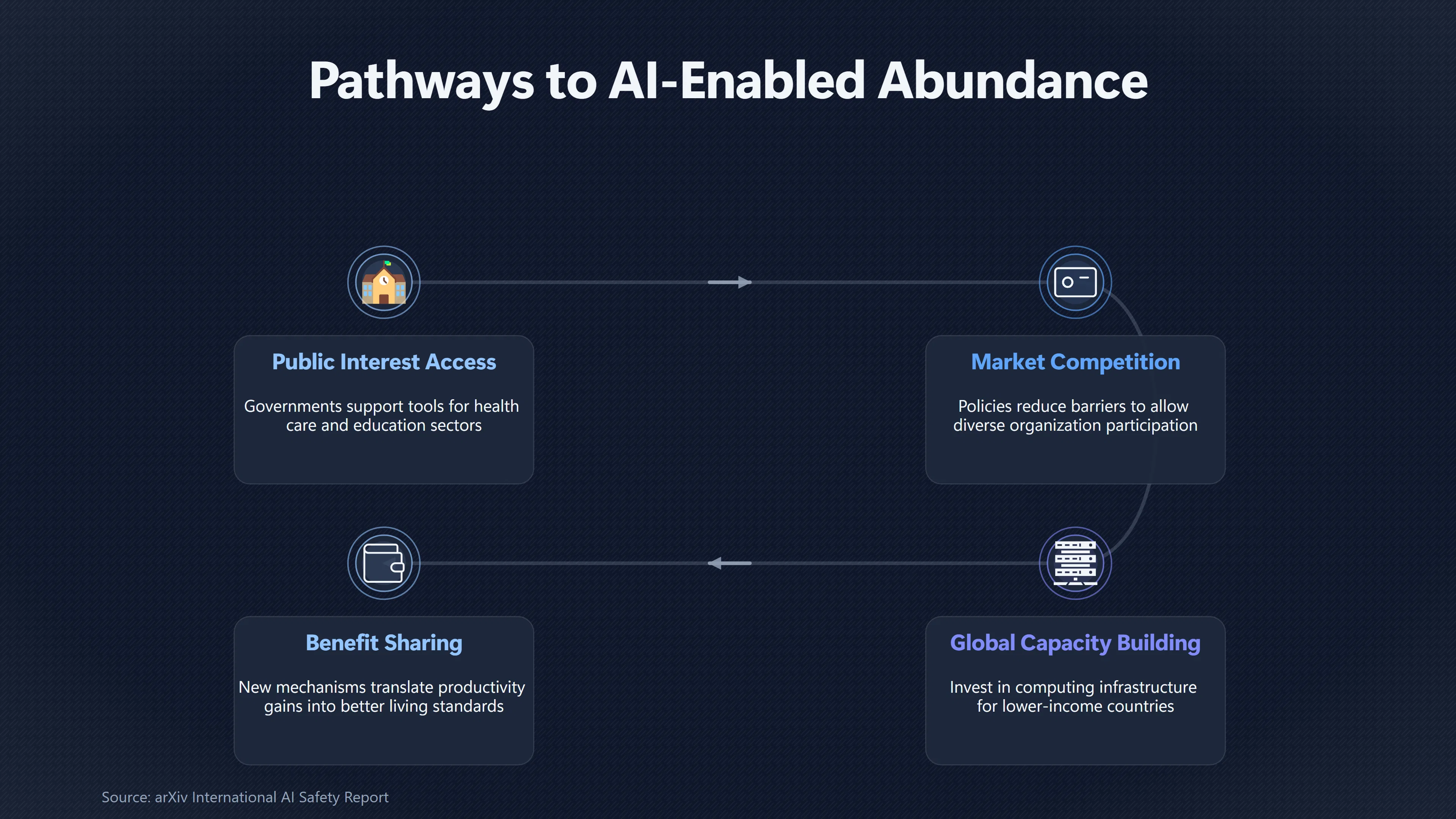
- Public-interest access: Governments and institutions could support AI tools for healthcare, education, scientific research and public services rather than leaving transformative applications entirely to private markets.
- Competition and interoperability: Policies that reduce unnecessary barriers and prevent excessive market control could allow more organisations to build on AI capabilities.
- Global capacity building: Lower-income countries may need investment in computing infrastructure, skills and institutions so they can participate in an AI-enabled economy rather than only consume technologies developed elsewhere.
- Benefit-sharing mechanisms: Societies may need new approaches to ensure productivity gains translate into improved living standards, shorter working hours, better services or broader economic security.
The OECD’s work on governing AI in public institutions highlights that governments need more than regulations alone. They also need skills, infrastructure, investment and partnerships to use AI effectively while maintaining accountability.[oecd.org]oecd.orggoverning with artificial intelligence 398fa287Governing with Artificial Intelligence | OECDSeptember 18, 2025…
The risk of a “winner takes most” future
A major debate in AI governance is whether advanced AI will naturally spread benefits or whether it will intensify existing inequalities. Optimists argue that intelligence is potentially abundant: once powerful systems exist, they could provide expertise, education and scientific assistance at unprecedented scale. Critics argue that ownership, infrastructure and political influence may determine who captures the value.
Both possibilities can be true. AI may become widely useful while still producing severe inequality if access to the most valuable systems, data, computing resources or automated industries remains concentrated.
The human flourishing perspective therefore treats distribution as part of the technology itself. The question is not simply what superintelligence can do, but what social arrangements determine who benefits from what it can do.
Building institutions for human flourishing
Superintelligence governance must address two linked problems: making advanced AI safe enough to trust and making it legitimate enough to serve humanity.
Aligning powerful AI with human values
The technical challenge often called AI alignment asks how to ensure advanced systems pursue goals that are compatible with human interests. This becomes harder as systems become more capable because small misunderstandings could have larger consequences.
However, alignment is not only a technical problem. Human societies themselves contain disagreements about values, priorities and trade-offs. A system designed to maximise economic growth, improve health outcomes or protect the environment might face conflicts between different groups and principles.
This creates a governance question: whose values should guide advanced AI?
A flourishing approach cannot mean simply embedding the preferences of whoever builds the system. It requires processes that involve broader society, protect individual rights and maintain human agency. Research on AI governance increasingly emphasises accountability, transparency and participation as essential elements of trustworthy AI systems.[arXiv]arxiv.orgResponsible AI Governance: A Response to UN Interim Report on Governing AI for HumanityNovember 29, 2024…
Keeping humans in control of important decisions
One of the most important distinctions in AI governance is between using AI to expand human capabilities and allowing AI systems to replace human judgement in areas where legitimacy matters.
For example, AI could help scientists generate hypotheses, doctors analyse medical information, teachers personalise learning and governments improve public services. These uses could increase human capability. But decisions about rights, justice, political priorities or the distribution of resources involve questions of values and responsibility, not only prediction or optimisation.
The goal is not necessarily to prevent advanced AI from becoming deeply involved in society. A mature governance model would instead create clear boundaries: where AI can advise, where humans must decide, and where independent oversight is required.
Global coordination for a long-term AI future
Superintelligence governance cannot be solved by one company or one country alone. AI development is international, and competition between states could create pressure to prioritise speed over caution.
The International AI Safety Report was created through an international expert process involving researchers and representatives nominated by governments and international organisations. It reflects growing recognition that advanced AI requires shared understanding of risks, capabilities and safety measures.[arXiv]arxiv.orgarXiv International AI Safety ReportarXiv International AI Safety Report
International coordination faces real difficulties. Countries may disagree about regulation, fear losing technological advantage or have different views about acceptable risks. Yet unmanaged competition could make it harder to invest in safety and harder to ensure that powerful AI systems support shared human goals.
Possible governance tools include:
- common safety standards for advanced AI development;
- independent evaluation and testing of powerful systems;
- international research cooperation on AI safety;[internationalaisafetyreport.org]internationalaisafetyreport.orgInternational AI Safety ReportInternational AI Safety Report
- transparency requirements for high-impact systems;
- agreements on preventing dangerous uses.
These measures aim to avoid two extremes: a world where AI development is uncontrolled, and a world where excessive restrictions prevent beneficial innovation.

The hardest question: can superintelligence enlarge human agency?
The deepest promise of advanced AI is not merely efficiency. It is the possibility that humanity gains access to forms of intelligence that help people solve problems previously beyond reach.
A well-governed superintelligence could potentially accelerate scientific discovery, improve medicine, expand education and help societies coordinate on challenges such as climate change and global health. The governance challenge is ensuring that these capabilities remain tools for human development rather than sources of dependency or domination.[oecd.org]oecd.orgAssessing potential future artificial intelligence risks, benefits and policy imperatives | OECDNovember 14, 2024…
This requires a broader definition of success. A flourishing AI future would not be measured only by computational power or economic output. It would be measured by whether people become healthier, freer, more knowledgeable and better able to shape their own futures.
Superintelligence governance is therefore ultimately a question about civilisation’s ability to handle abundance. The challenge is not only creating greater intelligence, but creating institutions wise enough to use it for the benefit of humanity across generations.
Amazon book picks
Further Reading
Books and field guides related to Who controls the superintelligence future?. Use these as the next step if you want deeper reading beyond the article.
The Coming Wave: Technology, Power, and the Twenty-first Cent...
"We are approaching a critical threshold in the history of our species. Everything is about to change. Soon you will live surrounded by A...
Human Compatible: Artificial Intelligence and the Problem of...
A leading artificial intelligence researcher lays out a new approach to AI that will enable us to coexist successfully with increasingly...
AI Superpowers: China, Silicon Valley, and the New World Order
AI Superpowers is Kai-Fu Lee's New York Times and USA Today bestseller about the American-Chinese competition over the future of artifici...
The Age of A.I.: And Our Human Future
Traditional Chinese edition of The Age of A.I.: And Our Human Future
eBay marketplace picks
Marketplace Samples
Live-tested eBay searches with available results related to this page.
Selected fromAI poster oneBay.co.uk.


Endnotes
1.
Source: oecd.org
Link:https://www.oecd.org/en/publications/assessing-potential-future-artificial-intelligence-risks-benefits-and-policy-imperatives_3f4e3dfb-en.html
Source snippet
Assessing potential future artificial intelligence risks, benefits and policy imperatives | OECDNovember 14, 2024...
Published: November 14, 2024
2.
Source: arxiv.org
Title: arXiv International AI Safety Report
Link:https://arxiv.org/abs/2501.17805
3.
Source: oecd.org
Title: governing with artificial intelligence 398fa287
Link:https://www.oecd.org/en/publications/2025/06/governing-with-artificial-intelligence_398fa287.html
Source snippet
Governing with Artificial Intelligence | OECDSeptember 18, 2025...
Published: September 18, 2025
4.
Source: arxiv.org
Link:https://arxiv.org/abs/2412.12108
Source snippet
Responsible AI Governance: A Response to UN Interim Report on Governing AI for HumanityNovember 29, 2024...
Published: November 29, 2024
5.
Source: oecd.org
Title: full report
Link:https://www.oecd.org/en/publications/2025/06/governing-with-artificial-intelligence_398fa287/full-report.html
6.
Source: oecd.org
Title: enablers guardrails and engagement for unlocking trustworthy ai 2f817983
Link:https://www.oecd.org/en/publications/2025/06/governing-with-artificial-intelligence_398fa287/full-report/enablers-guardrails-and-engagement-for-unlocking-trustworthy-ai_2f817983.html
7.
Source: oecd.org
Title: enablers guardrails and engagement for unlocking trustworthy ai 2f817983
Link:https://www.oecd.org/en/publications/governing-with-artificial-intelligence_795de142-en/full-report/enablers-guardrails-and-engagement-for-unlocking-trustworthy-ai_2f817983.html
8.
Source: oecd.ai
Title: A I’s potential futures: Mitigating risks, harnessing opportunities
Link:https://oecd.ai/en/wonk/ai-potential-futures
9.
Source: oecd.ai
Link:https://oecd.ai/en/ai-publications/futures
10.
Source: oecd.org
Title: governing with artificial intelligence 26324bc2 en
Link:https://www.oecd.org/en/publications/governing-with-artificial-intelligence_26324bc2-en.html
11.
Source: oecd.org
Link:https://www.oecd.org/en/topics/[ai-principles
12.
Source: oecd.ai
Title: A I in Government: Issues > Overview
Link:https://oecd.ai/en/gov/issues/overview/
13.
Source: un.org
Title: preliminary report
Link:https://www.un.org/independent-international-scientific-panel-ai/en/preliminary-report
Source snippet
ited NationsPreliminary Report | Independent International Scientific Panel on AIJuly 1, 2026...
Published: July 1, 2026
14.
Source: internationalaisafetyreport.org
Title: International AI Safety Report
Link:https://internationalaisafetyreport.org/
Additional References
15.
Source: frontiersin.org
Link:https://www.frontiersin.org/journals/artificial-intelligence/articles/10.3389/frai.2026.1872620/full
Source snippet
Artif. Intell., 03 July 2026 Sec. Technology and Law Volume 9 - 2026 | [https://doi.org/10.3389/frai.2026.1872620](https://doi.org/10.3389/frai.2026.1872620) Published in Frontiers i...
Published: July 2026
16.
Source: youtube.com
Title: We’re Not Ready for Superintelligence
Link:https://www.youtube.com/watch?v=5KVDDfAkRgc
Source snippet
This selection features discussions covering the governance, safety, and societal control frameworks necessary to align advanced artifici...
17.
Source: youtube.com
Title: Deep Mind’s New Paper: How AI Goes From Human-Level to Superintelligent
Link:https://www.youtube.com/watch?v=d0mjTEpKQp8
Source snippet
AI Safety Expert: Ban Superintelligence...
18.
Source: papers.ssrn.com
Link:https://papers.ssrn.com/sol3/papers.cfm?abstract_id=6911998
Source snippet
Future of Human and AI Coexistence: Admissibility and Recoverability - Governance Is Not Control, and Control Is Not Governance by Wolfga...
19.
Source: citizens-track.org
Link:https://citizens-track.org/2026/report/
Source snippet
A Citizens Track on AI Governance: Alignment, Agency and Accountability | Citizens' Track on AIJuly 6, 2026 — Resource • July 06, 2026 A...
Published: July 6, 2026
20.
Source: cambridge.org
Link:https://www.cambridge.org/core/journals/german-law-journal/article/from-principle-to-practice-value-alignment-in-ai-ethics-and-governance/3E75AC1B06FF6438A8D92C181C09D1E8
21.
Source: tandfonline.com
Link:https://www.tandfonline.com/doi/abs/10.1080/12460125.2026.2662348
22.
Source: doi.org
Link:https://doi.org/10.70777/si.v2i6.16253
23.
Source: sciencedirect.com
Link:https://www.sciencedirect.com/science/article/pii/S1877050925032715
24.
Source: GOV.UK
Link:https://www.gov.uk/government/news/first-international-ai-safety-report-to-inform-discussions-at-ai-action-summit