Within Discovery
When robot labs meet reality
Robot labs promise faster science, but the A-Lab debate shows why reproducible proof matters more than impressive candidate counts.
On this page
- How closed loop labs try to speed discovery
- What the A Lab case appeared to show
- Why reproducibility is the real acceleration test
Page outline Jump by section
Introduction
Robot laboratories are one of the most ambitious versions of the scientific acceleration story. Instead of using AI only to analyse data or predict molecules, they attempt to automate the entire discovery loop: generating hypotheses, planning experiments, operating equipment, analysing results, and deciding what to test next. In the strongest vision, a laboratory can run continuously, learning from each result and compressing months of experimental work into days.
 That possibility matters to the broader AI bloom idea because science is often constrained less by imagination than by experimental throughput. Researchers can generate huge numbers of potential drugs, materials or biological hypotheses, but testing them remains slow, expensive and labour-intensive. Autonomous labs aim to attack that bottleneck directly.
Yet the most important question is not whether a robot can run many experiments. It is whether the resulting discoveries are real. The debate around the A-Lab autonomous materials project became a useful stress test for the field because it exposed a central issue: scientific acceleration only counts if other scientists can reproduce and verify the results. Impressive candidate counts, AI-generated recipes and automated workflows are not substitutes for proof.[Nature]nature.comAn autonomous laboratory for the accelerated synthesis of…29 Nov 2023 — We introduce the A-Lab, an autonomous laboratory for the…
How closed-loop labs try to speed discovery
Traditional scientific research often involves long delays between idea and result. A researcher proposes a hypothesis, designs an experiment, performs the work, analyses the outcome, adjusts the plan and repeats the cycle. Much of that process is slowed by practical constraints: equipment availability, manual preparation, data handling and human working hours.
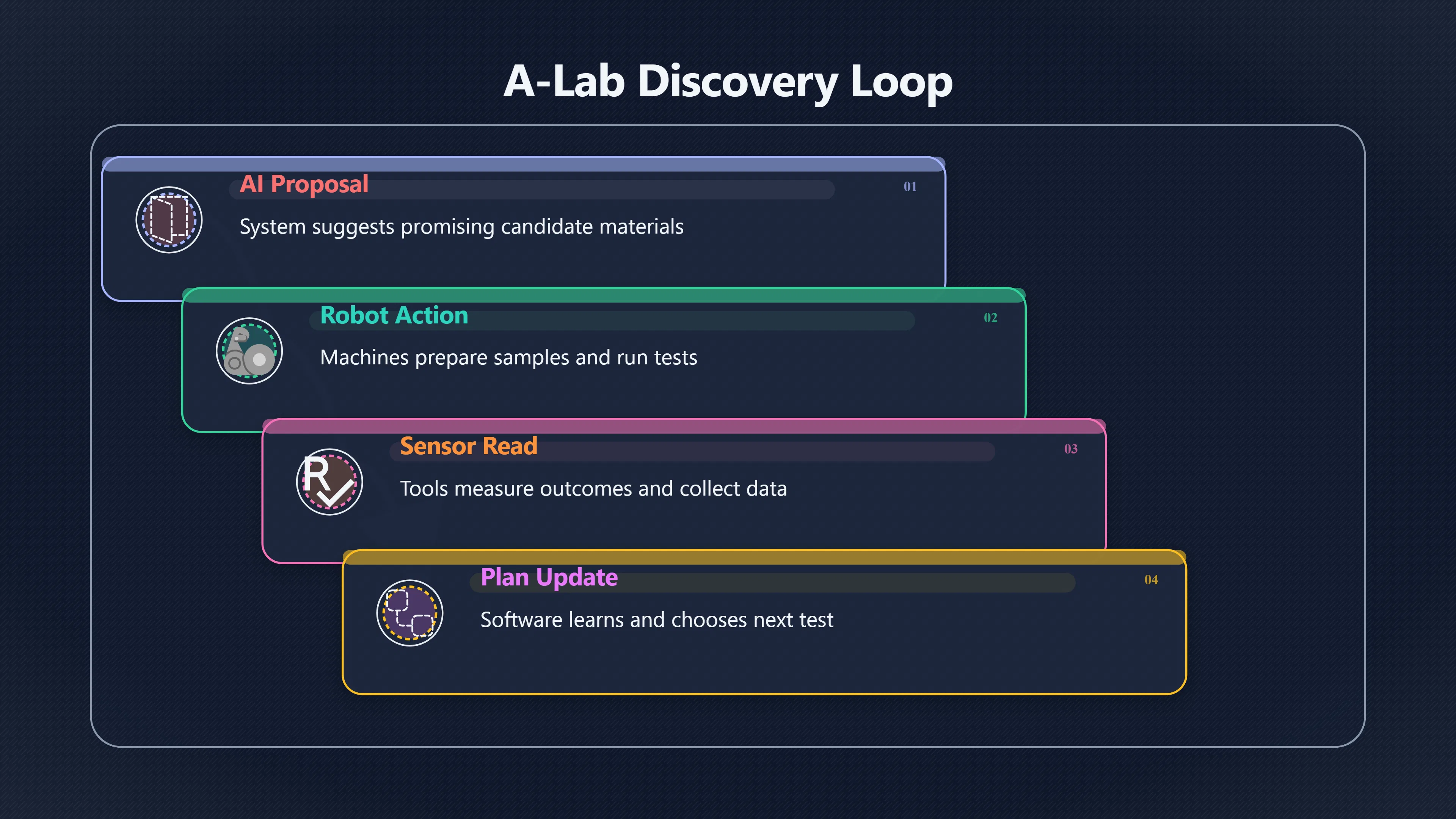
Autonomous or “self-driving” laboratories try to turn this into a closed-loop system. Instead of waiting for researchers to manually interpret results and plan the next experiment, software continuously updates its understanding and chooses the next tests automatically. The loop generally contains several components:
- AI systems that propose promising candidates or experimental conditions.
- Robotic equipment that prepares samples and runs experiments.
- Sensors and analytical tools that measure outcomes.
- Machine-learning systems that update predictions from new data.
- Planning systems that decide what to test next.
The goal is not merely automation but optimisation. Rather than exploring possibilities randomly, the system attempts to learn where the most informative experiments are likely to be. Researchers often describe this as active learning: the machine chooses experiments partly to improve its own understanding.[ACS Publications]pubs.acs.orgACS PublicationsSelf-Driving Laboratories for Chemistry and Materials Scienceby G Tom · 2024 · Cited by 715 — As such, autonomous synthes… 2arXiv
Supporters argue that this could transform areas such as materials science, battery chemistry, catalysts, drug development and synthetic biology. Many scientific fields involve enormous search spaces. A new battery material, for example, might be chosen from millions or billions of possible combinations. Human intuition alone cannot efficiently explore all of them.
This is why autonomous labs occupy a distinctive place in the scientific acceleration story. AlphaFold accelerated prediction. Robot labs aim to accelerate verification.
What the A-Lab case appeared to show
One of the most widely discussed examples arrived in 2023 with the publication of A-Lab, an autonomous laboratory developed by researchers associated with Lawrence Berkeley National Laboratory and collaborators. The system combined computational screening, machine learning, literature-based recipe generation, robotics and automated analysis to synthesise inorganic materials.[Nature]nature.comRobot chemist sparks row with claim it created new materials12 Dec 2023 — Researchers question whether an AI-controlled lab assistant act…
The headline result was striking. According to the Nature paper, the system operated continuously for 17 days and successfully realised dozens of target materials from a larger candidate set. The work was presented as evidence that AI-guided autonomous experimentation could help close the gap between theoretical predictions and real-world synthesis.[Nature]nature.comAutonomous closed-loop framework for reproducible…by D Gao · 2026 — This work establishes an automated closed-loop system that s…[ResearchGate]researchgate.netAn autonomous laboratory for the accelerated synthesis of…29 Nov 2023 — Over 17 days of continuous operation, the A-Lab realized 36 co…
The timing also mattered. Around the same period, Google DeepMind’s GNoME project reported hundreds of thousands of predicted stable materials. A-Lab seemed to provide a partial answer to an obvious criticism: prediction is easy compared with actually making something. If AI could both suggest new materials and rapidly synthesise them, scientific discovery might begin operating at a fundamentally different scale.[WIRED]wired.comGoogle Deep Mind's AI Dreamed Up 380,000 New MaterialsThe Next Challenge Is Making ThemNovember 29, 2023 — Google DeepMind developed an AI program, GNoME, which has predicted 380,000 new stab…
For advocates of long-run AI-enabled abundance, this looked like an early glimpse of a larger possibility. Instead of waiting years for experimental follow-up, autonomous systems could potentially test ideas continuously. New batteries, catalysts, superconductors, solar materials and manufacturing processes might emerge faster than traditional research cycles allow.
The excitement was not simply about robotics. It was about the possibility that intelligence itself could become a scalable experimental resource.
Why the discoveries became controversial
The A-Lab paper quickly attracted scrutiny from other materials scientists. Critics argued that the most important claim was not whether the robots functioned, but whether the reported materials were genuinely new discoveries.
Several researchers examined the reported compounds and argued that many had already been described in prior scientific literature or databases. In early 2024, a published critique concluded that the evidence did not support the claim that the system had discovered dozens of novel materials. Critics argued that the materials were often known compounds synthesised through automated methods rather than previously unknown substances.[Chemistry World]chemistryworld.comChemistry WorldNew analysis raises doubts over autonomous lab's…16 Jan 2024 — A critique of a paper published in Nature last year, whi…
The dispute became unusually visible because the paper sat at the intersection of several fast-moving fields: AI, automation, materials science and scientific publishing. Questions that might otherwise have remained technical suddenly became part of a larger debate about how AI achievements are evaluated.
Importantly, the criticism was not that the laboratory was fake or that the automation failed. Few doubted that the robotic system genuinely executed experiments. The disagreement centred on interpretation:
- What counts as a new material?
- How strong must evidence be before a discovery claim is justified?
- How should automated systems be evaluated?
- Is successful synthesis enough, or must novelty be independently established?
Those questions exposed a deeper issue. Scientific acceleration can be measured in many ways: number of experiments, number of candidates, number of hypotheses generated or amount of data collected. But those metrics can diverge from actual scientific knowledge.
A machine can generate thousands of plausible candidates very quickly. That does not necessarily mean humanity has learned thousands of new facts about the world.

Reproducibility is the real acceleration test
The A-Lab debate highlighted a principle that extends far beyond materials science: science advances through reproducible knowledge, not merely through outputs.
This is especially important for AI systems because they can generate impressive quantities of results. Modern models can propose molecules, proteins, materials, experimental protocols and research hypotheses at scales impossible for individual researchers. The temptation is to measure progress through volume.
Yet scientific history is full of examples where apparent breakthroughs failed replication tests.
For autonomous laboratories, the crucial questions become:
- Can another laboratory reproduce the result?
- Are the measurements reliable?
- Do the reported properties hold up under independent testing?
- Is the claimed novelty genuine?
- Does the system reveal enough information for others to verify the work?
If the answer is no, then apparent acceleration may simply create larger piles of unverified claims.
This is why many researchers increasingly frame autonomous laboratories as data-quality systems rather than discovery machines. The most valuable outcome may not be a single dramatic breakthrough but a steady stream of standardised, reproducible experimental evidence.[Nature]nature.comTowards end-to-end automation of AI researchby C Lu · 2026 · Cited by 38 — We present The AI Scientist, which creates research ideas, wri…
In that sense, the proof problem is not an obstacle to scientific acceleration. It is the central requirement.
The hidden challenge: moving from prediction to reality
The broader scientific acceleration narrative often focuses on AI’s ability to generate possibilities. In many fields, however, possibilities are already abundant.
Materials scientists had large candidate lists before A-Lab. Drug researchers can generate enormous numbers of molecules. Biologists can produce endless hypotheses about genes and proteins.
The bottleneck is deciding which ideas survive contact with reality.
One reason autonomous labs matter is that they target this bottleneck directly. They are built around the transition from simulation to experiment.
But the A-Lab controversy demonstrated that even this stage contains multiple layers:
- Predicting a candidate.
- Successfully synthesising it.
- Measuring its properties.
- Confirming novelty.
- Replicating results independently.
- Demonstrating practical usefulness.
A system may succeed at one stage and fail at another.
This helps explain why many experts remain simultaneously excited and cautious. The ability to run experiments continuously is genuinely important. Yet the history of science suggests that verification often scales more slowly than generation. AI may accelerate the creation of hypotheses much faster than it accelerates the process of proving which hypotheses are true.[WIRED]wired.comGoogle Deep Mind's AI Dreamed Up 380,000 New MaterialsThe Next Challenge Is Making ThemNovember 29, 2023 — Google DeepMind developed an AI program, GNoME, which has predicted 380,000 new stab…
What success would actually look like
The strongest version of the autonomous-lab vision is not a machine that claims thousands of discoveries every week. It is a system that produces trusted knowledge faster.
Several newer projects increasingly emphasise this point. Researchers working on self-driving laboratories now often focus on closed-loop validation, standardised workflows, uncertainty estimation and reproducibility metrics rather than headline discovery counts alone. Some recent autonomous systems explicitly report gains in experimental consistency and repeatability, arguing that automation can reduce human variability rather than merely increase throughput.[Nature]nature.comA flexible and affordable self-driving laboratory for…by S Pilon · 2026 · Cited by 1 — Here we introduce RoboChem-Flex, a low-cost, mo…
If such systems mature, their long-run impact could be substantial.
- Materials science could search vast design spaces more systematically.
- Energy technologies could be tested faster.
- New catalysts could reduce industrial costs and emissions.
- Biomedical research could explore more candidate therapies.
- Experimental knowledge could become less dependent on a small number of elite laboratories.
These possibilities connect directly to the broader AI bloom question. Scientific abundance depends not only on generating ideas but on turning them into reliable knowledge that many people can build upon.
The lesson from A-Lab is therefore more useful than either uncritical hype or blanket scepticism. Autonomous laboratories may become one of the most important scientific technologies of the century. But the field’s success will not be measured by how many candidates an AI proposes or how many robotic experiments run overnight. It will be measured by whether independent researchers can verify the results and use them to discover something genuinely new.
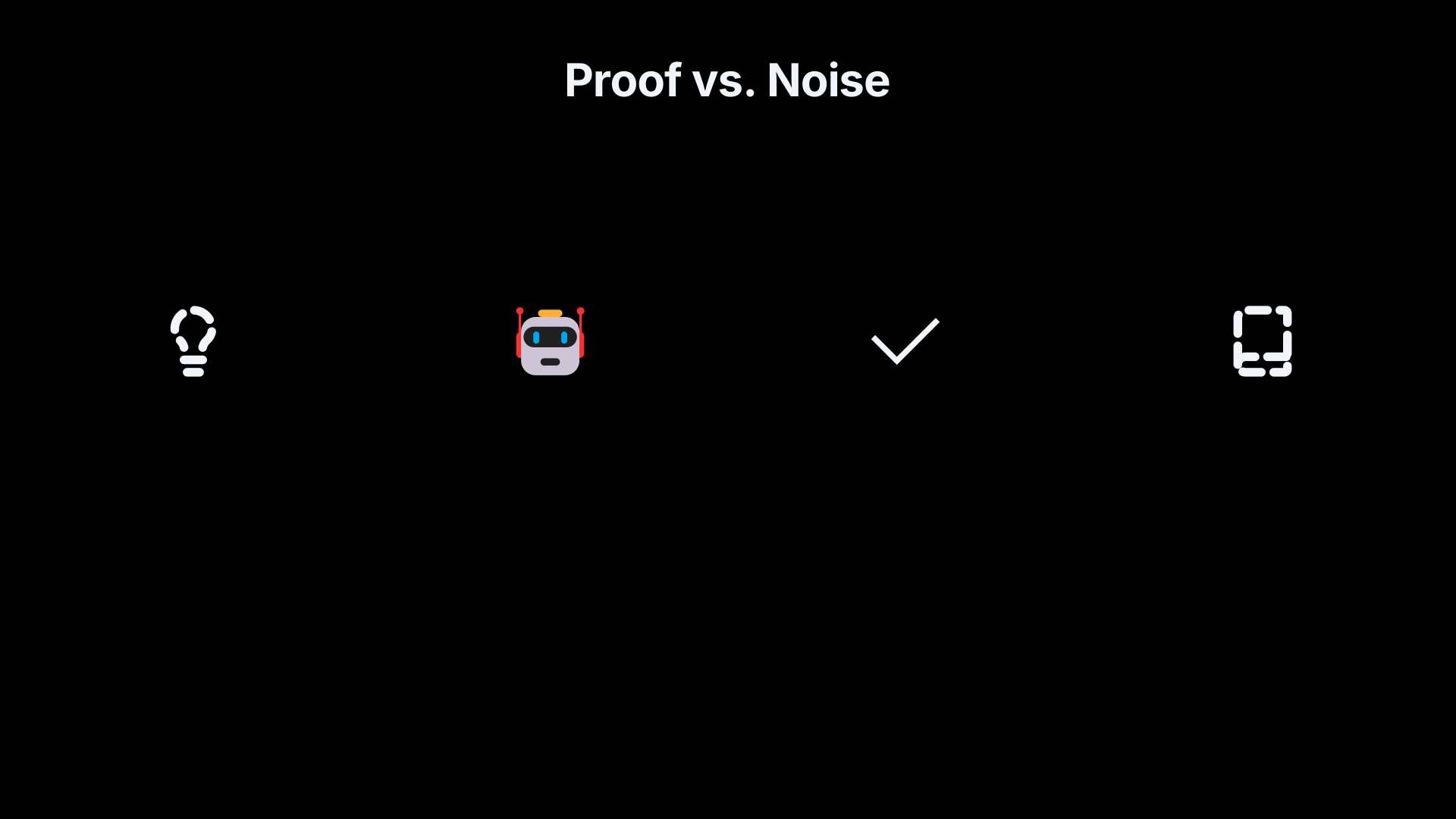
In science, acceleration without proof is noise. Acceleration with proof becomes knowledge. That distinction may determine whether autonomous labs remain impressive demonstrations or become a foundation for a much larger expansion of human discovery.[Chemistry World]chemistryworld.comChemistry WorldNew analysis raises doubts over autonomous lab's…16 Jan 2024 — A critique of a paper published in Nature last year, whi…[Nature]nature.comSelf-Driving Laboratories for Chemistry and Materials…Oct 8, 2024 — Self-driving labs are capable of autonomously designing, executing…
Amazon book picks
Further Reading
Books and field guides related to When robot labs meet reality. Use these as the next step if you want deeper reading beyond the article.
The Coming Wave
Directly addresses whether advanced AI can deliver broad civilisational benefits while remaining governable.
The Kill Chain
Directly addresses AI-enabled military intelligence and decision advantage.
Human Compatible
Explores how powerful AI could advance humanity if aligned with human values.
eBay marketplace picks
Marketplace Samples
Example marketplace items related to this page. Use the search link to explore similar finds on eBay.


Endnotes
1.
Source: nature.com
Link:https://www.nature.com/articles/s41586-023-06734-w
Source snippet
An autonomous laboratory for the accelerated synthesis of...29 Nov 2023 — We introduce the A-Lab, an autonomous laboratory for the...
2.
Source: nature.com
Link:https://www.nature.com/articles/d41586-023-03956-w
Source snippet
Robot chemist sparks row with claim it created new materials12 Dec 2023 — Researchers question whether an AI-controlled lab assistant act...
3.
Source: pubs.acs.org
Link:https://pubs.acs.org/doi/10.1021/acs.chemrev.4c00055
Source snippet
ACS PublicationsSelf-Driving Laboratories for Chemistry and Materials Scienceby G Tom · 2024 · Cited by 715 — As such, autonomous synthes...
4.
Source: arxiv.org
Link:https://arxiv.org/abs/2006.06141
5.
Source: researchgate.net
Link:https://www.researchgate.net/publication/376043973_An_autonomous_laboratory_for_the_accelerated_synthesis_of_inorganic_materials
Source snippet
An autonomous laboratory for the accelerated synthesis of...29 Nov 2023 — Over 17 days of continuous operation, the A-Lab realized 36 co...
6.
Source: wired.com
Title: Google Deep Mind’s AI Dreamed Up 380,000 New Materials
Link:https://www.wired.com/story/an-ai-dreamed-up-380000-new-materials-the-next-challenge-is-making-them
Source snippet
The Next Challenge Is Making ThemNovember 29, 2023 — Google DeepMind developed an AI program, GNoME, which has predicted 380,000 new stab...
Published: November 29, 2023
7.
Source: ceder.berkeley.edu
Title: [a lab]({{ ‘a-lab/’ | relative_url }}) paper published in nature featured in news story
Link:https://ceder.berkeley.edu/news/a-lab-paper-published-in-nature-featured-in-news-story/
Source snippet
A-Lab paper published in Nature, featured in news stories29 Nov 2023 — Autonomous experimentation for accelerated materials discovery · H...
8.
Source: nature.com
Link:https://www.nature.com/articles/s41586-026-10482-y
Source snippet
Autonomous closed-loop framework for reproducible...by D Gao · 2026 — This work establishes an automated closed-loop system that s...
9.
Source: nature.com
Link:https://www.nature.com/articles/s41586-026-10265-5
Source snippet
Towards end-to-end automation of AI researchby C Lu · 2026 · Cited by 38 — We present The AI Scientist, which creates research ideas, wri...
10.
Source: nature.com
Link:https://www.nature.com/articles/s44160-026-01053-0
Source snippet
A flexible and affordable self-driving laboratory for...by S Pilon · 2026 · Cited by 1 — Here we introduce RoboChem-Flex, a low-cost, mo...
11.
Source: nature.com
Link:https://www.nature.com/collections/eiiadfbbhb
Source snippet
Self-Driving Laboratories for Chemistry and Materials...Oct 8, 2024 — Self-driving labs are capable of autonomously designing, executing...
12.
Source: cen.acs.org
Link:https://cen.acs.org/research-integrity/Nature-robot-chemist-paper-corrected/104/web/2026/01
Source snippet
C&EN29 Jan 2026 — The prominent scientific journal Nature has corrected a highly cited study about a robot designed to synthesize entirel...
13.
Source: researchgate.net
Link:https://www.researchgate.net/publication/393750833Autonomous%27self-driving%27_laboratories_a_review_of_technology_and_policy_implications
Source snippet
(PDF) Autonomous 'self-driving' laboratories: a review of...16 Jul 2025 — This article reviews and provides perspective on the emerging...
14.
Source: researchgate.net
Link:https://www.researchgate.net/publication/399899062_Author_Correction_An_autonomous_laboratory_for_the_accelerated_synthesis_of_inorganic_materials
Source snippet
(PDF) Author Correction: An autonomous laboratory for the...19 Jan 2026 — Autonomous experimentation driven by artificial intelligence (...
15.
Source: ceder.berkeley.edu
Title: autonomous experimentation for accelerated materials discovery
Link:https://ceder.berkeley.edu/research-areas/autonomous-experimentation-for-accelerated-materials-discovery/
Source snippet
experimentation for accelerated materials...Figure: The [closed loop]({{ 'closed-loop/' | relative_url }}) workflow used to discover and synthesize new materials in the A-Lab...
16.
Source: arxiv.org
Link:https://arxiv.org/pdf/2204.04187
Source snippet
A Low-Cost Robot Science Kit for Education with Symbolic...by L Saar · 2022 · Cited by 4 — Students learned and executed autonomous ML a...
17.
Source: chemistryworld.com
Link:https://www.chemistryworld.com/news/new-analysis-raises-doubts-over-autonomous-labs-materials-discoveries/4018791.article
Source snippet
Chemistry WorldNew analysis raises doubts over autonomous lab's...16 Jan 2024 — A critique of a paper published in Nature last year, whi...
Additional References
18.
Source: linkedin.com
Link:https://www.linkedin.com/pulse/ai-powered-labs-discovering-materials-10x-faster-brightbeam-ai-dfvle
Source snippet
AI-Powered Labs: Discovering Materials 10x FasterBy allowing artificial intelligence to plan and conduct chemical experiments in real-tim...
19.
Source: reddit.com
Link:https://www.reddit.com/r/slatestarcodex/comments/1923p07/autonomous_lab_did_not_synthesize_any_new/
Source snippet
Autonomous lab did not synthesize any new materialsThis is a reanalysis of Nature paper An autonomous laboratory for the accelerated synt...
20.
Source: chemrxiv.org
Link:https://chemrxiv.org/engage/api-gateway/chemrxiv/assets/orp/resource/item/65e0ce79e9ebbb4db993d6fe/original/autonomous-laboratories-for-accelerated-materials-discovery-a-community-survey-and-practical-insights.pdf
Source snippet
Autonomous laboratories for accelerated materials discoveryby L Hung · 2024 · Cited by 25 — In this article, we share the outcomes of the...
21.
Source: pure.uva.nl
Link:https://pure.uva.nl/ws/files/186174483/Autonomous_chemistry.pdf
Source snippet
self-driving labs in chemical and material sciencesThis approach leverages advanced algorithms (artificial intelligence [AI] planners), r...
22.
Source: facebook.com
Link:https://www.facebook.com/groups/entanglementandemergence/posts/2052781258402895/
23.
Source: pmc.ncbi.nlm.nih.gov
Link:https://pmc.ncbi.nlm.nih.gov/articles/PMC10700133/
Source snippet
autonomous laboratory for the accelerated synthesis of...by NJ Szymanski · 2023 · Cited by 1182 — We introduce the A-Lab, an autonomous...
24.
Source: dim-materre.fr
Title: an autonomous laboratory for the accelerated synthesis of novel materials
Link:https://www.dim-materre.fr/en/publications/an-autonomous-laboratory-for-the-accelerated-synthesis-of-novel-materials/
Source snippet
An autonomous laboratory for the accelerated synthesis of...29 Nov 2023 — Over 17 days of continuous operation, the A-Lab realized 41 no...
25.
Source: scispace.com
Title: review robot scientists for autonomous scientific discovery 45skjgfjfq
Link:https://scispace.com/pdf/review-robot-scientists-for-autonomous-scientific-discovery-45skjgfjfq.pdf
Source snippet
We review the main components of autonomous scientific discovery, and how they lead to the concept of a Robot. Scientist.Read more...
26.
Source: pubmed.ncbi.nlm.nih.gov
Link:https://pubmed.ncbi.nlm.nih.gov/38030721/
Source snippet
An autonomous laboratory for the accelerated synthesis of...by NJ Szymanski · 2023 · Cited by 1143 — We introduce the A-Lab, an au...
27.
Source: rsc.org
Link:https://www.rsc.org/suppdata/d4/dd/d4dd00059e/d4dd00059e1.pdf
Source snippet
be used to accelerate the discovery process in research labs that work...Read more...
Topic Tree