Within Inverse design
Can AI materials make it out of the lab?
MatterGen's generated crystals are promising hypotheses, but synthesis, stability and real-world testing decide whether they matter.
On this page
- Why generated crystals are only hypotheses
- What synthesis and validation must prove
- Where Matter Gen's early proof of principle still falls short
Page outline Jump by section
Introduction
AI systems such as MatterGen are often presented as a glimpse of a future where new materials can be designed almost to order: batteries with higher energy density, catalysts that cut industrial emissions, magnets that avoid scarce minerals, or entirely new classes of electronic materials. But there is a crucial distinction between generating a promising crystal on a computer and creating a useful material in the physical world.
 The central question is not whether AI can propose novel structures. It clearly can. The harder question is whether those structures survive contact with chemistry, manufacturing constraints and experimental reality. MatterGen’s importance lies partly in showing that generative AI can produce plausible candidates rather than merely screen known materials. Yet the real test remains synthesis, validation and performance under laboratory conditions. For the broader AI bloom vision of scientific acceleration, this distinction matters enormously. A world transformed by AI-driven discovery depends not on attractive simulations but on discoveries that can actually be made, measured and deployed. Nature[PubMed]pubmed.ncbi.nlm.nih.govA generative model for inorganic materials designby C Zeni · 2025 · Cited by 633 — After fine-tuning, MatterGen successfully genera…
Why generated crystals are only hypotheses
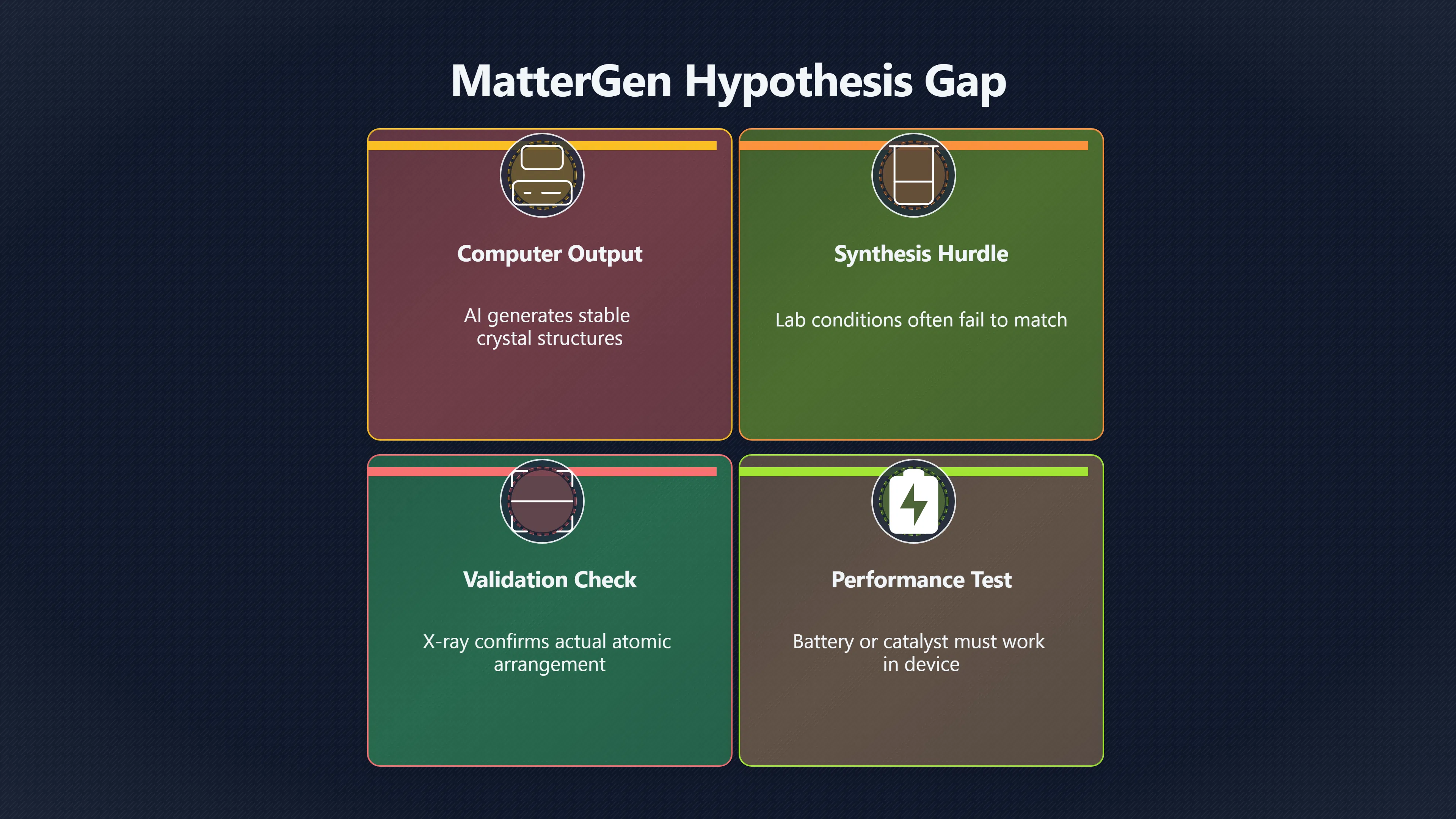
MatterGen generates candidate crystal structures that satisfy desired constraints, such as magnetic, mechanical or electronic properties. These outputs are not products, prototypes or verified discoveries. They are hypotheses about how atoms might be arranged.[Nature]nature.comA generative model for inorganic materials designby C Zeni · 2025 · Cited by 633 — We present MatterGen, a model that generates sta…
Even when a generated structure appears stable in computation, several layers of uncertainty remain:
- The structure may correspond to a local energy minimum rather than the form nature prefers to create.
- The required synthesis pathway may be unknown.
- The material may require temperatures, pressures or precursor chemicals that are impractical.
- Small defects introduced during manufacturing may destroy the predicted properties.
- The material may behave differently when combined with other components in a real device.
Materials science has long relied on computational predictions. What generative systems change is the scale and novelty of the search. MatterGen can produce structures that do not appear in existing databases and that human researchers might never have proposed. That is valuable because it expands the space of possibilities. But novelty also increases uncertainty. The further researchers move from known chemical families, the less experience exists to guide synthesis.[Nature]nature.comA generative model for inorganic materials designby C Zeni · 2025 · Cited by 633 — After fine-tuning, MatterGen suc- cessfully generates…[arXiv]arxiv.orgarXiv Matter Gen: a generative model for inorganic materials designarXiv Matter Gen: a generative model for inorganic materials design
This is one reason researchers often describe AI-generated materials as candidates rather than discoveries. A generated crystal is closer to a promising lead than a finished result.
What synthesis and validation must prove
For an AI-designed material to matter, several separate questions must be answered experimentally.
Can it actually be made?
The first hurdle is synthesis itself. A crystal may look stable in simulation while remaining extremely difficult to produce in practice.
Researchers must determine:
- Which precursor chemicals to use.
- What temperatures and pressures are required.
- How long reactions should run.
- Whether impurities destabilise the structure.
- Whether the material forms consistently rather than appearing only under narrow laboratory conditions.
This is often where theoretical proposals fail. A material may exist in principle while remaining impractical to manufacture reliably.[WIRED]wired.comGoogle Deep Mind's AI Dreamed Up 380,000 New MaterialsThe Next Challenge Is Making ThemNovember 29, 2023 — Google DeepMind developed an AI program, GNoME, which has predicted 380,000 new stab…
The challenge becomes even harder for complex compounds involving many elements. As the number of interacting components rises, so does the difficulty of finding a workable synthesis recipe. Human intuition becomes less reliable, but physical experimentation remains unavoidable.[WIRED]wired.comGoogle Deep Mind's AI Dreamed Up 380,000 New MaterialsThe Next Challenge Is Making ThemNovember 29, 2023 — Google DeepMind developed an AI program, GNoME, which has predicted 380,000 new stab…
Does the real material match the predicted structure?
Even if synthesis succeeds, researchers must verify that the resulting crystal actually corresponds to the predicted arrangement of atoms.
Techniques such as X-ray diffraction, electron microscopy and spectroscopy are used to check whether the produced material matches the computational design. Small structural deviations can dramatically alter behaviour.
A generated structure may therefore pass the synthesis test while failing the validation test. The lab-created material exists, but not in the form the model intended.[ScienceDirect]sciencedirect.comHas generative artificial intelligence solved inverse…by H Park · 2024 · Cited by 96 — We provide a perspective on progre…
Does it deliver the promised property?
The most important question comes last.
A battery material must improve battery performance. A catalyst must accelerate reactions. A magnetic material must exhibit the expected magnetic behaviour.
This sounds obvious, but it is where many computational predictions encounter reality. Real materials contain defects, grain boundaries, contamination and manufacturing variations that are difficult to model perfectly. Predicted performance can therefore diverge significantly from measured performance.
For practical technologies, success often depends not only on a material’s intrinsic properties but on how it interacts with neighbouring materials inside a larger system. A promising electrolyte, for example, may react badly with other battery components and become unusable despite excellent standalone predictions.[WIRED]wired.comGoogle Deep Mind's AI Dreamed Up 380,000 New MaterialsThe Next Challenge Is Making ThemNovember 29, 2023 — Google DeepMind developed an AI program, GNoME, which has predicted 380,000 new stab…
MatterGen’s proof of principle is encouraging but limited
The strongest evidence that MatterGen is more than a theoretical exercise comes from experimental validation.
In the Nature paper describing the system, the researchers synthesised one material generated by MatterGen and measured a target property. The measured value came within roughly 20% of the intended target. This does not prove that the model can routinely design commercially useful materials, but it does demonstrate that at least some generated candidates can survive the transition from computation to experiment.[PubMed]pubmed.ncbi.nlm.nih.govA generative model for inorganic materials designby C Zeni · 2025 · Cited by 633 — After fine-tuning, MatterGen successfully genera…
That result matters because inverse design systems face a tougher challenge than ordinary prediction models. They are not merely estimating the behaviour of known materials. They are proposing structures that may never have existed before.
The successful synthesis therefore serves as a proof of principle that generative models can produce physically realisable candidates rather than only mathematically plausible ones.[PubMed]pubmed.ncbi.nlm.nih.govA generative model for inorganic materials designby C Zeni · 2025 · Cited by 633 — After fine-tuning, MatterGen successfully genera…
Yet one successful demonstration should not be confused with industrial readiness.
A useful comparison is early AI protein prediction. Systems such as AlphaFold demonstrated impressive scientific capability before their outputs translated into large numbers of medicines. Likewise, one synthesised MatterGen material does not automatically imply rapid breakthroughs across batteries, semiconductors, superconductors or carbon-capture technologies.
The gap between scientific possibility and widespread application remains substantial.
The bottleneck may shift from discovery to experimentation
One of the most important implications of systems like MatterGen is that they may move the bottleneck rather than eliminate it.
Historically, discovering candidate materials was often the slow step. AI can generate candidates much faster than human researchers can evaluate them. This creates a new challenge: testing enough proposals to identify genuinely useful ones.[Nature]nature.comA generative model for inorganic materials designby C Zeni · 2025 · Cited by 633 — We present MatterGen, a model that generates sta…
The experience of Google’s GNoME project illustrates this problem. GNoME predicted hundreds of thousands of potentially stable materials. Yet only a tiny fraction can be synthesised and characterised in laboratories. Researchers at Lawrence Berkeley National Laboratory used an autonomous experimental platform known as A-Lab to test a subset of these predictions. Out of 58 selected candidates, 41 were successfully synthesised after repeated experimentation and adjustment. That is an impressive result, but it also highlights the scale mismatch between computational generation and physical testing.[WIRED]wired.comGoogle Deep Mind's AI Dreamed Up 380,000 New MaterialsThe Next Challenge Is Making ThemNovember 29, 2023 — Google DeepMind developed an AI program, GNoME, which has predicted 380,000 new stab…
In other words, AI may soon be able to generate more promising materials than the global research system can practically investigate.
This creates strong incentives for automated laboratories, robotics and AI-guided experimentation. If generative models become discovery engines, automated validation may become equally important. Scientific acceleration may depend not just on smarter models but on tighter integration between computation and physical experimentation.[WIRED]wired.comGoogle Deep Mind's AI Dreamed Up 380,000 New MaterialsThe Next Challenge Is Making ThemNovember 29, 2023 — Google DeepMind developed an AI program, GNoME, which has predicted 380,000 new stab…
Where the hardest uncertainties remain
Several major uncertainties still stand between current demonstrations and the broader abundance vision often associated with AI-driven materials science.
Useful properties are harder than stability. Predicting whether a crystal can exist is not the same as predicting whether it solves an important technological problem. Stability is often only the first filter.[WIRED]wired.comGoogle Deep Mind's AI Dreamed Up 380,000 New MaterialsThe Next Challenge Is Making ThemNovember 29, 2023 — Google DeepMind developed an AI program, GNoME, which has predicted 380,000 new stab…
Manufacturing may dominate performance. Many technologies depend on large-scale production techniques, defect control and cost optimisation. A material that works in a laboratory sample may fail commercially.
Economic constraints still matter. Some generated materials may require rare, expensive or geopolitically sensitive elements. MatterGen explicitly explores designs that reduce supply-chain risk, but balancing performance, manufacturability and cost remains difficult.[arXiv]arxiv.orgarXiv Matter Gen: a generative model for inorganic materials designarXiv Matter Gen: a generative model for inorganic materials design
Data limitations remain significant. Generative models learn from existing materials databases. Although they can move beyond known examples, their capabilities are still shaped by the quality and coverage of available data. Researchers continue to debate how effectively current systems can generalise into genuinely unexplored regions of materials space.[ScienceDirect]sciencedirect.comHas generative artificial intelligence solved inverse…by H Park · 2024 · Cited by 96 — We provide a perspective on progre… 2arXiv
Many predictions may never be practical. Some proposed structures may require extreme synthesis conditions or involve materials that are too scarce, toxic or expensive for real-world use.[WIRED]wired.comGoogle Deep Mind's AI Dreamed Up 380,000 New MaterialsThe Next Challenge Is Making ThemNovember 29, 2023 — Google DeepMind developed an AI program, GNoME, which has predicted 380,000 new stab…

Why this still matters for the AI bloom case
The importance of MatterGen is not that it has already solved materials discovery. It has not. The importance is that it offers evidence that generative AI can participate in one of the most difficult parts of scientific creativity: proposing new physical structures that satisfy human goals.
If systems like MatterGen improve steadily, the long-term implication is not merely faster laboratory work. It is the possibility of compressing decades of trial-and-error discovery across energy, manufacturing, electronics, climate technology and medicine. Better batteries, more efficient catalysts, advanced computing materials and cleaner industrial processes all depend on the ability to discover useful matter, not just useful information.[Microsoft]microsoft.commattergen a new paradigm of materials design with generative aiMatterGen: A new paradigm of materials design with…16 Jan 2025 — MatterGen enables a new paradigm of generative AI-assisted m…[Nature]nature.comA generative model for inorganic materials designby C Zeni · 2025 · Cited by 633 — After fine-tuning, MatterGen suc- cessfully generates…
For advocates of an AI-enabled scientific bloom, this is the deeper significance. Materials have often been civilisation’s hidden constraint. Entire technological eras are defined by what substances humans can reliably create and manipulate. If AI helps researchers navigate vastly larger regions of chemical possibility, then the ceiling on future technological progress may rise.
But the laboratory remains the judge. MatterGen’s generated crystals are promising ideas, not finished breakthroughs. The path from AI proposal to world-changing technology still runs through synthesis, measurement, replication and engineering. The most optimistic future depends not merely on generating possibilities, but on repeatedly proving that those possibilities can survive reality.[PubMed]pubmed.ncbi.nlm.nih.govA generative model for inorganic materials designby C Zeni · 2025 · Cited by 633 — After fine-tuning, MatterGen successfully genera…[Nature]nature.comA generative model for inorganic materials designby C Zeni · 2025 · Cited by 633 — After fine-tuning, MatterGen suc- cessfully generates…
Amazon book picks
Further Reading
Books and field guides related to Can AI materials make it out of the lab?. Use these as the next step if you want deeper reading beyond the article.
Human Compatible
Explores how powerful AI could advance humanity if aligned with human values.
The Alignment Problem
Explores how AI systems can generate outputs that require careful validation.
The Genesis Machine
Explores how AI may accelerate discovery across biology and other sciences.
The Coming Wave
Directly addresses whether advanced AI can deliver broad civilisational benefits while remaining governable.
eBay marketplace picks
Marketplace Samples
Example marketplace items related to this page. Use the search link to explore similar finds on eBay.


Endnotes
1.
Source: nature.com
Link:https://www.nature.com/articles/s41586-025-08628-5
Source snippet
A generative model for inorganic materials designby C Zeni · 2025 · Cited by 633 — We present MatterGen, a model that generates sta...
2.
Source: sciencedirect.com
Link:https://www.sciencedirect.com/science/article/pii/S259023852400242X
Source snippet
Has generative artificial [intelligence]({{ 'intelligence/' | relative_url }}) solved inverse...by H Park · 2024 · Cited by 96 — We provide a perspective on progre...
3.
Source: arxiv.org
Title: arXiv Matter Gen: a generative model for inorganic materials design
Link:https://arxiv.org/abs/2312.03687
4.
Source: arxiv.org
Title: arXiv AI-driven inverse design of materials: Past, present and future
Link:https://arxiv.org/abs/2411.09429
5.
Source: wired.com
Title: Google Deep Mind’s AI Dreamed Up 380,000 New Materials
Link:https://www.wired.com/story/an-ai-dreamed-up-380000-new-materials-the-next-challenge-is-making-them
Source snippet
The Next Challenge Is Making ThemNovember 29, 2023 — Google DeepMind developed an AI program, GNoME, which has predicted 380,000 new stab...
Published: November 29, 2023
6.
Source: arxiv.org
Link:https://arxiv.org/html/2411.09429v1
Source snippet
AI-driven inverse design of materials: Past, present and future14 Nov 2024 — This survey provides the latest overview of AI-driven invers...
7.
Source: arxiv.org
Link:https://arxiv.org/pdf/2604.14082
Source snippet
Generative design of inorganic materialsby J Recatala-Gomez · 2026 — Generative design of inorganic materials can be understood as the in...
8.
Source: arxiv.org
Title: arXiv Generative deep learning for the inverse design of materials
Link:https://arxiv.org/abs/2409.19124
9.
Source: microsoft.com
Title: mattergen a new paradigm of materials design with generative ai
Link:https://www.microsoft.com/en-us/research/blog/mattergen-a-new-paradigm-of-materials-design-with-generative-ai/
Source snippet
MatterGen: A new paradigm of materials design with...16 Jan 2025 — MatterGen enables a new paradigm of generative AI-assisted m...
10.
Source: microsoft.com
Link:https://www.microsoft.com/en-us/research/project/materials/
Source snippet
Microsoft ResearchMatterGen is a diffusion model specifically designed for generating stable inorganic materials across the periodic tabl...
11.
Source: nature.com
Link:https://www.nature.com/articles/s41586-025-08628-5_reference.pdf
Source snippet
A generative model for inorganic materials designby C Zeni · 2025 · Cited by 633 — After fine-tuning, MatterGen suc- cessfully generates...
12.
Source: sciencedirect.com
Link:https://www.sciencedirect.com/science/article/pii/S2666386425006186
Source snippet
Accelerated inorganic materials design with generative AI...by I Takahara · 2025 · Cited by 15 — Here, we present MatAgent, a generative...
13.
Source: microsoft.com
Title: mattergen a generative model for materials design
Link:https://www.microsoft.com/en-us/research/quarterly-brief/jun-2024-brief/articles/mattergen-a-generative-model-for-materials-design/
Source snippet
MatterGen: A Generative Model for Materials DesignJun 4, 2024 — Tian Xie introduces MatterGen, a generative model that creates new inorga...
14.
Source: microsoft.com
Link:https://www.microsoft.com/en-us/research/wp-content/uploads/2025/01/WEF-2025_Leave-Behind_Accelerating-Materials-Design-with-AI.pdf
Source snippet
Accelerating Materials Design with AIMatterGen is a generative AI model that operates similarly to text-to-image and text-to- video AI mo...
15.
Source: pubmed.ncbi.nlm.nih.gov
Link:https://pubmed.ncbi.nlm.nih.gov/39821164/
Source snippet
A generative model for inorganic materials designby C Zeni · 2025 · Cited by 633 — After fine-tuning, MatterGen successfully genera...
16.
Source: github.com
Link:https://github.com/microsoft/mattergen
17.
Source: medium.com
Link:https://medium.com/data-science-in-your-pocket/microsoft-mattergen-ai-model-for-material-design-and-discovery-4d1b74ba4cfe
18.
Source: venturebeat.com
Link:https://venturebeat.com/ai/microsoft-mattergen-ai-system-generates-materials-that-could-change-industries-forever
Source snippet
Microsoft just built an AI that designs materials for the futureJan 16, 2025 — Microsoft researchers unveil MatterGen, which accelerates...
19.
Source: researchmatters.in
Link:https://researchmatters.in/news/microsofts-mattergen-could-be-ai-revolution-materials-discovery
Source snippet
Microsoft's MatterGen could be the AI Revolution in...Jan 20, 2025 — One of the materials suggested by MatterGen was synthesized by the...
20.
Source: reddit.com
Link:https://www.reddit.com/r/singularity/comments/1i2ompg/microsoft_researchers_introduce_mattergen_a_model/
Source snippet
Microsoft researchers introduce MatterGen, a model that...Microsoft researchers introduce MatterGen, a model that can discover new mater...
Additional References
21.
Source: medium.com
Link:https://medium.com/%40musicalchemist/how-ai-is-revolutionizing-material-discovery-meet-mattergen-ceb7d3156128
Source snippet
How AI is Revolutionizing Material DiscoveryOne of the standout validations is the successful synthesis of TaCr₂O₆. The material's experi...
22.
Source: linkedin.com
Link:https://www.linkedin.com/posts/txie-93_excited-to-finally-announce-the-publication-activity-7285599087683354625-43EJ
Source snippet
Tian Xie's PostExcited to finally announce the publication of MatterGen on Nature. MatterGen represents a new paradigm of materials desig...
23.
Source: linkedin.com
Link:https://www.linkedin.com/posts/satyanadella_today-in-nature-magazine-our-mattergen-model-activity-7285726218019057664-AYIl
Source snippet
Today in Nature Magazine: Our MatterGen model...Our MatterGen model represents a paradigm shift in materials design, applying generative...
24.
Source: dspace.ewha.ac.kr
Link:https://dspace.ewha.ac.kr/bitstream/2015.oak/269226/1/1-s2.0-S259023852400242X-main.pdf
Source snippet
generative artificial intelligence solved inverse...by H Park · Cited by 96 — We provide a perspective on progress toward achieving this...
25.
Source: youtube.com
Link:https://www.youtube.com/watch?v=kPOfPZlugv8
Source snippet
Ideas: AI for materials discovery with Tian Xie and Ziheng LuHow do you generate and test materials that don't exist yet? Researchers Tia...
26.
Source: youtube.com
Link:https://www.youtube.com/watch?v=yWXPV3bsC2c
Source snippet
MatterGen: A Generative Model for Materials Design...Tian Xie introduces MatterGen, a generative model that creates new inorganic materi...
27.
Source: researchgate.net
Title: 388093762 A generative model for inorganic materials design
Link:https://www.researchgate.net/publication/388093762_A_generative_model_for_inorganic_materials_design
Source snippet
(PDF) A generative model for inorganic materials design16 Jan 2025 — Here we present MatterGen, a model that generates stable, diverse in...
28.
Source: labmanager.com
Link:https://www.labmanager.com/ai-system-redesigns-hard-to-synthesize-materials-into-lab-feasible-forms-35004
Source snippet
y predicted crystal structures that are impractical for laboratory synthesis...Read more...
29.
Source: scribd.com
Title: Matter Gen: Inorganic Materials Design Model | PDF10)
Link:https://www.scribd.com/document/865267299/A-generative-model-for-inorganic-materials-design-Peer-Review-Report
Source snippet
• Experimental validation: We have experimentally synthesized and characterized a material that was conditionally sampled by MatterGen, d...
30.
Source: mse.stanford.edu
Title: mattergen generative model inorganic materials design
Link:https://mse.stanford.edu/events/rising-stars-colloquium/mattergen-generative-model-inorganic-materials-design
Source snippet
stanford.eduMatterGen: a generative model for inorganic materials designIn this talk, we present MatterGen, a generative model that gener...
Topic Tree