Within False Mastery
Can guardrails stop AI answer copying?
Guardrails can shift AI coding help away from answer-copying and towards explanation, prediction, testing, and reflection.
On this page
- What guardrails changed in tutoring research
- Socratic hints, code tracing, and delayed answers
- How coding courses could test real independence
Page outline Jump by section
Introduction
As generative models like ChatGPT become common helpers in introductory coding courses and online learning, educators and researchers are increasingly focused on a core question: can AI be shaped to support real learning rather than just deliver answers? Without careful design, these systems can encourage students to copy working code without understanding the concepts behind it. That risk — often framed as false mastery — arises when learners complete tasks using AI‑provided solutions but fail to build durable problem‑solving skills. Contemporary research suggests that well‑designed guardrails — structural, behavioural, and pedagogical constraints — can redirect these powerful tools from answer machines into genuine tutors that provoke reflection, hint at reasoning processes, and support independent thinking. Here we explore how such guardrails function, what forms they take, and why they matter in turning ChatGPT‑style assistants into effective coding tutors.[ScienceStack]sciencestack.aiSocraticAI: Transforming LLMs into Guided CS Tutors Through Scaffolded Interaction (arXiv:2512.03501v1) - ScienceStackDecembe…
What Guardrails Changed in Tutoring Research
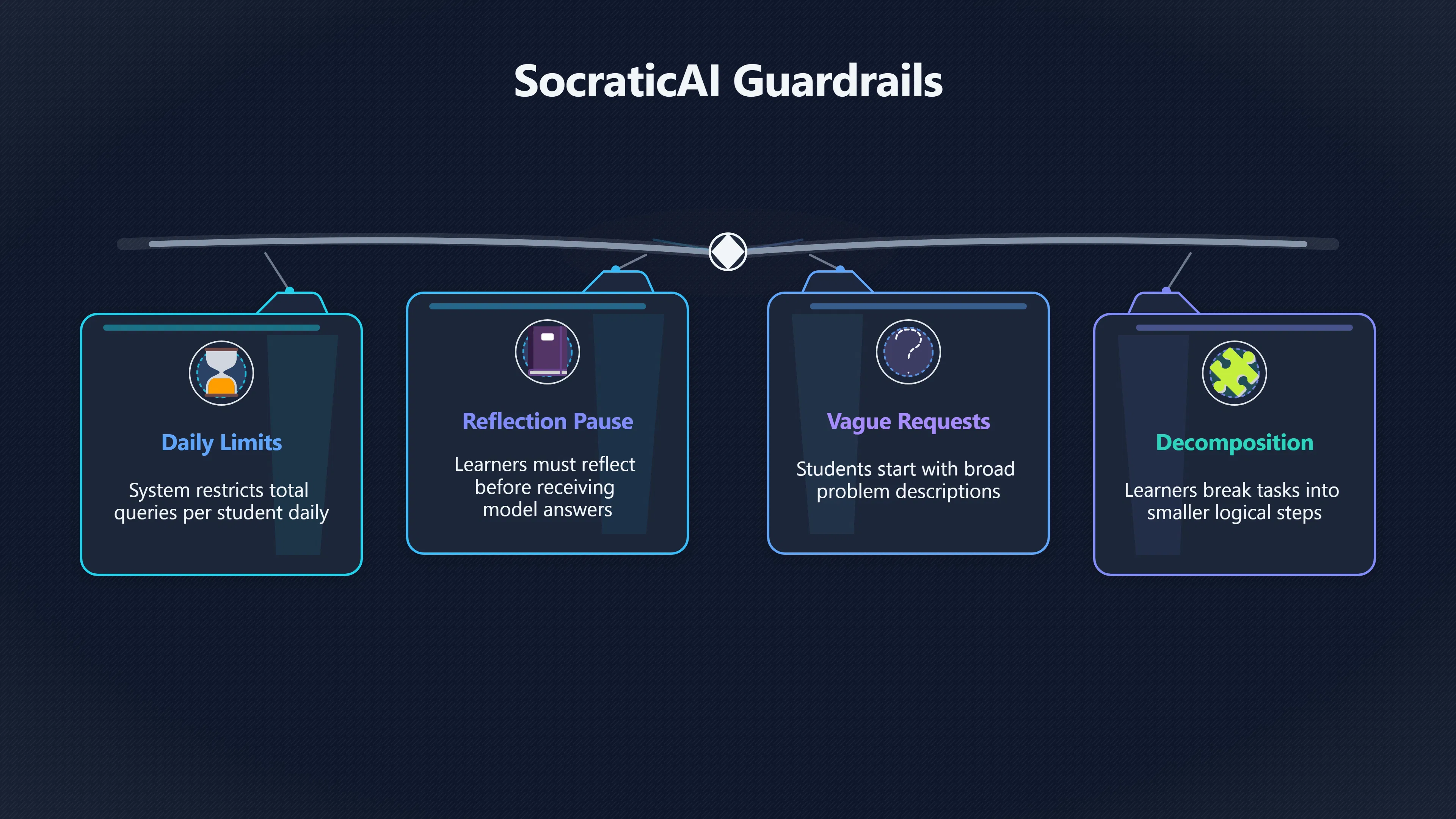
The growing literature on AI in programming education makes a clear distinction between unconstrained code generation and guided AI support. A recent system called SocraticAI illustrates this shift: rather than allowing open‑ended solution requests, it enforces structured dialogue, limits on daily queries, and requirements for students to reflect on their own thinking before the model answers. In early deployments in undergraduate computer science classes, students began with vague requests but, after a few weeks under these constraints, moved toward more sophisticated problem decomposition and self‑questioning.[ScienceStack]sciencestack.aiSocraticAI: Transforming LLMs into Guided CS Tutors Through Scaffolded Interaction (arXiv:2512.03501v1) - ScienceStackDecembe…
Another line of enquiry has emerged from participatory design with beginners. In work on SocratiCode, researchers iteratively refined an adaptive tutor for K‑12 learners by reducing directive solutions and instead embedding guided questions, reflection prompts, misconception checks, incremental hints, and enforced pauses for learner input. Participants appeared more engaged in problem‑solving as the system moved further from direct answer delivery toward dialogue resembling tutor‑student interaction.[Cool Papers]papers.coolCool PapersTowards SocratiCode: Designing a Generative AI-Based Programming Tutor for K-12 Students through a 4-Week Participatory Design…
These designs reflect a broader consensus from computational‑learning research: guardrails are not merely technical filters or policy rules but pedagogical scaffolds — structured interactions that reshape how learners use AI. Research on generative AI in computation education stresses that when AI “answers directly,” students can fall into passive use modes that bypass the mental effort central to coding skill development. Conversely, systems that intentionally avoid direct solutions, instead prompting learners to explain, hypothesise, and debug, are more aligned with active learning goals.[ScienceDirect]sciencedirect.comScienceDirectGenerative AI-enhanced learning experiences for computational thinking: A systematic scoping review and design guidelines -…
Socratic Hints, Code Tracing, and Delayed Answers
A central theme in guardrail research is the Socratic method: guiding learners through questions that prompt them to articulate reasoning and detect errors themselves. In studies comparing generative AI that uses structured questioning versus direct answer giving, learners exposed to Socratic prompts showed better engagement with problem structure and reported clearer conceptual understanding than their peers receiving unfiltered solutions.[SciLove]scilove.appWhen Generative AI Meets Socratic Method: Investigating Programming Learning Dynamics Through Behaviours, Interaction Qualities an…
This approach complements traditional cognitive techniques such as code tracing — stepping through the execution of a program to predict output and uncover bugs. Classic tutoring research has shown that scaffolding assistance at key moments in code tracing helps learners build stronger mental models. When applied to AI systems, guardrails that deliver incremental hints about code behaviour rather than whole solutions encourage the same process, helping learners practise the deduction and verification skills foundational to programming.[ScienceDirect]sciencedirect.comScienceDirectGenerative AI-enhanced learning experiences for computational thinking: A systematic scoping review and design guidelines -…
Delaying answers or providing them only after learners have articulated their own hypotheses is another key guardrail. Versions of GPT‑based math tutoring that include explicit instructions to avoid giving away the answer and instead offer step‑by‑step guided reasoning have been shown to mitigate the “crutch” effect — where students lean on the model rather than grapple with the task. Although that work focuses on mathematics, the mechanism — delaying full solutions until students exhibit engagement — is directly relevant to programming education.[PMC]pmc.ncbi.nlm.nih.govJuly 1, 2025…
How Coding Courses Could Test Real Independence
Guardrails not only change how AI responds but also how courses assess student independence. In traditional settings, code that runs correctly is often taken as evidence of understanding, but AI‑assisted learning complicates this signal. Educators are exploring assessment practices that require evidence of reasoning beyond output. For example:
- Prompt documentation: students may be required to submit not just working code but also the thought process and questions they asked the AI — a form of interaction log that shows intent and strategy rather than only the finished product.[Scale]scale.stanford.eduSource details in endnotes.
- Controlled prompt environments: AI TAs with observable guardrails can be integrated into course infrastructure so instructors can see interaction histories and ensure compliance with pedagogical constraints, rather than students resorting to unconstrained external AI sessions.[Scale]scale.stanford.eduSource details in endnotes.
- Skills checkpoints: assignments can include explanation phases, where students must step through code, identify potential edge cases or errors, and predict outputs before asking the AI for feedback, ensuring they practise foundational skills. Emerging research emphasises that such structured interaction patterns help make learning transferable rather than ephemeral.[ScienceDirect]sciencedirect.comScienceDirectGenerative AI-enhanced learning experiences for computational thinking: A systematic scoping review and design guidelines -…
Together, these approaches shift assessment from a binary correctness paradigm toward a richer picture of competence — where students must demonstrate internalisation of concepts and not just external validation by an AI engine.
Summary
Guardrails that turn ChatGPT into a coding tutor are more than safety wrappers or prompt templates — they are pedagogical frameworks that reshape the learner‑AI interaction toward reflection, hypothesis testing, and guided problem solving. Through structured questioning, delayed answers, scaffolded hints, and assessment practices that focus on deep engagement rather than output, guardrails can help avoid the false mastery trap where students produce functioning code without genuine understanding. Early research like SocraticAI and adaptive studies such as SocratiCode points toward designs that uphold educational integrity while harnessing AI’s potential to broaden access to programming knowledge. This contributes to the broader AI Bloom vision by empowering learners to build authentic capability rather than superficial performance, helping cultivate a generation of programmers who can leverage — rather than be overshadowed by — powerful AI tools.[ScienceStack]sciencestack.aiSocraticAI: Transforming LLMs into Guided CS Tutors Through Scaffolded Interaction (arXiv:2512.03501v1) - ScienceStackDecembe…
Amazon book picks
Further Reading
Books and field guides related to Can guardrails stop AI answer copying?. Use these as the next step if you want deeper reading beyond the article.
The AI Classroom
Directly addresses how AI tools can be structured to support learning.
Make It Stick
Supports the case for guardrails, retrieval practice and guided learning.
The Pragmatic Programmer
Rating: 4.5/5 from 7 Google Books ratings
Emphasises thinking, debugging and judgement rather than answer-copying.
eBay marketplace picks
Marketplace Samples
Example marketplace items related to this page. Use the search link to explore similar finds on eBay.


Endnotes
1.
Source: sciencestack.ai
Link:https://www.sciencestack.ai/paper/2512.03501
Source snippet
SocraticAI: Transforming LLMs into Guided CS Tutors Through Scaffolded Interaction (arXiv:2512.03501v1) - ScienceStackDecembe...
2.
Source: papers.cool
Link:https://papers.cool/arxiv/2605.17857
Source snippet
Cool PapersTowards SocratiCode: Designing a Generative AI-Based Programming Tutor for K-12 Students through a 4-Week Participatory Design...
3.
Source: sciencedirect.com
Link:https://www.sciencedirect.com/science/article/pii/S2666920X26000706
4.
Source: scilove.app
Link:https://www.scilove.app/article/10.1002/jcal.70210
Source snippet
When Generative AI Meets Socratic Method: Investigating Programming Learning Dynamics Through Behaviours, Interaction Qualities an...
5.
Source: sciencedirect.com
Link:https://www.sciencedirect.com/science/article/pii/S1560429226001861
Source snippet
When Does Scaffolding Provide Too Much Assistance? A Code-Tracing Tutor Investigation - ScienceDirect...
6.
Source: pmc.ncbi.nlm.nih.gov
Link:https://pmc.ncbi.nlm.nih.gov/articles/PMC12232635/
Source snippet
July 1, 2025...
Published: July 1, 2025
7.
Source: papers.cool
Title: Do Agent Rules Shape or Distort?
Link:https://papers.cool/arxiv/2604.11088
Source snippet
Guardrails Beat Guidance in Coding Agents | Cool Papers - Immersive Paper DiscoveryApril 13, 2026 — 2604.11088 Total: 1 #1 DO AGENT RULES...
Published: April 13, 2026
8.
Source: papers.cool
Title: S. Santos, Marcos Zampieri
Link:https://papers.cool/arxiv/2602.02509
Source snippet
CodeGuard: Improving LLM Guardrails in CS Education | Cool Papers - Immersive Paper DiscoveryJanuary 22, 2026 — 2602.02509 Total: 1 #1 CO...
Published: January 22, 2026
9.
Source: sciencedirect.com
Link:https://www.sciencedirect.com/science/article/pii/S2666920X24001127
Source snippet
Enhancing python learning with PyTutor: Efficacy of a ChatGPT-Based intelligent tutoring system in programming education - ScienceDirectC...
10.
Source: sciencedirect.com
Link:https://www.sciencedirect.com/science/article/pii/S1877050921024984
Source snippet
PROCEDIA COMPUTER SCIENCE Volume 198, 2022, Pages 391-396 COMPARATIVE STUDY BETWEEN AUTOMATIC HINT GENERATION APPROACHES IN...
11.
Source: scale.stanford.edu
Link:https://scale.stanford.edu/genai/repository/exploring-student-behaviors-and-motivations-when-using-ai-teaching-assistants
12.
Source: scale.stanford.edu
Link:https://scale.stanford.edu/ai/repository/automating-human-tutor-style-programming-feedback-leveraging-gpt-4-tutor-model-hint
Source snippet
[Human Tutor]({{ 'human-role/' | relative_url }})-Style Programming Feedback: Leveraging GPT-4 Tutor Model for Hint Generation and GPT-3.5 Student Model for Hint Validation |...
Additional References
13.
Source: mdpi.com
Link:https://www.mdpi.com/2227-7102/14/2/120
Source snippet
Artificial [Intelligence]({{ 'intelligence/' | relative_url }}) Supporting Independent Student Learning: An Evaluative Case Study of ChatGPT and Learning to Code | MDPIJanuary 2...
14.
Source: [discovery]({{ ‘discovery/’ | relative_url }}). ucl.ac.uk
Link:https://discovery.ucl.ac.uk/id/eprint/10198256/
Source snippet
Empirical Study of the Non-determinism of ChatGPT in Code Generation - UCL DiscoveryAN EMPIRICAL STUDY OF THE NON-DETERMINISM OF CHATGPT...
15.
Source: mdpi.com
Title: Beyond Answers: Pedagogical Design Rationale for Multi-Persona AI Tutors
Link:https://www.mdpi.com/2571-5577/9/1/17
Source snippet
BACKGROUND AND RELATED WORK 2.1. ONE-TO-ONE TUTORING AND ITS IMPLICATIONS FOR AI AGENTS Classic work on tutoring foregrounds the potentia...
16.
Source: scholars.iwu.edu
Title: codehelp using large language models with guardrails for scalable 2
Link:https://scholars.iwu.edu/en/publications/codehelp-using-large-language-models-with-guardrails-for-scalable-2
Source snippet
iwu.eduCodeHelp: Using Large Language Models with Guardrails for Scalable Support in Programming Classes - Illinois Wesleyan UniversityNo...
18.
Source: researchtrend.ai
Title: Do Agent Rules Shape or Distort?
Link:https://researchtrend.ai/papers/2604.11088
Source snippet
Guardrails Beat Guidance in Coding Agents | ResearchTrend.AIApril 13, 2026 — DO AGENT RULES SHAPE OR DISTORT? GUARDRAILS BEAT GUIDANCE IN...
Published: April 13, 2026
19.
Source: link.springer.com
Link:https://link.springer.com/article/10.1007/s11528-024-00939-0
Source snippet
Educational Affordances and Challenges of ChatGPT: State of the Field | TechTrends | Springer Nature LinkFebruary 17, 2024 — THE EDUCATIO...
Published: February 17, 2024
20.
Source: link.springer.com
Link:https://link.springer.com/article/10.1007/s44163-024-00203-7
Source snippet
chatbots in programming education: guiding success or encouraging plagiarism | Discover Artificial Intelligence | Springer Nature LinkNov...
21.
Source: journals.sagepub.com
Link:https://journals.sagepub.com/doi/abs/10.1177/07356331241240460
Source snippet
Artificial Intelligence-Human Paired Programming: A Review of the Educational Applications and Research on Artificial Intelligence Code-G...
22.
Source: youtube.com
Title: This AI Taught Me Calculus in 5 Minutes
Link:https://www.youtube.com/watch?v=Erxh0dx4nts
Source snippet
Build Your Own ChatGPT: Input and Output Guardrails | Advanced RAG Series #6...
Topic Tree