Within AI Benefits
Will AI Pull Up the Career Ladder?
AI may raise productivity while weakening entry-level routes into skilled work, making the transition feel unfair even if total wealth grows.
On this page
- Which jobs are most exposed
- Why entry level roles may change first
- Policies for fair labour transitions
Page outline Jump by section
Introduction
AI could eventually make societies far richer. If advanced systems help automate routine work, accelerate science, improve healthcare, and raise productivity across entire industries, the long-run gains could be enormous. But one of the sharpest concerns in the transition period is not simply whether jobs disappear. It is whether the normal routes into skilled careers begin to break down.
 Many professions depend on a ladder structure. New workers start with simpler tasks, learn through supervised practice, and gradually take on more responsibility. Generative AI often performs exactly those simpler tasks first: drafting documents, writing basic code, producing reports, handling customer queries, summarising research, or processing administrative work. If firms automate too much of this layer, they may save money today while weakening the pipeline that produces experienced professionals tomorrow. The result could be an economy that becomes more productive overall while leaving many younger workers struggling to gain experience, credentials, and stable career footholds.[OECD]oecd.orgwho will be the workers most affected by ai 14dc6f89 enWho will be the workers most affected by AI?by M Lane · 2024 · Cited by 23 — As AI can automate non-routine, cognitive tasks, tertiar…[OECD]oecd.orgArtificial intelligence and jobs: No signs of slowing labour…Jul 11, 2023 — High-skilled, white‑collar occupations have been most…
This matters directly to the broader question of AI abundance. A future of widespread prosperity depends not only on technological capability but on whether people can still participate meaningfully in economic life, build expertise, and share in the gains.
Which Jobs Are Most Exposed?
Much public discussion about automation still focuses on factory work or low-skill routine labour. Recent AI systems have changed that picture.
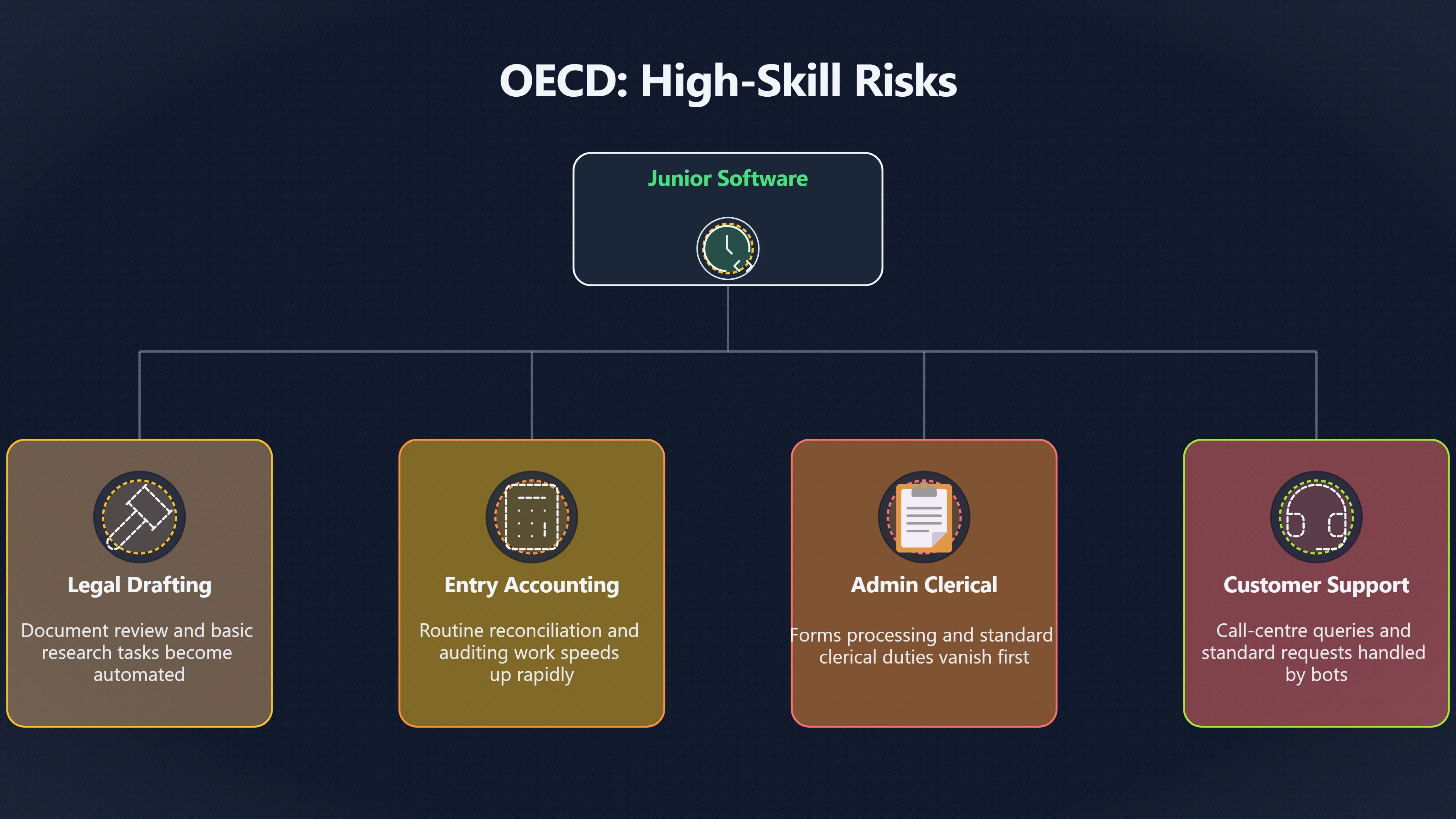
Research from the OECD finds that occupations most exposed to current AI advances are often high-skill white-collar roles rather than traditional manual jobs. Business professionals, managers, engineers, scientists, analysts, programmers, administrative staff, and other knowledge workers increasingly perform tasks that large language models can assist with or partially automate.[OECD]oecd.orgthe impact of artificial intelligence on the labour market a4b9cac2The impact of Artificial Intelligence on the labour marketby M Lane · 2021 · Cited by 354 — This literature review takes stock of what is…
The important distinction is that AI often targets tasks rather than whole occupations. A lawyer’s job may survive even if document review becomes heavily automated. An accountant may remain valuable even if routine reconciliation becomes faster. But when enough entry-level tasks disappear, the structure of the profession can still change dramatically.
Several categories appear especially exposed:
- Junior software development and testing.[tomshardware.com]tomshardware.comOver the past three years, job listings in these AI-susceptible fields have dropped by 13%, especially affecting workers aged 22-25. Cond…
- Basic legal research and document drafting. * Entry-level accounting and auditing work.[tomshardware.com]tomshardware.comOver the past three years, job listings in these AI-susceptible fields have dropped by 13%, especially affecting workers aged 22-25. Cond… * Administrative and clerical roles.[tomshardware.com]tomshardware.comOver the past three years, job listings in these AI-susceptible fields have dropped by 13%, especially affecting workers aged 22-25. Cond…
- Customer support and call-centre work.
- Content production, translation, and routine marketing tasks.
- Research assistance and information synthesis roles. Anthropic[investopedia]investopedia.comAnthropic Identifies the Jobs Most Exposed to AI Risks—Is…10 Mar 2026 — Computer programmers, customer service representatives and dat… The Anthropic Economic Index, which studies real-world AI usage patterns, finds particularly heavy adoption in software development, writing, analysis, and information-processing tasks. These are precisely the kinds of activities that often serve as training grounds for younger workers.[Anthropic]anthropic.comLabor market impacts of AI: A new measure and early…by T Claude — A job's exposure is higher if: Its tasks are theoretically…[Anthropic]anthropic.comeconomic indexAnthropic Economic Index Understanding AI's effects…24 Mar 2026 — The Anthropic Economic Index reveals the shape of AI adoption across…
This does not necessarily mean entire professions disappear. It does mean the first rung of the ladder may become narrower.
Why Entry-Level Roles May Change First
The reason entry-level work is vulnerable is not mysterious. Junior workers are often hired to perform tasks that are structured, repetitive, heavily supervised, and relatively low-risk. Those same characteristics make them attractive targets for automation.
In many firms, graduates spend their first years:
- Producing draft materials.
- Summarising documents.
- Conducting background research.
- Writing routine code.
- Preparing presentations.
- Processing forms and records.
- Handling standard customer requests.
These are exactly the areas where modern AI systems have shown rapid capability gains.[Anthropic]anthropic.comeconomic index march 2026 reportAnthropic Economic Index report: Learning curves24 Mar 2026 — The Anthropic Economic Index uses our privacy-preserving data analysis syst…
Historically, organisations accepted the cost of training because today’s junior worker became tomorrow’s senior professional. The concern is that AI changes this calculation. If one experienced worker equipped with powerful AI tools can perform work that previously required several junior employees, firms may reduce graduate hiring without immediately damaging output.
Emerging evidence suggests this may already be occurring in some sectors. Research drawing on payroll, employment, and vacancy data has found declines in hiring for younger workers in AI-exposed occupations, driven more by reduced recruitment than by mass layoffs. Some studies estimate employment reductions of between 6% and 16% among workers aged roughly 22 to 25 in highly exposed occupations. Yahoo Finance[Tom's Hardware]tomshardware.comOver the past three years, job listings in these AI-susceptible fields have dropped by 13%, especially affecting workers aged 22-25. Cond…
Other evidence remains more cautious. Some researchers argue that remote work, post-pandemic hiring corrections, and broader economic conditions explain part of the decline in junior hiring. The labour-market effects of AI remain difficult to isolate cleanly.[Business Insider]businessinsider.comResearchers Peter John Lambert and Yannick Schindler analyzed extensive résumé and job posting data across the US, UK, Canada, and Austra…
The uncertainty is important. The evidence does not yet show a civilisation-wide collapse of entry-level employment. It does show enough warning signs that policymakers and employers are increasingly discussing the issue.
The Hidden Problem: Expertise Comes From Practice
The deeper concern is not merely unemployment. It is expertise formation.
Many professions rely on apprenticeship-like learning structures. Junior lawyers learn by reviewing contracts. Junior doctors learn through supervised clinical work. Junior journalists learn by reporting smaller stories. Junior programmers learn by fixing bugs, writing simple features, and reviewing existing code.
The early work is often repetitive, but it serves an educational purpose.
If AI performs much of this foundational work, future professionals may accumulate less practical experience before reaching positions that require judgment. A firm may become more productive in the short term while creating a shortage of experienced talent later.
This creates a potential paradox. AI may increase the productivity of senior workers while reducing opportunities for people to become senior workers in the first place.
Economists sometimes describe this as a pipeline problem. The labour market does not simply allocate workers; it develops them. Career ladders are part of society’s knowledge-production system.
The issue is especially significant in sectors that depend on tacit knowledge: skills that are difficult to learn from textbooks alone and instead emerge through repeated exposure to real-world cases, mistakes, and mentorship.
Why Labour Disruption Can Feel Unfair Even If Society Gets Richer
One reason AI labour disruption generates political tension is that aggregate prosperity and individual opportunity are not the same thing.
Imagine a future where AI raises national productivity dramatically. Goods become cheaper. Medical treatments improve. Scientific progress accelerates. Average living standards rise.
Yet a graduate entering the workforce may still face a much harder path than earlier generations.
This creates a distributional problem that standard economic statistics may miss.
A society can become wealthier while simultaneously producing:
- Fewer routes into professional careers.
- Greater dependence on inherited wealth.
- Stronger advantages for already-established workers.
- Higher barriers to gaining experience.
- Larger gaps between AI owners and non-owners.
The result may feel unfair even if total output rises.
This concern echoes broader debates in economic history. Industrialisation increased overall wealth enormously, but the benefits did not automatically arrive in a smooth or equal way. Institutions, labour protections, education systems, and social insurance played major roles in spreading gains across society.
The AI transition may require similar institutional adaptation.
Could AI Also Create New Career Ladders?
The pessimistic scenario is not the only possibility.
Historically, technological change has often destroyed some jobs while creating entirely new professions. Few people in 1990 could have predicted social-media managers, cloud architects, app developers, prompt engineers, machine-learning operations specialists, or AI safety researchers.
Some evidence already suggests new categories of work emerging around AI deployment, integration, oversight, evaluation, and workflow design. Companies increasingly seek employees who can redesign business processes around AI systems rather than merely perform individual tasks.[Business Insider]businessinsider.comResearchers Peter John Lambert and Yannick Schindler analyzed extensive résumé and job posting data across the US, UK, Canada, and Austra…
The key question is whether these new ladders are wide enough.
A healthy labour market does not just create elite opportunities for a small technical class. It creates large numbers of accessible pathways through which ordinary people can build skills and advance.
The optimistic view is that AI becomes a tool that accelerates learning. Junior workers may accomplish more quickly, receive better feedback, and gain access to expertise that was previously unavailable.
Some experimental studies suggest AI can particularly boost the performance of less experienced workers on certain tasks, potentially narrowing skill gaps.[arXiv]arxiv.orgarXiv AI and jobs. A review of theory, estimates, and evidencearXiv AI and jobs. A review of theory, estimates, and evidence
The risk is that firms use AI primarily to reduce headcount rather than expand capability. The same technology can support either outcome depending on incentives and policy.
What Happens If Career Ladders Break?
If entry routes shrink substantially across multiple professions, the effects could extend beyond individual workers.
Slower social mobility
Career ladders are one of the main mechanisms through which people improve their economic position.
When entry-level opportunities contract, advancement may depend more heavily on family wealth, personal networks, prestigious credentials, or existing social advantages.
The result could be lower social mobility even in a technologically advanced economy.
Concentration of expertise
Large organisations may increasingly rely on smaller numbers of highly productive senior workers supported by AI systems.
This could raise the value of elite expertise while reducing opportunities for newcomers to acquire it.
Political backlash against AI
Public support for technological progress often depends on whether people believe they have a place within the new economy.
If large numbers of younger workers perceive AI as removing opportunities rather than expanding them, political resistance to AI deployment could intensify even if aggregate economic indicators remain positive.
Weakening long-term capability
Civilisations need mechanisms for producing future experts.
Engineers, scientists, doctors, managers, and researchers are not created instantly. If training pipelines weaken for long enough, societies may discover years later that they have underinvested in human expertise.
This is one reason the issue matters even within an optimistic AI bloom framework. A flourishing future requires both powerful machines and a continual supply of capable humans.

Policies for Fair Labour Transitions
The policy challenge is not simply preventing automation. It is ensuring that productivity gains do not sever pathways into meaningful work.
Several approaches are receiving growing attention.
Incentivising training rather than replacement
Governments have long subsidised apprenticeships, vocational training, and graduate development programmes.
Similar policies could encourage firms to use AI as a teaching tool rather than a substitute for junior hiring.
Tax incentives, training grants, or public procurement requirements could reward organisations that maintain strong early-career pipelines while adopting AI.
Expanding access to AI-enhanced education
If AI becomes a powerful tutor, mentor, and learning assistant, it could help workers acquire skills faster and more cheaply.
The distributional question is whether these tools remain expensive premium services or become widely accessible educational infrastructure.
This links directly to broader debates about public-interest AI and universal access to advanced systems.
Supporting mid-career adaptation
Labour disruption will not affect only new graduates.
Workers whose roles become partially automated may need retraining, career counselling, wage insurance, or transition support.
The goal is not to freeze existing jobs but to reduce the human cost of economic adjustment.
Measuring career pathways, not only employment
Many labour statistics focus on unemployment rates.
That may miss an important signal.
If AI mainly reduces hiring rather than causing mass layoffs, unemployment figures can remain relatively stable while career ladders quietly weaken. Researchers increasingly argue that hiring patterns, promotion pathways, and early-career opportunities deserve closer attention.[Yahoo Finance]finance.yahoo.comanthropic ai influence over labor 110500564Yahoo FinanceAnthropic: AI's influence over the labor market is only…13 Mar 2026 — Citing a 2025 study from Brynjolfsson et al., Anthr… 2arXiv
Broadening ownership of AI gains
If AI dramatically increases productivity, some of the resulting wealth may need to flow back into education, training, public services, and transition support.
The question is not only how much wealth AI creates, but who has the resources to adapt when labour markets change.
The Larger Question for an AI-Abundant Future
The debate over AI labour disruption is sometimes framed as a simple contest between jobs and automation. That framing misses the deeper issue.
The central question is whether advanced AI helps expand human opportunity or narrows it.
A future of AI abundance could mean shorter working hours, safer jobs, better education, higher living standards, and greater freedom to pursue creative, scientific, and social goals. But reaching that future depends on maintaining pathways through which people develop skills, contribute meaningfully, and share in the gains.
If AI removes drudgery while helping more people become capable, educated, and productive, it could strengthen the foundations of human flourishing. If it concentrates opportunity among a small group while eroding routes into skilled work, the transition may become economically and politically unstable.
The state of the career ladder may therefore become one of the most important tests of whether AI-driven prosperity is genuinely broad-based. The question is not merely how many jobs survive, but whether the next generation still has a way to climb.
Amazon book picks
Further Reading
Books and field guides related to Will AI Pull Up the Career Ladder?. Use these as the next step if you want deeper reading beyond the article.
The Second Machine Age
Explains how digital technologies reshape work and career pathways.
Power and Progress
Directly addresses whether technological progress benefits workers broadly.
The Future of the Professions
Relevant to entry-level professional tasks being automated first.
eBay marketplace picks
Marketplace Samples
Example marketplace items related to this page. Use the search link to explore similar finds on eBay.



Endnotes
1.
Source: oecd.org
Title: who will be the workers most affected by ai 14dc6f89 en
Link:https://www.oecd.org/en/publications/who-will-be-the-workers-most-affected-by-ai_14dc6f89-en.html
Source snippet
Who will be the workers most affected by AI?by M Lane · 2024 · Cited by 23 — As AI can automate non-routine, cognitive tasks, tertiar...
2.
Source: oecd.org
Link:https://www.oecd.org/en/publications/oecd-employment-outlook-2023_08785bba-en/full-report/artificial-[intelligence
Source snippet
Artificial intelligence and jobs: No signs of slowing labour...Jul 11, 2023 — High-skilled, white‑collar occupations have been most...
3.
Source: oecd.org
Title: the impact of artificial intelligence on the labour market a4b9cac2
Link:https://www.oecd.org/en/publications/2021/01/the-impact-of-artificial-intelligence-on-the-labour-market_a4b9cac2.html
Source snippet
The impact of Artificial Intelligence on the labour marketby M Lane · 2021 · Cited by 354 — This literature review takes stock of what is...
4.
Source: anthropic.com
Link:https://www.anthropic.com/research/labor-market-impacts
Source snippet
Labor market impacts of AI: A new measure and early...by T Claude — A job's exposure is higher if: Its tasks are theoretically...
5.
Source: investopedia.com
Link:https://www.investopedia.com/anthropic-identifies-jobs-most-exposed-to-ai-risks-is-your-occupation-affected-11922109
Source snippet
Anthropic Identifies the Jobs Most Exposed to AI Risks—Is...10 Mar 2026 — Computer programmers, customer service representatives and dat...
6.
Source: anthropic.com
Title: economic index
Link:https://www.anthropic.com/economic-index
Source snippet
Anthropic Economic Index Understanding AI's effects...24 Mar 2026 — The Anthropic Economic Index reveals the shape of AI adoption across...
7.
Source: anthropic.com
Title: economic index march 2026 report
Link:https://www.anthropic.com/research/economic-index-march-2026-report
Source snippet
Anthropic Economic Index report: Learning curves24 Mar 2026 — The Anthropic Economic Index uses our privacy-preserving data analysis syst...
Published: march 2026
8.
Source: finance.yahoo.com
Title: anthropic ai influence over labor 110500564
Link:https://finance.yahoo.com/news/anthropic-ai-influence-over-labor-110500564.html
Source snippet
Yahoo FinanceAnthropic: AI's influence over the labor market is only...13 Mar 2026 — Citing a 2025 study from Brynjolfsson et al., Anthr...
9.
Source: arxiv.org
Title: arXiv AI and jobs. A review of theory, estimates, and evidence
Link:https://arxiv.org/abs/2509.15265
10.
Source: arxiv.org
Link:https://arxiv.org/abs/2605.00843
11.
Source: arxiv.org
Link:https://arxiv.org/abs/2601.06087
12.
Source: arxiv.org
Link:https://arxiv.org/abs/2507.22748
13.
Source: oecd.org
Link:https://www.oecd.org/en/topics/policy-issues/future-of-work.html
Source snippet
Future of workAI can bring many benefits to the workplace such as higher productivity, improved job quality and stronger occupational saf...
14.
Source: oecd.org
Link:https://www.oecd.org/en.html
Source snippet
The Organisation for Economic Co-operation and...The OECD designs international standards and guidelines for development co-operat...
15.
Source: oecd.org
Title: 194a947b en
Link:https://www.oecd.org/content/dam/oecd/en/publications/reports/2025/07/oecd-employment-outlook-2025_5345f034/194a947b-en.pdf
Source snippet
OECD Employment Outlook 2025The 2025 edition of the OECD Employment Outlook examines the challenges that population ageing poses to curre...
16.
Source: oecd.org
Title: the impact of ai on the labour market 69793977
Link:https://www.oecd.org/en/publications/artificial-intelligence-and-the-labour-market-in-korea_68ab1a5a-en/full-report/the-impact-of-ai-on-the-labour-market_69793977.html
Source snippet
Artificial Intelligence and the Labour Market in Korea27 Oct 2025 — This report analyses the impact of AI on Korea's labour market from a...
17.
Source: oecd.org
Link:https://www.oecd.org/en/topics/sub-issues/ai-and-work.html
Source snippet
AI and workThe OECD's research on the impact of AI on the labour market show the urgent need to act now, with policies that allow countri...
18.
Source: anthropic.com
Title: economic index primitives
Link:https://www.anthropic.com/research/economic-index-primitives
Source snippet
New building blocks for understanding AI use15 Jan 2026 — Anthropic is an AI safety and research company that's working to build reliable...
19.
Source: oecd.ai
Link:https://oecd.ai/en/incidents/2025
Source snippet
AI-driven automation fuels spike in IT unemploymentAI-powered automation has driven IT unemployment from 3.9% to 5.7% (98000 to 152000 wo...
20.
Source: oecd.ai
Link:https://oecd.ai/en/incidents/2025-07-29-10f4
Source snippet
AI Automation Shrinks Entry-Level Job Market for US...29 Jul 2025 — The article clearly identifies AI as a factor disrupting the labor m...
21.
Source: oecd.ai
Link:https://oecd.ai/en/incidents/2026
Source snippet
AI Automation Threatens Entry-Level Job Market for Gen Z...The article involves AI systems in the context of their use and impact on the...
22.
Source: finance.yahoo.com
Link:https://finance.yahoo.com/news/anthropic-just-mapped-jobs-ai-163800195.html
Source snippet
just mapped out which jobs AI could potentially...7 Mar 2026 — Computer programmers, customer service reps, and data entry keyers are th...
23.
Source: creators.yahoo.com
Link:https://creators.yahoo.com/lifestyle/story/these-jobs-are-the-most-affected-by-ai-according-to-new-anthropic-report-135528912.html
Source snippet
jobs are the most affected by AI, according to new...9 Mar 2026 — A new “AI exposure index” from Anthropic compares real-world AI usage...
24.
Source: tomshardware.com
Link:https://www.tomshardware.com/tech-industry/artificial-intelligence/ai-is-eating-entry-level-coding-and-customer-service-roles-according-to-a-new-stanford-study-junior-job-listings-drop-13-percent-in-three-years-in-fields-vulnerable-to-ai
Source snippet
Over the past three years, job listings in these AI-susceptible fields have dropped by 13%, especially affecting workers aged 22-25. Cond...
25.
Source: businessinsider.com
Link:https://www.businessinsider.com/wfh-bigger-driver-entry-level-job-woes-ai-researchers-say
Source snippet
Researchers Peter John Lambert and Yannick Schindler analyzed extensive résumé and job posting data across the US, UK, Canada, and Austra...
26.
Source: businessinsider.com
Link:https://www.businessinsider.com/stanford-lecturer-hot-ai-job-grad-workflows-entry-level
Source snippet
Unlike traditional Biz Ops roles, AI workflows positions focus on identifying and automating organizational processes using artificial in...
27.
Source: Wikipedia
Link:https://en.wikipedia.org/wiki/Anthropic
Source snippet
AnthropicAnthropic is an American artificial intelligence (AI) company headquartered in San Francisco. It has developed a series of la...
28.
Source: linkedin.com
Link:https://www.linkedin.com/posts/jawadabdulsamad_anthropics-ceo-said-that-50-of-entry-level-activity-7451551398325972992-s949
29.
Source: medium.com
Title: anthropic looked at whether ai is killing jobs 759fbc0563f1
Link:https://medium.com/illumination/anthropic-looked-at-whether-ai-is-killing-jobs-759fbc0563f1
Source snippet
Anthropic Looked at Whether AI Is Killing Jobs.Brynjolfsson et al. (2025), a separate study using payroll data from ADP, found a 6–16% fa...
30.
Source: ivopbernardo.medium.com
Title: anthropics view on ai impact in the job market cc14915e1268
Link:https://ivopbernardo.medium.com/anthropics-view-on-ai-impact-in-the-job-market-cc14915e1268
Source snippet
medium.comAnthropics' View on AI Impact in the Job Market - Ivo BernardoAnthropic's report echoes these findings using a different data s...
31.
Source: hdsr.mitpress.mit.edu
Link:https://hdsr.mitpress.mit.edu/pub/ppjz2dg9
Source snippet
Anthropic CEO: Half of all entry-level white-collar jobs could go away within 5 years. Axios. [https://www.axios.com/2025/05...Read](https://www.axios.com/2025/05...Read) more...
32.
Source: edtechinnovationhub.com
Link:https://www.edtechinnovationhub.com/news/anthropic-data-shows-ai-boosts-complex-work-fastest-with-uneven-impact-across-jobs-and-countries
Source snippet
Anthropic Economic Index shows AI boosts complex work...19 Jan 2026 — New findings from Anthropic's Economic Index suggest AI is acceler...
33.
Source: m.economictimes.com
Link:https://m.economictimes.com/nri/work/is-your-job-on-the-ai-firing-line-anthropic-lists-roles-most-under-threat/articleshow/129192049.cms
Source snippet
Anthropic lists roles most...7 Mar 2026 — AI job losses: New research introduces "observed exposure" to measure AI's impact on jobs, fin...
34.
Source: businessinsider.com
Title: anthropic is tracking the jobs most exposed to ai disruption 2026 3
Link:https://www.businessinsider.com/anthropic-is-tracking-the-jobs-most-exposed-to-ai-disruption
Source snippet
Anthropic Is Tracking the Jobs Most Exposed to AI Disruption6 Mar 2026 — Anthropic economists say there's not yet evidence to suggest AI...
35.
Source: zenvanriel.com
Title: anthropic economic index ai workforce impact data
Link:https://zenvanriel.com/ai-engineer-blog/anthropic-economic-index-ai-workforce-impact-data/
Source snippet
Anthropic Economic Index Reveals How AI Reshapes Work15 Jan 2026 — New Anthropic data from 2 million AI conversations shows complex tasks...
36.
Source: pooya.blog
Title: Will AI Take Your Job?
Link:https://pooya.blog/blog/anthropic-ai-labor-market-impacts/
Source snippet
Anthropic's 2026 Data Says No7 Mar 2026 — (2025) found a 6 to 16% fall in employment for young workers in AI-exposed fields.... The Anth...
37.
Source: cbsnews.com
Title: Anthropic is tracking which jobs are most exposed to AI
Link:https://www.cbsnews.com/news/anthropic-ai-jobs-most-exposed-risk/
Source snippet
9 Mar 2026 — To determine a job's exposure, Anthropic compared AI's ability to perform specific tasks with how common those tasks are acr...
Additional References
38.
Source: researchgate.net
Link:https://www.researchgate.net/publication/360515390_AI_automation_and_the_Future_of_WorkThe_EU_digital_strategy_job_polarisation_and_skill-_biased_technological_change
Source snippet
(PDF) AI, automation and the Future of Work:The EU digital...11 May 2022 — According to OECD estimates, 14% of jobs are currently at ris...
Published: May 2022
39.
Source: linkedin.com
Link:https://www.linkedin.com/posts/noamsp_ai-could-eliminate-about-50-of-entry-level-activity-7452340854129815552-1n0H
Source snippet
AI to Eliminate 50% of Entry-Level White-Collar Jobs in 1-5...AI could eliminate about 50% of entry-level white-collar jobs within 1-5 y...
40.
Source: linkedin.com
Link:https://www.linkedin.com/posts/jonkrohn_superdatascience-ai-automation-activity-7387517960908632064-_rVc
41.
Source: facebook.com
Link:https://www.facebook.com/theOECD/posts/which-workers-will-be-most-affected-by-ai-our-report-takes-a-closer-look-at-the-/1200799698759136/
Source snippet
Which workers will be most affected by #AI? Our report...Globally, 1 in 4 jobs could be disrupted by #GenerativeAI - but the larger risk...
42.
Source: linkedin.com
Link:https://www.linkedin.com/posts/organisation-eco-cooperation-development-organisation-cooperation-developpement-eco_oecd-employment-outlook-2025-activity-7348706600485892096-YgpD
Source snippet
OECD Employment Outlook 2025 | OECD - OCDE✓ Key Takeaways Jobs strong, but cooling: OECD unemployment stood at 4.9% in May 2025; the empl...
Published: May 2025
43.
Source: facebook.com
Title: ai is rapidly reshaping the job market and the first roles disappearing are entr
Link:https://www.facebook.com/deutschewellenews/posts/ai-is-rapidly-reshaping-the-job-market-and-the-first-roles-disappearing-are-entr/1381962990625678/
Source snippet
AI is rapidly reshaping the job market and the first roles...Entry-level job postings have collapsed by 35% since the start of 2023, and...
44.
Source: youtube.com
Link:https://www.youtube.com/watch?v=iMmo_cZFovE
Source snippet
AI could take more than 1/4 of jobs warns OECDMore than a quarter of jobs in OECD countries rely on skills that could be easily automated...
45.
Source: digital-skills-jobs.europa.eu
Title: oecd employment outlook 2025 can we get through demographic crunch
Link:https://digital-skills-jobs.europa.eu/en/latest/news/oecd-employment-outlook-2025-can-we-get-through-demographic-crunch
Source snippet
Employment Outlook 2025: can we get through the...26 Sept 2025 — The “OECD Employment Outlook 2025” explores how shifting demographics...
46.
Source: linkedin.com
Link:https://www.linkedin.com/posts/conorgrennan_two-hours-ago-anthropic-released-an-ai-exposure-activity-7435468941248049152-d7eT
Source snippet
AI Exposure Index: Jobs Most Vulnerable to AutomationThe clearest early signal: hiring of workers aged 22-25 has slowed in the most AI-ex...
47.
Source: digitalplanet.tufts.edu
Title: ai and the emerging geography of american job risk page
Link:https://digitalplanet.tufts.edu/ai-and-the-emerging-geography-of-american-job-risk-page/
Source snippet
Digital PlanetOn one end, Dario Amodei, CEO of Anthropic, predicted in May 2025 that AI could eliminate half of all entry-level white-col...
Published: May 2025
Topic Tree