Within Resilience
Why Accurate AI Forecasts Still Fail to Prevent Crises
Better prediction does not guarantee action when institutions are fragmented or political incentives resist prevention.
On this page
- What Anticipatory Governance Means
- Political Bottlenecks After Early Warnings
- Designing Institutions That Act Faster
Page outline Jump by section
Introduction
Even the most accurate forecasts of pandemics, climate impacts or geopolitical stress do little to change real‑world outcomes unless political systems act on them. This gap between knowing and doing is a central challenge in anticipatory governance — the idea that societies should systematically use foresight and prediction to make decisions before crises become disasters. Anticipatory governance aims to embed foresight into policy and institutional routines so that early warnings lead to prevention, resilience and effective action. Yet in practice political incentives, institutional design and short‑term pressures often frustrate this ideal, meaning that improved forecasting alone rarely translates into preventive action. Understanding these political bottlenecks is vital for civilisational resilience — whether against pandemics, climate shocks, war or other systemic risks — and for realising the larger promise that more intelligent, future‑oriented governance can steer humanity toward flourishing rather than catastrophe.[OECD]oecd.orgcomponent 13Anticipatory innovation: Tackling Policy Challenges Through Public Sector Innovation | OECDNovember 23, 2022…

What Anticipatory Governance Means
At its core, anticipatory governance refers to governance systems that systematically incorporate foresight, prediction and planning into decision‑making processes to manage uncertain future developments before they escalate into full crises. Rather than responding reactively to shocks, an anticipatory approach seeks to:
- Build foresight capabilities (horizon scanning, scenario planning, early warning systems).
- Integrate insights across institutions and sectors so that information flows to decision‑makers with authority and capacity to act.
- Embed feedback loops where evidence from past decisions shapes future anticipatory efforts and policy design.
- Engage diverse stakeholders so that futures thinking is not isolated in expert silos but shapes public dialogue and priorities.[Wikipedia]WikipediaAnticipatory governanceAnticipatory governance
In principle, this kind of governance could help societies make decisions that reduce risk rather than merely mitigate harm after crises unfold. In the context of civilisational resilience, anticipatory governance connects improved forecasting — whether of disease outbreaks, climate extremes or conflict — with stronger institutional responses, ideally preventing worst‑case scenarios rather than scrambling to manage them.[Wikipedia]WikipediaAnticipatory governanceAnticipatory governance
Political Bottlenecks After Early Warnings
Accurate forecasts — even if distributed widely — do not automatically trigger political action. Research across early warning systems and governance studies identifies several recurrent political failures that break the chain from prediction to prevention.
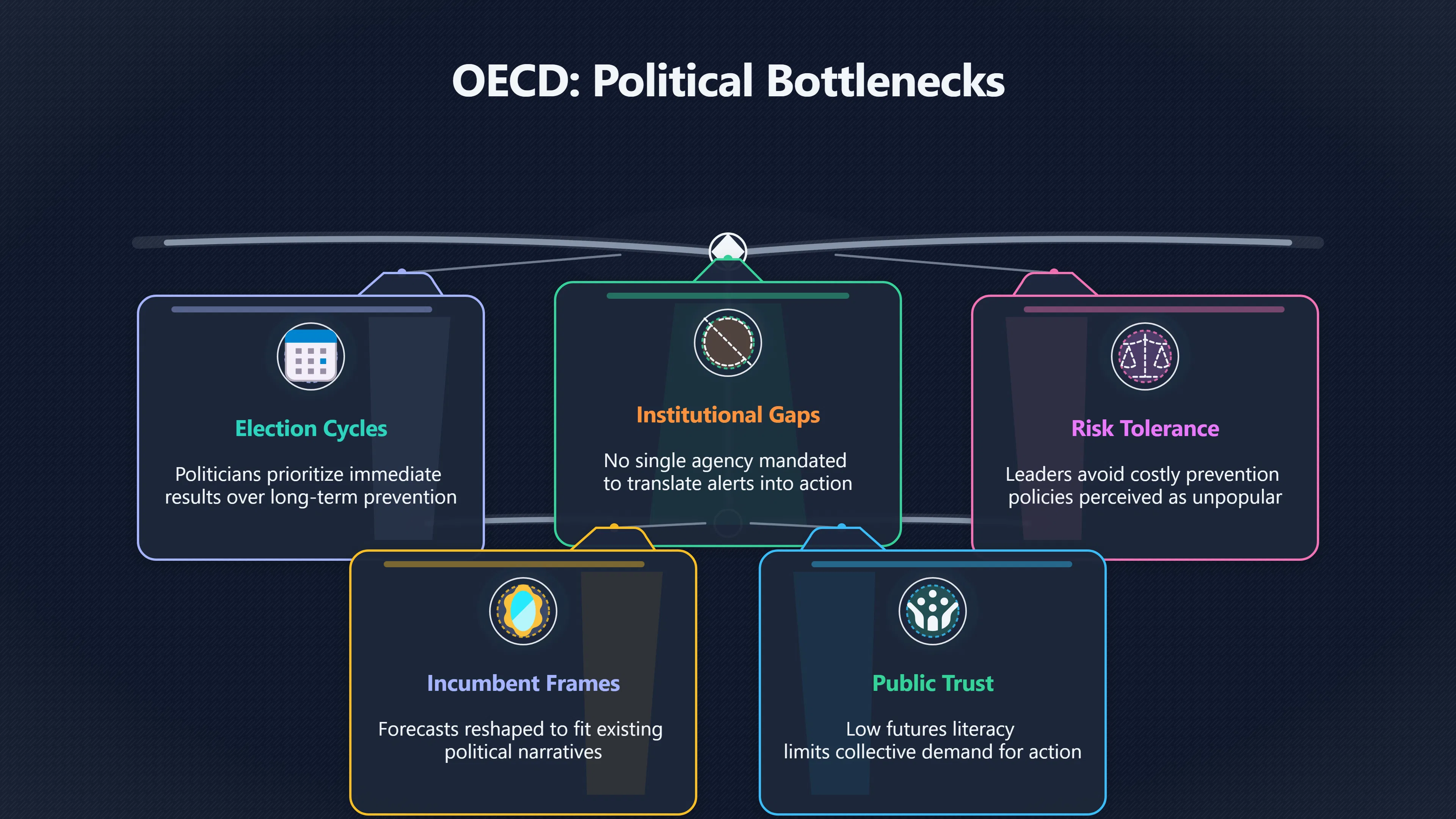
1. Incentives for short‑term politics over long‑term prevention
Governments operate within election cycles, budget cycles and media cycles that prioritise immediate, visible results. The OECD notes that policymakers are “often driven by events rather than visionary or forward‑looking practices,” with crises becoming opportunities for major policy changes by chance rather than by design. Persistent reliance on short‑term decision‑making impedes action on slow‑burn risks, meaning that long‑range forecasts often languish without decisive follow‑up.[OECD]oecd.orgAnticipatory innovation governance (ENAnticipatory innovation governance (EN)May 15, 2025…
2. Institutional fragmentation and accountability gaps
Effective anticipatory governance requires clear lines of responsibility. Early warning systems often work technically — generating alerts — but fall short politically because no one agency or office is mandated to translate these alerts into coordinated policy action. For example, conflict early warning systems frequently fail to trigger adequate preventative measures due to unclear accountability and institutional inertia among agencies that hold responsibility for peacebuilding, humanitarian action and security.[Center on International Cooperation]cic.nyu.eduCenter on International CooperationWarning Without Response: Why Early Warning Fails, and How to Turn Foresight Into PreventionAugust 13…
3. Political will and risk tolerance are often misaligned with evidence
Even when forecasts highlight looming threats, political leaders may lack incentives to prioritise costly prevention or policies perceived as unpopular. Early warning systems for social unrest or violence, for instance, can produce credible risk assessments, but governments often demur because the predicted events seem distant or politically inconvenient compared with pressing daily concerns. This action aversion reflects structural misalignment between knowledge and political appetite — an obstacle anticipatory governance must address, not just forecast.[Center on International Cooperation]cic.nyu.eduCenter on International CooperationWarning Without Response: Why Early Warning Fails, and How to Turn Foresight Into PreventionAugust 13…
4. Forecasts that fit incumbent frames are more likely to be acted on
Not all anticipatory processes influence policy equally. Empirical research on climate anticipatory governance in the Global South finds that many foresight exercises open up dialogue about uncertainty and pluralistic futures, but policy recommendations tend to be moulded into familiar, technocratic frames that align with existing priorities. In other words, forecasts reshape perceptions but often don’t alter policy choices unless they resonate with prevailing political narratives.[ScienceDirect]sciencedirect.comIs anticipatory governance opening up or closing down future possibilities? Findings from diverse contexts in the Global Sou…
5. Public understanding, trust and legitimacy matter politically
Governance systems that lack broad futures literacy or public engagement struggle to build collective demand for anticipatory action. Comparative analysis shows that countries with stronger futures literacy and civic trust — where citizens, civil society and government share an orientation toward long‑term planning — are more successful in translated foresight into policy. By contrast, where awareness is low and implementation fragmented, anticipatory governance risks becoming a distant exercise with minimal impact on concrete decisions.[University of Bristol]research-information.bris.ac.ukUniversity of BristolThe traps and pitfalls of anticipatory governance: Comparative cases of South Korea and the United Kingdom - Univers…

Designing Institutions That Act Faster
Recognising these political bottlenecks suggests several design principles for institutions that can better turn forecasts into action:
Build dedicated anticipatory governance structures(#endnote-2 “Endnote 2”)[Wikipedia]WikipediaAnticipatory governanceAnticipatory governance
Instituting permanent bodies (such as parliamentary committees on future generations or interagency foresight teams) that have clear mandates, resources and accountability for integrating foresight into policy can help avoid ad hoc reactions after crises emerge. These bodies should operate across sectors and administrative siloes, ensuring early warnings are connected to budgetary and regulatory levers.
Align incentives with preventive action
Public governance must adjust incentives so that long‑term risk reduction is rewarded politically and institutionally. This might include performance measures that value anticipatory policy adoption, cross‑party commitments to multi‑year resilience plans, and mechanisms to protect long‑term projects from short‑term political shifts.
Enhance accountability and transparency
Clear rules about who acts on early warnings — and how progress (or lack thereof) is communicated to the public — can reduce political avoidance of preventive action. Transparent reporting on risk indicators and policy responses can build public demand for anticipatory measures, creating political space for leaders to act.
Engage publics and diverse knowledge systems
Anticipatory governance is not purely technocratic. Embedding public deliberation and diverse perspectives in foresight — beyond narrow technical scenarios — can legitimise preventive strategies and broaden societal ownership of resilience goals. This includes engaging marginalised communities whose experiences might be overlooked in conventional forecasting.
Why Forecast Improvements Matter, But Aren’t Enough
Advances in data, AI and modelling can yield earlier and more precise forecasts of disease outbreaks, climate impacts and conflict risk. But without political systems equipped to respond — systems that value prevention, absorb evidence into decision‑making and act collaboratively — these forecasts risk becoming unused signals. Bridging the gap between foresight and governance requires more than better prediction; it demands institutional design that anticipates political behaviour as much as natural or social processes.
Anticipatory governance holds potential to rewire how societies interact with future risks, but its success depends on overcoming entrenched political patterns. In the context of AI‑enabled civilisational resilience — whether against pandemics, climate shocks or global systemic threats — aligning governance incentives with preventive action might matter as much as technical forecasting power if humanity is to turn knowledge into flourishing outcomes rather than repeated crises.[OECD]oecd.orgcomponent 13Anticipatory innovation: Tackling Policy Challenges Through Public Sector Innovation | OECDNovember 23, 2022…
Amazon book picks
Further Reading
Books and field guides related to Why Accurate AI Forecasts Still Fail to Prevent Crises. Use these as the next step if you want deeper reading beyond the article.
The Black Swan
Rating: 4.0/5 from 25 Google Books ratings
Explains why institutions struggle with rare but high-impact events.
The Signals Are Talking
Focuses on anticipating future developments before crises emerge.
eBay marketplace picks
Marketplace Samples
Topic-anchored marketplace searches for visual, collectible, or second-hand items related to this page.



Endnotes
1.
Source: oecd.org
Title: component 13
Link:https://www.oecd.org/en/publications/tackling-policy-challenges-through-public-sector-innovation_052b06b7-en/full-report/component-13.html
Source snippet
Anticipatory innovation: Tackling Policy Challenges Through Public Sector Innovation | OECDNovember 23, 2022...
Published: November 23, 2022
2.
Source: Wikipedia
Title: Anticipatory governance
Link:https://en.wikipedia.org/wiki/Anticipatory_governance
3.
Source: oecd.org
Title: Anticipatory innovation governance (EN)
Link:https://www.oecd.org/content/dam/oecd/en/publications/reports/2020/12/anticipatory-innovation-governance_d1aded4e/cce14d80-en.pdf
Source snippet
Anticipatory innovation governance (EN)May 15, 2025...
Published: May 15, 2025
4.
Source: sciencedirect.com
Link:https://www.sciencedirect.com/science/article/pii/S0959378023000602
Source snippet
Is anticipatory governance opening up or closing down future possibilities? Findings from diverse contexts in the Global Sou...
5.
Source: cic.nyu.edu
Link:https://cic.nyu.edu/resources/warning-without-response-why-early-warning-fails-and-how-to-turn-foresight-into-prevention/
Source snippet
Center on International CooperationWarning Without Response: Why Early Warning Fails, and How to Turn Foresight Into PreventionAugust 13...
6.
Source: research-information.bris.ac.uk
Link:https://research-information.bris.ac.uk/en/publications/the-traps-and-pitfalls-of-anticipatory-governance-comparative-cas/
Source snippet
University of BristolThe traps and pitfalls of anticipatory governance: Comparative cases of South Korea and the United Kingdom - Univers...
Additional References
7.
Source: gsdrc.org
Link:https://gsdrc.org/document-library/systemic-disconnects-why-regional-organisations-fail-to-use-early-warning-and-response-mechanisms/
Source snippet
February 18, 2011 — SYSTEMIC DISCONNECTS: WHY REGIONAL ORGANISATIONS FAIL TO USE EARLY WARNING AND RESPONSE MECHANISMS Library Herbe...
Published: February 18, 2011
8.
Source: academic.oup.com
Link:https://academic.oup.com/policyandsociety/article/33/4/317/6422326
Source snippet
orders of governance failure: Design mismatches and policy capacity issues in modern governance | Policy and Society | Oxford AcademicDec...
9.
Source: dspace.library.uu.nl
Link:https://dspace.library.uu.nl/handle/1874/408825
Source snippet
approaches to anticipatory climate governance: Different conceptions of the future and implications for the presentFOUR APPROACHES TO ANT...
10.
Source: dspace.library.uu.nl
Link:https://dspace.library.uu.nl/handle/1874/424855
Source snippet
just playing: The politics of designing games for impact on anticipatory climate governanceNOT JUST PLAYING: THE POLITICS OF DESIGNING GA...
11.
Source: link.springer.com
Link:https://link.springer.com/article/10.1007/s13280-014-0604-x
Source snippet
governance for social-ecological resilience | Ambio | Springer Nature LinkJanuary 9, 2015 — DISCUSSION There are varied and conflicting u...
Published: January 9, 2015
12.
Source: dbc.library.uu.nl
Title: nl Is anticipatory governance opening up or closing down future possibilities?
Link:https://dbc.library.uu.nl/handle/1874/435917
Source snippet
Findings from diverse contexts in the Global SouthIS ANTICIPATORY GOVERNANCE OPENING UP OR CLOSING DOWN FUTURE POSSIBILITIES? FINDINGS FR...
13.
Source: dspace.library.uu.nl
Title: nl Is anticipatory governance opening up or closing down future possibilities?
Link:https://dspace.library.uu.nl/handle/1874/435917
Source snippet
Findings from diverse contexts in the Global SouthIS ANTICIPATORY GOVERNANCE OPENING UP OR CLOSING DOWN FUTURE POSSIBILITIES? FINDINGS FR...
14.
Source: research-portal.uu.nl
Title: nl Is anticipatory governance opening up or closing down future possibilities?
Link:https://research-portal.uu.nl/en/publications/is-anticipatory-governance-opening-up-or-closing-down-future-poss/
Source snippet
Findings from diverse contexts in the Global South - Utrecht UniversityIS ANTICIPATORY GOVERNANCE OPENING UP OR CLOSING DOWN FUTURE POSSI...
15.
Source: research.wur.nl
Title: nl Is anticipatory governance opening up or closing down future possibilities?
Link:https://research.wur.nl/en/publications/is-anticipatory-governance-opening-up-or-closing-down-future-poss/
Source snippet
Findings from diverse contexts in the Global South - Research Portal - Wageningen University & ResearchIS ANTICIPATORY GOVERNANCE OPENING...
16.
Source: research.wur.nl
Title: Muiderman^{} *, A. Gupta *, J.M. Vervoort *, F. Biermann ^{}Corr
Link:https://research.wur.nl/en/publications/four-approaches-to-anticipatory-climate-governance-different-conc/
Source snippet
approaches to anticipatory climate governance: Different conceptions of the future and implications for the present - Wageningen Universi...
Topic Tree