Within Broad Access
Why access alone will not close the AI divide
Giving people AI tools is not enough if language, connectivity, training and institutions determine who can use them well.
On this page
- The layers of unequal AI benefit
- Why language and infrastructure gaps matter
- How training and local institutions can narrow the divide
Page outline Jump by section
Introduction
If advanced AI eventually becomes a major source of education, expertise, planning help and scientific insight, then the key question is not simply who can log in to a chatbot. The deeper question is who can actually convert AI into real capability.
 The history of technology suggests that access alone rarely closes gaps. A school can have computers without producing digital literacy. A village can have internet coverage without gaining high-value online jobs. A company can buy AI software without becoming more productive. The same pattern is emerging with generative AI. People, organisations and countries differ not only in whether they possess AI tools, but in whether they have the language support, connectivity, training, institutional capacity and social trust needed to use those tools well.[UNESCO]unesco.orgAI literacy and the new Digital Divide - A Global Call for…6 Aug 2024 — The rapid advancements in artificial intelligence (AI) h…[World Bank]worldbank.orgdptr2025 ai foundationsWorld BankDigital Progress and Trends Report 2025: AI FoundationsThe World Bank's Digital Progress and Trends 2025 report explores how AI…
This matters for the broader idea of AI-enabled human flourishing. The optimistic vision is that advanced AI could make high-level cognitive assistance widely available, helping billions of people learn faster, solve problems more effectively and participate in scientific, economic and cultural progress. But if the supporting infrastructure for using AI remains uneven, the benefits may concentrate among already advantaged populations while others receive only limited gains. The AI divide may therefore become less about access to software and more about access to the conditions that make software useful.
The layers of unequal AI benefit
Public discussion often treats the AI divide as a simple binary: some people have access to AI and others do not. In practice, the divide operates across several layers.
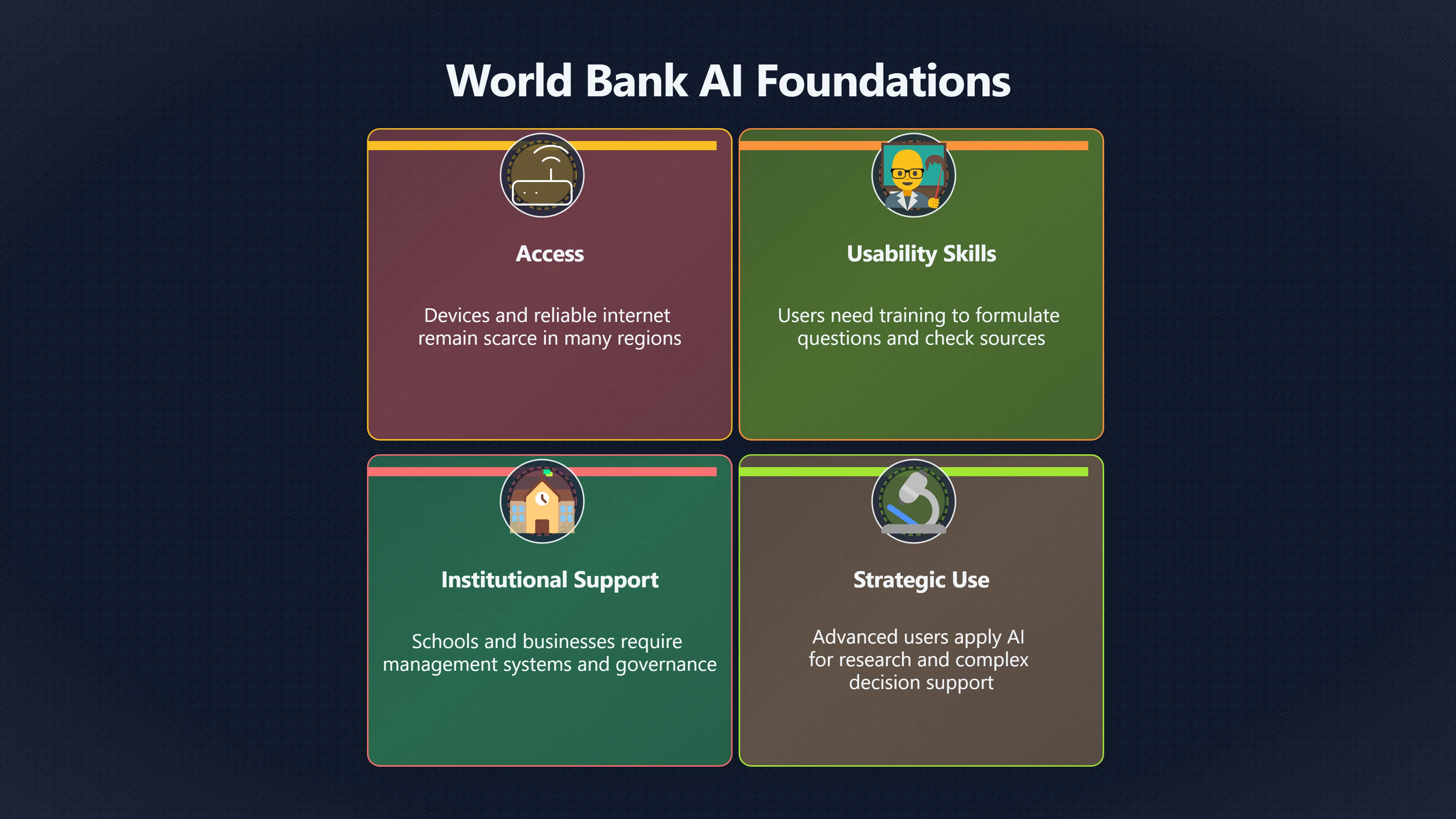
The first layer is basic access. People need devices, connectivity and affordable services. This remains a significant challenge in many regions, particularly where internet access is unreliable or expensive. The World Bank argues that many lower-income countries still face substantial barriers in digital infrastructure and AI readiness despite growing interest in AI adoption.[World Bank]worldbank.orgdptr2025 ai foundationsWorld BankDigital Progress and Trends Report 2025: AI FoundationsThe World Bank's Digital Progress and Trends 2025 report explores how AI…[World]WikipediaWorldThe world is the totality of entities, the whole of reality, or everything that exists. The nature of the world has been conceptu…
The second layer is usability. Having access to a system does not mean understanding how to use it. Effective AI use often depends on skills such as formulating questions, evaluating outputs, checking sources, identifying mistakes and integrating AI assistance into real workflows. UNESCO has increasingly framed AI literacy as a central challenge, arguing that unequal understanding of AI can create a new form of digital exclusion.[UNESCO]unesco.orgguidance generative ai education and researchGuidance for generative AI in education and research7 Sept 2023 — UNESCO's first global guidance on GenAI in education aims to supp…
The third layer is institutional support. Schools, businesses, hospitals, local governments and community organisations all influence whether AI becomes genuinely useful. A teacher trained to integrate AI into lessons can produce very different outcomes from a school where students are left to experiment without guidance. Likewise, a small business with AI training, management support and reliable digital systems may gain much more from the same tools than a business that lacks those foundations.[UNESCO]unesco.orgAI and technologies in educationUNESCO partners with countries and institutions on ideas, research, and evidence-informed digital l…[UNESCO]unesco.orglaunches global roadmap multilingualism digital eraUnveiled during the solutions session “Safeguarding Languages, Empowering…Read more…
The fourth layer is strategic use. Some individuals and institutions learn how to use AI not merely as a convenience tool but as a force multiplier. They employ it for research, software development, scientific analysis, planning and decision support. As these higher-value uses spread unevenly, the productivity gap between advanced users and basic users may grow substantially. OpenAI’s own analysis has argued that differences in institutional readiness and capability use are becoming as important as differences in formal access.[TechRadar]techradar.comWhile 66% of leaders prioritize AI skills development, only 33% of employees report receiving AI-related training. Misalignment between e…
In this sense, AI may resemble higher education more than electricity. The technology can be widely available while its most transformative benefits remain concentrated among those with the skills and structures needed to exploit it.
Why language gaps could become one of the biggest AI inequalities
One of the most overlooked dimensions of the AI divide is language.
Large language models are trained on enormous collections of text, but those collections are highly uneven across languages. English and a small number of other widely digitised languages dominate the data used to build many frontier systems. Speakers of thousands of lower-resource languages often receive weaker performance, fewer specialised tools and less reliable outputs.[arXiv]arxiv.orgarXiv Learning to Adopt Generative AIarXiv Learning to Adopt Generative AI
This is not merely a cultural issue. It affects practical access to knowledge.
A farmer seeking agricultural advice, a student seeking educational support or a patient seeking health information may receive much better assistance if AI systems operate fluently in their native language and local context. When systems perform poorly in those languages, the quality of cognitive assistance declines precisely where it may be most valuable.
UNESCO and other organisations have increasingly warned that AI could reinforce existing linguistic hierarchies if language diversity is not treated as a major infrastructure challenge. Recent research examining more than 6,000 languages argues that AI resources remain concentrated in a small number of linguistic communities and that disparities may be widening rather than narrowing.[UNESCO]courier.unesco.orgUNESCO CourierAfrican languages, the blind spot of AI4 days ago — This initiative aimed to use AI to translate academic texts into local…
The problem extends beyond translation. AI systems also reflect the assumptions, examples, cultural references and institutional contexts present in their training data. A model that performs well for a lawyer in London or New York may be much less useful for navigating local institutions elsewhere.
As AI becomes more deeply embedded in education, administration and knowledge work, language support may become a form of cognitive infrastructure. Societies whose languages are well represented in AI systems could gain easier access to knowledge and expertise, while poorly represented communities risk a new form of digital marginalisation.[UNESCO Courier]courier.unesco.orgUNESCO CourierAfrican languages, the blind spot of AI4 days ago — This initiative aimed to use AI to translate academic texts into local…
Connectivity still matters more than many AI forecasts assume
Some visions of AI abundance focus on increasingly powerful models while paying less attention to the physical systems that allow people to use them.
Yet advanced AI depends on electricity, telecommunications networks, data centres, cloud services and digital devices. The benefits of frontier AI cannot easily reach communities lacking these foundations.
This creates a familiar pattern in technological history. Innovations often appear globally available in theory but remain unevenly distributed in practice because the supporting infrastructure arrives slowly or inconsistently. The internet itself demonstrated this dynamic. Simply making websites available did not guarantee equal participation in the digital economy.
The World Bank’s work on AI readiness repeatedly emphasises that countries require data infrastructure, computing resources, cloud access, digital skills and governance capacity alongside AI tools themselves. Without these complementary systems, AI adoption tends to remain shallow and fragmented.[World Bank]worldbank.orgdptr2025 ai foundationsWorld BankDigital Progress and Trends Report 2025: AI FoundationsThe World Bank's Digital Progress and Trends 2025 report explores how AI…[World]WikipediaWorldThe world is the totality of entities, the whole of reality, or everything that exists. The nature of the world has been conceptu…
This issue becomes especially important in discussions of long-term AI bloom. If advanced systems eventually help accelerate science, education, medicine and entrepreneurship, then gaps in infrastructure could determine which regions participate in those gains and which primarily consume technologies developed elsewhere.
Why training may matter as much as the models
One of the strongest findings from technology adoption research is that tools rarely create value automatically.
People often need time, experimentation and social support before they discover how a new technology fits into their work. AI appears to follow the same pattern.
Recent research on generative AI adoption identifies both a “learning divide” and a “utility divide”. Some groups learn more slowly that AI can be useful, while others discover valuable applications more quickly. The researchers describe a potential “belief trap” in which people underestimate a tool’s usefulness, avoid using it and therefore never gain the experience that would change their assessment. Training programmes can help break this cycle.[arXiv]arxiv.orgarXiv Learning to Adopt Generative AIarXiv Learning to Adopt Generative AI
This finding challenges a common assumption that AI diffusion will naturally occur once systems become cheap enough. In reality, people often need examples, guidance, institutional encouragement and trusted intermediaries before adoption accelerates.
The pattern appears repeatedly:
- Teachers need support integrating AI into classrooms rather than simply being given access.
- Small businesses often need workflow redesign and staff training before productivity gains appear.
- Public-sector organisations frequently need procurement standards, governance frameworks and technical expertise.
- Workers need opportunities to learn new skills before AI complements rather than replaces parts of their jobs.[UNESCO]unesco.orgGenerative AI: UNESCO study reveals alarming evidence…7 Mar 2024 — A UNESCO study revealed worrying tendencies in Large Language…[TechRadar]techradar.comWhile 66% of leaders prioritize AI skills development, only 33% of employees report receiving AI-related training. Misalignment between e…
This means AI literacy may become a major determinant of future opportunity. The societies that teach people how to collaborate effectively with AI systems could gain advantages that exceed the benefits of merely possessing the software.
Institutions can widen or narrow the divide
The most important differences in AI outcomes may emerge at the level of institutions rather than individuals.
Two schools can use the same AI systems and achieve very different results. One may use AI to personalise learning, provide additional tutoring and reduce administrative burdens on teachers. Another may deploy the same technology poorly, generating confusion, dependency or low-quality educational outcomes.
The same applies to governments, health systems and businesses.
UNESCO’s guidance on AI in education repeatedly emphasises human capacity-building rather than technological deployment alone. The organisation argues that governance, teacher training, curriculum design and ethical safeguards are essential parts of successful AI adoption.[UNESCO]unesco.orgAI and education: Protecting the rights of learnersThe rapid digitalization of education and the development of generative artificial int…
This institutional dimension is especially relevant for the broader bloom thesis. If advanced AI eventually provides extraordinary cognitive leverage, then schools, universities, research institutions, libraries, public services and civic organisations may become the mechanisms through which those capabilities spread.
Historically, many of the largest gains from science and technology came not from inventions themselves but from institutions that helped people use them. Public education systems, agricultural extension services, universities and healthcare networks all served as transmission mechanisms for knowledge.
The same may prove true for AI. A society with strong institutions could turn advanced AI into a widely shared resource. A society with weak institutions might see the same technology reinforce existing inequalities.
Bias, representation and whose knowledge gets amplified
The AI divide is not only about access and skills. It is also about whose knowledge, perspectives and experiences become embedded in the systems themselves.
Researchers and international organisations have repeatedly identified problems with bias in large language models. Studies have found patterns of gender stereotyping, cultural bias and unequal representation across different groups and regions.[UNESCO]articles.unesco.orgAIParis, 7 March 2024 – Ahead of the International Women's Day, a UNESCO study revealed worrying tendencies in Large Language models (LLM…
For users, this creates a subtler form of inequality.
If AI systems understand some cultures, professions and social contexts far better than others, then the quality of assistance becomes uneven. Some communities may find that AI reliably helps them navigate institutions, generate opportunities and solve practical problems. Others may receive advice that is less accurate, less relevant or less culturally informed.
The risk is that AI becomes a global amplifier of existing informational inequalities. Communities already well represented in digital systems become easier for AI to serve, while communities with limited digital representation remain harder to model and support.
Addressing this challenge requires more than technical fixes. It often depends on local data collection, multilingual development, community participation and institutional investment in underrepresented populations.

The fight over broad access is increasingly a fight over capability
As AI systems become more powerful, the central question may shift from “Who has AI?” to “Who can do meaningful things with AI?”
A country where students, workers, researchers and public servants routinely use AI to solve real problems may gain much more than a country where the same tools exist but remain poorly integrated into education and institutions.
Similarly, two individuals may both have access to the same model while deriving radically different benefits from it. One may use it for learning, planning, coding, research and entrepreneurship. The other may use it only occasionally for simple queries. The difference is not access. It is capability.
This distinction is important for evaluating optimistic visions of AI abundance. The strongest version of the bloom case assumes that advanced cognitive assistance becomes genuinely widespread and useful across humanity. That outcome depends not only on model performance but on language inclusion, digital infrastructure, education systems, institutional quality and social capacity.
The future divide may therefore be less visible than the old digital divide. Instead of separating people who are online from people who are offline, it may separate those who can translate AI into lasting capability from those who cannot.
Whether advanced AI expands human flourishing broadly or concentrates advantages among already capable groups will depend heavily on how societies build that surrounding cognitive infrastructure. Access is the beginning of the story, not the end of it.
Amazon book picks
Further Reading
Books and field guides related to Why access alone will not close the AI divide. Use these as the next step if you want deeper reading beyond the article.
Power and Progress
Directly addresses why access alone does not guarantee shared benefits.
Poor Economics
Explains why interventions need local capacity and institutions to work.
eBay marketplace picks
Marketplace Samples
Example marketplace items related to this page. Use the search link to explore similar finds on eBay.



Endnotes
1.
Source: unesco.org
Link:https://www.unesco.org/ethics-ai/en/articles/ai-literacy-and-new-digital-divide-global-call-action
Source snippet
AI literacy and the new Digital Divide - A Global Call for...6 Aug 2024 — The rapid advancements in artificial [intelligence]({{ 'intelligence/' | relative_url }}) (AI) h...
2.
Source: arxiv.org
Title: arXiv Learning to Adopt Generative AI
Link:https://arxiv.org/abs/2410.19806
3.
Source: unesco.org
Title: guidance generative ai education and research
Link:https://www.unesco.org/en/articles/guidance-generative-ai-education-and-research
Source snippet
Guidance for generative AI in education and research7 Sept 2023 — UNESCO's first global guidance on GenAI in education aims to supp...
4.
Source: unesco.org
Link:https://www.unesco.org/en/digital-education
Source snippet
AI and technologies in educationUNESCO partners with countries and institutions on ideas, research, and evidence-informed digital l...
5.
Source: techradar.com
Link:https://www.techradar.com/pro/closing-ai-learning-gaps-between-leaders-and-employees
Source snippet
While 66% of leaders prioritize AI skills development, only 33% of employees report receiving AI-related training. Misalignment between e...
6.
Source: techradar.com
Link:https://www.techradar.com/pro/put-plainly-some-countries-are-already-using-ai-to-solve-harder-problems-and-move-faster-openai-wants-to-make-ai-usage-more-equal-between-countries-but-will-it-actually-work
Source snippet
The study underscores a notable capability overhang — existing AI systems are more advanced than how they are being used, leading to a si...
7.
Source: arxiv.org
Title: arXiv Artificial intelligence is creating a new global linguistic hierarchy
Link:https://arxiv.org/abs/2602.12018
Source snippet
Artificial intelligence is creating a new global linguistic hierarchyFebruary 12, 2026...
Published: February 12, 2026
8.
Source: arxiv.org
Link:https://arxiv.org/abs/2505.04531
9.
Source: arxiv.org
Title: arXiv AI Diffusion in Low Resource Language Countries
Link:https://arxiv.org/abs/2511.02752
10.
Source: unesco.org
Title: launches global roadmap multilingualism digital era
Link:https://www.unesco.org/en/articles/unesco-launches-global-roadmap-multilingualism-digital-era
Source snippet
Unveiled during the solutions session “Safeguarding Languages, Empowering...Read more...
11.
Source: courier.unesco.org
Link:https://courier.unesco.org/en/articles/african-languages-blind-spot-ai
Source snippet
UNESCO CourierAfrican languages, the blind spot of AI4 days ago — This initiative aimed to use AI to translate academic texts into local...
12.
Source: unesco.org
Link:https://www.unesco.org/en/articles/generative-ai-unesco-study-reveals-alarming-evidence-regressive-gender-stereotypes
Source snippet
Generative AI: UNESCO study reveals alarming evidence...7 Mar 2024 — A UNESCO study revealed worrying tendencies in Large Language...
13.
Source: unesco.org
Link:https://www.unesco.org/en/articles/ai-and-education-protecting-rights-learners
Source snippet
AI and education: Protecting the rights of learnersThe rapid digitalization of education and the development of generative artificial int...
14.
Source: articles.unesco.org
Link:https://articles.unesco.org/sites/default/files/medias/fichiers/2024/07/PR_Generative_AI_UNESCO_study_reveals_alarming_evidence_of_regressive_gender_stereotypes_en.pdf
Source snippet
AIParis, 7 March 2024 – Ahead of the International Women's Day, a UNESCO study revealed worrying tendencies in Large Language models (LLM...
Published: March 2024
15.
Source: unesco.org
Title: what you need know about ai and right education
Link:https://www.unesco.org/en/articles/what-you-need-know-about-ai-and-right-education
Source snippet
What you need to know about AI and the right to education25 Sept 2025 — During Digital Learning Week 2025, UNESCO released a new report “...
16.
Source: unesco.org
Link:https://www.unesco.org/en/articles/languages-matter-global-guidance-multilingual-education
Source snippet
Languages matter: global guidance on multilingual educationThis guide presents up-to-date principles for language-in-education policies t...
17.
Source: unesdoc.unesco.org
Link:https://unesdoc.unesco.org/ark%3A/48223/pf0000388971
Source snippet
investigation into bias against women and girls in large...Challenging systematic prejudices: an investigation into bias against women a...
18.
Source: unesdoc.unesco.org
Link:https://unesdoc.unesco.org/ark%3A/48223/pf0000395373.locale%3Den
Source snippet
UNESCO's Guidance for Generative AI in Education and Research (UNESCO, 2023b).... equitable access to digital infrastructure and skills...
19.
Source: unesco.org
Title: qa how unesco driving digital learning and transformation education
Link:https://www.unesco.org/en/articles/qa-how-unesco-driving-digital-learning-and-transformation-education
Source snippet
Q&A: How UNESCO is driving digital learning and the...19 Mar 2024 — It focuses on AI's role in addressing inequalities regarding access...
20.
Source: unesco.org
Title: global roadmap multilingualism
Link:https://www.unesco.org/en/global-roadmap-multilingualism
Source snippet
Global Roadmap for Multilingualism in the Digital Era13 Feb 2026 — Led by UNESCO, this initiative provides guidance for global efforts to...
21.
Source: unesco.org
Title: and g20 promote linguistic diversity digital age
Link:https://www.unesco.org/en/articles/unesco-and-g20-promote-linguistic-diversity-digital-age
Source snippet
UNESCO and G20 promote Linguistic Diversity in Digital AgeNov 21, 2025 — Nearly half of the world's 7,000 languages are now at risk of fa...
22.
Source: worldbank.org
Title: dptr2025 ai foundations
Link:https://www.worldbank.org/en/publication/dptr2025-ai-foundations
Source snippet
World BankDigital Progress and Trends Report 2025: AI FoundationsThe World Bank's Digital Progress and Trends 2025 report explores how AI...
23.
Source: worldbank.org
Title: emerging technologies
Link:https://www.worldbank.org/en/topic/digital/brief/emerging-technologies
Source snippet
Data, AI, and Emerging Technologies10 Apr 2025 — The World Bank prioritizes building robust Artificial Intelligence (AI) foundations and...
24.
Source: worldbank.org
Link:https://www.worldbank.org/ext/en/topic/digital-and-ai/data-and-ai
Source snippet
Data and AIThe World Bank Group supports governments in building data infrastructure and AI foundations, strengthening data ecosystems, a...
25.
Source: worldbank.org
Link:https://www.worldbank.org/en/about/unit/unit-dec/research/initiatives
Source snippet
Research InitiativesThe AI and Digital Development (AI/DD) Research Initiative asks, What is the impact of AI and the digital transformat...
26.
Source: openknowledge.worldbank.org
Link:https://openknowledge.worldbank.org/bitstreams/99474f35-6a0c-48c3-9104-7b693e04313e/download
Source snippet
Progress and Trends Report 2025: Strengthening AI...20 Nov 2025 — From 2021 to 2024, job postings requiring AI skills grew by 2 percent...
27.
Source: worldbank.org
Title: generative ai and jobs in lac
Link:https://www.worldbank.org/en/topic/poverty/publication/generative-ai-and-jobs-in-lac
Source snippet
Generative AI and Jobs in Latin America and the CaribbeanJul 31, 2024 — Researchers found that generative AI (GenAI) could have transform...
28.
Source: openknowledge.worldbank.org
Link:https://openknowledge.worldbank.org/server/api/core/bitstreams/d2ac1ea9-b70e-4080-b5de-8b31098e992f/content
Source snippet
Progress and Trends Report 202515 Sept 2025 — DIGITAL PROGRESS AND TRENDS REPORT 2025. Our new World Bank Group digital strategy includes...
29.
Source: openknowledge.worldbank.org
Link:https://openknowledge.worldbank.org/server/api/core/bitstreams/f2509a0f-7153-4f32-b180-bc11e90c4940/content
Source snippet
Progress and Trends Report 2025: Strengthening AI...24 Jun 2025 — Our new World Bank Group digital strategy includes AI readiness as a c...
30.
Source: openknowledge.worldbank.org
Link:https://openknowledge.worldbank.org/entities/publication/4a11a37d-149a-44fb-a941-100065ff5eb8
Source snippet
Exposure of Workers to Artificial Intelligence in Lowby G Demombynes · 2025 · Cited by 5 — This paper analyzes this issue using microdata...
31.
Source: openknowledge.worldbank.org
Link:https://openknowledge.worldbank.org/bitstreams/5e2d0789-43dc-4f7b-9804-90a5fcade533/download
Source snippet
Progress and Trends Report 2025: Strengthening AI...20 Nov 2025 — As AI adoption accelerates in advanced countries, delayed action in LI...
32.
Source: openknowledge.worldbank.org
Link:https://openknowledge.worldbank.org/entities/publication/6b514a80-1d5a-5e54-9c8d-b51473775613
Source snippet
worldbank.orgPublication: The Role of Artificial Intelligence in Supporting...by D Strusani · Cited by 158 — AI offers an opportunity to...
33.
Source: blogs.worldbank.org
Title: What we re reading about the age of AI jobs and inequality
Link:https://blogs.worldbank.org/en/jobs/What-we-re-reading-about-the-age-of-AI-jobs-and-inequality
Source snippet
we're reading about the age of AI, jobs, and inequalityMay 7, 2024 — Anxieties about job displacement and income insecurity in the age of...
Published: May 7, 2024
34.
Source: documents1.worldbank.org
Link:https://documents1.worldbank.org/curated/en/099123512172521590/pdf/IDU-393e0705-dc57-406a-b146-6c04a2656a43.pdf
Source snippet
Affordability, Ecosystem, and AI Readiness, underpinned by robust Digital. Safeguards. Looking ahead...Read more...
35.
Source: worldbank.org
Link:https://www.worldbank.org/ext/en/topic/digital-and-ai
Source snippet
nclusive growth. Read the report.Read more...
36.
Source: openknowledge.worldbank.org
Title: It discusses the demand and supply of digital skills.Read more
Link:https://openknowledge.worldbank.org/entities/publication/18cfa834-c2bf-5286-9510-6dc615e96faf
Source snippet
worldbank.orgPublication: Digital Skills: Frameworks and ProgramsThis paper presents a framework for digital skills, based on a review of...
37.
Source: linkedin.com
Link:https://www.linkedin.com/posts/welker_protecting-teacher-agency-in-the-age-of-ai-activity-7369676563895730177-Epq1
Source snippet
UNESCO paper on AI and teacher agency highlights...- Generative AI should only be applied under clear controls (e.g. in the classroom un...
38.
Source: linkedin.com
Link:https://www.linkedin.com/posts/welker_unesco-governance-of-digital-platforms-and-activity-7383863780478263297-WAUg
Source snippet
UNESCO releases guidelines for AI and digital platform...The Guidelines for the Governance of Digital Platforms and Generative Artificia...
39.
Source: linkedin.com
Link:https://www.linkedin.com/posts/ifc-education_devising-a-strategic-approach-to-ai-activity-7368655733782888449-QOOi
Source snippet
World Bank launches AI strategy framework for countriesThe World Bank developed a practical and flexible framework to help shape national...
40.
Source: linkedin.com
Link:https://www.linkedin.com/posts/cija-augustus-89811a13_globaleducation-educationequity-digitaldivide-activity-7378191151079518208-3Dk6
Source snippet
UNESCO report: AI widens digital divide in education28 Sept 2025 — The digital divide in education is no longer just about access to devi...
41.
Source: linkedin.com
Link:https://www.linkedin.com/posts/karina-kesserwan-2065266_ai-indigenoussovereignty-dataethics-activity-7302726351755640833–8YG
Source snippet
UNESCO report on AI and Indigenous communities in Latin...UNESCO has just shared a report on AI & Culture — a publication which examined...
42.
Source: Wikipedia
Link:https://en.wikipedia.org/wiki/World
Source snippet
WorldThe world is the totality of entities, the whole of reality, or everything that exists. The nature of the world has been conceptu...
43.
Source: cdut.edu.cn
Title: protecting the rights of learners
Link:https://www.cdut.edu.cn/__local/0/68/31/67B2897D8ADD86271124C1D7A58_F36B9C93_1BFF3E9.pdf
Source snippet
UNESCO Digital LibraryThe rapid digitalization of education, accelerated by the COVID-19 pandemic and the development of generative artif...
44.
Source: fhsmun.org
Title: UNESC O
Link:https://www.fhsmun.org/wp-content/uploads/2025/01/UNESCO-Digital-Equity-in-Education-and-Culture-1.pdf
Source snippet
UNESCO - Digital Equity in Education and Culture4 Studies indicate that a 10% increase in broadband penetration correlates with a 1.2% in...
45.
Source: tandfonline.com
Title: The ethics of AI or techno-solutionism?
Link:https://www.tandfonline.com/doi/full/10.1080/01425692.2025.2502808
Source snippet
UNESCO's policy...by Y Mochizuki · 2025 · Cited by 29 — This unambiguously exemplifies UNESCO's role in legitimating technology companie...
46.
Source: enmaeya.com
Title: 68da3a22f9ce754f0163e8b9 unesco warns ai could deepen inequality in education
Link:https://enmaeya.com/en/news/68da3a22f9ce754f0163e8b9-unesco-warns-ai-could-deepen-inequality-in-education
Source snippet
UNESCO Warns AI Could Deepen Inequality in EducationSep 29, 2025 — UNESCO warns AI in education may worsen inequalities, urging human-rig...
Additional References
47.
Source: oecd.org
Link:https://www.oecd.org/content/dam/oecd/en/publications/reports/2025/12/ai-and-the-global-productivity-divide_f47026c5/c315ea90-en.pdf
Source snippet
AI and the Global Productivity Divide: Fuel for the Fast or a...Technological leapfrogging would favour rapid adoption of AI by avoiding...
48.
Source: frontiersin.org
Link:https://www.frontiersin.org/journals/computer-science/articles/10.3389/fcomp.2026.1759027/full
Source snippet
AI and the digital divide in educationby MA Matjie · Cited by 3 — A recent study on AI adoption and the digital divide in education found...
49.
Source: sea-vet.net
Link:https://sea-vet.net/images/seb/e-library/doc_file/1417/386693eng.pdf
Source snippet
Guidance for generative AI in education and researchUNESCO's first global guidance on GenAI in education aims to support countries to imp...
50.
Source: unctad.org
Link:https://unctad.org/system/files/official-document/tir2025ch2_en.pdf
Source snippet
Leveraging AI for productivity and workers' empowermentThe adoption of AI in developing countries can be accelerated by redesigning AI so...
51.
Source: linkedin.com
Link:https://www.linkedin.com/posts/the-world-bank-group_future-jobs-activity-7424436592028766208-koLU
Source snippet
Report: AI, Jobs, and Digital Platforms in EAP CountriesAutomation and AI increase productivity, but the benefits are uneven. Roles built...
52.
Source: cecyt17.ipn.mx
Link:https://www.cecyt17.ipn.mx/assets/files/cecyt17/docs/inicio/unescoia.pdf
Source snippet
and educationThe rapid digitalization of education, accelerated by the COVID-19 pandemic and the development of generative artificial int...
53.
Source: researchgate.net
Link:https://www.researchgate.net/publication/389936132_Integrating_AI_in_Education_Navigating_UNESCO_Global_Guidelines_Emerging_Trends_and_Its_Intersection_with_Sustainable_Development_Goals
Source snippet
Integrating AI in Education: Navigating UNESCO Global...Mar 18, 2025 — This comprehensive review explores the integration of artificial...
54.
Source: bera.ac.uk
Link:https://www.bera.ac.uk/blog/digital-equity-in-the-age-of-generative-ai-bridging-the-divide-in-educational-technology
Source snippet
Digital equity in the age of generative AI30 May 2025 — Generative AI holds enormous potential to transform education, but its benefits w...
Published: May 2025
55.
Source: news.ruforum.org
Link:https://news.ruforum.org/ai-in-education-navigating-fears-embracing-possibilities-and-charting-a-path-forward/
Source snippet
in Education: Navigating Fears, Embracing Possibilities...by N Muhanguzi — A comparative analysis of generative AI adoption found signif...
56.
Source: linkedin.com
Link:https://www.linkedin.com/posts/jose-f-quesada_lt4all2025-languagetechnology-ai-activity-7293536455686025218-IrtS
Source snippet
Jose F Quesada's Post6 Feb 2025 —... AI research and data collection, with a focus on advancing digital inclusion for Europe's low-resou...
Topic Tree