Within Public Compute
How Public Compute Unlocks Scientific and Public Interest AI Research
Access to public compute allows AI-driven discoveries in medicine, climate, and neglected public-interest areas.
On this page
- Accelerating scientific discovery with AI
- Supporting rare diseases and climate research
- Reducing dependence on commercial priorities
Page outline Jump by section
Introduction
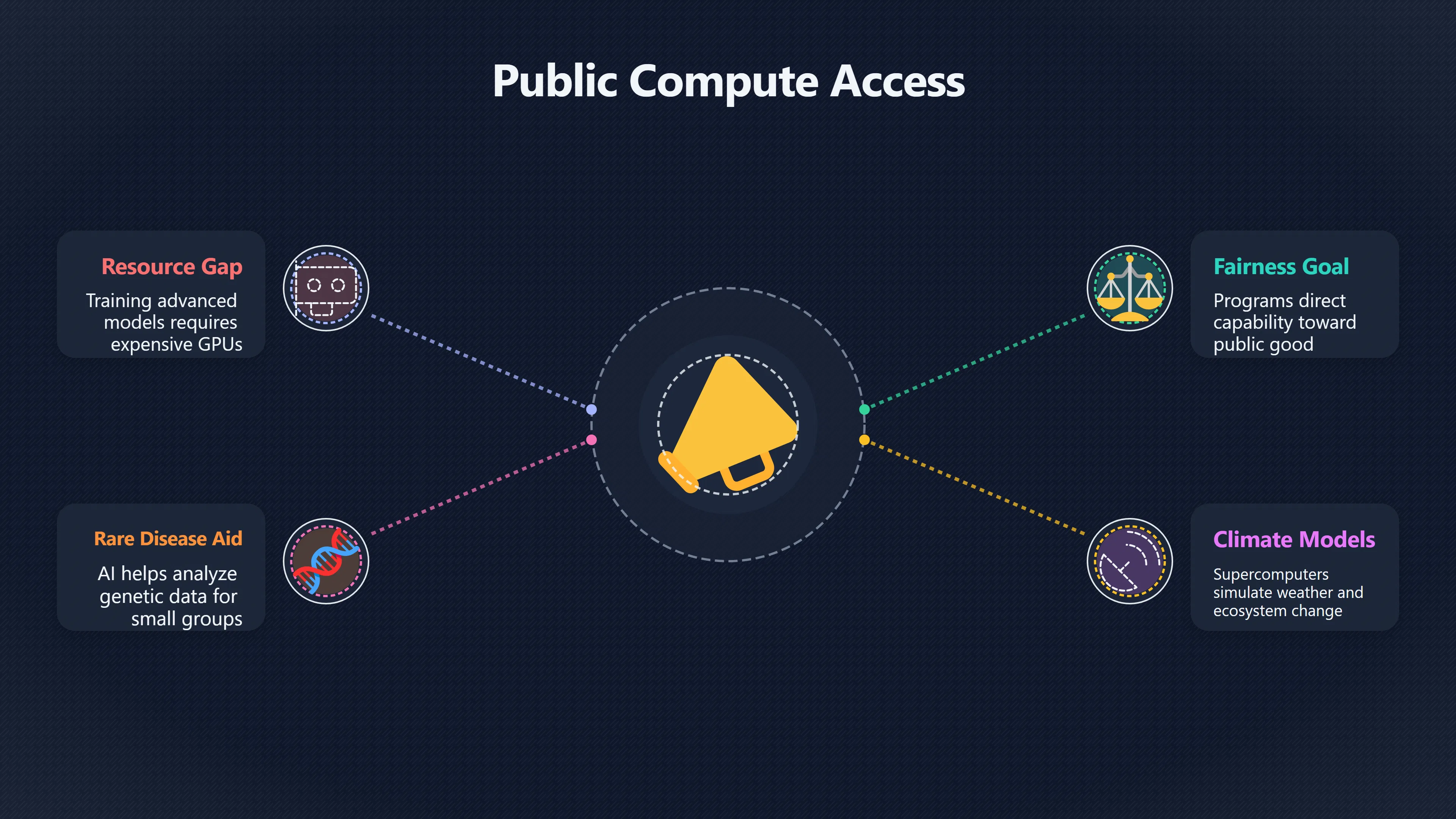
If advanced AI is going to help accelerate medicine, climate science, materials research and other fields that shape humanity’s long-term future, access to computing power cannot remain confined to a small number of technology companies. Modern AI research increasingly depends on expensive graphics processing units (GPUs), large datasets and specialised infrastructure. Public compute programmes aim to make some of those resources available to universities, non-profits, public laboratories and smaller research groups that would otherwise be locked out.[NSF - U.S. National Science Foundation]nsf.govNational Science FoundationNational Artificial Intelligence Research ResourceInitially established as a pilot in 2024, the NAIRR concept…
 Supporters see this as more than a fairness issue. They argue that many of the most socially valuable AI applications may not be the most commercially lucrative ones. Research on rare diseases, climate adaptation, public health, disaster resilience, scientific modelling and educational tools can struggle to compete with commercial incentives. Public compute is therefore often presented as a mechanism for directing AI capability towards broader human flourishing rather than only towards the most profitable markets.[Ada Lovelace Institute]adalovelaceinstitute.orgglobal public computeAda Lovelace InstituteMapping global approaches to public compute4 Nov 2024 — Exploration of a National AI Research Resource to provide p…
Why scientific AI increasingly depends on compute access
For much of modern science, access to laboratories and instruments has always mattered. AI adds a new layer: access to large-scale computation. Training advanced models, running simulations and analysing enormous scientific datasets now requires infrastructure that many researchers cannot afford independently.
This changes the structure of scientific opportunity. A university team may have a promising idea for modelling protein interactions, forecasting floods or designing new materials, yet still be unable to test it because the required compute budget exceeds available funding. In practice, this means that the direction of research can become shaped not only by scientific merit but also by who can obtain computational resources.[Stanford HAI]hai.stanford.eduHAINational AI Research Resource (NAIRRStanford HAINational AI Research Resource (NAIRR) - Stanford HAIA National AI Research Resource (NAIRR) would provide academic and non-pr…
Within the broader AI bloom vision, this matters because many of the most transformative possibilities depend on scientific acceleration. If AI can help researchers discover medicines faster, improve clean-energy technologies, model complex biological systems or understand climate risks more effectively, then widening access to compute becomes part of widening access to future discovery itself.
Accelerating scientific discovery with AI
One reason governments are investing in public compute is the growing evidence that AI and high-performance computing together can significantly accelerate scientific work.
Recent research examining millions of scientific papers found that projects combining AI methods with advanced computing infrastructure were substantially more likely to produce novel concepts and highly cited results than conventional approaches. The authors argue that AI and large-scale compute are becoming core drivers of modern scientific discovery across multiple disciplines.[arXiv]arxiv.orgarXiv AI and Supercomputing are Powering the Next Wave of Breakthrough ScienceAI and Supercomputing are Powering the Next Wave of Breakthrough Science - But at What Cost?November 16, 2025…
The mechanism is straightforward:
- AI systems can search enormous design spaces that humans cannot explore manually.
- Large-scale compute allows millions of simulations or experiments to be run virtually.
- Researchers can prioritise the most promising candidates for real-world testing.
- Scientific cycles that once took years can sometimes be compressed into months or weeks.
Materials science provides a useful example. Researchers have demonstrated systems that combine AI models with large-scale cloud computing to screen tens of millions of possible materials and identify promising candidates for experimental validation. Instead of relying solely on slow laboratory trial and error, scientists can use computation to narrow the search dramatically before physical testing begins.[arXiv]arxiv.orgarXiv AI and Supercomputing are Powering the Next Wave of Breakthrough ScienceAI and Supercomputing are Powering the Next Wave of Breakthrough Science - But at What Cost?November 16, 2025…
The significance extends beyond any individual discovery. If AI-assisted research repeatedly shortens the time required to generate hypotheses, test possibilities and interpret results, scientific progress itself may accelerate. Advocates of AI abundance often point to this possibility as one of the strongest reasons advanced AI could have effects far larger than ordinary productivity growth.
Supporting rare diseases and neglected research areas
Commercial incentives do not always align with social importance.
Pharmaceutical companies often focus resources on diseases with large potential markets. Technology firms similarly concentrate on applications with clear commercial returns. Yet some of the areas where AI could have the greatest humanitarian value fall outside those incentives.
Rare diseases are a common example. Individual conditions may affect relatively small populations, making them less attractive from a purely market-based perspective. AI systems can assist with protein analysis, genetic interpretation and biomedical literature review, but these applications still require significant computational resources. Public compute programmes can make such work feasible for academic and medical researchers who lack commercial-scale budgets.[NSF - U.S. National Science Foundation]nsf.govNational Science FoundationNational Artificial Intelligence Research ResourceInitially established as a pilot in 2024, the NAIRR concept…
The same logic applies to public health challenges that primarily affect lower-income populations. Diseases with limited commercial markets may still represent major sources of suffering. Publicly supported compute can help researchers investigate treatments, diagnostics and epidemiological models that might otherwise receive less attention.
This does not guarantee breakthroughs. Biology remains difficult, and compute alone cannot solve scientific bottlenecks. But access to computational infrastructure lowers one important barrier, allowing researchers to pursue questions that private markets may underfund.
Why climate and environmental research often need shared compute
Climate science provides another example of why public-interest research frequently depends on shared computational infrastructure.
Modern climate modelling involves enormous datasets, complex simulations and increasingly sophisticated machine-learning systems. Researchers use AI to improve weather prediction, analyse satellite imagery, model ecosystem change and identify patterns in environmental data that would be difficult to detect manually.
These workloads are computationally intensive. Running them at meaningful scale often requires supercomputers or specialised AI systems that exceed the resources of many research groups. Public compute programmes therefore function as shared scientific infrastructure, comparable to national laboratories or major research telescopes.[University of Cambridge Mathematics]maths.cam.ac.ukUniversity of Cambridge MathematicsNew AI supercomputer to support climate research | FeaturesAIRR is a national facility announced by th…
The UK’s AI Research Resource (AIRR), for example, explicitly links national AI computing capacity to scientific goals including climate research, fusion energy, medical science and other public-interest domains. Government-backed compute initiatives are increasingly framed not merely as technology investments but as tools for solving long-term societal challenges. UK Research and Innovation[University of Cambridge Mathematics]maths.cam.ac.ukUniversity of Cambridge MathematicsNew AI supercomputer to support climate research | FeaturesAIRR is a national facility announced by th…
For readers interested in the larger AI bloom question, climate research illustrates an important point: some of the most valuable applications of advanced intelligence may involve managing civilisation-scale systems rather than creating consumer products. Better forecasting, energy optimisation and environmental modelling could affect billions of people over decades.

The NAIRR experiment and the democratisation of AI research
The United States’ National AI Research Resource (NAIRR) pilot has become one of the most important attempts to widen access to advanced AI infrastructure.
The programme was launched to provide researchers and educators with access to computing resources, datasets, models, software and technical support. Rather than concentrating resources in a single government facility, it uses a federated model involving federal agencies, universities and private-sector partners.[Meritalk]meritalk.comnsf partners launch national ai research resource pilotNSF, Partners Launch National AI Research Resource Pilot24 Jan 2024 — The pilot will provide US-based researchers and educators w…
A central goal is reducing the gap between elite technology organisations and the broader research community. Universities, non-profits, public-interest researchers and smaller institutions can apply for resources that would otherwise be difficult or impossible to obtain.[Stanford HAI]hai.stanford.eduHAINational AI Research Resource (NAIRRStanford HAINational AI Research Resource (NAIRR) - Stanford HAIA National AI Research Resource (NAIRR) would provide academic and non-pr…
The programme has expanded rapidly. According to the National Science Foundation, the initiative has supported hundreds of research projects and thousands of students across all fifty US states and multiple territories.[NSF - U.S. National Science Foundation]nsf.govNational Science FoundationNational Artificial Intelligence Research ResourceInitially established as a pilot in 2024, the NAIRR concept…
The importance of programmes like NAIRR is not only the research they directly support. They also help preserve a scientific ecosystem in which AI capability is not concentrated entirely within a handful of firms. That diversity may matter for both innovation and accountability.
Reducing dependence on commercial priorities
Public compute is often described as a way to democratise AI, but the deeper issue is intellectual independence.
When access to frontier computing depends entirely on commercial providers, researchers can become dependent on the strategic priorities, pricing decisions and platform rules of a small number of companies. Even when those companies act responsibly, their incentives are not identical to those of public research institutions.
Shared public infrastructure can create space for different kinds of inquiry:
- Research with long time horizons rather than immediate commercial returns.
- Projects aimed at public goods rather than marketable products.
- Independent evaluation of powerful AI systems.
- Research on AI safety, governance and societal impacts.
- Work led by universities, non-profits and public laboratories.
The Ada Lovelace Institute has argued that public compute can increase public influence over the direction of AI development and reduce the risk that critical infrastructure becomes concentrated in a narrow set of actors.[Ada Lovelace Institute]adalovelaceinstitute.orgglobal public computeAda Lovelace InstituteMapping global approaches to public compute4 Nov 2024 — Exploration of a National AI Research Resource to provide p…
For those concerned with humanity’s long-term future, this question becomes especially important if AI capabilities continue to grow. If increasingly powerful systems help drive scientific and economic progress, then who gets access to those systems may shape which problems civilisation chooses to solve.
The limits of the public-compute approach
The optimistic case for public compute has important caveats.[adalovelaceinstitute.org]adalovelaceinstitute.orgglobal public computeAda Lovelace InstituteMapping global approaches to public compute4 Nov 2024 — Exploration of a National AI Research Resource to provide p…
The largest technology companies still possess vastly greater resources than most public programmes. Frontier AI training runs can require investments measured in hundreds of millions or even billions of pounds. Public infrastructure may expand access without fully closing the gap.[TechUK]techuk.orgcompute infrastructure and the ai opportunities action planCompute infrastructure and the AI Opportunities Action Plan15 May 2025 — The AI Opportunities Action Plan states that, to build a s…
There are also practical challenges:
- Building and maintaining advanced compute infrastructure is expensive.
- AI hardware becomes obsolete quickly.
- Public systems often face procurement and administrative constraints.
- Skilled engineers are needed alongside the hardware itself.
- Access allocation can become politically contentious.
Another concern is that compute alone does not guarantee scientific success. Researchers also need talent, data, institutional support and pathways to translate discoveries into real-world outcomes.
Some critics therefore argue that public compute should be viewed as one ingredient within a larger scientific ecosystem rather than as a standalone solution.

Why this matters for an AI-enabled human future
The strongest argument for public compute is not simply that it distributes resources more fairly. It is that broad participation may increase the chances that AI contributes to widely shared human flourishing.
If advanced AI becomes a powerful engine of discovery, then limiting access to a small number of organisations risks narrowing the range of questions being explored. Publicly accessible infrastructure creates opportunities for universities, medical researchers, climate scientists and public-interest institutions to experiment with those tools as well.
The long-term AI bloom vision depends on more than faster software. It depends on whether intelligence-enhancing technologies can help humanity solve difficult problems, expand knowledge and improve life on a civilisational scale. Public compute does not guarantee that outcome. But it may help ensure that the search for breakthroughs in health, science, sustainability and human development is conducted by a broader community than the market alone would support. NSF - U.S. National Science Foundation[Ada Lovelace Institute]adalovelaceinstitute.orgglobal public computeAda Lovelace InstituteMapping global approaches to public compute4 Nov 2024 — Exploration of a National AI Research Resource to provide p…
Amazon book picks
Further Reading
Books and field guides related to How Public Compute Unlocks Scientific and Public Interest AI Research. Use these as the next step if you want deeper reading beyond the article.
Power and Progress
Directly supports the case for shaping AI gains through institutions.
The Entrepreneurial State
Explains why public infrastructure can unlock socially valuable innovation.
eBay marketplace picks
Marketplace Samples
Example marketplace items related to this page. Use the search link to explore similar finds on eBay.

![Listing image for Dell PowerEdge R730xd 16LFF+2SFF Server /IndigoVision NVR-AS 4000/32GB RAM [16D]](/assets/images/marketplace-covers/18895e58d071ea980a50.jpg)


Endnotes
1.
Source: nsf.gov
Link:https://www.nsf.gov/focus-areas/ai/nairr
Source snippet
National Science FoundationNational Artificial Intelligence Research ResourceInitially established as a pilot in 2024, the NAIRR concept...
2.
Source: hai.stanford.edu
Title: HAINational AI Research Resource (NAIRR)
Link:https://hai.stanford.edu/policy/policy-efforts/national-ai-research-resource
Source snippet
Stanford HAINational AI Research Resource (NAIRR) - Stanford HAIA National AI Research Resource (NAIRR) would provide academic and non-pr...
3.
Source: arxiv.org
Title: arXiv AI and Supercomputing are Powering the Next Wave of Breakthrough Science
Link:https://arxiv.org/abs/2511.12686
Source snippet
AI and Supercomputing are Powering the Next Wave of Breakthrough Science - But at What Cost?November 16, 2025...
Published: November 16, 2025
4.
Source: arxiv.org
Link:https://arxiv.org/abs/2401.04070
Source snippet
Accelerating computational materials discovery with artificial intelligence and cloud high-performance computing: from large-scale s...
5.
Source: meritalk.com
Title: nsf partners launch national ai research resource pilot
Link:https://www.meritalk.com/articles/nsf-partners-launch-national-ai-research-resource-pilot/
Source snippet
NSF, Partners Launch National AI Research Resource Pilot24 Jan 2024 — The pilot will provide US-based researchers and educators w...
6.
Source: techuk.org
Title: compute infrastructure and the ai opportunities action plan
Link:https://www.techuk.org/resource/compute-infrastructure-and-the-ai-opportunities-action-plan.html
Source snippet
Compute infrastructure and the AI Opportunities Action Plan15 May 2025 — The AI Opportunities Action Plan states that, to build a s...
Published: May 2025
7.
Source: weather.gov
Link:https://www.weather.gov/
8.
Source: dictionary.cambridge.org
Link:https://dictionary.cambridge.org/us/dictionary/english/national
Source snippet
definition in the Cambridge English Dictionaryrelating to all parts of a nation or to a nation as a whole rather than to any part of it...
9.
Source: adalovelaceinstitute.org
Title: global public compute
Link:https://www.adalovelaceinstitute.org/policy-briefing/global-public-compute/
Source snippet
Ada Lovelace InstituteMapping global approaches to public compute4 Nov 2024 — Exploration of a National AI Research Resource to provide p...
10.
Source: maths.cam.ac.uk
Link:https://www.maths.cam.ac.uk/features/new-ai-supercomputer-support-climate-research
Source snippet
University of Cambridge MathematicsNew AI supercomputer to support climate research | FeaturesAIRR is a national facility announced by th...
11.
Source: docs.ycrc.yale.edu
Link:https://docs.ycrc.yale.edu/ai/nairr/
Source snippet
AI Research Resource (NAIRR)5 Feb 2026 — The National Artificial Intelligence Research Resource (NAIRR) provides researchers with hardwar...
Additional References
12.
Source: nps.gov
Link:https://www.nps.gov/
Source snippet
Homepage (U.S. National Park Service)Discover America's stories. Plan your visit and explore the diverse landscapes, national parks, and...
13.
Source: aicomputeaccess.com
Link:https://aicomputeaccess.com/
Source snippet
AI Compute Access: Government Infrastructure, Commercial...This resource provides independent editorial coverage of AI compute access ac...
14.
Source: cuit.columbia.edu
Link:https://www.cuit.columbia.edu/national-hpc-access/nairr
Source snippet
Columbia Information TechnologyNational Artificial Intelligence Research Resource (NAIRR)...The National Artificial Intelligence Researc...
15.
Source: microsoft.com
Link:https://www.microsoft.com/en-us/research/project/national-ai-research-resource-nairr-pilot/
Source snippet
National AI Research Resource (NAIRR) PilotThe mission of the NAIRR pilot aligns with our commitment to broaden AI research and spur inno...
16.
Source: nationalairlines.com
Link:https://www.nationalairlines.com/
Source snippet
National AirlinesIt's time to board world's premiere air charter service. Welcome aboard a luxurious, comfortable and personalized journe...
17.
Source: nationalgridus.com
Link:https://www.nationalgridus.com/
Source snippet
National Grid: Natural Gas & ElectricityWelcome to National Grid, providing New York and Massachusetts with natural gas and electricity f...
18.
Source: linkedin.com
Link:https://www.linkedin.com/posts/scitechgovuk_get-free-access-to-the-uks-most-powerful-activity-7381629916859121664-Ti3H
Source snippet
UK's AIRR offers free AI computing power to universities...Get free access to the UK's most powerful AI supercomputers with our AI Rese...
19.
Source: GOV.UK
Link:https://www.gov.uk/government/news/cambridge-supercomputer-set-to-get-6-times-more-powerful-as-government-backs-british-ai-innovation
Source snippet
supercomputer set to get 6 times more powerful...26 Jan 2026 — The AI Research Resource (AIRR) provides free compute access to UK rese...
20.
Source: today.ucsd.edu
Link:https://today.ucsd.edu/story/national-ai-researchers-have-the-chance-to-access-san-diego-supercomputer-center-resources-through-nsf-nairr-pilot
Source snippet
AI Researchers Have the Chance to Access...7 May 2024 — The NSF has opened the next opportunity for researchers and educators to apply f...
Published: May 2024
21.
Source: nationaljournal.com
Link:https://www.nationaljournal.com/
Topic Tree