Within Longevity
Can AI spot ageing before illness starts?
AI ageing clocks may help spot biological risk before symptoms appear, but their value depends on whether they guide useful care.
On this page
- What ageing clocks try to measure
- How early warning could change prevention
- Why biomarkers need clinical meaning
Page outline Jump by section
Introduction
AI ageing clocks are one of the most ambitious attempts to turn ageing itself into something medicine can measure. Instead of waiting for a heart attack, dementia diagnosis, cancer, or visible frailty, researchers are trying to detect earlier biological signals that suggest a person is ageing faster than expected and may face higher future disease risk.
 The basic idea fits naturally into the wider AI longevity story. If disease develops over decades, then prevention depends on seeing problems before symptoms appear. Machine learning systems can analyse enormous biological datasets — from DNA methylation patterns and blood proteins to medical images and health records — looking for signatures associated with accelerated ageing. The optimistic vision is that AI could help shift medicine from repairing damage to preventing it. The harder question is whether these ageing clocks measure something clinically useful enough to change care, rather than simply producing interesting numbers about biological age.
What ageing clocks try to measure
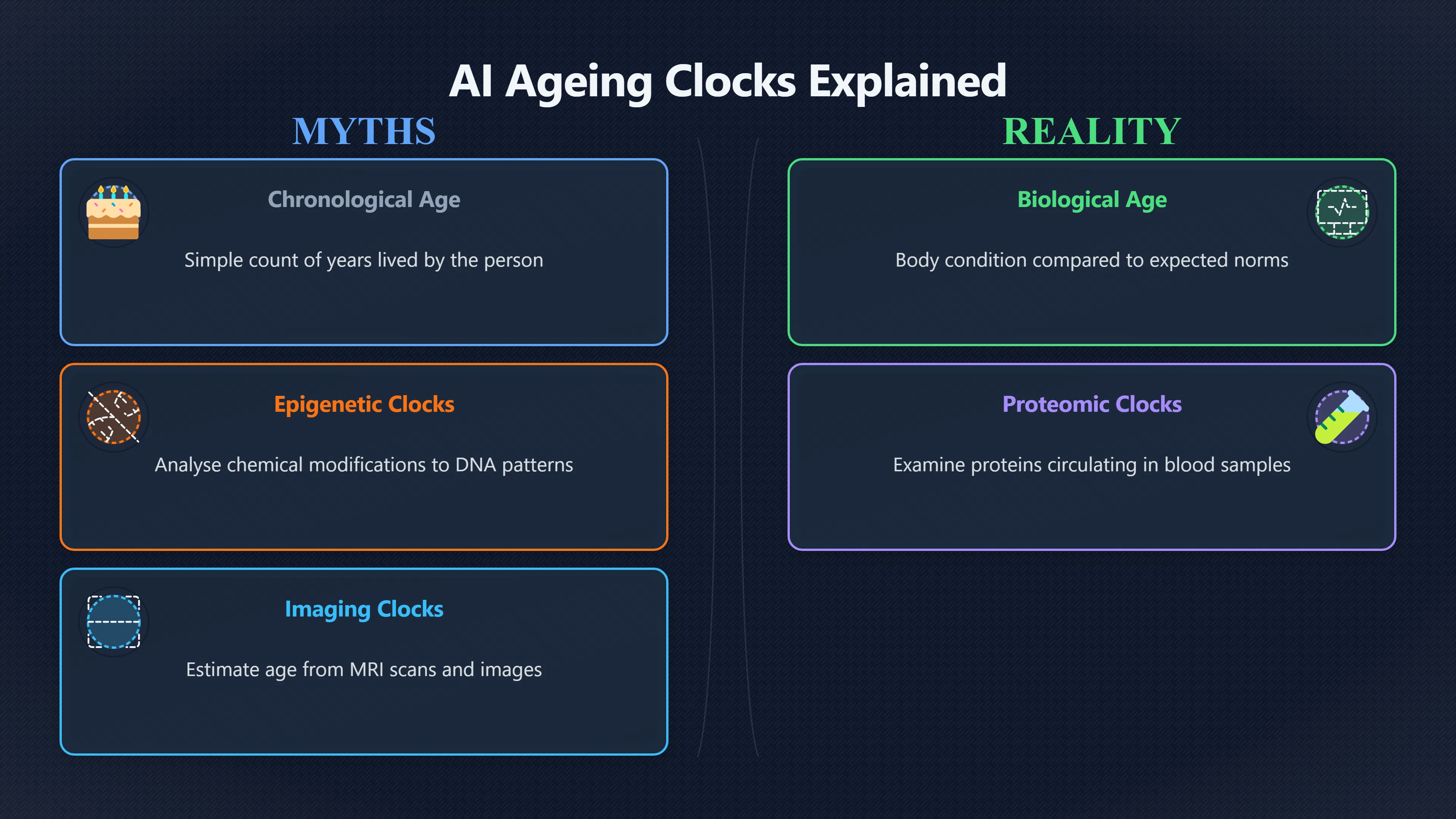
Chronological age is straightforward: it is how many years a person has lived. Biological age is more complicated. It refers to the condition of the body’s systems compared with what would normally be expected at a given age. Two people may both be 60 years old, but one may have cardiovascular, immune, metabolic, and cognitive systems that resemble a typical 50-year-old, while another resembles a typical 70-year-old.[Live Science]livescience.comHow do they work?August 29, 2025 — The article explores the concept of "aging clocks," tools designed to estimate biological age—how old…
Ageing clocks attempt to estimate this biological age. Most use machine learning to identify patterns that correlate with health outcomes, mortality risk, or future disease. Researchers train models on large datasets and ask them to predict age, disease risk, or rates of physiological decline from biological measurements.[Live Science]livescience.comHow do they work?August 29, 2025 — The article explores the concept of "aging clocks," tools designed to estimate biological age—how old…[PMC]pmc.ncbi.nlm.nih.govEpigenetic Clocks: Beyond Biological Age, Using the Past to…by R Liang · 2024 · Cited by 26 — Epigenetic clocks, which measure pred…
Different clocks use different inputs:[azolifesciences.com]azolifesciences.comStudy Reveals Limits of Epigenetic Clocks in Predicting Biological Age.aspxStudy Reveals Limits of Epigenetic Clocks in Predicting…Feb 13, 2025 — A recent study published in Aging Cell explored how the accurac…
- Epigenetic clocks analyse chemical modifications to DNA, especially DNA methylation patterns.
- Proteomic clocks examine proteins circulating in blood.
- Transcriptomic clocks study patterns of gene activity.
- Clinical clocks use ordinary laboratory tests and medical records.
- Imaging clocks estimate biological age from scans such as MRI images or other medical imaging data.
- Multi-omics clocks combine several biological layers at once. ScienceDirect[PMC]pmc.ncbi.nlm.nih.govEpigenetic Clocks: Beyond Biological Age, Using the Past to…by R Liang · 2024 · Cited by 26 — Epigenetic clocks, which measure pred…
AI matters because these signals are extraordinarily complex. Thousands of biomarkers may each contribute a small amount of information. Machine learning systems can find patterns across them that would be difficult for clinicians or researchers to detect directly.[ScienceDirect]sciencedirect.comDeep aging clocks: AI-powered strategies for biological…by L Srour · 2025 · Cited by 4 — In this review, we summarize the…[Aging-US]aging-us.comence (GenAI) are used in biomarker discovery, deep aging clock development.Read more…
Why epigenetic clocks became the flagship approach
The most influential ageing clocks are based on epigenetics, particularly DNA methylation. Certain methylation patterns change predictably over a lifetime. Researchers discovered that machine learning models could use these patterns to estimate age with surprising accuracy.[PMC]pmc.ncbi.nlm.nih.govEpigenetic Clocks: Beyond Biological Age, Using the Past to…by R Liang · 2024 · Cited by 26 — Epigenetic clocks, which measure pred…[PMC]pmc.ncbi.nlm.nih.govEpigenetic Clocks: Beyond Biological Age, Using the Past to…by R Liang · 2024 · Cited by 26 — Epigenetic clocks, which measure pred…
Over time, newer generations of clocks moved beyond estimating age alone. Models such as GrimAge, PhenoAge, and DunedinPACE were designed to predict outcomes more directly, including mortality risk, disease burden, and pace of ageing. MDPI[PMC]pmc.ncbi.nlm.nih.govEpigenetic Clocks: Beyond Biological Age, Using the Past to…by R Liang · 2024 · Cited by 26 — Epigenetic clocks, which measure pred…
This shift reflects an important realisation: a clock that merely predicts someone’s birthday is not especially useful. A clock becomes medically interesting only if it predicts future health better than conventional measures.
How early warning could change prevention
The strongest argument for ageing clocks is not that they can tell people how old they are biologically. It is that they might reveal elevated risk while intervention is still possible.
Many major diseases develop slowly. Atherosclerosis can build for decades before causing a heart attack. Neurodegenerative diseases often begin years before symptoms become obvious. Metabolic dysfunction accumulates gradually. By the time traditional diagnosis occurs, substantial damage may already exist.
If biological ageing measurements identify high-risk individuals earlier, several preventive strategies become possible:
- More intensive screening.
- Earlier lifestyle interventions.
- Faster identification of people suitable for preventive therapies.
- Better monitoring of whether interventions are working.
- More efficient clinical trials for anti-ageing or disease-prevention treatments. Nature[PMC]pmc.ncbi.nlm.nih.govEpigenetic Clocks: Beyond Biological Age, Using the Past to…by R Liang · 2024 · Cited by 26 — Epigenetic clocks, which measure pred…
This is where the broader AI bloom vision becomes visible in practical medicine. Instead of adding a few years of survival after disease emerges, AI-assisted prevention aims to delay the disease process itself. Even modest improvements in preventing age-related illness could create enormous gains in healthy life years across large populations.
Dementia prediction shows the attraction
One of the clearest examples comes from dementia research.
Researchers analysing UK Biobank data used AI methods to examine around 1,500 blood proteins and identify patterns associated with future dementia. The resulting model found several proteins linked to increased risk many years before diagnosis, with some signals appearing more than a decade in advance.[The Guardian]theguardian.comAnalysis of blood samples from over 50,000 volunteers in the UK Biobank revealed patterns of four proteins linked to dementia onset. Comb…
This kind of work is attractive because Alzheimer’s disease and related dementias are often detected relatively late. If reliable early-warning systems existed, patients could potentially receive interventions, monitoring, or future disease-modifying therapies earlier in the disease process.
The same logic extends beyond dementia. Researchers are investigating whether biological ageing measures can help forecast cardiovascular disease, metabolic disorders, frailty, respiratory illness, and other age-related conditions before symptoms become severe. Nature[PMC]pmc.ncbi.nlm.nih.govEpigenetic Clocks: Beyond Biological Age, Using the Past to…by R Liang · 2024 · Cited by 26 — Epigenetic clocks, which measure pred…
Why researchers care about ageing clocks even before clinical use
There is a second reason ageing clocks attract so much attention: they may accelerate longevity research itself.
Testing whether a treatment genuinely slows ageing is difficult. Human lifespans are long. Waiting decades to see whether an intervention reduces mortality makes research slow and expensive.
Researchers therefore want biomarkers that change much sooner than lifespan outcomes. If a therapy improves a validated biological ageing measure after months or years rather than decades, trials become faster and more practical.[PMC]pmc.ncbi.nlm.nih.govEpigenetic Clocks: Beyond Biological Age, Using the Past to…by R Liang · 2024 · Cited by 26 — Epigenetic clocks, which measure pred…
This could matter for the wider AI-enabled acceleration of science. Better biomarkers make experiments cheaper. Cheaper experiments allow more ideas to be tested. More testing increases the chance of finding interventions that genuinely improve healthspan.
In this sense, ageing clocks may become scientific infrastructure as much as clinical tools. Even if they never become routine consumer tests, they could help researchers evaluate potential therapies more efficiently.

Why biomarkers need clinical meaning
The central controversy is that predicting biological age is not the same thing as improving health.
A clock might estimate age extremely accurately yet still provide little useful information for patient care. If a model says someone has a biological age of 67 rather than 60, what exactly should happen next?
This problem has become one of the biggest debates in the field. Several recent reviews argue that many ageing clocks remain better at prediction than explanation. They identify statistical patterns associated with ageing, but often cannot clearly show which biological processes are being measured or which interventions should follow from the result. Nature[PMC]pmc.ncbi.nlm.nih.govEpigenetic Clocks: Beyond Biological Age, Using the Past to…by R Liang · 2024 · Cited by 26 — Epigenetic clocks, which measure pred…
Researchers increasingly distinguish between three different questions:
- Can the clock predict outcomes?
- Does the clock measure a real ageing process?
- Does changing the clock improve health?
The first question is often easier than the other two.
Correlation is not causation
Many ageing clocks detect correlations. People with certain biological signatures may have higher mortality risk or disease incidence. But that does not necessarily mean those signatures cause the problem.
A biomarker may function like a warning light on a car dashboard. The warning light predicts trouble, but repairing the light itself does not fix the engine.
The same concern applies to ageing clocks. A treatment might improve a clock score without delivering meaningful health benefits. Alternatively, a therapy might improve health while barely affecting the clock. Nature[PMC]pmc.ncbi.nlm.nih.govEpigenetic Clocks: Beyond Biological Age, Using the Past to…by R Liang · 2024 · Cited by 26 — Epigenetic clocks, which measure pred…
For prevention medicine, this distinction is critical. Doctors need evidence that acting on a biomarker leads to better outcomes, not merely different measurements.
Individual predictions remain difficult
Another challenge is variation between individuals.
Many clocks are trained on large populations and perform well statistically across thousands of people. But clinical medicine operates one patient at a time.
A review in npj Aging argued that ageing clocks face major problems involving uncertainty, inconsistent validation, and unclear clinical interpretation. Other researchers have similarly warned that current clocks often fail standards expected of medical tests used for individual treatment decisions.[Nature]nature.comRecommendations for biomarker data collection in clinical…by CMS Herzog · 2025 · Cited by 1 — Biomarkers of aging have the poten…
A model may identify elevated risk on average while still providing insufficient certainty for decisions about a specific person.
The move from whole-body clocks to organ-specific risk
One response to these limitations is greater precision.
Instead of asking whether a person is generally ageing faster, researchers increasingly try to estimate ageing in particular organs or systems. Separate models may assess cardiovascular ageing, immune ageing, cognitive ageing, liver ageing, or brain ageing. Nature[The Lancet]thelancet.comThe LancetImaging biomarkers of ageing: a review of artificial…18 Jul 2025 — In this Review, we highlight consistent associations betw…
This approach may be more clinically useful because prevention decisions are usually organ-specific.
For example:
- Accelerated cardiovascular ageing might justify earlier heart disease screening.
- Brain-age measurements could potentially support dementia risk assessment.
- Liver-age models may identify elevated risk before obvious disease develops.
- Imaging-based ageing models may detect structural decline invisible to routine assessment. Nature[The Lancet]thelancet.comThe LancetImaging biomarkers of ageing: a review of artificial…18 Jul 2025 — In this Review, we highlight consistent associations betw…
Researchers have also begun combining routine health records with AI-derived ageing measures. A 2025 study in Nature Medicine described a biological clock framework built partly from widely available clinical data rather than relying exclusively on specialised molecular testing.[Nature]nature.comAn unbiased comparison of 14 epigenetic clocks in relation…by C Mavrommatis · 2025 · Cited by 9 — Second- and third-generation e…
If such approaches work, they may prove easier to scale through existing healthcare systems.
The inequality question behind prevention
The optimistic version of AI-enabled prevention assumes that early detection becomes widely available.
The pessimistic version is more familiar. Wealthy patients receive expensive biological-age testing, personalised monitoring, and preventive interventions, while everyone else continues to receive treatment only after disease appears.
This distribution question matters because ageing clocks are often discussed within private longevity medicine, where access can already be expensive. The technology itself does not guarantee broader health gains.
The more transformative version of the AI bloom story would involve prevention becoming cheaper, more accurate, and more widely distributed. If AI models can extract useful ageing signals from routine blood tests, ordinary clinical records, or standard imaging, preventive medicine could potentially reach much larger populations than today’s boutique longevity services.[Nature]nature.comPrincipal component-based clinical aging clocks identify…by S Fong · 2024 · Cited by 70 — Clocks that measure biological age should pr…[Nature]nature.comDo we actually need aging clocks?npj Agingby D Kriukov · 2025 · Cited by 1 — Aging clocks use machine learning to estimate biological age as a proxy for general health…
Whether that happens depends less on the clocks themselves than on healthcare systems, incentives, regulation, and public access.
What would count as success?
The strongest future for AI ageing clocks is not a world where everyone obsessively tracks a biological-age score.
It is a world where those measurements become reliable enough to guide prevention. A successful ageing clock would identify elevated risk before illness develops, point towards interventions that reduce that risk, and demonstrate through long-term evidence that patients actually experience better outcomes.
Researchers are making progress towards that goal. Newer clocks increasingly predict mortality, disease incidence, and functional decline rather than age alone. Multi-omics approaches combine larger biological datasets. AI systems are finding patterns across blood tests, imaging, molecular data, and health records that may reveal earlier stages of disease.[The Lancet]thelancet.comThe LancetImaging biomarkers of ageing: a review of artificial…18 Jul 2025 — In this Review, we highlight consistent associations betw… [3Nature 3Nature]
But the field remains in a transitional stage. Many clocks are impressive research instruments without yet being proven clinical tools. The key challenge is not generating another biological-age number. It is demonstrating that the number helps doctors and patients make decisions that genuinely extend healthy life.
That distinction captures both the promise and the caution surrounding AI ageing clocks. They offer a glimpse of medicine that intervenes earlier, potentially years before disease becomes visible. Yet the real test is whether early warning translates into effective action. If it does, ageing clocks could become part of a broader shift from treating age-related disease to delaying its arrival — one of the most consequential pathways through which AI might contribute to longer, healthier human lives.
eBay marketplace picks
Marketplace Samples
Example marketplace items related to this page. Use the search link to explore similar finds on eBay.


Endnotes
1.
Source: pmc.ncbi.nlm.nih.gov
Link:https://pmc.ncbi.nlm.nih.gov/articles/PMC12539533/
Source snippet
Epigenetic Clocks: Beyond Biological Age, Using the Past to...by R Liang · 2024 · Cited by 26 — Epigenetic clocks, which measure pred...
2.
Source: pmc.ncbi.nlm.nih.gov
Link:https://pmc.ncbi.nlm.nih.gov/articles/PMC11552646/
Source snippet
biotechnology: bridging AI, biomarkers, geroscience...by YX Lyu · 2024 · Cited by 61 — These clocks often use a combination of biomarker...
3.
Source: sciencedirect.com
Link:https://www.sciencedirect.com/science/article/pii/S1568163725002351
Source snippet
Deep aging clocks: AI-powered strategies for biological...by L Srour · 2025 · Cited by 4 — In this review, we summarize the...
4.
Source: pmc.ncbi.nlm.nih.gov
Link:https://pmc.ncbi.nlm.nih.gov/articles/PMC13100650/
Source snippet
By addressing conceptual and...Read more...
5.
Source: aging-us.com
Link:https://www.aging-us.com/article/206190/text
Source snippet
ence (GenAI) are used in biomarker [discovery]({{ 'discovery/' | relative_url }}), deep aging clock development.Read more...
6.
Source: pmc.ncbi.nlm.nih.gov
Link:https://pmc.ncbi.nlm.nih.gov/articles/PMC11088934/
Source snippet
Biomarkers of Aging for the Identification and Evaluation of...by M Moqri · 2023 · Cited by 642 — In particular, epigenetic biomarker...
7.
Source: mdpi.com
Link:https://www.mdpi.com/2077-0383/14/10/3604
Source snippet
Epigenetic Clocks and EpiScore for Preventive Medicineby H Yamada · 2025 · Cited by 12 — This review explores the clinical potential...
8.
Source: nature.com
Link:https://www.nature.com/articles/s41514-025-00313-1
Source snippet
Recommendations for biomarker data collection in clinical...by CMS Herzog · 2025 · Cited by 1 — Biomarkers of aging have the poten...
9.
Source: nature.com
Link:https://www.nature.com/articles/s41467-025-66106-y
Source snippet
An unbiased comparison of 14 epigenetic clocks in relation...by C Mavrommatis · 2025 · Cited by 9 — Second- and third-generation e...
10.
Source: pmc.ncbi.nlm.nih.gov
Link:https://pmc.ncbi.nlm.nih.gov/articles/PMC12928021/
Source snippet
Clocks of Biological Aging and Risk of Incident...by S Nguyen · 2026 · Cited by 2 — Epigenetic clocks are DNA methylation (DNAm)‐based m...
11.
Source: nature.com
Link:https://www.nature.com/articles/s43587-024-00646-8
Source snippet
Principal component-based clinical aging clocks identify...by S Fong · 2024 · Cited by 70 — Clocks that measure biological age should pr...
12.
Source: nature.com
Title: Do we actually need aging clocks?
Link:https://www.nature.com/articles/s41514-025-00312-2
Source snippet
npj Agingby D Kriukov · 2025 · Cited by 1 — Aging clocks use machine learning to estimate biological age as a proxy for general health...
13.
Source: pmc.ncbi.nlm.nih.gov
Title: PMCFrom Population Science to the Clinic?
Link:https://pmc.ncbi.nlm.nih.gov/articles/PMC12714307/
Source snippet
Limits of Epigenetic...by AT Apsley · 2025 · Cited by 2 — We show that clocks fail to meet common standards for clinical utility compare...
14.
Source: mdpi.com
Link:https://www.mdpi.com/1422-0067/27/4/1908
Source snippet
Epigenetic Clocks, [Resilience]({{ 'resilience/' | relative_url }}), and Multi-Omics Ageingby H Yamada · 2026 · Cited by 3 — ” In this Review, we delineate the limitations of...
15.
Source: nature.com
Link:https://www.nature.com/articles/s41514-025-00207-2
Source snippet
While promising, the recent focus on molecular aspects should not detract from the functional...Read more...
16.
Source: nature.com
Link:https://www.nature.com/articles/s41514-025-00289-y
Source snippet
Cognitive aging clock based on Explainable artificial...by MI Krivonosov · 2025 — Biological clocks aim to estimate the physiologi...
17.
Source: nature.com
Link:https://www.nature.com/articles/s41591-025-04006-w
Source snippet
A full life cycle biological clock based on routine clinical...by K Wang · 2025 · Cited by 16 — Our study presents a novel framewo...
18.
Source: aging-us.com
Title: longevity biotechnology ai biomarkers geroscience applications for healthy aging
Link:https://www.aging-us.com/news-room/longevity-biotechnology-ai-biomarkers-geroscience-applications-for-healthy-aging
Source snippet
Longevity Biotechnology: AI, Biomarkers, Geroscience &...Oct 31, 2024 — “The fusion of AI with biomarker research has markedly revolutio...
19.
Source: aging-us.com
Link:https://www.aging-us.com/article/206098/text
Source snippet
A systematic review of phenotypic and epigenetic clocks...A key advantage of epigenetic clocks is their ability to provide robust aging...
20.
Source: nature.com
Link:https://www.nature.com/articles/s43587-025-00883-5
Source snippet
A blood-based epigenetic clock for intrinsic capacity...by M Fuentealba · 2025 · Cited by 33 — A blood-based epigenetic clock for intrin...
21.
Source: nature.com
Link:https://www.nature.com/articles/s43587-026-01066-6
Source snippet
Longitudinal changes in epigenetic clocks predict survival...by PL Kuo · 2026 · Cited by 5 — We found that faster increases in several c...
22.
Source: nature.com
Link:https://www.nature.com/nataging/
Source snippet
Nature Aging... reviews and opinion pieces on recent advances in reproductive aging research.... Multiple epigenetic clocks have been de...
23.
Source: nature.com
Link:https://www.nature.com/articles/s43587-025-01016-8
Source snippet
an-specific proteomic aging clocks predict disease and...by Y Wang · 2025 · Cited by 11 — Focusing on neurodegenerative diseases (NDs...
24.
Source: sciencedirect.com
Link:https://www.sciencedirect.com/science/article/pii/S1568163724003702
Source snippet
A systematic review and meta-analysis of epigenetic age...by O Chervova · 2024 · Cited by 57 — They were designed to predict chronologic...
25.
Source: sciencedirect.com
Link:https://www.sciencedirect.com/science/article/abs/pii/S0959440X24000046
Source snippet
Application of AI in biological age predictionby D Meng · 2024 · Cited by 21 — The most commonly used method to predict biological age is...
26.
Source: sciencedirect.com
Link:https://www.sciencedirect.com/science/article/pii/S1471491425002576
Source snippet
Predicting healthspan and disease risks through biological...by G Li · 2025 · Cited by 5 — Aging clocks offer precise measures of biolog...
27.
Source: sciencedirect.com
Link:https://www.sciencedirect.com/science/article/pii/S1063458425010234
Source snippet
more...
28.
Source: livescience.com
Link:https://www.livescience.com/health/ageing/aging-clocks-tell-you-how-much-older-you-are-than-your-chronological-age-how-do-they-work
Source snippet
How do they work?August 29, 2025 — The article explores the concept of "aging clocks," tools designed to estimate biological age—how old...
Published: August 29, 2025
29.
Source: theguardian.com
Link:https://www.theguardian.com/society/2024/feb/12/early-blood-test-to-predict-dementia-is-step-closer-as-biological-markers-identified
Source snippet
Analysis of blood samples from over 50,000 volunteers in the UK Biobank revealed patterns of four proteins linked to dementia onset. Comb...
30.
Source: thelancet.com
Link:https://www.thelancet.com/journals/lanhl/article/PIIS2666-7568%2825%2900047-9/fulltext?rss=yes
Source snippet
The LancetImaging biomarkers of ageing: a review of artificial...18 Jul 2025 — In this Review, we highlight consistent associations betw...
31.
Source: Wikipedia
Link:https://en.wikipedia.org/wiki/Ageing
Source snippet
AgeingAgeing is the process of becoming older. The term refers mainly to humans, many other animals, and fungi; whereas for example, b...
Additional References
32.
Source: researchgate.net
Link:https://www.researchgate.net/publication/332352097_The_epigenetic_clock_as_a_predictor_of_disease_and_mortality_risk_A_systematic_review_and_meta-analysis
Source snippet
(PDF) The epigenetic clock as a predictor of disease and...Apr 13, 2019 — The aims of this systematic review were to identify and synthe...
33.
Source: verseon.com
Link:https://www.verseon.com/news-systematic-review-of-phenotypic-and-epigenetic-clocks-used-for-aging-and-mortality-quantification-in-humans.html
Source snippet
The Current State of Predicting Mortality and DiseaseAug 30, 2024 — This review aimed to systematically survey all proposed epigenetic an...
34.
Source: linkedin.com
Link:https://www.linkedin.com/pulse/whats-science-longevity-what-does-matter-tony-medrano-poczc
35.
Source: nad.com
Link:https://www.nad.com/news/ai-analyzes-millions-of-molecular-profiles-to-uncover-overlooked-aging-interventions
Source snippet
AI Analyzes Millions of Molecular Profiles to Uncover...8 Dec 2025 — A new AI platform has uncovered hundreds of pro-longevity agents ba...
36.
Source: institute-genetics-cancer.ed.ac.uk
Link:https://institute-genetics-cancer.ed.ac.uk/second-generation-epigenetic-clocks-show-greater-promise-for-disease-risk-prediction
Source snippet
ed.ac.ukSecond-generation epigenetic clocks show greater promise...Dec 17, 2025 — The study found that several second and third-generati...
37.
Source: azolifesciences.com
Title: Study Reveals Limits of Epigenetic Clocks in Predicting Biological Age.aspx
Link:https://www.azolifesciences.com/news/20250213/Study-Reveals-Limits-of-Epigenetic-Clocks-in-Predicting-Biological-Age.aspx
Source snippet
Study Reveals Limits of Epigenetic Clocks in Predicting...Feb 13, 2025 — A recent study published in Aging Cell explored how the accurac...
38.
Source: patsnap.com
Title: epigenetic clock aging biomarkers 2026 patsnap eureka
Link:https://www.patsnap.com/resources/blog/rd-blog/epigenetic-clock-aging-biomarkers-2026-patsnap-eureka/
Source snippet
Epigenetic Clock Aging Biomarker Technology Landscape23 Apr 2026 — DNA methylation clocks have emerged as the most robust aging biomarker...
39.
Source: ubiehealth.com
Link:https://ubiehealth.com/doctors-note/biological-age-epigenetic-clocks-longevity99-aging21e2
Source snippet
Ubie2 Feb 2026 — This article explains Biological Age in clear, practical terms, with a focus on epigenetic clocks and other longevity bi...
40.
Source: facebook.com
Link:https://www.facebook.com/NUSMedicine/posts/associate-professor-jan-gruber-from-the-healthy-longevity-translational-research/883996057104408/
Source snippet
ical and molecular parameters to estimate a person's biological age.Read more...
41.
Source: facebook.com
Link:https://www.facebook.com/XinhuaSciTech/posts/a-team-of-chinese-researchers-has-built-a-computational-framework-to-study-aging/1470051428490587/
Source snippet
lp researchers predict biological age as well as mortality of...Read more...
Topic Tree