Within Industrial Robotics
How Wearable Exoskeletons Protect Workers in Industry
Exoskeletons reduce strain and cumulative injury for workers lifting, bending, or performing repetitive industrial tasks.
On this page
- Mechanical designs for lifting and support
- Applications in factories and construction
- Evidence on reducing fatigue and injury
Page outline Jump by section
Introduction
Wearable industrial exoskeletons are one of the clearest examples of AI-enabled robotics augmenting workers rather than replacing them. Instead of sending a fully autonomous machine to do a task, an exoskeleton places mechanical support directly on the worker’s body, helping with lifting, overhead work, bending, carrying and other physically demanding movements. The goal is not superhuman strength. It is reducing strain, fatigue and the cumulative injuries that make industrial work one of the largest sources of musculoskeletal disorders worldwide.
 In the broader vision of AI-enabled robotics for hazardous industrial tasks, exoskeletons occupy a distinctive middle ground. They keep human judgement, dexterity and situational awareness in the loop while offloading some of the physical burden. If dangerous and exhausting labour can increasingly be assisted by intelligent machines, that offers an early glimpse of a larger AI abundance question: can technology reduce the amount of human life spent on pain, injury and physical wear without reducing people’s ability to participate in productive work? The answer remains uncertain, but industrial exoskeletons provide one of the most practical real-world tests of that idea.[PMC]pmc.ncbi.nlm.nih.govexoskeletons: A roadmap toward large-scale…by S Crea · 2021 · Cited by 264 — This paper reviews present-day scientific methods for ass…
How Industrial Exoskeletons Actually Work
Industrial exoskeletons are wearable mechanical systems that redistribute forces away from vulnerable joints and muscles. Most current systems are not science-fiction powered suits. They are relatively lightweight devices designed to support specific body regions.
Three broad categories dominate industrial use:
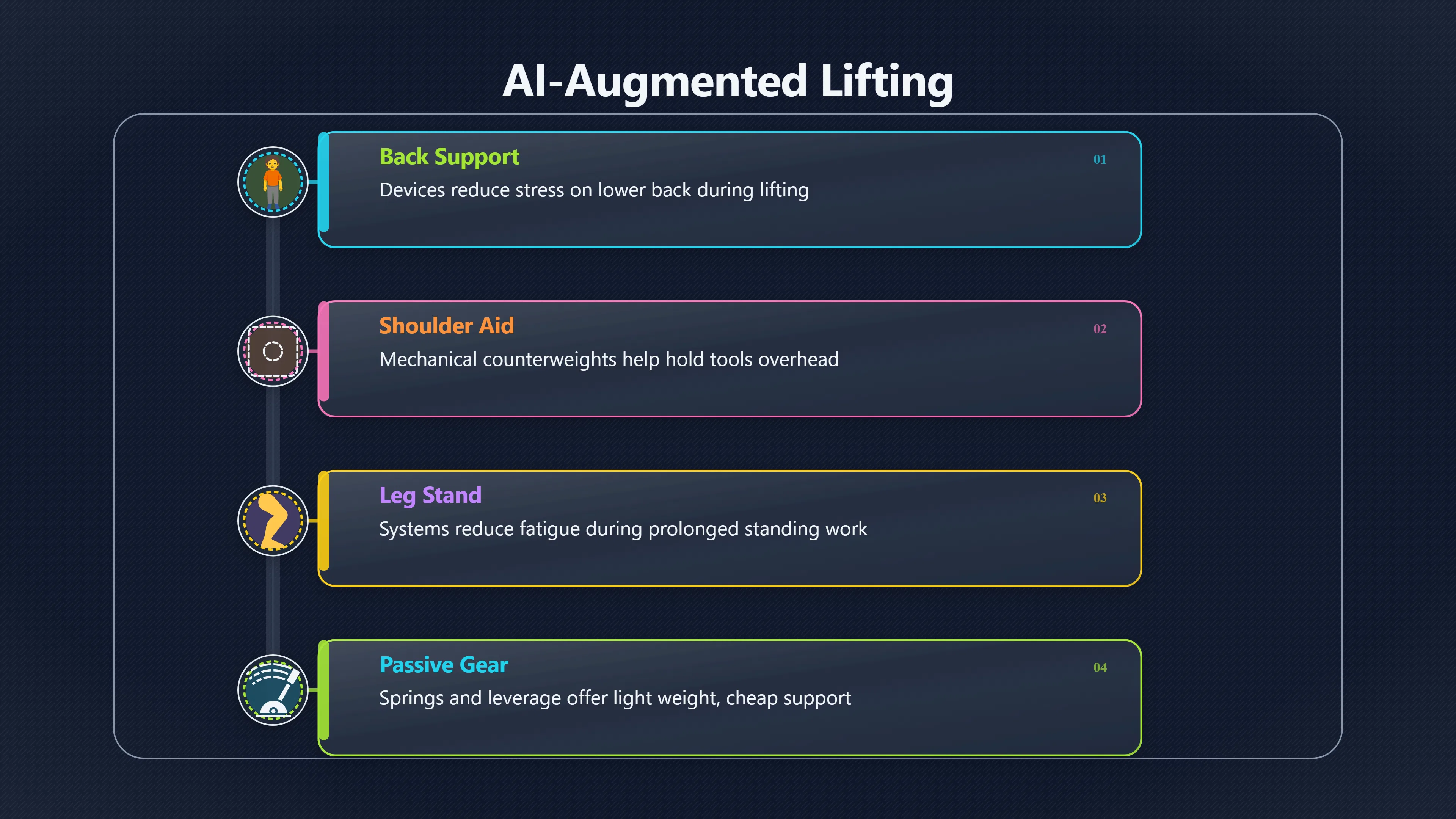
- Back-support exoskeletons, which reduce stress on the lower back during lifting and repetitive bending.
- Shoulder-support exoskeletons, which help workers performing overhead tasks such as drilling, welding, assembly or painting.
- Leg and sit-stand support systems, which reduce fatigue during prolonged standing, crouching or semi-seated work.
Some systems are passive, using springs, elastic elements and mechanical leverage. Others are active, using motors, sensors and control software to provide adjustable assistance. Passive systems tend to be lighter, cheaper and easier to deploy. Active systems can provide greater support but require batteries, control systems and more complex maintenance.[PMC]pmc.ncbi.nlm.nih.govExoskeletons: Contribution to Occupational Health and Safetyby O Flor-Unda · 2023 · Cited by 40 — Exoskeletons have significantly impr…[MDPI]mdpi.comOpen source on mdpi.com.
The key engineering challenge is subtle. An exoskeleton must reduce load without interfering with natural movement. A device that helps a worker lift a heavy object but restricts walking, climbing or turning can simply move risk elsewhere in the body. This is why modern designs increasingly focus on human-machine interaction rather than raw mechanical strength. ScienceDirect[Research Repository]researchrepository.ul.ieCommercially, industrial exoskeletons…Read more…
Why AI Matters Beyond Mechanical Assistance
The simplest exoskeletons contain little or no artificial intelligence. Yet AI is becoming increasingly important as developers attempt to make support more adaptive and less intrusive.
Traditional systems provide fixed levels of assistance. More advanced designs use sensors, machine vision, motion tracking and predictive software to determine what a worker is doing and how much support is needed. Rather than continuously applying force, they attempt to anticipate movement.
Recent research has explored computer-vision systems that estimate payload weight, identify lifting tasks and adjust support in real time. Other projects combine wearable cameras, gaze tracking and AI-based object recognition to predict when a worker is preparing to lift an item, allowing assistance to begin earlier and more smoothly. Researchers have reported reductions in muscle activation and improvements in perceived comfort when intelligent control systems are added.[arXiv]arxiv.orgFrom Vision to Assistance: Gaze and Vision-Enabled Adaptive Control for a Back-Support ExoskeletonFebruary 4, 2026…
This shift mirrors a broader pattern across industrial robotics. The value increasingly comes not only from mechanical hardware but from systems that understand context. In the long run, AI-enabled exoskeletons may become part of larger workplace ecosystems that integrate computer vision, digital twins, ergonomic monitoring and predictive safety systems.
Where Exoskeletons Are Being Used
Factories and Assembly Lines
Manufacturing environments were among the earliest testing grounds because many tasks involve repetitive motion rather than unpredictable terrain.
Automotive assembly plants have experimented extensively with shoulder-support exoskeletons for workers installing components above head height. Such tasks can require thousands of arm-elevation movements per shift, creating long-term shoulder strain. Exoskeletons effectively act as a mechanical counterweight, reducing the muscular effort required to hold tools or components overhead.[Frontiers]frontiersin.orgdustrial exoskeletons from bench to fieldby A Baldassarre · 2022 · Cited by 94 — A systematic review has been carried out to a…
The appeal is straightforward: companies can often reduce fatigue without redesigning entire production lines. For ageing workforces in particular, the possibility of extending healthy working years is a major attraction.[PMC]pmc.ncbi.nlm.nih.govthe evidence on occupational exoskeleton use for…by S Bhat · 2025 · Cited by 3 — Biomechanical research continues to highlight the pot…
Warehouses and Logistics
Warehouses involve some of the most repetitive lifting in modern industry. Workers may handle hundreds or thousands of items per shift, creating substantial cumulative stress on the lower back.
Back-support exoskeletons are increasingly being tested in distribution centres, order-picking operations and logistics facilities. Recent deployment studies have reported notable reductions in reported strain injuries, although researchers continue to debate how broadly such findings generalise across different workplaces and device designs.[Risk & Insurance]riskandinsurance.comexosuit study demonstrates 62 reduction in warehouse back injuriesRisk & InsuranceExosuit Study Demonstrates 62% Reduction in Warehouse…26 Jan 2026 — The findings revealed a striking outcome: total st…
The warehouse sector is particularly significant because it sits at the intersection of robotics and human labour. Fully autonomous warehouses remain difficult and expensive in many settings. Exoskeletons offer a different path: augmenting workers instead of replacing them.
Construction and Infrastructure
Construction presents a harder environment than manufacturing because tasks are more variable and sites change constantly.
Workers may carry materials across uneven ground, climb ladders, crouch in confined spaces and perform lifting tasks that differ from hour to hour. These conditions make exoskeleton design more difficult, but they also create a strong need for ergonomic support.
Construction researchers have identified substantial potential benefits in reducing musculoskeletal injuries, which remain one of the industry’s most persistent safety problems. Recent studies suggest exoskeletons can reduce fatigue and muscle loading during demanding tasks, though effectiveness varies significantly depending on the activity and the design of the device.[CDC Stacks]stacks.cdc.govPotential of Exoskeleton Technologies to Enhance Safety…by A Akanmu · 2019 · Cited by 246 — Potential of Exoskeleton Technologi…[MDPI]mdpi.comEvaluation of Worker Fatigue During Exoskeleton-Assisted…by D Jo · 2025 · Cited by 1 — This study shows that exoskeleton support signi…
What the Evidence Actually Shows
The strongest evidence does not yet show that exoskeletons eliminate workplace injuries. Instead, it suggests they can reduce biomechanical loads associated with injury risk.
A large body of laboratory and field research has found reductions in muscle activity, joint loading and perceived exertion when workers use appropriately matched exoskeletons for specific tasks. Multiple systematic reviews conclude that occupational exoskeletons can reduce physical strain and may help prevent work-related musculoskeletal disorders, especially in repetitive lifting and overhead work.[PMC]pmc.ncbi.nlm.nih.govFatigue assessment for back-support exoskeletons during…by X Xiang · 2024 · Cited by 4 — We aimed to develop a method that combines…[PMC]pmc.ncbi.nlm.nih.govexoskeletons: A roadmap toward large-scale…by S Crea · 2021 · Cited by 264 — This paper reviews present-day scientific methods for ass…[PMC]pmc.ncbi.nlm.nih.govExoskeletons: Contribution to Occupational Health and Safetyby O Flor-Unda · 2023 · Cited by 40 — Exoskeletons have significantly impr…
Researchers frequently measure:
- Lower activation of back and shoulder muscles.
- Reduced fatigue during repetitive tasks.[mdpi.com]mdpi.comEvaluation of Worker Fatigue During Exoskeleton-Assisted…by D Jo · 2025 · Cited by 1 — This study shows that exoskeleton support signi…
- Lower spinal loading during lifting.
- Improved endurance during prolonged physical work.
- Reduced worker perception of exertion.
Back-support systems have shown particularly promising results in reducing lumbar muscle activity and delaying fatigue accumulation during lifting tasks.[PMC]pmc.ncbi.nlm.nih.govthe evidence on occupational exoskeleton use for…by S Bhat · 2025 · Cited by 3 — Biomechanical research continues to highlight the pot…[ScienceDirect]sciencedirect.comInsights into evaluating and using industrial exoskeletonsby L Ralfs · 2023 · Cited by 34 — Especially in industrial workpla…
At the same time, occupational health researchers repeatedly emphasise that reducing muscle activity is not identical to preventing injuries. Long-term workplace studies remain relatively limited, and outcomes vary by worker, task and device design. NIOSH, the US National Institute for Occupational Safety and Health, has consistently urged caution about assuming broad injury-prevention benefits before stronger evidence accumulates.[CDC]cdc.govexoskeletons health equityExoskeletons and Occupational Health EquityDec 14, 2020 — Poor fitting exoskeleton suits can cause awkward working postures and thus…
Why Some Trials Produce Mixed Results
One reason exoskeleton research can appear contradictory is that support in one area can sometimes create new stresses elsewhere.
An exoskeleton that reduces lower-back loading may alter hip movement. A shoulder-support system may change neck posture. Poorly fitted equipment can encourage awkward compensatory movements. Some studies have found workers responding differently to the same device, with benefits for some users and minimal gains for others.[CDC]stacks.cdc.govPotential of Exoskeleton Technologies to Enhance Safety…by A Akanmu · 2019 · Cited by 246 — Potential of Exoskeleton Technologi…[ScienceDirect]sciencedirect.comAbility of a passive back support exoskeleton to mitigate…by EJ Ratke · 2025 · Cited by 7 — While these findings generally support the…
Several recurring challenges appear across the literature:
- Fit and body diversity: many devices were initially designed around limited body-size assumptions.
- Comfort: heat, pressure points and restricted movement can reduce adoption.
- Task mismatch: a device effective for one task may hinder another.
- Training requirements: workers often need time to adapt their movement patterns.
- Long-term acceptance: workers may reject systems they perceive as uncomfortable or intrusive.
Research on occupational health equity has also highlighted concerns that poor fit can disproportionately affect women and workers whose body dimensions differ from the design assumptions used during development.[CDC]cdc.govindustrial exoskeletonsIndustrial Exoskeletons | NIOSH Science Bulletin7 Jan 2020 — Summary: A new commentary, summarized below, highlights some of the poten…
These issues matter because industrial exoskeletons are not simply machines. They are machines attached directly to human bodies for hours at a time.
Could Exoskeletons Change the Nature of Physical Labour?
The most ambitious claims about exoskeletons often focus on productivity. The more consequential question may be health.
Musculoskeletal disorders are among the most common causes of work-related pain, disability and lost productivity worldwide. Many industrial workers accumulate injuries gradually over years rather than through dramatic accidents. If wearable robotics can meaningfully reduce that burden, the impact may extend beyond individual workplaces.
In the context of AI bloom and long-term human flourishing, exoskeletons matter because they point toward a broader possibility: advanced technology making physically demanding work less damaging to the human body. Rather than treating pain, fatigue and repetitive injury as unavoidable costs of industrial civilisation, wearable robotics suggests that some of those costs may be engineering problems.
That does not imply a future without physical work. Construction, maintenance, manufacturing and infrastructure development are likely to remain important for decades. The more realistic vision is that workers increasingly operate alongside intelligent machines that absorb the most harmful aspects of those tasks.
Industrial exoskeletons remain an early-stage technology rather than a proven revolution. Yet they offer a tangible example of how AI-assisted robotics can shift technological progress away from pure efficiency and toward a different goal: reducing the amount of human wear, injury and exhaustion required to keep society functioning.[Frontiers]frontiersin.orgdustrial exoskeletons from bench to fieldby A Baldassarre · 2022 · Cited by 94 — A systematic review has been carried out to a…[PMC]pmc.ncbi.nlm.nih.govFatigue assessment for back-support exoskeletons during…by X Xiang · 2024 · Cited by 4 — We aimed to develop a method that combines…
Amazon book picks
Further Reading
Books and field guides related to How Wearable Exoskeletons Protect Workers in Industry. Use these as the next step if you want deeper reading beyond the article.
Human + Machine
Fits exoskeletons as a case of machines supporting rather than replacing workers.
Make It Stick
Supports the training and skill adaptation side of workers using wearable robotics.
Introduction to Robotics
Provides fundamentals of robotics and mechanical assistance relevant to exoskeleton design.
eBay marketplace picks
Marketplace Samples
Example marketplace items related to this page. Use the search link to explore similar finds on eBay.



Endnotes
1.
Source: pmc.ncbi.nlm.nih.gov
Link:https://pmc.ncbi.nlm.nih.gov/articles/PMC10936259/
Source snippet
exoskeletons: A roadmap toward large-scale...by S Crea · 2021 · Cited by 264 — This paper reviews present-day scientific methods for ass...
2.
Source: mdpi.com
Link:https://www.mdpi.com/2313-7673/10/5/337
3.
Source: sciencedirect.com
Link:https://www.sciencedirect.com/science/article/pii/S0169814123000860
Source snippet
Insights into evaluating and using industrial exoskeletonsby L Ralfs · 2023 · Cited by 34 — Especially in industrial workpla...
4.
Source: cdc.gov
Title: exoskeletons health equity
Link:https://www.cdc.gov/niosh/bulletin/2020/exoskeletons-health-equity.html
Source snippet
Exoskeletons and Occupational Health EquityDec 14, 2020 — Poor fitting exoskeleton suits can cause awkward working postures and thus...
5.
Source: arxiv.org
Link:https://arxiv.org/abs/2602.04648
Source snippet
From Vision to Assistance: Gaze and Vision-Enabled Adaptive Control for a Back-Support ExoskeletonFebruary 4, 2026...
Published: February 4, 2026
6.
Source: arxiv.org
Link:https://arxiv.org/abs/2508.06207
7.
Source: pmc.ncbi.nlm.nih.gov
Link:https://pmc.ncbi.nlm.nih.gov/articles/PMC10647659/
Source snippet
Exoskeletons: Contribution to Occupational Health and Safetyby O Flor-Unda · 2023 · Cited by 40 — Exoskeletons have significantly impr...
8.
Source: pmc.ncbi.nlm.nih.gov
Link:https://pmc.ncbi.nlm.nih.gov/articles/PMC12569392/
Source snippet
the evidence on occupational exoskeleton use for...by S Bhat · 2025 · Cited by 3 — Biomechanical research continues to highlight the pot...
9.
Source: stacks.cdc.gov
Link:https://stacks.cdc.gov/view/cdc/226220
Source snippet
Potential of Exoskeleton Technologies to Enhance Safety...by A Akanmu · 2019 · Cited by 246 — Potential of Exoskeleton Technologi...
10.
Source: mdpi.com
Link:https://www.mdpi.com/2075-5309/15/9/1503
Source snippet
Evaluation of Worker Fatigue During Exoskeleton-Assisted...by D Jo · 2025 · Cited by 1 — This study shows that exoskeleton support signi...
11.
Source: sciencedirect.com
Link:https://www.sciencedirect.com/science/article/pii/S0021929025000648
Source snippet
Ability of a passive back support exoskeleton to mitigate...by EJ Ratke · 2025 · Cited by 7 — While these findings generally support the...
12.
Source: pmc.ncbi.nlm.nih.gov
Link:https://pmc.ncbi.nlm.nih.gov/articles/PMC11461313/
Source snippet
Fatigue assessment for back-support exoskeletons during...by X Xiang · 2024 · Cited by 4 — We aimed to develop a method that combines...
13.
Source: cdc.gov
Title: industrial exoskeletons
Link:https://www.cdc.gov/niosh/bulletin/2020/industrial-exoskeletons.html
Source snippet
Industrial Exoskeletons | NIOSH Science Bulletin7 Jan 2020 — Summary: A new commentary, summarized below, highlights some of the poten...
14.
Source: cdc.gov
Link:https://www.cdc.gov/niosh/bulletin/2016/xoskeletons.html
Source snippet
Wearable Exoskeletons to Reduce Physical Load at Work4 Mar 2016 — Summary: This blog aims to: (1) describe wearable exoskeletons in the c...
15.
Source: sciencedirect.com
Link:https://www.sciencedirect.com/science/article/pii/S000368702600044X
Source snippet
•. 34.8% of construction workers showed adverse postural responses...Read more...
16.
Source: arxiv.org
Link:https://arxiv.org/abs/2408.02852
17.
Source: cdc.gov
Link:https://www.cdc.gov/niosh/index.html
18.
Source: cdc.gov
Title: exoskeletons construction
Link:https://www.cdc.gov/niosh/bulletin/2022/exoskeletons-construction.html
Source snippet
Exoskeletons: Potential for Preventing Work-related...Feb 3, 2022 — This study utilized a modular-type exoskeleton system and correspond...
19.
Source: mdpi.com
Link:https://www.mdpi.com/2076-3417/14/1/84
Source snippet
The study includes a thorough evaluation of the current literature on occupational...Read...
20.
Source: sciencedirect.com
Link:https://www.sciencedirect.com/science/article/pii/S0926580524004783
Source snippet
Analyzing muscle fatigue, metabolic cost, ergonomic risks...by A Ojha · 2024 · Cited by 33 — A user-centered experiment assessed the imp...
21.
Source: nature.com
Link:https://www.nature.com/articles/s44172-024-00180-w
Source snippet
Lightweight active back exosuit reduces muscular effort...by J Chung · 2024 · Cited by 32 — To date, only one study provides evidence th...
22.
Source: researchrepository.ul.ie
Link:https://researchrepository.ul.ie/bitstreams/a4a0df03-9078-46bc-ad48-73c04174a45e/download
Source snippet
Commercially, industrial exoskeletons...Read more...
23.
Source: frontiersin.org
Link:https://www.frontiersin.org/journals/public-health/articles/10.3389/fpubh.2022.1039680/full
Source snippet
dustrial exoskeletons from bench to fieldby A Baldassarre · 2022 · Cited by 94 — A systematic review has been carried out to a...
24.
Source: riskandinsurance.com
Title: exosuit study demonstrates 62 reduction in warehouse back injuries
Link:https://riskandinsurance.com/exosuit-study-demonstrates-62-reduction-in-warehouse-back-injuries/
Source snippet
Risk & InsuranceExosuit Study Demonstrates 62% Reduction in Warehouse...26 Jan 2026 — The findings revealed a striking outcome: total st...
25.
Source: play.google.com
Link:https://play.google.com/store/apps/details?hl=en&id=com.samsung.android.app.watchmanager
Source snippet
Wearable - Apps on Google PlayThe Galaxy Wearable application connects your wearable devices to your mobile device. It also manages and m...
Additional References
26.
Source: researchgate.net
Link:https://www.researchgate.net/publication/398585734_Evaluating_the_Impact_of_Back-Support_Exoskeletons_on_Construction_Workers%27_Fall_Risk
Source snippet
Evaluating the Impact of Back-Support Exoskeletons on...Dec 23, 2025 — Evaluating the Impact of Back-Support Exoskeletons on Constructio...
27.
Source: researchgate.net
Link:https://www.researchgate.net/publication/401656075_Investigating_the_effects_of_back-support_exoskeletons_on_work_posture_An_automated_AI-based_NIOSH_measurement_using_YOLO
Source snippet
Investigating the effects of back-support exoskeletons on...7 Mar 2026 — Using YOLO v11 pose estimation to analyze 351,615 video frames...
28.
Source: imnovation-hub.com
Link:https://www.imnovation-hub.com/science-and-technology/exoskeleton-work-injuries
Source snippet
A Promising Exoskeleton to Tackle Workplace Back StrainDesigned for environments requiring heavy lifting, the BBEX demonstrated its abili...
29.
Source: wareable.com
Link:https://www.wareable.com/
Source snippet
HomepageNews · Reviews · Features · Smartwatches · Wear OS · Apple Watch · Samsung · Fitbit · Fitness trackers · Health and wel...
30.
Source: merriam-webster.com
Link:https://www.merriam-webster.com/dictionary/occupational
Source snippet
OCCUPATIONAL Definition & Meaning1. of or relating to a job or occupation; occupational choices; occupational training/skills; occupation...
31.
Source: linkedin.com
Link:https://www.linkedin.com/posts/stefanotoxiri_pdf-investigating-the-effects-of-back-support-activity-7438645045664292864-A_Mv
Source snippet
Stefano Toxiri's PostEXOSKELETONS REDUCE STRAIN IN THE WORKPLACE We know this. Evidence that exoskeletons are effective at biomechanicall...
32.
Source: vbn.aau.dk
Link:https://vbn.aau.dk/ws/portalfiles/portal/781254790/PHD_LSJ_ONLINE.pdf
Source snippet
aau.dkPHD_LSJ_ONLINE.pdfAssistive technologies, such as exoskeletons, offer the potential to reduce the physical load on workers and ther...
33.
Source: emerald.com
Link:https://www.emerald.com/ci/article/25/4/1231/1254680/The-potential-of-exoskeletons-in-construction
Source snippet
(2007) reported that arm-support exoskeleton reduces the muscular fatigue of carpentry workers by providing suitable assistive...Read more...
34.
Source: hammer.purdue.edu
Link:https://hammer.purdue.edu/articles/thesis/ARTIFICIAL_INTELLIGENCE_POWERED_PHYSICAL_FATIGUE_ANALYSIS_OF_TRANSPORTATION_WORKFORCES/23523483
Source snippet
INTELLIGENCE POWERED PHYSICAL...by X Guo · 2023 · Cited by 2 — The results from field experiments revealed several key findings: (1) The...
35.
Source: seco.admin.ch
Link:https://www.seco.admin.ch/dam/seco/de/dokumente/Publikationen_Dienstleistungen/Publikationen_Formulare/Arbeit/Arbeitsbedingungen/studien_berichte/report_zhaw_occupational_exoskeletons_2024.pdf.download.pdf/report_zhaw_occupational_exoskeletons_2024.pdf
Source snippet
Marino et al. [24] reported agreement on reduced work-related fatigue 4 of 5 [IQR 4, 5] for a back...Read more...
Topic Tree