Within Access gap
Can public healthcare make AI care fair?
AI-guided medicine needs strong primary care, digital records and auditing before it can improve health at population scale.
On this page
- Why software alone is not enough
- Primary care, records and follow up as the real infrastructure
- Auditing AI outcomes after deployment
Page outline Jump by section
Introduction
AI-guided medicine is often presented as a path towards longer, healthier lives. But population-wide health gains do not come from algorithms alone. An AI system can identify a patient at risk of cancer, heart disease, medication error, or dementia years earlier than traditional methods, yet that prediction only matters if someone receives follow-up care, treatment, monitoring, and support. The central question for fair AI healthcare is therefore not only whether the technology works, but whether public health systems can turn predictions into real improvements in people’s lives.
 This matters for the wider debate about AI-guided longevity and human flourishing. If advanced medical AI remains concentrated in elite hospitals, private clinics, or wealthy countries, then gains in healthy lifespan could become another source of inequality. If public healthcare systems can build the infrastructure to deploy AI safely and broadly, the same technologies could help reduce some existing health gaps instead of widening them. The challenge is less about creating smarter software than about building institutions capable of using it well.
Why software alone is not enough
Many discussions of AI medicine focus on model performance: diagnostic accuracy, prediction scores, or benchmark results. Health systems, however, operate through workflows, staff, budgets, records, referrals, and patient relationships.
A predictive model that flags high-risk patients generates little value if those patients cannot access appointments. An AI screening tool cannot improve cancer outcomes if scans are delayed, specialist capacity is limited, or patients are lost between diagnosis and treatment. Healthcare repeatedly demonstrates that implementation matters as much as invention.
Researchers studying AI adoption in primary care increasingly argue that success depends on governance, workforce readiness, financing, infrastructure, and integration with existing services rather than technological capability alone.[PMC]pmc.ncbi.nlm.nih.govPMCDeploying artificial intelligence software in an NHS trustartificial intelligence software in an NHS trust - PMCby SR Blake · 2023 · Cited by 8 — This article set out clear guidance on the practi…
This creates an important distinction in the broader AI bloom discussion. The optimistic vision is not merely that AI becomes intelligent enough to identify disease earlier. It is that societies become capable of translating intelligence into population-scale health improvements. That requires functioning public systems.
The history of public health offers a useful comparison. Clean water, vaccination campaigns, sanitation networks, and primary care systems produced enormous gains in life expectancy because they reached entire populations. Their power came from scale and coverage rather than from benefiting only a small group of early adopters. AI-guided medicine faces a similar test.
Primary care, records and follow-up as the real infrastructure
Strong primary care is where most health gains happen
Many of the diseases associated with reduced lifespan are not primarily solved in specialist hospitals. Cardiovascular disease, diabetes, respiratory illness, hypertension, obesity, medication interactions, and many cancers are heavily influenced by prevention, early detection, and long-term management.
This means primary care often becomes the crucial layer between AI prediction and improved outcomes.
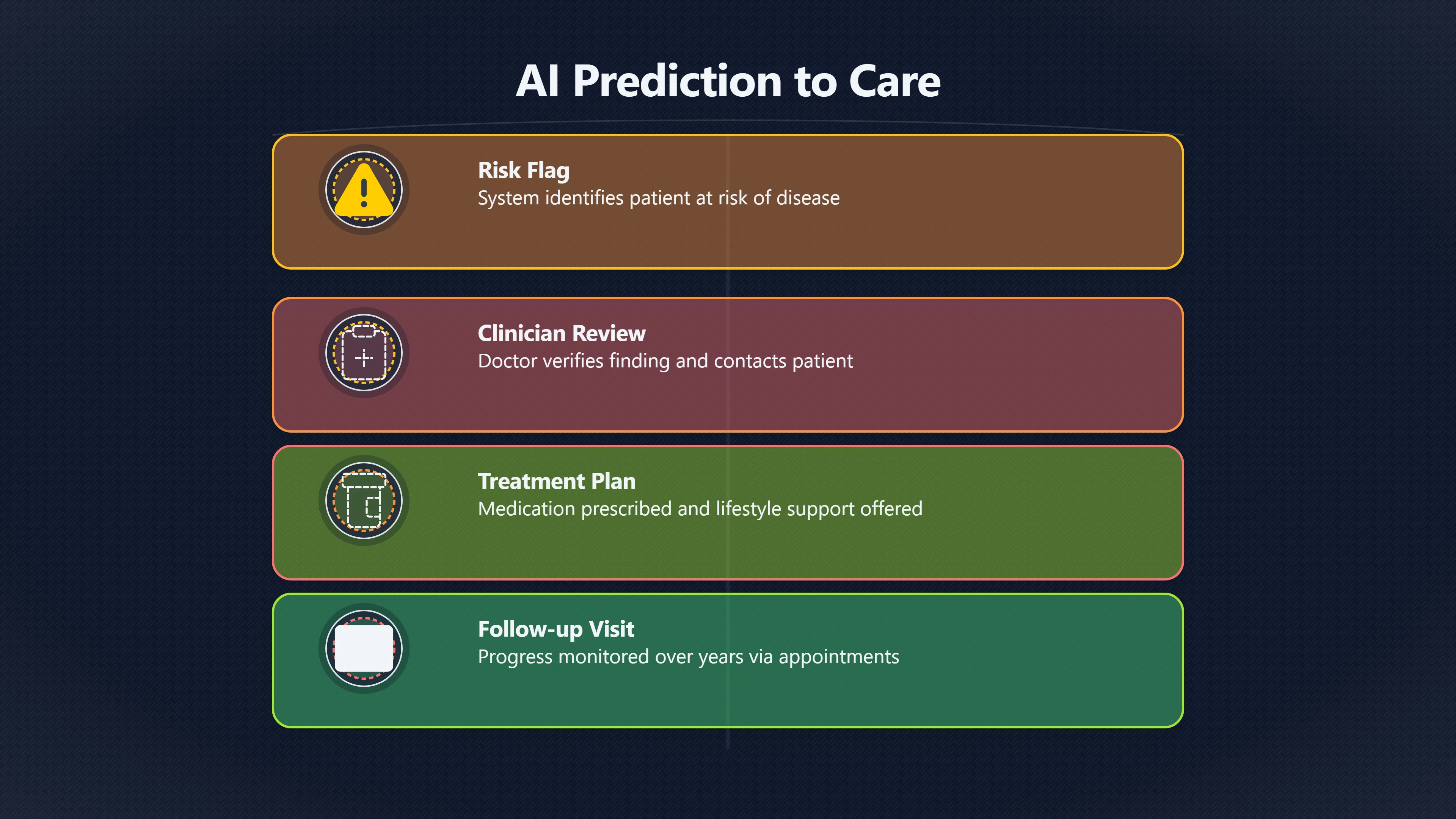
An AI system may identify a patient whose blood tests suggest elevated cardiovascular risk. The practical value comes from what follows:
- A clinician reviews the finding.
- The patient is contacted.
- Medication is prescribed if needed.
- Lifestyle support is offered.
- Follow-up appointments occur.
- Progress is monitored over years.
Without those steps, prediction becomes information without intervention.
This is why countries with stronger primary care systems may ultimately capture more value from healthcare AI than countries with fragmented care. The technology depends on a delivery network capable of acting on its recommendations.
Digital records are a prerequisite, not a luxury
Modern AI systems depend heavily on electronic health records, laboratory data, imaging archives, medication histories, and longitudinal patient information.
When records are fragmented across providers, incomplete, or inaccessible, AI performance often falls. More importantly, clinicians cannot easily verify recommendations or understand how they fit into a patient’s broader medical history.
Several health policy initiatives increasingly frame digital health records as foundational infrastructure for the AI era rather than optional modernisation projects. The argument is straightforward: without reliable data systems, even highly capable medical AI remains difficult to deploy safely at scale.[Tony Blair Institute]institute.globalTony Blair Institute Preparing the NHS for the AI Era: A Digital Health RecordTony Blair InstitutePreparing the NHS for the AI Era: A Digital Health Record…August 19, 2024 — 19 Aug 2024 — Here we propose a digita…
This creates a practical fairness issue. Wealthier hospitals often have better digital infrastructure, cleaner datasets, and greater technical support. Poorer regions frequently have weaker records systems and fewer resources for implementation. If AI deployment follows existing infrastructure advantages, healthcare disparities can deepen.
The result is a recurring pattern in technology adoption: places that already function well gain improvements first, while struggling systems face the highest barriers to benefiting.
Follow-up capacity determines whether predictions matter
One of the least discussed bottlenecks in AI healthcare is follow-up capacity.
Imagine an AI system that doubles the identification rate for patients at risk of serious disease. On paper, this appears transformative. In practice, the health system must absorb a larger number of consultations, diagnostic tests, specialist referrals, and preventive interventions.
If capacity does not expand, earlier detection can create new queues rather than better outcomes.
This challenge appears repeatedly in NHS and international evaluations of healthcare AI. Real-world success depends not only on model performance but on workflow redesign, staffing, procurement, training, and pathway integration. NHS England[PMC]pmc.ncbi.nlm.nih.govPMCDeploying artificial intelligence software in an NHS trustartificial intelligence software in an NHS trust - PMCby SR Blake · 2023 · Cited by 8 — This article set out clear guidance on the practi…
The lesson is important for long-term longevity debates. Extending healthy life at population scale is not simply an information problem. It is also a systems problem.
Fair AI care depends on public infrastructure
The strongest argument for public involvement in healthcare AI is not ideological. It is practical.
Private healthcare providers can often move faster, experiment more aggressively, and offer premium services. But longevity inequality becomes more likely when the most powerful preventive tools remain available mainly to affluent patients.
Public systems provide mechanisms that markets alone often struggle to supply:
- Universal or broad coverage.
- Shared standards.
- Population-scale screening.
- Long-term health records.
- Public accountability.
- Equity monitoring.
- Coordination across regions.
The World Health Organization repeatedly emphasises that AI governance should aim for public benefit, equity, and broad access rather than concentrating gains among already advantaged populations.[World Health Organization]who.intWorld Health OrganizationEthics and governance of artificial intelligence for healthJun 28, 2021 — The report identifies the ethical chal…[World Health Organization]who.intWorld Health OrganizationEthics and governance of artificial intelligence for healthJun 28, 2021 — The report identifies the ethical chal…
This does not mean every AI system must be developed by governments. Many important innovations will come from universities, startups, hospitals, and technology companies. The question is whether public institutions can ensure that effective tools become widely available rather than remaining niche products.
In an AI-enabled future where disease prediction becomes dramatically more powerful, access to healthcare infrastructure may become as important as access to healthcare itself.

Auditing AI outcomes after deployment
Approval is only the beginning
Healthcare regulation has traditionally focused on evaluating technologies before deployment. AI creates a new challenge because systems can interact with changing populations, changing clinical practices, and changing data environments.
A model that performs well in one hospital may perform differently elsewhere. A system trained on historical data may gradually become less reliable as disease patterns, demographics, or treatment standards change.
This is why many researchers and health regulators increasingly advocate lifecycle governance rather than one-time approval. AI systems require ongoing monitoring after deployment, not merely pre-launch testing.[PMC]pmc.ncbi.nlm.nih.govPMCDeploying artificial intelligence software in an NHS trustartificial intelligence software in an NHS trust - PMCby SR Blake · 2023 · Cited by 8 — This article set out clear guidance on the practi… Nature The practical question becomes: who notices when an AI system stops working as intended[nature.com]nature.comThe TLA governance model embeds core healthcare law principles.Read more…
Measuring real-world impact
Many healthcare AI products are initially assessed using technical metrics such as sensitivity, specificity, or diagnostic accuracy. These measures matter, but they do not fully answer the most important public health question: do patients actually become healthier?
Recent guidance from NHS programmes and evaluation researchers places increasing emphasis on real-world assessment, including workflow effects, patient outcomes, implementation challenges, and unintended consequences.[digital-transformation.hee.nhs.uk]digital-transformation.hee.nhs.ukhee.nhs.uk3.2 Evaluation and validationProspective clinical studies: The AI model is tested in a real-world clinical setting using data c…[NHS England]england.nhs.ukNHS EnglandPlanning and implementing real-world artificial intelligence…16 Oct 2024 — This document provides lessons on the practical…[NHS England]england.nhs.ukNHS EnglandPlanning and implementing real-world artificial intelligence…16 Oct 2024 — This document provides lessons on the practical…
A system might correctly identify more high-risk patients while simultaneously increasing administrative burden, overwhelming clinics, or producing excessive false positives. Another system might save clinician time but perform worse for underrepresented populations.
Public health systems therefore need mechanisms to evaluate:
- Health outcomes.
- Waiting times.
- Equity impacts.
- Clinical workload.
- Patient trust.
- Cost-effectiveness.
- Error patterns across demographic groups.
These are institutional capabilities rather than purely technical ones.
Watching for unequal outcomes
Perhaps the most important reason for post-deployment auditing is that inequality often becomes visible only after large-scale use.
Research has repeatedly documented cases where medical AI systems perform differently across demographic groups because of training data imbalances, healthcare access disparities, or underlying social inequalities.[arXiv]arxiv.orgarXiv Quantifying Health Inequalities Induced by Data and AI ModelsQuantifying Health Inequalities Induced by Data and AI ModelsApril 24, 2022…[2zhiyanbao.cn]zhiyanbao.cnervices and systems based on race, ethnicity, age, and gender, that are encoded in data.Read more…
A system can appear successful on average while producing worse outcomes for specific populations.
For example, researchers and public health bodies have raised concerns about medical technologies that work less effectively for people with darker skin tones, underrepresented ethnic groups, women, or deprived communities. Similar concerns extend to AI-based diagnostic and risk prediction systems trained on incomplete or unrepresentative datasets.[The Guardian]theguardian.comIt emphasizes the need for an equity perspective throughout the lifecycle of medical devices to ensure fair healthcare. Concerns were hig…[NHS England Digital]digital.nhs.ukstriving for health equityNHS England DigitalStriving for health equity27 Feb 2026 — Understanding and enabling opportunities to use AI to address health inequalit…
This means fairness cannot be assessed only during development. It must be measured continuously after deployment using real patient outcomes.
The emerging model: health systems as AI stewards
A growing theme in healthcare AI governance is that hospitals and public health systems cannot act merely as purchasers of software. They increasingly need to become stewards of AI systems throughout their operational life.
WHO guidance, NHS evaluation programmes, and emerging governance frameworks all point toward a similar direction: health organisations require structures that oversee procurement, validation, monitoring, accountability, patient rights, and ongoing performance review.[ihi.org]ihi.orgAI Governance: Maximizing Benefit and Minimizing Harm…Sep 3, 2025 — Governance is necessary for the safe, impactful, and trustworthy a…[World Health Organization]who.intWorld Health OrganizationEthics and governance of artificial intelligence for healthJun 28, 2021 — The report identifies the ethical chal…[NHS England]england.nhs.ukNHS EnglandPlanning and implementing real-world artificial intelligence…16 Oct 2024 — This document provides lessons on the practical…
Under this model, deploying AI resembles managing critical infrastructure rather than installing a conventional software package.
Several emerging frameworks therefore focus on:
- Continuous monitoring rather than one-off approval.
- Explicit responsibility for failures.
- Documentation of model updates.
- Equity assessments.
- Clinical oversight.
- Audit trails.
- Mechanisms for withdrawing systems that perform poorly.
Researchers studying deployed healthcare AI increasingly describe monitoring as an ongoing operational responsibility, covering technical reliability, clinical performance, and patient impact.[arXiv]arxiv.orgarXiv Quantifying Health Inequalities Induced by Data and AI ModelsQuantifying Health Inequalities Induced by Data and AI ModelsApril 24, 2022…
This may become one of the defining institutional challenges of AI medicine over the coming decades.
What fair AI care would look like
The most optimistic version of AI-guided healthcare is not a world where wealthy individuals buy increasingly sophisticated longevity services. It is a world where the underlying capabilities become embedded in ordinary healthcare systems.
In that future, AI might help identify disease earlier, personalise prevention, reduce diagnostic delays, improve medication safety, and support clinicians across entire populations. Healthy lifespan could rise not because a small elite receives exceptional treatment, but because prevention and high-quality care become more widely available.
Whether that happens depends less on model intelligence than on public capacity. Countries need reliable records, strong primary care, effective referral systems, post-deployment auditing, workforce training, and institutions capable of measuring who benefits and who is left behind.
The broader AI bloom vision often asks whether advanced intelligence could help humanity overcome some of the limits that have constrained health and longevity for centuries. Public health systems determine whether those gains become a shared social achievement or another dividing line between populations. In practice, fair AI care may depend as much on clinics, records, governance, and follow-up as on the algorithms themselves.
Amazon book picks
Further Reading
Books and field guides related to Can public healthcare make AI care fair?. Use these as the next step if you want deeper reading beyond the article.
An American Sickness
Gives context on why fair access depends on institutions, not software alone.
The Age of Scientific Wellness
Explores personalised prevention that would need equitable implementation.
The Patient Will See You Now
Explores how digital medicine could shift power toward patients.
eBay marketplace picks
Marketplace Samples
Example marketplace items related to this page. Use the search link to explore similar finds on eBay.


Endnotes
1.
Source: pmc.ncbi.nlm.nih.gov
Link:https://pmc.ncbi.nlm.nih.gov/articles/PMC12840649/
Source snippet
Integrating Artificial Intelligence (AI) in Primary Health Care...by F Yousefi · 2026 · Cited by 1 — AI integration in PHC depends pr...
2.
Source: institute.global
Title: Tony Blair Institute Preparing the NHS for the AI Era: A Digital Health Record
Link:https://institute.global/insights/public-services/preparing-the-nhs-for-the-ai-era-a-digital-health-record-for-every-citizen
Source snippet
Tony Blair InstitutePreparing the NHS for the AI Era: A Digital Health Record...August 19, 2024 — 19 Aug 2024 — Here we propose a digita...
Published: August 19, 2024
3.
Source: england.nhs.uk
Link:https://www.england.nhs.uk/publication/planning-and-implementing-real-world-artificial-intelligence-ai-evaluations-lessons-from-the-ai-in-health-and-care-award/
Source snippet
NHS EnglandPlanning and implementing real-world artificial intelligence...16 Oct 2024 — This document provides lessons on the practical...
4.
Source: pmc.ncbi.nlm.nih.gov
Title: PMCDeploying artificial intelligence software in an NHS trust
Link:https://pmc.ncbi.nlm.nih.gov/articles/PMC11027237/
Source snippet
artificial intelligence software in an NHS trust - PMCby SR Blake · 2023 · Cited by 8 — This article set out clear guidance on the practi...
5.
Source: england.nhs.uk
Link:https://www.england.nhs.uk/aac/what-we-do/how-can-the-aac-help-me/ai-award/
Source snippet
Artificial Intelligence in Health and Care AwardThe Award supports AI innovators and technologies across the spectrum of development: fro...
6.
Source: who.int
Link:https://www.who.int/publications/i/item/9789240029200
Source snippet
World Health OrganizationEthics and governance of artificial intelligence for healthJun 28, 2021 — The report identifies the ethical chal...
7.
Source: who.int
Link:https://www.who.int/teams/digital-health-and-innovation/harnessing-artificial-intelligence-for-health
Source snippet
World Health OrganizationHarnessing artificial intelligence for healthWHO's vision is to foster digital frontiers and nurture an AI ecosy...
8.
Source: nature.com
Link:https://www.nature.com/articles/s41746-025-01614-1
Source snippet
The TLA governance model embeds core healthcare law principles.Read more...
9.
Source: professional.heart.org
Link:https://professional.heart.org/en/science-news/pragmatic-approaches-to-the-evaluation-and-monitoring-of-artificial-intelligence-in-healthcare
Source snippet
Pragmatic Approaches to the Evaluation and Monitoring of...Nov 10, 2025 — AHA advisory outlines risk-based governance and continuous mon...
10.
Source: england.nhs.uk
Link:https://www.england.nhs.uk/long-read/planning-and-implementing-real-world-ai-evaluations-lessons-from-the-ai-in-health-and-care-award/
Source snippet
It will gather insights from all the AI Award project reports to...Read more...
11.
Source: pmc.ncbi.nlm.nih.gov
Link:https://pmc.ncbi.nlm.nih.gov/articles/PMC11309043/
Source snippet
Evaluation of Artificial Intelligence-Enabled Interventionsby HDJ Hogg · 2024 · Cited by 12 — This article summarizes good practices acro...
12.
Source: digital-transformation.hee.nhs.uk
Link:https://digital-transformation.hee.nhs.uk/support-for-organisations/research-and-publications/dart-ed/horizon-scanning/understanding-healthcare-workers-confidence-in-ai/chapter-3-governance/evaluation-and-validation
Source snippet
hee.nhs.uk3.2 Evaluation and validationProspective clinical studies: The AI model is tested in a real-world clinical setting using data c...
13.
Source: arxiv.org
Title: arXiv Quantifying Health Inequalities Induced by Data and AI Models
Link:https://arxiv.org/abs/2205.01066
Source snippet
Quantifying Health Inequalities Induced by Data and AI ModelsApril 24, 2022...
Published: April 24, 2022
14.
Source: zhiyanbao.cn
Link:https://www.zhiyanbao.cn/index/partFile/5/who/2022-04/5_23759.pdf
Source snippet
ervices and systems based on race, ethnicity, age, and gender, that are encoded in data.Read more...
15.
Source: digital.nhs.uk
Title: striving for health equity
Link:https://digital.nhs.uk/services/ai-knowledge-repository/nhs-lab-ai-ethics-initiative/striving-for-health-equity
Source snippet
NHS England DigitalStriving for health equity27 Feb 2026 — Understanding and enabling opportunities to use AI to address health inequalit...
16.
Source: ihi.org
Link:https://www.ihi.org/library/blog/ai-governance-maximizing-benefit-and-minimizing-harm-patients-providers-and-health
Source snippet
AI Governance: Maximizing Benefit and Minimizing Harm...Sep 3, 2025 — Governance is necessary for the safe, impactful, and trustworthy a...
17.
Source: arxiv.org
Title: arXiv Monitoring Deployed AI Systems in Health Care
Link:https://arxiv.org/abs/2512.09048
Source snippet
Monitoring Deployed AI Systems in Health CareDecember 9, 2025...
Published: December 9, 2025
18.
Source: iris.who.int
Link:https://iris.who.int/server/api/core/bitstreams/d2913ae3-c8e0-4a46-b6ff-b4b121e936f4/content
Source snippet
intelligence is reshaping health systems: state of...This report presents the first assessment of AI integration into health systems acr...
19.
Source: who.int
Link:https://www.who.int/publications/i/item/9789240084759
Source snippet
Ethics and governance of artificial intelligence for healthMar 25, 2025 — This guidance addresses one type of generative AI, large multi...
20.
Source: digital.nhs.uk
Link:https://digital.nhs.uk/services/ai-knowledge-repository/a-z-resources
Source snippet
We have explored the use of specific algorithms used...Read more...
21.
Source: nature.com
Link:https://www.nature.com/articles/s41599-024-02894-w
Source snippet
Shaping the future of AI in healthcare through ethics and...by R Bouderhem · 2024 · Cited by 197 — The purpose of this research is to id...
22.
Source: nature.com
Link:https://www.nature.com/articles/s41746-025-01900-y
Source snippet
A practical framework for appropriate implementation and...by BJ Wells · 2025 · Cited by 47 — Health systems face the challenge of balan...
23.
Source: ardengemcsu.nhs.uk
Link:https://www.ardengemcsu.nhs.uk/showcase/news-events/news-events/evaluation-report-launched-for-the-nhs-ai-lab/
Source snippet
Evaluation report launched for the NHS AI labThe evaluation explores the AI Lab's contributions to AI policy, infrastructure and real-wor...
24.
Source: england.nhs.uk
Link:https://www.england.nhs.uk/long-read/artificial-intelligence-ai-and-machine-learning/
Source snippet
The report is essential reading to those using AI...Read more...
25.
Source: theguardian.com
Link:https://www.theguardian.com/society/2024/mar/11/medical-tools-devices-healthcare-bias-uk
Source snippet
It emphasizes the need for an equity perspective throughout the lifecycle of medical devices to ensure fair healthcare. Concerns were hig...
26.
Source: publichealthaihandbook.com
Link:https://publichealthaihandbook.com/future/policy.html
Source snippet
AI Policy and Governance in HealthcareJan 6, 2026 — The EU AI Act classifies medical AI as high-risk. FDA has cleared over 1000 AI device...
Additional References
27.
Source: paho.org
Link:https://www.paho.org/sites/default/files/2024-08/ai-ra-tool-rev-final-eng-aug-1_0.pdf
Source snippet
Pan American Health OrganizationArtificial Intelligence in Public healthThe assessment presents essential categories, from existing healt...
28.
Source: pratiquesensante.odoo.com
Link:https://pratiquesensante.odoo.com/en/blog/opinions-8/ethics-and-governance-of-artificial-intelligence-for-health-who-recommendations-on-large-ai-models-5873
Source snippet
WHO...12 hours ago — On an operational level, the document proposes a framework in three phases – development, 'provision' (deployment b...
29.
Source: integratedcarejournal.com
Link:https://integratedcarejournal.com/evaluation-of-nhs-artificial-intelligence-lab-identifies-lessons-to-shape-ais-future-in-health-and-care/
Source snippet
Evaluation of NHS Artificial Intelligence Lab identifies...29 Apr 2025 — The report offers assessment of the NHS AI Lab's achievements a...
30.
Source: GOV.UK
Link:https://www.gov.uk/government/news/thousands-of-patients-to-benefit-from-quicker-diagnosis-more-accurate-tests-from-ground-breaking-ai-research
Source snippet
of patients to benefit from quicker diagnosis...3 Mar 2023 — Tens of thousands of patients across the country could benefit from quicker...
31.
Source: privacyinternational.org
Title: our analysis who report ethics and governance artificial intelligence health
Link:https://privacyinternational.org/news-analysis/4594/our-analysis-who-report-ethics-and-governance-artificial-intelligence-health
Source snippet
Our analysis of the WHO report on Ethics and Governance...Jul 20, 2021 — Last month, the World Health Organization published its guidanc...
32.
Source: usher.ed.ac.uk
Title: independent evaluation highlights impact and future potential of nhs ai lab
Link:https://usher.ed.ac.uk/news-events/news/independent-evaluation-highlights-impact-and-future-potential-of-nhs-ai-lab
Source snippet
evaluation highlights impact and future potential...5 May 2025 — This evaluation provides real-world empirical evidence and learning tha...
Published: May 2025
33.
Source: bma.org.uk
Link:https://www.bma.org.uk/media/njgfbmnn/bma-principles-for-artificial-intelligence-ai-and-its-application-in-healthcare.pdf
Source snippet
ttings and continuously monitored to ensure it improves care quality and job satisfaction...Read more...
34.
Source: GOV.UK
Title: world first ai system to warn of nhs patient safety concerns
Link:https://www.gov.uk/government/news/world-first-ai-system-to-warn-of-nhs-patient-safety-concerns
Source snippet
www.gov.ukWorld-first AI system to warn of NHS patient safety concerns30 Jun 2025 — Pioneering AI technology will be developed to scan NH...
35.
Source: GOV.UK
Title: guidance on the impact evaluation of ai interventions html
Link:https://www.gov.uk/government/publications/the-magenta-book/guidance-on-the-impact-evaluation-of-ai-interventions-html
Source snippet
on the Impact Evaluation of AI Interventions...9 Jul 2025 — This guidance outlines key principles of best practice in carrying out a rob...
36.
Source: censinet.com
Link:https://censinet.com/perspectives/patient-first-ethical-ai-implementation-clinical-care
Source snippet
signed and implemented to prioritize fairness, transparency, and patient safety.Read more...
Topic Tree