Within Resilience
Can AI Really Warn US Before the Next Pandemic?
AI outbreak models may buy valuable time, but novel pathogens can still outrun data-driven prediction.
On this page
- How Pandemic LLMs Combine Real Time Data
- Where Early Warning Systems Have Succeeded
- Why Novel Outbreaks Still Surprise Models
Page outline Jump by section
Introduction
AI‑enhanced pandemic forecasting and early warning systems are among the most tangible ways advanced intelligence technologies could help civilisation anticipate and mitigate outbreaks before they overwhelm health systems and societies. By analysing diverse, large‑scale data in real time, AI holds out the promise of detecting signals of emerging disease far earlier than traditional epidemiological reporting alone. Yet the practical reality is nuanced: these tools have demonstrated promising improvements in outbreak detection and short‑term forecasting, but they also face structural and data‑driven limits that mean truly reliable early warning — especially for novel pathogens — remains a hard frontier. Understanding both the capabilities and the limits of pandemic forecasting AI is crucial for assessing its role in civilisational resilience and the broader “AI bloom” potential to narrow surprise and strengthen global preparedness.[PubMed]pubmed.ncbi.nlm.nih.govArtificial intelligence in early warning systems for infectious disease surveillance: a systematic review - PubMedJune 23, 2025…
How AI Forecasting Systems Work
AI‑based early warning systems (EWS) for infectious disease combine machine learning, deep learning and, increasingly, natural language processing (NLP) with multi‑source data to detect and forecast outbreaks. Models typically ingest epidemiological time‑series data, digital surveillance streams (news reports, web searches, social media), environmental and climate data, and sometimes policy or mobility signals. Algorithms such as Long Short‑Term Memory networks (LSTMs), random forests, ensemble methods and other regression or classification techniques detect patterns or anomalies that may presage rising case counts or outbreak events. In some experimental frameworks, large language models (LLMs) are also being adapted to integrate textual policy and genomic surveillance information into forecasting.[Frontiers]frontiersin.orgFrontiers | AI-driven epidemic intelligence: the future of outbreak detection and responseJuly 30, 2025 — EPIDEMIOLOGICAL MODELING AND AI…
Across the literature, machine learning systems frequently outperform baseline statistical models in early detection and short‑range forecasting — for example, improving accuracy and timeliness of case count projections over one to several weeks. They also automate data integration across sources that conventional surveillance alone struggles to unify, potentially offering earlier clues to emerging threats.[Frontiers]frontiersin.orgFrontiers | AI-driven epidemic intelligence: the future of outbreak detection and responseJuly 30, 2025 — EPIDEMIOLOGICAL MODELING AND AI…
Where Early Warning Has Succeeded
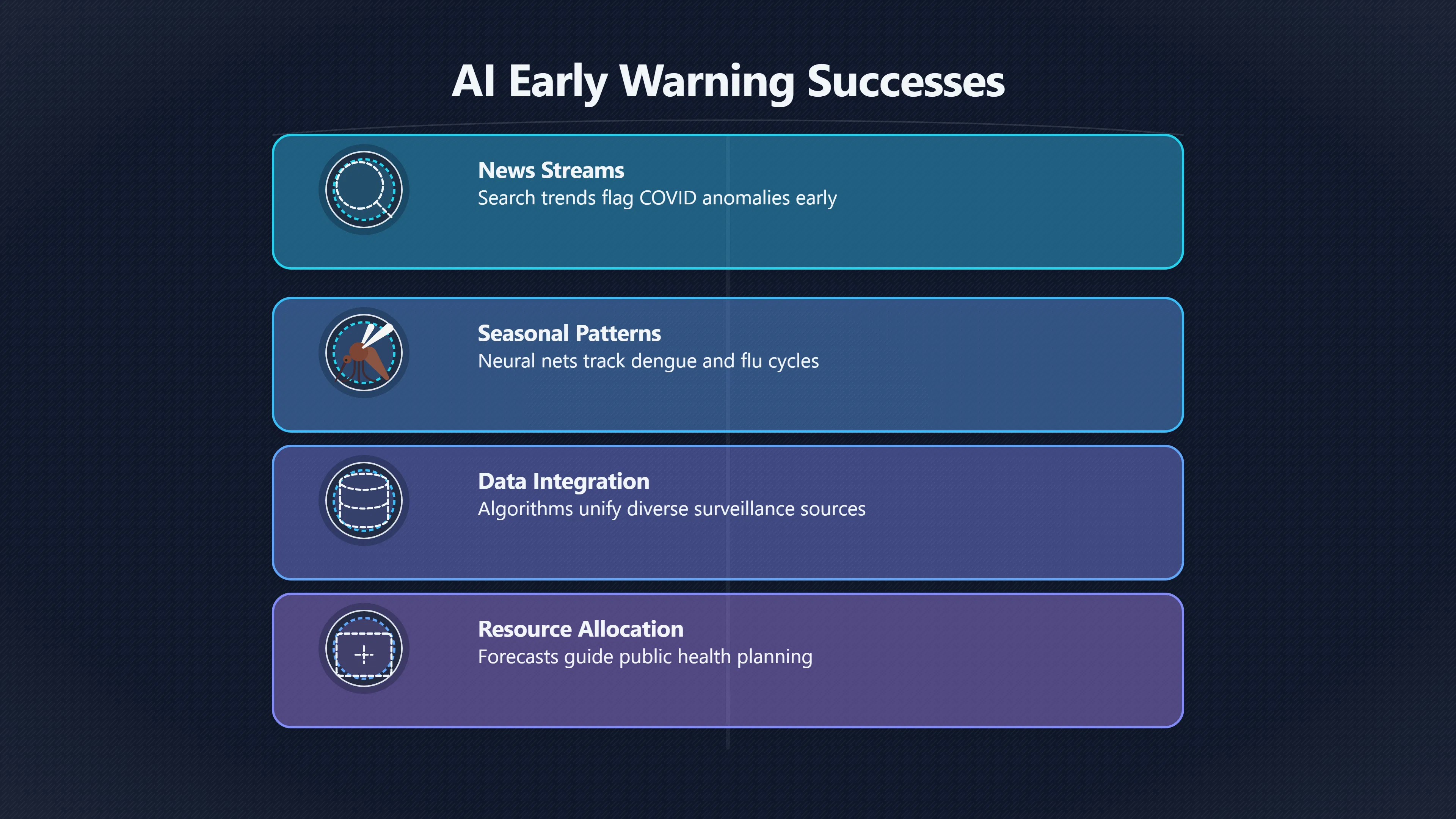
In practice, AI‑augmented systems have delivered useful signals ahead of traditional reporting in certain settings. Commercial and research systems using open‑source data streams such as news and search trends were able to flag COVID‑19 anomalies earlier than some formal health systems during the pandemic, illustrating that automated pattern recognition can sometimes buy valuable time for situational awareness.[Frontiers]frontiersin.orgFrontiers | AI-driven epidemic intelligence: the future of outbreak detection and responseJuly 30, 2025 — EPIDEMIOLOGICAL MODELING AND AI…
More broadly, systematic reviews of AI applications in early epidemic detection show that models can reliably identify patterns associated with outbreaks when sufficient historical and real‑time data are available. Neural networks and ensemble models have shown strong performance in forecasting seasonal outbreaks of known diseases like dengue, influenza and malaria.[Sage Journals]journals.sagepub.comSage JournalsAI-based epidemic and pandemic early warning systems: A systematic scoping review - Christo El Morr, Deniz Ozdemir, Yasmeen…
These successes tend to cluster around situations where the underlying dynamics are familiar — seasonal diseases with relatively stable historical patterns, comprehensive data streams and known influencing factors such as climate or mobility. In such contexts, AI can enhance traditional surveillance and even provide useful short‑term predictions that support public‑health planning and resource allocation.[Frontiers]frontiersin.orgFrontiers | AI-driven epidemic intelligence: the future of outbreak detection and responseJuly 30, 2025 — EPIDEMIOLOGICAL MODELING AND AI…
Why Novel Outbreaks Still Surprise Models
Despite encouraging use cases, AI forecasting systems have inherent limits that constrain their reliability — especially when a truly novel pathogen or outbreak pattern emerges.
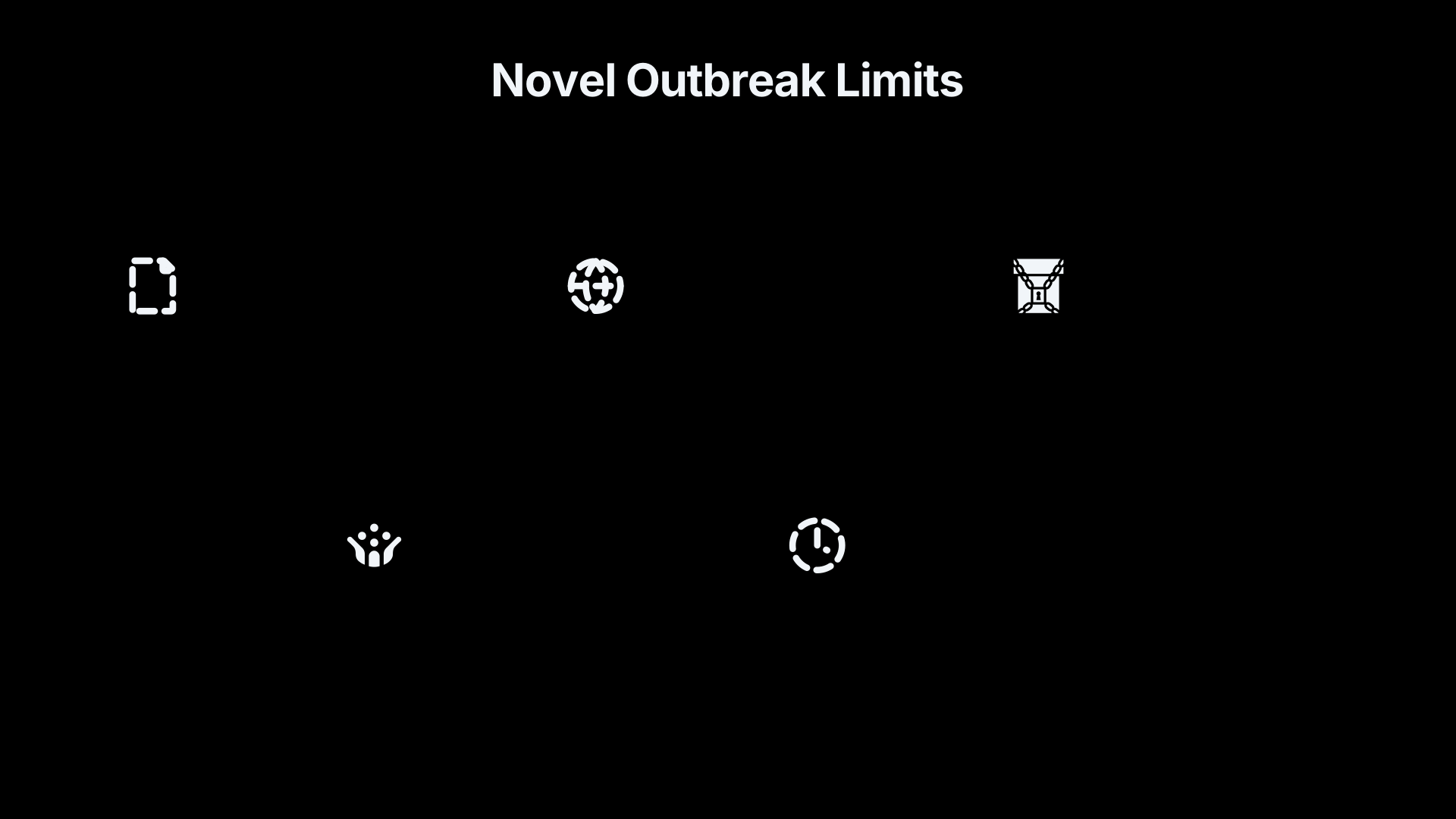
Data Quality and Availability: AI models are fundamentally dependent on input data. In early outbreak stages, reporting is sparse, inconsistent across jurisdictions, and often delayed. Poor quality, incomplete or biased datasets yield unreliable predictions (“garbage in, garbage out”), and models may perform poorly when the training distributions do not reflect the actual unfolding dynamics.[PMC]pmc.ncbi.nlm.nih.govJune 23, 2025…
Generalisability and Bias: Many models are trained on data from particular regions, diseases or demographic contexts. When applied to new settings — different geographies, unobserved transmission patterns, or entirely novel agents — their forecasts can degrade rapidly due to lack of generalisability. AI models may also encode biases that underrepresent certain populations, further weakening early detection in those communities.[Sage Journals]journals.sagepub.comSage JournalsAI-based epidemic and pandemic early warning systems: A systematic scoping review - Christo El Morr, Deniz Ozdemir, Yasmeen…
Structural “Black Box” Challenges: Advanced AI models, especially deep learning systems, often lack transparency. Their internal decision processes can be opaque to public‑health officials, making it difficult to validate or contextualise predictions. This “black box” nature complicates trust and integration into public health workflows.[PMC]pmc.ncbi.nlm.nih.govJune 23, 2025…
Complex, Non‑Linear Dynamics: Disease spread is shaped by human behaviour, policy interventions, mobility, climate, immunity landscapes, and socio‑political factors. Data‑driven models struggle to disentangle such complex dynamics when they are unprecedented or rapidly shifting, leading to poor predictive performance early in a new crisis.[Sage Journals]journals.sagepub.comSage JournalsAI-based epidemic and pandemic early warning systems: A systematic scoping review - Christo El Morr, Deniz Ozdemir, Yasmeen…
Limitations for Long‑Range Forecasts: Most AI systems show degradation in performance over longer prediction horizons. Forecasts that look weeks ahead are far less reliable than short, near‑term predictions — a key limitation when policymakers seek early warning well before exponential growth accelerates.[Sage Journals]journals.sagepub.comSage JournalsAI-based epidemic and pandemic early warning systems: A systematic scoping review - Christo El Morr, Deniz Ozdemir, Yasmeen…
Balancing Promise and Limits
AI forecasting systems represent a clear incremental advance over traditional surveillance approaches, particularly for enhancing situational awareness, integrating diverse data streams and improving short‑range outbreak detection. In those roles, they strengthen early warning and help allocate public health resources more effectively.[Frontiers]frontiersin.orgFrontiers | AI-driven epidemic intelligence: the future of outbreak detection and responseJuly 30, 2025 — EPIDEMIOLOGICAL MODELING AND AI…
At the same time, the current generation of AI models is constrained by data limitations, bias, structural opacity and limited adaptability to novel conditions. These aren’t just technical quirks but fundamental challenges of predicting systems with high uncertainty and sparse early data. Even the most advanced AI cannot reliably ‘foresee’ the first emergence of a truly new pathogen before any observable signals exist to learn from or model.[PMC]pmc.ncbi.nlm.nih.govJune 23, 2025…
This limits the ability of AI alone to guarantee early warning on its own — novel outbreaks can and do outrun prediction models until sufficient data has accumulated and system biases are corrected. Building resilience therefore hinges not only on better models but on improving data infrastructure, transparency, equitable data access and integration with expert epidemiological judgement.

Implications for Civilisational Resilience
In the broader context of civilisational resilience and the “AI bloom” framework, pandemic forecasting AI offers valuable evidence that intelligent systems can help human societies narrow surprise and respond quicker to emerging health threats. They show how AI can extend human analytical capacity across complex, multi‑dimensional data and support decision‑making in crisis conditions.
Yet the limits of early warning remind us that technology is not a panacea: advancing forecasting should go hand‑in‑hand with governance improvements, data sharing, ethical deployment, and investments in health systems — especially in under‑resourced settings. Early warning AI matters most when it forms part of a broader, robust preparedness ecosystem rather than a stand‑alone predictor.[PubMed]pubmed.ncbi.nlm.nih.govArtificial intelligence in early warning systems for infectious disease surveillance: a systematic review - PubMedJune 23, 2025…
In sum, AI can significantly enhance pandemic preparedness, but truly overcoming the surprise of novel pathogens will require both technological innovation and systemic strengthening of global public health infrastructure.[Frontiers]frontiersin.orgFrontiers | AI-driven epidemic intelligence: the future of outbreak detection and responseJuly 30, 2025 — EPIDEMIOLOGICAL MODELING AND AI…
eBay marketplace picks
Marketplace Samples
Topic-anchored marketplace searches for visual, collectible, or second-hand items related to this page.


Endnotes
1.
Source: pubmed.ncbi.nlm.nih.gov
Link:https://pubmed.ncbi.nlm.nih.gov/40626156/
Source snippet
Artificial intelligence in early warning systems for infectious disease surveillance: a systematic review - PubMedJune 23, 2025...
Published: June 23, 2025
2.
Source: frontiersin.org
Link:https://www.frontiersin.org/articles/10.3389/fpubh.2025.1609615/full
Source snippet
FrontiersFrontiers | Artificial intelligence in early warning systems for infectious disease surveillance: a systematic reviewJune 23, 2025...
Published: June 23, 2025
3.
Source: frontiersin.org
Link:https://www.frontiersin.org/journals/public-health/articles/10.3389/fpubh.2025.1609615/abstract
Source snippet
FrontiersFrontiers | Artificial intelligence in early warning systems for infectious disease surveillance: a systematic reviewJune 23, 2025...
Published: June 23, 2025
4.
Source: journals.sagepub.com
Link:https://journals.sagepub.com/doi/10.1177/14604582241275844
Source snippet
Sage JournalsAI-based epidemic and pandemic early warning systems: A systematic scoping review - Christo El Morr, Deniz Ozdemir, Yasmeen...
5.
Source: pmc.ncbi.nlm.nih.gov
Link:https://pmc.ncbi.nlm.nih.gov/articles/PMC12230060/
Source snippet
June 23, 2025...
Published: June 23, 2025
6.
Source: journals.sagepub.com
Link:https://journals.sagepub.com/doi/full/10.1177/14604582241275844
Source snippet
Sage JournalsAI-based epidemic and pandemic early warning systems: A systematic scoping review - Christo El Morr, Deniz Ozdemir, Yasmeen...
7.
Source: pubmed.ncbi.nlm.nih.gov
Link:https://pubmed.ncbi.nlm.nih.gov/39172555/
Source snippet
AI-based epidemic and pandemic early warning systems: A systematic scoping review - PubMed...
8.
Source: frontiersin.org
Link:https://www.frontiersin.org/journals/artificial-intelligence/articles/10.3389/frai.2025.1645467/full
Source snippet
Frontiers | AI-driven epidemic intelligence: the future of outbreak detection and responseJuly 30, 2025 — EPIDEMIOLOGICAL MODELING AND AI...
Published: July 30, 2025
9.
Source: youtube.com
Title: Harnessing AI for early epidemic detection
Link:https://www.youtube.com/watch?v=-qSNJYZPegg
Source snippet
PMC - NIH...
Additional References
10.
Source: mdpi.com
Link:https://www.mdpi.com/2504-4990/8/1/15
Source snippet
tive Performance AnalysisJanuary 7, 2026 — ABSTRACT Background: Mosquito-borne viral diseases are a growing global health threat, and art...
Published: January 7, 2026
11.
Source: sciencedirect.com
Link:https://www.sciencedirect.com/science/article/pii/S2949924026000066
Source snippet
CHALLENGES AND LIMITATIONS Despite the transformative potential of AI and big data in infectious disease modeling, several challenges con...
12.
Source: pmc.ncbi.nlm.nih.gov
Title: In response, many population-level computational modeling approaches ha
Link:https://pmc.ncbi.nlm.nih.gov/articles/PMC9702983/
Source snippet
approaches for early warning and monitoring of pandemic situations as well as decision support - PMCNovember 14, 2022 — ABSTRACT The COVI...
Published: November 14, 2022
13.
Source: link.springer.com
Title: The limitations presented in most studies often include rel
Link:https://link.springer.com/article/10.1186/s12982-025-00573-y
Source snippet
forecasting for future pandemics: a review of pathogens, models, and data | Discover Public Health | Springer Nature LinkApril 30, 2025 —...
Published: April 30, 2025
14.
Source: pmc.ncbi.nlm.nih.gov
Link:https://pmc.ncbi.nlm.nih.gov/articles/PMC10052500/
Source snippet
intelligence in public health: the potential of epidemic early warning systems - PMCMarch 26, 2023 — ABSTRACT The use of artificial intel...
Published: March 26, 2023
15.
Source: pmc.ncbi.nlm.nih.gov
Link:https://pmc.ncbi.nlm.nih.gov/articles/PMC11731462/
Source snippet
2024 Dec 3;10(2):410–422. doi: 10.1016/j.idm.2024.12.001 GLOBAL INFECTIOUS DISEASE EARLY WARNING MODELS: AN UPDATED REVIEW AND LESSONS FR...
16.
Source: pmc.ncbi.nlm.nih.gov
Link:https://pmc.ncbi.nlm.nih.gov/articles/PMC13111277/
Source snippet
CHALLENGES The continual development of novel predictive models drives the advancement of forecasting techniques aimed at reducing the ga...
17.
Source: arxiv.org
Link:https://arxiv.org/abs/2404.06962
18.
Source: youtube.com
Title: Beyond the Genome: Tracking Climate-Driven Epidemic Risk with AI
Link:https://www.youtube.com/watch?v=G_itaJHx1Iw
Source snippet
AI, qualitative data, and the case for statistical rigour...
19.
Source: youtube.com
Title: AI, qualitative data, and the case for statistical rigour
Link:https://www.youtube.com/watch?v=IhCTCfW-pdg
Source snippet
Building a Grounded Approach to AI in Public Health Surveillance...
Topic Tree