Within Moon and Mars
How Autonomous Systems Sustain Lunar Life Support
Explores how AI and robotics monitor and maintain air, water, and power systems on the Moon over extended missions.
On this page
- Air and Water Recycling Technologies
- Predictive Maintenance and Fault Detection
- Integration with Robotic Operations
Page outline Jump by section
Introduction
A long-duration lunar base cannot depend on constant human supervision from Earth. Even though the Moon is only a few days away by spacecraft, crews will still live in an environment where a failed oxygen generator, a contaminated water loop or a power-system fault can quickly become life-threatening. That is why autonomous life-support management has become one of the most important technologies in plans for sustained lunar habitation.
 Within the broader vision of AI-enabled human expansion beyond Earth, autonomous life-support systems are not simply labour-saving tools. They are attempts to create habitats that can monitor themselves, detect problems before humans notice them, coordinate repairs, manage scarce resources and continue operating despite equipment failures. The Moon offers a relatively accessible place to test these capabilities before more distant missions, especially eventual Martian settlements where communication delays make constant Earth-based oversight impossible. NASA[NASA Technical Reports Server]ntrs.nasa.govICESNASA Technical Reports ServerRegenerative Life Support Systems for Exploration Habitatsby DF Howard · 2022 · Cited by 5 — The surface hab…
The challenge is not merely keeping astronauts alive for a few weeks. It is learning whether software, robotics and increasingly capable AI systems can help maintain closed-loop environments for months or years while reducing the need for constant resupply and human intervention.
Why Lunar Life Support Is Harder Than It Looks
Life support is often imagined as a single machine that generates oxygen. In reality it is a tightly interconnected network of systems that manages air quality, water recycling, waste processing, temperature control, pressure regulation, power use and emergency response.
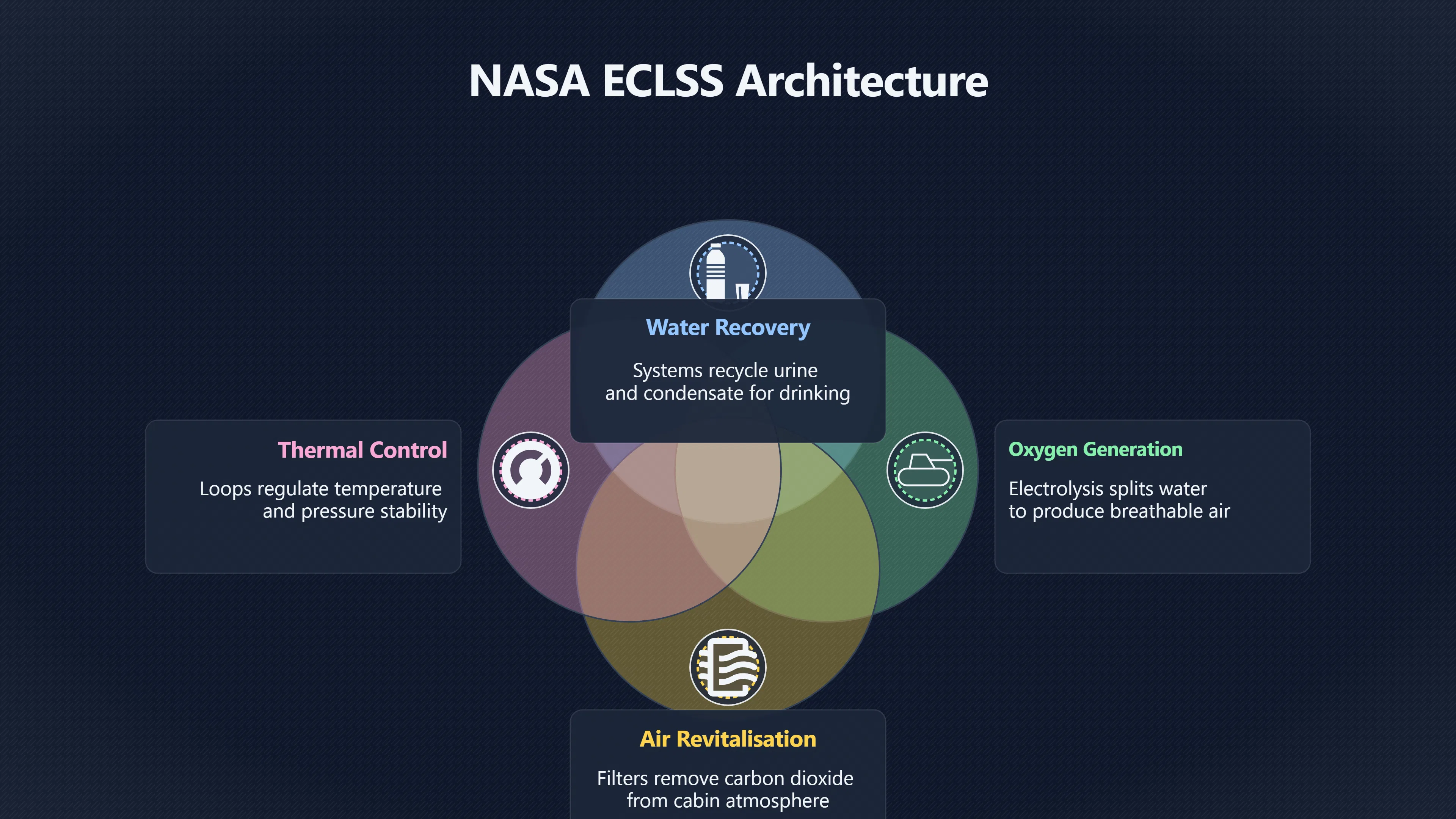
Modern Environmental Control and Life Support Systems (ECLSS) already perform many of these functions aboard the International Space Station. NASA’s ECLSS architecture includes water recovery systems, oxygen generation systems and air revitalisation systems that recycle critical resources rather than treating them as disposable supplies.[NASA]nasa.govenvironmental control and life support systems eclssEnvironmental Control and Life Support Systems (ECLSS)4 Apr 2025 — ECLSS is a life support system that provides or controls atmospher…
A lunar base introduces additional complications:
- Crews may spend months on the surface.
- Dust can damage seals, filters and mechanical equipment.
- Power availability can fluctuate depending on location and solar conditions.
- Frequent surface expeditions increase oxygen and water demand.
- Spare parts remain expensive and slow to replace.
- Small failures can cascade through multiple connected systems.[NASA]ntrs.nasa.govTechnical Reports Server Challenges with Deploying and Integrating EnvironmentalNASA Technical Reports ServerChallenges with Deploying and Integrating Environmental…October 6, 2009 — by RM Bagdigian · 2009 · Cited… Technical Reports Server[NASA Technical Reports Server]ntrs.nasa.govICESNASA Technical Reports ServerRegenerative Life Support Systems for Exploration Habitatsby DF Howard · 2022 · Cited by 5 — The surface hab…
The result is that future lunar habitats are expected to rely heavily on automation. Human crews cannot spend most of their time acting as maintenance technicians for pumps, filters and recycling units. The habitat itself must increasingly function as an intelligent system.
Air and Water Recycling Technologies
The most important life-support resources are oxygen and water. Every kilogram delivered from Earth dramatically increases mission cost, making recycling essential.
NASA studies of extended lunar missions have repeatedly concluded that high rates of water recovery are necessary for long-duration habitation. Water is needed not only for drinking but also for hygiene, cooling systems, oxygen production and other operational functions. Research into lunar surface missions has shown that recovering water from waste streams can make a significant contribution to overall resource balance and reduce dependence on imported supplies.[NASA]ntrs.nasa.govTechnical Reports Server Challenges with Deploying and Integrating EnvironmentalNASA Technical Reports ServerChallenges with Deploying and Integrating Environmental…October 6, 2009 — by RM Bagdigian · 2009 · Cited…
Autonomous management becomes important because these recycling systems are highly complex. A typical closed-loop water system may include:
- Condensate collection from cabin humidity.
- Urine processing and purification.
- Filtration and contaminant removal.
- Storage management.
- Distribution to different habitat subsystems.
- Monitoring for microbial growth or chemical imbalance.[NASA]ntrs.nasa.govICESNASA Technical Reports ServerRegenerative Life Support Systems for Exploration Habitatsby DF Howard · 2022 · Cited by 5 — The surface hab…
Rather than waiting for astronauts to inspect each subsystem manually, future habitats are expected to use extensive sensor networks combined with automated control software. These systems can continuously adjust flow rates, pressure levels and purification cycles while identifying unusual patterns that might indicate leaks, contamination or equipment degradation.[NASA]ntrs.nasa.govTechnical Reports Server Challenges with Deploying and Integrating EnvironmentalNASA Technical Reports ServerChallenges with Deploying and Integrating Environmental…October 6, 2009 — by RM Bagdigian · 2009 · Cited…
Oxygen management presents similar challenges. Future lunar bases may obtain oxygen from multiple sources, including water electrolysis and eventually in-situ resource utilisation (ISRU) systems that extract oxygen from lunar materials. Coordinating production, storage and consumption requires constant balancing between habitat needs, power availability and safety constraints.[ResearchGate]researchgate.netResearchGate(PDF) Lunar Habitat Wastewater Subsystem Power and…27 Apr 2023 — First, the ISRU power demand profile is presented conside…
Predictive Maintenance and Fault Detection
One of the strongest arguments for AI-assisted habitat management is not that machines will operate perfectly. It is that they may recognise failures earlier than humans.
Traditional maintenance often follows one of two models: scheduled replacement or human observation after something goes wrong. Neither approach is ideal on the Moon. Replacing parts too early wastes valuable resources. Waiting for visible failure can endanger the crew.
Researchers have therefore focused on predictive maintenance systems that monitor equipment continuously and search for subtle warning signs.
NASA’s work on autonomous fault management systems has explored architectures capable of anomaly detection, fault isolation and system-effects analysis. Instead of merely reporting an alarm, these systems attempt to determine what is failing, what other systems may be affected and which corrective actions are available.[NASA]ntrs.nasa.govTechnical Reports Server Challenges with Deploying and Integrating EnvironmentalNASA Technical Reports ServerChallenges with Deploying and Integrating Environmental…October 6, 2009 — by RM Bagdigian · 2009 · Cited…
More recent research has applied machine learning techniques to habitat monitoring. Experiments using simulated extraterrestrial habitats have demonstrated unsupervised learning systems capable of identifying faulty temperature and pressure sensors by recognising patterns that differ from normal operating behaviour. Such approaches are attractive because future habitats may generate more data than human operators can continuously interpret.[NASA]ntrs.nasa.govTechnical Reports Server Challenges with Deploying and Integrating EnvironmentalNASA Technical Reports ServerChallenges with Deploying and Integrating Environmental…October 6, 2009 — by RM Bagdigian · 2009 · Cited…
A useful way to think about this is as the difference between a smoke alarm and a skilled engineer. A basic alarm says something is wrong. An advanced autonomous system attempts to identify the probable cause, estimate the risk, recommend a response and, in some cases, reconfigure equipment automatically.
For lunar operations, this capability matters because life-support systems are tightly coupled. A malfunctioning valve may eventually affect air quality. A damaged filter may increase power consumption elsewhere. Early detection can prevent small faults from becoming emergencies.[Stottler Henke Associates]stottlerhenke.comStottler Henke AssociatesAutonomous, hybrid space system fault and anomaly…by D Stottler · Cited by 2 — It is therefore important that…[NASA Technical Reports Server]ntrs.nasa.govICESNASA Technical Reports ServerRegenerative Life Support Systems for Exploration Habitatsby DF Howard · 2022 · Cited by 5 — The surface hab…
How Autonomous Systems Coordinate an Entire Habitat
The long-term goal is not simply automated components but an integrated habitat that functions as a coordinated system.
Life-support, power generation, thermal management, robotics and resource extraction are deeply interconnected. Water production affects power demand. Oxygen reserves affect mission planning. Surface exploration schedules influence airlock cycles and consumable usage.
Several lunar habitat studies increasingly treat the base as a large autonomous network rather than a collection of independent machines. Research into lunar microgrids, for example, emphasises autonomous control systems that continuously balance power production, storage and consumption across habitat infrastructure.[TechRxiv]techrxiv.orgThe Importance of Autonomous Control Systems for Lunar…by M Yousaf · 2024 — Autonomous control systems (ACS) are crucial for t…
This integration becomes especially important near the lunar south pole, a favoured location for future bases because of potential access to water ice and extended sunlight. Resource extraction systems, water-processing units and habitat life-support systems may all compete for limited power at different times. Intelligent control software can help determine which activities receive priority while maintaining safety margins for the crew.[ResearchGate]researchgate.netResearchGate(PDF) Lunar Habitat Wastewater Subsystem Power and…27 Apr 2023 — First, the ISRU power demand profile is presented conside…
The broader implication is that future settlements may increasingly resemble managed ecosystems. Instead of astronauts directly operating every subsystem, crews would supervise higher-level objectives while software coordinates thousands of routine operational decisions.
Integration with Robotic Operations
Autonomous life-support management becomes more powerful when combined with robotic maintenance and inspection.
A lunar base is unlikely to rely solely on human labour. Robots can inspect external infrastructure, monitor solar arrays, transport supplies, perform routine maintenance and operate in hazardous conditions that would otherwise require astronauts to conduct spacewalks.
NASA’s robotics and autonomous systems roadmaps have long highlighted predictive fault detection, autonomous operations and recovery capabilities as core technologies for future exploration missions. Uncrewed lunar operations studies similarly emphasise the need for robotic systems that can function despite communication delays, environmental hazards and limited human oversight.[NASA]ntrs.nasa.govNASA Technical Reports ServerModel-based Autonomy for Robust Mars Operationsby JA Kurien · 1998 · Cited by 13 — Enter model-based autonom…
In practice, this could mean:
- Robotic inspection of pipes, valves and external tanks.
- Automated replacement of modular components.
- Drone-like internal monitoring systems within pressurised habitats.
- Robotic management of water-extraction and oxygen-production equipment.
- AI coordination between maintenance schedules and crew activities.[NASA]ntrs.nasa.govTechnical Reports Server Challenges with Deploying and Integrating EnvironmentalNASA Technical Reports ServerChallenges with Deploying and Integrating Environmental…October 6, 2009 — by RM Bagdigian · 2009 · Cited… Technical Reports Server[CORE]core.ac.ukmultiple technologies to enable the autonomous operation of a dormant space habitat.Read more…
One of the most important capabilities is dormant habitat management. Future lunar infrastructure may spend months unoccupied between crew visits. NASA technology demonstrations have explored autonomous management systems capable of monitoring and maintaining habitat functions during these periods, reducing the need for continuous human presence.[CORE]core.ac.ukmultiple technologies to enable the autonomous operation of a dormant space habitat.Read more…
This matters because a sustainable lunar presence may emerge gradually through a combination of human crews and robotic caretakers rather than through permanently occupied settlements from the beginning.
The Limits of Full Autonomy
Despite rapid advances in AI and automation, fully self-managing lunar habitats remain a difficult goal.
Space systems operate in environments where failure can have severe consequences, making engineers cautious about handing complete control to autonomous software. Life-support systems must remain understandable, verifiable and recoverable by human operators.
NASA’s own history illustrates this challenge. Researchers have pursued highly automated life-support systems for decades, yet the International Space Station still depends heavily on human oversight. Some early ambitions for supervisory automation proved harder to implement than expected because of system complexity and reliability concerns.[NASA]ntrs.nasa.govTechnical Reports Server Challenges with Deploying and Integrating EnvironmentalNASA Technical Reports ServerChallenges with Deploying and Integrating Environmental…October 6, 2009 — by RM Bagdigian · 2009 · Cited…
Several obstacles remain:
- Verifying AI behaviour in rare emergency conditions.
- Preventing false alarms and incorrect diagnoses.
- Handling unexpected interactions between subsystems.
- Maintaining cybersecurity and software integrity.
- Preserving human understanding of increasingly automated operations.[Stottler Henke Associates]stottlerhenke.comStottler Henke AssociatesAutonomous, hybrid space system fault and anomaly…by D Stottler · Cited by 2 — It is therefore important that…[NASA Technical Reports Server]ntrs.nasa.govICESNASA Technical Reports ServerRegenerative Life Support Systems for Exploration Habitatsby DF Howard · 2022 · Cited by 5 — The surface hab…
As a result, most current designs favour adjustable autonomy rather than complete machine control. Humans remain responsible for strategic decisions while autonomous systems handle monitoring, optimisation and routine responses.[SciSpace]scispace.compaper discusses on-going research at the NASA Ames Research Center and…
Why Lunar Life Support Matters Beyond the Moon
The importance of autonomous life-support management extends beyond space exploration.
A lunar base is one of the harshest environments in which humans might attempt to build a semi-self-sustaining settlement. Every litre of water, every kilogram of oxygen and every watt of electricity must be tracked carefully. This creates a natural testbed for closed-loop resource management systems that may eventually influence terrestrial infrastructure as well.
Researchers increasingly connect advanced life-support work with broader questions of sustainability, resilience and resource efficiency. Technologies developed for recycling water, detecting faults automatically and managing complex resource networks may have applications in remote communities, disaster response systems, industrial facilities and future climate-stressed environments on Earth.[ScienceDirect]sciencedirect.comToward sustainable living in space: A review of…by A Raihan · 2026 · Cited by 1 — These operational insights, gathered in…
Within the wider AI bloom perspective, lunar habitats are valuable not because they immediately create vast new societies, but because they force civilisation to solve a difficult problem: how to build environments that can preserve human life with minimal waste, high reliability and increasingly intelligent coordination. If advanced AI eventually helps humanity expand into larger and more resilient forms of civilisation, autonomous life-support systems may be among the earliest demonstrations of that capability operating under real-world conditions. ScienceDirect[NASA Technical Reports Server]ntrs.nasa.govICESNASA Technical Reports ServerRegenerative Life Support Systems for Exploration Habitatsby DF Howard · 2022 · Cited by 5 — The surface hab…
Amazon book picks
Further Reading
Books and field guides related to How Autonomous Systems Sustain Lunar Life Support. Use these as the next step if you want deeper reading beyond the article.
A City on Mars
Directly evaluates whether off-Earth bases can become sustainable settlements.
The Future of Humanity
Covers the broader pathway from bases to long-term space settlement.
The Case for Space
Discusses technology and strategy for expanding human presence beyond Earth.
eBay marketplace picks
Marketplace Samples
Example marketplace items related to this page. Use the search link to explore similar finds on eBay.
Endnotes
1.
Source: nasa.gov
Title: environmental control and life support systems eclss
Link:https://www.nasa.gov/reference/environmental-control-and-life-support-systems-eclss/
Source snippet
Environmental Control and Life Support Systems (ECLSS)4 Apr 2025 — ECLSS is a life support system that provides or controls atmospher...
2.
Source: ntrs.nasa.gov
Title: ICES 2022 196
Link:https://ntrs.nasa.gov/api/citations/20220006727/downloads/ICES-2022-196.pdf
Source snippet
NASA Technical Reports ServerRegenerative Life Support Systems for Exploration Habitatsby DF Howard · 2022 · Cited by 5 — The surface hab...
3.
Source: ntrs.nasa.gov
Link:https://ntrs.nasa.gov/api/citations/20020066395/downloads/20020066395.pdf
Source snippet
NASA Technical Reports ServerModel-based Autonomy for Robust Mars Operationsby JA Kurien · 1998 · Cited by 13 — Enter model-based autonom...
4.
Source: ntrs.nasa.gov
Link:https://ntrs.nasa.gov/citations/20190027321
Source snippet
NASA Technical Reports ServerControls and Automation Research in Space Life Supportby HW Jones · 2019 · Cited by 10 — Controls and Automa...
5.
Source: ntrs.nasa.gov
Title: Technical Reports Server Challenges with Deploying and Integrating Environmental
Link:https://ntrs.nasa.gov/api/citations/20090035622/downloads/20090035622.pdf
Source snippet
NASA Technical Reports ServerChallenges with Deploying and Integrating Environmental...October 6, 2009 — by RM Bagdigian · 2009 · Cited...
Published: October 6, 2009
6.
Source: researchgate.net
Link:https://www.researchgate.net/publication/369816266_Lunar_Habitat_Wastewater_Subsystem_Power_and_Water_Management
Source snippet
ResearchGate(PDF) Lunar Habitat Wastewater Subsystem Power and...27 Apr 2023 — First, the ISRU power demand profile is presented conside...
7.
Source: ntrs.nasa.gov
Title: Technical Reports Server Impact of Water Recovery from Wastes on the Lunar
Link:https://ntrs.nasa.gov/api/citations/20100033687/downloads/20100033687.pdf
Source snippet
NASA Technical Reports ServerImpact of Water Recovery from Wastes on the Lunar...November 10, 2010 — by JW Fisher · 2010 · Cited by 8 —...
Published: November 10, 2010
8.
Source: ntrs.nasa.gov
Title: PDF R1 Clean Version
Link:https://ntrs.nasa.gov/api/citations/20250002072/downloads/PDF_R1_Clean_Version.pdf
Source snippet
However, measured data can be affected by sensor faults, which...Read more...
9.
Source: ntrs.nasa.gov
Link:https://ntrs.nasa.gov/citations/20140002222
Source snippet
NASA Technical Reports ServerA System for Fault Management for NASA's Deep Space...by SP Colombano · 2013 · Cited by 4 — In this paper...
10.
Source: techrxiv.org
Link:https://www.techrxiv.org/doi/10.36227/techrxiv.173385688.82005253
Source snippet
The Importance of Autonomous Control Systems for Lunar...by M Yousaf · 2024 — Autonomous control systems (ACS) are crucial for t...
11.
Source: nasa.gov
Title: 2015 nasa technology roadmaps ta 4 robotics and autonomous systems final
Link:https://www.nasa.gov/wp-content/uploads/2016/08/2015_nasa_technology_roadmaps_ta_4_robotics_and_autonomous_systems_final.pdf
Source snippet
TA 4: Robotics and Autonomous Systems2 Jul 2015 — Enables autonomous sampling with predictive fault detection, as well as effective s...
12.
Source: ntrs.nasa.gov
Title: Uncrewed LSO Support final1
Link:https://ntrs.nasa.gov/api/citations/20220013667/downloads/Uncrewed%20LSO-Support-final1.pdf
Source snippet
NASA Technical Reports ServerUncrewed Lunar Surface Operations and Support Activitiesby ME Lewis · 2022 · Cited by 2 — It will also discu...
13.
Source: core.ac.uk
Link:https://core.ac.uk/download/pdf/161998071.pdf
Source snippet
multiple technologies to enable the autonomous operation of a dormant space habitat.Read more...
14.
Source: ntrs.nasa.gov
Link:https://ntrs.nasa.gov/citations/19830043546
Source snippet
ALSS would require little or no input of matter...
15.
Source: scispace.com
Link:https://scispace.com/pdf/adjustable-autonomy-for-human-centered-autonomous-systems-on-1yep8j6juo.pdf
Source snippet
paper discusses on-going research at the NASA Ames Research Center and...
16.
Source: sciencedirect.com
Link:https://www.sciencedirect.com/science/article/pii/S2950616625000452
Source snippet
Toward sustainable living in space: A review of...by A Raihan · 2026 · Cited by 1 — These operational insights, gathered in...
17.
Source: nasa.gov
Title: intelligent systems division
Link:https://www.nasa.gov/intelligent-systems-division/
Source snippet
NASA Ames Intelligent Systems Division home30 Sept 2025 — The NASA Ames Intelligent Systems Division provides leadership in information t...
18.
Source: sciencedirect.com
Link:https://www.sciencedirect.com/science/article/pii/S0265964626000196
Source snippet
It lowers the cost of resupply by...Read more...
19.
Source: nasa.gov
Title: 20170329 nacheoc crusan gatens hab eclss v5b tagged
Link:https://www.nasa.gov/wp-content/uploads/2016/05/20170329-nacheoc-crusan-gatens-hab-eclss-v5b_tagged.pdf
Source snippet
Capabilities and systems for use in conjunction with Orion and SLS on.Read more...
20.
Source: stottlerhenke.com
Link:https://stottlerhenke.com/wp-content/uploads/2024/03/AMOS-2023-autonomous-fault-and-anomaly-detection.pdf
Source snippet
Stottler Henke AssociatesAutonomous, hybrid space system fault and anomaly...by D Stottler · Cited by 2 — It is therefore important that...
21.
Source: spj.science.org
Link:https://spj.science.org/doi/10.34133/space.0236
Source snippet
Material Flow Scheme Design of Controlled...At this stage, a life support system suitable for medium- to long-term habitation has been e...
Additional References
22.
Source: nasahunch.com
Link:https://nasahunch.com/projects/lunar-smart-adaptive-habitat-design-with-ai-psychological-monitoring-for-crew-adaptive-positive-mental-health-1z
Source snippet
ASA's latest architectural and operational requirements with advanced artificial...Read more...
23.
Source: space.blog.gov.uk
Title: game changing life support system for mars missions
Link:https://space.blog.gov.uk/2024/09/09/game-changing-life-support-system-for-mars-missions/
Source snippet
blog.gov.ukGame-changing life support system for Mars missions9 Sept 2024 — The CHRSy system offers a more efficient and sustainable solu...
24.
Source: youtube.com
Link:https://www.youtube.com/watch?v=kWr_QHoroMk
Source snippet
The DIANA Lunar Base: A Vision for Sustainable Lunar Exploration...
25.
Source: youtube.com
Title: The DIANA Lunar Base: A Vision for Sustainable Lunar Exploration
Link:https://www.youtube.com/watch?v=d8D1D1NusO0
Source snippet
NASA ScienceCasts: ECLSS on Station - YouTube NASA ScienceCasts: ECLSS on Station - YouTube...
26.
Source: core.ac.uk
Title: Thus, the prolx)_d.Read more
Link:https://core.ac.uk/download/pdf/42810362.pdf
Source snippet
SUPPORT SYSTEM FOR A LUNAR BASEby B John · Cited by 2 — The ECLS system included both water and 02 recovery, whole-body bathing, clot...
27.
Source: arxiv.org
Link:https://arxiv.org/abs/2408.04936
28.
Source: youtube.com
Title: Resilient Extra Terrestrial Habitats Institute (RETHi) at Purdue
Link:https://www.youtube.com/watch?v=yFd8wE9qtkw
Source snippet
RETHi Presentation at the SPARC Symposium, November 6th, 2020...
29.
Source: lpi.usra.edu
Link:https://www.lpi.usra.edu/publications/books/lunar_bases/LSBchapter09.pdf
Source snippet
9 / LIFE SUPPORT AND HEALTH MAINTENANCEby I ITS — The lunar surface rock is rich in oxygen, an essential component of a life support s...
30.
Source: youtube.com
Title: NASA Science Casts: ECLSS on Station
Link:https://www.youtube.com/watch?v=MB68LeUOvZI
Source snippet
OLH – Oxygen Lunar Habitat | The First Hybrid-Inflatable Moon Habitat by iSaisei Corporation...
31.
Source: spacearchitect.org
Title: AIAA 2006 7336
Link:https://spacearchitect.org/pubs/AIAA-2006-7336.pdf
Source snippet
Cargo Transport System and the Lunar Exploration Surface Infrastructure and discusses some of the critical challenges faced...Read more...
Topic Tree