Within Power
Who Controls AI Platforms and Why It Matters
Dominance by a few firms in cloud and AI services raises questions of access, pricing, and democratic oversight.
On this page
- Market concentration in cloud infrastructure
- Vertical integration and sector dependence
- Competition and interoperability policies
Page outline Jump by section
Introduction
The promise of an AI-enabled human bloom depends not only on how powerful AI becomes, but on who controls it. If advanced AI helps accelerate medicine, science, education, engineering and economic production, then access to AI systems may become as important as access to electricity, communications networks or financial infrastructure. A future of abundant intelligence could expand human flourishing on a vast scale. But if the key platforms remain concentrated in a handful of companies, many of the gains may be shaped by private decisions about pricing, access, standards and acceptable use rather than by democratic institutions.
 This tension is already visible. A small number of firms dominate the cloud infrastructure, specialised chips and foundation model ecosystems on which advanced AI depends. Governments and competition authorities increasingly view this not as a normal software market, but as a strategic infrastructure question. The debate is not simply whether concentration slows competition. It is whether a technology that could influence scientific discovery, healthcare, education, labour markets and public administration should be governed primarily through a small set of commercial gatekeepers.[OECD]oecd.orgcomponent 5AI supply chain: Competition in artificial intelligence…14 Nov 2025 — 4 The most recently reported market share estimates for the…[GOV.UK]GOV.UKcloud services market investigationservices market investigation28 January 2025: The CMA has published its provisional decision in its market investigation into the supply…
Why AI tends towards concentration
Many digital technologies become concentrated because scale creates advantages. AI may intensify this pattern.
The largest frontier models require enormous quantities of computing power, specialised chips, engineering talent, training data and electricity. Building and operating these systems demands billions of pounds in capital expenditure. The firms best positioned to make those investments are typically large cloud providers and technology companies with existing global infrastructure.[GOV.UK]GOV.UKai foundation models initial reviewFoundation Models: initial review4 May 2023 — This initial review will help create an early understanding of the market for foundation mo…
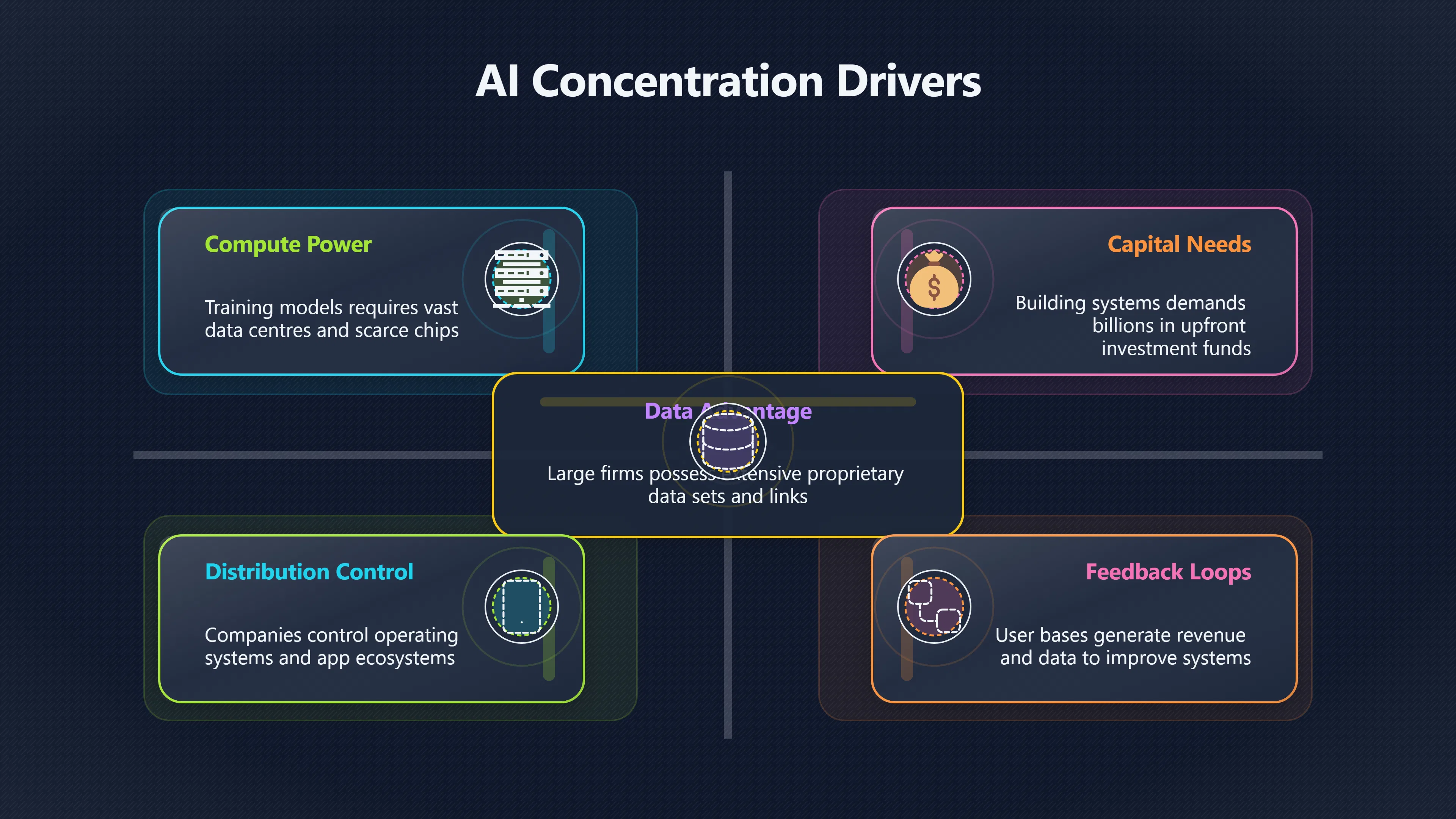
Several reinforcing mechanisms push power towards a relatively small group of actors:
- Compute concentration: Training and serving advanced models requires vast data centres and access to scarce AI accelerators.
- Capital concentration: Frontier development often requires funding levels unavailable to most universities, startups or public institutions.
- Data advantages: Large firms often possess extensive proprietary datasets and customer relationships.
- Distribution advantages: Companies that already control operating systems, productivity software, cloud platforms or app ecosystems can rapidly deploy AI products to hundreds of millions of users.
- Feedback loops: Larger user bases generate more revenue, data and product feedback, which can improve future systems.
The result is not necessarily a monopoly, but a market structure in which a few firms possess disproportionate influence over the direction of AI development and deployment.
Market concentration in cloud infrastructure
Cloud computing has become the physical backbone of modern AI. Even organisations building their own models often depend on rented infrastructure from major cloud providers.
OECD analysis notes that cloud markets are highly concentrated, with the largest providers collectively holding the majority of global market share. Multiple studies place Amazon Web Services (AWS), Microsoft Azure and Google Cloud as the dominant providers worldwide, together accounting for more than 60% of global cloud infrastructure spending.[OECD]oecd.orgcomponent 6Global share of largest provider reported over 80%. Global share of largest 3 players reported as having over 60% share…Read more…[OECD]oecd.orgpartnerships involving generative AI companies and cloud providers.Read morePotential competition policy responses in AI infrastructureNov 14, 2025 — The US Federal Trade Commission in January 2025 published s…
This matters because cloud platforms are no longer merely storage and computing businesses. They increasingly function as AI platforms, offering:
- Training infrastructure.
- Access to frontier models.
- AI development tools.
- Enterprise integration services.
- Security and compliance systems.
- Distribution channels into governments and large organisations.
A university, hospital trust, pharmaceutical company or government department may therefore depend on the same providers for both general computing infrastructure and advanced AI services.
Competition authorities worry that this creates bottlenecks. If a small number of firms become unavoidable intermediaries for advanced AI, they gain substantial influence over pricing, technical standards and market access. The UK’s Competition and Markets Authority (CMA) has repeatedly highlighted the strategic importance of cloud infrastructure to AI competition and innovation.[GOV.UK]GOV.UKai foundation models initial reportFoundation Models: Initial report18 Sept 2023 — The CMA started its initial review into AI Foundation Models in May 2023, to help create…[GOV.UK]GOV.UKai foundation models update paperFoundation Models: Update paper11 Apr 2024 — Update paper as part of the CMA's AI Foundation Models: initial review, following initial re…
Vertical integration and the rise of AI ecosystems
The concentration question is not only about market share. It is also about vertical integration.
Many of the largest AI firms operate across multiple layers of the stack at once:
LayerExamples of controlInfrastructureData centres, cloud platforms, networkingComputeAI chips, chip design, procurement relationshipsModelsFoundation models and AI assistantsApplicationsWorkplace software, coding tools, search, consumer productsDistributionEnterprise contracts, operating systems, app ecosystems
A company that controls several layers simultaneously can create efficiencies. Customers often benefit from integrated systems that work together smoothly.
However, vertical integration can also increase dependency. A business that trains models on one cloud platform, stores data there, integrates AI into workplace software from the same provider and relies on its security infrastructure may find switching increasingly difficult.
The concern is not merely that large firms become successful. It is that the costs of leaving their ecosystems become so high that competitors struggle to emerge even if they build technically superior products.
This is one reason regulators have examined partnerships between major cloud providers and leading AI developers. The CMA, FTC and other authorities have investigated whether investments and commercial agreements could strengthen existing infrastructure dominance or create barriers for rivals.[Federal Trade Commission]ftc.govFederal Trade CommissionFTC Issues Staff Report on AI Partnerships & Investments…The report details key aspects regarding the structur…[Federal Trade Commission]ftc.govFederal Trade CommissionFTC Issues Staff Report on AI Partnerships & Investments…The report details key aspects regarding the structur…[CIO Dive]ciodive.comregulators, who have taken a sweeping aim at AI startup deals.Read moreCIO DiveUK regulators add Amazon, Anthropic partnership to…Aug 8, 2024 — The probe into Anthropic and Amazon's partnership is the late…
Why regulators worry about AI partnerships
Many of the most important AI companies are connected through investment, cloud supply agreements and long-term infrastructure contracts.
Microsoft’s relationship with OpenAI became the most prominent example, but similar arrangements have emerged elsewhere, including Amazon’s partnership with Anthropic and Google’s investments in frontier AI firms.[GOV.UK]GOV.UKto GOV.UKServices and information, benefits, includes eligibility, appeals, tax credits and Universal Credit, births, deaths, marriages a…
Supporters of these partnerships argue that they solve a genuine financing problem. Frontier AI development requires infrastructure that startups could not otherwise afford. Large cloud providers can supply capital, chips and engineering support that accelerate innovation.
Critics argue that the same arrangements may entrench existing power structures.
In 2025, the US Federal Trade Commission published findings from its inquiry into AI partnerships and investments. The report identified several areas of concern, including control over critical inputs such as compute resources, increased switching costs for AI developers, and access by cloud providers to commercially sensitive information. The FTC also explored whether some partnership structures could provide strategic influence without triggering traditional merger review processes.[Federal Trade Commission]ftc.govFederal Trade CommissionFTC Issues Staff Report on AI Partnerships & Investments…The report details key aspects regarding the structur…[Federal Trade Commission]ftc.govFederal Trade CommissionFTC Issues Staff Report on AI Partnerships & Investments…The report details key aspects regarding the structur…[Federal Trade Commission]ftc.govFederal Trade CommissionFTC Issues Staff Report on AI Partnerships & Investments…The report details key aspects regarding the structur…
The broader governance question is whether frontier AI remains an open field with multiple competing centres of innovation, or whether it gradually consolidates around a few interconnected infrastructure providers.
What concentration could mean for an AI-enabled future
For advocates of AI abundance, concentration presents a paradox.
On one hand, large firms may be essential for building the infrastructure needed to support transformative AI. Massive investments in chips, data centres, energy systems and global deployment networks are often beyond the reach of governments, universities and smaller companies.
On the other hand, a future in which intelligence becomes abundant may look very different depending on ownership structures.
Consider several possibilities:
- Scientific research: If advanced research assistants are controlled by a few providers, access conditions may shape who can participate in scientific discovery.
- Healthcare: AI systems that accelerate drug discovery or diagnosis could either become widely available public goods or expensive proprietary services.
- Education: Personalised AI tutors could be broadly accessible or concentrated behind subscription models and platform ecosystems.
- Public administration: Governments may become dependent on private systems they cannot independently audit or operate.
- Labour markets: Workers and businesses may increasingly rely on tools whose capabilities, prices and rules are determined externally.
The optimistic AI bloom vision usually assumes broad diffusion of intelligence. Commercial concentration raises the possibility that intelligence becomes abundant in technical terms while remaining institutionally controlled.
The argument that concentration may not last
The concentration story is not uncontested.
Some economists and technology analysts argue that AI markets remain highly dynamic. Today’s leaders face competition from open-source models, specialised AI firms, new cloud providers and emerging infrastructure companies.
Recent years have already seen significant challenges to incumbents. Open-weight models have reduced some barriers to experimentation. Specialised AI cloud providers have emerged. Large firms themselves compete intensely against one another rather than functioning as a single bloc.[Business Insider]businessinsider.comTraditionally, AWS was a go-to platform for startups due to its scalable compute and storage offerings. However, the rise of generative A…
There are also historical reasons for caution before assuming permanent dominance. Technology markets often appear locked up until new technical shifts create opportunities for challengers. Mainframe computing, personal computing, web browsers, social media and smartphones all experienced periods of dramatic change in competitive leadership.
The strongest governance arguments therefore do not necessarily assume inevitable monopoly. Instead, they focus on preserving contestability: ensuring that future competitors have a realistic chance to emerge.
Competition and interoperability policies
The policy debate increasingly centres on how to encourage innovation without allowing infrastructure power to become self-reinforcing.
Several approaches have attracted attention.
Interoperability and portability
One goal is making it easier for organisations to move between providers.
Policies can include:
- Easier transfer of data between cloud platforms.
- Standardised interfaces.
- Reduced technical barriers to migration.
- Limits on contractual lock-in mechanisms.
Advocates argue that lower switching costs strengthen competition while preserving incentives to innovate.
Scrutiny of partnerships and acquisitions
Competition authorities increasingly examine investments, exclusive agreements and hiring arrangements involving major AI companies.
The concern is not only traditional mergers but also forms of influence that may shape market structure without formal ownership changes. Recent CMA and FTC investigations have focused heavily on this issue.[Federal Trade Commission]ftc.govFederal Trade CommissionFTC Issues Staff Report on AI Partnerships & Investments…The report details key aspects regarding the structur…[Federal Trade Commission]ftc.govFederal Trade CommissionFTC Issues Staff Report on AI Partnerships & Investments…The report details key aspects regarding the structur…[Federal Trade Commission]ftc.govFederal Trade CommissionFTC Issues Staff Report on AI Partnerships & Investments…The report details key aspects regarding the structur…
Public and academic compute
Some researchers argue that governments should support shared computing infrastructure for universities, public-interest research and smaller firms.
The logic resembles earlier investments in scientific infrastructure. If access to advanced computing becomes a prerequisite for participation in frontier research, public alternatives may help prevent capability from becoming exclusively commercial.
Open models and open standards
Open-source and open-weight AI systems are often presented as a counterbalance to concentration.
The advantages include:
- Greater transparency.
- Lower barriers to experimentation.
- Reduced dependence on single vendors.
- Wider geographic access.
However, open systems also create governance challenges involving misuse, safety and accountability. The trade-off is not straightforward.
The deeper question: who governs intelligence?
The long-term significance of AI concentration goes beyond economics.
Previous industrial revolutions changed access to energy, manufacturing capacity and transportation. Advanced AI may change access to intelligence itself: the ability to generate knowledge, solve problems, design technologies and coordinate complex systems.
If that happens, control over AI platforms could become a form of structural power comparable to control over financial systems, communications networks or energy infrastructure.
This does not mean private firms should be excluded from building advanced AI. Many of the breakthroughs that could contribute to a flourishing future may emerge from commercial research laboratories. But the governance challenge becomes more serious as AI capabilities become more central to medicine, science, education and public decision-making.
The central question is therefore not whether successful AI companies should exist. It is whether societies allow the institutions that shape intelligence production to become so concentrated that public choices increasingly depend on private platform governance. A world in which AI helps humanity bloom may require not only more intelligence, but more pluralism in who can access, develop and direct it.[OECD]one.oecd.orgmore…[GOV.UK]GOV.UKcloud services market investigationservices market investigation28 January 2025: The CMA has published its provisional decision in its market investigation into the supply…[OECD]oecd.orgcomponent 5AI supply chain: Competition in artificial intelligence…14 Nov 2025 — 4 The most recently reported market share estimates for the…
Amazon book picks
Further Reading
Books and field guides related to Who Controls AI Platforms and Why It Matters. Use these as the next step if you want deeper reading beyond the article.
The Coming Wave
Directly addresses concentration and control of advanced technologies.
eBay marketplace picks
Marketplace Samples
Example marketplace items related to this page. Use the search link to explore similar finds on eBay.


![Listing image for Dell PowerEdge R730xd 16LFF+2SFF Server /IndigoVision NVR-AS 4000/32GB RAM [16D]](https://i.ebayimg.com/images/g/kRQAAeSweFlqHX4b/s-l225.jpg)

Endnotes
1.
Source: oecd.org
Title: component 5
Link:https://www.oecd.org/en/publications/competition-in-artificial-intelligence-infrastructure_623d1874-en/full-report/component-5.html
Source snippet
AI supply chain: Competition in artificial intelligence...14 Nov 2025 — 4 The most recently reported market share estimates for the...
2.
Source: assets.publishing.service.gov.uk
Title: UKA I Foundation Models
Link:https://assets.publishing.service.gov.uk/media/661e5a4c7469198185bd3d62/AI_Foundation_Models_technical_update_report.pdf
Source snippet
Foundation Models - Technical update report16 Apr 2024 — 1.2 We published our initial report in September 2023, in which we proposed prin...
Published: September 2023
3.
Source: ftc.gov
Link:https://www.ftc.gov/news-events/news/press-releases/2025/01/ftc-issues-staff-report-ai-partnerships-investments-study
Source snippet
Federal Trade CommissionFTC Issues Staff Report on AI Partnerships & Investments...The report details key aspects regarding the structur...
4.
Source: assets.publishing.service.gov.uk
Title: Full report
Link:https://assets.publishing.service.gov.uk/media/65081d3aa41cc300145612c0/Full_report_.pdf
Source snippet
Foundation Models Initial Report18 Sept 2023 — 30 Microsoft Corporate Blogs (2023) Microsoft and OpenAI extend partnership. 31 Anthropic...
5.
Source: oecd.org
Title: component 6
Link:https://www.oecd.org/en/publications/competition-in-artificial-intelligence-infrastructure_623d1874-en/full-report/component-6.html
Source snippet
Global share of largest provider reported over 80%. Global share of largest 3 players reported as having over 60% share...Read more...
6.
Source: GOV.UK
Title: cloud services market investigation
Link:https://www.gov.uk/cma-cases/cloud-services-market-investigation
Source snippet
services market investigation28 January 2025: The CMA has published its provisional decision in its market investigation into the supply...
Published: January 2025
7.
Source: GOV.UK
Title: ai foundation models initial review
Link:https://www.gov.uk/cma-cases/ai-foundation-models-initial-review
Source snippet
Foundation Models: initial review4 May 2023 — This initial review will help create an early understanding of the market for foundation mo...
Published: May 2023
8.
Source: ftc.gov
Title: launches inquiry generative ai investments partnerships
Link:https://www.ftc.gov/news-events/news/press-releases/2024/01/ftc-launches-inquiry-generative-ai-investments-partnerships
Source snippet
Federal Trade CommissionFTC Launches Inquiry into Generative AI Investments and...Jan 25, 2024 — The FTC's inquiry will help the agency...
9.
Source: ftc.gov
Title: staff report ai partnerships investments 6b study
Link:https://www.ftc.gov/reports/ftc-staff-report-ai-partnerships-investments-6b-study
Source snippet
January 2025. Documents. File. FTC Staff Report on AI Partnerships & Investments 6(b) Study (...Read more...
Published: January 2025
10.
Source: ftc.gov
Link:https://www.ftc.gov/system/files/ftc_gov/pdf/p246201_aipartnerships6breport_redacted_0.pdf
Source snippet
Federal Trade CommissionPartnerships Between Cloud Service Providers and AI...4.5.1 - The partnerships offer CSP partners the ability to...
11.
Source: ftc.gov
Title: behind ftcs 6b report large ai partnerships investments
Link:https://www.ftc.gov/policy/advocacy-research/tech-at-ftc/2025/01/behind-ftcs-6b-report-large-ai-partnerships-investments
Source snippet
Federal Trade CommissionBehind the FTC's 6(b) Report on Large AI Partnerships &...Jan 17, 2025 — Today, the FTC released a staff report...
12.
Source: oecd.org
Title: partnerships involving generative AI companies and cloud providers.Read more
Link:https://www.oecd.org/en/publications/competition-in-artificial-intelligence-infrastructure_623d1874-en/full-report/component-7.html
Source snippet
Potential competition policy responses in AI infrastructureNov 14, 2025 — The US Federal Trade Commission in January 2025 published s...
Published: January 2025
13.
Source: one.oecd.org
Link:https://one.oecd.org/document/DAF/COMP%282025%298/en/pdf
Source snippet
more...
14.
Source: GOV.UK
Title: ai foundation models initial report
Link:https://www.gov.uk/government/publications/ai-foundation-models-initial-report
Source snippet
Foundation Models: Initial report18 Sept 2023 — The CMA started its initial review into AI Foundation Models in May 2023, to help create...
Published: May 2023
15.
Source: GOV.UK
Title: ai foundation models update paper
Link:https://www.gov.uk/government/publications/ai-foundation-models-update-paper
Source snippet
Foundation Models: Update paper11 Apr 2024 — Update paper as part of the CMA's AI Foundation Models: initial review, following initial re...
16.
Source: GOV.UK
Link:https://www.gov.uk/
Source snippet
to GOV.UKServices and information, benefits, includes eligibility, appeals, tax credits and Universal Credit, births, deaths, marriages a...
17.
Source: assets.publishing.service.gov.uk
Link:https://assets.publishing.service.gov.uk/media/661941a6c1d297c6ad1dfeed/Update_Paper__1_.pdf
Source snippet
Foundation Models: Update Paper11 Apr 2024 — In September 2023, we published a report as part of our initial review of...
Published: September 2023
18.
Source: blog.promise.legal
Title: ftc report on cloud providers and ai partnerships
Link:https://blog.promise.legal/ftc-report-on-cloud-providers-and-ai-partnerships/
Source snippet
Report on Cloud Providers and AI PartnershipsJan 31, 2025 — Explore the dynamics of partnerships between major cloud providers and AI dev...
19.
Source: ciodive.com
Title: regulators, who have taken a sweeping aim at AI startup deals.Read more
Link:https://www.ciodive.com/news/uk-regulatory-scrutiny-anthropic-amazon-competition-market/723777/
Source snippet
CIO DiveUK regulators add Amazon, Anthropic partnership to...Aug 8, 2024 — The probe into Anthropic and Amazon's partnership is the late...
20.
Source: businessinsider.com
Link:https://www.businessinsider.com/amazon-ai-startups-delaying-aws-spending
Source snippet
Traditionally, AWS was a go-to platform for startups due to its scalable compute and storage offerings. However, the rise of generative A...
21.
Source: ciodive.com
Title: ftc AI cloud inquiry
Link:https://www.ciodive.com/news/ftc-AI-cloud-inquiry/705671/
Source snippet
The agency sent formal requests to Alphabet, Amazon, Anthropic, Microsoft and OpenAI, as part of...Read more...
22.
Source: awards.concurrences.com
Link:https://awards.concurrences.com/IMG/pdf/bradley_weber_taylor_levesque_cloud_and_competition_policy-_part_viii_-_cloud_service-ai_partnerships-_the_ftc_s_section_6_b_report_and_its_antitrust_implications_in_the_trump_2.0_administration_1_august_2025_concurrences_no_8-2025.pdf?149193%2Fcc0306ddb4ee1f75142844f9ece7723833c7aa2cb5a11f9042244118d9b420e7=
Source snippet
Federal Trade Commission's Section 6(b) Report investigated three partnerships between major cloud service providers (Alphabet/Google, Am...
Additional References
23.
Source: linkedin.com
Link:https://www.linkedin.com/posts/oecd-competition-law-and-policy_cloud-cloudcomputing-competition-activity-7331691640044060672-HjNY
Source snippet
OECD Competition Law and Policy's PostGoogle Cloud leads with 38% of new startup relationships, followed by AWS at 30% and Azure at 8%. M...
24.
Source: visitbritain.com
Link:https://www.visitbritain.com/en
Source snippet
The Official Website For UK Tourism | VisitBritainLet VisitBritain provide you with fresh perspectives of the UK's diverse cities, modern...
25.
Source: nortonrosefulbright.com
Link:https://www.nortonrosefulbright.com/en-gb/knowledge/publications/8ca8f277/the-uk-cmas-ai-foundation-models-initial-report
Source snippet
The UK CMA's review of AI Foundation ModelsThe CMA published its Initial Report (Initial Report) on AI Foundation Models (FM), supplement...
26.
Source: nortonrosefulbright.com
Link:https://www.nortonrosefulbright.com/en/knowledge/publications/8ca8f277/the-uk-cmas-ai-foundation-models-initial-report
Source snippet
The UK CMA's review of AI Foundation ModelsThe CMA published its Initial Report (Initial Report) on AI Foundation Models (FM), supplement...
27.
Source: aifray.com
Link:https://aifray.com/ftc-releases-staff-report-on-ai-partnerships-investments-collection-of-information-and-innuendo-with-unclear-contours/
Source snippet
FTC releases Staff Report on AI Partnerships & InvestmentsJan 17, 2025 — What's new: Today the FTC released the Staff Report on AI Partne...
28.
Source: linkedin.com
Link:https://www.linkedin.com/posts/israeldaniel_competition-in-artificial-intelligence-infrastructure-activity-7416848936986128386-goye
Source snippet
OECD Analyzes AI Competition in 2025 Strategic Policy...The OECD's 2025 strategic policy paper on competition in artificial intelligence...
29.
Source: clearygottlieb.com
Link:https://www.clearygottlieb.com/-/media/files/alert-memos-2023/cma-publishes-initial-report-on-ai-foundation-models-and-guiding-principles-for-firms.pdf
Source snippet
cma-publishes-initial-report-on-ai-foundation-models-and-...20 Sept 2023 — The CMA's initial report marks a major development in the bur...
30.
Source: euronews.com
Title: uk regulator says microsoft and amazons cloud dominance hurts competition
Link:https://www.euronews.com/next/2025/07/31/uk-regulator-says-microsoft-and-amazons-cloud-dominance-hurts-competition
Source snippet
UK regulator says Microsoft, Amazon dominate cloud marketJul 31, 2025 — The UK authority found that Microsoft and Amazon Web Services hav...
31.
Source: businessatoecd.org
Title: Artificial Intelligence, Data, and Competition
Link:https://www.businessatoecd.org/hubfs/Artificial%20Intelligence%2C%20Data%2C%20and%20Competition.pdf?hsLang=en
Source snippet
12 Jun 2024 — There are therefore indications that the market is competitive, even though the largest cloud computing services providers...
32.
Source: inquisitiveminds.bristows.com
Title: google anthropic the latest chapter in the cmas scrutiny of generative ai
Link:https://inquisitiveminds.bristows.com/post/102jnrs/google-anthropic-the-latest-chapter-in-the-cmas-scrutiny-of-generative-ai
Source snippet
bristows.comGoogle/Anthropic: the latest chapter in the CMA's scrutiny of...Nov 8, 2024 — The CMA has been tracking partnerships across...
Topic Tree