Within Ageing clocks
Can ageing clocks warn early enough?
Ageing clocks are most useful if they reveal treatable risk early enough to change screening, prevention, or follow-up care.
On this page
- What a useful early warning would need to show
- Where earlier screening and prevention might change care
- Why a biological age number alone is not enough
Page outline Jump by section
Introduction
The most important promise behind AI ageing clocks is not that they can tell someone their “true age”. It is that they might reveal biological deterioration years before a disease becomes obvious. If that works, medicine could move part of its focus from treating heart disease, dementia, cancer, diabetes, and frailty after damage has accumulated to identifying people whose bodies appear to be ageing unusually fast and intervening earlier.[ScienceDirect]sciencedirect.comPredicting healthspan and disease risks through biological…by G Li · 2025 · Cited by 7 — Aging clocks offer precise measu…
 That possibility matters well beyond longevity research. In the broader vision of AI-enabled human flourishing, earlier detection is one of the most plausible near-term pathways through which advanced data analysis could improve health at population scale. But the central question is not whether ageing clocks can predict risk in statistical studies. It is whether they can provide warnings early enough, accurately enough, and clearly enough to change medical decisions before illness appears. That is a much higher standard than producing an interesting biological-age score.[Nature]nature.comAn unbiased comparison of 14 epigenetic clocks in relation…by C Mavrommatis · 2025 · Cited by 6 — A key question in evaluating t…
What a useful early warning would need to show
A biological-age signal becomes clinically valuable only if it changes what happens next.
Many ageing clocks already show correlations with future disease, disability, and mortality. People whose clocks suggest accelerated ageing often experience worse health outcomes over subsequent years than people of the same chronological age whose clocks indicate slower ageing. Measures such as GrimAge, PhenoAge, proteomic ageing clocks, and DunedinPACE were specifically designed to capture risks linked to future decline rather than simply estimate calendar age.[ScienceDirect]sciencedirect.comPredicting healthspan and disease risks through biological…by G Li · 2025 · Cited by 7 — Aging clocks offer precise measu…[PMC]pmc.ncbi.nlm.nih.govDunedinPACE, a DNA methylation biomarker of the pace of…by DW Belsky · 2022 · Cited by 1035 — DunedinPACE showed high test-retest r…[King's College London]kclpure.kcl.ac.ukdunedinpace a dna methylation biomarker of the pace of agingKing's College LondonDunedinPACE, a DNA methylation biomarker of the pace of…by DW Belsky · 2022 · Cited by 942 — DunedinPACE showed h…
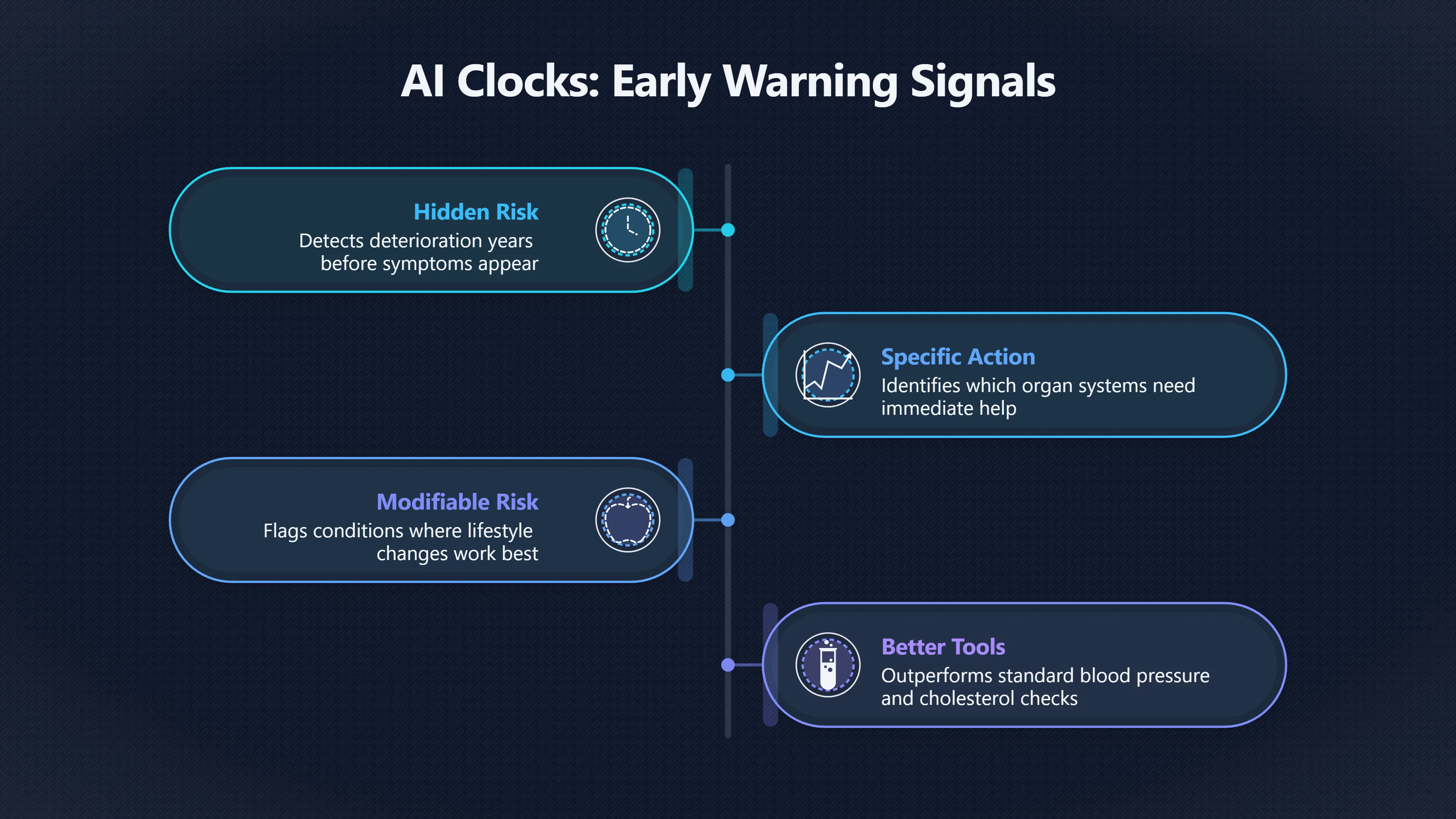
However, an early warning system must clear several additional hurdles:
- The signal must appear before symptoms. Detecting accelerated ageing after disease is already established is far less useful.
- The prediction must be specific enough to guide action. A general warning that someone is at higher risk is less valuable than identifying which risks are elevated.
- The risk must be modifiable. If no intervention exists, the practical benefit becomes limited.
- The warning must outperform existing methods. Doctors already use blood pressure, cholesterol, imaging, family history, smoking history, and other established risk tools.
- Results must be reliable across populations. A clock that works mainly in the dataset used to train it may fail in real-world clinical settings.[Nature]nature.comDo we actually need aging clocks? | npj Agingby D Kriukov · 2025 — Aging clocks use machine learning to estimate biological age as…[PMC]pmc.ncbi.nlm.nih.govreview of aging clocks and factors that may influence…by M Min · 2024 · Cited by 33 — Aging clocks are computational models designed t…
This distinction is easy to miss. A model can be scientifically impressive while still having little impact on healthcare decisions. Many researchers now argue that ageing clocks should be judged less by how accurately they estimate biological age and more by whether they improve prediction, prevention, or treatment compared with existing clinical approaches.[Nature]nature.comProteomic aging clock predicts mortality and risk of…by MA Argentieri · 2024 · Cited by 327 — Of note, our study provides compre…
Where earlier screening and prevention might change care
The strongest case for ageing clocks is not that they replace disease-specific screening. It is that they help identify who may need earlier or more intensive monitoring.
Cardiovascular disease
Heart disease develops gradually over decades. By the time symptoms appear, arteries may already contain extensive damage.
Several biological-age measures are associated with future cardiovascular risk, suggesting that accelerated ageing signatures may capture cumulative physiological stress before a heart attack or stroke occurs. Researchers have found that advanced epigenetic and proteomic clocks predict mortality and multiple chronic diseases independently of chronological age.[Nature]nature.comLongitudinal changes in epigenetic clocks predict survival…by PL Kuo · 2026 · Cited by 5 — Broadly termed 'epigenetic clocks,' these m…[PMC]pmc.ncbi.nlm.nih.govDunedinPACE, a DNA methylation biomarker of the pace of…by DW Belsky · 2022 · Cited by 1035 — DunedinPACE showed high test-retest r…
In principle, a patient with apparently normal health but unusually rapid biological ageing might receive:
- earlier cardiovascular imaging,
- more aggressive management of blood pressure,
- earlier cholesterol-lowering treatment,
- intensified lifestyle interventions,
- closer follow-up over subsequent years.
The clock itself would not diagnose disease. Instead, it would function as a signal that hidden risk may be accumulating faster than expected.
Frailty and loss of physical function
One reason geroscientists are interested in pace-of-ageing measures such as DunedinPACE is that they appear linked to later disability, mobility problems, and overall functional decline.[PMC]pmc.ncbi.nlm.nih.govreview of aging clocks and factors that may influence…by M Min · 2024 · Cited by 33 — Aging clocks are computational models designed t…
If validated further, such measures could identify people entering a trajectory towards frailty years before visible deterioration emerges. That could potentially support earlier exercise programmes, nutritional interventions, fall-prevention efforts, or monitoring for conditions that often accompany accelerated ageing.
For ageing societies, this may eventually matter as much as extending lifespan. Preventing ten years of disability can be more meaningful than extending life by a few months.
Dementia and neurodegenerative disease
Neurodegenerative disorders often begin decades before diagnosis. By the time memory symptoms become obvious, substantial brain changes may already have occurred.
Researchers are increasingly exploring whether biological-age measures can identify people whose overall ageing trajectory suggests elevated risk for later cognitive decline. Some newer clocks incorporate information linked to cognitive health, inflammation, and systemic physiological deterioration.[Nature]nature.comA full life cycle biological clock based on routine clinical…by K Wang · 2025 · Cited by 10 — Key aging biomarkers such as urea…
The challenge is that dementia risk remains difficult to predict with high precision. Even if ageing clocks contribute useful information, they will likely need to be combined with imaging, genetics, cognitive testing, and other biomarkers before they can meaningfully alter care pathways.
Multi-disease risk
One of the more ambitious goals is identifying people whose entire biological system appears to be deteriorating unusually quickly.
Unlike conventional screening programmes that focus on a single disease, ageing clocks may reveal broad vulnerability across several conditions simultaneously. Researchers increasingly view ageing itself as a common risk factor underlying cardiovascular disease, cancer, metabolic disease, frailty, and aspects of cognitive decline.[ScienceDirect]sciencedirect.comPredicting healthspan and disease risks through biological…by G Li · 2025 · Cited by 7 — Aging clocks offer precise measu…
If that view proves correct, an ageing clock could act as a general warning signal that multiple disease processes are becoming more likely, even before any single disease reaches a diagnostic threshold.
Why a biological-age number alone is not enough
A major problem is that a biological-age result often answers the wrong question.
Imagine being told that your biological age is 58 despite being 50 years old. The number sounds alarming, but what exactly should happen next?
Should you receive extra cancer screening? More cardiovascular testing? Different medication? Dietary changes? Exercise prescriptions? More frequent monitoring? Or simply reassurance that the estimate may be imperfect?
Without a clear decision pathway, a biological-age score risks becoming a sophisticated form of health anxiety rather than a medical tool.
This is why many researchers argue that future ageing clocks must become more actionable. Instead of generating a single summary number, they may need to identify:
- which organ systems appear most vulnerable,
- which diseases are driving the elevated risk,
- how large the risk increase actually is,
- what interventions are most likely to help,
- whether the risk changes after treatment or lifestyle modification.[Nature]nature.comAn unbiased comparison of 14 epigenetic clocks in relation…by C Mavrommatis · 2025 · Cited by 6 — A key question in evaluating t…
The difference is similar to the difference between hearing that a car is “ageing badly” and receiving a diagnostic report that identifies failing brakes, tyre wear, and engine problems separately.
The implementation challenge: prediction versus intervention
Many ageing-clock studies demonstrate prediction. Far fewer demonstrate improved outcomes.
Researchers can already show that some clocks predict mortality, multimorbidity, disability, and future disease better than chronological age alone. Large comparisons increasingly support the idea that biological-age measures contain meaningful health information.[Nature]nature.comDo we actually need aging clocks? | npj Agingby D Kriukov · 2025 — Aging clocks use machine learning to estimate biological age as…[Nature]nature.comProteomic aging clock predicts mortality and risk of…by MA Argentieri · 2024 · Cited by 327 — Of note, our study provides compre…
The harder test is prospective clinical use.
A healthcare system would need evidence that:
- the clock identifies a high-risk individual,
- clinicians change management because of the result,
- those changes reduce disease, disability, or death.
That final step remains largely unproven.
This explains why enthusiasm and scepticism coexist. Supporters see ageing clocks as an emerging foundation for preventive medicine. Critics note that many existing risk scores already predict disease and that clocks must demonstrate clear advantages before becoming routine clinical tools.[Nature]nature.comLongitudinal changes in epigenetic clocks predict survival…by PL Kuo · 2026 · Cited by 5 — Broadly termed 'epigenetic clocks,' these m…
The gap between prediction and intervention is where most of the real-world challenge lies.
Why AI could make early warning more useful
The long-term opportunity is not necessarily a single ageing clock. It may be AI systems that continuously integrate many different signals.
Future models could combine:
- blood biomarkers,
- DNA methylation patterns,[aginganddisease.org]aginganddisease.orgemselves as powerful aging biomarkers, capable of estimating biological age and…Read more…
- protein measurements,
- imaging data,
- wearable-device information,
- electronic health records,
- environmental exposures,
- lifestyle patterns.
Instead of producing one biological-age estimate, such systems could generate personalised forecasts of likely health trajectories. Some emerging models already attempt to combine routine clinical data with machine learning to predict disease risk and ageing-related decline across the lifespan. Nature[2aging.jmir.org]aging.jmir.orgArtificial Intelligence-Driven Biological Age Prediction Model…by CU Jeong · 2025 · Cited by 10 — This study aimed to develop and vali…
In the optimistic AI-bloom scenario, this becomes part of a broader shift towards anticipatory medicine: detecting deterioration before symptoms, tailoring interventions to individuals, and reducing the burden of chronic disease across populations.
The crucial uncertainty is whether these systems will genuinely uncover hidden risk early enough to alter outcomes, or whether they will mostly repackage information that doctors could already infer from conventional measurements.
The strongest reason researchers remain interested
Despite the unresolved questions, ageing clocks continue attracting attention because they address a fundamental limitation of medicine.
Most chronic diseases develop slowly. Prevention often fails because the warning signs arrive too late or remain invisible until damage is extensive.
If AI-driven ageing measures can reliably identify accelerated biological decline years before conventional diagnosis, they could provide a new layer of preventive intelligence between apparent health and overt disease. Even modest success would matter. A warning delivered five or ten years earlier can create opportunities for intervention that no treatment available after diagnosis can recover.
That is why the most important test for ageing clocks is not whether they estimate age accurately. It is whether they help people stay healthy for longer by revealing meaningful risk while there is still time to act.[Nature]nature.comA full life cycle biological clock based on routine clinical…by K Wang · 2025 · Cited by 10 — Key aging biomarkers such as urea…[ScienceDirect]sciencedirect.comPredicting healthspan and disease risks through biological…by G Li · 2025 · Cited by 7 — Aging clocks offer precise measu…[Nature]nature.comA full life cycle biological clock based on routine clinical…by K Wang · 2025 · Cited by 10 — Key aging biomarkers such as urea…
Amazon book picks
Further Reading
Books and field guides related to Can ageing clocks warn early enough?. Use these as the next step if you want deeper reading beyond the article.
The Age of Scientific Wellness
Discusses predictive biomarkers and preventive medicine.
eBay marketplace picks
Marketplace Samples
Example marketplace items related to this page. Use the search link to explore similar finds on eBay.


Endnotes
1.
Source: sciencedirect.com
Link:https://www.sciencedirect.com/science/article/pii/S1471491425002576
Source snippet
Predicting healthspan and disease risks through biological...by G Li · 2025 · Cited by 7 — Aging clocks offer precise measu...
2.
Source: sciencedirect.com
Link:https://www.sciencedirect.com/science/article/abs/pii/S0959440X24000046
Source snippet
The traditional linear models...Read more...
3.
Source: nature.com
Link:https://www.nature.com/articles/s41467-025-66106-y
Source snippet
An unbiased comparison of 14 epigenetic clocks in relation...by C Mavrommatis · 2025 · Cited by 6 — A key question in evaluating t...
4.
Source: nature.com
Link:https://www.nature.com/articles/s41514-025-00312-2
Source snippet
Do we actually need aging clocks? | npj Agingby D Kriukov · 2025 — Aging clocks use machine learning to estimate biological age as...
5.
Source: pmc.ncbi.nlm.nih.gov
Link:https://pmc.ncbi.nlm.nih.gov/articles/PMC8853656/
Source snippet
DunedinPACE, a DNA methylation biomarker of the pace of...by DW Belsky · 2022 · Cited by 1035 — DunedinPACE showed high test-retest r...
6.
Source: nature.com
Link:https://www.nature.com/articles/s41591-024-03164-7
Source snippet
Proteomic aging clock predicts mortality and risk of...by MA Argentieri · 2024 · Cited by 327 — Of note, our study provides compre...
7.
Source: sciencedirect.com
Link:https://www.sciencedirect.com/science/article/abs/pii/S1568163722001854
Source snippet
Epigenetic clock: A promising biomarker and practical tool...by R Duan · 2022 · Cited by 331 — This review provides a compr...
8.
Source: pmc.ncbi.nlm.nih.gov
Link:https://pmc.ncbi.nlm.nih.gov/articles/PMC11671503/
Source snippet
review of aging clocks and factors that may influence...by M Min · 2024 · Cited by 33 — Aging clocks are computational models designed t...
9.
Source: nature.com
Link:https://www.nature.com/articles/s43587-026-01066-6
Source snippet
Longitudinal changes in epigenetic clocks predict survival...by PL Kuo · 2026 · Cited by 5 — Broadly termed 'epigenetic clocks,' these m...
10.
Source: nature.com
Link:https://www.nature.com/articles/s41591-025-04006-w
Source snippet
A full life cycle biological clock based on routine clinical...by K Wang · 2025 · Cited by 10 — Key aging biomarkers such as urea...
11.
Source: aging.jmir.org
Link:https://aging.jmir.org/2025/1/e64473
Source snippet
Artificial Intelligence-Driven Biological Age Prediction Model...by CU Jeong · 2025 · Cited by 10 — This study aimed to develop and vali...
12.
Source: kclpure.kcl.ac.uk
Title: dunedinpace a dna methylation biomarker of the pace of aging
Link:https://kclpure.kcl.ac.uk/portal/en/publications/dunedinpace-a-dna-methylation-biomarker-of-the-pace-of-aging/
Source snippet
King's College LondonDunedinPACE, a DNA methylation biomarker of the pace of...by DW Belsky · 2022 · Cited by 942 — DunedinPACE showed h...
Additional References
13.
Source: linkedin.com
Link:https://www.linkedin.com/posts/garywmonk_ai-digitalhealth-activity-7280938464982818816-3QcE
Source snippet
AI-Based 'Aging Clocks' Predict Health, Lifespan, and...AI-based aging clocks use blood metabolite data to predict an individual's healt...
14.
Source: fightaging.org
Link:https://www.fightaging.org/archives/2026/03/the-dunedin-pace-of-aging-epigenetic-clock-predicts-mortality-better-than-simple-clinical-measures/
Source snippet
The Dunedin Pace of Aging Epigenetic Clock Predicts...23 Mar 2026 — It isn't surprising to find that epigenetic clocks predict mortality...
15.
Source: news-medical.net
Title: AI powered Life Clock forecasts diseases years before symptoms appear.aspx
Link:https://www.news-medical.net/news/20251028/AI-powered-LifeClock-forecasts-diseases-years-before-symptoms-appear.aspx
Source snippet
AI-powered LifeClock forecasts diseases years before...28 Oct 2025 — Using transformer-based AI, scientists created a full life-cycle bi...
16.
Source: aginganddisease.org
Link:https://www.aginganddisease.org/EN/10.14336/AD.2024.1495
Source snippet
emselves as powerful aging biomarkers, capable of estimating biological age and...Read more...
17.
Source: kcl.ac.uk
Title: researchers ai ageing clocks predict health lifespan
Link:https://www.kcl.ac.uk/news/researchers-ai-ageing-clocks-predict-health-lifespan
Source snippet
Researchers compare artificial intelligence 'ageing clocks...19 Dec 2024 — Metabolomic ageing clocks have the potential to provide insig...
18.
Source: facebook.com
Link:https://www.facebook.com/SNHScienceMission/posts/aging-clock-to-predict-healthspan-and-disease-risksaging-clocks-offer-precise-me/1297433335743398/
Source snippet
in identifying individuals at high risk of chronic diseases...Read more...
19.
Source: aging-us.com
Link:https://www.aging-us.com/article/206098/text
Source snippet
Biological clocks may be categorized as phenotypic...Read more...
20.
Source: trudiagnostic.com
Title: Which Epigenetic Clock Should I Use?
Link:https://www.trudiagnostic.com/post/the-dunedinpace-algorithm-meeting-the-criteria-for-an-epigenetic-age-related-biomarker-to-use-in-personalized-medicine
Source snippet
A case study on...In the case of the GrimAge clock, which was developed to predict mortality using this Framingham dataset, this analysi...
21.
Source: medrxiv.org
Title: 2026.03.23.26349074v1.full text
Link:https://www.medrxiv.org/content/10.64898/2026.03.23.26349074v1.full-text
Source snippet
Biological age acceleration measured by DunedinPACE...25 Mar 2026 — Second-generation clocks, including PhenoAge and GrimAge were design...
22.
Source: biorxiv.org
Title: 2025.04.14.648594v1.full text
Link:https://www.biorxiv.org/content/10.1101/2025.04.14.648594v1.full-text
Source snippet
Biometric aging clock for practical utility in clinical settings15 Apr 2025 — In this article, we present a cost-efficient aging clock th...
Topic Tree