Within AI Abundance
Will Abundant AI Benefit Everyone or Mainly Owners?
Low-cost AI services may still remain expensive or unequal when platforms, patents, professional rules and asset ownership control access.
On this page
- How platforms and intellectual property can preserve high prices
- Why professional rules and liability shape access
- Policies that could spread gains beyond asset owners
Page outline Jump by section
Introduction
If advanced AI makes high-quality advice, design, analysis, education and other knowledge-intensive services dramatically cheaper, who will actually enjoy the benefits? This is one of the central questions in the broader debate about AI-enabled abundance. Lower production costs do not automatically translate into lower prices, wider access or more equal prosperity. History shows that new technologies can either spread their gains widely or concentrate them among those who control key assets, intellectual property, infrastructure and markets. The same is likely to be true for AI.
The optimistic case is that abundant AI services could make expertise available to billions of people who cannot currently afford it, boosting productivity, education, healthcare and innovation. The sceptical case is that dominant platforms, owners of AI infrastructure, holders of valuable intellectual property and scarce physical assets could capture much of the economic value instead. Which outcome prevails depends less on AI capability alone than on competition, regulation, institutional design and political choices.[oecd.org]oecd.orgThe impact of Artificial Intelligence on productivity, distribution and growth | OECDApril 16, 2024…
Cheap Intelligence Does Not Guarantee Cheap Services
One of the easiest mistakes is to assume that if AI reduces the cost of producing an answer, the market price of the final service must also fall.
Many products contain only a small proportion of cognitive labour. A legal service includes insurance, regulation, professional responsibility and reputation. Medical care depends on hospitals, medicines, equipment and licensed clinicians. Building a house requires land, planning permission, materials and construction labour.
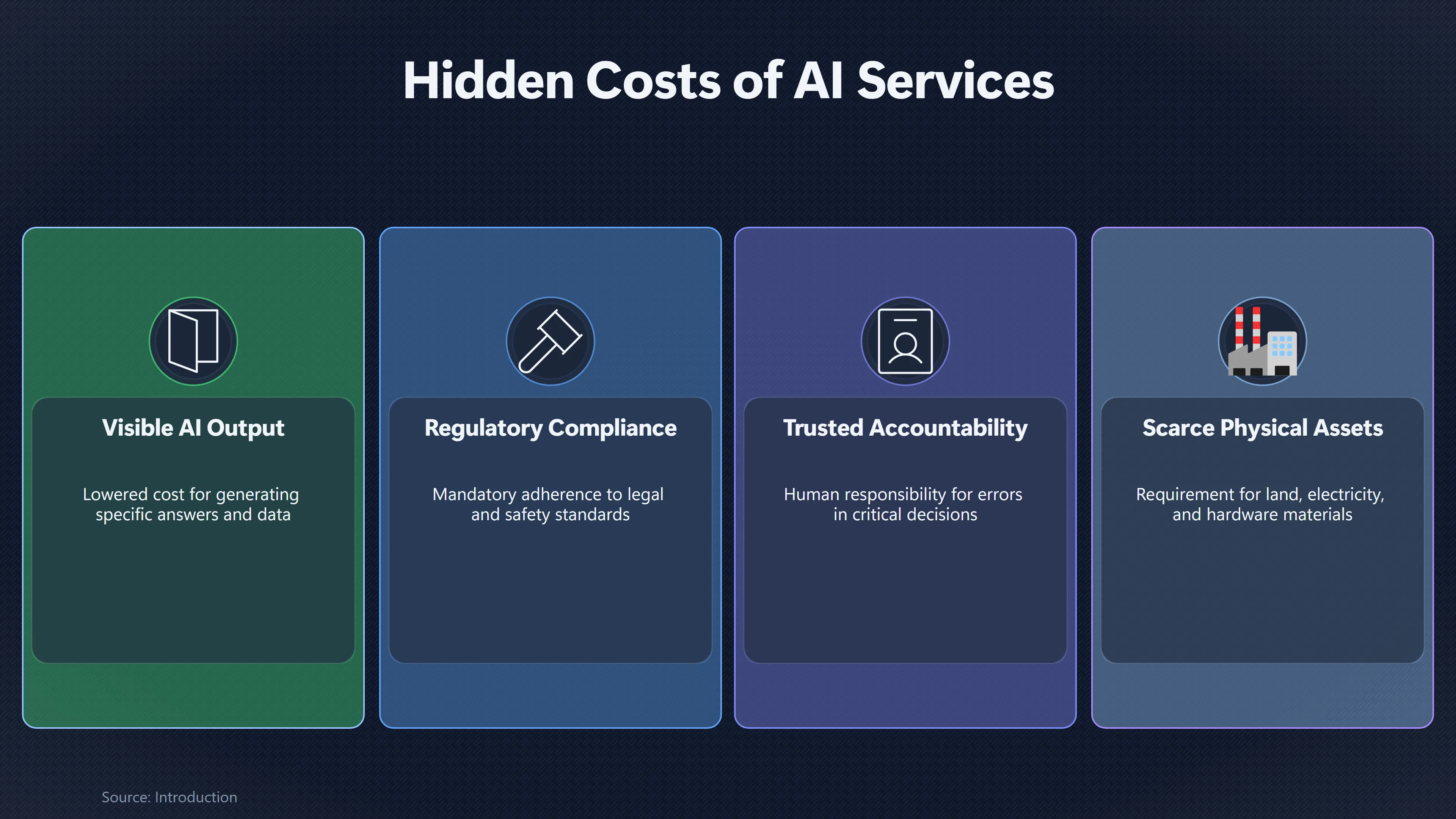
Even where AI performs most of the intellectual work, customers often pay for:
- trusted accountability if something goes wrong
- compliance with regulation
- human judgement in unusual situations
- access to scarce physical resources
- convenience through established platforms
This means AI may reduce production costs substantially while only partially reducing consumer prices. Much depends on whether competition forces providers to pass efficiency gains to users or allows them to retain higher profit margins.[oecd.org]oecd.orgThe impact of Artificial Intelligence on productivity, distribution and growth | OECDApril 16, 2024…
How Platforms and Intellectual Property Can Preserve High Prices
Digital markets frequently display strong network effects. The more users a platform attracts, the more data it gathers, the better its services may become and the harder it becomes for rivals to compete. AI could strengthen these feedback loops rather than weaken them.
Large AI companies may possess several reinforcing advantages:
- enormous computing infrastructure
- proprietary training data
- valuable model weights and trade secrets
- established cloud platforms
- distribution through widely used software ecosystems
- financial resources to train ever larger models
Intellectual property also matters. Patents, copyright, trade secrets and licensing agreements exist partly to reward innovation. They can encourage investment in expensive research. However, they can also limit competition, delay diffusion or increase dependence on a small number of technology providers if used aggressively. Competition authorities therefore face the difficult task of protecting incentives for innovation without allowing durable market power to become entrenched.[oecd.org]oecd.orgOpen source on oecd.org.
Open-weight or open-source AI models illustrate the opposite possibility. They can reduce barriers to entry by allowing universities, startups, governments and smaller firms to build services without paying for every layer of the technology stack. Yet even open models still depend on access to computing power, engineering expertise and deployment infrastructure.
Why Professional Rules and Liability Still Matter
Many valuable services cannot simply be automated because society requires someone to remain legally responsible.
Consider healthcare. An AI system may accurately suggest diagnoses or treatment options, but clinicians remain accountable for decisions affecting patients. Similarly, lawyers, architects and accountants often carry professional duties, insurance obligations and regulatory responsibilities that AI alone cannot satisfy.
Professional regulation serves several purposes:
- protecting the public from unsafe advice
- establishing accountability
- maintaining ethical standards
- providing legal remedies when mistakes occur
These protections can also slow diffusion. If regulations require extensive human review regardless of AI quality, productivity improvements may translate into lower workloads for professionals rather than dramatically cheaper services.
Conversely, if regulators eventually recognise highly reliable AI-assisted workflows, supervision requirements could evolve, allowing experienced professionals to oversee far more work than today. That would spread expertise more broadly while retaining human accountability.

The Importance of Who Owns Complementary Assets
Even if intelligence becomes abundant, many complementary resources remain scarce.
These include:
- land
- housing
- electricity
- semiconductor fabrication
- advanced computing facilities
- robotics
- mineral supplies
- distribution networks
- trusted brands
Owners of scarce assets often capture a significant share of economic gains from productivity improvements.
For example, if AI enables architects to design buildings almost instantly but urban land remains scarce, lower design costs alone will not make housing inexpensive. Likewise, if AI accelerates pharmaceutical discovery but manufacturing capacity and regulatory approval remain bottlenecks, medicine prices may not fall proportionately.
Abundant intelligence therefore does not eliminate classical economic scarcity. It changes which bottlenecks become most valuable.
Why Labour Does Not Automatically Lose
Public discussion sometimes frames AI as a simple contest between workers and capital owners. Reality is likely to be more complicated.
Historically, productivity improvements have often produced several simultaneous effects:
- higher profits
- lower prices
- creation of new products
- new occupations
- increased consumer demand
- rising wages in complementary sectors
Whether AI follows this pattern depends on how organisations deploy it.
Systems designed primarily to replace workers may shift income towards capital owners. Systems designed to augment workers can instead increase individual productivity, allowing employees to produce more value and potentially command higher wages.
The distinction between automation and augmentation has become an important theme in current economic research. It reflects a broader choice about the direction of technological development rather than an inevitable consequence of AI itself.[arXiv]arxiv.orgarXiv AI and Shared ProsperityAI and Shared ProsperityMay 18, 2021…
Global Distribution May Become More Uneven Before It Becomes Broader
Countries differ enormously in digital infrastructure, education, language resources and regulatory capacity.
Recent research using global AI usage data suggests that the economic value currently generated by AI is much more concentrated in developing economies, often benefiting relatively small groups of highly skilled professionals, while higher-income countries show broader diffusion across occupations. This suggests that adoption alone does not guarantee widely shared gains. Institutional capacity, education and access all influence who benefits first.[IMF]imf.orgAggregate Gains from AI and Their Distribution: Global Evidence from Usage DataAggregate Gains from AI and Their Distribution: Global Evidence from Usage DataJuly 10, 2026…
Language also matters. Models typically perform best in languages with abundant digital content, potentially delaying benefits for communities whose languages have fewer online resources.
Without investment in connectivity, education and local adaptation, abundant AI services could widen international inequalities even while lowering costs globally.
Policies That Could Spread Gains Beyond Asset Owners
There is no single policy capable of ensuring broadly shared prosperity from AI. Instead, economists and policy organisations generally emphasise a combination of measures that increase competition, widen access and strengthen people’s ability to benefit from new technology.
Important approaches include:
Maintaining competitive markets. Strong competition policy can reduce barriers to entry, scrutinise anti-competitive mergers and prevent dominant firms from using control of infrastructure to exclude rivals.[oecd.org]oecd.orgOpen source on oecd.org.
Supporting open innovation. Public research, interoperable standards and appropriately licensed open models can lower entry barriers while preserving incentives for innovation.
Expanding access to computing resources. Universities, startups and public-interest organisations may require shared computing infrastructure to compete with firms possessing vast private resources.
Investing in skills. Education, retraining and digital literacy determine whether workers use AI as a productivity multiplier or are excluded from its benefits.
Updating professional regulation. Regulators can encourage safe AI-assisted practice without unnecessarily preserving outdated restrictions that limit access.
Strengthening public services. Governments may deploy AI directly in healthcare, education, tax administration and legal assistance, allowing productivity gains to reach citizens regardless of income.
Tax and redistribution policies. If AI substantially increases returns to capital relative to labour, governments may choose different combinations of taxation, social insurance or public investment to spread gains more broadly. These remain politically contested questions rather than settled economic conclusions.
Institutions Will Shape Whether AI Enables Human Flourishing
The long-term vision behind AI abundance is not simply that software becomes cheaper. It is that more people gain access to capabilities previously reserved for wealthy organisations or highly trained experts.
Whether this contributes to genuine human flourishing depends on institutions as much as technology. Nobel laureate Daron Acemoglu and colleagues have argued that inclusive institutions have historically been essential for translating technological progress into shared prosperity rather than concentrated wealth. Their argument does not reject innovation; instead, it stresses that societies make choices about how technologies are developed, governed and deployed.[Nobel Prize]nobelprize.orgNobel Prize Daron Acemoglu – Banquet speechNobel PrizeDaron Acemoglu – Banquet speech - NobelPrize.org…
For the broader AI Bloom vision, this distinction is fundamental. Intelligence may become increasingly abundant, but abundance alone does not determine who benefits. The economic and social outcome depends on whether lower costs are converted into widespread access through competitive markets, effective governance and institutions that enable people—not only owners of scarce assets—to share in the gains.
Amazon book picks
Further Reading
Books and field guides related to Will Abundant AI Benefit Everyone or Mainly Owners?. Use these as the next step if you want deeper reading beyond the article.
The Coming Wave
"We are approaching a critical threshold in the history of our species. Everything is about to change. Soon you will live surrounded by A...
Platform Revolution
A practical guide to the new economy that is transforming the way we live, work, and play. Uber. Airbnb. Amazon. Apple. PayPal. All of th...

Capitalism and freedom
Rating: 3.8/5 from 6 Google Books ratings
First published 1962. Subjects: Business, Capitalism, Economic policy, Liberty, Nonfiction.
The Wealth of Nations
Presents a statement and defense of capitalist economics, first published in the late eighteenth century by Scottish scholar Adam Smith.
eBay marketplace picks
Marketplace Samples
Live-tested eBay searches with available results related to this page.
Selected fromtechnology poster oneBay.co.uk.




Endnotes
1.
Source: oecd.org
Link:https://www.oecd.org/en/publications/the-impact-of-artificial-intelligence-on-productivity-distribution-and-growth_8d900037-en.html?wcmmode=disabled%27.html
Source snippet
The impact of Artificial Intelligence on productivity, distribution and growth | OECDApril 16, 2024...
Published: April 16, 2024
2.
Source: oecd.org
Link:https://www.oecd.org/content/dam/oecd/en/publications/reports/2025/11/competition-in-artificial-intelligence-infrastructure_69319aee/623d1874-en.pdf
3.
Source: oecd.ai
Title: AIThe main policy issues that surround AI
Link:https://oecd.ai/en/ai-policy-issues
Source snippet
The main policy issues that surround AI - OECD.AI...
4.
Source: arxiv.org
Title: arXiv AI and Shared Prosperity
Link:https://arxiv.org/abs/2105.08475
Source snippet
AI and Shared ProsperityMay 18, 2021...
Published: May 18, 2021
5.
Source: imf.org
Title: Aggregate Gains from AI and Their Distribution: Global Evidence from Usage Data
Link:https://www.imf.org/en/publications/wp/issues/2026/07/10/aggregate-gains-from-ai-and-their-distribution-global-evidence-from-usage-data-577586
Source snippet
Aggregate Gains from AI and Their Distribution: Global Evidence from Usage DataJuly 10, 2026...
Published: July 10, 2026
6.
Source: oecd-ilibrary.org
Title: OECDCompetition in the age of AI | OECD
Link:https://www.oecd-ilibrary.org/en/publications/competition-in-the-age-of-ai_6f88a1ea-en.html
Source snippet
Competition in the age of AI | OECDYesterday — Forthcoming COMPETITION IN THE AGE OF AI Initial evidence from microdata Working paper Mor...
7.
Source: elibrary.imf.org
Title: article A001 en.xml
Link:https://www.elibrary.imf.org/view/journals/001/2026/147/article-A001-en.xml
8.
Source: elibrary.imf.org
Title: article A000 en.xml
Link:https://www.elibrary.imf.org/view/journals/001/2026/147/article-A000-en.xml
9.
Source: elibrary.imf.org
Title: 001.2026.issue 147 en.xml
Link:https://www.elibrary.imf.org/view/journals/001/2026/147/001.2026.issue-147-en.xml
10.
Source: oecd.org
Title: ai meets trade 13081644 en
Link:https://www.oecd.org/en/publications/ai-meets-trade_13081644-en.html
11.
Source: oecd.org
Title: ai and the global productivity divide c315ea90 en
Link:https://www.oecd.org/en/publications/ai-and-the-global-productivity-divide_c315ea90-en.html
12.
Source: oecd.ai
Title: GPA I Intellectual Property (IP) Primer
Link:https://oecd.ai/en/wonk/documents/gpai-intellectual-property-ip-primer-2
13.
Source: oecd.ai
Link:https://oecd.ai/en/wonk/documents/fostering-contractual-pathways-for-responsible-ai-data-and-model-sharing-for-generative-ai-and-other-ai-applications
14.
Source: oecd.ai
Link:https://oecd.ai/en/wonk/ip-data-scraping
15.
Source: oecd.org
Link:https://www.oecd.org/en/publications/miracle-or-myth-assessing-the-macroeconomic-productivity-gains-from-artificial-intelligence_b524a072-en.html
16.
Source: oecd.ai
Title: Fostering a digital ecosystem for AI (OECD AI Principle)
Link:https://oecd.ai/en/dashboards/[ai-principles
17.
Source: oecd.org
Link:https://www.oecd.org/en/topics/technology-diffusion.html
18.
Source: oecd.org
Link:https://www.oecd.org/en/topics/data-flows-and-governance.html
19.
Source: imf.org
Link:https://www.imf.org/en/publications/fandd/issues/2023/12/rebalancing-ai-acemoglu-johnson
20.
Source: nobelprize.org
Title: Nobel Prize Daron Acemoglu – Banquet speech
Link:https://www.nobelprize.org/prizes/economic-sciences/2024/acemoglu/speech/
Source snippet
Nobel PrizeDaron Acemoglu – Banquet speech - NobelPrize.org...
21.
Source: nobelprize.org
Title: Transcript from an interview with Daron Acemoglu
Link:https://www.nobelprize.org/prizes/economic-sciences/2024/acemoglu/1722488-interview-transcript/
22.
Source: nobelprize.org
Title: Daron Acemoglu – Podcast
Link:https://www.nobelprize.org/prizes/economic-sciences/2024/acemoglu/473848-daron-acemoglu-podcast/
23.
Source: nobelprize.org
Title: Daron Acemoglu – Interview
Link:https://www.nobelprize.org/prizes/economic-sciences/2024/acemoglu/interview/
Additional References
24.
Source: apnews.com
Link:https://apnews.com/article/db3bfe55ac17dd22cf82f1dd637bfa94
Source snippet
Robinson for their research on why some countries are wealthier while others remain poor. Their work highlights the significance of socie...
25.
Source: youtube.com
Link:https://www.youtube.com/watch?v=r8s2SnK1hkQ
Source snippet
This video selection explores how productivity gains, market concentration, ownership structures, and pricing power determine who capture...
26.
Source: youtube.com
Link:https://www.youtube.com/watch?v=vwqSI7APFe8
Source snippet
How AI Will Reshape Investing and Business | Global Alts Miami 2026 Podcast...
27.
Source: youtube.com
Title: Time Episode 24
Link:https://www.youtube.com/watch?v=B9JghGDuCyE
Source snippet
Who captures the profits in the AI era? | AI Economics™...
28.
Source: youtube.com
Title: Who captures the profits in the AI era? | AI Economics™
Link:https://www.youtube.com/watch?v=J71PADKpVWY
Source snippet
How AI Is Driving the Shift From Automation to Autonomy | Phoenix Global Forum 2026...
29.
Source: youtube.com
Title: A Primer on the Economics of AI from Justin Wolfers
Link:https://www.youtube.com/watch?v=pdEgLS5XIQU
Source snippet
Time Episode 24 - AI Makes Legal Work Faster. So Why Is Your Bill the Same?...
30.
Source: oecd-ilibrary.org
Title: full report
Link:https://www.oecd-ilibrary.org/en/publications/artificial-intelligence-markets_d531d73f-en/full-report.html
Source snippet
Artificial Intelligence markets | OECDJuly 10, 2026 — ARTIFICIAL INTELLIGENCE MARKETS Recent developments and competition issues Policy b...
Published: July 10, 2026
31.
Source: ilo.org
Link:https://www.ilo.org/publications/aggregation-paradox-ai-why-do-micro-economic-productivity-gains-ai
32.
Source: oecd-events.org
Title: Session 4. Competition for-the-market Global Forum on Competition DEC 06 | 15:30
Link:https://www.oecd-events.org/competition-globalforum/en/session/6534d5af-e211-ea11-828b-281878305d39/session-4-competition-for-the-market
33.
Source: aeaweb.org
Title: Nobel Lecture: The Institutional Origins of Shared Prosperity
Link:https://www.aeaweb.org/articles?id=10.1257%2Faer.115.6.1749