Within AI Bloom
Can AI Help US Live Healthier Longer?
AI could speed up drug discovery and personalised care, but better health depends on trials, regulation and fair access.
On this page
- Drug discovery and protein structure prediction
- Personalised medicine and clinical decision support
- Validation, accountability and equal access
Page outline Jump by section
Introduction
AI could help people live healthier for longer, but the honest version of the longevity promise is not “AI will cure ageing”. It is that AI may speed up the slowest parts of medicine: finding drug targets, designing molecules, matching treatments to patients, spotting disease earlier, and helping clinicians make better decisions. If those gains compound over decades, they could extend healthspan — the years of life spent in good health — and make longer, more capable lives part of a wider AI bloom.
The catch is that medicine is not software. A model can propose a molecule in seconds, but a medicine still has to survive biology, toxicity tests, manufacturing, clinical trials, regulation, cost barriers and real-world use. AI can widen the search for cures, but it cannot remove the need for evidence. The central question is therefore not whether AI can produce impressive medical demos. It is whether AI-enabled medicine can reliably improve outcomes for ordinary patients, at scale, without deepening inequality.
Why medicine is central to the AI bloom case
Health is one of the clearest ways an AI-enabled future would feel real. Abundance is abstract until a person’s cancer is caught earlier, a rare disease is diagnosed, a disability is better supported, or a parent has more healthy years with their family. In the wider AI bloom story, medicine matters because it touches both human flourishing and the long-term future: healthier people can learn more, create more, care more, and carry civilisation’s projects further.
The strongest case for AI in medicine starts with a simple bottleneck. Modern biology is too complex for unaided human reasoning. A disease may involve genes, proteins, immune signals, cells, tissues, lifestyle, age, environment and social conditions. Clinicians then have to make decisions under time pressure, often with incomplete records and limited access to specialists. AI systems are useful when they can search patterns across this complexity: not replacing doctors or researchers wholesale, but expanding what they can see and test.
That is why the real longevity promise is broader than anti-ageing clinics or miracle pills. It includes earlier diagnosis, better treatment selection, safer drug design, faster clinical trials, continuous monitoring, and prevention that begins before a disease becomes severe. AI may contribute to all of these, but each route has a different evidence standard. A model that helps a chemist choose molecules is not the same as a model that tells a patient what treatment to take. The closer AI gets to the bedside, the more validation, accountability and public trust matter.
Drug discovery: faster searches, slower proof
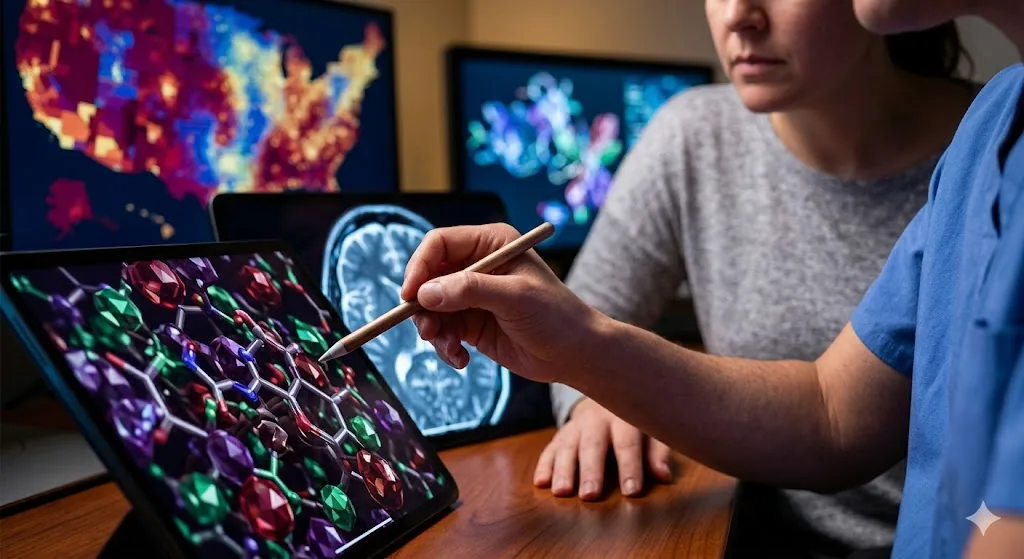
Drug discovery is the most famous medical AI story because the early wins are visible and technically impressive. AlphaFold, developed by Google DeepMind with the AlphaFold Protein Structure Database hosted with EMBL-EBI, has made more than 200 million predicted protein structures openly available for research. This matters because protein shape is often central to understanding disease and designing drugs, and experimental structure determination can be slow and expensive.[alphafold.ebi.ac.uk]alphafold.ebi.ac.ukAlpha Fold Protein Structure DatabaseAlphaFold Protein Structure Database - EMBL-EBIAlphaFold DB provides open access to over 200 million protein structure predictions to acc…
AlphaFold 3 pushed this further by predicting structures of complexes involving proteins, nucleic acids, small molecules, ions and modified residues, which brings the tool closer to drug discovery questions about how biological molecules interact. The Nature paper presenting AlphaFold 3 described a diffusion-based architecture for predicting the joint structure of such complexes, not just isolated proteins.[Nature]nature.comOpen source on nature.com.
The practical promise is not that AI “knows biology” perfectly. It is that AI can reduce blind search. Traditional drug development can involve screening huge numbers of compounds, narrowing them through laboratory tests, optimising candidates, and then discovering late that a molecule is unsafe or ineffective. AI can help at several points: identifying targets, generating candidate molecules, predicting binding, flagging toxicity risks, repurposing existing drugs, and designing trials around patients most likely to benefit.
A concrete example is rentosertib, formerly ISM001-055, a generative-AI-discovered TNIK inhibitor for idiopathic pulmonary fibrosis. In a 2025 Nature Medicine paper, the authors reported that their AI-driven approach identified both a disease-associated target and a compound, with preclinical candidate nomination in 18 months and phase 0/1 clinical testing completed within under 30 months from the start of target discovery. They also stressed the unresolved wider question: few AI-designed drugs have reached human trials, none had yet progressed through phase 3, and phase 2 failures have so far been comparable to non-AI-discovered drugs.[Nature]nature.comOpen source on nature.com.
This is the key distinction for readers. AI can speed up the front end of discovery, but the back end remains brutally selective. Human bodies are not just collections of target proteins. A promising compound still has to reach the right tissue, at the right dose, without unacceptable side effects, in patients who are often older, sicker and more varied than laboratory models. The AI bloom case in medicine therefore depends less on one spectacular algorithm than on whether AI raises the productivity of the whole pipeline over many cycles.
Protein prediction is powerful, not magic
Protein structure prediction is a genuine scientific leap, but it is sometimes oversold. AlphaFold-style systems are best understood as instruments that make some biological questions cheaper to ask. They can suggest structures, highlight plausible interactions and guide experiments. They do not remove the need for experimental confirmation, especially when flexible regions, conformational changes, binding affinity, cellular context or disease-specific biology are decisive.
That limitation matters for longevity. Age-related disease is not usually caused by one simple defect. Alzheimer’s disease, cardiovascular disease, fibrosis, cancer, frailty and immune decline involve networks of interacting processes over years. Protein models can help researchers explore these networks, but an intervention that looks plausible on a screen may fail once metabolism, immune response, tissue ageing and patient variation enter the picture.
The same caution applies to AI-designed molecules. Machine learning can reduce the search space. In one Nature Communications study, researchers used machine learning trained on published data to screen more than 4,000 compounds for senolytic activity — the ability to selectively eliminate senescent cells, which are linked to ageing and disease — and narrowed the experimental search to 21 candidates, identifying three compounds with senolytic activity in model systems. The authors also noted challenges that are central to longevity medicine, including cell-type specificity and toxicity against non-senescent cells.[Nature]nature.comDiscovery of senolytics using machine learning | Nature CommunicationsDiscovery of senolytics using machine learning | Nature Communications
That is a useful model for the field: AI as a filter, not a verdict. The nearer the claim gets to “this will extend healthy human life”, the more the evidence must move from computational prediction to animal studies, then carefully designed human trials, then long-term monitoring.
Personalised medicine: the promise of the right care for the right person
Personalised medicine means using information about an individual patient — such as genetics, imaging, blood tests, medical history, lifestyle and treatment response — to choose care more precisely. AI is well suited to this because it can combine many weak signals that would be hard for a human clinician to weigh unaided.
In cancer care, for example, AI may help identify tumours on scans, predict which patients are eligible for trials, match molecular features to therapies, or monitor recurrence. In chronic disease, it may help spot deterioration earlier. In primary care, it may act as a safety net, prompting clinicians to consider diagnoses, tests or treatments they might otherwise miss. In ageing medicine, it may help distinguish someone’s chronological age from their biological risk profile.
This is where AI medicine connects most directly to longevity. Living longer in good health is not only about discovering new drugs. It is also about preventing small problems becoming irreversible. A future health system might combine routine imaging, blood biomarkers, wearable data and medical records to identify people at rising risk of heart failure, cancer, diabetes complications or cognitive decline before symptoms become severe. AI would not make those interventions valuable by itself; it would make the targeting more precise.
There are early signs of this direction. Reviews of deep learning and generative AI in ageing research describe work on biological ageing clocks, biomarker discovery, drug repurposing, multimodal data and healthy-longevity medicine. The field is still young, but its core ambition is clear: use AI to detect patterns in ageing that are too subtle or high-dimensional for conventional analysis.[PMC]pmc.ncbi.nlm.nih.govOpen source on nih.gov.
The risk is that “personalised” becomes a luxury label. If advanced diagnostics and AI-guided prevention are available only to wealthy patients, AI medicine could widen healthy-life gaps rather than close them. A genuine bloom outcome would mean better prediction and prevention in public health systems, community clinics and lower-resource settings, not only private longevity programmes.
Clinical decision support: useful only if it improves real care
AI clinical decision support is the part of the story patients are most likely to meet first. These systems may read scans, flag deterioration, summarise notes, suggest diagnoses, prioritise referrals or help clinicians navigate guidelines. The promise is practical: fewer missed findings, faster results and less pressure on overstretched staff.
Breast screening shows both the promise and the caution. In February 2025, the UK government announced the EDITH trial, involving nearly 700,000 women across 30 sites, to test whether AI tools can help radiologists detect breast cancer earlier and potentially reduce the need for two specialist readers per mammogram if the trial is successful. The announcement framed the trial as a way to improve cancer care while easing radiology workload, but the scale of the trial itself shows that national deployment needs strong evidence, not just promising accuracy scores.[GOV.UK]GOV.UKWorld-leading AI trial to tackle breast cancer launchedWorld-leading AI trial to tackle breast cancer launched
Clinical AI has already entered regulated use. The US Food and Drug Administration maintains a list of AI-enabled medical devices authorised for marketing, intended to improve transparency for clinicians and patients. The FDA says listed devices have met applicable premarket requirements, including review of safety and effectiveness, while also warning that the list is not comprehensive and is identified partly through AI-related terms in public summaries.[U.S. Food and Drug Administration]fda.govSource details in endnotes.
The hardest question is not whether an AI can perform well on a benchmark. It is whether it helps in messy clinical reality. A tool may work in one hospital but fail in another because scanners differ, patient populations differ, workflows differ, or clinicians use the output in unexpected ways. AI can also create automation bias: people may over-trust a confident recommendation, especially when they are tired or under pressure.
This is why AI medicine needs prospective trials, post-market monitoring and clear responsibility. A model that improves radiology throughput is valuable only if it preserves or improves patient outcomes. A sepsis alert is useful only if it catches patients early without overwhelming staff with false alarms. A chatbot-style clinical assistant is safe only if it is grounded in reliable sources, tested with real users, and constrained when uncertainty is high.
Longevity: healthspan before immortality
The word “longevity” often attracts extravagant claims. A grounded AI bloom view should begin with healthspan, not immortality. The near-term prize is more years without disability, frailty, dementia, uncontrolled pain or preventable disease. That would already be a profound expansion of human freedom.
AI could contribute to healthspan in three main ways. First, it can accelerate research into age-related mechanisms such as inflammation, cellular senescence, immune decline, fibrosis, metabolic dysfunction and DNA damage responses. Second, it can help discover or repurpose compounds that target those mechanisms. Third, it can help measure ageing more precisely, using biological clocks, imaging markers or combined biomarkers to assess whether an intervention is plausibly changing risk.
Senolytics are a useful example because they show both excitement and caution. Senescent cells are involved in ageing and several diseases, and machine learning has helped identify candidate senolytic compounds. But senescent cells can also have useful roles, such as in wound healing and cancer suppression, and senolytic effects may vary by cell type and tissue. The path from “AI found candidate senolytics” to “people live healthier longer” requires careful evidence about timing, dosage, target tissue, side effects and long-term outcomes.[Nature]nature.comOpen source on nature.com.
Biological-age tools raise a similar issue. AI can estimate age-related risk from epigenetic markers, imaging, blood biomarkers or other data. These tools may become useful for prevention and trial design, because waiting decades to measure lifespan is impractical. But a biomarker is not the same as a patient-centred outcome. Slowing a clock is meaningful only if it predicts fewer heart attacks, less dementia, better mobility, lower frailty or longer independent life.
The best version of AI-enabled longevity therefore looks less like a single anti-ageing cure and more like a learning health system. It would discover interventions, test them quickly but rigorously, measure biological and functional outcomes, identify who benefits, monitor harms, and update practice as evidence accumulates.
Validation is the bottleneck that optimism must respect
Medical AI fails when it treats prediction as proof. A model can be accurate in retrospective data yet unhelpful or unsafe in practice. It can perform well on average while failing for minority groups. It can drift over time as equipment, populations or clinical behaviour change. It can make clinicians faster while subtly changing what they pay attention to.
Regulators are therefore trying to govern AI across the lifecycle, not just at first approval. The UK Medicines and Healthcare products Regulatory Agency says software, including AI, plays an essential role in health and social care and is often regulated as a medical device. Its programme covers issues across the software lifecycle, including qualification, classification, pre- and post-market requirements, transparency, explainability, interpretability and adaptivity when AI models retrain.[GOV.UK]GOV.UKSoftware and artificial intelligence (AI) as a medical deviceSoftware and artificial intelligence (AI) as a medical device
For medicines, the European Medicines Agency’s reflection paper covers AI and machine learning at any step of the medicines lifecycle, from drug discovery to post-authorisation use. That scope is important because AI may influence not only molecule design, but trial recruitment, manufacturing, pharmacovigilance and regulatory submissions.[European Medicines Agency (EMA]ema.europa.euSource details in endnotes.
World Health Organization guidance on large multimodal models in health makes a similar point from an ethics and governance angle. Such systems may be used in healthcare, scientific research, public health and drug development, but it remains unproven whether general-purpose models can safely accomplish the wide range of tasks sometimes claimed for them.[World Health Organization]who.intEthics and governance of artificial intelligence for health: Guidance on large multi-modal models…
The practical standard should be simple: the higher the stakes, the stronger the evidence required. Low-risk administrative support may need usability testing, privacy protection and audit. A diagnostic tool needs clinical validation across relevant populations. A treatment recommendation system needs evidence that it changes decisions safely. A drug candidate needs the full discipline of pharmacology and trials. Longevity interventions need especially long-term vigilance because harms may emerge slowly.
Equal access is part of the medicine, not an afterthought
AI medicine could produce a cruel paradox: the tools that promise longer, healthier lives might first reach people who are already healthier, wealthier and better served. That would not be a bloom. It would be a sharper version of today’s health inequality.
Bias can enter medical AI at many points: who is represented in training data, which hospitals contribute records, how disease labels are defined, whether missing data reflects clinical neglect, and whether a tool has been tested in the communities where it will be deployed. A review of bias in medical AI describes how bias can arise throughout the development pipeline and affect clinical decision-making, not merely model performance in the abstract.[PMC]pmc.ncbi.nlm.nih.govOpen source on nih.gov.
There is also a distribution problem. AI-enabled medicine depends on data infrastructure, digitised records, imaging equipment, laboratory capacity, broadband, trained staff, procurement systems and maintenance. A hospital with modern scanners and informatics teams can use AI very differently from an underfunded clinic struggling with basic staffing. If public systems cannot afford or evaluate the best tools, private markets may set the terms.
Broad benefit requires deliberate choices:
- Representative evidence. Trials and validation studies should include the populations that will actually use the tool, including older adults, ethnic minorities, disabled people and patients with multiple conditions.
- Public-interest procurement. Health systems should buy tools that improve outcomes, integrate with workflows and allow audit, not just tools with impressive marketing claims.
- Transparency for patients and clinicians. People should know when AI is involved in care, what it is intended to do, and who remains responsible.
- Affordable access. AI-designed drugs and diagnostics will not improve population health if they are priced beyond reach.
- Global relevance. Models trained on wealthy-country data may not transfer to health systems with different diseases, resources or demographics.
This is where AI medicine becomes a governance question. The science can be brilliant and still fail the public if benefits are captured narrowly.
What would count as real progress?
For AI medicine to fulfil part of the longevity promise, the evidence should move beyond isolated success stories. Real progress would look like repeated, measurable improvements across the medical pipeline and across health systems.
In drug discovery, the signal would be more AI-assisted candidates reaching late-stage trials, not just entering phase 1. It would include lower attrition, faster target validation, better toxicity prediction and more medicines for diseases that are currently neglected because the markets are small or the biology is hard.
In clinical care, the signal would be improved patient outcomes: cancers caught earlier without unacceptable false positives, fewer diagnostic errors, safer prescribing, lower hospital admissions, better chronic disease control and reduced workload without reduced accountability. The NHS breast screening trial is important not because it proves AI works, but because it shows the kind of large-scale testing needed before changing public screening pathways.[GOV.UK]GOV.UKethics transparency and accountability framework for automated decision makingethics transparency and accountability framework for automated decision making
In longevity, the signal would be interventions that improve functional outcomes: mobility, cognition, immune resilience, recovery, independence and reduced incidence of age-related disease. Better biomarkers can help, but they should be tied to outcomes people care about. A longer life is not the only goal; a longer capable life is.
The largest gains may come from compounding. A slightly faster discovery cycle, a slightly better trial design, a slightly earlier diagnosis and a slightly more personalised treatment pathway may not sound utopian. But across millions of patients and decades of iteration, those gains could become civilisation-scale health improvement.
The balanced promise
AI can help medicine become more predictive, preventive and personalised. It can let researchers explore biological possibilities that were previously too expensive or complex. It can help clinicians catch disease earlier and reduce some of the cognitive burden of care. It can make longevity research more serious by improving target discovery, biomarkers and trial design.
But the promise is conditional. AI-generated hypotheses must survive experiments. AI-designed drugs must survive trials. AI clinical tools must improve real workflows and outcomes. Longevity claims must be measured against healthspan, not hype. And the benefits must be available beyond the already privileged.
Within the broader AI bloom vision, medicine is one of the most plausible and morally urgent domains. If advanced AI helps humanity live not just longer but healthier, with better access to care and more years of agency, it would loosen one of the deepest constraints on human flourishing. The path runs through laboratories, hospitals, regulators, public health systems and fair access — not around them.
eBay marketplace picks
Marketplace Samples
Example marketplace items related to this page. Use the search link to explore similar finds on eBay.


Endnotes
1.
Source: alphafold.ebi.ac.uk
Title: Alpha Fold Protein Structure Database
Link:https://alphafold.ebi.ac.uk/
Source snippet
AlphaFold Protein Structure Database - EMBL-EBIAlphaFold DB provides open access to over 200 million protein structure predictions to acc...
2.
Source: deepmind.google
Link:https://deepmind.google/science/alphafold/
Source snippet
Google DeepMindAlphaFold — Google DeepMindSo far, AlphaFold has predicted over 200 million protein structures – nearly all catalogued pro...
3.
Source: nature.com
Link:https://www.nature.com/articles/s41586-024-07487-w
4.
Source: nature.com
Link:https://www.nature.com/articles/s41591-025-03743-2
5.
Source: nature.com
Title: Discovery of senolytics using machine learning | Nature Communications
Link:https://www.nature.com/articles/s41467-023-39120-1
6.
Source: pmc.ncbi.nlm.nih.gov
Link:https://pmc.ncbi.nlm.nih.gov/articles/PMC11810058/
7.
Source: GOV.UK
Title: World-leading AI trial to tackle breast cancer launched
Link:https://www.gov.uk/government/news/world-leading-ai-trial-to-tackle-breast-cancer-launched
8.
Source: fda.gov
Link:https://www.fda.gov/medical-devices/software-medical-device-samd/artificial-[intelligence
9.
Source: GOV.UK
Title: Software and artificial intelligence (AI) as a medical device
Link:https://www.gov.uk/government/publications/software-and-artificial-intelligence-ai-as-a-medical-device/software-and-artificial-intelligence-ai-as-a-medical-device
10.
Source: who.int
Title: World Health Organization
Link:https://www.who.int/publications/i/item/9789240084759
Source snippet
Ethics and governance of artificial intelligence for health: Guidance on large multi-modal models...
11.
Source: pmc.ncbi.nlm.nih.gov
Link:https://pmc.ncbi.nlm.nih.gov/articles/PMC11542778/
12.
Source: who.int
Link:https://www.who.int/publications/i/item/9789240029200
13.
Source: GOV.UK
Title: ethics transparency and accountability framework for automated decision making
Link:https://www.gov.uk/government/publications/ethics-transparency-and-accountability-framework-for-automated-decision-making/ethics-transparency-and-accountability-framework-for-automated-decision-making
14.
Source: GOV.UK
Title: software and ai as a medical device change programme roadmap
Link:https://www.gov.uk/government/publications/software-and-ai-as-a-medical-device-change-programme/software-and-ai-as-a-medical-device-change-programme-roadmap
15.
Source: nature.com
Link:https://www.nature.com/articles/s44276-026-00221-1
16.
Source: nature.com
Link:https://www.nature.com/articles/s41698-026-01310-7.pdf
17.
Source: nature.com
Link:https://www.nature.com/articles/s41698-026-01310-7
18.
Source: nature.com
Link:https://www.nature.com/articles/s41587-024-02143-0
19.
Source: nature.com
Link:https://www.nature.com/articles/s43856-025-00781-2
20.
Source: nature.com
Link:https://www.nature.com/articles/s41514-026-00355-z
21.
Source: nature.com
Link:https://www.nature.com/articles/s41514-025-00193-5
22.
Source: nature.com
Link:https://www.nature.com/articles/s41514-025-00199-z
23.
Source: deepmind.google
Title: alphafold five years of impact
Link:https://deepmind.google/blog/alphafold-five-years-of-impact/
24.
Source: assets.publishing.service.gov.uk
Link:https://assets.publishing.service.gov.uk/media/6217bac58fa8f54916f45f51/UK_NSC_evidence_summary_-_the_use_of_AI_for_mammographic_image_analysis_in_breast_cancer_screening.pdf
25.
Source: assets.publishing.service.gov.uk
Link:https://assets.publishing.service.gov.uk/media/662fce1e9e82181baa98a988/MHRA_Impact-of-AI-on-the-regulation-of-medical-products.pdf
26.
Source: lifespan.io
Title: longevity biotech in 2025 the expert roundup
Link:https://lifespan.io/longevity-biotech-in-2025-the-expert-roundup/
27.
Source: ebi.ac.uk
Link:https://www.ebi.ac.uk/training/online/courses/navigating-alphafold-database/what-is-the-afdb/accessing-searching-afdb/access-via-website/
28.
Source: alphafold.ebi.ac.uk
Title: ebi.ac.uk About
Link:https://alphafold.ebi.ac.uk/about
29.
Source: fda.gov
Title: artificial intelligence software medical device
Link:https://www.fda.gov/medical-devices/software-medical-device-samd/artificial-intelligence-software-medical-device
30.
Source: fda.gov
Link:https://www.fda.gov/media/167973/download
31.
Source: digital-transformation.hee.nhs.uk
Link:https://digital-transformation.hee.nhs.uk/support-for-organisations/research-and-publications/dart-ed/horizon-scanning/understanding-healthcare-workers-confidence-in-ai/chapter-3-governance/guidelines
32.
Source: embl.org
Title: first complexes alphafold database
Link:https://www.embl.org/news/science-technology/first-complexes-alphafold-database/
33.
Source: medregs.blog.gov.uk
Title: blog.gov.uk Emerging Roadmap and transition provisions
Link:https://medregs.blog.gov.uk/2024/11/01/emerging-roadmap-and-transition-provisions/
34.
Source: ema.europa.eu
Link:https://www.ema.europa.eu/en/use-artificial-intelligence-ai-medicinal-product-lifecycle-scientific-guideline
35.
Source: frontiersin.org
Link:https://www.frontiersin.org/journals/health-services/articles/10.3389/frhs.2025.1682159/full
Additional References
36.
Source: communities.springernature.com
Title: ai meets ipf taking an ai designed drug from target discovery to phase iia
Link:https://communities.springernature.com/posts/ai-meets-ipf-taking-an-ai-designed-drug-from-target-discovery-to-phase-iia
37.
Source: researchgate.net
Link:https://www.researchgate.net/publication/374676009_AlphaFold_Protein_Structure_Database_Predicted_Millions_of_3D_Structures_Can_AlphaFold_revolutionize_the_discovery_of_new_drugs
38.
Source: researchgate.net
Link:https://www.researchgate.net/publication/390704176_AlphaFold3_in_Drug_Discovery_A_Comprehensive_Assessment_of_Capabilities_Limitations_and_Applications
39.
Source: researchgate.net
Link:https://www.researchgate.net/publication/392366960_A_generative_AI-discovered_TNIK_inhibitor_for_idiopathic_pulmonary_fibrosis_a_randomized_phase_2a_trial
40.
Source: researchgate.net
Link:https://www.researchgate.net/publication/399664083_The_Healthspan_Horizon_How_AI_Wellness_Science_and_Medicine_Are_Rewriting_the_Future_of_Human_Life_Expectancy
41.
Source: ketryx.com
Link:https://www.ketryx.com/blog/a-complete-guide-to-the-fdas-ai-ml-guidance-for-medical-devices
42.
Source: rcastoragev2.blob.core.windows.net
Link:https://rcastoragev2.blob.core.windows.net/9e6c827f9d7f88eac8af0797432cefc7/41586_2024_7487_MOESM1_ESM.pdf
43.
Source: 311institute.com
Link:https://www.311institute.com/an-ai-just-discovered-three-new-anti-ageing-senolytic-compounds/
44.
Source: insilico.com
Link:https://insilico.com/casestudy
45.
Source: kostendigital.com
Link:https://kostendigital.com/sites/default/files/2024-06/WHO-Ethics%20and%20governance%20of%20AI%20for%20health_CI_0.pdf
Topic Tree
Follow this branch
Parent topic
AI BloomRelated pages 9
- Control Can Humanity Stay in Control?
- Discovery Could AI Make Science Move Faster?
- Education Can Everyone Have a World Class Tutor?
- Energy What Still Stays Scarce in AI Abundance?
- Intelligence What If Expert Help Became Cheap?
- Long Future How Big Could Humanity's Future Become?
- Power Who Owns an AI Enabled Future?
- Resilience Can AI Help Civilisation Avoid Catastrophe?
- +1 more in sidebar