Within Longevity
Will AI longevity care reach everyone?
Personalised AI medicine could extend healthy life, but only if advanced diagnostics and prevention reach ordinary health systems.
On this page
- Why personalised prevention could become a luxury
- What public health systems would need
- How access shapes the AI bloom case
Page outline Jump by section
Introduction
AI-guided medicine could become one of the most important parts of the wider AI longevity story. If artificial intelligence helps doctors predict disease earlier, personalise prevention, monitor health continuously, and match treatments more precisely to individual patients, then longer healthy lives may become more achievable. In the optimistic version of the AI bloom future, healthspan improves not just for a wealthy minority but across entire populations.
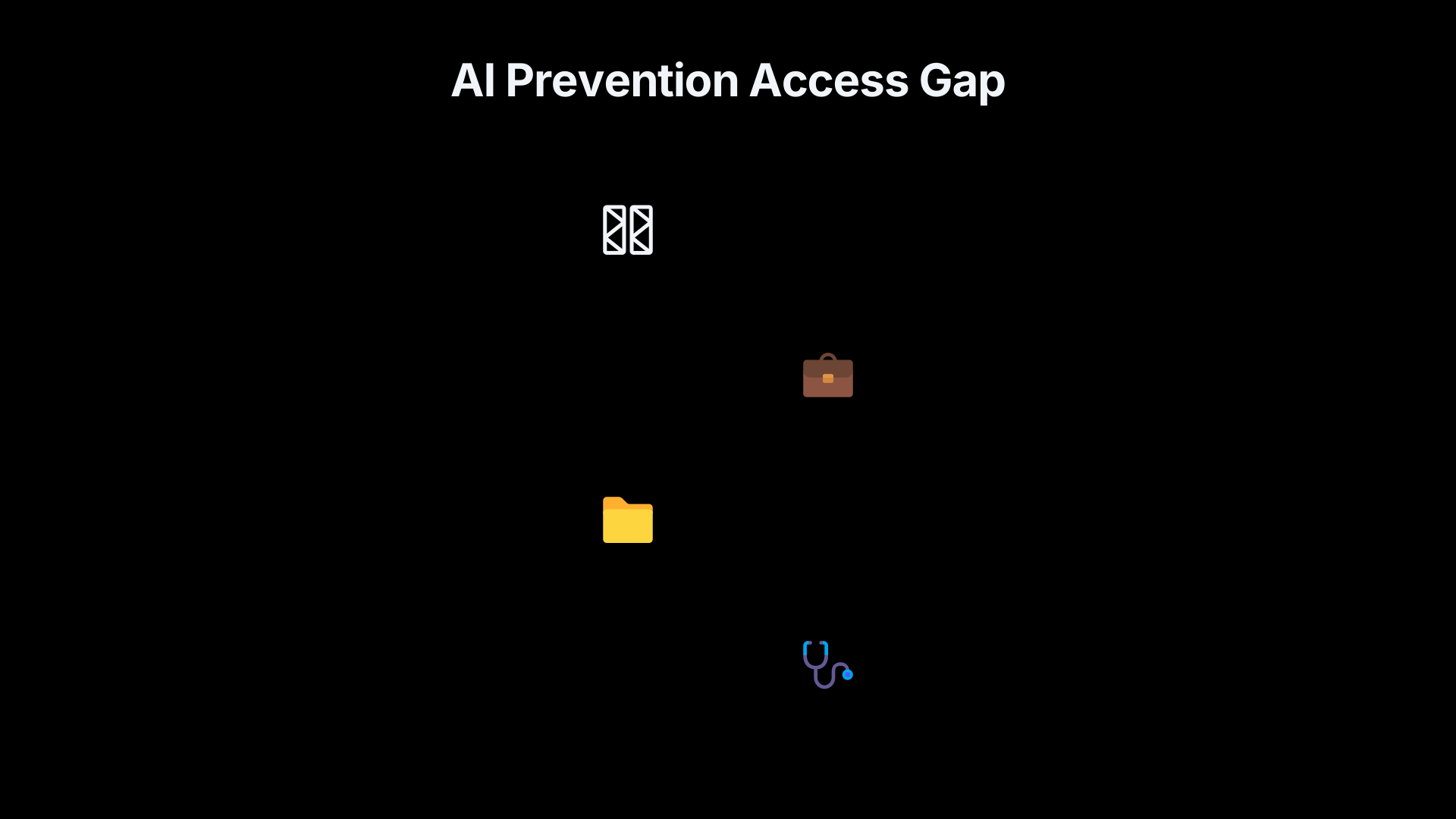 The danger is that longevity gains may not spread evenly. Advanced prevention often depends on expensive testing, large amounts of personal data, specialist interpretation, regular monitoring, and strong healthcare infrastructure. If those capabilities remain concentrated among affluent patients, elite hospitals, or rich countries, AI could extend healthy life for some groups far faster than for others. The question is therefore not only whether AI can improve medicine, but whether the benefits can reach ordinary health systems at population scale.
Why personalised prevention could become a luxury
Much of the excitement around AI medicine comes from the possibility of moving healthcare upstream. Instead of treating disease after symptoms appear, AI systems may identify risks years earlier through patterns in medical records, imaging, genetics, wearable sensors, blood tests, and lifestyle data.
In theory, this could be transformative. A person might receive warnings about cardiovascular disease, diabetes, dementia risk, or cancer long before conventional diagnosis. Treatments could become more tailored. Screening schedules could be adjusted to individual risk profiles rather than broad age categories.
But personalised prevention has an access problem.
The people most able to benefit from early AI-guided care are often those who already have advantages: regular healthcare access, comprehensive medical records, expensive wearable devices, private clinics, high-quality insurance, and the time to act on preventive advice. By contrast, many of the conditions that reduce life expectancy are concentrated among populations with less access to healthcare, poorer housing, higher environmental exposure, and greater financial stress.
This creates a paradox. The groups most likely to gain from better prevention are often the groups least likely to receive it.
The history of medicine offers a warning here. New technologies frequently arrive first as premium services before becoming routine care. MRI scans, genetic testing, specialist cancer therapies, and advanced biologic drugs often followed this pattern. AI-guided longevity care may do the same unless health systems deliberately expand access.
The result could be a world where wealthy patients receive continuous AI-assisted monitoring and personalised intervention while others continue to encounter diseases only after symptoms become severe. In that scenario, AI would improve health overall while widening longevity gaps.
The inequality problem starts with data
AI systems learn from data, and healthcare data are unevenly distributed.
Many medical datasets contain disproportionate representation from wealthier populations, large urban hospitals, and patients who receive consistent medical care. Groups with weaker healthcare access often generate less complete medical records and therefore contribute less to the data used to train models. Researchers have repeatedly warned that this can produce systems that perform less reliably for underrepresented populations.[PMC]pmc.ncbi.nlm.nih.govPMCAlgorithm fairness in artificial intelligence for medicineby RJ Chen · 2023 · Cited by 798 — In healthcare, the development and deployment of insufficiently fair systems of artificial intellig…[PMC]pmc.ncbi.nlm.nih.govPMCAddressing bias in big data and AI for health careThis can result in misdiagnosing certain…Read more…
A well-known example comes from medical imaging. Researchers found that several chest X-ray AI systems systematically underdiagnosed disease in underserved patient groups, with particularly high error rates for some intersectional populations.[Nature]nature.comUnderdiagnosis bias of artificial intelligence algorithms…by L Seyyed-Kalantari · 2021 · Cited by 1091 — We find that classifier…
These problems are not merely technical. If an AI screening system misses disease more often in disadvantaged populations, those populations may receive delayed diagnosis, delayed treatment, and ultimately worse health outcomes. A longevity technology that works better for affluent patients than for everyone else can reinforce existing inequalities even while appearing successful on average metrics.
Researchers increasingly argue that fairness must be evaluated throughout the development process rather than added later as a correction. Sources of bias can emerge from data collection, measurement methods, labelling practices, healthcare access patterns, and research priorities themselves.[arXiv]arxiv.orgarXiv Algorithm Fairness in AI for Medicine and HealthcarearXiv Algorithm Fairness in AI for Medicine and Healthcare [3Nature 3PMC]
Longevity inequality is not only about algorithms
Public discussion sometimes frames the problem as biased software. That is only part of the picture.
Many of the biggest determinants of healthy lifespan lie outside hospitals. Income, education, housing quality, nutrition, pollution exposure, social support, and healthcare access all strongly influence health outcomes.
An AI system may identify elevated diabetes risk, but the patient still needs access to healthy food, medication, follow-up appointments, and safe places to exercise. An AI model may predict cardiovascular risk, but prediction alone does not remove barriers to treatment.
This means longevity inequality could persist even if AI models become highly accurate.
In fact, there is a risk that prediction becomes easier faster than intervention. Wealthy patients may be able to respond immediately to AI-generated recommendations through private healthcare, personalised coaching, preventative drugs, and specialist services. Lower-income patients may receive the same risk assessment but lack practical ways to act on it.
The result would be a form of informational inequality: better knowledge without equal capacity to benefit from that knowledge.

What public health systems would need
If AI-guided care is to support broad human flourishing rather than selective advantage, public healthcare systems will need more than access to software.
Several conditions appear especially important.
Strong primary care infrastructure. AI is often most useful when combined with regular patient contact. Screening tools, risk prediction systems, and monitoring technologies depend on clinicians, nurses, and community health workers who can act on the information generated.
High-quality digital records. Personalised prevention relies heavily on longitudinal data. Fragmented records, incompatible systems, and poor data quality limit the effectiveness of AI-assisted care.
Population-scale deployment. The greatest gains may come not from elite medical centres but from routine use across large healthcare systems. AI that improves screening uptake, identifies missed diagnoses, or supports overstretched clinicians can affect millions of people if integrated into everyday care.
Continuous auditing. Performance must be measured across demographic groups rather than only at aggregate levels. Researchers and regulators increasingly argue that AI systems should be monitored after deployment to detect unequal outcomes.[PMC]pmc.ncbi.nlm.nih.govPMCHuman-Centered Design to Address Biases in Artificialby Y Chen · 2023 · Cited by 268 — This perspective highlights the dual impact of AI on health disparities and inequalities; potential…[Nature]nature.comBias recognition and mitigation strategies in artificial…by F Hasanzadeh · 2025 · Cited by 251 — This review examines the origin…
Affordable access. Prevention only changes population health when testing, follow-up care, medicines, and specialist referrals remain accessible. Otherwise AI simply identifies unmet need without addressing it.
The practical lesson is that AI medicine depends heavily on institutions. A sophisticated model operating inside a weak health system may achieve less than a modest model integrated into a well-funded public healthcare network.
The global gap could become even larger
The longevity inequality question extends beyond individual countries.
Many advanced AI healthcare systems are being developed in wealthy economies with extensive hospital infrastructure, digitised records, specialist staff, and large research budgets. The same conditions often do not exist in lower-income regions.
This creates two possible futures.
In the pessimistic version, rich countries gain most of the benefits from AI-assisted medicine while poorer regions continue facing shortages of clinicians, medicines, diagnostics, and healthcare infrastructure. Longevity gains accelerate in already advantaged populations.
In the more optimistic version, AI becomes a force multiplier for scarce medical resources. Automated triage, diagnostic assistance, medical translation, remote monitoring, and decision-support systems could help extend healthcare capacity into underserved regions. The World Health Organization has repeatedly argued that AI should be developed around principles of equity and broad access rather than concentrated benefit.[World Health Organization]who.intWorld Health OrganizationHarnessing artificial intelligence for healthWHO's vision is to foster digital frontiers and nurture an AI ecosy…[World Health Organization]who.intWorld Health OrganizationHarnessing artificial intelligence for healthWHO's vision is to foster digital frontiers and nurture an AI ecosy…
Evidence exists for both possibilities. AI may help compensate for shortages of specialists and improve access to expertise in remote settings. Yet implementation costs, data limitations, infrastructure gaps, and unequal investment remain substantial barriers. ScienceDirect[reuters]reuters.comAI and machine learning offer potential solutions to health issues caused by geographical, financial, and cultural barriers, aiming to in… The outcome is likely to depend less on AI capability itself than on whether deployment strategies prioritise inclusion from the start.
A warning from insurance and healthcare incentives
Another concern is that AI may be used differently depending on institutional incentives.
The public image of medical AI often centres on discovering disease earlier or designing better treatments. But healthcare organisations may also deploy AI to reduce costs, automate administrative work, prioritise patients, or determine eligibility for services.
These uses are not inherently harmful. Efficient systems can free resources for patient care. However, critics worry that poorly designed optimisation targets may disadvantage vulnerable populations. Previous research has shown that healthcare algorithms can reproduce inequalities when proxies such as healthcare spending are used to estimate health needs. Because some groups historically receive less care, spending data may underestimate their actual illness burden.[PMC]pmc.ncbi.nlm.nih.govPMCAlgorithm fairness in artificial intelligence for medicineby RJ Chen · 2023 · Cited by 798 — In healthcare, the development and deployment of insufficiently fair systems of artificial intellig…
The broader lesson is that healthcare AI does not automatically optimise for healthspan. It optimises for whatever objectives institutions choose. If those objectives focus narrowly on cost reduction, throughput, or resource allocation, longevity benefits may be distributed unevenly.
Governance therefore matters as much as technical performance.
How access shapes the AI bloom case
The strongest version of the AI bloom vision is not that a small group of people live dramatically longer lives. It is that scientific progress becomes broad enough to raise the baseline of human flourishing.
Health occupies a special place in that vision because longer, healthier lives affect almost every other domain. Education, creativity, work, family life, civic participation, and scientific achievement all become easier when people remain healthy for longer.
But the longevity promise becomes much weaker if access is highly unequal.
A society in which affluent populations receive decades of additional healthy life while poorer populations see only marginal gains would still represent medical progress. Yet it would fall far short of the broader abundance narrative often associated with AI bloom. Instead of expanding opportunity across society, it could deepen existing divides between those who benefit from accelerated science and those who remain excluded from it.
The optimistic case therefore depends on diffusion. AI-guided diagnostics, preventive care, and treatment selection must become ordinary services rather than luxury products. Public health systems, regulatory frameworks, research institutions, and international health organisations all influence whether that happens.
The central question is not whether AI can help extend healthy life. Increasing evidence suggests it can contribute to earlier diagnosis, more personalised treatment, and more effective prevention. The deeper question is whether those gains become civilisation-wide improvements or remain concentrated among those already best positioned to benefit. The answer may determine whether AI medicine becomes a pillar of broad human flourishing or another example of technological progress arriving unevenly.
eBay marketplace picks
Marketplace Samples
Example marketplace items related to this page. Use the search link to explore similar finds on eBay.


Endnotes
1.
Source: pmc.ncbi.nlm.nih.gov
Title: PMCAlgorithm fairness in artificial intelligence for medicine
Link:https://pmc.ncbi.nlm.nih.gov/articles/PMC10632090/
Source snippet
by RJ Chen · 2023 · Cited by 798 — In healthcare, the development and deployment of insufficiently fair systems of artificial intellig...
2.
Source: pmc.ncbi.nlm.nih.gov
Title: PMCAddressing bias in big data and AI for health care
Link:https://pmc.ncbi.nlm.nih.gov/articles/PMC8515002/
Source snippet
This can result in misdiagnosing certain...Read more...
3.
Source: arxiv.org
Title: arXiv Algorithm Fairness in AI for Medicine and Healthcare
Link:https://arxiv.org/abs/2110.00603
4.
Source: nature.com
Link:https://www.nature.com/articles/s41591-021-01595-0
Source snippet
Underdiagnosis bias of artificial intelligence algorithms...by L Seyyed-Kalantari · 2021 · Cited by 1091 — We find that classifier...
5.
Source: nature.com
Link:https://www.nature.com/articles/s41746-025-01503-7
Source snippet
Bias recognition and mitigation strategies in artificial...by F Hasanzadeh · 2025 · Cited by 251 — This review examines the origin...
6.
Source: pmc.ncbi.nlm.nih.gov
Title: PMCHuman-Centered Design to Address Biases in Artificial
Link:https://pmc.ncbi.nlm.nih.gov/articles/PMC10132017/
Source snippet
by Y Chen · 2023 · Cited by 268 — This perspective highlights the dual impact of AI on health disparities and inequalities; potential...
7.
Source: arxiv.org
Link:https://arxiv.org/abs/2604.14514
8.
Source: arxiv.org
Title: arXiv Bias by Design? How Data Practices Shape Fairness in AI Healthcare Systems
Link:https://arxiv.org/abs/2510.20332
9.
Source: who.int
Link:https://www.who.int/teams/digital-health-and-innovation/harnessing-artificial-intelligence-for-health
Source snippet
World Health OrganizationHarnessing artificial intelligence for healthWHO's vision is to foster digital frontiers and nurture an AI ecosy...
10.
Source: who.int
Link:https://www.who.int/publications/i/item/9789240084759
Source snippet
World Health OrganizationEthics and governance of artificial intelligence for health25 Mar 2025 — This guidance addresses one type of gen...
11.
Source: sciencedirect.com
Link:https://www.sciencedirect.com/science/article/pii/S1386505625002680
Source snippet
Bridging the digital divide: artificial intelligence as a...by A Osonuga · 2025 · Cited by 45 — This comprehensive narrativ...
12.
Source: reuters.com
Link:https://www.reuters.com/sustainability/can-artificial-intelligence-extend-healthcare-all-2024-03-25/
Source snippet
AI and machine learning offer potential solutions to health issues caused by geographical, financial, and cultural barriers, aiming to in...
13.
Source: iris.who.int
Title: int Ethics and governance of artificial intelligence for health
Link:https://iris.who.int/server/api/core/bitstreams/e9e62c65-6045-481e-bd04-20e206bc5039/content
Source snippet
and governance of artificial intelligence for health - IRISThis guidance addresses one type of generative AI, large multi-modal models (L...
14.
Source: iris.who.int
Title: int Demystifying artificial intelligence in health
Link:https://iris.who.int/server/api/core/bitstreams/e3467cc3-6cea-4807-a286-8716e930caa7/content
Source snippet
artificial intelligence in health - IRISby P del Rey Puech — The European Observatory on Health Systems and Policies supports and promote...
15.
Source: who.int
Link:https://www.who.int/publications/i/item/9789240029200
Source snippet
Ethics and governance of artificial intelligence for health28 Jun 2021 — The report identifies the ethical challenges and risks with the...
16.
Source: sciencedirect.com
Link:https://www.sciencedirect.com/science/article/pii/S2666389926000449
Source snippet
AI-driven strategies for advancing health equity in rare...by C Lei · 2026 — This perspective identifies five key dimensions to equitabl...
17.
Source: sciencedirect.com
Link:https://www.sciencedirect.com/org/science/article/pii/S2976871325000481
Source snippet
Smart drug delivery systems...Read more...
18.
Source: nature.com
Link:https://www.nature.com/articles/s41746-025-01746-4
Source snippet
Racial bias in AI-mediated psychiatric diagnosis and...by A Bouguettaya · 2025 · Cited by 38 — Results indicated that LLMs often propose...
19.
Source: nature.com
Link:https://www.nature.com/articles/s41599-024-02894-w
Source snippet
Also, the WHO is...Read more...
Additional References
20.
Source: researchgate.net
Link:https://www.researchgate.net/publication/393950503_Algorithmic_bias_in_public_health_AI_a_silent_threat_to_equity_in_low-resource_settings
Source snippet
Algorithmic bias in public health AI: a silent threat to equity...Jul 23, 2025 — Models trained on unbalanced or poorly stratified datas...
21.
Source: linkedin.com
Link:https://www.linkedin.com/pulse/algorithms-artificial-intelligence-bias-healthcare-problem-kantor
Source snippet
Algorithms, Artificial Intelligence and Bias in HealthcareOne of the main concerns with Artificial Intelligence (AI) in healthcare is the...
22.
Source: news-medical.net
Link:https://www.news-medical.net/news/20240123/WHO-issues-ethical-guidelines-for-AI-in-healthcare-focusing-on-large-multi-modal-models.aspx
Source snippet
WHO issues ethical guidelines for AI in healthcare...23 Jan 2024 — The World Health Organization (WHO) recently released detailed guidan...
23.
Source: resources.physio-pedia.com
Link:https://resources.physio-pedia.com/resource/ethics-and-governance-of-artificial-intelligence-for-health-guidance-on-large-multi-modal-models/
Source snippet
and governance of artificial intelligence for healthJan 18, 2024 — On 18 January 2024, the World Health Organization (WHO) released updat...
Published: January 2024
24.
Source: unaihub.aiforgood.itu.int
Link:https://unaihub.aiforgood.itu.int/activity-details.html?id=1243
Source snippet
Global Initiative on AI for Health (GI-AI4H)In leveraging AI, WHO envisions a future where innovative technologies bridge gaps in healthc...
25.
Source: journalistsresource.org
Link:https://journalistsresource.org/home/research-artificial-intelligence-can-fuel-racial-bias-in-health-care-but-can-mitigate-it-too/
Source snippet
Artificial intelligence exacerbates and mitigates racial bias...Jul 11, 2022 — Several studies show it can also propagate racial biases...
26.
Source: globalcompliancenews.com
Link:https://www.globalcompliancenews.com/2024/02/17/https-insightplus-bakermckenzie-com-bm-healthcare-life-sciences-singapore-world-health-organization-releases-ai-ethics-and-governance-guidance-for-large-multimodal-models_01312024/
Source snippet
Global: World Health Organization releases AI ethics and...17 Feb 2024 — On 18 January 2024, the World Health Organization (WHO) issued...
Published: January 2024
27.
Source: nam.edu
Link:https://nam.edu/perspectives/advancing-artificial-intelligence-in-health-settings-outside-the-hospital-and-clinic/
Source snippet
urge of artificial intelligence (AI)-driven technologies and products that can potentially augment care delivery...
28.
Source: afmw.org.au
Title: ethics and governance of artificial intelligence for health course who
Link:https://afmw.org.au/ethics-and-governance-of-artificial-intelligence-for-health-course-who/
Source snippet
Ethics and Governance of Artificial Intelligence for Health...3 Sept 2024 — The report identifies the ethical challenges and risks with...
29.
Source: learn.hms.harvard.edu
Title: confronting mirror reflecting our biases through ai health care
Link:https://learn.hms.harvard.edu/insights/all-insights/confronting-mirror-reflecting-our-biases-through-ai-health-care
Source snippet
on Our Biases Through AI in Health CareSep 24, 2024 — Biases are inadvertently programmed into AI systems and, as a result, can have a ne...
Topic Tree