Within Intelligence
Who Gets Access to Abundant Intelligence?
Abundant intelligence depends on whether reliable AI help becomes public infrastructure or a costly service controlled by a few powerful actors.
On this page
- Why access is as important as capability
- Concentration of power in frontier AI systems
- Public interest safeguards for reliable cognitive help
Page outline Jump by section
Introduction
If advanced AI eventually makes high-quality cognitive help cheap and widely available, one of the most important questions will not be how intelligent the systems become. It will be who gets access to them.
 The optimistic vision behind abundant intelligence is that millions or billions of people gain access to forms of cognitive support that were previously scarce: tutoring, translation, research assistance, legal guidance, medical information, planning help, software development support and scientific tools. But history suggests that transformative technologies do not automatically spread their benefits evenly. Railways, electricity, higher education, the internet and modern medicine all produced large gains while also creating new forms of concentration and inequality before wider diffusion.
The same tension sits at the centre of AI bloom. Cheap cognitive help could become a kind of public infrastructure that expands opportunity across society. Or it could become a strategic resource controlled by a small number of firms, states or wealthy institutions. The difference may shape whether AI produces broad human flourishing or a more unequal version of technological progress.
Why access matters as much as capability
Much discussion of frontier AI focuses on whether systems become more capable. But from a social perspective, access can matter almost as much as raw capability.
A highly capable model that is expensive, restricted or available only to large corporations does not create abundant intelligence for society as a whole. By contrast, a somewhat less capable system that is affordable, reliable and broadly accessible may have much larger real-world effects on education, entrepreneurship and social mobility.
The distinction already appears in other domains. Scientific knowledge is valuable partly because universities, libraries and journals spread it. Electricity transformed societies not because generators existed, but because power networks eventually reached homes, schools and businesses. The internet became civilisation-scale infrastructure because billions of people could connect to it.
AI may follow a similar pattern. The largest social gains could come not from the smartest laboratory system but from the extent to which useful cognitive assistance becomes available to ordinary people.
This matters especially because intelligence is a force multiplier. People who receive better explanations, better planning support, better access to expertise and better educational tools often become more capable in many areas simultaneously. A farmer, nurse, student, entrepreneur or local official equipped with reliable cognitive assistance can solve problems that previously required scarce specialist support.
The bloom case therefore depends partly on diffusion. Intelligence only becomes abundant if access becomes abundant.
The new bottleneck: compute, data and infrastructure
One reason access is contested is that modern AI depends on infrastructure that is unusually concentrated.
Frontier systems require vast computing resources, specialised chips, large-scale data centres, engineering talent and enormous capital investment. A relatively small number of companies control much of this stack. Governments increasingly view advanced AI infrastructure as strategically important in the same way they view energy systems, telecommunications networks or semiconductor supply chains.[Tony Blair Institute]institute.globalsovereignty in the age of ai strategic choices structural dependenciesTony Blair InstituteSovereignty in the Age of AI: Strategic Choices, Structural…19 Jan 2026 — An agenda for states to strengthen AI so…
This creates a tension at the heart of abundant intelligence.
On one side, AI systems can make knowledge and expertise dramatically cheaper to distribute. Once trained, a model can serve millions of users simultaneously. That creates the possibility of cognitive abundance.
On the other side, the infrastructure needed to build and operate the most advanced systems may naturally concentrate power. The same technologies that could democratise expertise can also centralise control over the tools that provide it.
Researchers examining AI compute governance note that computing power is unusually concentrated, measurable and controllable compared with many other technological resources. That makes it attractive as a policy lever, but also raises concerns about dependency and centralisation.[Frontiers Policy Labs]policylabs.frontiersin.orgFrontiers Policy LabsDesigning capability: institutions and the future of emerging…December 16, 2025 — by V Dhar — Emerging compute is…
In practical terms, this means the future of cognitive infrastructure may be shaped not only by model quality but also by who owns the data centres, chips, cloud platforms and deployment channels through which intelligence is delivered.
What concentration could look like
The concern is not simply that some companies become successful. Large-scale infrastructure often requires large-scale organisations.
The deeper concern is that a small number of actors could gain disproportionate influence over how knowledge, reasoning and cognitive assistance are distributed.
Several forms of concentration are frequently discussed:
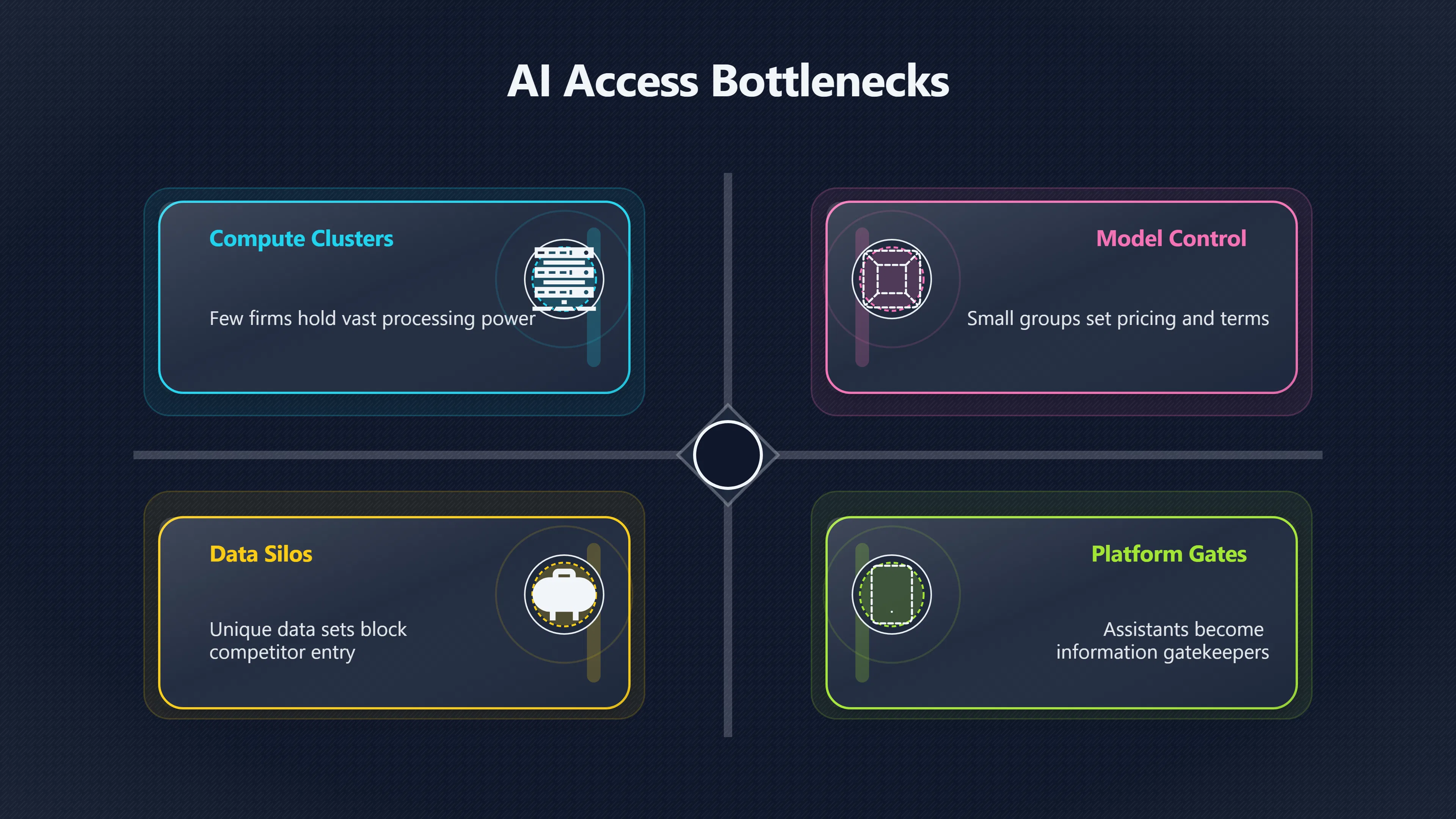
- Compute concentration. A handful of firms and countries possess the largest AI computing clusters and semiconductor supply chains. Access to advanced compute increasingly shapes who can train frontier systems.[OECD.AI]oecd.aithe geopgraphy of ai compute mapping what is available and whereThe geography of AI compute: Mapping what is available…Oct 29, 2025 — Policymakers and industry leaders need to measure and map AI com…
- Model concentration. If only a few organisations can build the most capable systems, they may set prices, terms of access and acceptable uses for large parts of the economy.
- Data concentration. Organisations with unique datasets may enjoy enduring advantages that are difficult for competitors to replicate.
- Platform concentration. AI assistants may become the interface through which people access information, services and institutions, creating new gatekeepers.
- Knowledge concentration. Organisations with privileged access to advanced systems may improve their productivity and decision-making faster than those without such access.
The risk is not merely economic. It is also political and cultural. If cognitive infrastructure becomes as important as electricity or communications networks, control over that infrastructure may translate into influence over education, media, public administration and scientific research.
OECD analyses of AI competition and productivity increasingly emphasise that concentration in AI development, uneven adoption and unequal diffusion could widen existing social and economic gaps if not addressed through policy.[OECD]oecd.orgThe impact of Artificial Intelligence on productivity…by F Filippucci · 2024 · Cited by 161 — The paper discusses the concentrati…[OECD]oecd.orgcomponent 6AI-related competition concerns in downstream marketsNov 14, 2025 — This paper examines how the adoption of artificial intelligence (AI)…
A new cognitive divide
The most familiar inequality story is that some people have AI tools and others do not.
The more important divide may be subtler.
Access alone does not guarantee benefit. People also need the skills, infrastructure and institutional support required to use AI effectively.
UNESCO has increasingly described an emerging “AI divide” in which unequal access to technology, education and digital capability determines who benefits from AI systems.[UNESCO]unesco.orgAI literacy and the new Digital DivideAI literacy and the new Digital Divide - A Global Call for…Aug 6, 2024 — This divide represents the unequal access, benefits, an…
Several layers of inequality may emerge simultaneously:
Infrastructure inequality
Many regions still face unreliable electricity, limited internet access or weak computing infrastructure. If advanced AI becomes central to education, research and economic participation, these gaps become more consequential.
Recent analyses of global AI diffusion argue that access to power, data centres and connectivity may become as important as access to software itself.[Business Insider]businessinsider.comHowever, this rapid uptake is uneven and is exacerbating a global digital divide. High-income nations like the UAE (59.4% adoption), Sing…
Language inequality
Most frontier models perform best in high-resource languages, especially English. People working in less represented languages may receive weaker assistance, fewer educational benefits and less effective local adaptation. UNESCO has repeatedly warned that AI systems must become more responsive to local linguistic and cultural contexts if benefits are to spread broadly.[UNESCO]unesco.orgguidance generative ai education and researchGuidance for generative AI in education and research7 Sept 2023 — UNESCO's first global guidance on GenAI in education aims to supp…
Institutional inequality
Large companies can hire AI specialists, purchase premium systems and redesign workflows around AI adoption.
A small school, local council, charity or rural clinic often cannot.
If access to cognitive infrastructure becomes a major productivity advantage, institutional capacity differences could widen even when the technology itself is widely available.
Literacy inequality
The ability to work effectively with AI is becoming a skill in its own right.
Recent research suggests that productivity gains from generative AI vary substantially across users. People who are better at prompting, checking and integrating model outputs often gain much more value than those who are not. Importantly, some studies suggest that training and structured workflows can reduce these gaps.[arXiv]arxiv.orgGenerative AI and the Productivity Divide: Human-AI Complementarities in EducationMay 18, 2026…
The lesson is that abundant intelligence requires more than distributing software. It also requires helping people use it well.
Why governments increasingly treat AI as infrastructure
One response to these risks is to think of advanced AI less like a consumer app and more like infrastructure.
Governments already treat roads, electricity, water systems, schools and telecommunications as foundational capabilities that support participation in modern society. Some policymakers increasingly argue that reliable cognitive assistance may eventually deserve similar treatment.
This does not necessarily mean state ownership of AI systems. Rather, it means recognising that broad access has public value.
Several emerging policy approaches reflect this idea:
- Public computing resources for researchers and universities.
- National AI infrastructure programmes.[oecd.ai]oecd.aithe geopgraphy of ai compute mapping what is available and whereThe geography of AI compute: Mapping what is available…Oct 29, 2025 — Policymakers and industry leaders need to measure and map AI com…
- Shared datasets and research platforms.
- Public-sector AI deployments designed to improve government capacity.
- Open standards that reduce dependence on a single vendor.
- Funding for educational access and AI literacy.
UNESCO’s work on AI in the public sector focuses on building institutional capacity so governments can use and govern AI in the public interest rather than remaining dependent on external actors.[UNESCO]unesco.orgAI for the Public SectorUNESCO's AI for the Public Sector programme strengthens the institutional capacity of governments worldwide…
The underlying question is whether societies want cognitive capability to function primarily as a private luxury good or as a broadly available public resource.
Open models, public models and the argument over openness
One of the most important disputes concerns openness.
Supporters of more open AI ecosystems argue that broad access requires alternatives to fully closed systems. Open-weight models, shared research and distributed innovation can lower barriers to entry, support local adaptation and reduce dependence on a few providers.
The argument is partly economic. If only a small number of firms control advanced systems, competition may weaken and users may have fewer choices.
It is also partly democratic. More open ecosystems can allow universities, smaller companies, nonprofits and governments to inspect, adapt and deploy systems for local needs.
However, openness creates trade-offs.
More capable models can also be misused. Open release may increase risks related to cybercrime, misinformation, biological threats or other harmful applications. Policymakers therefore face a difficult balancing problem: expanding access without making dangerous capabilities easier to exploit.
OECD work on AI openness highlights that the issue is not binary. Different systems can be open in different ways, with varying levels of access to weights, code, training details and deployment rights. The debate is increasingly about finding governance models that preserve innovation and broad participation without ignoring security concerns.[OECD]oecd.org7376c776 enEmerging divides in the transition to artificial intelligenceby S Kergroach · 2025 · Cited by 28 — It compares business adoption rates ov…
Public-interest safeguards for reliable cognitive help
If abundant intelligence is to become genuine cognitive infrastructure, reliability and accountability matter as much as availability.
People will increasingly rely on AI systems for decisions involving education, employment, finance, health and public services. Errors, biases and manipulation can therefore have large consequences.
Several safeguards are frequently proposed.
Independent evaluation
External testing can help determine how systems perform across different populations and use cases.
The UK’s AI Security Institute and similar organisations have argued that systematic evaluation is necessary because model capabilities and risks often evolve faster than public understanding.[AI Security Institute]aisi.gov.ukAI Security InstituteFrontier AI Trends Report by The AI Security Institute (AISI)The UK AI Security Institute (AISI) has conducted evalu…
Competition and interoperability
Competition policy may become increasingly important in AI markets.
If users can switch providers easily, move data between systems and avoid lock-in, infrastructure becomes more contestable and less dependent on a single organisation. OECD competition analyses increasingly focus on these questions.[OECD]oecd.orgai openness 02f73362 enAI opennessAug 14, 2025 — This paper analyses current trends in open-weight foundation models using experimental data, illustrating b…
Public-sector expertise
Governments need enough technical capability to evaluate vendors, negotiate contracts and regulate effectively.
Without that expertise, public institutions risk becoming permanently dependent on private providers for core cognitive functions. UNESCO’s public-sector programmes are partly motivated by this concern.[UNESCO]unesco.orgTrust, capacity and motivation: How public administrations…Mar 20, 2026 — Turning to UNESCO's Artificial Intelligence and Digital Tran…
Universal literacy and training
Broad access means little if people cannot evaluate outputs or recognise errors.
Education systems may increasingly need to teach AI literacy alongside traditional digital literacy. UNESCO and other international organisations have repeatedly argued that human judgement and critical evaluation should remain central.[UNESCO]unesco.orggovernments must quickly regulate generative ai schoolsGovernments must quickly regulate Generative AI in schoolsSep 8, 2023 — UNESCO is calling on governments to implement appropriate regulat…[UNESCO]unesdoc.unesco.orgfor generative AI in education and research…
Access beyond affluent regions
If advanced AI becomes concentrated in a small number of countries, global inequality could deepen.
Policies that support infrastructure development, language inclusion, educational access and international research collaboration may therefore become part of the broader effort to make abundant intelligence genuinely global.[UNESCO]unesco.organticipating change how will ai shape future public serviceHow Will AI Shape the Future of Public Service?Dec 19, 2025 — As AI reshapes automation, procurement, and even elements of decision-makin…[OECD.AI]oecd.orgcomponent 6Market features in AI infrastructure: Competition in artificial…Nov 14, 2025 — In the context of AI infrastructure, such competiti…
The deeper question: what kind of civilisation-scale technology is AI?
The fight over broad access ultimately reflects a larger uncertainty about what AI becomes.
If advanced AI remains mainly a productivity tool for corporations, the access question will matter, but within familiar economic frameworks.
If AI develops into something closer to a general-purpose cognitive infrastructure layer for civilisation, the stakes become much larger.
In that world, access to reliable intelligence assistance could influence scientific discovery, educational opportunity, democratic participation, entrepreneurship, public administration and long-run human flourishing. The question would resemble earlier debates about universal schooling, public libraries, electricity grids and internet access: not whether the technology is valuable, but how widely its benefits are distributed.
The strongest version of the AI bloom vision depends on the latter outcome. A future of abundant intelligence is not simply a future with more powerful models. It is a future in which cognitive capability spreads widely enough to expand what ordinary people, institutions and societies can understand, create and achieve.
Whether that happens will depend not only on advances in AI capability, but on ownership, governance, competition, infrastructure, education and public choice. The central political question may be surprisingly simple: when intelligence becomes cheaper, who gets to use it?
Amazon book picks
Further Reading
Books and field guides related to Who Gets Access to Abundant Intelligence?. Use these as the next step if you want deeper reading beyond the article.
The Coming Wave
Directly addresses who controls powerful AI and how access could be governed.
Power and Progress
Explores how societies can share gains from transformative technologies.
Co-Intelligence
Shows how everyday access to AI can expand practical cognitive capability.
The Age of A. I.
Frames AI as a civilisation-scale technology affecting knowledge and power.
eBay marketplace picks
Marketplace Samples
Example marketplace items related to this page. Use the search link to explore similar finds on eBay.


Endnotes
1.
Source: institute.global
Title: sovereignty in the age of ai strategic choices structural dependencies
Link:https://institute.global/insights/tech-and-digitalisation/sovereignty-in-the-age-of-ai-strategic-choices-structural-dependencies
Source snippet
Tony Blair InstituteSovereignty in the Age of AI: Strategic Choices, Structural...19 Jan 2026 — An agenda for states to strengthen AI so...
2.
Source: oecd.ai
Title: the geopgraphy of ai compute mapping what is available and where
Link:https://oecd.ai/en/wonk/the-geopgraphy-of-ai-compute-mapping-what-is-available-and-where
Source snippet
The geography of AI compute: Mapping what is available...Oct 29, 2025 — Policymakers and industry leaders need to measure and map AI com...
3.
Source: oecd.org
Link:https://www.oecd.org/en/publications/the-impact-of-artificial-intelligence-on-productivity-distribution-and-growth_8d900037-en.html
Source snippet
The impact of Artificial Intelligence on productivity...by F Filippucci · 2024 · Cited by 161 — The paper discusses the concentrati...
4.
Source: oecd.org
Title: component 6
Link:https://www.oecd.org/en/publications/artificial-intelligence-and-competitive-dynamics-in-downstream-markets_ccf0624a-en/full-report/component-6.html
Source snippet
AI-related competition concerns in downstream marketsNov 14, 2025 — This paper examines how the adoption of artificial intelligence (AI)...
5.
Source: oecd.org
Title: 7376c776 en
Link:https://www.oecd.org/content/dam/oecd/en/publications/reports/2025/06/emerging-divides-in-the-transition-to-artificial-intelligence_eeb5e120/7376c776-en.pdf
Source snippet
Emerging divides in the transition to artificial intelligenceby S Kergroach · 2025 · Cited by 28 — It compares business adoption rates ov...
6.
Source: unesco.org
Title: AI literacy and the new Digital Divide
Link:https://www.unesco.org/ethics-ai/en/articles/ai-literacy-and-new-digital-divide-global-call-action
Source snippet
AI literacy and the new Digital Divide - A Global Call for...Aug 6, 2024 — This divide represents the unequal access, benefits, an...
7.
Source: unesco.org
Title: guidance generative ai education and research
Link:https://www.unesco.org/en/articles/guidance-generative-ai-education-and-research
Source snippet
Guidance for generative AI in education and research7 Sept 2023 — UNESCO's first global guidance on GenAI in education aims to supp...
8.
Source: arxiv.org
Link:https://arxiv.org/abs/2605.18143
Source snippet
Generative AI and the Productivity Divide: Human-AI Complementarities in EducationMay 18, 2026...
Published: May 18, 2026
9.
Source: unesco.org
Link:https://www.unesco.org/en/artificial-intelligence/ai-public-sector
Source snippet
AI for the Public SectorUNESCO's AI for the Public Sector programme strengthens the institutional capacity of governments worldwide...
10.
Source: unesco.org
Link:https://www.unesco.org/en/articles/trust-capacity-and-motivation-how-public-administrations-are-building-ai-readiness
Source snippet
Trust, capacity and motivation: How public administrations...Mar 20, 2026 — Turning to UNESCO's Artificial Intelligence and Digital Tran...
11.
Source: oecd.org
Title: ai openness 02f73362 en
Link:https://www.oecd.org/en/publications/ai-openness_02f73362-en.html
Source snippet
AI opennessAug 14, 2025 — This paper analyses current trends in open-weight foundation models using experimental data, illustrating b...
12.
Source: oecd.org
Title: component 6
Link:https://www.oecd.org/en/publications/competition-in-artificial-intelligence-infrastructure_623d1874-en/full-report/component-6.html
Source snippet
Market features in AI infrastructure: Competition in artificial...Nov 14, 2025 — In the context of AI infrastructure, such competiti...
13.
Source: unesco.org
Title: governments must quickly regulate generative ai schools
Link:https://www.unesco.org/en/articles/unesco-governments-must-quickly-regulate-generative-ai-schools
Source snippet
Governments must quickly regulate Generative AI in schoolsSep 8, 2023 — UNESCO is calling on governments to implement appropriate regulat...
14.
Source: oecd.ai
Title: can mid sized economies come together to build frontier ai
Link:https://oecd.ai/en/wonk/can-mid-sized-economies-come-together-to-build-frontier-ai
Source snippet
Can mid-sized economies come together to build frontier AI?Dec 16, 2025 — Mid-sized economies can preserve AI sovereignty through multina...
15.
Source: unesdoc.unesco.org
Link:https://unesdoc.unesco.org/ark%3A/48223/pf0000386693
Source snippet
for generative AI in education and research...
16.
Source: unesco.org
Title: anticipating change how will ai shape future public service
Link:https://www.unesco.org/en/articles/anticipating-change-how-will-ai-shape-future-public-service
Source snippet
How Will AI Shape the Future of Public Service?Dec 19, 2025 — As AI reshapes automation, procurement, and even elements of decision-makin...
17.
Source: unesco.org
Title: ai and education guidance policy makers
Link:https://www.unesco.org/en/articles/ai-and-education-guidance-policy-makers
Source snippet
AI and education: guidance for policy-makersApr 14, 2025 — This publication offers guidance to policy-makers in understanding AI and resp...
18.
Source: unesco.org
Link:https://www.unesco.org/en/digital-education
Source snippet
AI and technologies in educationThrough our digital and AI competency frameworks, UNESCO prioritizes human agency, critical thinking, and...
19.
Source: unesco.org
Link:https://www.unesco.org/ethics-ai/en/articles/unescos-ai-literacy-training-civil-servants-empowering-ethical-ai-governance-around-world-0
Source snippet
UNESCO's AI Literacy Training for Civil ServantsDec 2, 2025 — UNESCO is offering Member States its newly launched AI Literacy Training Pr...
20.
Source: unesco.org
Title: Artificial intelligence in education
Link:https://www.unesco.org/en/digital-education/artificial-intelligence
Source snippet
AIUNESCO AI in Education guides the ethical use of artificial intelligence to enhance learning, teaching, and assessment globally...
21.
Source: oecd.org
Link:https://www.oecd.org/content/dam/oecd/en/publications/reports/2025/06/the-effects-of-generative-ai-on-productivity-innovation-and-entrepreneurship_da1d085d/b21df222-en.pdf
Source snippet
ity by improving their workforce efficiency, notably enhancing workers' short-term...Read more...
22.
Source: oecd.org
Link:https://www.oecd.org/en.html
23.
Source: oecd.org
Link:https://www.oecd.org/content/dam/oecd/en/publications/reports/2025/12/ai-and-the-global-productivity-divide_f47026c5/c315ea90-en.pdf
24.
Source: oecd.org
Title: component 5
Link:https://www.oecd.org/en/publications/artificial-intelligence-and-competitive-dynamics-in-downstream-markets_ccf0624a-en/full-report/component-5.html
Source snippet
The impact of AI adoption on market dynamicsNov 14, 2025 — This paper examines how the adoption of artificial intelligence (AI), particul...
25.
Source: oecd.org
Link:https://www.oecd.org/en/publications/the-effects-of-generative-ai-on-productivity-innovation-and-entrepreneurship_b21df222-en.html
Source snippet
The effects of generative AI on productivity, innovation and...by F Calvino · 2025 · Cited by 42 — This document reviews experimental re...
26.
Source: oecd.org
Link:https://www.oecd.org/en/topics/sub-issues/ai-compute.html
Source snippet
AI computeThe OECD AI Principles are the first intergovernmental standard on AI. They promote innovative, trustworthy AI that respects hu...
27.
Source: oecd.org
Title: unlocking productivity with generative ai evidence from experimental studies
Link:https://www.oecd.org/en/blogs/2025/07/unlocking-productivity-with-generative-ai-evidence-from-experimental-studies.html
Source snippet
Unlocking productivity with generative AI: Evidence from...8 Jul 2025 — The studies highlight how generative AI can increase efficiency...
28.
Source: wp.oecd.ai
Title: 20250128 GPAI GenAI FoW report final VOECD
Link:https://wp.oecd.ai/app/uploads/2025/01/20250128_GPAI_GenAI_FoW_report_final_VOECD.pdf
Source snippet
Generative AI and the future of work global dialogue: Perceptions and prospects. Roundtables in Asia, Europe, and Latin America, Report...
29.
Source: arxiv.org
Link:https://arxiv.org/html/2602.10900v3
Source snippet
AI Infrastructure Sovereignty7 Apr 2026 — We analyze how AI workloads reshape data center design, driving extreme power densities, advanc...
30.
Source: policylabs.frontiersin.org
Link:https://policylabs.frontiersin.org/content/policy-outlook-designing-capability-institutions-and-the-future-of-emerging-compute
Source snippet
Frontiers Policy LabsDesigning capability: institutions and the future of emerging...December 16, 2025 — by V Dhar — Emerging compute is...
Published: December 16, 2025
31.
Source: businessinsider.com
Link:https://www.businessinsider.com/ai-fastest-tech-in-history-microsoft-warns-billions-left-out
Source snippet
However, this rapid uptake is uneven and is exacerbating a global digital divide. High-income nations like the UAE (59.4% adoption), Sing...
32.
Source: aisi.gov.uk
Link:https://www.aisi.gov.uk/frontier-ai-trends-report
Source snippet
AI Security InstituteFrontier AI Trends Report by The AI Security Institute (AISI)The UK AI Security Institute (AISI) has conducted evalu...
33.
Source: Wikipedia
Link:https://en.wikipedia.org/wiki/OECD
Source snippet
OECDIt is a forum whose member countries describe themselves as committed to democracy and the market economy, providing a platform to...
34.
Source: unesco.org.uk
Link:https://unesco.org.uk/resources/guidance-for-generative-ai-in-education-and-research
Source snippet
Guidance for generative AI in education and researchThe publication offers concrete recommendations for policy-makers and educational ins...
35.
Source: researchgate.net
Link:https://www.researchgate.net/publication/385105010_UNESCO_Proposal_for_the_use_of_Generative_AI_in_Education_Eight_Challenges_and_Seven_Actions
Source snippet
UNESCO Proposal for the use of Generative AI in Education31 Oct 2024 — This proposal explores the integration of Generative Artificial In...
36.
Source: govtech.com
Title: unesco reassert public control over generative ai
Link:https://www.govtech.com/education/k-12/unesco-reassert-public-control-over-generative-ai
Source snippet
UNESCO: Reassert Public Control Over Generative AISep 14, 2023 — An arm of the United Nations urges the world's governments to regulate g...
37.
Source: ohchr.org
Link:https://www.ohchr.org/sites/default/files/documents/issues/education/cfis/ai-education/submissions/subm-artificial-intelligence-un-enti-unesco-ibe.docx
Source snippet
ibePlease provide examples of how AI tools and systems, including generative AI, are used in education process and related decision makin...
38.
Source: verifywise.ai
Link:https://verifywise.ai/ai-governance-library/sector-specific-governance/unesco-ai-education
Source snippet
UNESCO AI and Education GuidanceUNESCO's guidance on AI in education, including ethical considerations, pedagogical implications, and gov...
39.
Source: youtube.com
Link:https://www.youtube.com/oecd
Source snippet
OECDThe OECD is a global forum covering a diverse range of topics, from inequality and climate change to the gender gap and migrant integ...
40.
Source: facebook.com
Link:https://www.facebook.com/theOECD/
Source snippet
OECD | ParisEvery year, the #OECD Global Forum on Local Development brings together businesses, entrepreneurs, social enterprises and nat...
Additional References
41.
Source: researchgate.net
Link:https://www.researchgate.net/publication/399504193_AI_AS_PUBLIC_INFRASTRUCTURE_A_CRITICAL_REVIEW_OF_THE_TRANSITION_FROM_TOOL_TO_SOCIETAL_NECESSITY
Source snippet
ai as public infrastructure: a critical review of the transition...7 Jan 2026 — This paper conceptualizes AI as Public Infrastructure (A...
42.
Source: brookings.edu
Link:https://www.brookings.edu/articles/ai-growth-acceleration-versus-distributional-fairness/
Source snippet
AI growth acceleration versus distributional fairness2 days ago — OECD work using cross-country firm evidence finds that AI use is more p...
43.
Source: discovery.ucl.ac.uk
Title: Miao and Holmes 2023 Guidance for Generative AI in Education and Resear
Link:https://discovery.ucl.ac.uk/id/eprint/10176438/1/Miao%20and%20Holmes%20-%202023%20-%20Guidance%20for%20Generative%20AI%20in%20Education%20and%20Resear.pdf
Source snippet
for generative AI in education and researchby F Miao · 2023 · Cited by 1234 — This publication guidance offered here aims to support the...
44.
Source: laweconcenter.org
Title: ai productivity and labor markets a review of the empirical evidence
Link:https://laweconcenter.org/resources/ai-productivity-and-labor-markets-a-review-of-the-empirical-evidence/
Source snippet
AI, Productivity, and Labor Markets: A Review of the...5 Feb 2026 — By lowering the minimum viable team size, AI reduces entry costs, in...
45.
Source: linkedin.com
Title: [ai wealth]({{ ‘ai-wealth/’ | relative_url }}) power polarization digital divides new andre iedge
Link:https://www.linkedin.com/pulse/ai-wealth-power-polarization-digital-divides-new-andre-iedge
Source snippet
AI and Wealth-Power Polarization: The Digital Divide's...According to a 2023 report by the International Monetary Fund, AI is poised to...
46.
Source: weforum.org
Title: World Economic Forum Generative AI has disrupted education
Link:https://www.weforum.org/stories/2023/09/generative-ai-education-unesco/
Source snippet
Here's how it can...27 Sept 2023 — UNESCO is calling on GenAI tools to “be made sensitive to the context and needs of local communities”...
47.
Source: aigi.ox.ac.uk
Title: a blueprint for multinational advanced ai development
Link:https://aigi.ox.ac.uk/publications/a-blueprint-for-multinational-advanced-ai-development/
Source snippet
Blueprint for Multinational Advanced AI Development24 Nov 2025 — By working together and strategically choosing their AI development appr...
48.
Source: theschoolhouse.org
Title: Guidance for Generative AI in Education and Research
Link:https://www.theschoolhouse.org/post/generative-ai-in-education-research-guidance
Source snippet
May 12, 2025 — UNESCO's 2023 guidance outlines a rights-based approach to GenAI in education, with emphasis on ethical alignment, inclusi...
Published: May 12, 2025
49.
Source: GOV.UK
Title: frontier ai capabilities and risks discussion paper
Link:https://www.gov.uk/government/publications/frontier-ai-capabilities-and-risks-discussion-paper/frontier-ai-capabilities-and-risks-discussion-paper
Source snippet
It describes the current state and key trends relating to frontier AI capabilities, and then explores how frontier AI capabilities...Rea...
50.
Source: school-education.ec.europa.eu
Title: guidance generative ai education and research
Link:https://school-education.ec.europa.eu/en/discover/publications/guidance-generative-ai-education-and-research
Source snippet
for generative AI in education and research5 Apr 2024 — UNESCO's first global guidance on generative artificial intelligence (GenAI) in e...
Topic Tree