Within Civilisation backup
Can Space Colonies Sustain Themselves Without Earth?
Evaluates the role of trade, local industry, and resource availability in determining whether off-Earth settlements can truly act as a backup for civilisation.
On this page
- In situ resource utilisation and mining
- Local manufacturing and trade systems
- Cost benefit of Earth independent economies
Page outline Jump by section
Introduction
The idea of off-Earth settlements as a backup for civilisation sounds straightforward: if humanity lives in more than one place, a catastrophe on Earth is less likely to end the human story. But the hardest part of that vision is not rockets, habitats, or even survival in hostile environments. It is economics.
 A settlement that depends on regular shipments from Earth is not really an independent backup. If Earth suffers a severe collapse, war, pandemic, or economic breakdown, those supply chains could fail. The central question is therefore not merely whether people can live on the Moon, Mars, or in orbital habitats for a few years. It is whether they can build economies capable of producing most of what they need themselves, repairing complex systems, and maintaining technological civilisation across generations. The answer remains uncertain, and economic constraints may be among the strongest arguments against viewing near-term space settlements as robust civilisational insurance.[NASA]nasa.govoverview in situ resource utilizationOverview: In-Situ Resource Utilization26 Jul 2023 — NASA's Lunar Surface Innovation Initiative will develop and demonstrate technolog…[NASA]nasa.govin situ resource utilization isruIn-Situ Resource Utilization (ISRU)2 Aug 2024 — ISRU is the harnessing of local natural resources at mission destinations, instead of tak…
Within broader discussions about AI-enabled abundance and humanity’s long-term future, this question matters because advanced AI, robotics, automation, and accelerated scientific discovery could dramatically reduce some of today’s barriers. Yet even in optimistic scenarios, resource extraction, manufacturing complexity, energy production, and economic self-sufficiency remain fundamental challenges.
Why Economic Independence Matters More Than Physical Survival
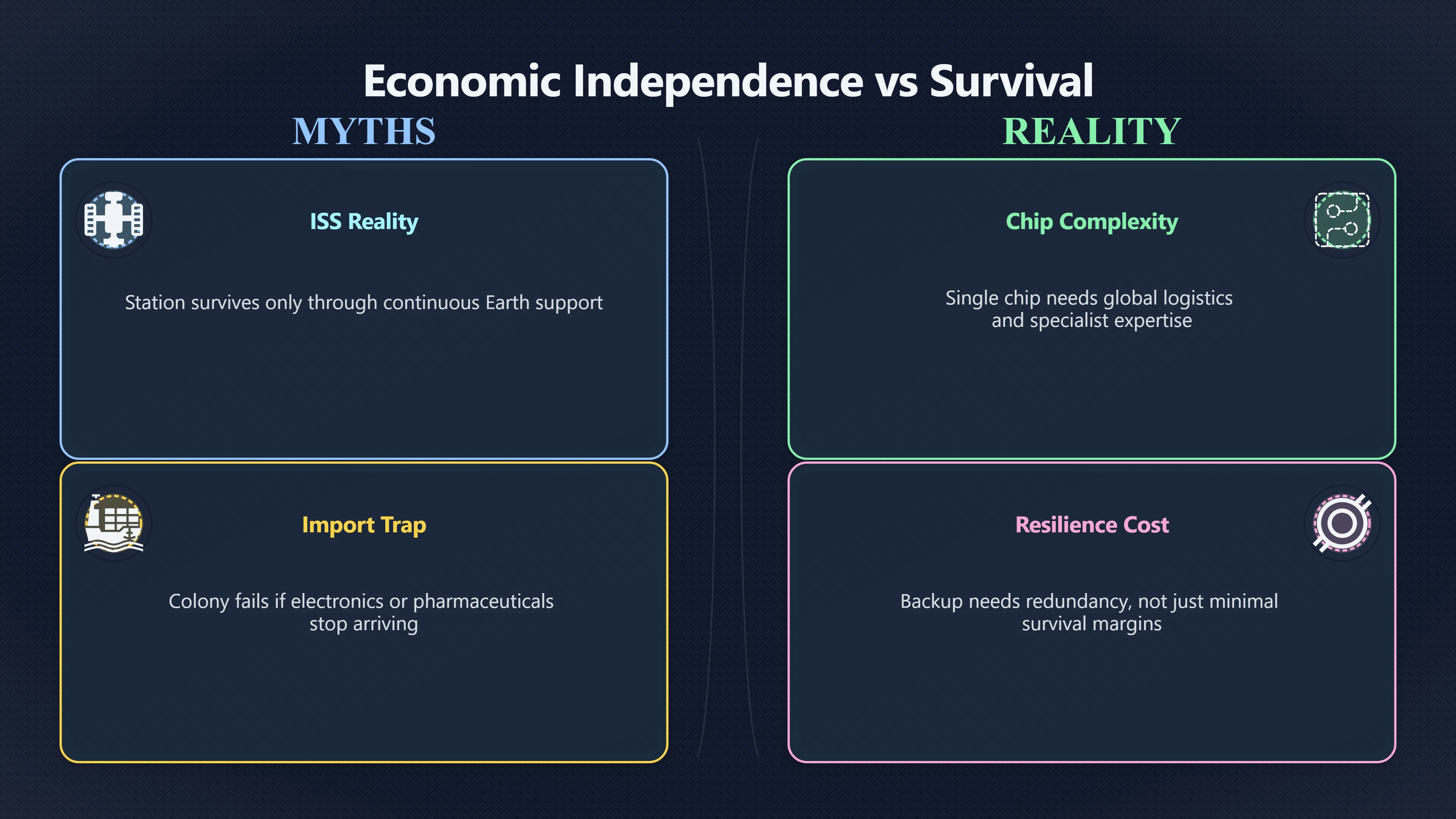
A small outpost can survive while remaining economically dependent. The International Space Station demonstrates that humans can live in space for long periods, but it survives only through continuous support from Earth.
A genuine civilisational backup requires something much more demanding. It must be able to continue functioning if contact with Earth is reduced or lost entirely. That means not only producing food, water, oxygen, and energy, but also replacing machinery, educating new generations, maintaining scientific knowledge, and preserving industrial capabilities.[NSS]nss.orgRoadmap to Space SettlementDeveloping and using space resources to reduce humanity's reliance on Earth-based resources and industry. •…[NASA]nasa.govNASA's Journey to Mars - Pioneering Next Steps in Space…NASA will have to learn new ways of operating in space, based on self-reli…
The challenge is that modern civilisation depends on extraordinarily complex supply chains. A single computer chip requires specialised materials, precision manufacturing equipment, global logistics networks, and layers of scientific expertise. Even advanced nations on Earth depend heavily on international trade for critical components.
A Mars settlement with a few thousand people would face a difficult question: how many parts of Earth’s industrial ecosystem must it recreate locally before it becomes genuinely resilient?
This issue creates a tension in many space-settlement visions. A colony may appear self-sufficient because it grows food and recycles water, yet still depend on Earth for electronics, pharmaceuticals, replacement machinery, or specialist materials. If those imports stop, long-term survival becomes uncertain.
In Situ Resource Utilisation Is Necessary but Not Sufficient
The most widely discussed solution is in situ resource utilisation, usually abbreviated to ISRU. The basic idea is simple: instead of transporting everything from Earth, settlements use local materials. NASA and other agencies consider ISRU essential for long-duration lunar and Martian operations.[NASA]history.arc.nasa.govAmes Research Center ArchivesSPACE RESOURCES and SPACE SETTLEMENTSThis publication contains the technical papers from the five task group…[NASA]nasa.govoverview in situ resource utilizationOverview: In-Situ Resource Utilization26 Jul 2023 — NASA's Lunar Surface Innovation Initiative will develop and demonstrate technolog…
Potential examples include:
- Extracting water ice from lunar polar regions.
- Producing oxygen from lunar regolith.[researchgate.net]researchgate.netFrom the lunar soil, also referred to as regolith, many vital…Read more…
- Generating methane and oxygen fuel on Mars.
- Using local soil and rock for construction.
- Manufacturing structural materials from local minerals.
These capabilities could dramatically reduce launch costs. Studies of lunar resource utilisation have repeatedly found that local oxygen production alone could eliminate large numbers of expensive cargo missions from Earth.[LPI]lpi.usra.eduLPINASA In-Situ Resource Utilization (ISRU) CapabilityApril 17, 2006 — 19 May 2005 — If one assumed a single lander was required for the Lunar oxygen production plant emplacement, ISRU would…
NASA’s MOXIE experiment on the Perseverance rover demonstrated that oxygen can be produced from the Martian atmosphere, providing an important proof of concept for future resource production.[WIRED]wired.comNASA's MOXIE Experiment Is Making Oxygen on MarsThe toaster-sized device on the Mars Perseverance Rover has successfully produced small amounts of oxygen, enough for a person to breathe…
Yet resource extraction is only the first step.
Finding water is not the same as operating a water industry. Producing oxygen is not the same as maintaining a civilisation. Raw materials must be mined, refined, transported, processed, stored, and incorporated into larger manufacturing systems. Each stage requires machinery, maintenance, energy, and technical expertise.
Researchers examining lunar and Martian ISRU repeatedly emphasise that extraction technologies remain early-stage and that scaling them into robust industrial systems presents major engineering and economic challenges.[Science Advances]spj.science.orgScience AdvancesOverview of the Lunar In Situ Resource Utilization…by P Zhang · 2023 · Cited by 167 — In situ resource utilization (IS… 2arXiv
In other words, ISRU may solve part of the import problem without solving the wider problem of economic autonomy.
The Hidden Difficulty of Local Manufacturing
Many discussions of space settlement focus on life-support systems because they are immediately visible. But manufacturing may be the deeper bottleneck.
A resilient settlement would need the ability to produce not only basic materials but increasingly sophisticated goods:
- Construction materials.
- Replacement mechanical parts.
- Industrial machinery.
- Electronics.
- Medical equipment.
- Computing hardware.
- Scientific instruments.
Each layer depends on the others.
A settlement capable of extracting aluminium from lunar materials still needs machines to perform the extraction. Those machines require spare parts. The spare parts require manufacturing equipment. That equipment requires maintenance, software, sensors, and power systems.
This creates what economists sometimes call a complexity problem. Modern industrial economies work because millions of people participate in vast networks of specialisation. A remote settlement may not have enough population, capital, or industrial diversity to reproduce that system internally.
The problem resembles the challenge faced by isolated societies throughout history, but in a much harsher environment where failures in critical systems can become life-threatening very quickly.
Recent reviews of lunar manufacturing emphasise the importance of additive manufacturing, robotics, and local production methods, but they also note major unresolved issues involving energy requirements, material quality, reliability, and the difficulty of reproducing advanced industrial products entirely from local resources.[arXiv]arxiv.orgSource details in endnotes.
Could Trade Solve the Problem?
One response is that settlements do not need complete self-sufficiency. They could participate in broader interplanetary trade networks.
Historically, most human settlements prospered through trade rather than autarky. Cities became resilient not because they produced everything themselves but because they exchanged goods with other regions.
Some space advocates envision similar arrangements:
- Lunar settlements exporting propellant or oxygen.
- Asteroid mining operations supplying metals.
- Orbital habitats specialising in manufacturing.
- Martian settlements exporting scientific knowledge, intellectual property, or specialised products.
Under this model, resilience comes from a distributed network rather than isolated independence. NSS[Ames Research Center Archives]history.arc.nasa.govAmes Research Center ArchivesSPACE RESOURCES and SPACE SETTLEMENTSThis publication contains the technical papers from the five task group…
However, trade creates its own vulnerabilities.
A settlement that relies on imports remains exposed to disruptions elsewhere in the network. If Earth is the dominant economic hub, then Earth remains a critical point of failure. A severe terrestrial collapse could destroy demand, financing, transportation systems, and technical support simultaneously.
This creates a distinction between two different goals:
- Economic viability: being able to survive through trade.
- Civilisational backup capacity: being able to survive even when trade collapses.
A settlement may achieve the first long before it achieves the second.

The Cost Problem Remains Enormous
Even if launch costs continue falling, establishing self-sustaining settlements requires huge investments.
Large populations need:
- Housing.
- Power generation.
- Life-support infrastructure.[facebook.com]facebook.comSpace Settlements: Preparing for Life Beyond EarthThese ultra-advanced habitats combine self-healing materials, artificial weather system…
- Medical facilities.
- Industrial equipment.
- Food production systems.[patentpc.com]patentpc.comthe future of space colonization market growth and lunar martian habitat trendsThe Future of Space Colonization: Market Growth and…2 May 2026 — Companies should explore how they can contribute to self-sustaining s…
- Transportation networks.
- Education and governance institutions.
All of these must operate in environments with extreme radiation, temperature variation, dust hazards, low gravity, or vacuum exposure.
The economics become especially difficult because resilience requires redundancy. A backup civilisation cannot operate on minimal margins. It needs spare capacity, multiple production pathways, emergency reserves, and the ability to withstand shocks.
That means resilience is often more expensive than mere survival.
For example, a settlement may technically survive with one oxygen production system. But a genuine civilisational backup would need multiple systems, spare parts, trained operators, and replacement manufacturing capabilities. Each additional layer improves resilience while increasing costs.
This is one reason some critics argue that proposals for self-sustaining colonies often underestimate the industrial scale required. Researchers and commentators who became more sceptical of settlement timelines frequently cite economic and logistical complexity rather than any single technological impossibility.[80,000 Hours]80000hours.orgzach weinersmith space settlement80,000 HoursZach Weinersmith on how researching his book turned him…14 May 2024 — I spoke with Zach Weinersmith about settling space…
How AI Could Change the Equation
This is where AI becomes relevant to the broader AI Bloom discussion.
The strongest optimistic case is not simply that AI helps design rockets. It is that advanced AI could reduce many of the economic barriers that currently make settlement difficult.
Potential mechanisms include:
- Fully autonomous mining operations.
- AI-managed life-support systems.[facebook.com]facebook.comSpace Settlements: Preparing for Life Beyond EarthThese ultra-advanced habitats combine self-healing materials, artificial weather system…
- Automated scientific research.
- Robotic manufacturing.
- Rapid design and testing of new equipment.
- More efficient resource extraction.[nasa.gov]nasa.govin situ resource utilization isruIn-Situ Resource Utilization (ISRU)2 Aug 2024 — ISRU is the harnessing of local natural resources at mission destinations, instead of tak…
- Reduced labour requirements.
- Better supply-chain optimisation.
A settlement supported by highly capable AI and robotics might need far fewer people to maintain critical infrastructure. It could potentially manufacture a wider range of products locally and respond more quickly to unexpected failures.
Advanced AI could also accelerate materials science, energy systems, recycling technologies, and closed-loop industrial processes. These developments would not only support space settlement but also improve sustainability on Earth.
In this sense, space resilience may be partly downstream of intelligence abundance. A future with dramatically expanded scientific and engineering capability could make economic self-sufficiency far more achievable than it appears today.
Yet this remains speculative. The same uncertainties surrounding superintelligence and AI-driven economic transformation apply here. No one currently knows how far automation can substitute for large industrial populations, or whether certain forms of manufacturing will remain difficult to decentralise.

The Resource Abundance Argument and Its Limits
Space advocates often point to the enormous material wealth of the Solar System. The Moon contains vast quantities of oxygen-bearing minerals. Mars possesses water ice, carbon dioxide, and numerous useful elements. Asteroids contain metals that exceed terrestrial reserves by many orders of magnitude.[Wikipedia]WikipediaIn situ resource utilizationIn situ resource utilization
In principle, these resources could support populations far larger than Earth’s.
But abundance in a geological sense is not the same as economic accessibility.
History offers many examples of regions rich in resources that remained poor because extraction, transportation, processing, or governance proved difficult. Space settlements face a similar challenge on a much larger scale.
The key question is not whether resources exist. It is whether settlements can access and transform them cheaply enough to sustain advanced economies.
A tonne of metal embedded in an asteroid has little practical value until a settlement possesses the energy, machinery, expertise, and institutions required to mine and use it.
For this reason, some researchers argue that the critical resource is not raw material itself but industrial capability. The settlement that can manufacture machines, maintain infrastructure, and expand productive capacity may ultimately be more resilient than the settlement that merely sits near valuable deposits.[ResearchGate]researchgate.netFrom the lunar soil, also referred to as regolith, many vital…Read more…
The Strongest Critique: A Small Colony May Not Be a Real Backup
The most serious criticism of the backup-civilisation argument is that genuinely independent settlements may require populations and economies far larger than many current visions assume.
A few hundred people are unlikely to reproduce the full range of skills needed to maintain modern civilisation. Even a few thousand may struggle to support advanced manufacturing, medicine, education, governance, and scientific research simultaneously.
This suggests that resilience may depend less on the existence of a settlement and more on its scale.
A small scientific outpost could preserve some knowledge and genetic diversity while remaining economically fragile. A large, industrially diverse settlement might eventually function as a genuine backup, but reaching that point could require decades or centuries of growth.
The debate therefore shifts from “Can humans live off Earth?” to “How large and economically complex must an off-Earth society become before it can survive independently?”
That question remains unresolved.
Economic Sustainability as the Real Test
The long-term resilience value of space settlement may ultimately depend less on launch technology than on economics.
A settlement that can mine local resources, manufacture critical goods, generate energy, educate new generations, and maintain technological capabilities without constant Earth support begins to resemble a genuine second branch of civilisation. A settlement that cannot do these things remains vulnerable to the same collapse it is supposed to hedge against.
This does not mean the backup-civilisation idea is impossible. It means that self-sufficiency is not primarily a question of survival technology. It is a question of whether an off-Earth community can develop a sufficiently broad and productive economy.
For advocates of humanity’s long future, that distinction matters. The strongest version of the space-settlement argument is not that humans can temporarily inhabit other worlds. It is that they can eventually build independent centres of industry, knowledge, and culture beyond Earth. Whether future advances in AI, robotics, manufacturing, and resource utilisation can make that transition economically realistic remains one of the central open questions in the broader vision of civilisational resilience and human flourishing beyond a single planet.
Amazon book picks
Further Reading
Books and field guides related to Can Space Colonies Sustain Themselves Without Earth?. Use these as the next step if you want deeper reading beyond the article.
A City on Mars
Directly discusses whether space colonies can actually support themselves.
The Future of Humanity
Places space economies within a larger future of human expansion.
eBay marketplace picks
Marketplace Samples
Example marketplace items related to this page. Use the search link to explore similar finds on eBay.




Endnotes
1.
Source: nasa.gov
Title: overview in situ resource utilization
Link:https://www.nasa.gov/overview-in-situ-resource-utilization/
Source snippet
Overview: In-Situ Resource Utilization26 Jul 2023 — NASA's Lunar Surface Innovation Initiative will develop and demonstrate technolog...
2.
Source: nasa.gov
Title: in situ resource utilization isru
Link:https://www.nasa.gov/mission/in-situ-resource-utilization-isru/
Source snippet
In-Situ Resource Utilization (ISRU)2 Aug 2024 — ISRU is the harnessing of local natural resources at mission destinations, instead of tak...
3.
Source: 80000hours.org
Title: zach weinersmith space settlement
Link:https://80000hours.org/podcast/episodes/zach-weinersmith-space-settlement/
Source snippet
80,000 HoursZach Weinersmith on how researching his book turned him...14 May 2024 — I spoke with Zach Weinersmith about settling space...
Published: May 2024
4.
Source: nss.org
Link:https://nss.org/wp-content/uploads/2019/03/NSS-Roadmap-to-Space-Settlement-3rd-Ed.pdf
Source snippet
Roadmap to Space SettlementDeveloping and using space resources to reduce humanity's reliance on Earth-based resources and industry. •...
5.
Source: nasa.gov
Link:https://www.nasa.gov/wp-content/uploads/2017/11/journey-to-mars-next-steps-20151008_508.pdf
Source snippet
NASA's Journey to Mars - Pioneering Next Steps in Space...NASA will have to learn new ways of operating in space, based on self-reli...
6.
Source: nss.org
Link:https://nss.org/the-colonization-of-space-gerard-k-o-neill-physics-today-1974/
Source snippet
The Colonization of Space – Gerard K. O'Neill, Physics...The self-sufficiency of space communities probably has a strong effect on go...
7.
Source: researchgate.net
Link:https://www.researchgate.net/publication/268569660_NASA_In-Situ_Resource_Utilization_ISRU_Project_Development_and_Implementation
Source snippet
From the lunar soil, also referred to as regolith, many vital...Read more...
8.
Source: wired.com
Title: NASA’s MOXIE Experiment Is Making Oxygen on Mars
Link:https://www.wired.com/story/nasas-moxie-experiment-is-making-oxygen-on-mars
Source snippet
The toaster-sized device on the Mars Perseverance Rover has successfully produced small amounts of oxygen, enough for a person to breathe...
9.
Source: arxiv.org
Link:https://arxiv.org/abs/2404.00800
10.
Source: arxiv.org
Title: arXiv A Comprehensive Review of Lunar-based Manufacturing and Construction
Link:https://arxiv.org/abs/2408.05823
11.
Source: history.arc.nasa.gov
Link:https://history.arc.nasa.gov/hist_pdfs/nasa_sp428.pdf
Source snippet
Ames Research Center ArchivesSPACE RESOURCES and SPACE SETTLEMENTSThis publication contains the technical papers from the five task group...
12.
Source: researchgate.net
Link:https://www.researchgate.net/publication/389210192_The_Settlement_of_Space_Economical_and_Logistical_Drivers_and_Constraints
Source snippet
(PDF) The Settlement of Space: Economical and Logistical...21 Feb 2025 — This paper traces the potential development of space settlement...
13.
Source: Wikipedia
Title: In situ resource utilization
Link:https://en.wikipedia.org/wiki/In_situ_resource_utilization
14.
Source: researchgate.net
Link:https://www.researchgate.net/publication/355910240_Changing_the_ISRU_Paradigm_from_Sustainability_to_Economic_Tool
Source snippet
local manufacturing and ISRU by a... Indeed, ISRU projects can be self-sufficient while being neither resilient nor sustainable.Read more...
15.
Source: nss.org
Link:https://nss.org/space-basics-what-is-space-settlement/
16.
Source: arxiv.org
Link:https://arxiv.org/html/2602.13291v1
Source snippet
Agent Mars: Multi-Agent Simulation for Multi-Planetary Life...9 Feb 2026 — Space exploration and settlement offer access to vast environ...
17.
Source: spj.science.org
Link:https://spj.science.org/doi/10.34133/space.0037
Source snippet
Science AdvancesOverview of the Lunar In Situ Resource Utilization...by P Zhang · 2023 · Cited by 167 — In situ resource utilization (IS...
Additional References
18.
Source: facebook.com
Link:https://www.facebook.com/groups/930540941927100/posts/998203675160826/
Source snippet
Space Settlements: Preparing for Life Beyond EarthThese ultra-advanced habitats combine self-healing materials, artificial weather system...
19.
Source: patentpc.com
Title: the future of space colonization market growth and lunar martian habitat trends
Link:https://patentpc.com/blog/the-future-of-space-colonization-market-growth-and-lunar-martian-habitat-trends
Source snippet
The Future of Space Colonization: Market Growth and...2 May 2026 — Companies should explore how they can contribute to self-sustaining s...
Published: May 2026
20.
Source: spaceresourcetech.com
Link:https://spaceresourcetech.com/blogs/articles/in-situ-resource-utilization-the-future-of-human-settlements-in-space?srsltid=AfmBOoptMCPQPETM9AeyQkVVkWcZtwjL8xEOHEBR0vhn5WG8nlXTIKG7
Source snippet
surface to produce oxygen and hydrogen, which can be used for [life support]({{ 'life-support/' | relative_url }})...Read more...
21.
Source: lpi.usra.edu
Title: LPINASA In-Situ Resource Utilization (ISRU) Capability
Link:https://www.lpi.usra.edu/lunar_resources/documents/ISRUFinalReportRev1519_05%20_2.pdf
Source snippet
April 17, 2006 — 19 May 2005 — If one assumed a single lander was required for the Lunar oxygen production plant emplacement, ISRU would...
Published: April 17, 2006
22.
Source: globalspaceexploration.org
Link:https://www.globalspaceexploration.org/wordpress/wp-content/uploads/IAC61/IAC-10.A5.1.7-Lunar-ISRU.pdf
Source snippet
Situ Resource Utilization (ISRU) development activities and areas of interest of the international space agencies.Read more...
23.
Source: facebook.com
Link:https://www.facebook.com/ScienceNaturePage/posts/the-future-of-space-the-oneill-cylinder-this-space-settlement-concept-proposed-b/1113442126903322/
Source snippet
allenge. All realistic "live in space" (or "live on Mars!" ideas/...
24.
Source: sciencedirect.com
Title: ScienceDirect In Situ Resource Utilization
Link:https://www.sciencedirect.com/topics/earth-and-planetary-sciences/in-situ-resource-utilization
Source snippet
In Situ Resource Utilization - an overviewIn situ Resource Utilization (ISRU) refers to the extraction and processing of local resources...
25.
Source: thespacereview.com
Link:https://www.thespacereview.com/article/4917/1
Source snippet
pacefaring civilization to ensure the survival of humanity...
26.
Source: spacebandits.io
Title: what is isru and how can it help humanity explore the solar system
Link:https://www.spacebandits.io/post/what-is-isru-and-how-can-it-help-humanity-explore-the-solar-system
Source snippet
ISRU technologies are making it possible to have sustainable extraterrestrial settlements...
27.
Source: meegle.com
Title: in situ resource utilization isru
Link:https://www.meegle.com/en_us/topics/space-commercial/in-situ-resource-utilization-isru
Source snippet
In-Situ Resource Utilization (ISRU)19 Jan 2025 — ISRU involves the extraction and conversion of local resources found on extraterrestrial...
Topic Tree