Within Discovery
Can a Robot Lab Really Discover New Materials?
A-Lab showed that an automated system could adjust failed recipes and physically produce new materials, not just predict them on a screen.
On this page
- How A Lab linked literature, robotics and active learning
- What its reported synthesis results demonstrate
- What the experiment still does not prove
Page outline Jump by section
Introduction
Berkeley’s A-Lab is one of the clearest demonstrations so far that an AI-guided laboratory can do more than generate interesting predictions on a computer. It showed that software could search scientific knowledge, propose synthesis recipes, operate laboratory equipment, analyse experimental results and revise its next attempt with minimal human intervention. That does not mean the system became an independent scientist, nor does it prove that autonomous laboratories can replace human researchers. What it does show is that a key bottleneck in modern science—the slow translation of computational predictions into physical experiments—can be substantially reduced by combining AI with robotics in a closed experimental loop.[nature.com]nature.comNovember 29, 2023…
For the broader question of whether AI could accelerate scientific discovery and ultimately contribute to a future of greater human flourishing, A-Lab matters because it demonstrates an important transition. Instead of AI merely suggesting ideas for people to test, it performed much of the cycle from hypothesis to physical evidence on its own.
Can a Robot Lab Really Discover New Materials?
For many years, computational tools have predicted enormous numbers of potentially useful materials for batteries, catalysts, electronics and clean-energy technologies. The problem has never been generating possibilities. It has been determining which predictions correspond to materials that can actually be manufactured.
A-Lab was designed to close this gap.
Developed through a collaboration involving researchers at the University of California, Berkeley and Lawrence Berkeley National Laboratory, the system combines several previously separate capabilities into a single automated workflow:
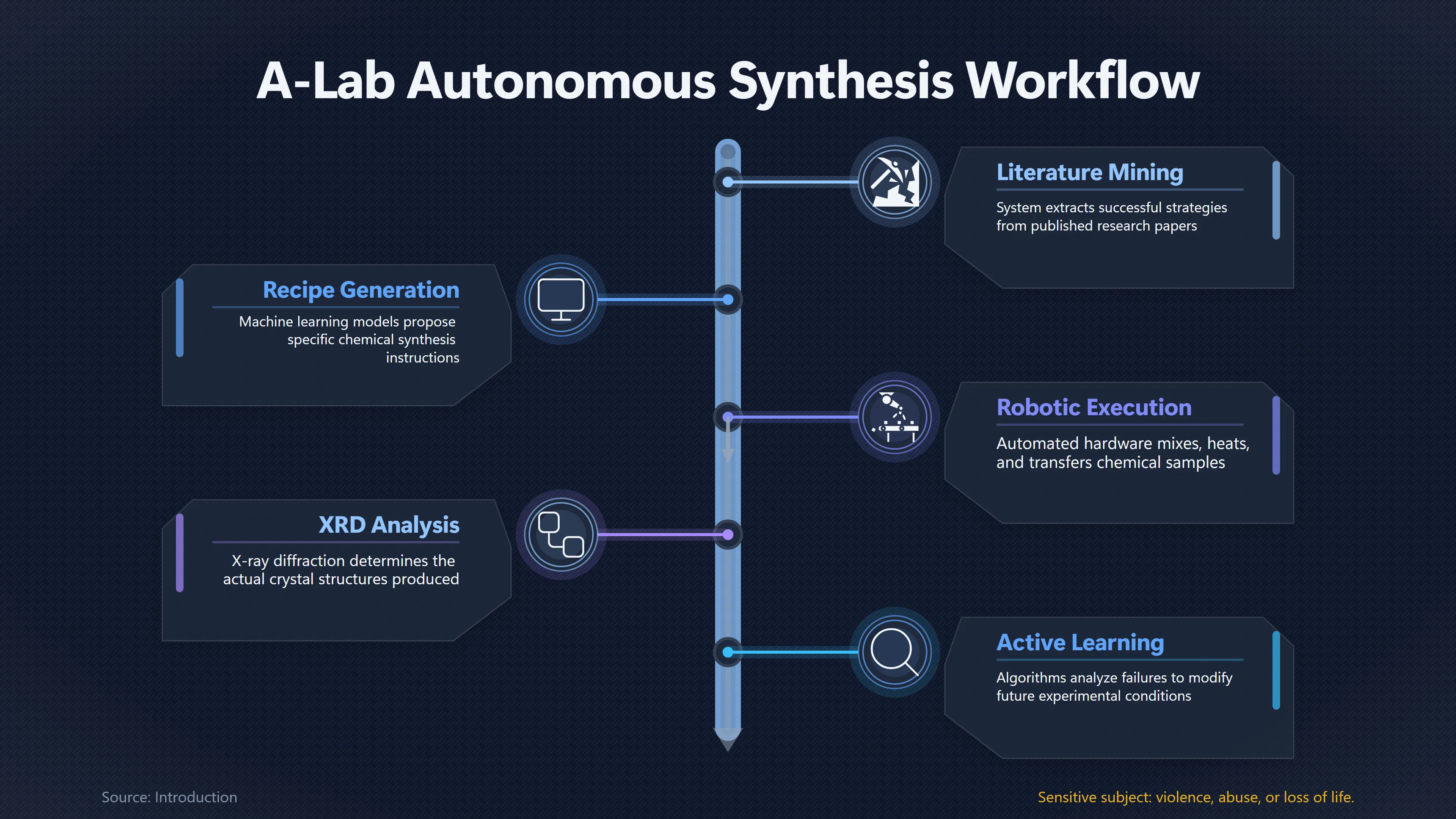
- literature mining to learn successful synthesis strategies from published papers;
- computational databases such as the Materials Project, alongside predicted stable compounds from Google DeepMind’s materials research;
- machine-learning models that propose synthesis recipes;
- robotic equipment that measures, mixes, heats and characterises samples;
- automated X-ray diffraction analysis to determine what was actually produced;
- active-learning algorithms that modify future experiments after failures rather than repeating unsuccessful recipes.[nature.com]nature.comNovember 29, 2023…
The important advance is not any single component. Robotic laboratories, materials databases and machine learning all existed beforehand. A-Lab integrated them into a closed-loop system in which each experiment influenced the next without requiring researchers to manually redesign every step.
How A-Lab Linked Literature, Robotics and Active Learning
A-Lab’s workflow resembles a compressed version of how human materials scientists normally work over weeks or months.
It began by selecting candidate materials predicted to be stable using computational methods. Rather than inventing laboratory procedures from scratch, the system examined published synthesis literature to identify recipes likely to work for chemically similar compounds. Those recipes were converted into machine-readable laboratory instructions.
Robotic systems then automatically:
- dispensed precursor powders;
- mixed materials;
- heated samples under controlled conditions;
- transferred samples between instruments;
- measured the resulting crystal structures using X-ray diffraction.
Instead of stopping there, the AI interpreted whether the intended material had actually formed. When experiments failed, active-learning algorithms analysed why and proposed revised synthesis conditions designed to improve the chances of success in later attempts. This feedback process is what distinguishes an autonomous laboratory from simple laboratory automation.[nature.com]nature.comNovember 29, 2023…
The system therefore did not merely execute pre-written instructions. It adjusted future experiments based on evidence generated during previous ones.
What Its Reported Synthesis Results Demonstrate
The headline result is straightforward.
During approximately 17 days of continuous operation, A-Lab attempted to synthesise 57 target inorganic compounds and successfully realised 36 of them, including various oxides and phosphates. Several additional successful syntheses came only after the active-learning system modified initially unsuccessful recipes, demonstrating that the software learned from experimental failure rather than relying solely on literature-derived procedures.[nature.com]nature.comNovember 29, 2023…
Equally important were the unsuccessful experiments.
Rather than treating failures as wasted effort, the researchers analysed them to identify recurring obstacles such as:
- slow reaction kinetics;
- unsuitable precursor choices;
- competing intermediate phases;
- volatility of starting materials;
- limitations in computational predictions.
These failures became new knowledge that improved future decision-making. The laboratory also accumulated a growing database of experimentally observed reactions that could inform subsequent synthesis campaigns.[nature.com]nature.comNovember 29, 2023…
This illustrates one of the strongest arguments for autonomous laboratories: they can convert unsuccessful experiments into structured information at a much higher rate than traditional research workflows.
Why This Matters for Autonomous Discovery
A-Lab provides evidence for a broader idea increasingly discussed in AI-enabled science.
Discovery is often portrayed as finding one brilliant insight. In reality, many scientific fields depend on thousands of repetitive cycles of planning, testing, measuring and refinement.
If AI systems can automate much of that cycle, several things become possible.
First, researchers can evaluate many more hypotheses than would otherwise fit into available laboratory time.
Second, laboratories can operate continuously rather than only during working hours.
Third, computational predictions become far more valuable because they can be experimentally filtered much faster.
Fourth, scientists spend proportionally less time supervising routine procedures and more time defining important research questions, interpreting surprising results and deciding which scientific directions deserve exploration.
This distinction is important for the broader AI bloom perspective. Faster experimentation is not valuable simply because robots work harder. It matters because the limiting factor in many areas of science is no longer generating possible ideas but determining which ideas survive contact with physical reality.
What the Experiment Still Does Not Prove
The significance of A-Lab should not be overstated.
The experiment demonstrates autonomous execution within a carefully defined scientific domain. It does not establish that AI systems can independently conduct open-ended science across disciplines.
Several important limitations remain.
It addressed a specialised problem. The laboratory focused on inorganic powder synthesis using predefined equipment and workflows. It was not designed to investigate arbitrary scientific questions.[nature.com]nature.comNovember 29, 2023…
Human researchers defined the overall objectives. Scientists selected the research problem, designed the platform and interpreted the broader scientific significance. The AI did not decide independently which fields deserved investigation.
Many materials still failed. Roughly one-third of target compounds were not successfully synthesised, revealing genuine physical and computational constraints rather than unlimited autonomous capability.[nature.com]nature.comNovember 29, 2023…
Physical experimentation remains essential. Computational models predicted promising materials, but only laboratory testing determined whether they could actually be produced. A-Lab reduced this bottleneck rather than eliminating it.
Scientific claims still require scrutiny. Some researchers have questioned how many synthesised compounds should be regarded as genuinely new discoveries or whether some reported successes reflect previously known materials or interpretation issues. Those debates do not negate the achievement of autonomous laboratory operation, but they illustrate why independent verification remains central to scientific progress.[ft.com]ft.comCan AI really change our material world?Google DeepMind afirmó haber encontrado más de 2 millones de nuevos materiales cristalinos usando su herramienta de IA, un hecho inicialm…
What A-Lab Suggests About the Future of Scientific Acceleration
The deeper importance of A-Lab is conceptual rather than numerical.
Previous AI systems often accelerated isolated tasks such as literature search, molecular prediction or image analysis. A-Lab demonstrated that these capabilities can be linked into a continuous experimental cycle in which software proposes experiments, robotics performs them, measurements generate evidence and AI decides what to try next.
That is still a long way from a fully autonomous scientific researcher capable of choosing important questions, inventing new theories and reshaping entire disciplines. Nevertheless, it provides one of the strongest real-world demonstrations that parts of the scientific method itself can be automated rather than merely assisted.
For advocates of AI-enabled scientific acceleration, this is why A-Lab has become an influential case study. It shows that autonomous discovery is not simply about predicting more candidates on a computer. The crucial step is connecting prediction with reproducible physical experimentation, allowing ideas to be tested, refined and discarded far faster than conventional laboratory practice permits. If similar closed-loop systems become common across chemistry, biology, materials science and engineering, they could shorten the time between computational insight and experimentally verified knowledge—one of the key pathways through which advanced AI might eventually contribute to faster scientific progress and, in turn, broader human flourishing.
Amazon book picks
Further Reading
Books and field guides related to Can a Robot Lab Really Discover New Materials?. Use these as the next step if you want deeper reading beyond the article.
Life 3.0
'This is the most important conversation of our time, and Tegmark's thought-provoking book will help you join it' Stephen Hawking THE INT...
Superintelligence
This profoundly ambitious and original book picks its way carefully through a vast tract of forbiddingly difficult intellectual terrain.
The AI Revolution in Medicine
AI is about to transform medicine. Here's what you need to know right now. ''The development of AI is as fundamental as the creation of t...
The Gene
Prologue: Families -- "The missing science of heredity" 1865-1935 -- "In the sum of the parts, there are only the parts" 1930-1970 -- "Th...
eBay marketplace picks
Marketplace Samples
Live-tested eBay searches with available results related to this page.
Selected fromrobotics kit oneBay.co.uk.

Endnotes
1.
Source: nature.com
Link:https://www.nature.com/articles/s41586-023-06734-w
Source snippet
November 29, 2023...
Published: November 29, 2023
2.
Source: ft.com
Title: Can AI really change our material world?
Link:https://www.ft.com/content/ca7f67c5-6db7-4cbb-858b-67876d2c1e63
Source snippet
Google DeepMind afirmó haber encontrado más de 2 millones de nuevos materiales cristalinos usando su herramienta de IA, un hecho inicialm...
3.
Source: nature.com
Title: Robot chemist sparks row with claim it created new materials | Nature
Link:https://www.nature.com/articles/d41586-023-03956-w
4.
Source: ceder.berkeley.edu
Title: a lab paper published in nature featured in news story
Link:https://ceder.berkeley.edu/news/a-lab-paper-published-in-nature-featured-in-news-story/
5.
Source: nature.com
Title: Autonomous experiments using active learning and AI | Nature Reviews Materials
Link:https://www.nature.com/articles/s41578-023-00588-4
6.
Source: nature.com
Title: Combinatorial synthesis for AI-driven materials discovery | Nature Synthesis
Link:https://www.nature.com/articles/s44160-023-00251-4
7.
Source: ceder.berkeley.edu
Title: autonomous experimentation for accelerated materials discovery
Link:https://ceder.berkeley.edu/research-areas/autonomous-experimentation-for-accelerated-materials-discovery/
Additional References
8.
Source: newscenter.lbl.gov
Link:https://newscenter.lbl.gov/2025/04/29/harnessing-artificial-intelligence-for-high-impact-science/
Source snippet
Berkeley Lab News CenterHarnessing Artificial Intelligence for High-Impact Science - Berkeley Lab – Berkeley Lab News Center...
9.
Source: pmc.ncbi.nlm.nih.gov
Link:https://pmc.ncbi.nlm.nih.gov/articles/PMC10700133/
Source snippet
PubMed Central (PMC)An autonomous laboratory for the accelerated synthesis of inorganic materials - PMC...
10.
Source: newscenter.lbl.gov
Title: new matterchat model helps ai to see the language of science
Link:https://newscenter.lbl.gov/2026/05/18/new-matterchat-model-helps-ai-to-see-the-language-of-science/
Source snippet
MatterChat Model Helps AI to ‘See’ the Language of Science - Berkeley Lab – Berkeley Lab News CenterMay 18, 2026 — Now, a new AI framewor...
Published: May 18, 2026
11.
Source: newscenter.lbl.gov
Title: A new multi-institutional project led by the D
Link:https://newscenter.lbl.gov/2026/02/03/berkeley-lab-leads-effort-to-build-ai-assistant-for-energy-materials-discovery/
Source snippet
Lab Leads Effort to Build AI Assistant for Energy Materials Discovery – Berkeley Lab News CenterFebruary 3, 2026 — BERKELEY LAB LEADS EFF...
Published: February 3, 2026
12.
Source: youtube.com
Title: Inside the DOE’s Autonomous Lab for Materials Discovery
Link:https://www.youtube.com/watch?v=UoGyefEIbH0
Source snippet
39 MDL- Gerbrand Ceder: "AI and autonomous laboratories for materials synthesis"...
13.
Source: youtube.com
Title: 39 MDL- Gerbrand Ceder: “AI and autonomous laboratories for materials synthesis”
Link:https://www.youtube.com/watch?v=_ErwzVx_Bng
Source snippet
Autonomous Laboratory for Inorganic Materials Synthesis and Discovery...
14.
Source: youtube.com
Title: NERSC User Meeting: Kristin Persson
Link:https://www.youtube.com/watch?v=1MxEGgOtcC4
Source snippet
The AI That Discovered 380,000 New Materials | DeepMind GNoME...
15.
Source: youtube.com
Title: Autonomous Laboratory for Inorganic Materials Synthesis and Discovery
Link:https://www.youtube.com/watch?v=Z_cBhe5v0Ss
Source snippet
NERSC User Meeting: Kristin Persson - Fueling the AI Revolution for Materials Science...
16.
Source: newscenter.lbl.gov
Title: * In just a fe
Link:https://newscenter.lbl.gov/2025/09/18/optimized-materials-in-a-flash/
Source snippet
Materials in a Flash – Berkeley Lab News CenterSeptember 18, 2025 — OPTIMIZED MATERIALS IN A FLASH * Article * AI KEY TAKEAWAYS * Researc...
Published: September 18, 2025
17.
Source: osti.gov
Link:https://www.osti.gov/biblio/2281696