Within Life support
Can AI Keep a Tiny Ecosystem Alive?
Plants, algae and microbes can recycle resources, but AI may be needed to keep living systems stable in closed habitats.
On this page
- Why biological recycling is attractive
- What makes plants and microbes hard to control
- Lessons from MELi SSA and closed ecosystem experiments
Page outline Jump by section
Introduction
Future space settlements may depend as much on living ecosystems as on machinery. A habitat on Mars or in deep space cannot easily afford to throw away water, nutrients and organic waste. Plants, algae and microbes can recycle many of these resources, turning carbon dioxide into oxygen, recovering nutrients from waste streams and helping produce food. The attraction is obvious: instead of continually importing supplies from Earth, a settlement could increasingly regenerate its own essentials.
 The difficulty is that living systems are not simple machines. Crops grow unevenly. Microbial communities mutate and shift. Nutrient cycles drift. A tiny imbalance that would be absorbed by Earth’s vast biosphere can become dangerous inside a sealed habitat. This is why bioregenerative life support is increasingly viewed as a control problem as much as a biological one. The optimistic case for advanced AI is not merely that it automates farming. It is that it could help keep a fragile artificial ecosystem stable enough for humans to depend on for years or generations. Whether that is achievable remains one of the most important open questions in long-duration space habitation. Nature[Webs UAB]webs.uab.catMelissa: The European project of a closed life support systemby C Lasseur · Cited by 199 — The MELiSSA (Micro-ecological life-sup…
Why Biological Recycling Is Attractive
Traditional spacecraft life-support systems rely heavily on mechanical and chemical processes. They can scrub carbon dioxide, purify water and regulate cabin conditions, but they generally require replacement parts, stored consumables or resupply.
Bioregenerative life-support systems aim for something more ambitious. They attempt to create closed or semi-closed loops in which waste from one process becomes input for another. Human waste can feed microbial reactors. Microbes can release nutrients for crops. Plants can absorb carbon dioxide and produce oxygen. Water can circulate repeatedly through biological and technical treatment systems.[Frontiers]frontiersin.orgFrontiers Stoichiometric model of a fully closed bioregenerative lifeFrontiersStoichiometric model of a fully closed bioregenerative life…August 16, 2023 — by ACJ Vermeulen · 2023 · Cited by 17 — A BLSS…[Nature For long-duration missions]nature.comPlant and microbial science and technology as…by V De Micco · 2023 · Cited by 72 — The concept of Bioregenerative Life Support S…, the advantages compound:
- Reduced dependence on Earth resupply.
- Lower launch mass over time.
- Continuous production of fresh food.
- Recycling of nutrients that would otherwise become waste.
- Potential psychological benefits from tending living plants rather than living entirely inside an industrial environment.[NASA TechPort]techport.nasa.govNASA TechPortImproving Habitability, Mood & Diet through…Dec 18, 2025 — Growing fresh foods will enhance habitability and diet includi…[National Academies]nationalacademies.orgAdvanced Technology for Human Support in Space (1997)Closed-loop life support systems require an initial supply of resources but then pro…
Supporters of long-term space settlement often see these systems as essential rather than optional. A small lunar outpost might survive largely on stored supplies and industrial recycling. A settlement intended to last decades or centuries probably requires something closer to an artificial ecosystem. The larger the population becomes, the more attractive biological recycling appears because it can continuously regenerate critical resources rather than merely conserve them. PMC[NASA Science]science.nasa.govNASA ScienceBioregenerative Life Support SystemsSeveral NASA needs assessments identify closed regenerative life support as an enabling t…
In the broader AI bloom perspective, this matters because it touches a recurring theme: whether intelligence can help civilisation manage complexity that would otherwise limit expansion. A thriving off-world settlement may require not just better hardware but better coordination of thousands of interacting biological processes.
What Makes Plants And Microbes Hard To Control
The central challenge is that biological systems are adaptive, nonlinear and often only partially understood.
An air filter behaves predictably until it fails. A microbial ecosystem may gradually change its behaviour long before anyone notices. Bacteria compete with one another. Some populations explode under favourable conditions. Others collapse. Plants alter nutrient uptake rates depending on light, temperature, atmospheric composition and stress. Small changes can ripple through the entire system.[PubMed]pubmed.ncbi.nlm.nih.govMicrobial ecology of the closed artificial ecosystem…by L Hendrickx · 2006 · Cited by 230 — MELiSSA is a bioregenerative life su…[Nature]nature.comPlant and microbial science and technology as…by V De Micco · 2023 · Cited by 72 — The concept of Bioregenerative Life Support S…
A closed habitat must simultaneously regulate:
- Oxygen and carbon dioxide levels.
- Water purification and recovery.
- Nitrogen cycling.
- Crop growth.
- Waste decomposition.
- Microbial populations.
- Trace gases and contaminants.
- Food production schedules. ScienceDirect[National Academies]nationalacademies.orgAdvanced Technology for Human Support in Space (1997)Closed-loop life support systems require an initial supply of resources but then pro…
These are not separate subsystems. They are coupled together.
If crop growth slows unexpectedly, oxygen production may fall. If waste decomposition changes, nutrient availability can shift. If microbial communities become unstable, water quality may degrade. The habitat begins behaving less like a collection of machines and more like a miniature biosphere.[Frontiers]frontiersin.orgFrontiers Stoichiometric model of a fully closed bioregenerative lifeFrontiersStoichiometric model of a fully closed bioregenerative life…August 16, 2023 — by ACJ Vermeulen · 2023 · Cited by 17 — A BLSS… PubMed This interconnectedness creates what control engineers call a high-dimensional system: many variables influence one another simultaneously. H[pubmed.ncbi.nlm.nih.gov]pubmed.ncbi.nlm.nih.govMicrobial ecology of the closed artificial ecosystem…by L Hendrickx · 2006 · Cited by 230 — MELiSSA is a bioregenerative life su… uman operators can monitor summaries, but understanding the full state of the ecosystem becomes increasingly difficult as complexity grows.
The history of ecology provides a warning. Even on Earth, scientists still struggle to predict ecosystem behaviour with precision. Closed habitats attempt to compress part of that ecological complexity into a much smaller volume while demanding far greater reliability.
Why Stability Matters More Than Efficiency
Many discussions focus on recycling efficiency. Stability may be the more fundamental requirement.
A habitat that recycles 99% of resources but occasionally suffers ecological crashes is less useful than a system that recycles somewhat less but remains predictable. Human life depends on continuity.
Research into ecological systems repeatedly finds that stability emerges from feedback loops, redundancy and the ability to absorb shocks. In a sealed habitat, these properties are harder to maintain because biodiversity is limited and the ecosystem is intentionally simplified.[arXiv]arxiv.orgarXiv Stability of Ecological Systems: A Theoretical ReviewStability of Ecological Systems: A Theoretical ReviewDecember 12, 2023…
One way to think about the challenge is that engineers are trying to build a small ecosystem that remains alive without becoming uncontrollable.
Too little complexity creates brittleness. A single failure can cascade through the system.
Too much complexity creates unpredictability. Operators may no longer understand why conditions are changing.
The control problem sits between these extremes. The goal is not merely keeping organisms alive. It is maintaining an ecological equilibrium that reliably supports humans.
Where AI Could Become The Supervisory Layer
The strongest argument for advanced AI is not that it replaces biology but that it helps manage biological complexity.
Modern machine-learning systems already excel at pattern recognition across huge streams of data. A future habitat might contain continuous measurements of:
- Gas composition.
- Crop growth rates.
- Nutrient concentrations.
- Water chemistry.
- Microbial activity.
- Waste-processing performance.
- Energy flows.
- Human consumption patterns. European Space Agency[esa.int]esa.intEuropean Space Agency ESAEuropean Space AgencyESA - Life supportA sensor developed by MELiSSA controls the fermentation and monitors biological processes. The sam…
Instead of reacting only after thresholds are crossed, an AI system could potentially build predictive models of ecosystem behaviour.
For example:
- Detecting subtle microbial shifts before water quality deteriorates.
- Predicting oxygen shortfalls weeks ahead from crop-health signals.
- Identifying nutrient imbalances before yields fall.
- Simulating alternative interventions before applying them.
- Coordinating lighting, irrigation and nutrient delivery across multiple crop systems.[ScienceDirect]sciencedirect.comKey ecological challenges for closed systems facilitiesby M Nelson · 2013 · Cited by 38 — The problems of achieving sustaina…
Researchers involved in projects such as MELiSSA have long emphasised modelling and monitoring because the number of interactions becomes difficult to track manually. As habitats grow larger, the volume of ecological data may exceed what human operators can continuously interpret. AI offers a possible path toward real-time ecosystem supervision. ScienceDirect[2melissafoundation.org]melissafoundation.orgLiterature list about the MELiSSA Project and connected…24 Feb 2023 — Literature list about the MELiSSA Project and connected research…
This possibility connects to a broader AI bloom theme. Advanced intelligence may not only automate routine work but help humanity manage systems whose complexity would otherwise exceed human cognitive limits.
Lessons From MELiSSA
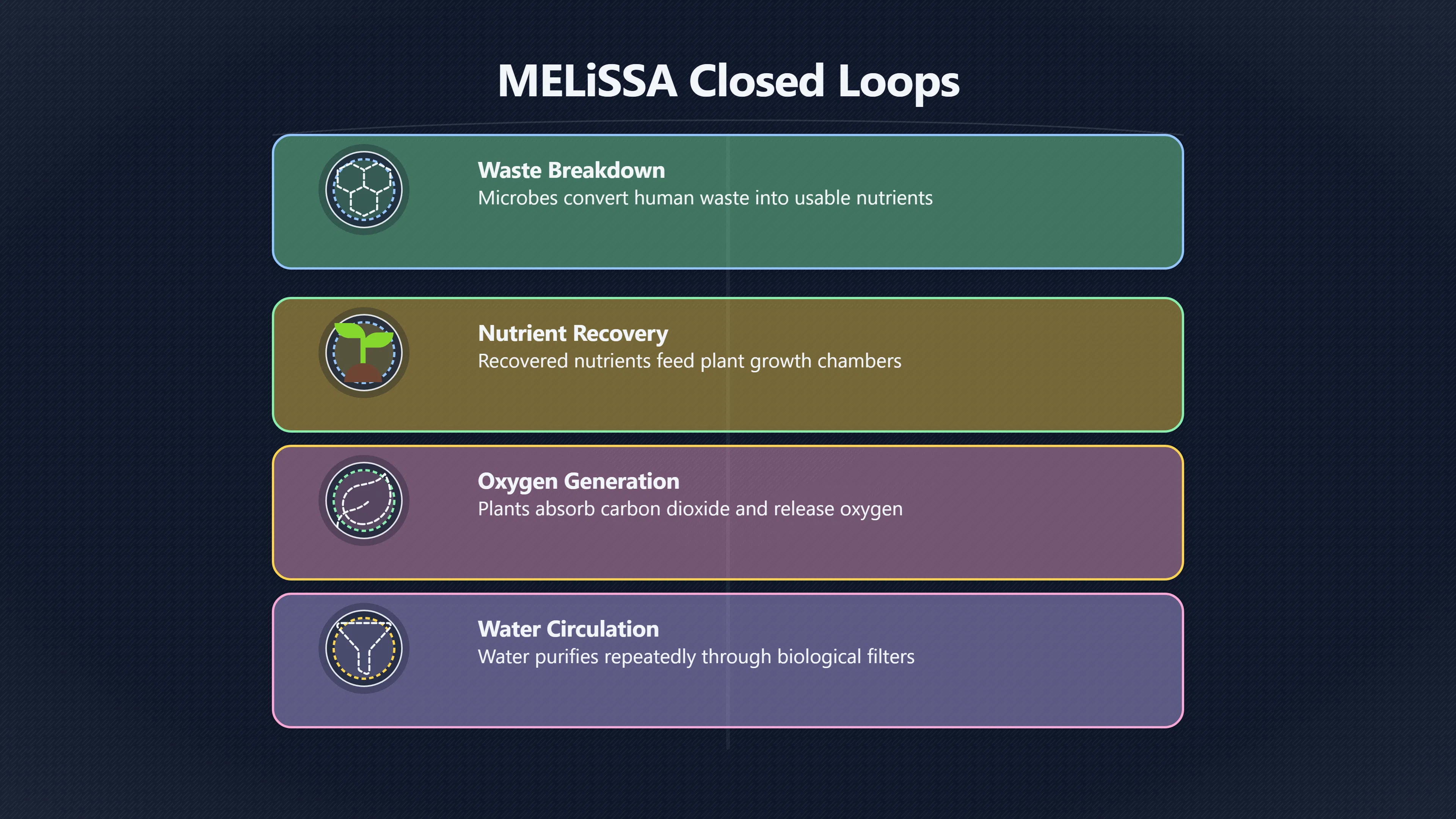
The European Space Agency’s MELiSSA programme is one of the longest-running efforts to study bioregenerative life support. Rather than building a single giant ecosystem, MELiSSA divides the recycling process into specialised biological compartments connected in a loop. Different microbial communities perform different functions, including waste breakdown, nutrient recovery and oxygen generation.[Webs UAB]webs.uab.catMelissa: The European project of a closed life support systemby C Lasseur · Cited by 199 — The MELiSSA (Micro-ecological life-sup… PubMed This architecture reveals an important lesson.[pubmed.ncbi.nlm.nih.gov]pubmed.ncbi.nlm.nih.govMicrobial ecology of the closed artificial ecosystem…by L Hendrickx · 2006 · Cited by 230 — MELiSSA is a bioregenerative life su…
Successful life support may depend less on creating a miniature copy of Earth’s biosphere and more on carefully engineered ecological networks whose behaviour can be monitored and controlled.
MELiSSA researchers have spent decades studying how biological compartments interact and how disturbances propagate through the system. The programme’s pilot plants generate data specifically because understanding long-term dynamics is difficult. Even when each component works individually, the integrated system can behave in unexpected ways. ScienceDirect[Webs UAB]webs.uab.catMelissa: The European project of a closed life support systemby C Lasseur · Cited by 199 — The MELiSSA (Micro-ecological life-sup…
The project also highlights a recurring theme in future habitat design: sensing becomes almost as important as recycling itself.
A biological loop cannot be managed if operators cannot observe its state. Advanced sensors, automated monitoring and predictive control become part of the life-support infrastructure rather than optional add-ons. ESA has already highlighted monitoring technologies developed through MELiSSA that track biological processes in real time.[European Space Agency]esa.intEuropean Space Agency ESAEuropean Space AgencyESA - Life supportA sensor developed by MELiSSA controls the fermentation and monitors biological processes. The sam…
Lessons From BIOS-3 And Other Closed Ecosystem Experiments
Long before today’s AI systems existed, researchers attempted to build closed ecological habitats.
The Soviet BIOS-3 facility in Krasnoyarsk was among the most influential. It used algae and plant cultivation systems to support crews in sealed environments and demonstrated substantial closure of air and water cycles. The experiments showed that biological regeneration could work for extended periods under controlled conditions. OUP Academic[IBP]ibp.ruBIOS-3 – BIOlogical closed life support SystemBIOS-3 consists of a 315 cubic meter habitat suitable for up to three persons, and was init…
But they also revealed how much management was required.
Crop selection, lighting, atmospheric regulation and nutrient balancing demanded continual attention. The systems were not self-maintaining ecosystems that could simply be left alone. Human intervention remained essential.[OUP Academic]academic.oup.comOUP AcademicBios-3: Siberian Experiments in Bioregenerative Life Supportby FB Salisbury · 1997 · Cited by 261 — These developments show t…
Later closed-environment projects repeatedly encountered similar issues:
- Trace gases accumulated unexpectedly.
- Nutrient cycles drifted.
- Biological productivity varied over time.
- Ecological interactions proved difficult to predict. ScienceDirect[Institute of Ecotechnics]ecotechnics.eduInstitute of EcotechnicsClosed Ecological Systems, Space Life Support and…by M Nelson · Cited by 79 — The use of plants to provide air…
The lesson is sobering. Building a closed ecological system is possible. Keeping it stable may be much harder.
For AI advocates, this history strengthens rather than weakens the case for intelligent monitoring. The failures often emerged from complexity rather than from a lack of biological capability. Future systems may generate enough ecological data that algorithmic supervision becomes a practical necessity.

The Risk Of Automation Becoming A Single Point Of Failure
The same technology that could stabilise a habitat could also introduce new vulnerabilities.
If AI becomes deeply integrated into ecosystem management, operators may gradually lose the ability to understand the entire system directly. Decisions could emerge from predictive models too complex for human crews to inspect in detail.
This creates a familiar alignment problem in miniature.
The objective is not simply maximising crop yield or oxygen output. It is preserving human wellbeing while balancing many competing variables simultaneously.
An optimisation system focused too narrowly on one target could unintentionally destabilise another part of the habitat. Ecological systems frequently involve delayed consequences, feedback loops and trade-offs that are difficult to encode in simple objectives. A strategy that appears beneficial in the short term may create long-term instability.[arXiv]arxiv.orgarXiv Stability of Ecological Systems: A Theoretical ReviewStability of Ecological Systems: A Theoretical ReviewDecember 12, 2023…
For this reason, many researchers envision layered control systems rather than fully autonomous ecological management. AI may function as a forecasting, diagnosis and optimisation layer while human operators retain authority over major interventions.
The challenge resembles a broader question raised throughout discussions of advanced AI: how much responsibility should humans delegate when the system being managed becomes too complex for unaided human oversight?
A Small Ecosystem As A Test Of A Larger Future
Bioregenerative life support is often discussed as a niche space technology. In reality it tests a deeper idea.
Can intelligence deliberately manage living systems at a level of complexity that once seemed beyond human control?
A successful closed habitat would require continuous coordination of biology, engineering, computation and human behaviour. It would be an example of civilisation learning to maintain an artificial ecosystem not for days or months but indefinitely.
That does not mean the challenge is solved. Complete closure remains elusive, ecological stability is still difficult to guarantee and decades of research have not eliminated fundamental uncertainties. Researchers continue to identify major capability gaps before large-scale lunar or Martian settlements become realistic.[PMC]pmc.ncbi.nlm.nih.govCritical investments in bioregenerative life support systems for…by DM Porterfield · 2025 · Cited by 8 — It examines the history of…[Epsilon Archive for Student Projects]stud.epsilon.slu.seEpsilon Archive for Student ProjectsClosed Ecological Life Support Systemsby H Persson · 2020 · Cited by 1 — To close the carbon cycle, o…
Yet the long-term significance extends beyond spaceflight. If advanced AI can help keep a tiny ecosystem alive inside a sealed habitat, it would demonstrate a broader capacity: managing complex resource cycles, predicting biological failures and coordinating living systems that are too intricate for constant human supervision. In the most optimistic vision of humanity’s long future, that capability could become one of the foundations that allows civilisation to expand beyond Earth while remaining resilient, sustainable and biologically alive.[ScienceDirect]sciencedirect.comKey ecological challenges for closed systems facilitiesby M Nelson · 2013 · Cited by 38 — The problems of achieving sustaina…[Nature]nature.comCritical investments in bioregenerative life support systems…by D Marshall Porterfield · 2025 · Cited by 9 — It examines the history o…
Amazon book picks
Further Reading
Books and field guides related to Can AI Keep a Tiny Ecosystem Alive?. Use these as the next step if you want deeper reading beyond the article.
A City on Mars
Directly examines the biological and practical challenges of sustaining humans off Earth.
The Future of Humanity
Places closed habitat life support within the wider long-term space settlement vision.
Thinking in Systems
Useful for understanding how fragile biological loops can behave unpredictably.
Packing for Mars
Explores the messy biological realities of keeping people alive in space.
eBay marketplace picks
Marketplace Samples
Example marketplace items related to this page. Use the search link to explore similar finds on eBay.


Endnotes
1.
Source: nature.com
Link:https://www.nature.com/articles/s41526-023-00317-9
Source snippet
Plant and microbial science and technology as...by V De Micco · 2023 · Cited by 72 — The concept of Bioregenerative Life Support S...
2.
Source: webs.uab.cat
Link:https://webs.uab.cat/melissapilotplant/wp-content/uploads/sites/397/2023/11/Melissa_The_European_project_of_a_closed_life_supp-1.pdf
Source snippet
Melissa: The European project of a closed life support systemby C Lasseur · Cited by 199 — The MELiSSA (Micro-ecological life-sup...
3.
Source: science.nasa.gov
Link:https://science.nasa.gov/wp-content/uploads/2023/05/238_6ff87ea936983a40220107cf200cb6b8_ShevtsovJane.pdf?emrc=f743fe
Source snippet
NASA ScienceBioregenerative Life Support SystemsSeveral NASA needs assessments identify closed regenerative life support as an enabling t...
4.
Source: techport.nasa.gov
Link:https://techport.nasa.gov/projects/11493
Source snippet
NASA TechPortImproving Habitability, Mood & Diet through...Dec 18, 2025 — Growing fresh foods will enhance habitability and diet includi...
5.
Source: pmc.ncbi.nlm.nih.gov
Link:https://pmc.ncbi.nlm.nih.gov/articles/PMC12357894/
Source snippet
Critical investments in bioregenerative life support systems for...by DM Porterfield · 2025 · Cited by 8 — It examines the history of...
6.
Source: nature.com
Link:https://www.nature.com/articles/s41526-025-00518-4
Source snippet
Critical investments in bioregenerative life support systems...by D Marshall Porterfield · 2025 · Cited by 9 — It examines the history o...
7.
Source: sciencedirect.com
Link:https://www.sciencedirect.com/science/article/abs/pii/S0273117713001725
Source snippet
Key ecological challenges for closed systems facilitiesby M Nelson · 2013 · Cited by 38 — The problems of achieving sustaina...
8.
Source: ecotechnics.edu
Link:https://ecotechnics.edu/wp-content/uploads/backup/2011/08/Handbook-Envt-Engineering-Closed-system-chapter.pdf
Source snippet
Institute of EcotechnicsClosed Ecological Systems, Space Life Support and...by M Nelson · Cited by 79 — The use of plants to provide air...
9.
Source: arxiv.org
Title: arXiv Stability of Ecological Systems: A Theoretical Review
Link:https://arxiv.org/abs/2312.07737
Source snippet
Stability of Ecological Systems: A Theoretical ReviewDecember 12, 2023...
Published: December 12, 2023
10.
Source: esa.int
Title: European Space Agency ESA
Link:https://www.esa.int/Science_Exploration/Human_and_Robotic_Exploration/Research/Life_support
Source snippet
European Space AgencyESA - Life supportA sensor developed by MELiSSA controls the fermentation and monitors biological processes. The sam...
11.
Source: sciencedirect.com
Link:https://www.sciencedirect.com/science/article/abs/pii/S1369703X1930258X
Source snippet
Continuous controlled long-term operation and modeling of...by L Alemany · 2019 · Cited by 35 — The MELiSSA (MicroEcologica...
12.
Source: melissafoundation.org
Link:https://www.melissafoundation.org/download/971
Source snippet
Literature list about the MELiSSA Project and connected...24 Feb 2023 — Literature list about the MELiSSA Project and connected research...
13.
Source: academic.oup.com
Link:https://academic.oup.com/bioscience/article-pdf/47/9/575/594737/47-9-575.pdf
Source snippet
OUP AcademicBios-3: Siberian Experiments in Bioregenerative Life Supportby FB Salisbury · 1997 · Cited by 261 — These developments show t...
14.
Source: ibp.ru
Link:https://www.ibp.ru/science/bios3.php
Source snippet
BIOS-3 – BIOlogical closed life support SystemBIOS-3 consists of a 315 cubic meter habitat suitable for up to three persons, and was init...
15.
Source: nasa.gov
Link:https://www.nasa.gov/
Source snippet
National Aeronautics and Space Administration. NASA explores the unknown in air and space, innovates for the benefit of humanity, and...
16.
Source: ntrs.nasa.gov
Link:https://ntrs.nasa.gov/citations/20190027510
Source snippet
of Synthetic Biology to Bioregenerative Life...by MJ Dougherty · 2014 — The conversion of carbon dioxide into higher value products is a...
17.
Source: nature.com
Link:https://www.nature.com/articles/npre.2010.3926.2.pdf
Source snippet
The driving element of MELiSSA...
18.
Source: space.com
Title: NAS A just released 12,000 photos from Artemis 2. Here are our top picks
Link:https://www.space.com/space-exploration/artemis/nasa-just-released-12-000-photos-from-artemis-2-here-are-our-top-picks
19.
Source: sciencedirect.com
Link:https://www.sciencedirect.com/science/article/abs/pii/S0273117710003194
Source snippet
Closed bioregenerative life support systemsby YS Polyakov · 2010 · Cited by 24 — This review discusses the key space technology findings...
20.
Source: nationalacademies.org
Link:https://www.nationalacademies.org/read/5826/chapter/4
Source snippet
Advanced Technology for Human Support in Space (1997)Closed-loop life support systems require an initial supply of resources but then pro...
21.
Source: frontiersin.org
Title: Frontiers Stoichiometric model of a fully closed bioregenerative life
Link:https://www.frontiersin.org/journals/astronomy-and-space-sciences/articles/10.3389/fspas.2023.1198689/full
Source snippet
FrontiersStoichiometric model of a fully closed bioregenerative life...August 16, 2023 — by ACJ Vermeulen · 2023 · Cited by 17 — A BLSS...
Published: August 16, 2023
22.
Source: pubmed.ncbi.nlm.nih.gov
Link:https://pubmed.ncbi.nlm.nih.gov/16431089/
Source snippet
Microbial ecology of the closed artificial ecosystem...by L Hendrickx · 2006 · Cited by 230 — MELiSSA is a bioregenerative life su...
23.
Source: stud.epsilon.slu.se
Link:https://stud.epsilon.slu.se/16055/1/persson_h_200904.pdf
Source snippet
Epsilon Archive for Student ProjectsClosed Ecological Life Support Systemsby H Persson · 2020 · Cited by 1 — To close the carbon cycle, o...
24.
Source: Wikipedia
Link:https://en.wikipedia.org/wiki/NASA
Source snippet
NASAThe National Aeronautics and Space Administration (NASA /ˈnæsə/) is an independent agency of the U.S. federal government responsib...
25.
Source: pubmed.ncbi.nlm.nih.gov
Link:https://pubmed.ncbi.nlm.nih.gov/12481804/
Source snippet
cycles in closed ecological systems: effects of...by VY Rygalov · 2002 · Cited by 16 — This water cycle is a consequence of the continuo...
26.
Source: facebook.com
Link:https://www.facebook.com/NASA/
Source snippet
NASA - National Aeronautics and Space AdministrationNASA - National Aeronautics and Space Administration. 28647386 likes · 82073 talking...
Additional References
27.
Source: nss.org
Link:https://nss.org/settlement/nasa/Contest/Results/96/winner/seis.html
Source snippet
Life Support SystemNASA's acronym for these systems is CELSS (Controlled Ecological Life Support System).... plant based bioregenerative...
28.
Source: x.com
Link:https://x.com/NASA?lang=en
Source snippet
NASA (@NASA) / Posts / XAfter reviewing the @Space_Station flight schedule, @NASA and its partners are adjusting launch opportunities for...
29.
Source: researchgate.net
Link:https://www.researchgate.net/publication/232890528_Closed_Ecological_Systems
Source snippet
Closed Ecological Systems | Request PDFBios-3 was an impressive closed life-support system containing two plant-growth compartments, an a...
30.
Source: researchgate.net
Link:https://www.researchgate.net/publication/234150318_Closed_Ecological_Systems
Source snippet
Closed Ecological Systems | Request PDFClosed ecological systems have been explored as model systems to investigate the ecological perfor...
31.
Source: youtube.com
Link:https://www.youtube.com/nasa
32.
Source: semanticscholar.org
Link:https://www.semanticscholar.org/paper/MELiSSA%3A-THE-EUROPEAN-PROJECT-OF-CLOSED-LIFE-SYSTEM-Lasseur-Brunet/5ff0928cba5a9673ddb05cd47eb2412fc58bebb9
Source snippet
MELiSSA: THE EUROPEAN PROJECT OF CLOSED LIFE...An overview of recent achievements of the MELiSSA project is presented, intended to be a...
33.
Source: unimelb.edu.au
Title: a greener future for earth through space exploration research
Link:https://www.unimelb.edu.au/newsroom/news/2025/november/a-greener-future-for-earth-through-space-exploration-research
Source snippet
27 Nov 2025 — Global scientists have developed a new roadmap for using plants to support long-term human life on the [Moon and Mars]({{ 'moon-and-mars/' | relative_url }}), using...
34.
Source: researchgate.net
Link:https://www.researchgate.net/publication/251166953_Closed_Ecological_Systems_Space_Life_Support_and_Biospherics
Source snippet
on closed ecological systems, bioregenerative space life support and biospherics...Read more...
35.
Source: Wikipedia
Title: Bioregenerative life support system
Link:https://en.wikipedia.org/wiki/Bioregenerative_life_support_system
Source snippet
Bioregenerative life support systemBioregenerative life support systems (BLSS) are artificial ecosystems consisting of many complex sy...
36.
Source: youtube.com
Link:https://www.youtube.com/watch?v=F0qv-v8zdPQ
Source snippet
2 Life in Space: Bioregenerative Life Support Systems...
Topic Tree