Within AI Benefits
Who Owns the Wealth AI Creates?
If AI mainly increases returns to capital, societies may need new ways to share gains beyond wages and cheaper services.
On this page
- Why AI can raise returns to capital
- Taxes, dividends, and shared ownership models
- Risks of overreach and weak incentives
Page outline Jump by section
Introduction
In an economy transformed by artificial intelligence (AI), answering “who owns the wealth?” becomes central to whether AI supports broad human flourishing or entrenches inequality. Advanced AI systems are powerful general‑purpose technologies that can dramatically raise productivity and economic output. But if the financial gains from these productivity shocks accrue mainly to capital owners rather than to ordinary workers, the result can be sharp concentration of wealth at the top. This page focuses on how capital ownership structures and returns to capital in an AI‑rich world could concentrate wealth, why that matters for distributional outcomes, and what kinds of policy responses are being proposed to address these risks.[ScienceDirect]sciencedirect.comAnalyzing wealth distribution effects of artificial intelligence: A dynamic stochastic general equilibrium approach - Scienc…
Why AI May Raise Returns to Capital
One of the most consistent findings in economic research on technological change is that automation and productivity‑enhancing technologies tend to shift income toward capital and away from labour, increasing the share of income captured by owners of productive assets rather than by workers. In a recent dynamic general equilibrium study, scholars found that AI adoption can increase the return on capital and raise the capital share of income, exacerbating wealth inequality unless the gains are widely distributed.[ScienceDirect]sciencedirect.comAnalyzing wealth distribution effects of artificial intelligence: A dynamic stochastic general equilibrium approach - Scienc…
A related theoretical analysis by leading economists shows that automation more broadly increases income inequality by raising returns to wealth, meaning those who already own capital see their incomes grow faster than wage earners at the bottom of the distribution. This mechanism does not depend on whether AI creates new jobs; it arises from the basic structure of how automated technologies shift economic returns toward asset owners.[NBER]nber.orgUneven Growth: Automation's Impact on Income and Wealth Inequality | NBERUneven Growth: Automation's Impact on Income and Wealth Inequality | NBER…
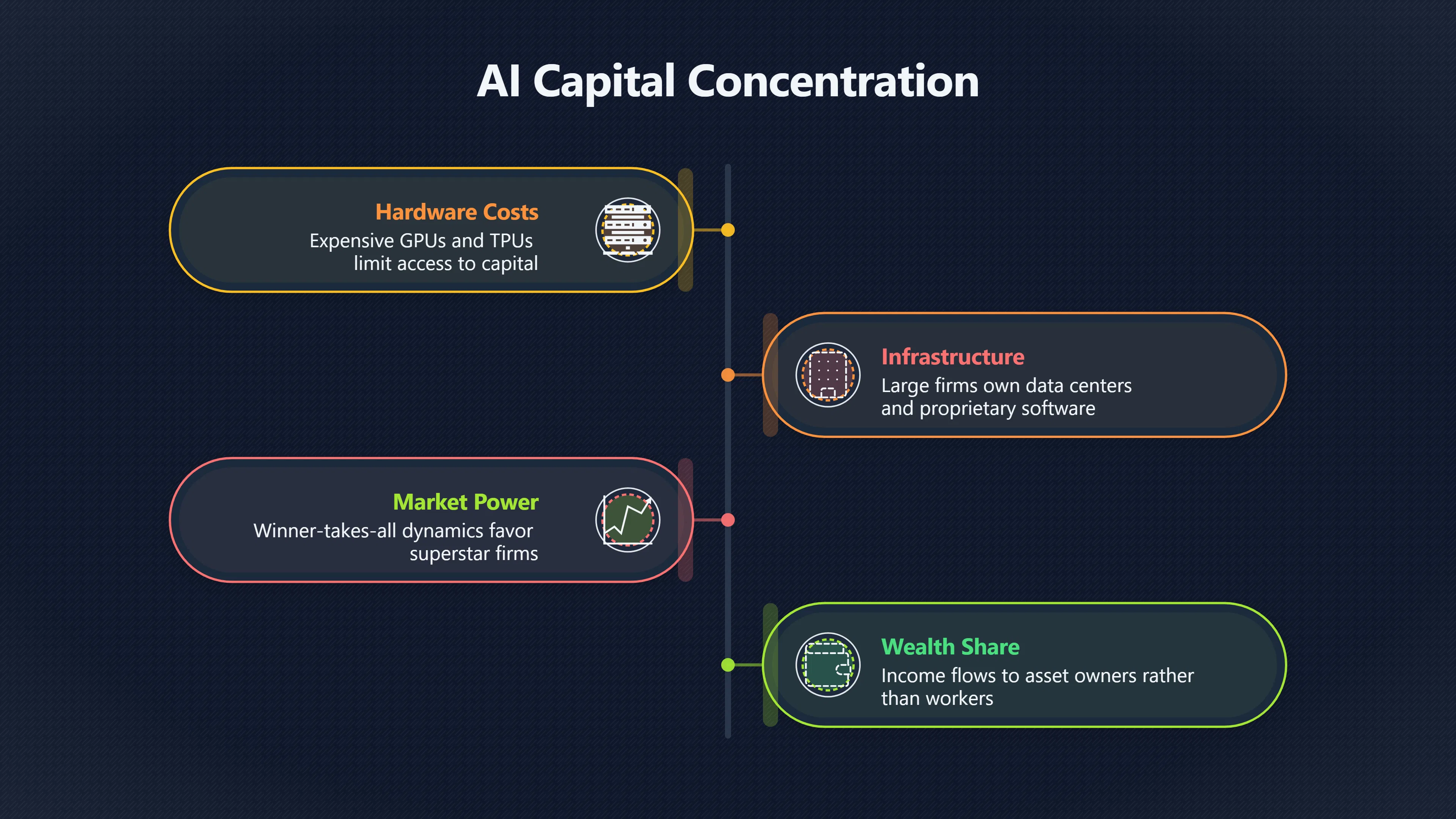
These patterns are especially important with AI because modern systems are intensely capital‑intensive: building and training large models requires expensive hardware (GPUs and TPUs), data centre infrastructure, and proprietary datasets. These inputs are concentrated among a small number of large firms and institutional investors, so the bulk of financial gains tend to accrue to those with access to capital and ownership stakes in these assets.[IMF]imf.orgAI Adoption and InequalityAI Adoption and Inequality…
Concentration of Ownership and Market Power
AI’s economic structure can amplify winner‑takes‑all dynamics. As digital platforms and AI infrastructure become more central to economic activity, a small number of firms can capture disproportionate market share, data, and profits. Academic research into the political economy of “AI capitalism” argues that commodification of data and control of compute capacity tends to concentrate power and profit, reinforcing dominance by a few large technology firms and their investors.[Springer Link]link.springer.comSpringer LinkDismantling AI capitalism: the commons as an alternative to the power concentration of Big Tech | AI & SOCIETY | Springer Na…
From a global perspective, this concentration is visible in how financial markets have rewarded AI firms. CEOs of major asset managers have publicly warned that the benefits of the AI boom are accruing largely to those already owning significant financial assets, with implications for broader wealth inequality. For example, the head of a leading global investment firm highlighted that recent gains in AI‑related stocks have driven market capitalisation increases that disproportionately benefit the wealthiest segments of society, given that these groups hold the majority of equities.[Reuters]reuters.comWhile AI is expected to generate significant economic value, Fink emphasized that much of it currently benefits large tech companies and…
Mechanisms Driving Wealth Concentration
1. Capital‑Intensive Production:
AI development hinges on specialised infrastructure—data centres, dedicated hardware, and proprietary software. These assets require large upfront investments that most individuals and small firms cannot afford, so the economic value generated tends to flow to large capital holders and institutional investors.[ScienceDirect]sciencedirect.comAnalyzing wealth distribution effects of artificial intelligence: A dynamic stochastic general equilibrium approach - Scienc…
2. Returns to Scale and Network Effects:
AI platforms often exhibit increasing returns to scale and strong network effects: the more data and users a platform has, the more valuable it becomes. This promotes superstar firm dynamics where a few firms dominate key markets, increasing profits and the value of capital ownership in those firms.[Springer Link]link.springer.comSpringer LinkDismantling AI capitalism: the commons as an alternative to the power concentration of Big Tech | AI & SOCIETY | Springer Na…
3. Shifts in Income Shares:
Studies show that technological change, especially AI, can alter the distribution of income between labour and capital by increasing the capital share (income going to asset owners) relative to labour share (income going to workers). When capital share rises, wealth concentrates among those who already own assets.[ScienceDirect]sciencedirect.comAnalyzing wealth distribution effects of artificial intelligence: A dynamic stochastic general equilibrium approach - Scienc…
4. Labour Displacement with Uneven Gains:
Even if AI displaces some high‑income labour, the same high‑skill workers often benefit from capital ownership (for example, through equity stakes or higher returns on investments) and thus can also capture a disproportionate share of the financial upside.[IMF eLibrary]elibrary.imf.orgarticle A001 en.xmlIMF eLibraryAI Adoption and Inequality in: IMF Working Papers Volume 2025 Issue 068 (2025)April 4, 2025…
These mechanisms jointly mean that, without deliberate intervention, AI’s wealth generation can intensify existing patterns of economic inequality.
Risks of Weak Incentives and Overreach
Concentrated capital ownership can have broader implications beyond inequality. If economic gains are tightly held by a small set of investors and firms, demand dynamics in the wider economy may weaken as labour incomes stagnate relative to capital incomes. This can undermine broad‑based consumption and social cohesion, even amidst overall economic growth.
Moreover, concentrated ownership may reduce incentives for investments that benefit the wider population—such as training programmes, public goods, or inclusive technologies—because returns to capital owners often favour ventures with high profit potential over those with social value but lower financial returns.

Policy and Institutional Responses
To mitigate wealth concentration risks, scholars and policymakers are considering a range of approaches that reshape capital ownership and participation:
- Broadening access to capital markets: Expanding ownership opportunities—for example, through employee equity programmes, community investment vehicles, or policies that encourage broader share ownership—can help more people participate in AI’s financial gains.
- Redistribution and progressive taxation: Tools such as wealth taxes, capital gains taxes, and redistribution mechanisms can aim to reduce inequality by transferring part of capital income into shared public goods or citizen dividends.
- Shared ownership or public equity models: Some proposals envisage mechanisms where AI infrastructure or digital public goods are collectively owned, with value distributed across society rather than accruing solely to private investors.
- Inclusive financial instruments: Ideas like the “consumption‑to‑ownership” mechanism automatically convert a portion of consumer spending on AI‑enabled services into diversified investments on consumers’ behalf, potentially widening ownership of capital returns.[SSRN]papers.ssrn.comConsumption to Ownership How Consumer Spending Can Build Capital When Labor Cannot by Brian Bruner:: SSRNApril 6, 2026…
These approaches underscore that capital ownership does not have to be static or narrowly concentrated; institutions and policies can play a central role in shaping how AI‑generated wealth circulates in the economy.
The Stakes for Human Flourishing
From the broader “AI bloom” perspective, how AI wealth is owned and distributed has direct implications for whether its benefits contribute to widespread human flourishing. If advanced AI primarily enriches capital owners while leaving others behind, the promise of abundance could coexist with deep inequality.
Yet, if societies rethink ownership structures and create inclusive pathways for people to share in AI’s gains—through equitable capital markets, inclusive public investment, and redistributive frameworks—then the economic transformations associated with AI can be more broadly aligned with prosperity and opportunity for all.[IMF]elibrary.imf.orgarticle A001 en.xmlIMF eLibraryAI Adoption and Inequality in: IMF Working Papers Volume 2025 Issue 068 (2025)April 4, 2025…
Understanding these dynamics is crucial not only for diagnosing the distributional impacts of AI but also for designing policies that help steer AI’s benefits toward a flourishing, inclusive future.
Amazon book picks
Further Reading
Books and field guides related to Who Owns the Wealth AI Creates?. Use these as the next step if you want deeper reading beyond the article.
Capital in the Twenty-First Century
Explains wealth concentration and returns to capital.
The Second Machine Age
Connects digital productivity with inequality and labour-market disruption.
The Entrepreneurial State
Supports questions about public value creation and shared returns.
eBay marketplace picks
Marketplace Samples
Example marketplace items related to this page. Use the search link to explore similar finds on eBay.




Endnotes
1.
Source: sciencedirect.com
Link:https://www.sciencedirect.com/science/article/pii/S2405844025003238
Source snippet
Analyzing wealth distribution effects of artificial intelligence: A dynamic stochastic general equilibrium approach - Scienc...
2.
Source: imf.org
Title: AI Adoption and Inequality
Link:https://www.imf.org/en/publications/wp/issues/2025/04/04/ai-adoption-and-inequality-565729
Source snippet
AI Adoption and Inequality...
3.
Source: nber.org
Title: Uneven Growth: Automation’s Impact on Income and Wealth Inequality | NBER
Link:https://www.nber.org/papers/w28440
Source snippet
Uneven Growth: Automation's Impact on Income and Wealth Inequality | NBER...
4.
Source: link.springer.com
Link:https://link.springer.com/article/10.1007/s00146-022-01437-8
Source snippet
Springer LinkDismantling AI capitalism: the commons as an alternative to the power concentration of Big Tech | AI & SOCIETY | Springer Na...
5.
Source: reuters.com
Link:https://www.reuters.com/business/blackrock-ceo-fink-backs-staying-invested-amid-volatility-flags-ai-shift-2026-03-23/
Source snippet
While AI is expected to generate significant economic value, Fink emphasized that much of it currently benefits large tech companies and...
6.
Source: elibrary.imf.org
Title: article A001 en.xml
Link:https://www.elibrary.imf.org/view/journals/001/2025/068/article-A001-en.xml
Source snippet
IMF eLibraryAI Adoption and Inequality in: IMF Working Papers Volume 2025 Issue 068 (2025)April 4, 2025...
Published: April 4, 2025
7.
Source: papers.ssrn.com
Link:https://papers.ssrn.com/sol3/papers.cfm?abstract_id=6539158
Source snippet
Consumption to Ownership How Consumer Spending Can Build Capital When Labor Cannot by Brian Bruner:: SSRNApril 6, 2026...
Published: April 6, 2026
8.
Source: papers.ssrn.com
Link:https://papers.ssrn.com/sol3/papers.cfm?abstract_id=5211272
Source snippet
2025/068 64 Pages Posted: 10 Apr 2025 See all articles by Emma Rockall EMMA ROCKALL Stanford University; Stanford University - Department...
9.
Source: papers.ssrn.com
Link:https://papers.ssrn.com/sol3/papers.cfm?abstract_id=3781327
Source snippet
Growth: Automation's Impact on Income and Wealth Inequality by Benjamin Moll, Lukasz Rachel, Pascual Restrepo:: SSRNFebruary 8, 2021 — D...
Published: February 8, 2021
10.
Source: sciencedirect.com
Link:https://www.sciencedirect.com/science/article/abs/pii/S0954349X18300432
Source snippet
December 1, 2018 — STRUCTURAL CHANGE AND ECONOMIC DYNAMICS Volume 47, December 2018, Pages 1-8 DEMAND DRIVEN GROWTH AND CAPI...
Published: December 1, 2018
11.
Source: nber.org
Link:https://www.nber.org/papers/w29544
Source snippet
king Paper 29544 DOI 10.3386/w29544 Issue Date December 2021 The distributions of wealth in the US and many...
Published: December 2021
12.
Source: sciencedirect.com
Link:https://www.sciencedirect.com/science/article/pii/S0160791X24002677
Source snippet
"ScienceDirectARTIFICIAL INTELLIGENCE AND WEALTH INEQUALITY: A COMPREHENSIVE EMPIRICAL EXPLORATION OF SOCIOECONOMIC IMPLICATIONS [https://d..."](https://d...")...
Additional References
13.
Source: econometricsociety.org
Link:https://www.econometricsociety.org/publications/econometrica/2022/11/01/Uneven-Growth-Automations-Impact-on-Income-and-Wealth-Inequality
Source snippet
November 1, 2022 — Edited by: Marina Halac • Print ISSN: 0012-9682 • Online ISSN: 1468-0262 Econometrica: Nov, 2022, Volume 90, Issue 6 U...
Published: November 1, 2022
14.
Source: businessthink.unsw.edu.au
Title: unsw.edu.au Will AI make a few people much richer, but most people poorer?
Link:https://www.businessthink.unsw.edu.au/articles/ai-financialisation-technological-concentration-inequality
Source snippet
UNSW BusinessThinkSeptember 28, 2025 — WILL AI MAKE A FEW PEOPLE MUCH RICHER, BUT MOST PEOPLE POORER? Opinion | 28 September 2025 Predict...
Published: September 28, 2025
15.
Source: compens.ai
Title: ai economic systems wealth justice democratic economics algorithms 2025
Link:https://compens.ai/articles/ai-economic-systems-wealth-justice-democratic-economics-algorithms-2025
Source snippet
AI, Economic Systems, and Wealth Justice: Building Democratic Economics in the Age of Algorithms | Compens AIAugust 28, 2025 — AI Ethics...
Published: August 28, 2025
16.
Source: collaborate.princeton.edu
Title: uneven growth automations impact on income and wealth inequality
Link:https://collaborate.princeton.edu/en/publications/uneven-growth-automations-impact-on-income-and-wealth-inequality
Source snippet
Growth: Automation's Impact on Income and Wealth Inequality - Princeton UniversityUNEVEN GROWTH: AUTOMATION'S IMPACT ON INCOME AND WEALTH...
18.
Source: ainvest.com
Title: A I’s Capital Flow: How Profits Concentrate at the Top
Link:https://www.ainvest.com/news/ai-capital-flow-profits-concentrate-top-2603/
Source snippet
AI's Capital Flow: How Profits Concentrate at the TopMarch 6, 2026 — AI'S CAPITAL FLOW: HOW PROFITS CONCENTRATE AT THE TOP Generated by A...
Published: March 6, 2026
19.
Source: econpapers.repec.org
Title: v 3a39 3ay 3a2025 3ai 3a2 3 3ap 3a197 215
Link:https://econpapers.repec.org/article/tafirapec/v_3a39_3ay_3a2025_3ai_3a2-3_3ap_3a197-215.htm
Source snippet
repec.orgEconPapers: Automation, artificial intelligence and capital concentration – A race for the machineMay 2, 2025 — AUTOMATION, ARTI...
Published: May 2, 2025
20.
Source: pubmed.ncbi.nlm.nih.gov
Link:https://pubmed.ncbi.nlm.nih.gov/39897810/
Source snippet
2025 Jan 13;11(2):e41943. doi: 10.1016/j.heliyon.2025.e41943. eCollection 2025 Jan 30. ANALYZING WEALTH DISTRIBUTION EFFECTS O...
21.
Source: journals.sagepub.com
Link:https://journals.sagepub.com/doi/10.1177/03098168261448192
Source snippet
techno-feudalism: A monopoly-capital analysis of artificial intelligence investment - Elliot Goodell Ugalde, 2026May 12, 2026 — First pub...
Published: May 12, 2026
22.
Source: youtube.com
Title: Who Owns AI Will Decide Who Gets Rich
Link:https://www.youtube.com/watch?v=oful9hVGNIc
Source snippet
AI Wealth: Why Most People Will Get Left Behind...
Topic Tree