Within Nuclear Power
Why Small Modular Reactors Aren't Yet Ready for AI
Development timelines, regulatory hurdles, and grid integration limit immediate deployment of SMRs for continuous AI electricity needs.
On this page
- Technical readiness and commercial timelines
- Regulatory and public acceptance barriers
- Grid integration challenges with AI load profiles
Page outline Jump by section
Introduction
Small modular reactors (SMRs) are often presented as a neat answer to one of the biggest questions in the AI boom: where will the enormous amounts of clean, reliable electricity come from? In theory, advanced nuclear reactors could provide round-the-clock power for data centres without the carbon emissions of gas plants and without the intermittency challenges of wind and solar. That promise helps explain why companies such as Google, Microsoft, Amazon and Meta have explored nuclear partnerships as AI electricity demand rises.[blog.google]blog.googlegoogle kairos power nuclear energy agreementNew nuclear clean energy agreement with Kairos PowerOct 14, 2024 — The initial phase of work is intended to bring Kairos Power's first SM…
 The problem is that most advanced SMRs are still years away from large-scale commercial deployment. Many designs remain in demonstration phases, licensing systems are still adapting to new reactor technologies, supply chains are immature, and the economics remain uncertain. Even where technology firms are signing nuclear agreements, many of the projects expected to support AI workloads are targeting the early 2030s or later rather than solving today’s power shortages.[blog.google]blog.googlegoogle kairos power nuclear energy agreementNew nuclear clean energy agreement with Kairos PowerOct 14, 2024 — The initial phase of work is intended to bring Kairos Power's first SM… TechCrunch For advocates of an AI-enabled future of abundance[techcrunch.com]techcrunch.comTim De Chant. 3Google signed a deal to power data centers with nuclear…Oct 14, 2024 — Google signed a deal to power data centers with nucle…, this matters because energy is one of the key physical constraints on expanding computation, scientific research, robotics and industrial automation. If advanced reactors arrive slowly, the path from AI progress to broader human flourishing may depend more heavily on existing nuclear plants, grid expansion, renewables, storage, geothermal energy and other power sources in the near term.
Technical Readiness Is Further Behind Than the Hype Suggests
One reason SMRs attract attention is that they promise to avoid some of the problems that have plagued traditional nuclear projects. Instead of constructing huge bespoke reactors on site, developers hope to manufacture smaller units in factories and assemble them more efficiently.
Yet many of the reactors discussed in AI power plans do not exist as commercial products today.
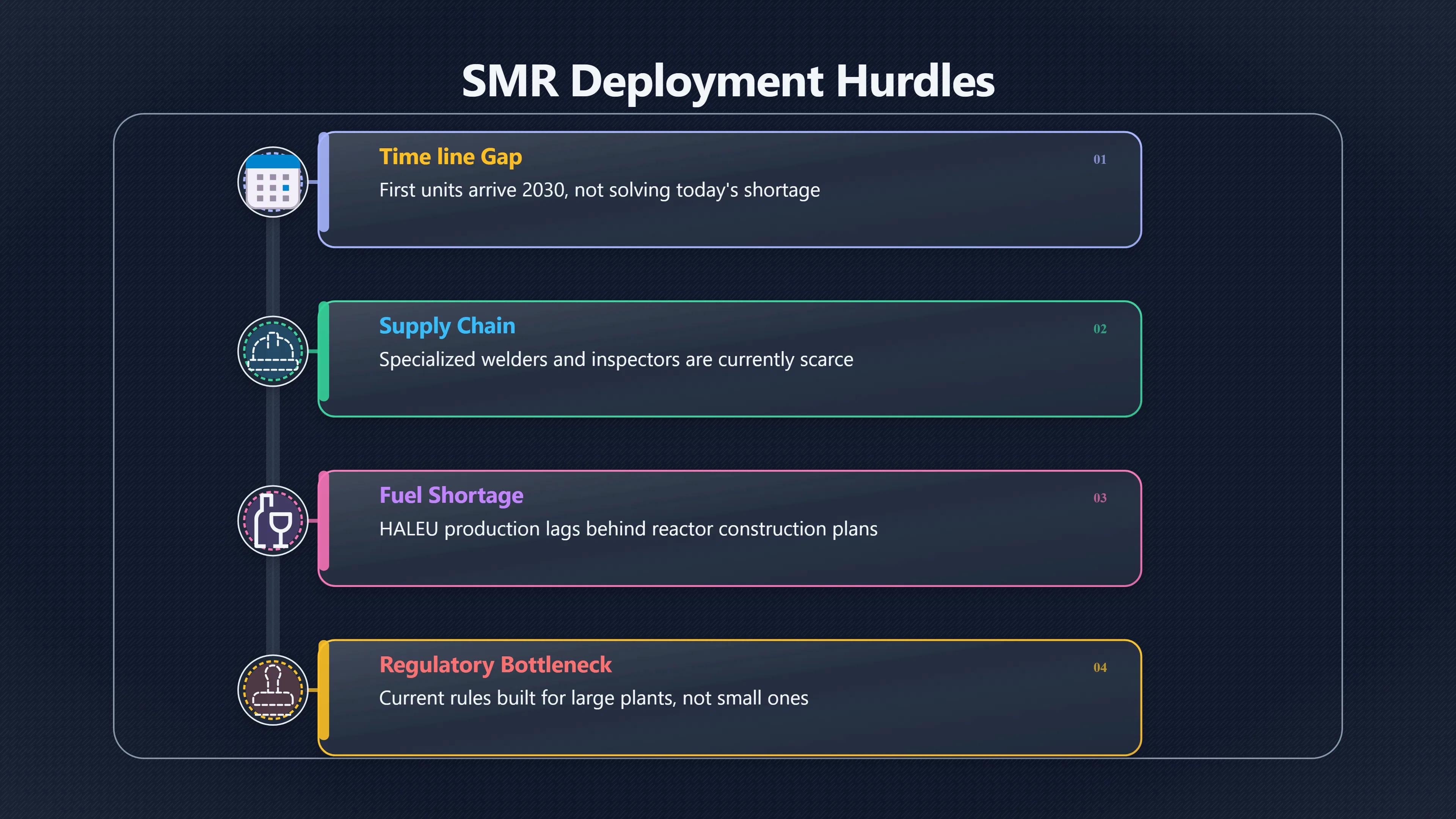
Google’s partnership with Kairos Power illustrates both the promise and the challenge. The companies announced plans to bring the first reactor online around 2030 and expand deployments through 2035. Even supporters describe this as an ambitious timeline because the reactors still need to move through demonstration, licensing, construction and commercial operation stages.[blog.google]blog.googlegoogle kairos power nuclear energy agreementNew nuclear clean energy agreement with Kairos PowerOct 14, 2024 — The initial phase of work is intended to bring Kairos Power's first SM… NucNet The gap between announcement and deployment is important because AI infrastructure is growing much faster than nuclear construction. Hypersca[nucnet.org]nucnet.orggoogle to commit funding for three advanced nuclear power projectsGoogle To Commit Funding For Three Advanced Nuclear…8 May 2025 — The deal at that time said the first Kairos project would come online… le data centres can be planned and built in a few years. Advanced reactors often require a decade or more from concept to operation, especially for first-of-a-kind designs. That creates a mismatch between the speed of AI demand growth and the speed of nuclear deployment.[U.S. Energy Information Administration]eia.govU.S. Energy Information AdministrationToday in Energy8 days ago — High capital costs and lengthy licensing and approval processes have li… TechCrunch Several technical issues contribute to the delay:[techcrunch.com]techcrunch.comTim De Chant. 3Google signed a deal to power data centers with nuclear…Oct 14, 2024 — Google signed a deal to power data centers with nucle…
- Many advanced reactor designs still need extensive testing under real operating conditions.
- Manufacturers have not yet demonstrated mass production of reactor modules at the scale envisioned by advocates.
- Nuclear-grade supply chains remain limited after decades of relatively low reactor construction activity.
- A shortage of specialised engineers, welders, inspectors and nuclear construction workers could constrain deployment even if demand rises sharply.[irecruit.co]irecruit.coSMR Data Centers Tracker: Nuclear-Powered Projects 20267 days ago — The delays in deploying SMR-powered data centers largely arise from t…[2perkinscoie.com]perkinscoie.comnuclear industry kicks 2026 major public and private sector announcements 0Nuclear Industry Kicks Off 2026 With Major Public and…Jan 27, 2026 — Project developers and hyperscalers face ongoing risks related to…
These constraints do not mean SMRs will fail. They mean that projections assuming rapid deployment across dozens of AI campuses should be treated as scenarios rather than established outcomes.
Regulation Remains a Major Bottleneck
Advanced reactors face a challenge common to many technologies connected to the long-term AI future: society wants innovation, but it also wants safety.
Nuclear power operates under some of the world’s strictest regulatory frameworks. That caution exists for obvious reasons. Reactor accidents are rare, but the consequences can be severe, and public trust can be difficult to rebuild once lost.
Many current regulations were designed around large conventional reactors rather than novel designs using different coolants, fuels and operating principles. As a result, regulators have had to develop new frameworks while preserving safety standards.[Reuters]reuters.comTime to go nuclear?Inside the battle to power AIAs AI technology rapidly expands, the demand for data centers—and consequently, electricity—is soaring. Fore…
The US Nuclear Regulatory Commission has recently introduced reforms intended to accelerate advanced reactor licensing. These include new pathways for advanced reactors and microreactors, as well as efforts to shorten review times. Even so, the need for regulatory reform itself highlights how much work remains before advanced nuclear becomes routine infrastructure.[Reuters]reuters.comNRC rolls out reforms to accelerate small reactor licensingNuclear Regulatory Commission (NRC) is expediting three major regulatory reforms to fast-track small modular and microreactor licensing…
For AI companies, the challenge is not merely obtaining reactor approval. Projects may also require:
- Environmental reviews.
- Local land-use permissions.
- Transmission approvals.
- Fuel handling authorisations.
- Security and emergency planning requirements.
- Community consultation and political approval.[perkinscoie.com]perkinscoie.comnuclear industry kicks 2026 major public and private sector announcements 0Nuclear Industry Kicks Off 2026 With Major Public and…Jan 27, 2026 — Project developers and hyperscalers face ongoing risks related to…
Each stage can introduce delays. A technology company may be accustomed to scaling software globally in months. Nuclear infrastructure operates on very different timescales.
Public Acceptance Could Still Slow Expansion
One assumption behind some AI-and-nuclear forecasts is that once reactors become technically viable, deployment will expand rapidly. History suggests the social and political picture may be more complicated.
Public attitudes toward nuclear energy have become more favourable in some countries because of concerns about climate change and energy security. Yet opposition has not disappeared. Questions about accident risk, waste disposal, security threats and long-term environmental impacts remain politically powerful.[Reuters]reuters.comDepartment of Defense (DOD) is accelerating development of nuclear microreactors—compact reactors with capacities of 1–20 MW—through init…
This matters because many proposed AI facilities are located near population centres, industrial corridors or rapidly growing regions where land, water and transmission infrastructure are already contested resources.
A company seeking to build a massive AI campus linked to an advanced reactor may therefore face several overlapping debates at once:
- Should the reactor be built at all?
- Should the data centre be built there?
- Who receives the economic benefits?
- Who bears the environmental and infrastructure costs?
- How should water use and cooling requirements be managed?
The result is that deployment challenges are not purely engineering problems. They are also governance and public legitimacy problems.
Fuel Supply Is an Overlooked Constraint
Many advanced reactor concepts depend on specialised fuels that are not yet available at large commercial scale.
A particularly important issue is High-Assay Low-Enriched Uranium (HALEU), a fuel required by numerous next-generation reactor designs. Supply remains limited, and geopolitical concerns have intensified scrutiny of nuclear fuel chains.[Reuters]reuters.comTime to go nuclear?Inside the battle to power AIAs AI technology rapidly expands, the demand for data centers—and consequently, electricity—is soaring. Fore…
For AI firms seeking confidence that reactors will operate for decades, fuel availability matters almost as much as reactor construction. A reactor design may look attractive on paper yet struggle commercially if fuel production lags behind deployment plans.
This challenge highlights a broader lesson often missed in discussions of AI abundance. Physical infrastructure depends on entire industrial ecosystems, not just breakthrough inventions. Building reactors requires fuel processing, manufacturing capacity, transport systems, regulatory oversight and skilled labour operating together.
AI Loads Create Their Own Grid Challenges
A common narrative presents SMRs as if they could simply be attached to data centres and solve energy problems. Real power systems are more complicated.
Large AI facilities can create unusual electricity demand patterns. Training runs, cooling systems and clustered computing loads can generate substantial fluctuations in consumption. Researchers studying AI-focused power systems have noted that these demand characteristics can affect grid stability and create integration challenges.[arXiv]arxiv.orgSource details in endnotes.
Even if an advanced reactor supplies constant power, operators still need systems that can respond quickly to changing conditions.
This is why many proposed architectures combine multiple technologies rather than relying on nuclear alone:
- Grid connections for redundancy.
- Large battery installations.
- Backup generators.
- Advanced cooling systems.
- Load management software.
- Energy storage integrated with reactor output.[arXiv]arxiv.orgSource details in endnotes.
In practice, the future AI energy system may look less like a single dedicated reactor powering a data centre and more like a complex network in which nuclear is one component among many.
Constant Nuclear Output Versus Variable AI Demand
Another subtle issue is that reactors are generally most economical when operating continuously at high output.
AI workloads do not always align perfectly with that model. Some facilities experience changing utilisation rates, rapid expansions in capacity, or shifting geographic demand. A reactor built for one generation of computing demand may not match the needs of the next.
That does not make nuclear unsuitable. It simply means the integration challenge is harder than matching a single power plant with a single customer.
The more ambitious visions of AI-enabled scientific acceleration and industrial abundance could ultimately require highly flexible energy systems that combine firm nuclear generation with storage, transmission networks and other clean sources rather than relying on one technology alone.[arXiv]arxiv.orgSource details in endnotes.
The Economics Remain Uncertain
The economic case for SMRs is one of the most contested parts of the debate.
Supporters argue that factory manufacturing, standardisation and serial production will eventually reduce costs. Critics note that many projected savings remain hypothetical because large-scale manufacturing has not yet been demonstrated commercially.[IEA]iea.orgOpen… Small modular reactor global installed capacity by scenario and case, 2025-2050.Read more…
Advanced reactors also face a classic infrastructure problem: first projects are usually the most expensive.
For AI companies, that creates a difficult calculation. Should they wait for advanced reactors to mature, invest directly in development, or pursue alternative energy strategies available today?
Current responses vary:
- Some firms are supporting advanced nuclear development despite long timelines.
- Others are signing agreements with existing nuclear plants.
- Many continue to invest heavily in renewables, storage and grid upgrades.
- Geothermal energy and other forms of firm clean power are also attracting interest as complementary options.[blog.google]blog.googlegoogle kairos power nuclear energy agreementNew nuclear clean energy agreement with Kairos PowerOct 14, 2024 — The initial phase of work is intended to bring Kairos Power's first SM… Reuters The result is that SMRs are increasingly viewed as part of a broader energy portfolio rather than a single decisive solution.[reuters.com]reuters.comTime to go nuclear?Inside the battle to power AIAs AI technology rapidly expands, the demand for data centers—and consequently, electricity—is soaring. Fore…

What This Means for the AI Bloom Vision
The idea of AI bloom depends partly on overcoming physical bottlenecks. If advanced AI accelerates science, medicine, manufacturing and knowledge creation, civilisation will need vast amounts of reliable energy to support that growth.
Advanced SMRs fit naturally into that vision because they promise scalable, low-carbon electricity without many of the land-use constraints associated with some other energy sources. In the most optimistic scenario, successful reactor deployment could help power future laboratories, automated factories, desalination systems, climate-repair technologies and large-scale AI infrastructure.[ScienceDirect]sciencedirect.comThe potential role of small modular reactors (SMRs) in…by S Cha · 2025 · Cited by 20 — This study investigates the necess…
The challenge is timing.
Most evidence suggests advanced SMRs are more likely to be part of the medium- and long-term energy picture than an immediate answer to today’s AI power crunch. Licensing reforms, demonstration projects and corporate partnerships show genuine momentum, but commercial deployment at the scale required for a civilisation-wide expansion of AI remains uncertain and unfinished.[U.S. Energy Information Administration]eia.govU.S. Energy Information AdministrationToday in Energy8 days ago — High capital costs and lengthy licensing and approval processes have li… 3Reuters 3blog.google(#endnote-1 “Snippet: New nuclear clean energy[blog.google]blog.googlegoogle kairos power nuclear energy agreementNew nuclear clean energy agreement with Kairos PowerOct 14, 2024 — The initial phase of work is intended to bring Kairos Power's first SM… agreement with Kairos PowerOct 14, 2024 — The initial phase of work is intended to bring Kairos Power’s first SM…”)
That does not weaken the broader case that abundant clean energy could help support a flourishing long-term future. It does suggest that the path there is likely to be slower, more politically contested and more infrastructure-intensive than some early narratives implied. The future of AI power may depend not on a single breakthrough reactor design, but on whether societies can build the regulatory systems, industrial capacity, grid networks and public trust needed to turn nuclear promises into operating power plants.
Amazon book picks
Further Reading
Books and field guides related to Why Small Modular Reactors Aren't Yet Ready for AI. Use these as the next step if you want deeper reading beyond the article.
Nuclear Energy
Explains nuclear economics, regulation and deployment barriers relevant to SMRs.
A Bright Future
Shows why nuclear is attractive while still requiring practical deployment timelines.
How to Avoid a Climate Disaster
Places advanced nuclear among the broader set of clean-energy innovation challenges.
The Grid
Shows why new generation technologies still need grid integration and delivery infrastructure.
eBay marketplace picks
Marketplace Samples
Example marketplace items related to this page. Use the search link to explore similar finds on eBay.
Endnotes
1.
Source: blog.google
Title: google kairos power nuclear energy agreement
Link:https://blog.google/company-news/outreach-and-initiatives/sustainability/google-kairos-power-nuclear-energy-agreement/
Source snippet
New nuclear clean energy agreement with Kairos PowerOct 14, 2024 — The initial phase of work is intended to bring Kairos Power's first SM...
2.
Source: reuters.com
Title: Time to go nuclear?
Link:https://www.reuters.com/sustainability/climate-energy/time-go-nuclear-inside-battle-power-ai–ecmii-2025-12-17/
Source snippet
Inside the battle to power AIAs AI technology rapidly expands, the demand for data centers—and consequently, electricity—is soaring. Fore...
3.
Source: techcrunch.com
Title: Tim De Chant. 3
Link:https://techcrunch.com/2024/10/14/google-signed-a-deal-to-power-data-centers-with-nuclear-micro-reactors-from-kairos-but-the-2030-timeline-is-very-optimistic/
Source snippet
Google signed a deal to power data centers with nuclear...Oct 14, 2024 — Google signed a deal to power data centers with nucle...
4.
Source: nucnet.org
Title: google to commit funding for three advanced nuclear power projects 5 4 2025
Link:https://www.nucnet.org/news/google-to-commit-funding-for-three-advanced-nuclear-power-projects
Source snippet
Google To Commit Funding For Three Advanced Nuclear...8 May 2025 — The deal at that time said the first Kairos project would come online...
Published: May 2025
5.
Source: irecruit.co
Link:https://www.irecruit.co/insights/smr-nuclear-powered-data-center-developments
Source snippet
SMR Data Centers Tracker: Nuclear-Powered Projects 20267 days ago — The delays in deploying SMR-powered data centers largely arise from t...
6.
Source: perkinscoie.com
Title: nuclear industry kicks 2026 major public and private sector announcements 0
Link:https://perkinscoie.com/insights/update/nuclear-industry-kicks-2026-major-public-and-private-sector-announcements-0
Source snippet
Nuclear Industry Kicks Off 2026 With Major Public and...Jan 27, 2026 — Project developers and hyperscalers face ongoing risks related to...
7.
Source: reuters.com
Title: NRC rolls out reforms to accelerate small reactor licensing
Link:https://www.reuters.com/business/energy/nrc-rolls-out-reforms-accelerate-small-reactor-licensing–reeii-2026-05-26/
Source snippet
Nuclear Regulatory Commission (NRC) is expediting three major regulatory reforms to fast-track small modular and microreactor licensing...
8.
Source: arxiv.org
Link:https://arxiv.org/abs/2504.02599
9.
Source: reuters.com
Link:https://www.reuters.com/business/energy/pentagon-spurs-us-microreactor-race-commercial-hurdles-remain–reeii-2026-05-27/
Source snippet
Department of Defense (DOD) is accelerating development of nuclear microreactors—compact reactors with capacities of 1–20 MW—through init...
10.
Source: arxiv.org
Link:https://arxiv.org/abs/2603.00415
Source snippet
Grid Integration of AI Data Centers: A Critical Review of Energy Storage SolutionsFebruary 28, 2026...
Published: February 28, 2026
11.
Source: arxiv.org
Link:https://arxiv.org/abs/2603.09110
12.
Source: iea.org
Link:https://www.iea.org/reports/the-path-to-a-new-era-for-nuclear-energy/executive-summary
Source snippet
Open... Small modular reactor global installed capacity by scenario and case, 2025-2050.Read more...
13.
Source: sciencedirect.com
Link:https://www.sciencedirect.com/science/article/pii/S1738573324005643
Source snippet
The potential role of small modular reactors (SMRs) in...by S Cha · 2025 · Cited by 20 — This study investigates the necess...
14.
Source: medium.com
Link:https://medium.com/write-your-world/the-great-ai-power-problem-2710cad6523d
Source snippet
The Great AI Power ProblemThe Great AI Power Problem How Small Modular Reactors Will Become the Only Scalable Answer to Data Center Energ...
15.
Source: energy.gov
Title: advantages and challenges nuclear powered data centers
Link:https://www.energy.gov/ne/articles/advantages-and-challenges-nuclear-powered-data-centers
Source snippet
New reactors will take time to build. · 2. First-of-a-kind reactor deployments are expensive. · 3. Metering issues could be a hurdle. · 4...
16.
Source: eia.gov
Link:https://www.eia.gov/todayinenergy/detail.php?id=67584
Source snippet
U.S. Energy Information AdministrationToday in Energy8 days ago — High capital costs and lengthy licensing and approval processes have li...
17.
Source: Wikipedia
Title: Nuclear Regulatory Commission
Link:https://en.wikipedia.org/wiki/Nuclear_Regulatory_Commission
Source snippet
Nuclear Regulatory CommissionIts functions include overseeing reactor safety and security, administering reactor licensing and renewal...
18.
Source: gisreportsonline.com
Link:https://www.gisreportsonline.com/r/smrs/
Source snippet
What is holding up progress on small modular reactors?25 Nov 2025 — Similarly, Google has partnered with Kairos Power to bring SMRs onlin...
Additional References
19.
Source: nrc.gov
Link:https://www.nrc.gov/
20.
Source: reddit.com
Link:https://www.reddit.com/r/investing/comments/1p5bdlu/big_tech_going_nuclear_hype_or_real/
Source snippet
Big tech going Nuclear Hype or Real?: r/investingMost people think Big Tech going nuclear is hype. They’re about to be very wrong. Micro...
21.
Source: businessinsider.com
Link:https://www.businessinsider.com/small-modular-reactor-venture-capital-ai-data-centers
Source snippet
These companies include X-energy, TerraPower, Newcleo, and NuScale Power. SMRs produce around 300 megawatts, compared to traditional reac...
22.
Source: nrchealth.com
Link:https://nrchealth.com/
Source snippet
NRC HealthNRC Health has built a healthcare experience management platform with next-gen AI that drives the most human healthcare experie...
23.
Source: linkedin.com
Link:https://www.linkedin.com/posts/amy-roma-jd-mba_with-electricity-demand-rising-serious-capital-activity-7414429722215911424-t7QD
Source snippet
NRC Activity Accelerates in 2026 with Licensing and...Under the 11th plan, data center electricity demand is projected to... (Small Mod...
24.
Source: shumaker.com
Link:https://www.shumaker.com/insight/nuclear-powered-artificial-[intelligence
Source snippet
"Nuclear Powered Artificial Intelligence (AI): Small Modular...12 Dec 2025 — AI is advancing at extraordinary speed due to development o...
25.
Source: linkedin.com
Link:https://www.linkedin.com/posts/toh-wee-khiang-0145a811_google-kairos-power-plan-advanced-nuclear-activity-7363436487360598016-e9Yl
Source snippet
Google and Kairos to build advanced SMR by 2030, first...Data centers will be co-located on the 5,200-acre site and will receive power b...
26.
Source: carboncredits.com
Link:https://carboncredits.com/google-kairos-and-tva-unlock-advanced-nuclear-energy-for-americas-ai-data-centers/
Source snippet
Google, Kairos, and TVA Unlock Advanced Nuclear Energy...Aug 20, 2025 — Google, Kairos Power, and TVA team up to deliver 50MW of advance...
27.
Source: kairospower.com
Title: google and kairos power partner to deploy 500 mw of clean electricity generation
Link:https://www.kairospower.com/updates/google-and-kairos-power-partner-to-deploy-500-mw-of-clean-electricity-generation
Source snippet
Google and Kairos Power Partner to Deploy 500 MW...Oct 14, 2024 — Plants will be sited in relevant service territories to supply clean e...
28.
Source: facebook.com
Title: google has partnered with kairos power to build small modular nuclear reactors s
Link:https://www.facebook.com/fossbytes/posts/google-has-partnered-with-kairos-power-to-build-small-modular-nuclear-reactors-s/960687726099272/
Source snippet
Google has partnered with Kairos Power to build small...The reactors, expected to be operational between 2030 and 2035, will produce 500...
Topic Tree