Within Interaction Safety
How close is too close for cobots?
Shared robot workspaces depend on speed limits, separation monitoring and force control to keep accidental contact from becoming injury.
On this page
- Why shared workspaces change robot safety
- Speed, separation and force limiting safeguards
- Where contact controls can still fail
Page outline Jump by section
Introduction
Collaborative robots—often called cobots—are designed to share physical space with human workers without the traditional safety fences and cages that surround industrial robots. This shared workspace model holds the promise of reducing hazardous manual labour, enabling humans and machines to work side‑by‑side on tasks such as assembly, inspection and material handling. But working close to a machine that moves with force and speed requires robust, well‑engineered safeguards. The core question is: how do cobots prevent dangerous contact with humans in practice? The answer lies not in fanciful safety claims but in specific mechanisms and standards that manage motion, sense humans, and limit impacts before they can cause injury—mechanisms defined primarily by international safety specifications such as ISO/TS 15066 and ISO 10218.[robolist.ai]robolist.aiforce limited safety iso ts 15066ISO/TS 15066 in Practice: Cobot Force and Pressure Limits Explained — Robolist.aiMay 12, 2026…
Why Shared Workspaces Change Robot Safety
Traditional industrial robots operate behind physical guards. Safety barriers, light curtains, interlocked cages and zoning keep people physically separate from robot arms moving at high speed and force. Those methods work because they eliminate contact: if a human can’t enter the robot’s envelope while it’s powered, there’s no possibility of striking a person. But collaborative workspaces intentionally remove those barriers, letting humans and robots move in overlapping areas for greater flexibility and efficiency. That changed safety calculus means designers must shift from preventing access to actively controlling robot behaviour so that contact either cannot occur or, if it does, it won’t cause harm. ISO/TS 15066 provides a structured set of approaches for how this can be done in practice.[iTeh Standards]standards.iteh.aiiTeh StandardsISO/TS 15066:2016 - Collaborative Robots Safety and Standards GuideFebruary 3, 2016…
Speed, Separation and Force‑Limiting Safeguards
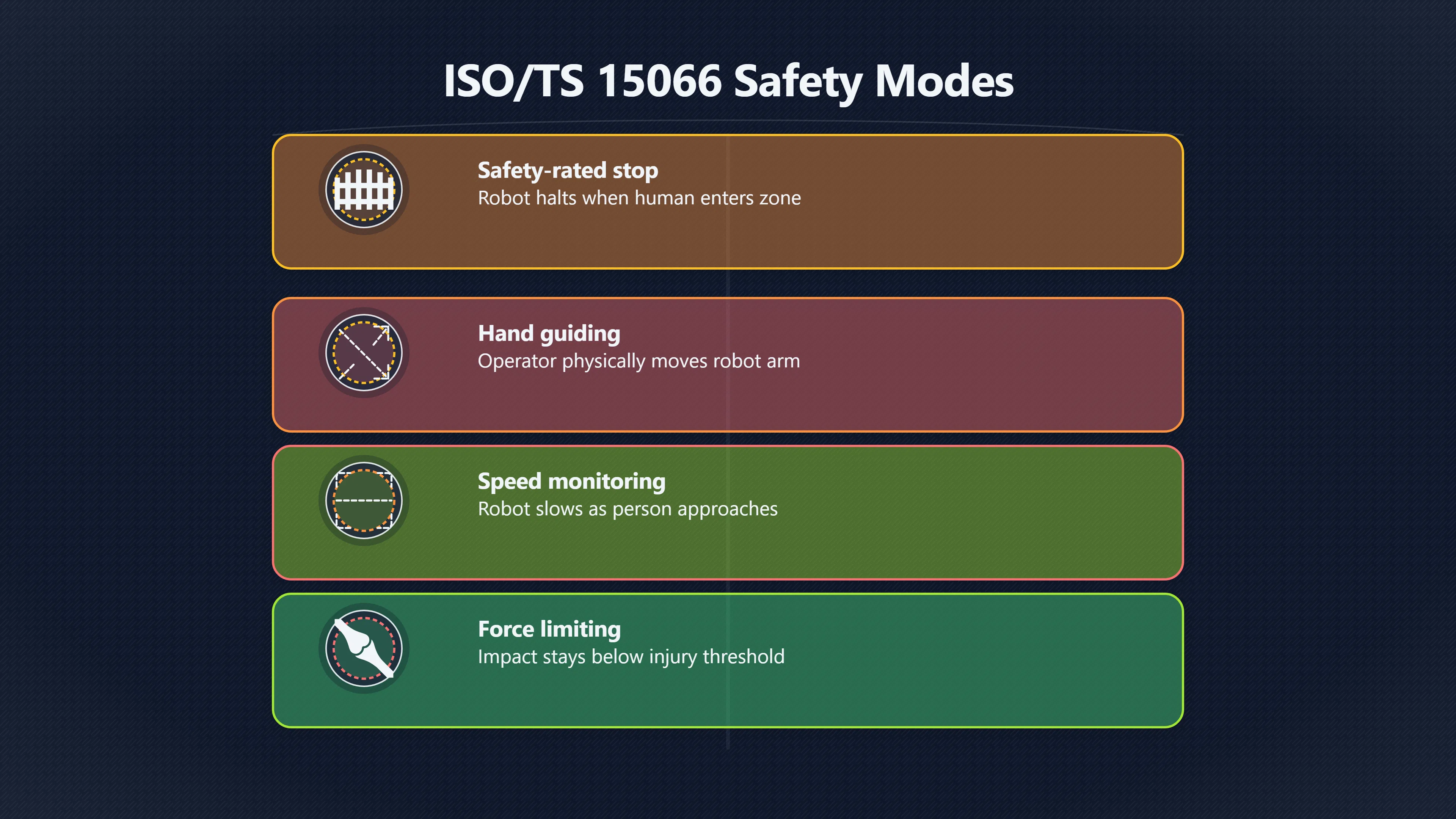
ISO/TS 15066 (supplementing ISO 10218) describes four interoperable modes of collaborative operation, each serving to prevent dangerous contact through distinct mechanisms:[robolist.ai]robolist.aiforce limited safety iso ts 15066ISO/TS 15066 in Practice: Cobot Force and Pressure Limits Explained — Robolist.aiMay 12, 2026…
1. Safety‑rated monitored stop (SMS)[mdpi.com]mdpi.comPerception and Computation for Speed and Separation Monitoring ArchitecturesSAFETY-RATED MONITORED STOP As previously mentioned, safety-rated monitor stop defines a safe stop state in which the robot actions are s…
In this basic mode, the robot halts motion whenever a human enters the designated collaborative workspace. Presence sensors such as light curtains, area scanners or pressure mats detect when someone crosses into a zone, and the robot immediately enters a safety‑certified stop. Because motion ceases before a human is close enough to be struck, contact does not occur during collaborative operation.[Robotomated]
2. Hand guiding[studylib.net]studylib.net8 5.5.3 Hand guidingISO/TS 15066: Collaborative Robot Safety SpecificationFebruary 15, 2016 — 7 5.5.2 Safety-rated monitored stop…
Here, the robot only moves under direct human control. The operator physically guides the robot’s motions using a purpose‑built enable switch or guiding device. Because the robot’s motion reflects the operator’s intent at every moment, the risk of unintended impact is minimised. This mode is typically used during programming or setup rather than continuous production.[Robotomated]
3. Speed and separation monitoring (SSM)[nist.gov]nist.govtestbed evaluation speed and separation monitoring human robot collaborativeA Testbed for Evaluation of Speed and Separation Monitoring in a Human Robot Collaborative Environment | NISTMarch 29, 2012…
SSM is a dynamic control method: the robot continuously measures the distance to the nearest human using safety‑rated sensors such as laser scanners or depth cameras. As a person approaches:
- the robot reduces speed proportionally to closing distance, and
- if the separation drops below a calculated threshold—the protective separation distance—the robot is automatically brought to a protective stop before contact is possible.[NIST]
ISO/TS 15066 even provides formulae for calculating minimum protective separation distances based on robot speed, human approach rates and system reaction times. This ensures the robot’s motion is constrained such that it always can stop before a hazardous region is reached.[iTeh Standards]standards.iteh.aiiTeh StandardsISO/TS 15066:2016 - Collaborative Robots Safety and Standards GuideFebruary 3, 2016…
4. Power and force limiting (PFL)
PFL is the collaborative mode most commonly associated with the phrase “no safety cage required.” Instead of guaranteeing zero contact, PFL allows contact but ensures it is not harmful. Cobots in this mode operate with reduced power, speed and momentum, and use compliant mechanical design (rounded edges, padding) and built‑in sensing (torque/force sensing in joints) to ensure that any collision does not exceed biomechanical thresholds for pain or injury. ISO/TS 15066 includes reference tables of maximum allowable force and pressure for different body regions, and risk assessments must demonstrate compliance with these limits for the specific application.[robolist.ai]robolist.aiforce limited safety iso ts 15066ISO/TS 15066 in Practice: Cobot Force and Pressure Limits Explained — Robolist.aiMay 12, 2026…
Together, SSM and PFL cover the spectrum from collision avoidance to collision tolerance. In safety practice, they are often combined: the robot slows and stops proactively as a person comes close (SSM), and if contact does occur in low‑distance interactions, the low energy impact is unlikely to cause injury (PFL).[Robotomated]
Mechanisms Under the Hood: Sensors and Controls
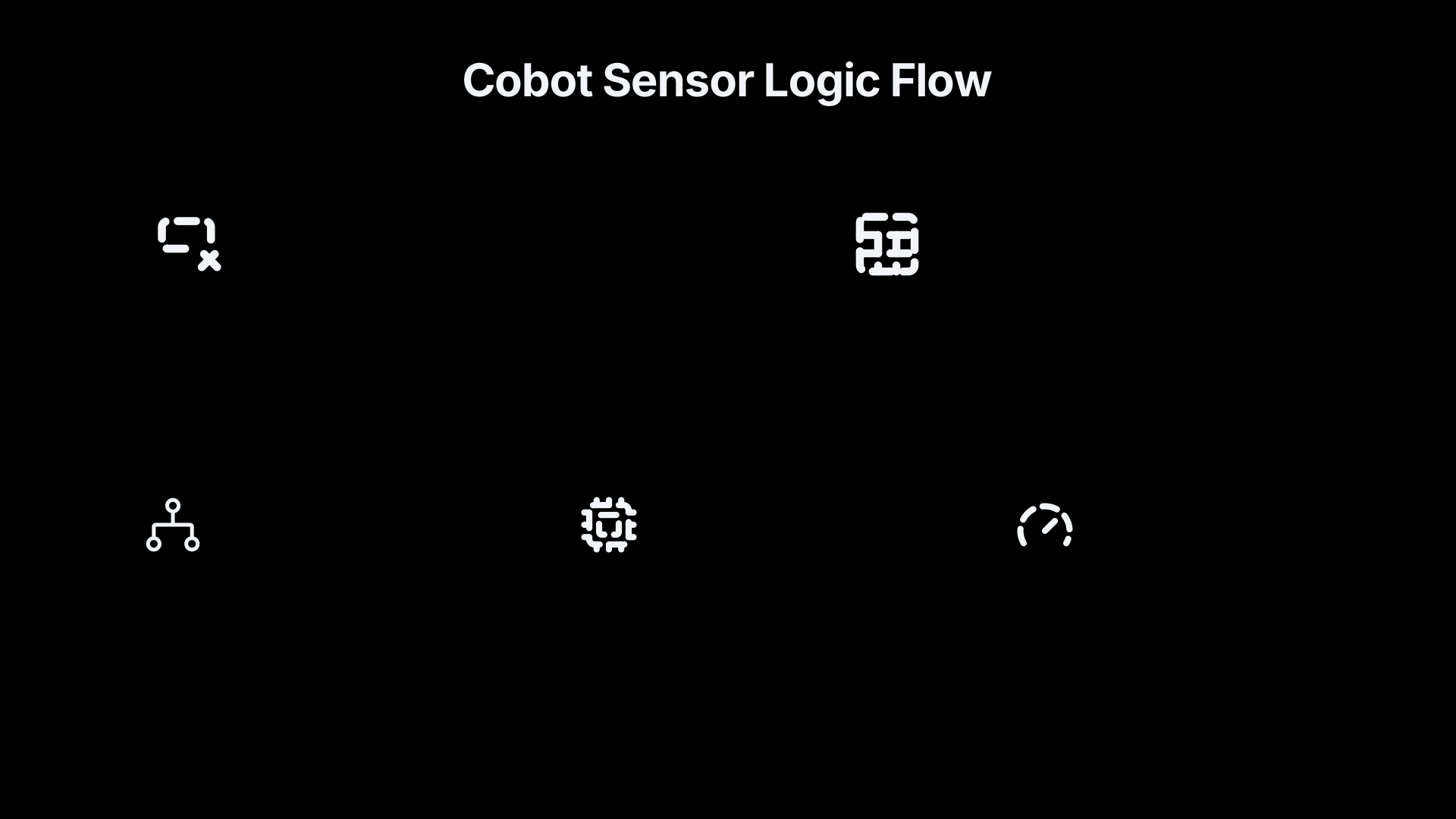
The practical implementation of these modes depends on real‑time monitoring and control systems integrated into the robot cell:
- Safety‑rated sensors such as LiDAR area scanners and light curtains provide continuous data on human location relative to the robot’s workspace. These sensors must meet recognised safety performance levels (e.g., IEC 62061 categories).[Robotic Systems Authority]roboticsystemsauthority.comSource details in endnotes.
- Control logic computes distances, speeds and stopping trajectories many times per second, ensuring that speed reduction or stops happen before a human enters a hazardous proximity.[PMC]pmc.ncbi.nlm.nih.govPMCImplementing Speed and Separation Monitoring in Collaborative Robot WorkcellsApril 1, 2017…
- Torque and force feedback loops in robot joints detect unexpected loads applied during motion. If the force exceeds a safe threshold, the controller halts motion immediately, preventing harmful impact under PFL.[Robotic Systems Authority]roboticsystemsauthority.comSource details in endnotes.
These systems operate on certified safety architectures, often involving safety PLCs (programmable logic controllers) and redundant circuits, to ensure that failures do not bypass safeguards.
Where Contact Controls Can Still Fail
While these mechanisms can dramatically reduce risk, they are not infallible without careful design and assessment. Two common challenges are:[Robotomated]
1. Inadequate risk assessment or poor integration:
Standards require that risk assessments consider not just the robot arm but the end effector, tooling, workpiece, motion paths and human tasks. Omitting any of these can lead to unsafe configurations—even if the robot itself has safety modes.[Robotomated]
2. Sensor limitations and response times:
SSM depends on sensors accurately detecting human presence and the controller having sufficient time to slow or stop. Rapid unpredicted human movements, occluded sensors or calibration errors can degrade performance. Therefore, protective separation distances must account for sensor and robot response latencies.[iTeh Standards]standards.iteh.aiiTeh StandardsISO/TS 15066:2016 - Collaborative Robots Safety and Standards GuideFebruary 3, 2016…
Moreover, even in PFL mode, excessive payload or high robot inertia can make it difficult to keep contact forces below injury thresholds without severely limiting tasks. In such cases, additional safety measures or partial segregation may still be necessary.[Engineering Service]engineeringservice.netcollaborative robot application guideEngineering ServiceCollaborative Robot Deployment & ISO/TS 15066 FAQs | Engineering Service…
Summary
To prevent dangerous contact in shared human–robot workspaces, cobots rely on a hierarchy of safety mechanisms anchored in robust international standards. Safety‑rated monitored stops eliminate contact, hand guiding puts human intent at the centre of motion, speed and separation monitoring dynamically avoids proximity that could lead to harm, and power and force limiting ensures that any incidental contact is within benign limits. Coupled with rigorous risk assessment, certified sensors and control systems, these mechanisms make collaborative operation feasible and help realise the vision of safer, more flexible automation that complements human labour.[robolist.ai]robolist.aiforce limited safety iso ts 15066ISO/TS 15066 in Practice: Cobot Force and Pressure Limits Explained — Robolist.aiMay 12, 2026…
Amazon book picks
Further Reading
Books and field guides related to How close is too close for cobots?. Use these as the next step if you want deeper reading beyond the article.
Introduction to Robotics
Gives technical grounding in robot motion, control and manipulators relevant to cobot safety.
Human + Machine
Provides accessible context for collaborative systems where humans and machines share tasks.
The Design of Everyday Things
Human-centred design principles are central to making cobot movement and intent understandable.
Robotics, Vision and Control
Explains sensing, control and robot behaviour that underpin safe shared workspaces.
eBay marketplace picks
Marketplace Samples
Example marketplace items related to this page. Use the search link to explore similar finds on eBay.


Endnotes
1.
Source: robolist.ai
Title: force limited safety iso ts 15066
Link:https://www.robolist.ai/industry-knowledge/cobot/force-limited-safety-iso-ts-15066
Source snippet
ISO/TS 15066 in Practice: Cobot Force and Pressure Limits Explained — Robolist.aiMay 12, 2026...
Published: May 12, 2026
2.
Source: robotomated.com
Title: robot safety standards iso 10218
Link:https://robotomated.com/learn/guides/robot-safety-standards-iso-10218
Source snippet
Understanding Robot Safety Standards: ISO 10218 and ISO/TS 15066 Explained | Robotomated...
3.
Source: standards.iteh.ai
Link:https://standards.iteh.ai/catalog/standards/iso/6856348f-7de9-4e6e-b903-d1ffd1e8c54c/iso-ts-15066-2016
Source snippet
iTeh StandardsISO/TS 15066:2016 - Collaborative Robots Safety and Standards GuideFebruary 3, 2016...
Published: February 3, 2016
4.
Source: robotomated.com
Title: cobot safety assessment guide
Link:https://robotomated.com/learn/manufacturing/cobot-safety-assessment-guide
Source snippet
Cobot Safety Assessment: ISO/TS 15066 and Risk Reduction in Practice | Robotomated...
5.
Source: nist.gov
Title: testbed evaluation speed and separation monitoring human robot collaborative
Link:https://www.nist.gov/publications/testbed-evaluation-speed-and-separation-monitoring-human-robot-collaborative
Source snippet
A Testbed for Evaluation of Speed and Separation Monitoring in a Human Robot Collaborative Environment | NISTMarch 29, 2012...
Published: March 29, 2012
6.
Source: pmc.ncbi.nlm.nih.gov
Title: PMCImplementing Speed and Separation Monitoring in Collaborative Robot Workcells
Link:https://pmc.ncbi.nlm.nih.gov/articles/PMC5117641/
Source snippet
April 1, 2017...
Published: April 1, 2017
7.
Source: nist.gov
Title: Marvel, Richard J. Norcross
Link:https://www.nist.gov/publications/implementing-speed-and-separation-monitoring-collaborative-robot-workcells
Source snippet
Implementing Speed and Separation Monitoring in Collaborative Robot Workcells | NISTAugust 1, 2016 — IMPLEMENTING SPEED AND SEPARATION MO...
Published: August 1, 2016
8.
Source: engineeringservice.net
Title: collaborative robot application guide
Link:https://engineeringservice.net/knowledge/collaborative-robot-application-guide
Source snippet
Engineering ServiceCollaborative Robot Deployment & ISO/TS 15066 FAQs | Engineering Service...
9.
Source: roboticsystemsauthority.com
Link:https://roboticsystemsauthority.com/collaborative-robots-cobots-overview
Additional References
10.
Source: mdpi.com
Title: Perception and Computation for Speed and Separation Monitoring Architectures
Link:https://www.mdpi.com/2218-6581/14/4/41
Source snippet
SAFETY-RATED MONITORED STOP As previously mentioned, safety-rated monitor stop defines a safe stop state in which the robot actions are s...
11.
Source: automate.org
Link:https://www.automate.org/[robotics
Source snippet
Anandan, Contributing Editor 08/27/2019 11 minutes Collaborative robots, cobots, or even cobotics… whatever you ca...
12.
Source: roboticsbiz.com
Title: four types of safety methods in human robot collaboration hrc
Link:https://roboticsbiz.com/four-types-of-safety-methods-in-human-robot-collaboration-hrc/
Source snippet
Four types of safety methods in human-robot collaboration (HRC) - RoboticsBizMarch 9, 2021 — To prevent this, it is important to identify...
Published: March 9, 2021
13.
Source: machinebuilding.net
Title: isots 15066 robots and robotic devices collaborative robots
Link:https://www.machinebuilding.net/isots-15066-robots-and-robotic-devices—collaborative-robots
Source snippet
ISO/TS 15066, Robots and robotic devices - Collaborative robots | Machine BuildingMarch 8, 2017 — As it is only a Technical Specification...
Published: March 8, 2017
14.
Source: isa.org
Title: Take a safe approach to collaborative robots
Link:https://www.isa.org/intech-home/2017/july-august/features/take-a-safe-approach-to-collaborative-robots
Source snippet
FOUR METHODS OF COLLABORATIVE OPERATION Under the ANSI/RIA 15.06 and ISO 10218 harmonized robot safety standards and the new TS 15066...
15.
Source: plantengineering.com
Title: Four types of collaborative robot operation
Link:https://www.plantengineering.com/articles/four-types-of-collaborative-robot-operation/
Source snippet
Plant EngineeringNovember 20, 2019 — Nov 20, 2019 Robotics FOUR TYPES OF COLLABORATIVE ROBOT OPERATION The ISO 10218-1 safety standard cl...
Published: November 20, 2019
16.
Source: techbriefs.com
Title: It also defines and discusses safet
Link:https://www.techbriefs.com/component/content/article/tb/pub/features/articles/34385?start=1
Source snippet
A Guide to Collaborative Robot Safety - Tech BriefsMay 1, 2019 — This article discusses industry standards, project stages, and solutions...
Published: May 1, 2019
17.
Source: automate.org
Title: iso ts 15066 explained
Link:https://www.automate.org/robotics/tech-papers/iso-ts-15066-explained
Source snippet
Tech Papers: ISO/TS 15066 Explained | RobotiqMay 25, 2016 — TECH PAPERS ISO/TS 15066 EXPLAINED By Robotiq 05/25/2016 8 minutes ISO/TS 150...
Published: May 25, 2016
18.
Source: youtube.com
Title: Collaborative Robot Force & Pressure Testing | Cobot Safety w/ Tom Chaldecott
Link:https://www.youtube.com/watch?v=gp3FN14WP5Y
Source snippet
CRB 1300 robot with speed and separation monitoring...
19.
Source: studylib.net
Title: 8 5.5.3 Hand guiding
Link:https://studylib.net/doc/27627297/iso-ts-15066-2016-en-
Source snippet
ISO/TS 15066: Collaborative Robot Safety SpecificationFebruary 15, 2016 — 7 5.5.2 Safety-rated monitored stop...
Published: February 15, 2016
Topic Tree