Within Interaction Safety
Why robot trust matters at work
Even physically guarded robots can undermine safety if their movements, signals or decisions feel unpredictable to nearby workers.
On this page
- How speed, direction and signalling shape trust
- Why confusing robot behaviour creates safety risks
- Design cues that make intent easier to read
Page outline Jump by section
Introduction
Even when physical safeguards are in place to prevent robots from harming human workers, how a robot behaves can make people feel unsafe — and those perceptions matter. In workplaces where humans share space with autonomous machines, unpredictability in speed, direction or signals can undermine workers’ confidence, erode trust and increase psychological stress. This “felt safety” isn’t just an abstract concern: research shows that predictability, transparency and clear intent in robot motion are key determinants of whether workers feel safe around robots, independent of whether the machines could physically harm them.[Springer]link.springer.comA Taxonomy of Factors Influencing Perceived Safety in Human–Robot Interaction | International Journal of Social Robotics | Spring…
 This page explains why robot behaviour influences worker safety perceptions, what specific motion and design cues can create confusion or confidence, and how better transparency and predictability support both worker wellbeing and effective human–robot teamwork.
How Robot Behaviour Shapes Safety Perceptions
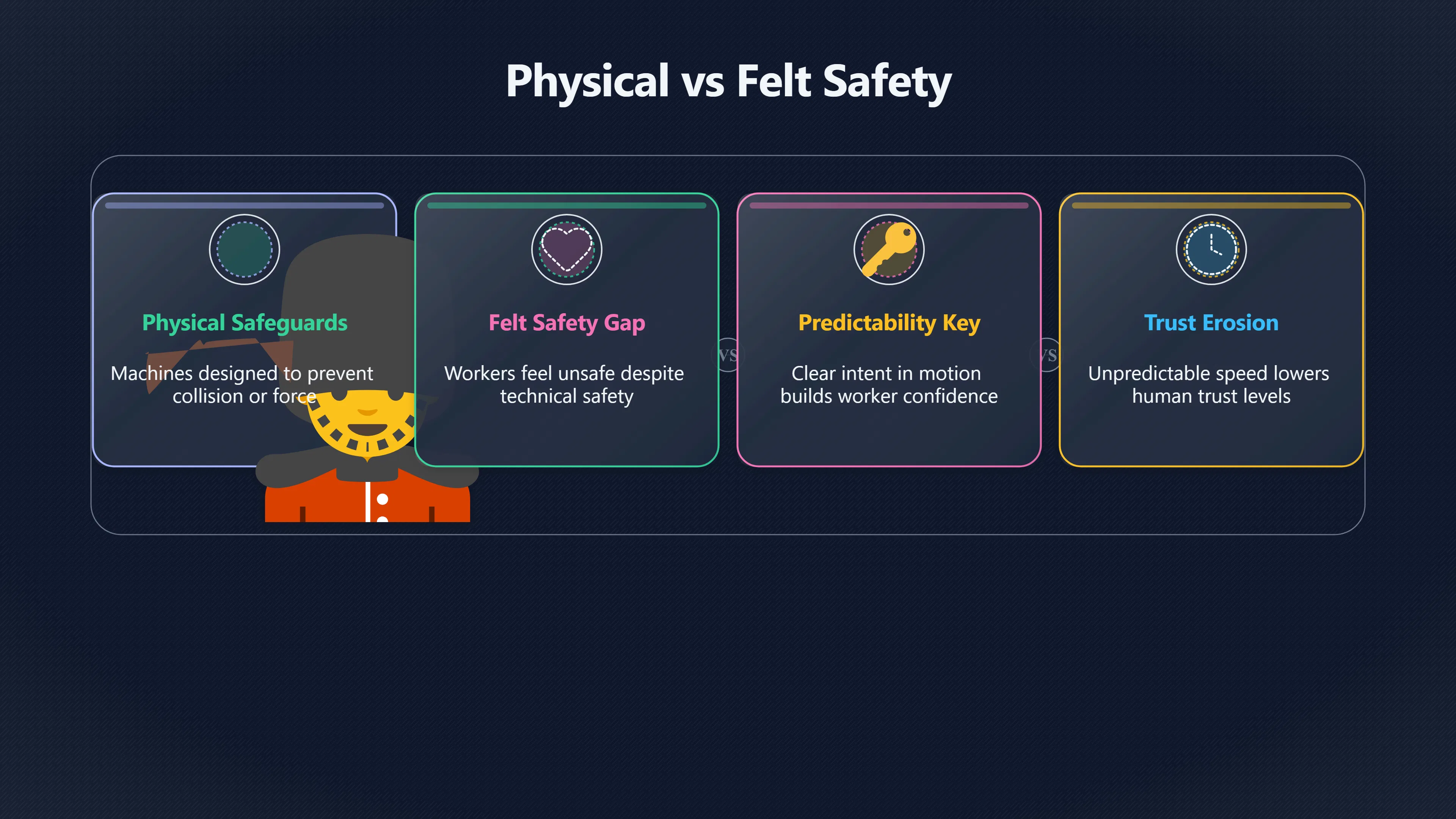
Safety in human–robot interaction has two distinct but related aspects: physical safety (no risk of harm from collision or force) and perceived safety (workers feeling secure while the robot operates). A robot can be compliant by design yet still evoke discomfort or anxiety if its actions are unpredictable or opaque.[Springer]link.springer.comInternational Journal of Social Robotics | Springer Nature LinkJanuary 7, 2022 — DO SPEED AND PROXIMITY AFFECT HUMAN-ROBOT COLLABORATIO…
Researchers studying perceived safety in shared work environments find that human workers respond emotionally and cognitively to robotic behaviour much as they do to other moving agents in their space. Uncertainty about what a robot will do next — for instance abrupt changes in direction or speed — increases discomfort and lowers trust, even when safety margins are technically satisfied.[ScienceDirect]sciencedirect.comDo you feel safe with your robot? Factors influencing perceived safety in human-robot interaction based on subjective and ob…
A systematic review of industrial settings highlighted that factors such as robot approach speed, approach direction, and unclear signalling significantly affect perceived safety and trust. In other words, it isn’t just whether robots are safe, but how they behave that shapes the human experience.[PubMed]pubmed.ncbi.nlm.nih.govA Literature Review on Safety Perception and Trust during Human-Robot Interaction with Autonomous Mobile Robots That Apply to Indus…
Why Confusing or Unpredictable Robot Behaviour Feels Unsafe
Speed and Motion Patterns
Studies show that faster robot speeds — even when within safety limits — tend to reduce workers’ sense of safety. As autonomous mobile robots accelerate, human collaborators are more likely to report uncertainty about when and where the robot will travel. This perceived unpredictability can raise stress and diminish trust.[ScienceDirect]sciencedirect.comDo you feel safe with your robot? Factors influencing perceived safety in human-robot interaction based on subjective and ob…
Another line of research compared robots following fixed, predictable paths with those that continuously replan trajectories in real time. Workers generally reported feeling safer when robots moved along fixed, easily anticipated paths compared with more dynamic, real-time planning behaviours, even when both technically satisfied physical safety constraints.[Nature]nature.comPerceived safety in human–cobot interaction for fixed-path and real-time motion planning algorithms | Scientific ReportsNovember 28…
Direction and Proximity
How a robot approaches a worker also matters. Robots that change direction erratically or close distances without clear cues can trigger discomfort, even absent actual collision risk. Maintaining proxemic distance — a comfortable buffer zone that respects human personal space — and approaching in predictable ways helps mitigate these feelings of unease.[Springer]link.springer.comspringer.comI, Robot: How Human Appearance and Mind Attribution Relate to the Perceived Danger of Robots | International Journal of Socia…
Lack of Transparency or Intent Cues
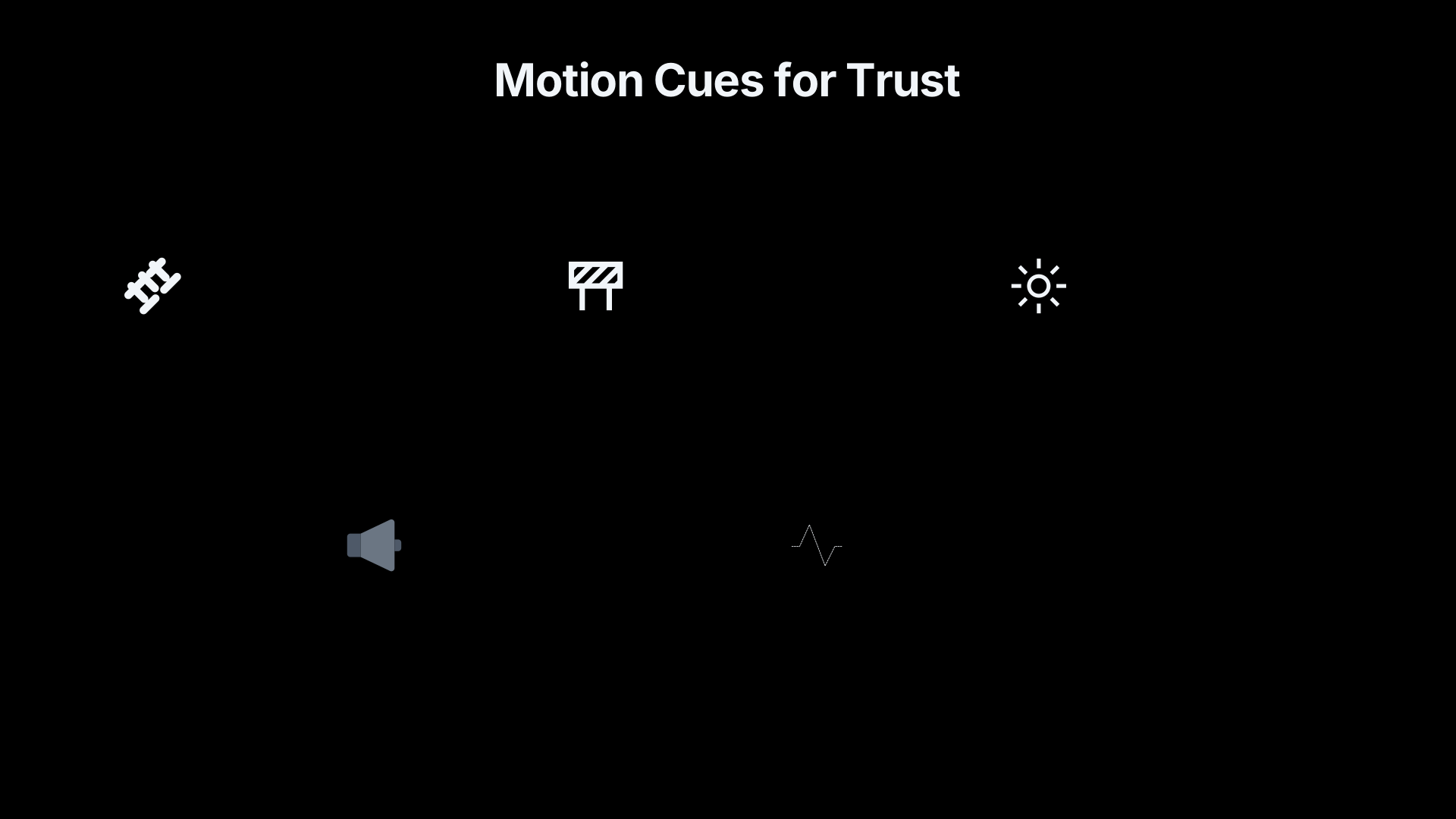
When robots don’t signal their intended movements or actions, humans are left guessing. This ambiguity can reduce the sense of control workers feel during interaction, lowering trust and perceived safety. Research indicates that transparent behaviour — where robots communicate intent through lights, projected paths or clearly legible motion — improves workers’ confidence and trust.[PubMed]pubmed.ncbi.nlm.nih.govA Literature Review on Safety Perception and Trust during Human-Robot Interaction with Autonomous Mobile Robots That Apply to Indus…
In workplace implementations with autonomous mobile robots, simple enhancements like turn signals, projected navigation paths on the floor, or haptic feedback devices help reduce surprises, making motions easier for nearby humans to interpret.[PubMed]pubmed.ncbi.nlm.nih.govA Literature Review on Safety Perception and Trust during Human-Robot Interaction with Autonomous Mobile Robots That Apply to Indus…
The Psychological Impact on Workers
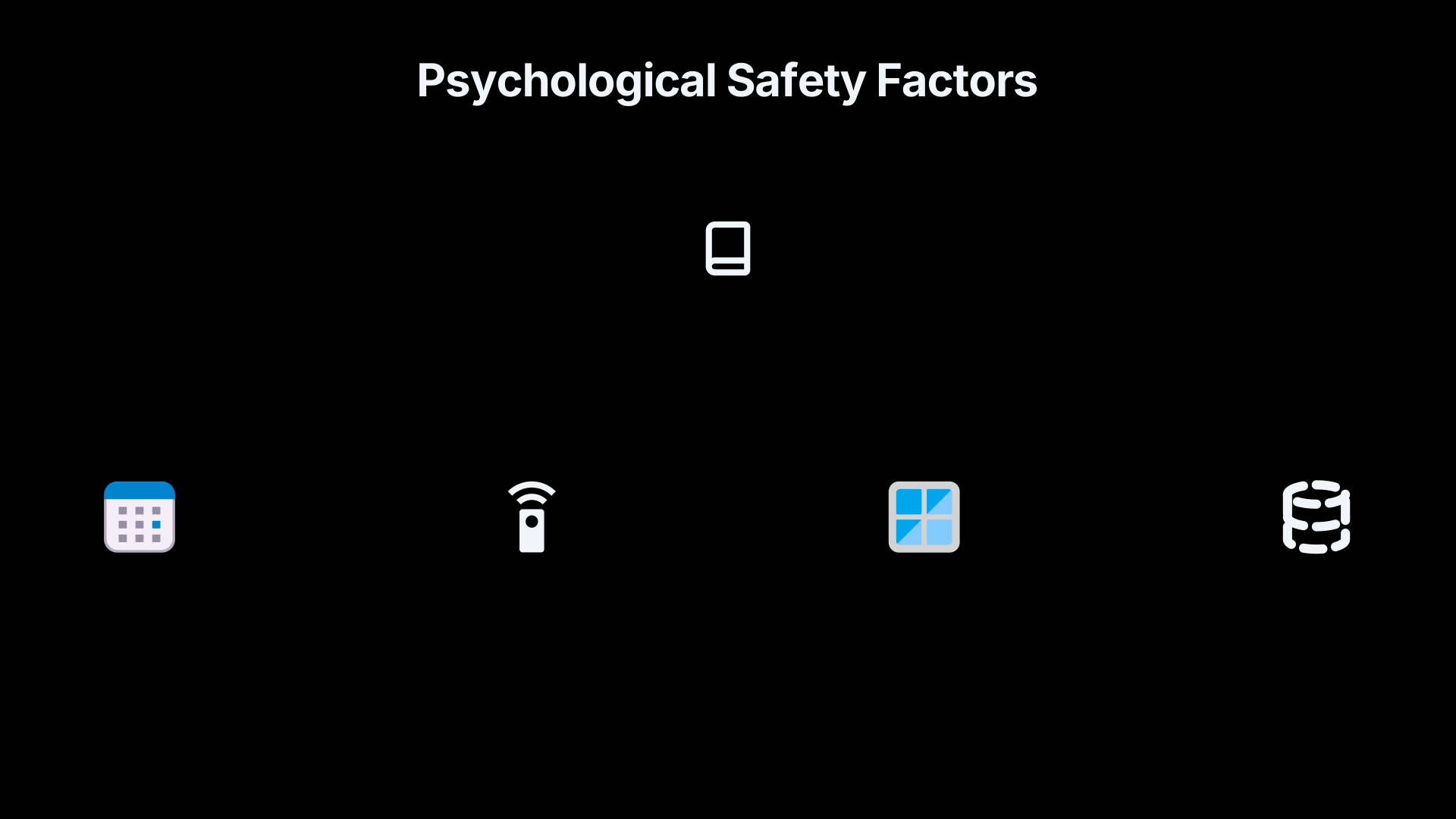
Perceived safety is tightly linked with trust, control and comfort — all fundamental to how humans respond to automation. A taxonomy of perceived safety factors in human–robot interaction includes:
- Experience and familiarity: Workers with prior exposure to robotic systems feel more at ease.[Springer]link.springer.comA Taxonomy of Factors Influencing Perceived Safety in Human–Robot Interaction | International Journal of Social Robotics | Spring…
- Predictability: Predictable robot behaviour correlates with higher perceived safety.[ScienceDirect]sciencedirect.comDo you feel safe with your robot? Factors influencing perceived safety in human-robot interaction based on subjective and ob…
- Sense of control: Feeling able to anticipate or influence robot actions supports confidence.[Springer]link.springer.comInternational Journal of Social Robotics | Springer Nature LinkJanuary 7, 2022 — DO SPEED AND PROXIMITY AFFECT HUMAN-ROBOT COLLABORATIO…
- Transparent actions: Clear, legible signals about what the robot will do next reduce uncertainty.[PubMed]pubmed.ncbi.nlm.nih.govA Literature Review on Safety Perception and Trust during Human-Robot Interaction with Autonomous Mobile Robots That Apply to Indus…
When these elements are lacking, workers may experience psychological stress akin to operating near unpredictable machinery, even if there is no direct physical hazard. This can affect task performance, job satisfaction and willingness to engage with automation.[ScienceDirect]sciencedirect.comDo you feel safe with your robot? Factors influencing perceived safety in human-robot interaction based on subjective and ob…
Design Cues That Make Intent Easier to Read
Given the importance of perceived safety for workplace acceptance, designers and operators can use several practical cues to make robot behaviour more legible to humans:
- Predictable paths and motion profiles: Fixed paths or constrained movement patterns are easier for humans to anticipate than continuously changing trajectories.[Nature]nature.comPerceived safety in human–cobot interaction for fixed-path and real-time motion planning algorithms | Scientific ReportsNovember 28…
- Slower approach speeds in shared zones: Lower motion speeds near humans increase comfort without compromising productivity when well balanced.[ScienceDirect]sciencedirect.comDo you feel safe with your robot? Factors influencing perceived safety in human-robot interaction based on subjective and ob…
- Visual signalling systems: Lights, arrows or projected navigation lines help humans understand intended routes.[PubMed]pubmed.ncbi.nlm.nih.govA Literature Review on Safety Perception and Trust during Human-Robot Interaction with Autonomous Mobile Robots That Apply to Indus…
- Audible or haptic feedback: Signals that a robot will start moving, change direction, or complete a task soon help set expectations.[PubMed]pubmed.ncbi.nlm.nih.govA Literature Review on Safety Perception and Trust during Human-Robot Interaction with Autonomous Mobile Robots That Apply to Indus…
- Design transparency: Communicating why a robot is pausing or altering its behaviour builds trust — for example through interfaces that explain robot reasoning or state.[Sage Journals]journals.sagepub.comSage JournalsWorking with Industrial Cobots: The Influence of Reliability and Transparency on Perception and Trust - Lina Kluy, Eileen Ro…
These cues aren’t just ergonomic extras; they are fundamental to reducing psychological stress and fostering safe, effective human–robot work relationships.
Why Felt Safety Matters for Human–Robot Collaboration
In the context of Human–robot interaction and workplace safety, perceived safety is more than an emotional accessory — it’s a performance and safety issue. Workers who feel unsafe are more likely to disengage, make mistakes, or avoid collaborative tasks altogether. In the longer view of AI bloom — where robots are intended to liberate humans from hazardous labour and unlock new capabilities — addressing how robots behave in ways that feel safe to workers is essential for broad adoption and inclusive benefits.
Improving robot transparency, predictability and design of motion behaviour isn’t just a mitigation of discomfort. It is a core ingredient of trustworthy automation that helps workers feel secure, valued and empowered — a psychological foundation for the flourishing workplace of the future.[Springer]link.springer.comspringer.comI, Robot: How Human Appearance and Mind Attribution Relate to the Perceived Danger of Robots | International Journal of Socia…
Amazon book picks
Further Reading
Books and field guides related to Why robot trust matters at work. Use these as the next step if you want deeper reading beyond the article.
The Design of Everyday Things
Explains why visible affordances, feedback and predictability shape trust in technology.
Human + Machine
Covers how human trust and machine assistance interact in redesigned workflows.
The Man Who Lied to His Laptop
Explores how people respond socially and emotionally to intelligent machines.
Rule of the Robots
Places robot trust and safety in the broader context of autonomous systems entering society.
eBay marketplace picks
Marketplace Samples
Example marketplace items related to this page. Use the search link to explore similar finds on eBay.



Endnotes
1.
Source: link.springer.com
Link:https://link.springer.com/article/10.1007/s12369-023-01027-8
Source snippet
A Taxonomy of Factors Influencing Perceived Safety in Human–Robot Interaction | International Journal of Social [Robotics]({{ 'robotics/' | relative_url }}) | Spring...
2.
Source: sciencedirect.com
Link:https://www.sciencedirect.com/science/article/pii/S1071581921001622
Source snippet
Do you feel safe with your robot? Factors influencing perceived safety in human-robot interaction based on subjective and ob...
3.
Source: sciencedirect.com
Link:https://www.sciencedirect.com/science/article/pii/S0003687026000256
Source snippet
Perceived safety during human-robot interaction with an autonomous mobile robot - ScienceDirectSeptember 1, 2026...
Published: September 1, 2026
4.
Source: nature.com
Link:https://www.nature.com/articles/s41598-022-24622-7
Source snippet
Perceived safety in human–cobot interaction for fixed-path and real-time motion planning algorithms | Scientific ReportsNovember 28...
5.
Source: link.springer.com
Link:https://link.springer.com/article/10.1007/s12369-021-00853-y
Source snippet
International Journal of Social Robotics | Springer Nature LinkJanuary 7, 2022 — DO SPEED AND PROXIMITY AFFECT HUMAN-ROBOT COLLABORATIO...
Published: January 7, 2022
6.
Source: link.springer.com
Link:https://link.springer.com/article/10.1007/s12369-020-00663-8
Source snippet
springer.comI, Robot: How Human Appearance and Mind Attribution Relate to the Perceived Danger of Robots | International Journal of Socia...
7.
Source: sciencedirect.com
Title: Perceived safety in physical human–robot interaction—A survey
Link:https://www.sciencedirect.com/science/article/pii/S0921889022000173
Source snippet
"ScienceDirectVolume 151, May 2022, 104047 PERCEIVED SAFETY IN PHYSICAL HUMAN–ROBOT INTERACTION—A SURVEY [https://doi.org/10.1016/j.robot.2..."](https://doi.org/10.1016/j.robot.2...")...
Published: May 2022
8.
Source: sciencedirect.com
Title: Safety bounds in human robot interaction: A survey
Link:https://www.sciencedirect.com/science/article/abs/pii/S0925753520300643
Source snippet
"ScienceDirectSAFETY SCIENCE Volume 127, July 2020, 104667 SAFETY BOUNDS IN HUMAN ROBOT INTERACTION: A SURVEY [https://doi.org/10.1016/j.ss..."](https://doi.org/10.1016/j.ss...")...
Published: July 2020
9.
Source: pubmed.ncbi.nlm.nih.gov
Link:https://pubmed.ncbi.nlm.nih.gov/38190192/
Source snippet
A Literature Review on Safety Perception and Trust during Human-Robot Interaction with Autonomous Mobile Robots That Apply to Indus...
10.
Source: journals.sagepub.com
Link:https://journals.sagepub.com/doi/10.1177/1071181321651110
Source snippet
Sage JournalsWorking with Industrial Cobots: The Influence of Reliability and Transparency on Perception and Trust - Lina Kluy, Eileen Ro...
11.
Source: pubmed.ncbi.nlm.nih.gov
Link:https://pubmed.ncbi.nlm.nih.gov/36443369/
Source snippet
2022 Nov 28;12(1):20438. doi: 10.1038/s41598-022-24622-7. PERCEIVED SAFETY IN HUMAN-COBOT INTERACTION FOR FIXED-PATH AND REAL-TIME MOTION...
12.
Source: pubmed.ncbi.nlm.nih.gov
Link:https://pubmed.ncbi.nlm.nih.gov/36055035/
Source snippet
2023 Jan:106:103863. doi: 10.1016/j.apergo.2022.103863. Epub 2022 Aug 30. PHYSIOLOGICAL AND PERCEPTUAL CONSEQUENCES OF TRUST IN COLLABORA...
Additional References
13.
Source: tandfonline.com
Link:https://www.tandfonline.com/doi/abs/10.1080/24725838.2023.2283537
Source snippet
Environments: IISE Transactions on Occupational Ergonomics and Human Factors: Vol 12, No 1-2January 8, 2024 — Image: Publication Cover II...
Published: January 8, 2024
14.
Source: youtube.com
Link:https://www.youtube.com/watch?v=CYMY2vabxUs
Source snippet
5 Inside Modern Warehouses: Where Algorithms Control Humans...
15.
Source: youtube.com
Title: Ravi Pandya
Link:https://www.youtube.com/watch?v=rfLP_4KmiKM
Source snippet
2 Human Robot Encounters Study - Stress Response with ECG and EDA Physiological Sensors...
16.
Source: youtube.com
Title: Human Robot Encounters Study
Link:https://www.youtube.com/watch?v=3xu5AoBYi44
Source snippet
3 Impedance Control for Human Robot Interaction...
17.
Source: pmc.ncbi.nlm.nih.gov
Link:https://pmc.ncbi.nlm.nih.gov/articles/PMC11076167/
Source snippet
Author manuscript; available in PMC: 2025 Jan 8. Published in final edited form as: IISE Trans Occup Ergon Hum Factors. 2024 Jan 8;12(1-2...
18.
Source: pmc.ncbi.nlm.nih.gov
Link:https://pmc.ncbi.nlm.nih.gov/articles/PMC9705370/
Source snippet
2022 Nov 28;12:20438. doi: 10.1038/s41598-022-24622-7 PERCEIVED SAFETY IN HUMAN–COBOT INTERACTION FOR FIXED-PATH AND REAL-TIME MOTION PLA...
19.
Source: youtube.com
Title: Impedance Control for Human Robot Interaction
Link:https://www.youtube.com/watch?v=AxqVdjwfp0Y
Source snippet
4 Lecture 2.4.5 | Human-Robot Interaction & Cognitive Load | Masters in Medical Robotics...
20.
Source: journals.sagepub.com
Link:https://journals.sagepub.com/doi/10.1177/1071181320641028
Source snippet
Majer, 2020February 9, 2021 — First published online February 9, 2021 Request permissions THE EFFECT OF ANTHROPOMORPHISM AND FAILURE COMP...
Published: February 9, 2021
21.
Source: journals.sagepub.com
Link:https://journals.sagepub.com/doi/10.1177/1071181320641506
Source snippet
Haney, 2020February 9, 2021 — First published online February 9, 2021 Request permissions SAFETY PERCEPTION AND BEHAVIORS DURING HUMAN-RO...
Published: February 9, 2021
22.
Source: es.mdu.se
Title: se ID T
Link:https://www.es.mdu.se/publications/6737-A_Taxonomy_of_Factors_Influencing_Perceived_Safety_in_Human_Robot_Interaction
Source snippet
A TAXONOMY OF FACTORS INFLUENCING PERCEIVED SAFETY IN HUMAN-ROBOT INTERACTION FULLTEXT: Image AUTHORS: Neziha Akalin, Andrey Kiselev...
Topic Tree