Within Anticipatory Gov
How Short Term Politics Undermine Early Warning Responses
Election cycles and media pressure often prevent governments from acting on early warnings, favouring immediate gains over long-term risk reduction.
On this page
- Election and budget cycle pressures
- Media driven policy priorities
- Consequences for long term risk management
Page outline Jump by section
Introduction
Many of the failures that follow major crises are not failures of prediction. Governments are often warned years in advance about pandemics, climate risks, infrastructure vulnerabilities, financial instability or emerging technological threats. The harder problem is political: leaders frequently have weak incentives to spend money, accept short-term costs or defend unpopular preventive measures when the benefits may not become visible until after the next election.
 This creates a persistent gap between early warning and early action. Forecasts may identify genuine dangers, but democratic politics is often organised around short electoral cycles, annual budgets, immediate media attention and visible results. The consequence is that prevention becomes politically difficult even when it is technically possible. For societies hoping to use advanced forecasting, strategic foresight and eventually AI-enhanced governance to reduce civilisational risks, understanding these incentive structures is as important as improving prediction itself. Accurate forecasts alone cannot produce resilience if political systems reward delay more than preparation.[OECD]oecd.orgAnticipatory governanceSuch an approach strengthens the social contract, fosters public trust, and promotes a more agile and resilien…[OECD]oecd.orgAnticipatory Innovation Governanceby P TÕNURIST · Cited by 161 — Whether because of political or perception concerns, election pressu…
Election Cycles Reward Immediate Gains
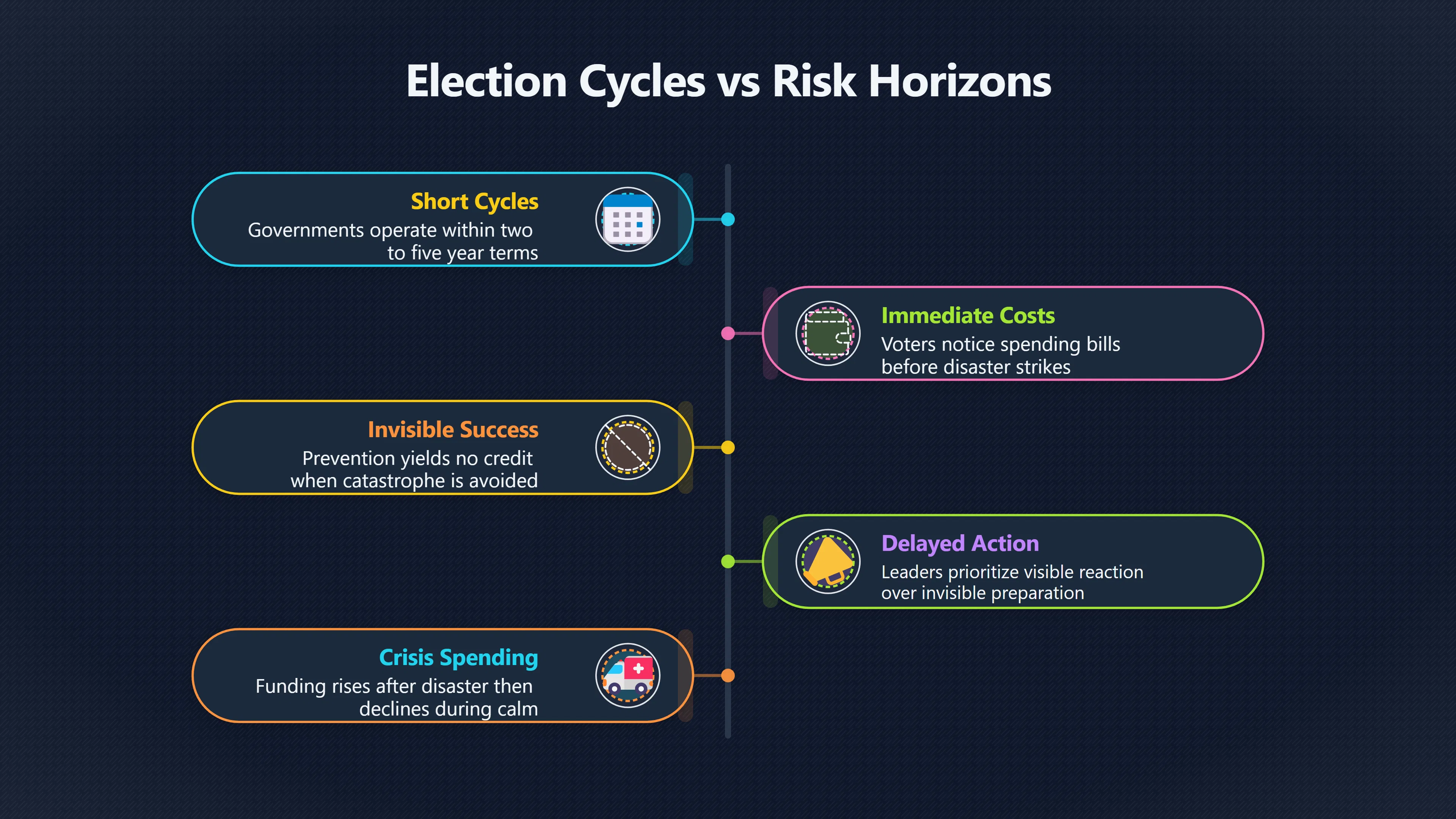
One of the most widely discussed barriers to anticipatory governance is the mismatch between political time horizons and the time horizons of major risks.
Elected governments typically operate within cycles of two to five years. By contrast, many preventive investments pay off over decades. Climate adaptation projects, pandemic preparedness systems, resilient energy infrastructure, scientific research programmes and AI safety institutions may require sustained investment long before their benefits become obvious.
The political problem is straightforward. Voters often notice the costs of prevention immediately but may never notice disasters that were successfully avoided. A politician can be criticised for spending billions on preparation that appears unnecessary, yet receive little credit for preventing an event that never occurs. Political scientists sometimes describe this as the problem of “invisible success”: prevention produces outcomes that are difficult to demonstrate because the catastrophe remains hypothetical.
Research on long-term policymaking repeatedly finds that future benefits are discounted relative to present costs. Climate policy is a particularly clear example because decarbonisation often requires immediate economic and political trade-offs while many of the benefits emerge over much longer periods. Scholars examining long-term governance note that these structural incentives make it difficult for political systems to sustain policies whose rewards arrive far beyond current electoral cycles.[preprints.apsanet.org]preprints.apsanet.orgInstitutions, climate change, and the foundations of longApril 9, 2019 — by JJ Finnegan · 2019 · Cited by 249 — Long-term policy challenges – biodiversity loss, education and skills, infrastruct…[Ariadne]ariadneprojekt.deAriadneMapping variation in institutions for climate policymakingby C Zwar · Cited by 4 — It demands long-term investments, which impose…
The OECD has similarly argued that governments are frequently driven by immediate events and routine political pressures rather than sustained future-oriented planning. Election pressures and day-to-day political demands can push decision-makers toward short-term choices even when evidence points toward the value of prevention.[OECD]oecd.orga5203d0b enShows whether there are effective processes…Read more…
Why Prevention Is Politically Harder Than Response
Political systems often reward visible reaction more than invisible preparation.
When a crisis becomes obvious, leaders can announce emergency measures, hold press conferences and demonstrate action. Preventive investments rarely generate comparable political rewards. Stockpiling medical equipment, strengthening disease surveillance, upgrading flood defences or funding long-term AI governance research may receive little public attention until after a failure occurs.
This creates several recurring incentives:
- Costs are immediate while benefits are uncertain.
- Preventive spending competes with highly visible public demands.
- Success is difficult to measure because it appears as a non-event.
- Opponents can portray preparedness spending as wasteful if no crisis follows.
- Future governments may receive the political credit for investments made today.
As a result, politicians can face rational electoral incentives to postpone action even when they privately accept the underlying risk assessment.
This dynamic helps explain why governments often invest heavily after disasters but struggle to maintain preparedness once public attention fades. Preparedness funding frequently rises after crises and then gradually declines during calmer periods, creating cycles of neglect followed by emergency spending. The pattern has appeared repeatedly in public health, disaster preparedness and climate adaptation policy.[GPMB]gpmb.orgGovernance Preparedness: Initial Lessons from COVID-1931 Jul 2020 — The 2019 novel coronavirus (COVID-19) pandemic has revealed that…[Queen Mary]qmul.ac.ukthe world had the tools to prevent the coronavirus pandemic why werent they usedStates only invest during or after a major outbreak; it is hard to…Read more… University of London
Pandemic Warnings Before COVID-19
The years preceding COVID-19 offer one of the clearest examples of short-term political incentives undermining preventive action.
Numerous governments, international organisations and public-health experts warned that a major pandemic was likely. Simulation exercises, preparedness assessments and expert reports repeatedly identified weaknesses in health systems, supply chains and emergency planning. Yet many countries entered 2020 with insufficient protective equipment, limited testing capacity and fragmented response structures.
The UK’s COVID-19 Inquiry concluded that preparedness structures were inadequate in several important respects and that known weaknesses had not been sufficiently addressed before the crisis. Parliamentary investigations and professional medical organisations later argued that warnings emerging from exercises and preparedness reviews had not been fully acted upon.[UK Covid-19 Inquiry]covid19.public-inquiry.ukIt examines the state of the UK's central structures and procedures for pandemic emergency preparedness…Read more…[UK Parliament Committees]committees.parliament.ukUK Parliament CommitteesGovernment preparedness for the COVID-19 PandemicThis follow up inquiry is based on the NAO's recent findings tha…
The problem was not simply technical ignorance. In many cases the warnings already existed. The challenge was that maintaining preparedness required sustained funding and political attention despite competing priorities.
The Global Preparedness Monitoring Board argued in 2020 that political leaders collectively failed to heed repeated warnings about pandemic risks. Subsequent analyses of COVID-19 governance similarly concluded that political barriers often mattered as much as technical preparedness measures.[PreventionWeb]preventionweb.netPandemic preparedness panel slams collective failure to…September 14, 2020 — 14 Sept 2020 — A collective failure by polit…[GPMB]gpmb.orgGovernance Preparedness: Initial Lessons from COVID-1931 Jul 2020 — The 2019 novel coronavirus (COVID-19) pandemic has revealed that…
The pandemic therefore became a powerful illustration of a broader governance problem: societies may possess forecasts, simulations and expert knowledge yet still fail to convert those warnings into preventive action.
Media Cycles Favour Crises Over Slow-Burn Risks
Modern media systems intensify short-term political incentives.
News coverage tends to prioritise immediate events, conflicts, scandals and visible emergencies. Risks that develop gradually over years or decades often struggle to maintain attention unless they produce dramatic incidents.
This creates a feedback loop:
- Media organisations focus on immediate developments.
- Public attention follows those developments.
- Politicians respond to what voters currently notice.
- Long-term risks receive less political priority.
- Preventive investments become easier to defer.
Climate change illustrates this dynamic particularly clearly. Scientific warnings have accumulated over decades, yet political attention often spikes after extreme weather events before declining again. Long-term mitigation and adaptation strategies compete with more immediate economic and political concerns.
Because democratic leaders are highly sensitive to public attention, media-driven political environments can encourage reactive rather than anticipatory policymaking. Governments may devote substantial effort to managing today’s headlines while underinvesting in threats that experts believe will become severe later.
The OECD’s work on anticipatory governance repeatedly identifies this tendency toward event-driven policymaking as a central obstacle to building future-oriented institutions.[OECD]oecd.orgd7eb0bb6 enBuilding Anticipatory Capacity with Strategic Foresight in…5 May 2025 — This report examines factors influencing anticipatory governan…[OECD]oecd.orging environmental degradation has seen governments at times shift towards more integrated, agile, evidence-…Read more…
Climate Policy and the Problem of Political Continuity
Climate governance demonstrates another aspect of the incentive problem: long-term policies often require continuity across multiple administrations.
Major energy transitions, infrastructure programmes and emissions-reduction pathways can take decades to complete. Yet elections can rapidly change political priorities. New governments may weaken, reverse or redesign policies introduced by their predecessors.
Researchers studying long-term climate strategies have found that many planning documents contain ambitious future visions but provide weaker mechanisms for overcoming political barriers and maintaining implementation over time. Long-term goals may survive on paper while practical execution becomes vulnerable to electoral shifts, lobbying pressures and changing coalitions.[ScienceDirect]sciencedirect.comScienceDirect Paper tiger or useful governance tool?Understanding long…by A Buylova · 2024 · Cited by 12 — Previous literature has shown that long-term planning and anticipatory action c…
Climate scholars also note that many environmental investments impose costs in the present while generating benefits far in the future. This creates strong incentives for postponement, especially when political leaders expect voters to judge performance primarily through near-term economic outcomes.[Ariadne]ariadneprojekt.deAriadneMapping variation in institutions for climate policymakingby C Zwar · Cited by 4 — It demands long-term investments, which impose…
The result is not necessarily outright denial of long-term risks. More commonly, governments acknowledge future dangers while repeatedly delaying the most difficult preventive measures.
Why AI Forecasting Alone Cannot Solve This Problem
As AI systems become better at forecasting, modelling and identifying emerging risks, a common assumption is that improved prediction will naturally lead to better decisions.
Political incentives complicate that assumption.
Future AI systems may dramatically improve forecasting in areas such as pandemic emergence, economic instability, climate impacts, infrastructure failures or geopolitical risks. They may generate earlier warnings, more detailed simulations and better estimates of likely outcomes.
Yet the historical record suggests that information is often not the primary bottleneck. Political incentives frequently determine whether warnings are acted upon.
An AI model might correctly identify a significant risk ten years in advance. However, leaders may still face pressure to prioritise visible short-term benefits over preventive spending. In some cases, better forecasts could even intensify political conflict by making costly preventive measures harder to avoid.
This means that the challenge of anticipatory governance is not merely computational. It is institutional and political. Societies may need mechanisms that help translate foresight into durable action rather than assuming that more accurate prediction automatically changes behaviour.
The Long-Term Stakes for Human Flourishing
The political difficulty of prevention becomes more consequential as technological capabilities grow.
If advanced AI substantially accelerates scientific discovery, economic productivity and humanity’s capacity to shape the future, then governance failures could become more important rather than less important. Societies may gain unprecedented forecasting abilities while still struggling to act on what those forecasts reveal.
The same institutions that currently struggle to prepare for pandemics, climate risks or infrastructure failures may eventually confront questions involving transformative AI, biotechnology, energy systems and other civilisation-scale technologies. In that world, the ability to sustain preventive action across political cycles could become a critical determinant of whether technological progress expands human flourishing or repeatedly collides with preventable crises.
For advocates of an AI-enabled future of abundance, longevity and scientific acceleration, this is a central lesson. Better intelligence does not automatically produce better governance. The benefits of forecasting, strategic foresight and advanced AI depend on political systems that can reward preparation before disaster rather than only reacting after it occurs. Building those institutions may be as important as improving the forecasts themselves.[OECD]oecd.orgAnticipatory governanceSuch an approach strengthens the social contract, fosters public trust, and promotes a more agile and resilien…[OECD]oecd.orgAnticipatory Innovation Governanceby P TÕNURIST · Cited by 161 — Whether because of political or perception concerns, election pressu…
Amazon book picks
Further Reading
Books and field guides related to How Short Term Politics Undermine Early Warning Responses. Use these as the next step if you want deeper reading beyond the article.
The Fifth Risk
Directly examines neglected government risks and failures of preparedness.
The Black Swan
Rating: 4.0/5 from 25 Google Books ratings
Explains why societies underprepare for low-probability high-impact risks.
Thinking, Fast and Slow
Explains short-term bias and flawed judgement in decision-making.
The Logic of Political Survival
Explains why leaders may prioritise electoral survival over long-term prevention.
eBay marketplace picks
Marketplace Samples
Example marketplace items related to this page. Use the search link to explore similar finds on eBay.


Endnotes
1.
Source: oecd.org
Link:https://www.oecd.org/en/topics/anticipatory-governance.html
Source snippet
Anticipatory governanceSuch an approach strengthens the social contract, fosters public trust, and promotes a more agile and resilien...
2.
Source: oecd.org
Link:https://www.oecd.org/content/dam/oecd/en/publications/reports/2020/12/anticipatory-innovation-governance_d1aded4e/cce14d80-en.pdf
Source snippet
Anticipatory Innovation Governanceby P TÕNURIST · Cited by 161 — Whether because of political or perception concerns, election pressu...
3.
Source: oecd.org
Title: a5203d0b en
Link:https://www.oecd.org/content/dam/oecd/en/publications/reports/2025/05/towards-anticipatory-governance-guidelines-for-public-sector-organisations_c1a40090/a5203d0b-en.pdf
Source snippet
Shows whether there are effective processes...Read more...
4.
Source: preprints.apsanet.org
Title: Institutions, climate change, and the foundations of long
Link:https://preprints.apsanet.org/engage/api-gateway/apsa/assets/orp/resource/item/5dc5bf7f7674470012336418/original/institutions-climate-change-and-the-foundations-of-long-term-policymaking.pdf
Source snippet
April 9, 2019 — by JJ Finnegan · 2019 · Cited by 249 — Long-term policy challenges – biodiversity loss, [education]({{ 'education/' | relative_url }}) and skills, infrastruct...
Published: April 9, 2019
5.
Source: sciencedirect.com
Title: ScienceDirect Paper tiger or useful governance tool?
Link:https://www.sciencedirect.com/science/article/pii/S146290112400145X
Source snippet
Understanding long...by A Buylova · 2024 · Cited by 12 — Previous literature has shown that long-term planning and anticipatory action c...
6.
Source: gpmb.org
Link:https://www.gpmb.org/docs/librariesprovider17/default-document-library/annual-reports/gpmb-2020-arbackgroundpaper1-cghss.pdf?download=true&sfvrsn=b885442f_3
Source snippet
Governance Preparedness: Initial Lessons from COVID-1931 Jul 2020 — The 2019 novel coronavirus (COVID-19) pandemic has revealed that...
7.
Source: committees.parliament.uk
Link:https://committees.parliament.uk/work/1664/government-preparedness-for-the-covid19-pandemic-lessons-for-government-on-risk/publications/
Source snippet
UK Parliament CommitteesGovernment preparedness for the COVID-19 PandemicThis follow up inquiry is based on the NAO's recent findings tha...
8.
Source: preventionweb.net
Link:https://www.preventionweb.net/news/pandemic-preparedness-panel-slams-collective-failure-heed-warnings
Source snippet
Pandemic preparedness panel slams collective failure to...September 14, 2020 — 14 Sept 2020 — A collective failure by polit...
Published: September 14, 2020
9.
Source: oecd.org
Title: d7eb0bb6 en
Link:https://www.oecd.org/content/dam/oecd/en/publications/reports/2025/05/building-anticipatory-capacity-with-strategic-foresight-in-government_ed581d05/d7eb0bb6-en.pdf
Source snippet
Building Anticipatory Capacity with Strategic Foresight in...5 May 2025 — This report examines factors influencing anticipatory governan...
Published: May 2025
10.
Source: sciencedirect.com
Title: Does political risk exacerbate climate risk?
Link:https://www.sciencedirect.com/science/article/pii/S1057521925003692
Source snippet
SA Basha · 2025 · Cited by 4 — Using machine-learning-based measures for political and climate risks derived from corpor...
11.
Source: oecd.org
Link:https://www.oecd.org/content/dam/oecd/en/publications/reports/2023/10/steering-responses-to-climate-change-from-the-centre-of-government_6296f4df/b95c8396-en.pdf
Source snippet
ing environmental degradation has seen governments at times shift towards more integrated, agile, evidence-...Read more...
12.
Source: ariadneprojekt.de
Link:https://ariadneprojekt.de/en/publication/report-mapping-variation-in-institutions-for-climate-policymaking/
13.
Source: qmul.ac.uk
Title: the world had the tools to prevent the coronavirus pandemic why werent they used
Link:https://www.qmul.ac.uk/news/latest-news/2020/hss/the-world-had-the-tools-to-prevent-the-coronavirus-pandemic–why-werent-they-used.html
Source snippet
States only invest during or after a major outbreak; it is hard to...Read more...
14.
Source: covid19.public-inquiry.uk
Link:https://covid19.public-inquiry.uk/reports/module-1-report-the-resilience-and-preparedness-of-the-united-kingdom/
Source snippet
It examines the state of the UK's central structures and procedures for pandemic emergency preparedness...Read more...
Additional References
15.
Source: oecd-opsi.org
Link:https://oecd-opsi.org/wp-content/uploads/2024/10/Guidebook_Capability-Building-Programmes-Strategic-Foresight-v5-1.pdf
Source snippet
BUILDING STRATEGIC FORESIGHT AND ANTICIPATORY...This guidebook and accompanying curriculum map are designed to support decision-makers a...
16.
Source: linkedin.com
Link:https://www.linkedin.com/pulse/election-cycles-impact-long-term-climate-goals-political-sahil-baxi-d1p8f
Source snippet
The Election Cycle's Impact on Long-Term Climate GoalsSee how election cycles hamper climate goals and discover data-driven strategies fo...
17.
Source: metis.unibw.de
Link:https://metis.unibw.de/assets/pdf/National_Interdisciplinary_Climate_Risk_Assessment.pdf
Source snippet
Interdisciplinary Climate Risk AssessmentThe climate crisis is depicted as an infinite loop in order to demonstrate that the process, inc...
18.
Source: reforms-investments.ec.europa.eu
Link:https://reforms-investments.ec.europa.eu/system/files/2022-11/Anticipatory%20Innovation%20Governance%20Model%20in%20Finland.pdf
Source snippet
Finland and the European Commission to examine how the Finland's governance processes and mechanisms need to...Read more...
19.
Source: bsg.ox.ac.uk
Title: global political response covid 19 was not effective we can learn it
Link:https://www.bsg.ox.ac.uk/blog/global-political-response-covid-19-was-not-effective-we-can-learn-it
Source snippet
Blavatnik School of GovernmentThe global political response to COVID-19 was not effective...29 Oct 2021 — A memo on the political barrie...
20.
Source: youtube.com
Link:https://www.youtube.com/watch?v=wnf8KsoXi30
Source snippet
"Political short-termism" risk prevention Representing future generations | Tyler John | EA Global: Virtual 2020 Effective Altruism...
21.
Source: climatepolicyinitiative.org
Link:https://climatepolicyinitiative.org/wp-content/uploads/2013/04/The-Policy-Climate.pdf
Source snippet
are pleased to present the inaugural edition of The Policy Climate. In this report, we offer an overview of policy issues relevant to cli...
22.
Source: ipcc.ch
Link:https://www.ipcc.ch/site/assets/uploads/sites/4/2020/05/Chapter-7_FINAL.pdf
Source snippet
Measurable indicators are useful. 5 for climate policy development and decision...Read more...
23.
Source: bma.org.uk
Title: pandemic preparedness warnings were ignored hears inquiry
Link:https://www.bma.org.uk/news-and-opinion/pandemic-preparedness-warnings-were-ignored-hears-inquiry
Source snippet
Pandemic preparedness warnings were ignored, hears...18 Jul 2023 — Inadequate capacity and a lack of preparation left the NHS unable to...
24.
Source: medium.com
Title: what anticipatory governance means in 2026 efe6005869ac
Link:https://medium.com/%40tarifabeach/what-anticipatory-governance-means-in-2026-efe6005869ac
Source snippet
What Anticipatory Governance Means in 2026Anticipatory governance refers to the institutional capacity to identify emerging challenges ea...
Topic Tree