Within AI Bloom
Could Robots End the Work Humans Should Not Do?
AI-controlled machines could remove people from hazardous and degrading work, while creating difficult questions about wages, purpose and transition.
On this page
- Where physical automation could matter most
- Safety, dexterity and real world bottlenecks
- Jobs, income and meaning after automation
Page outline Jump by section
Introduction
AI-controlled robots could eventually remove people from a large share of the work that is most likely to kill, injure or degrade them: entering radioactive buildings, handling toxic substances, inspecting unstable mines, lifting heavy loads, working beside fast-moving machinery and operating outdoors in extreme heat. That would be a genuine form of human flourishing, not merely a productivity improvement. The strongest case for robotics is not that machines should take every job, but that fewer people should have to risk crushed limbs, damaged lungs or shortened lives to provide essential goods.
The transition will not happen automatically. Robots remain far more capable in organised factories than in cluttered farms, construction sites or disaster zones. They can also create new hazards, particularly during maintenance or when humans and machines share space. Even technically successful automation may harm workers if its gains flow mainly to equipment owners while displaced staff lose income, status and community. Ending dangerous labour therefore requires progress in robotics, safety engineering and political economy at the same time.
Where could physical automation matter most?
Dangerous labour has declined greatly in many wealthy countries, but it has not disappeared. In Great Britain, 126 workers were killed in work-related accidents in 2025/26. Construction accounted for 25 deaths, agriculture, forestry and fishing for 22, manufacturing for 18, and transportation and storage for 15. Falls from height, moving vehicles, moving objects, collapses and machinery contact caused most of the fatalities. These are precisely the kinds of hazards that remote operation, autonomous vehicles, inspection drones and robotic handling might reduce.[HSE]hse.gov.ukHSEWork-related fatal injuries in Great BritainHSE Home Statistics Fatal injuries Work-related fatal injuries in Great Britain 126 workers killed in work-related accidents in 2025/26 (…
The global burden is much larger and includes chronic exposure as well as sudden accidents. The International Labour Organization estimates that workplace air pollution contributes to more than 860,000 deaths annually, while excessive heat is associated with nearly 19,000 occupational deaths and tens of millions of injuries each year. Agricultural, construction, emergency and other outdoor workers are particularly exposed as the climate warms. Robots that spray pesticides, inspect industrial plant, carry materials or work during dangerous heat could separate production from direct human exposure.[International Labour Organization]ilo.orgWorkers across different sectors are exposed to these hazards but some workers, such as agri…
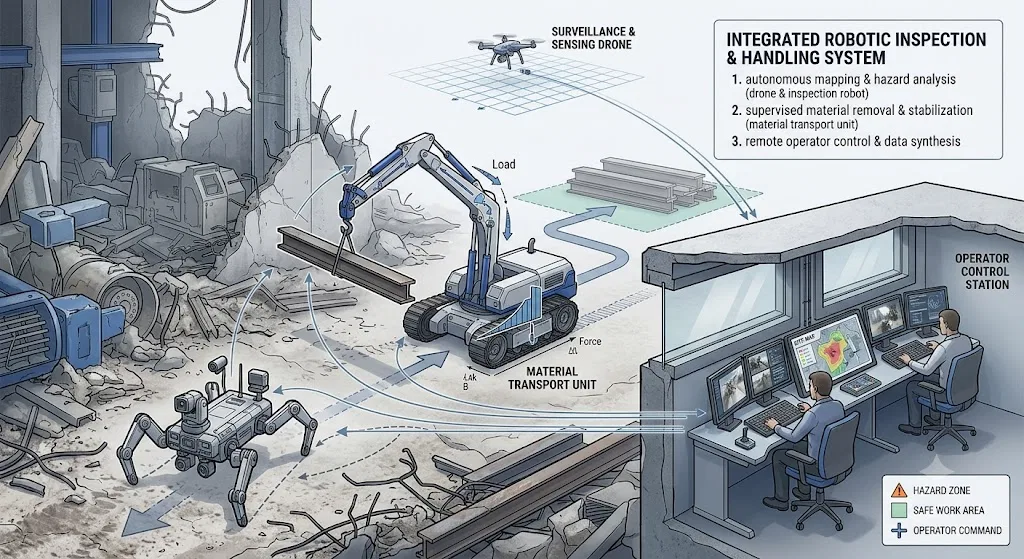
The most promising opportunities are not one universal humanoid doing every task. They are combinations of specialised machines, remote control and limited autonomy designed around particular hazards.
Radioactive and chemically contaminated sites. Nuclear decommissioning presents perhaps the clearest case. Some environments cannot safely be entered by humans at all; in others, staff can work only briefly while wearing cumbersome protective equipment. The OECD Nuclear Energy Agency regards robotic and remote systems as essential in high-radiation decommissioning, both to reduce worker exposure and to avoid generating large volumes of contaminated suits and other protective waste. Robots can map radiation, cut structures, retrieve objects and package material while operators remain behind shielding.[OECD ONE MP]one.oecd.orgOECD ONE MPRadioactive Waste Management Committee Status, Barriers and Cost-Benefits of Robotic and Remote Systems Applications in Nuclea…
Sellafield in Cumbria illustrates why this matters. Its legacy facilities contain poorly characterised radioactive material in buildings that were not designed for modern decommissioning. Remote demolition machines, mechanical arms, underwater vehicles and sensor-carrying quadrupeds are being developed or deployed to inspect and handle material before human entry becomes possible. A recent UK programme has also trialled new robotic techniques for retrieving and treating nuclear waste, reflecting the expectation that remote systems will play an increasing role in a clean-up lasting decades.[gov.uk]GOV.UKInnovative robotics trialled to tackle nuclear waste challenges30, 2026 — Innovative robotics trialled to tackle nuclear waste challenges - GOV.UK Home Environment Waste and recycling Radioactive and…
Mining and underground inspection. Mining combines rock falls, explosives, dust, heavy vehicles and poor visibility. Autonomous haulage trucks already show the value of moving operators away from large machinery, while mobile robots can inspect tunnels for gases, structural damage and other hazards. Yet a NIOSH-funded international review of autonomous and semi-autonomous mining equipment found that automation changes rather than simply removes risk. Safe deployment depends on traffic management, reliable communications, worker training and careful control of interactions between autonomous vehicles and people.[CDC Stacks]stacks.cdc.govStacks Automation Experience with a Global PerspectiveCDC StacksAutomation Experience with a Global Perspective - An Assessment of the Automation Impact on Worker Safety and Health: Final re…
Construction and work at height. Many construction tasks are difficult to automate because each site changes as the project advances. Even so, machines can take over selected high-risk activities: surveying roofs, inspecting bridges, drilling, demolition, moving materials and operating in unstable structures. The immediate opportunity is often not a robot replacing an entire trade, but a machine taking the most dangerous stage of a job while a person plans, supervises or controls it from a safer position.
Agriculture and outdoor labour. Farming remains unusually hazardous because workers operate powerful vehicles and machinery across irregular terrain, often alone and under time pressure. Agricultural robots could reduce exposure to tractor rollovers, pesticide spraying, repetitive harvesting and extreme heat. The attraction is especially strong where labour shortages already exist. But farms are also among the hardest environments for robots: mud, weather, animals, delicate crops, unreliable connectivity and thin profit margins all make deployment more difficult than on a factory floor.[mdpi.com]mdpi.comOpen source on mdpi.com.
Warehouses, factories and waste handling. Industrial robots are already effective at welding, painting, cutting and moving heavy or repetitive loads in controlled settings. AI may extend automation to objects and situations that were previously too variable. In waste sorting, for example, vision systems can identify materials while robotic arms separate items that may be sharp, contaminated or ergonomically damaging to handle. The larger opportunity is to redesign workplaces so that people deal with exceptions, judgement and maintenance rather than standing continuously beside heat, fumes, blades or heavy loads.
These applications suggest a more realistic path than waiting for general-purpose robots to become fully human-like. Dangerous labour can be reduced task by task: first through better sensors and remote control, then through supervised autonomy, and only later through machines capable of handling broad, changing environments.
Why is the real world so difficult for robots?
Modern industrial robots can move faster, lift more and repeat motions more precisely than people. Their apparent competence, however, often depends on a highly engineered environment. Parts arrive in predictable positions. Floors are level. Lighting is controlled. Humans are kept outside fenced cells. The robot is successful partly because uncertainty has been removed from the world around it.
Dangerous work often has the opposite character. A collapsed building, leaking pipe, ageing reactor or muddy farm contains unfamiliar objects, hidden damage, shifting surfaces and incomplete maps. A robot may have to recognise an object, judge whether it is safe to touch, select a grip, apply the right force and recover when something slips. Humans perform such adjustments almost unconsciously. Machines still struggle to combine perception, physical judgement and dexterity reliably across unfamiliar situations.
Robotic manipulation research is advancing through better vision, tactile sensing, simulation and learning from human demonstrations. Yet important gaps remain between laboratory success and dependable field performance. Simulations do not perfectly reproduce friction, deformation or contact forces, so a behaviour learned virtually may fail on real equipment. Dexterous systems can also require large amounts of training data and may not generalise safely to objects or conditions outside their experience.[Frontiers]frontiersin.orgOpen source on frontiersin.org.
Reliability matters more in dangerous settings than in impressive demonstrations. A household robot dropping a cup is inconvenient; a nuclear robot dropping radioactive material can obstruct a clean-up route and become contaminated equipment that another machine must retrieve. Decommissioning specialists therefore face a difficult balance. More autonomy can reduce operator workload and overcome delays in communication, but it can also make failure harder to predict. Remote control is often safer conceptually, yet poor visibility, weak signals and limited tactile feedback make complex manipulation slow and exhausting.[OECD ONE MP]one.oecd.orgOECD ONE MPRadioactive Waste Management Committee Status, Barriers and Cost-Benefits of Robotic and Remote Systems Applications in Nuclea…
This is why the near-term future is likely to involve graduated autonomy rather than an abrupt leap to fully independent robots. A machine might autonomously navigate a known route, hold a tool steady or stop before a collision while a human chooses the objective and handles unusual situations. AI can make the robot more adaptable without removing human authority over every consequential action.
Cost and integration are equally important bottlenecks. The robot itself may be only one part of the expense. Firms may need to redesign layouts, digitise records, install sensors, strengthen networks and train staff. A specialised system is easier to justify when a task is repeated thousands of times, or where human access is impossible, than when the job occurs occasionally at a small construction company or family farm. This creates a risk that large, capital-rich organisations automate hazards while smaller employers and workers in poorer countries remain exposed.
Can robots make work safer without creating new dangers?
Robots do not merely remove hazards; they rearrange them. A worker who no longer welds beside fumes and sparks may instead maintain a powerful automated arm. A driver removed from a mine truck may supervise a fleet of autonomous vehicles whose movements are difficult to anticipate. Technicians may enter robotic cells to clear jams, clean sensors or repair equipment precisely when normal safeguards have been disabled.
US workplace records identified 41 robot-related deaths between 1992 and 2017, most of them in manufacturing. Many involved workers being caught in machinery, often during maintenance, cleaning or other interventions. The number is small compared with the overall burden of occupational injury, but the pattern is important: the most dangerous moment is frequently not routine operation but the boundary between automatic and human work.[CDC Stacks]stacks.cdc.govcdc 230667 DS1cdc 230667 DS1
The US Occupational Safety and Health Administration highlights risks including crushing, trapping, collision, unexpected movement, electrical hazards and failures of tools or grippers. Mobile robots add vehicle-like dangers because they can share aisles and workspaces with people. Preventing harm requires more than reliable AI. It requires physical guarding, emergency stops, speed limits, safe separation, lockout procedures, clear responsibility and designs that remain safe when software, sensors or communications fail.[OSHA]osha.govTechnical Manual (OTMTechnical Manual (OTM
Cybersecurity also becomes an occupational safety issue when physical machinery is networked. A compromised planning system, corrupted software update or loss of communications could produce real movement in a mine, warehouse or chemical plant. Safety-critical robots therefore need stronger assurance than ordinary consumer software: tested operating limits, secure control channels, recorded decisions and an ability to enter a safe state when uncertain.
There is also a danger of measuring success too narrowly. An injury rate may fall while work becomes more stressful because fewer staff must supervise more machinery, respond constantly to alerts or meet a pace set by algorithms. European evidence on earlier industrial robot adoption found no clear improvement in the physical work environment and suggested that work intensity could worsen. The implication is that “robotic safety” must include workload, autonomy and mental health, not just separation from blades and fumes.[arXiv]arxiv.orgOpen source on arxiv.org.
The best designs treat workers as sources of operational knowledge rather than obstacles to automation. The person who performs a hazardous task usually knows its hidden variations, common shortcuts and failure modes. Involving workers and unions in design, testing and incident review can reveal risks that are invisible in a laboratory. It can also distinguish automation that genuinely removes danger from automation that merely transfers the hardest work to maintenance staff, subcontractors or supply-chain workers.
What happens to jobs, wages and purpose?
Historically, mechanisation has often removed particular forms of brutal labour without ending employment. Machines displaced large amounts of human and animal muscle, while new occupations developed around operating, repairing, designing and coordinating them. Living standards rose, but gains were neither immediate nor evenly shared. Workers and regions tied to declining tasks could suffer for years even when society as a whole became richer.
Robotics may repeat this pattern, but the scale could be larger if AI allows machines to perform a broad range of physical and cognitive tasks. Current evidence does not support a simple claim that every robot destroys a job. Automation can lower costs, expand production and create complementary work. It can also replace specific workers, weaken demand for routine labour or shift income from wages towards the owners of machines. Economic studies therefore reach different results depending on the period, country, industry and assumptions used.[World Bank]documents1.worldbank.orgOpen source on worldbank.org.
The moral case for ending dangerous labour becomes weaker if the affected workers simply lose their livelihoods. A refuse sorter, farm worker or warehouse picker may reasonably prefer a safer occupation, but not unemployment, insecure gig work or a prolonged struggle to retrain. “The robot took the dangerous task” and “the worker benefited” are separate claims.
A fair transition would need to connect automation to visible gains for the people whose work is changed. That could include higher wages for supervising and maintaining automated systems, paid retraining, reduced hours without proportional loss of income, strong redundancy protection, portable benefits and public investment in places dependent on vulnerable industries. Where automation produces very large returns with little human labour, broader mechanisms such as social dividends, shared ownership or more generous public services may become increasingly important.
Training alone cannot solve every disruption. A middle-aged worker cannot always move easily into robotics engineering, and an economy does not need an unlimited number of technicians. Transition policy therefore has to support income and bargaining power as well as skills. It should also avoid making safety conditional on a firm’s ability to eliminate jobs: some of the best systems will augment workers by carrying loads, inspecting hazards or stabilising tools rather than replacing an occupation completely.
Work also provides more than wages. It can offer structure, pride, social contact and a sense of contribution. Yet this does not mean dangerous or degrading jobs must be preserved for the sake of meaning. Few people would defend preventable mining deaths or toxic exposure simply because work builds character. The better question is whether society can separate meaningful activity from coerced risk.
In a more automated economy, purpose might come from safer paid work, shorter working weeks, caring, education, craft, community activity or projects that markets currently undervalue. That possibility depends on access to income and time. Without distributional reform, automation could create leisure for machine owners and insecurity for everyone else. With broad ownership and strong institutions, it could allow more people to refuse work that damages their bodies while continuing to contribute in ways they value.
What would count as genuine progress?
The end of dangerous labour should not be judged by the number of robots sold or the spectacle of humanoid machines. It should be judged by human outcomes.
The first measure is exposure removed: fewer people entering high-radiation rooms, breathing dust, spraying toxic chemicals, lifting injurious loads or working close to unstable structures. The second is total safety, including injuries among technicians, cleaners, contractors and people working alongside machines. The third is worker benefit: whether affected people receive higher pay, shorter hours, safer roles or genuine choices rather than dismissal and downward mobility. The fourth is global reach. A robotics bloom confined to wealthy firms would leave much of the world’s dangerous labour untouched.
Public policy can shape these outcomes. Safety regulation can require risk assessment throughout a robot’s life cycle, including maintenance and software updates. Procurement rules can reward technologies that demonstrably reduce exposure. Insurance and inspection systems can discourage firms from using automation to intensify work. Research funding can target socially valuable applications—such as disaster response, decommissioning and agricultural safety—that may not offer the fastest commercial return. International standards and shared technical knowledge could help lower-income countries adopt safer systems without becoming dependent on opaque, unsupported machinery.
The deepest optimistic possibility is not a world in which humans become economically useless. It is one in which civilisation gains enough mechanical capability that exposure to serious bodily harm is no longer treated as an ordinary cost of production. Advanced AI could help robots learn faster, interpret more complicated environments and operate with less detailed programming. Over decades, that may widen the range of physical tasks that can be performed remotely or autonomously.
But intelligence in the machine will not decide who benefits. Ending dangerous labour is partly an engineering project and partly a social choice: which tasks are automated first, how safe systems must be, who owns them, and whether productivity gains buy workers security and freedom. Robotics would contribute to an AI bloom only when it does more than move people out of hazardous workplaces—when it also gives them a fair share of the safer and more abundant world those machines help create.
Amazon book picks
Further Reading
Books and field guides related to Could Robots End the Work Humans Should Not Do?. Use these as the next step if you want deeper reading beyond the article.
The Industries of the Future
The New York Times bestseller, from leading innovation expert Alec Ross, a “fascinating vision” (Forbes) of what’s next for the world and...
The Second Machine Age
A New York Times Bestseller A revolution is under way. In recent years, Google’s autonomous cars have logged thousands of miles on Americ...
The Rise of the Robots: Technology and the Threat of a Jobles...
Updated for the unfolding AI disruption, this prescient classic shows how automation is changing the economy, undermining work, and resha...
Robot Ethics: The Ethical and Social Implications of Robotics
Prominent experts from science and the humanities explore issues in robot ethics that range from sex to war. Robots today serve in many r...
eBay marketplace picks
Marketplace Samples
Live-tested eBay searches with available results related to this page.
Selected fromrobotics kit oneBay.co.uk.



Endnotes
1.
Source: hse.gov.uk
Title: HSEWork-related fatal injuries in Great Britain
Link:https://www.hse.gov.uk/statistics/fatals-overview.htm?v=ACEVOMarch23&v=ACEVOMarch23&v=ACEVOMarch23&v=ACEVOMarch23&v=ACEVOMarch23&v=ACEVOMarch23&v=ACEVOMarch23&v=ACEVOMarch23&v=ACEVOMarch23&v=ACEVOMarch23&v=ACEVOMarch23&v=ACEVOMarch23&v=ACEVOMarch23&v=ACEVOMarch23&v=ACEVOMarch23&v=ACEVOMarch23&v=ACEVOMarch23&v=ACEVOMarch23&v=ACEVOMarch23&v=ACEVOMarch23&v=ACEVOMarch23&v=ACEVOMarch23&v=ACEVOMarch23&v=ACEVOMarch23&v=ACEVOMarch23&v=ACEVOMarch23&v=ACEVOMarch23&v=ACEVOMarch23&v=ACEVOMarch23&v=ACEVOMarch23&v=ACEVOMarch23&v=ACEVOMarch23&v=ACEVOMarch23&v=ACEVOMarch23&v=ACEVOMarch23&v=ACEVOMarch23&v=ACEVOMarch23&v=ACEVOMarch23&v=ACEVOMarch23&v=ACEVOMarch23&v=ACEVOMarch23&v=ACEVOMarch23&v=ACEVOMarch23&v=ACEVOMarch23&v=ACEVOMarch23&v=ACEVOMarch23&v=ACEVOMarch23&v=ACEVOMarch23&v=ACEVOMarch23&v=ACEVOMarch23&v=ACEVOMarch23&v=ACEVOMarch23&v=ACEVOMarch23&v=ACEVOMarch23&v=ACEVOMarch23&v=ACEVOMarch23&v=ACEVOMarch23&v=ACEVOMarch23&v=ACEVOMarch23&v=ACEVOMarch23&v=ACEVOMarch23&v=ACEVOMarch23&v=ACEVOMarch23&v=ACEVOMarch23
Source snippet
HSE Home Statistics Fatal injuries Work-related fatal injuries in Great Britain 126 workers killed in work-related accidents in 2025/26 (...
2.
Source: one.oecd.org
Link:https://one.oecd.org/document/NEA/RWM/R%282022%291/en/pdf
Source snippet
OECD ONE MPRadioactive Waste Management Committee Status, Barriers and Cost-Benefits of Robotic and Remote Systems Applications in Nuclea...
3.
Source: GOV.UK
Title: Innovative robotics trialled to tackle nuclear waste challenges
Link:https://www.gov.uk/government/news/innovative-robotics-trialled-to-tackle-nuclear-waste-challenges
Source snippet
30, 2026 — Innovative robotics trialled to tackle nuclear waste challenges - GOV.UK Home Environment Waste and recycling Radioactive and...
4.
Source: wired.com
Link:https://www.wired.com/story/inside-sellafield-nuclear-waste-decommissioning
Source snippet
The site, operational since the early 1950s, faces significant cleanup challenges, costs £1.9 billion annually to run, and clean-up effor...
5.
Source: stacks.cdc.gov
Title: Stacks Automation Experience with a Global Perspective
Link:https://stacks.cdc.gov/view/cdc/148735
Source snippet
CDC StacksAutomation Experience with a Global Perspective - An Assessment of the Automation Impact on Worker Safety and Health: Final re...
6.
Source: mdpi.com
Link:https://www.mdpi.com/2075-5309/13/11/2885
7.
Source: arxiv.org
Title: arXiv Dexterous Manipulation through Imitation Learning: A Survey
Link:https://arxiv.org/abs/2504.03515
8.
Source: stacks.cdc.gov
Title: cdc 230667 DS1
Link:https://stacks.cdc.gov/view/cdc/230667/cdc_230667_DS1.pdf
9.
Source: osha.gov
Title: Technical Manual (OTM)
Link:https://www.osha.gov/otm/section-4-safety-hazards/chapter-4
10.
Source: osha.gov
Link:https://www.osha.gov/robotics/hazard-evaluation-solutions
11.
Source: arxiv.org
Link:https://arxiv.org/abs/2208.14248
12.
Source: oecd.org
Link:https://www.oecd.org/en/publications/skills-in-the-ai-age_972bd15e-en/full-report/component-4.html
13.
Source: press.hse.gov.uk
Title: hse.gov.uk Latest annual work-related fatalities published – HSE Media Centre
Link:https://press.hse.gov.uk/2026/07/01/latest-annual-work-related-fatalities-published-2/
14.
Source: GOV.UK
Title: www.gov.uk Fatal injuries arising from accidents at work in Great Britain
Link:https://www.gov.uk/government/statistics/fatal-injuries-arising-from-accidents-at-work-in-great-britain-summary-for-april-to-december-2025
15.
Source: GOV.UK
Link:https://www.gov.uk/government/news/new-robot-swabbing-technology-trialled-for-the-first-time-at-sellafield
16.
Source: GOV.UK
Title: www.gov.uk How are [robot dogs]({{ ‘robot-dogs/’ | relative_url }}) helping clean up Sellafield?
Link:https://www.gov.uk/government/case-studies/how-are-robot-dogs-helping-clean-up-sellafield
17.
Source: GOV.UK
Title: health and safety statistics 2024 to 2025 annual release
Link:https://www.gov.uk/government/statistics/health-and-safety-statistics-2024-to-2025-annual-release
18.
Source: arxiv.org
Link:https://arxiv.org/html/2507.11840
19.
Source: GOV.UK
Link:https://www.gov.uk/government/news/rrobo-world-first-demonstrates-the-future-of-nuclear-clean-up-is-in-safe-hands
20.
Source: GOV.UK
Title: www.gov.uk ND A launches pioneering robotics partnership to manage nuclear waste
Link:https://www.gov.uk/government/news/nda-launches-pioneering-robotics-partnership-to-manage-nuclear-waste
21.
Source: mdpi.com
Link:https://www.mdpi.com/1424-8220/25/12/3598
22.
Source: mdpi.com
Link:https://www.mdpi.com/2218-6581/14/3/27
23.
Source: mdpi.com
Link:https://www.mdpi.com/2076-3417/15/1/275
24.
Source: disaster.shiksha
Link:https://disaster.shiksha/safety-philosophy-principles-of-accident-prevention/evolution-industrial-safety-modern-legislation/
25.
Source: cdc.gov
Link:https://www.cdc.gov/niosh/centers/robotics.html
26.
Source: cdc.gov
Link:https://www.cdc.gov/niosh/robotics/about/index.html
27.
Source: arxiv.org
Link:https://arxiv.org/abs/2401.07915
28.
Source: stacks.cdc.gov
Link:https://stacks.cdc.gov/view/cdc/229943
29.
Source: mdpi.com
Link:https://www.mdpi.com/2076-3417/13/6/3717
30.
Source: osha.gov
Link:https://www.osha.gov/enforcement/directives/ted
31.
Source: cdc.gov
Title: [robot safety]({{ ‘robot-safety/’ | relative_url }})
Link:https://www.cdc.gov/niosh/bulletin/2019/robot-safety.html
32.
Source: stacks.cdc.gov
Title: cdc 148735 DS1
Link:https://stacks.cdc.gov/view/cdc/148735/cdc_148735_DS1.pdf
33.
Source: stacks.cdc.gov
Title: cdc 155558 DS1
Link:https://stacks.cdc.gov/view/cdc/155558/cdc_155558_DS1.pdf
34.
Source: stacks.cdc.gov
Title: cdc 229943 DS1
Link:https://stacks.cdc.gov/view/cdc/229943/cdc_229943_DS1.pdf
35.
Source: oecd.org
Link:https://www.oecd.org/en/publications/the-impact-of-ai-on-the-workplace-evidence-from-oecd-case-studies-of-ai-implementation_2247ce58-en.html
36.
Source: one.oecd.org
Link:https://one.oecd.org/document/DSTI/CDEP/MADE%282016%296/FINAL/en/pdf
37.
Source: oecd.org
Link:https://www.oecd.org/en/publications/determinants-and-impact-of-automation_ef425cb0-en.html
38.
Source: oecd.org
Link:https://www.oecd.org/en/publications/the-risk-of-automation-for-jobs-in-oecd-countries_5jlz9h56dvq7-en.html
39.
Source: obis.osha.gov
Link:https://obis.osha.gov/dts/osta/otm/otm_iv/otm_iv_4.html
40.
Source: osha.gov
Link:https://www.osha.gov/robotics/standards
41.
Source: osha.gov
Link:https://www.osha.gov/robotics
42.
Source: osha.gov
Link:https://www.osha.gov/robotics/hazards
43.
Source: osha.gov
Link:https://www.osha.gov/ords/imis/AccidentSearch.search?acc_keyword=%22Robot%22&keyword_list=on
44.
Source: osha.gov
Link:https://www.osha.gov/robotics/resources
45.
Source: obis.osha.gov
Link:https://obis.osha.gov/Publications/Mach_SafeGuard/chapt6.html
46.
Source: hse.gov.uk
Title: Work-related fatal injuries in Great Britain
Link:https://www.hse.gov.uk/statistics/fatals-overview.htm?v=PPC&v=PPC&v=PPC&v=PPC&v=PPC&v=PPC&v=PPC&v=PPC&v=PPC&v=PPC&v=PPC&v=PPC&v=PPC&v=PPC&v=PPC&v=PPC&v=PPC&v=PPC&v=PPC&v=PPC&v=PPC&v=PPC&v=PPC&v=PPC&v=PPC&v=PPC&v=PPC&v=PPC&v=PPC&v=PPC&v=PPC&v=PPC&v=PPC&v=PPC&v=PPC&v=PPC&v=PPC&v=PPC&v=PPC&v=PPC&v=PPC&v=PPC&v=PPC&v=PPC&v=PPC&v=PPC&v=PPC&v=PPC&v=PPC&v=PPC&v=PPC&v=PPC&v=PPC&v=PPC&v=PPC&v=PPC&v=PPC&v=PPC&v=PPC&v=PPC&v=PPC&v=PPC&v=PPC&v=PPC&v=PPC&v=PPC&v=PPC&v=PPC&v=PPC&v=PPC&v=PPC&v=PPC&v=PPC&v=PPC&v=PPC&v=PPC&v=PPC&v=PPC&v=PPC&v=PPC&v=PPC&v=PPC&v=PPC&v=PPC&v=PPC&v=PPC&v=PPC&v=PPC&v=PPC&v=PPC&v=PPC&v=PPC&v=PPC&v=PPC&v=PPC&v=PPC&v=PPC&v=PPC&v=PPC&v=PPC&v=PPC&v=PPC&v=PPC&v=PPC&v=PPC&v=PPC&v=PPC&v=PPC&v=PPC&v=PPC&v=PPC&v=PPC&v=PPC&v=PPC&v=PPC&v=PPC&v=PPC&v=PPC&v=PPC&v=PPC&v=PPC&v=PPC&v=PPC&v=PPC&v=PPC&v=PPC&v=PPC&v=PPC
47.
Source: hse.gov.uk
Title: Work-related fatal injuries in Great Britain
Link:https://www.hse.gov.uk/statistics/fatals-overview.htm?layout=default&layout=default&layout=default&layout=default
48.
Source: arxiv.org
Link:https://arxiv.org/pdf/2408.10887
49.
Source: oecd.ai
Title: The Future of Work
Link:https://oecd.ai/en/working-group-future-of-work
50.
Source: vzd.mddsz.gov.si
Link:https://vzd.mddsz.gov.si/uploads/gradiva/9_HWC%202023-25/ILO_Report_EN.pdf
51.
Source: ilo.org
Link:https://www.ilo.org/sites/default/files/2024-04/ILO_SafeDay24_Report_r11_0.pdf
Source snippet
Workers across different sectors are exposed to these hazards but some workers, such as agri...
52.
Source: frontiersin.org
Link:https://www.frontiersin.org/journals/robotics-and-ai/articles/10.3389/frobt.2024.1455431/full
53.
Source: documents1.worldbank.org
Link:https://documents1.worldbank.org/curated/en/269231544735360818/pdf/Robots-Tasks-and-Trade.pdf
54.
Source: worldbank.org
Link:https://www.worldbank.org/en/news/press-release/2025/07/01/new-technologies-have-boosted-employment-in-east-asia-and-pacific-but-reforms-needed-to-ensure-continued-job-creating-gr
55.
Source: ilo.org
Title: IL O Live
Link:https://www.ilo.org/meetings-and-events/revolutionizing-health-and-safety-role-ai-and-digitalization-work
56.
Source: ieeexplore.ieee.org
Link:https://ieeexplore.ieee.org/document/10682597
57.
Source: blogs.worldbank.org
Title: What we re reading about the age of AI jobs and inequality
Link:https://blogs.worldbank.org/en/jobs/What-we-re-reading-about-the-age-of-AI-jobs-and-inequality
58.
Source: frontiersin.org
Link:https://www.frontiersin.org/journals/robotics-and-ai/articles/10.3389/frobt.2023.1277360/full
59.
Source: blogs.worldbank.org
Title: technology employment trade industry automation and income effects
Link:https://blogs.worldbank.org/en/developmenttalk/technology-employment-trade-industry-automation-and-income-effects
60.
Source: ilo.org
Link:https://www.ilo.org/resource/news/ai-and-digitalization-are-transforming-safety-and-health-work
61.
Source: ilo.org
Link:https://www.ilo.org/media/526461/download
62.
Source: researchrepository.ilo.org
Title: Revolutionizing health and safety the role
Link:https://researchrepository.ilo.org/esploro/outputs/report/Revolutionizing-health-and-safety-the-role/995649731702676
63.
Source: ilo.org
Link:https://www.ilo.org/publications/revolutionizing-health-and-safety-role-ai-and-digitalization-work
64.
Source: openknowledge.worldbank.org
Link:https://openknowledge.worldbank.org/server/api/core/bitstreams/811165b6-3c51-4acb-8e09-9f5aa6364106/content
65.
Source: openknowledge.worldbank.org
Link:https://openknowledge.worldbank.org/bitstreams/811165b6-3c51-4acb-8e09-9f5aa6364106/download
66.
Source: openknowledge.worldbank.org
Link:https://openknowledge.worldbank.org/bitstream/handle/10986/33301/Is-Automation-Labor-Displacing-in-the-Developing-Countries-Too-Robots-Polarization-and-Jobs.pdf
67.
Source: documents1.worldbank.org
Link:https://documents1.worldbank.org/curated/en/936911581022089414/txt/Is-Automation-Labor-Displacing-in-the-Developing-Countries-Too-Robots-Polarization-and-Jobs.txt
68.
Source: worldbank.org
Link:https://www.worldbank.org/en/region/eap/publication/future-jobs
69.
Source: frontiersin.org
Link:https://www.frontiersin.org/journals/robotics-and-ai/articles/10.3389/frobt.2024.1455431/pdf
70.
Source: osha.prod.pace.dol.gov
Link:https://osha.prod.pace.dol.gov/robotics/standards
71.
Source: osha.prod.pace.dol.gov
Link:https://osha.prod.pace.dol.gov/robotics
72.
Source: ieeexplore.ieee.org
Link:https://ieeexplore.ieee.org/abstract/document/11317793
Additional References
73.
Source: thetimes.com
Link:https://www.thetimes.com/uk/science/article/sellafield-nuclear-waste-robot-dogs-contamination-nx2klbv0j
Source snippet
These quadruped robots are now being used to detect radioactive contamination, reducing human exposure to dangerous environments. Traditi...
74.
Source: youtube.com
Link:https://www.youtube.com/watch?v=7uodyx4lrbI
Source snippet
May 2026 Safety Updates - Engineering the Hazard Out: Using Robotics to Prevent Workplace Injuries...
Published: May 2026
75.
Source: youtube.com
Link:https://www.youtube.com/watch?v=blrbgmq5BLU
Source snippet
How AI, robots and other cutting-edge technologies can keep workers safe and sound...
76.
Source: youtube.com
Title: How Do Robotics Applications Enhance Workplace Safety?
Link:https://www.youtube.com/watch?v=_ge_CwMRqGo
Source snippet
The Ultimate Guide to Robots in Hazardous Environments: Key Applications Explained...
77.
Source: osti.gov
Link:https://www.osti.gov/servlets/purl/1981412
78.
Source: youtube.com
Title: How Do Robots Improve Human Safety In Dangerous Jobs?
Link:https://www.youtube.com/watch?v=0b2VdieRGGk
Source snippet
How Do Robotics Applications Enhance Workplace Safety?...
79.
Source: academia.edu
Link:https://www.academia.edu/117586127/Catalysing_Construction_Safety_A_Comparative_Analysis_of_Technological_Advancements_across_High_Risk_Industries
80.
Source: researchgate.net
Link:https://www.researchgate.net/publication/369273978_[Development
81.
Source: etradeforall.org
Link:https://etradeforall.org/news/ai-and-digitalization-are-transforming-safety-and-health-work
82.
Source: uncclearn.org
Link:https://www.uncclearn.org/wp-content/uploads/library/ILO_SafeDay24_Report_r11_0.pdf