Within Inverse design
Why inverse design changes materials discovery
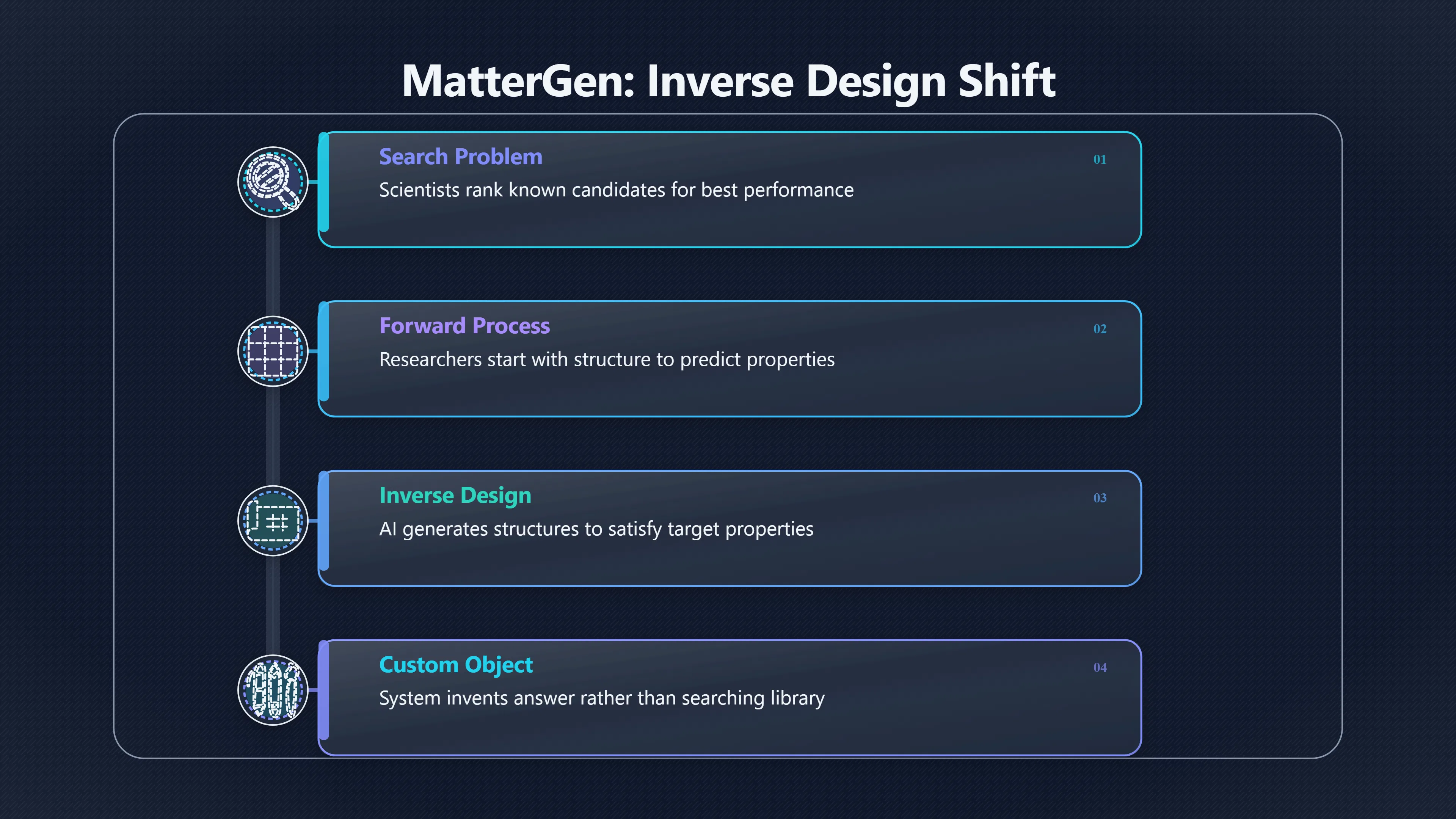
MatterGen changes the question from ranking known candidates to generating structures aimed at desired properties from the start.
On this page
- How conventional screening searches chemical space
- What inverse design asks AI to do differently
- Why the shift matters for batteries, magnets and catalysts
Page outline Jump by section
Introduction
Materials discovery has traditionally worked like a giant search problem. Scientists propose candidate substances, simulate or test them, and then rank the results. MatterGen represents a different ambition. Instead of asking which known or plausible material performs best, it starts with the properties researchers want and attempts to generate materials designed around those goals from the outset. This shift is known as inverse design.
 The distinction matters because the space of possible materials is vastly larger than the number humanity has explored. If advanced AI systems can move from screening candidates to generating structures aimed at specific outcomes, they could help accelerate some of the hardest bottlenecks in energy, computing, manufacturing and climate technology. MatterGen does not eliminate the need for experiments or physics, but it changes where the search begins and how researchers navigate chemical space.[Nature]nature.comA generative model for inorganic materials designby C Zeni · 2025 · Cited by 679 — We present MatterGen, a model that generates sta…[arXiv]arxiv.orgarXiv Matter Gen: a generative model for inorganic materials designarXiv Matter Gen: a generative model for inorganic materials design
How conventional screening searches chemical space
For most of modern materials science, discovery has followed a forward process.[github.com]github.comGit Hubgoogle-deepmind/materials_discoverygoogle-deepmind/materials_discovery - GNoMEWith results recently published, this repository serves to share the discovery of 381,000 nove…
Researchers begin with a crystal structure, chemical composition or family of compounds. They then estimate properties such as conductivity, magnetism, stability or strength. The question is essentially:
Given this material, what can it do?
Machine learning has already improved this workflow. Instead of running expensive calculations on every candidate, AI models can rapidly predict which materials are worth deeper investigation. Systems such as Google’s GNoME dramatically expanded the number of candidate materials available for screening by predicting millions of possible crystal structures and identifying hundreds of thousands likely to be stable.[Google DeepMind]deepmind.googleGoogle Deep Mind Millions of new materials discovered with deep learningGoogle DeepMindMillions of new materials discovered with deep learningNovember 29, 2023 — 29 Nov 2023 — AI tool GNoME finds 2.2 million n…[GitHub This is a significant advance]github.comGit Hubgoogle-deepmind/materials_discoverygoogle-deepmind/materials_discovery - GNoMEWith results recently published, this repository serves to share the discovery of 381,000 nove…, but it still resembles a search-and-rank process. Researchers generate or collect large numbers of candidates and then filter them according to desired criteria.
The challenge is scale. Even with powerful computers, the number of possible inorganic materials is effectively enormous. Many technologically useful materials require balancing multiple properties at once:
- High conductivity but low cost.
- Strong magnetism without rare elements.
- High battery energy density without instability.
- Catalytic performance without toxic ingredients.
A screening system may help identify good options among candidates already considered, but it can still spend much of its effort exploring vast regions of chemical space that ultimately do not contain what researchers need.[ScienceDirect]sciencedirect.comHas generative artificial intelligence solved inverse…by H Park · 2024 · Cited by 96 — We provide a perspective on progre…
What inverse design asks AI to do differently
Inverse design reverses the problem.
Instead of starting with a structure and predicting its properties, researchers begin with target properties and ask AI to propose structures capable of producing them.
The question becomes:
What material could satisfy these requirements?
MatterGen was built around this idea. Using a diffusion-based generative model, it creates crystal structures by gradually constructing atom types, positions and lattice arrangements. Researchers can then steer generation towards specific goals through fine-tuning and property constraints.[Nature]nature.comAn autonomous laboratory for the accelerated synthesis of…29 Nov 2023 — We introduce the A-Lab, an autonomous laboratory for the…[arXiv]arxiv.orgAI-driven inverse design of materials: Past, present and future14 Nov 2024 — This survey provides the latest overview of AI-driven i…
In practical terms, a researcher might request a material that combines:
- High magnetic density.
- Low supply-chain risk.
- Structural stability.
- Particular symmetry properties.
Rather than screening millions of existing candidates, the model attempts to generate entirely new candidates aligned with those requirements. Microsoft’s researchers demonstrated this capability by producing materials aimed at combinations of desired magnetic and chemical characteristics.[arXiv]arxiv.orgarXiv Matter Gen: a generative model for inorganic materials designarXiv Matter Gen: a generative model for inorganic materials design
The conceptual difference is similar to the difference between searching a catalogue and designing a custom object.
Screening asks whether a suitable answer already exists somewhere in a large library.
Inverse design asks AI to help invent an answer.
Why this changes the economics of discovery
The most important consequence is not merely speed.
Screening systems become more valuable as databases grow. Inverse-design systems become more valuable if they can expand the set of possibilities beyond what researchers would have considered.
That matters because many technological bottlenecks are materials bottlenecks.
A battery engineer may need a combination of properties that existing materials cannot simultaneously provide. A clean-energy researcher may want catalysts that are both efficient and made from abundant elements. Semiconductor designers may require compounds with highly unusual electrical behaviour.
In conventional workflows, researchers often make incremental changes to known materials and hope improvements emerge. Inverse design aims to search directly for the desired outcome.[ScienceDirect]sciencedirect.comHas generative artificial intelligence solved inverse…by H Park · 2024 · Cited by 96 — We provide a perspective on progre…
For advocates of AI-enabled scientific acceleration, this is one of the more interesting possibilities. Economic growth is often constrained not only by manufacturing capacity or labour but by the rate at which civilisation discovers new physical capabilities. Better materials can unlock entirely new engineering options, from power systems to medical devices.
If AI systems become substantially better at proposing useful materials, they could accelerate multiple industries simultaneously rather than improving only one application area.
Batteries, magnets and catalysts as test cases
The value of inverse design becomes easiest to understand through examples.

Batteries
Battery materials often require balancing competing demands.
A promising battery material may need high ionic conductivity, chemical stability, safety, affordability and manufacturability. Improving one characteristic frequently worsens another.
Traditional screening searches for compounds that happen to satisfy these requirements. Inverse design instead attempts to generate candidates optimised around the combination itself. Researchers working on materials discovery increasingly view this as a route towards finding chemistries that would be unlikely to emerge from intuition-driven exploration alone.[arXiv]arxiv.orgarXiv Matter Gen: a generative model for inorganic materials designarXiv Matter Gen: a generative model for inorganic materials design
Magnets
High-performance magnets are strategically important for electric vehicles, robotics, wind turbines and advanced electronics.
Many current magnets depend on rare-earth elements with supply-chain vulnerabilities. MatterGen’s researchers highlighted the possibility of generating materials with desired magnetic properties while also reducing dependence on scarce or geopolitically sensitive ingredients.[arXiv]arxiv.orgarXiv Matter Gen: a generative model for inorganic materials designarXiv Matter Gen: a generative model for inorganic materials design
This illustrates a broader advantage of inverse design: the optimisation target can include economic and geopolitical constraints, not just physical performance.
Catalysts
Catalysts accelerate chemical reactions and are central to industrial chemistry, fertiliser production, energy systems and carbon-management technologies.
Finding better catalysts often means discovering materials that satisfy several requirements simultaneously: activity, durability, cost and abundance.
Because inverse-design systems can target multiple objectives at once, they are especially attractive for catalyst discovery, where the most useful solution may not resemble existing materials families.[ScienceDirect]sciencedirect.comHas generative artificial intelligence solved inverse…by H Park · 2024 · Cited by 96 — We provide a perspective on progre…
Why generation does not replace screening
The contrast between MatterGen and screening can be overstated.
In practice, the two approaches are increasingly becoming parts of the same pipeline rather than rivals.
A generative system may propose novel materials. Those proposals still need evaluation through simulation, screening and eventually physical experiments. Even highly promising candidates can fail because they are difficult to synthesise, unstable under real-world conditions or economically impractical.[Nature]nature.comA generative model for inorganic materials designby C Zeni · 2025 · Cited by 679 — After fine-tuning, MatterGen suc- cessfully generates…
Likewise, screening systems remain valuable because they provide the feedback needed to judge generated candidates.
A likely future workflow looks more like:

- Generative AI proposes candidate materials.
- Screening models evaluate them rapidly.
- Physics-based calculations test the most promising options.
- Automated laboratories attempt synthesis.
- Experimental results feed back into the models.
Researchers at Lawrence Berkeley National Laboratory’s autonomous A-Lab have already demonstrated parts of this broader vision by combining AI-guided discovery with robotic synthesis systems. Nature[Time]time.comTheir AI tool, GNoME, was trained with data from the Materials Project and has accurately predicted 381,000 stable materials, significant…
The deeper shift is therefore not that screening disappears. It is that screening increasingly becomes one stage inside a larger generative discovery loop.
The limits of the current approach
MatterGen is an important research result, but it should not be mistaken for a machine that can invent any desired material on demand.
Several bottlenecks remain.
First, useful materials data are limited compared with the datasets that power modern language models. Many properties have sparse experimental measurements.[arXiv]arxiv.orgarXiv Matter Gen: a generative model for inorganic materials designarXiv Matter Gen: a generative model for inorganic materials design
Second, stability is only one requirement. A material can be theoretically stable and still fail to be manufacturable, economical or useful in commercial devices.[Time]time.comTheir AI tool, GNoME, was trained with data from the Materials Project and has accurately predicted 381,000 stable materials, significant…
Third, materials innovation often depends on processing methods, defects, interfaces and manufacturing techniques rather than chemical composition alone. Designing a crystal structure is only part of the challenge.[arXiv]arxiv.orgarXiv Matter Gen: a generative model for inorganic materials designarXiv Matter Gen: a generative model for inorganic materials design
Finally, there is a difference between generating candidates and transforming industries. Many proposed materials may never leave the laboratory. The history of materials science contains numerous discoveries that took decades to become commercially significant.
Why the screening shift matters for AI bloom
Within the broader idea of AI-enabled human flourishing, MatterGen is interesting because it illustrates a possible transition from prediction systems to invention systems.
Screening technologies help humanity evaluate options more efficiently. Inverse-design technologies attempt to expand the option set itself.
That distinction becomes increasingly important if advanced AI begins accelerating science across many domains simultaneously. Better batteries, cleaner energy infrastructure, improved semiconductors, stronger lightweight materials and more efficient catalysts are not isolated achievements. They influence the physical foundations of economic abundance.
MatterGen does not show that AI can automatically solve materials science. What it does suggest is that AI systems may increasingly participate in a more creative stage of discovery: proposing new structures aimed at human goals rather than merely ranking known possibilities. If that capability continues to improve, the long-term significance may be less about searching faster through existing knowledge and more about enlarging the range of technologies civilisation can realistically build.[Nature]nature.comA generative model for inorganic materials designby C Zeni · 2025 · Cited by 679 — We present MatterGen, a model that generates sta…
Amazon book picks
Further Reading
Books and field guides related to Why inverse design changes materials discovery. Use these as the next step if you want deeper reading beyond the article.
The Master Algorithm
Explains how learning systems search patterns and generate solutions from goals.
Stuff Matters
Shows why target properties such as strength, conductivity and durability matter.
The Alchemy of Us
Places inverse design within the larger history of materials changing civilisation.
Possible Minds
Provides wider context for how machine intelligence may change creative and scientific search.
eBay marketplace picks
Marketplace Samples
Example marketplace items related to this page. Use the search link to explore similar finds on eBay.


Endnotes
1.
Source: nature.com
Link:https://www.nature.com/articles/s41586-025-08628-5
Source snippet
A generative model for inorganic materials designby C Zeni · 2025 · Cited by 679 — We present MatterGen, a model that generates sta...
2.
Source: arxiv.org
Title: arXiv Matter Gen: a generative model for inorganic materials design
Link:https://arxiv.org/abs/2312.03687
3.
Source: sciencedirect.com
Link:https://www.sciencedirect.com/science/article/pii/S259023852400242X
Source snippet
Has generative artificial [intelligence]({{ 'intelligence/' | relative_url }}) solved inverse...by H Park · 2024 · Cited by 96 — We provide a perspective on progre...
4.
Source: deepmind.google
Title: Google Deep Mind Millions of new materials discovered with deep learning
Link:https://deepmind.google/blog/millions-of-new-materials-discovered-with-deep-learning/
Source snippet
Google DeepMindMillions of new materials discovered with deep learningNovember 29, 2023 — 29 Nov 2023 — AI tool GNoME finds 2.2 million n...
Published: November 29, 2023
5.
Source: github.com
Title: Git Hubgoogle-deepmind/materials_discovery
Link:https://github.com/google-deepmind/materials_discovery
Source snippet
google-deepmind/materials_discovery - GNoMEWith results recently published, this repository serves to share the discovery of 381,000 nove...
6.
Source: time.com
Link:https://time.com/6340681/deepmind-gnome-ai-materials/
Source snippet
Their AI tool, GNoME, was trained with data from the Materials Project and has accurately predicted 381,000 stable materials, significant...
7.
Source: arxiv.org
Link:https://arxiv.org/html/2411.09429v1
Source snippet
AI-driven inverse design of materials: Past, present and future14 Nov 2024 — This survey provides the latest overview of AI-driven i...
8.
Source: microsoft.com
Title: mattergen a generative model for inorganic materials design
Link:https://www.microsoft.com/en-us/research/publication/mattergen-a-generative-model-for-inorganic-materials-design/
Source snippet
MatterGen: a generative model for inorganic materials design6 Dec 2023 — We present MatterGen, a model that generates stable, diverse ino...
9.
Source: nature.com
Link:https://www.nature.com/articles/s41586-023-06734-w
Source snippet
An autonomous laboratory for the accelerated synthesis of...29 Nov 2023 — We introduce the A-Lab, an autonomous laboratory for the...
10.
Source: microsoft.com
Title: mattergen a new paradigm of materials design with generative ai
Link:https://www.microsoft.com/en-us/research/blog/mattergen-a-new-paradigm-of-materials-design-with-generative-ai/
Source snippet
MatterGen: A new paradigm of materials design with...16 Jan 2025 — MatterGen enables a new paradigm of generative AI-assisted materials...
11.
Source: microsoft.com
Link:https://www.microsoft.com/en-us/research/video/mattergen-a-generative-model-for-materials-design/
Source snippet
MatterGen: A Generative Model for Materials DesignTian Xie introduces MatterGen, a generative model that creates new inorganic materials...
12.
Source: nature.com
Link:https://www.nature.com/articles/s41586-025-08628-5_reference.pdf
Source snippet
A generative model for inorganic materials designby C Zeni · 2025 · Cited by 679 — After fine-tuning, MatterGen suc- cessfully generates...
13.
Source: wired.com
Title: Google Deep Mind’s AI Dreamed Up 380,000 New Materials
Link:https://www.wired.com/story/an-ai-dreamed-up-380000-new-materials-the-next-challenge-is-making-them
Source snippet
The Next Challenge Is Making ThemGoogle DeepMind developed an AI program, GNoME, which has predicted 380,000 new stable materials, expand...
Additional References
14.
Source: scribd.com
Link:https://www.scribd.com/document/752085993/s41586-023-06735-9
Source snippet
Advancing Materials Discovery with GNoME | PDFBy guiding searches with neural networks, we are able to use diversified stability (decompo...
15.
Source: medium.com
Link:https://medium.com/%40musicalchemist/how-ai-is-revolutionizing-material-discovery-meet-mattergen-ceb7d3156128
Source snippet
How AI is Revolutionizing Material DiscoveryMatterGen is a diffusion-based generative model tailored to handle the complexity of crystall...
16.
Source: cypris.ai
Link:https://www.cypris.ai/insights/ai-accelerated-materials-discovery-in-2025-how-generative-models-graph-neural-networks-and-autonomous-labs-are-transforming-r-d
Source snippet
How Generative Models, Graph Neural Networks, and...Google DeepMind released GNoME (Graph Networks for Materials Exploration), predictin...
17.
Source: facebook.com
Link:https://www.facebook.com/ItisaScience/posts/in-a-single-computational-discovery-campaign-google-deepminds-gnome-graph-networ/122218707482051326/
Source snippet
It's ScienceIn a groundbreaking leap for materials science, researchers at DeepMind have developed an AI system called GNoME (Graph Netwo...
18.
Source: medium.com
Link:https://medium.com/data-science-in-your-pocket/microsoft-mattergen-ai-model-for-material-design-and-discovery-4d1b74ba4cfe
Source snippet
Microsoft MatterGen: AI model for material design and...Unlike traditional methods, which are slow and costly, MatterGen accelerates inn...
19.
Source: youtube.com
Link:https://www.youtube.com/watch?v=yKJQJDehrko
Source snippet
MatterGen: a generative model for inorganic materials design...MatterGen: a generative model for inorganic materials design by Daniel Zü...
20.
Source: thelab.brookesbell.com
Title: googles deepmind ai tool makes material science breakthrough 158802
Link:https://thelab.brookesbell.com/about/news/googles-deepmind-ai-tool-makes-material-science-breakthrough-158802/
Source snippet
brookesbell.comGoogle's DeepMind AI Tool Makes Material Science...14 Dec 2023 — Of the 2.2 million new crystals discovered by GNoME appr...
21.
Source: researchgate.net
Title: 388093762 A generative model for inorganic materials design
Link:https://www.researchgate.net/publication/388093762_A_generative_model_for_inorganic_materials_design
Source snippet
(PDF) A generative model for inorganic materials design16 Jan 2025 — Here we present MatterGen, a model that generates stable, diverse in...
22.
Source: linkedin.com
Title: Revolutionizing Materials Discovery with Generative AIThe
Link:https://www.linkedin.com/pulse/mattergen-revolutionizing-materials-discovery-ai-majdi-srasra-78syf
Source snippet
introduction of MatterGen heralds a transformative era in materials science. By directly generating novel materials based on user-defined...
23.
Source: inorgmatchem.com
Title: Generative AI for Inverse Materials Design
Link:https://www.inorgmatchem.com/posts/generative-ai-for-inverse-materials-design-models-applications-and-breakthroughs
Source snippet
Inorganic Matrix26 Nov 2025 — MatterGen more than doubles the percentage of generated stable, unique, and new materials compared to previ...
Topic Tree