Within Robot labs
How robot labs learn what to test next
Closed-loop labs matter because they try to make experimentation adaptive, letting each result guide what the robot tests next.
On this page
- The discovery loop from hypothesis to result
- Active learning and experimental choice
- Where automation helps and where humans still matter
Page outline Jump by section
Introduction
The central promise of a closed-loop laboratory is not that robots can run experiments faster. It is that the laboratory can learn from each result and use that information to decide what to test next.
 In a traditional research programme, scientists often spend days or weeks interpreting results, debating hypotheses, designing follow-up experiments and scheduling equipment. A closed-loop system attempts to compress that cycle. Software analyses the latest data, updates its model of the problem, chooses the most useful next experiment and sends instructions directly to laboratory equipment. The result is an adaptive discovery process in which every experiment influences the next one.[ScienceDirect]sciencedirect.comThis feedback loop is…
This matters because many of the scientific challenges associated with an AI-enabled future involve enormous search spaces. There may be millions of possible battery materials, catalysts, drug candidates or synthesis conditions. The bottleneck is often not generating ideas but deciding which tiny fraction of possibilities deserve real-world testing. Closed-loop laboratories are an attempt to make that choice more systematically and more quickly than human researchers can manage alone.[ACS Publications]pubs.acs.orgOne of the most common strategies today for SDL experimental planning is Bayesian optimization (BO)…Read more…[Nature]nature.comAn autonomous laboratory for the accelerated synthesis of…29 Nov 2023 — Here we present the A-Lab, an autonomous laboratory that…
The discovery loop from hypothesis to result
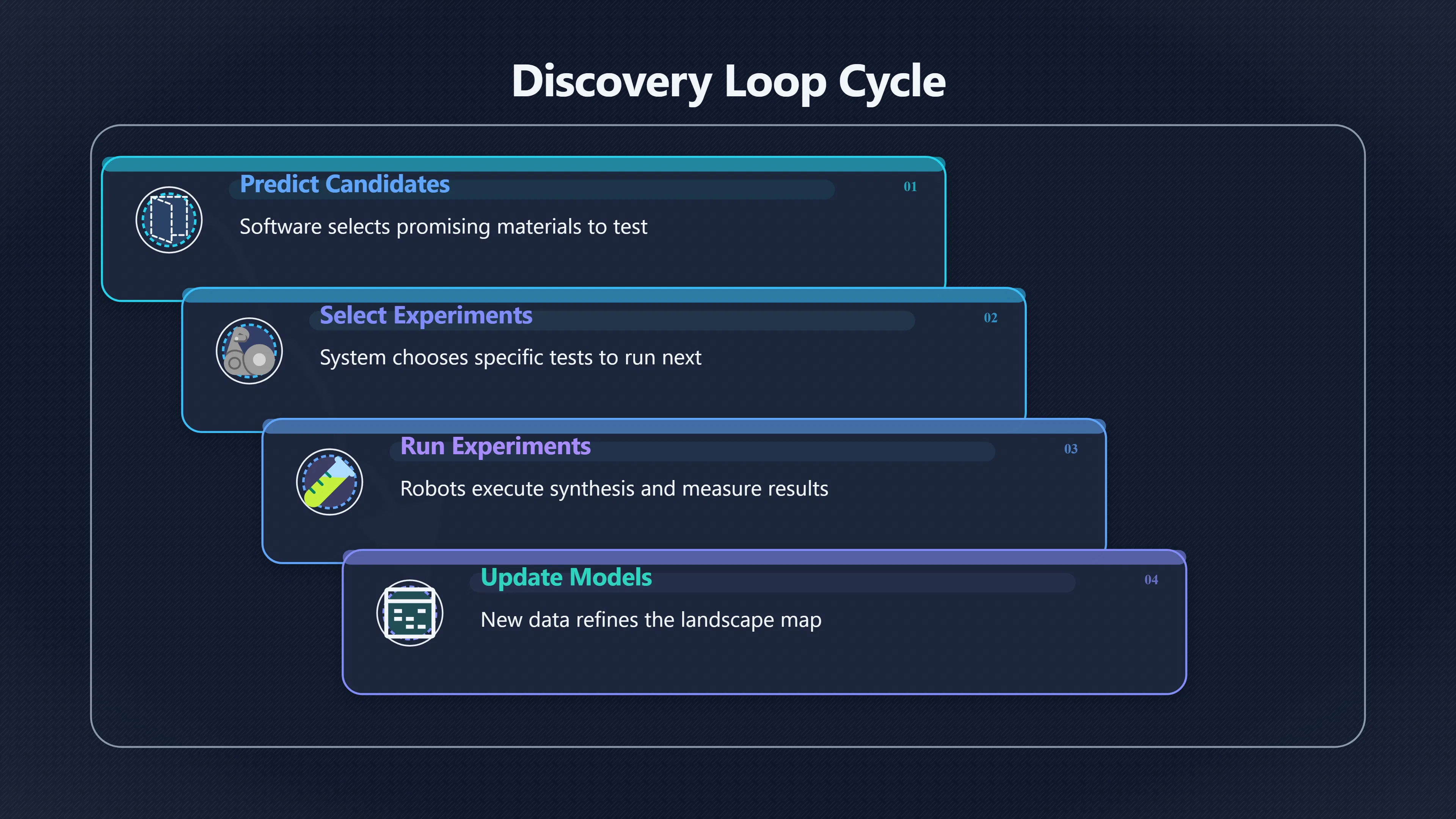
A closed-loop laboratory is often described as a self-driving lab because it repeatedly cycles through the same sequence:
- Predict promising candidates.[2. Select experiments.]pubs.rsc.orgSelf-driving labs, or systems that select experiments…Read more… 3. Run experiments with robotic equipment.[facebook.com]facebook.comAutonomous labs accelerate research with ai and roboticsThe automated laboratories use machine learning to design experiments, robotic sy…
- Measure outcomes.
- Update models.
- Choose the next experiments.
The key step is the fifth. After receiving new data, the system does not simply record the result. It updates its beliefs about the scientific landscape it is exploring. A material that performed unexpectedly well may cause the system to search nearby chemical combinations. A failed synthesis may teach it to avoid an entire region of the search space.[Nature]nature.comOn-the-fly closed-loop materials discovery via Bayesian…by AG Kusne · 2020 · Cited by 505 — We demonstrate an autonomous materia…
Researchers often compare this process to navigation. Imagine trying to find the highest mountain in a continent hidden by fog. Random searching wastes time. A closed-loop system instead uses each observation to estimate where the peaks might be and then decides where to look next. The goal is not only to find a good answer but to learn the shape of the landscape while searching.[ACS Publications]pubs.acs.orgOne of the most common strategies today for SDL experimental planning is Bayesian optimization (BO)…Read more…
This is why many autonomous laboratories are described as active learning systems. The experiment itself becomes part of the learning algorithm. Rather than treating experiments as isolated tests, the lab treats them as information-gathering actions that improve future decisions.[arXiv]arxiv.orgSource details in endnotes.
Active learning and experimental choice
The hardest question in a self-driving laboratory is often not “What happened?” but “What should we do next?”
Exploration versus exploitation
Most autonomous laboratories face a classic dilemma.
One option is exploitation: perform experiments that seem most likely to succeed according to current knowledge.
The other is exploration: test uncertain possibilities that could reveal something entirely new.
A laboratory that only exploits may get trapped in a local optimum, repeatedly improving a mediocre result. A laboratory that only explores may waste resources wandering through unlikely possibilities. The challenge is balancing both goals.[ACS Publications]pubs.acs.orgOne of the most common strategies today for SDL experimental planning is Bayesian optimization (BO)…Read more…
This trade-off appears throughout scientific discovery. Human researchers make similar judgments intuitively. Closed-loop systems attempt to formalise the process mathematically.
Bayesian optimisation
One of the most common methods is Bayesian optimisation, which has become a core technique in self-driving laboratories.[ACS Publications]pubs.acs.orgOne of the most common strategies today for SDL experimental planning is Bayesian optimization (BO)…Read more…[RSC Publishing]pubs.rsc.orgPublishing Atlas: a brain for self-driving laboratoriesRSC PublishingAtlas: a brain for self-driving laboratories - RSC Publishingby RJ Hickman · 2025 · Cited by 50 — We report Atlas, an appli…
The basic idea is simple.
Instead of assuming it already knows the best experiment, the system maintains a probability distribution over possible outcomes. It estimates both:
- Which regions seem promising.
- How uncertain those estimates are.
An experiment can therefore be valuable for two different reasons. It might be predicted to produce excellent results, or it might reduce uncertainty in an important area. Bayesian optimisation attempts to balance these considerations automatically.[ACS Publications]pubs.acs.orgOne of the most common strategies today for SDL experimental planning is Bayesian optimization (BO)…Read more…
In practice, this means a laboratory may deliberately choose an experiment that is not expected to be the best performer because the information gained could improve future decisions. This is one reason autonomous labs can sometimes outperform straightforward trial-and-error approaches while using fewer experiments.[Nature]nature.comThe ADePT framework for assessing autonomous…by P Salazar-Villacis · 2026 — Studies in robotics and chemical automation outline…
Learning from failure
An important feature of active learning systems is that negative results can be highly valuable.
Human researchers often focus attention on successful experiments. Closed-loop systems instead treat every outcome as information. A failed synthesis, an unstable material or a poor-performing catalyst can narrow the search space and improve the model’s understanding.[Nature]nature.comA flexible and affordable self-driving laboratory for…by S Pilon · 2026 · Cited by 1 — Through this interface, users can select experi…
Researchers behind the CAMEO autonomous materials platform described this as helping scientists “fail smarter”. The system continuously updates its model from both successes and failures, allowing it to learn faster from limited experimental budgets.[Nature]nature.comSelf-driving labs and automation software for chemistry and…7 Feb 2024 — This cross-journal collection is dedicated to the development…
That feature matters for the broader scientific acceleration story. Many important research problems are dominated by failed experiments. If AI systems can extract more knowledge from each failure, the effective rate of scientific learning may increase even when experimental resources remain limited.
Why the next experiment is often more valuable than the current one
A useful way to understand closed-loop laboratories is to think of experiments as investments.
The immediate result matters, but the larger value may come from improving future choices.
Suppose a materials laboratory has ten thousand candidate compounds. Testing one compound reveals something about that material. Testing a carefully chosen compound may reveal information about hundreds of related candidates. The second experiment has a larger informational return even if the material itself is not exceptional.[ACS Publications]pubs.acs.orgOne of the most common strategies today for SDL experimental planning is Bayesian optimization (BO)…Read more…
This is one reason autonomous labs are often evaluated by efficiency rather than raw throughput. The question is not merely how many experiments they perform. It is how much useful knowledge they gain per experiment.[ScienceDirect]sciencedirect.comThis feedback loop is…
Supporters argue that this distinction is easy to miss. A robot that runs ten thousand random experiments may produce less scientific value than a system that runs one hundred carefully chosen experiments guided by active learning. The promise of closed-loop research is therefore intelligence applied to experimentation, not automation alone.[ScienceDirect]sciencedirect.comThis feedback loop is…
Real examples of adaptive experiment selection
Several prominent self-driving laboratory projects already use versions of this approach.[emergentmind.com]emergentmind.comself driving laboratoriesSelf-Driving LaboratoriesNov 21, 2025 — Self-driving laboratories use autonomous robotics and Bayesian optimization to rapidly design, ex…
The CAMEO materials-discovery platform combined real-time experiments with Bayesian active learning to identify promising phase-change materials. Rather than following a fixed experimental sequence, the system updated its search strategy after each measurement. Researchers reported that experimental cycles could occur within seconds or minutes, allowing rapid adaptation.[Nature]nature.comAn autonomous laboratory for the accelerated synthesis of…29 Nov 2023 — Here we present the A-Lab, an autonomous laboratory that…
The A-Lab materials project integrated machine learning, robotics, automated characterisation and active learning to guide synthesis decisions. Its goal was not simply automated production but iterative refinement of experimental choices as new evidence accumulated.[Nature]nature.comOn-the-fly closed-loop materials discovery via Bayesian…by AG Kusne · 2020 · Cited by 505 — We demonstrate an autonomous materia…
Other chemistry and materials platforms increasingly use similar methods for reaction optimisation, catalyst design and process engineering. Reviews of self-driving laboratories consistently identify Bayesian optimisation and active learning as among the most widely adopted experimental planning methods.[ACS Publications]pubs.acs.orgOne of the most common strategies today for SDL experimental planning is Bayesian optimization (BO)…Read more…[ScienceDirect]sciencedirect.comThis feedback loop is…
The broader pattern is that laboratories are becoming less like automated factories and more like adaptive decision-making systems.
Where automation helps and where humans still matter
Despite the language of autonomous science, most closed-loop laboratories remain heavily dependent on human judgement.
Humans define the goal
A laboratory cannot optimise everything simultaneously.
Researchers still decide what counts as success:
- Maximum battery lifetime.
- Lowest manufacturing cost.
- Highest catalytic efficiency.
- Fastest reaction speed.
- Safest drug candidate.
These objectives shape the entire search process. An autonomous system may become extremely effective at optimisation while still pursuing a poorly chosen goal.[ACS Publications]pubs.acs.orgOne of the most common strategies today for SDL experimental planning is Bayesian optimization (BO)…Read more…
Humans define the search space
The machine usually explores within boundaries set by researchers.
Scientists decide which chemicals are available, which measurements matter, which equipment can be used and which safety constraints apply. The laboratory’s intelligence is therefore partly inherited from the design of the experimental space itself.[Cambridge University Press & Assessment]cambridge.orgCambridge University Press & AssessmentA Flexible and Affordable Self-Driving Laboratory for…by S Pilon · 2025 · Cited by 4 — RoboChem…
This matters because real science often depends on reframing problems rather than merely optimising within them. A system may become very effective at searching a defined landscape while missing entirely new directions that a human researcher might notice.
Humans interpret meaning
Even when a closed-loop laboratory finds something unusual, researchers still need to understand why it happened.
A surprising catalyst or material can generate new scientific theories, not just new data points. Many scientists argue that explanation remains one of the most difficult parts of the discovery process to automate. The machine may identify patterns before researchers understand them.[PMC]pmc.ncbi.nlm.nih.govThe automated lab of tomorrow - PMC - NIHby D Adam · 2024 · Cited by 13 — By combining automation and AI, labs could see big boosts in…
For this reason, many current systems are better described as human-machine scientific partnerships than fully independent robot scientists.
The limits of choosing experiments well
The next-experiment problem also reveals why scientific acceleration is difficult.
Real laboratories contain noisy measurements, equipment failures, hidden variables and conflicting objectives. An algorithm can only learn from the information it receives. If measurements are unreliable or incomplete, the system may confidently move in the wrong direction.[Nature]nature.comThe ADePT framework for assessing autonomous…by P Salazar-Villacis · 2026 — Studies in robotics and chemical automation outline…
There is also a risk of optimisation without understanding. A system may discover conditions that maximise a target metric while providing little insight into the underlying science. Critics worry that some autonomous workflows could become sophisticated search engines rather than generators of scientific explanation.[ScienceDirect]sciencedirect.comThis feedback loop is…
Recent research has also highlighted practical constraints. Many real experiments involve multiple stages, intermediate observations and changing workflows that are harder to represent in standard optimisation frameworks. New approaches are attempting to incorporate richer decision-making processes, but these remain active research problems.[arXiv]arxiv.orgSource details in endnotes.
Why this mechanism matters for AI bloom
The significance of closed-loop experimentation is not that a robot can pipette chemicals overnight. Laboratories have used automation for decades.
The deeper claim is that scientific learning itself may become partially automated. Each experiment can immediately influence the next. Models improve in real time. Search strategies adapt continuously. Knowledge accumulates faster because the cycle between observation and decision shrinks.[ScienceDirect]sciencedirect.comThis feedback loop is…
If that approach scales across fields such as materials science, energy storage, catalysis, biotechnology and medicine, it could help address one of the largest constraints on scientific progress: the limited rate at which humanity can test ideas against reality.
That does not guarantee a future of abundance. Discovery still faces physical limits, funding constraints, safety requirements, manufacturing bottlenecks and political choices. Yet closed-loop laboratories point to a specific mechanism through which advanced AI could contribute to a larger scientific acceleration story. Their value lies less in running experiments automatically than in learning, from each result, what reality is most useful to test next. Nature[ACS Publications]pubs.acs.orgOne of the most common strategies today for SDL experimental planning is Bayesian optimization (BO)…Read more…
Amazon book picks
Further Reading
Books and field guides related to How robot labs learn what to test next. Use these as the next step if you want deeper reading beyond the article.
The Master Algorithm
Explains the learning systems that underpin active learning and adaptive experiment selection.
Prediction Machines
Frames AI as cheaper prediction, directly relevant to choosing experiments more efficiently.
The Genesis Machine
Discusses the changing research stack around AI, automation and biological engineering.
The Knowledge Machine
Balances automated experiment loops with why proof and scientific norms remain necessary.
eBay marketplace picks
Marketplace Samples
Example marketplace items related to this page. Use the search link to explore similar finds on eBay.


Endnotes
1.
Source: sciencedirect.com
Link:https://www.sciencedirect.com/science/article/abs/pii/S258959741930019X
Source snippet
This feedback loop is...
2.
Source: pubs.acs.org
Link:https://pubs.acs.org/doi/10.1021/acs.chemrev.4c00055
Source snippet
One of the most common strategies today for SDL experimental planning is Bayesian optimization (BO)...Read more...
3.
Source: nature.com
Link:https://www.nature.com/articles/s41586-023-06734-w
Source snippet
An autonomous laboratory for the accelerated synthesis of...29 Nov 2023 — Here we present the A-Lab, an autonomous laboratory that...
4.
Source: sciencedirect.com
Link:https://www.sciencedirect.com/science/article/pii/S2590238524003229
Source snippet
Navigating self-driving labs in chemical and material...by O Bayley · 2024 · Cited by 82 — These SDLs have already shown si...
5.
Source: nature.com
Link:https://www.nature.com/articles/s41467-020-19597-w
Source snippet
On-the-fly closed-loop materials discovery via Bayesian...by AG Kusne · 2020 · Cited by 505 — We demonstrate an autonomous materia...
6.
Source: arxiv.org
Link:https://arxiv.org/abs/2006.06141
7.
Source: pubs.rsc.org
Title: Publishing Atlas: a brain for self-driving laboratories
Link:https://pubs.rsc.org/en/content/articlelanding/2025/dd/d4dd00115j
Source snippet
RSC PublishingAtlas: a brain for self-driving laboratories - RSC Publishingby RJ Hickman · 2025 · Cited by 50 — We report Atlas, an appli...
8.
Source: sciencedirect.com
Link:https://www.sciencedirect.com/org/science/article/pii/S2635098X25002591
Source snippet
Benchmarking self-driving labsby AD Adesiji · 2025 · Cited by 10 — The keyword “Bayesian optimization” was chosen due to its...
9.
Source: cambridge.org
Link:https://www.cambridge.org/engage/coe/article-details/686d106b9f3a716b54a2f8b0
Source snippet
Cambridge University Press & AssessmentA Flexible and Affordable Self-Driving Laboratory for...by S Pilon · 2025 · Cited by 4 — RoboChem...
10.
Source: pmc.ncbi.nlm.nih.gov
Link:https://pmc.ncbi.nlm.nih.gov/articles/PMC11046582/
Source snippet
The automated lab of tomorrow - PMC - NIHby D Adam · 2024 · Cited by 13 — By combining automation and AI, labs could see big boosts in...
11.
Source: nature.com
Link:https://www.nature.com/articles/s42004-026-01932-9
Source snippet
The ADePT framework for assessing autonomous...by P Salazar-Villacis · 2026 — Studies in robotics and chemical automation outline...
12.
Source: arxiv.org
Link:https://arxiv.org/abs/2512.15483
Source snippet
Multi-stage Bayesian optimisation for dynamic decision-making in self-driving labsDecember 17, 2025...
Published: December 17, 2025
13.
Source: self.inc
Link:https://www.self.inc/
Source snippet
Build Credit, Build Savings and Access CashBuild credit and savings with Self. The Credit Builder Account and Self Visa® Credit Ca...
14.
Source: dictionary.cambridge.org
Link:https://dictionary.cambridge.org/zht/%E8%A9%9E%E5%85%B8/%E8%8B%B1%E8%AA%9E-%E6%BC%A2%E8%AA%9E-%E7%B9%81%E9%AB%94/closed
Source snippet
cambridge.orgCLOSED中文(繁體)翻譯:劍橋詞典CLOSED翻譯:關閉, 關閉的,不開的, 關門的;不營業的, 結束的, 完成的;結束的, 僵化的,不接受新思想的;閉關排外的。了解更多。...
15.
Source: pubs.rsc.org
Link:https://pubs.rsc.org/en/content/articlehtml/2026/mh/d5mh01984b
Source snippet
self-driving laboratory 2.0 for chemistry and materials...by H Lee · 2026 · Cited by 2 — This review synthesizes key developments in sel...
16.
Source: pubs.rsc.org
Link:https://pubs.rsc.org/en/content/articlelanding/2026/mh/d5mh01984b
Source snippet
self-driving laboratory 2.0 for chemistry and...by H Lee · 2026 · Cited by 2 — This review outlines the vision of SDL 2.0: a new generat...
17.
Source: pubs.rsc.org
Link:https://pubs.rsc.org/en/content/articlehtml/2026/dd/d5dd00337g
Source snippet
Self-driving labs, or systems that select experiments...Read more...
18.
Source: pubs.rsc.org
Link:https://pubs.rsc.org/en/content/articlehtml/2024/dd/d4dd00040d
Source snippet
future of self-driving laboratories: from human in the loop...by H Hysmith · 2024 · Cited by 94 — This paper provides a joint analysis o...
19.
Source: self.com
Link:https://www.self.com/
Source snippet
SELF Magazine: Women's Workouts, Health Advice & Beauty...Discover new workout ideas, healthy-eating recipes, makeup looks, skin-care ad...
20.
Source: pubs.acs.org
Link:https://pubs.acs.org/doi/10.1021/jacsau.6c00213
Source snippet
Chemistry and Materials Innovation Driven by...1 day ago — In demonstrations of catalytic reaction optimization, the system achieved a c...
21.
Source: nature.com
Link:https://www.nature.com/articles/s44160-026-01053-0
Source snippet
A flexible and affordable self-driving laboratory for...by S Pilon · 2026 · Cited by 1 — Through this interface, users can select experi...
22.
Source: nature.com
Link:https://www.nature.com/collections/igbhhbedgi
Source snippet
Self-driving labs and automation software for chemistry and...7 Feb 2024 — This cross-journal collection is dedicated to the development...
23.
Source: arxiv.org
Link:https://arxiv.org/html/2509.05351v1
Source snippet
Self-Driving Laboratory Optimizes the Lower Critical...2 Sept 2025 — Our system integrates robotic fluid-handling, on-line sensors, and...
24.
Source: sciencedirect.com
Link:https://www.sciencedirect.com/science/article/pii/S2590238522006385
Source snippet
What is a minimal working example for a self-driving...by SG Baird · 2022 · Cited by 44 — We propose SDL-Demo: a low-cost “Hello, World...
25.
Source: Wikipedia
Link:https://en.wikipedia.org/wiki/Self
Source snippet
SelfIn philosophy, the self is an individual's own being, knowledge, and values, and the relationship between these attributes. The fi...
26.
Source: science.org
Link:https://www.science.org/doi/10.1126/sciadv.adu7426
Source snippet
Real-time experiment-theory closed-loop interaction for...by H Liang · 2025 · Cited by 13 — This study demonstrates real-time, autonomou...
27.
Source: emergentmind.com
Title: self driving laboratories
Link:https://www.emergentmind.com/topics/self-driving-laboratories
Source snippet
Self-Driving LaboratoriesNov 21, 2025 — Self-driving laboratories use autonomous robotics and Bayesian optimization to rapidly design, ex...
Additional References
28.
Source: researchgate.net
Link:https://www.researchgate.net/publication/397193999_The_Bright_Future_of_Materials_Science_with_AI_Self-Driving_Laboratories_and_Closed-Loop_Discovery
Source snippet
The Bright Future of Materials Science with AI: Self-Driving...5 Nov 2025 — Next-generation autonomous laboratories that combine machine...
29.
Source: facebook.com
Link:https://www.facebook.com/groups/1572893699951268/posts/2053869341853699/
Source snippet
Autonomous labs accelerate research with ai and roboticsThe automated laboratories use machine learning to design experiments, robotic sy...
30.
Source: liverpool.ac.uk
Link:https://www.liverpool.ac.uk/research/frontiers/ai-for-life/ai-innovation/future-economies/autonomous-robot/
Source snippet
Autonomous robot | ResearchRobots that are used in chemistry research are typically hardwired to a specific experiment, limiting their ab...
31.
Source: linkedin.com
Link:https://www.linkedin.com/posts/fanli_self-driving-labs-are-often-deemed-futuristic-activity-7436750150229749760-myyV
Source snippet
ORNL's AI-Powered Self-Driving Labs Boost Chemical...The paper notes that they used a polymer with excellent solubility to make reaction...
32.
Source: merriam-webster.com
Link:https://www.merriam-webster.com/dictionary/self
Source snippet
SELF Definition & Meaning1. a (1): an individual's typical character or behavior her true self was revealed (2): an individual's tempor...
33.
Source: preprints.org
Link:https://www.preprints.org/manuscript/202509.1369/v1
Source snippet
The Bright Future of Materials Science with AI: Self-Driving...Autonomous laboratories represent a significant development in modern mat...
34.
Source: self-help.org
Link:https://www.self-help.org/
Source snippet
Self-Help Credit Union | Community-Focused BankingGet personal and business banking, affordable home and auto loans, financial guidance...
35.
Source: newatlas.com
Title: robot scientist experiments discovers catalyst
Link:https://newatlas.com/robotics/robot-scientist-experiments-discovers-catalyst/
Source snippet
Autonomous robot scientist can choose its own experiments8 Jul 2020 — Engineers at the University of Liverpool have developed a robot sci...
36.
Source: reddit.com
Link:https://www.reddit.com/r/Chempros/comments/nflgzk/bayesian_optimization_for_chemical_synthesis_and/
Source snippet
a few number of experiments by balancing effectively extrapolation...
37.
Source: aicompetence.org
Title: self driving labs autonomous science
Link:https://aicompetence.org/self-driving-labs-autonomous-science/
Source snippet
Self-Driving Labs & Autonomous Science16 Aug 2025 — These autonomous laboratories combine AI decision-making with robotic hardware to des...
Topic Tree