Within Labour Impacts
Who gets the new robot jobs?
The promise of safer, better-paid work depends on whether miners, warehouse staff and construction workers can reach new technical roles.
On this page
- Which new roles appear around dangerous work automation
- Why displaced workers do not transition automatically
- Training, apprenticeships and employer duties that widen access
Page outline Jump by section
Introduction
One of the strongest arguments for automating dangerous work is simple: fewer people should have to risk injury, chronic illness or death doing tasks that machines can perform. But the promise of a safer AI-driven economy depends on more than deploying robots. It depends on who gets the new jobs created around those systems.
 As mines introduce autonomous haul trucks, warehouses add robotic picking systems, construction firms adopt robotic equipment and factories automate hazardous processes, new roles emerge in maintenance, repair, diagnostics, software support, sensor calibration and remote operations. The optimistic version of the AI bloom story is not merely that dangerous jobs disappear. It is that workers who once faced physical risks gain access to safer, more skilled and often better-paid technical work. Whether that happens depends heavily on training systems, apprenticeships, employer investment and public policy. Evidence from labour-market research suggests that technological transitions do create new work, but workers do not automatically move into those positions without deliberate support.[OECD]oecd.orgartificial intelligence and jobs no signs of slowing labour demand yet 5aebe670Artificial intelligence and jobs: No signs of slowing labour…11 Jul 2023 — AI will displace some human labour (displacement effect…[OECD]oecd.orgOpen source on oecd.org.
Which new roles appear around dangerous-work automation?
When people hear that robots are replacing dangerous tasks, they often imagine fully autonomous systems operating without human involvement. In practice, industrial automation usually creates a layer of human work around the machines themselves.
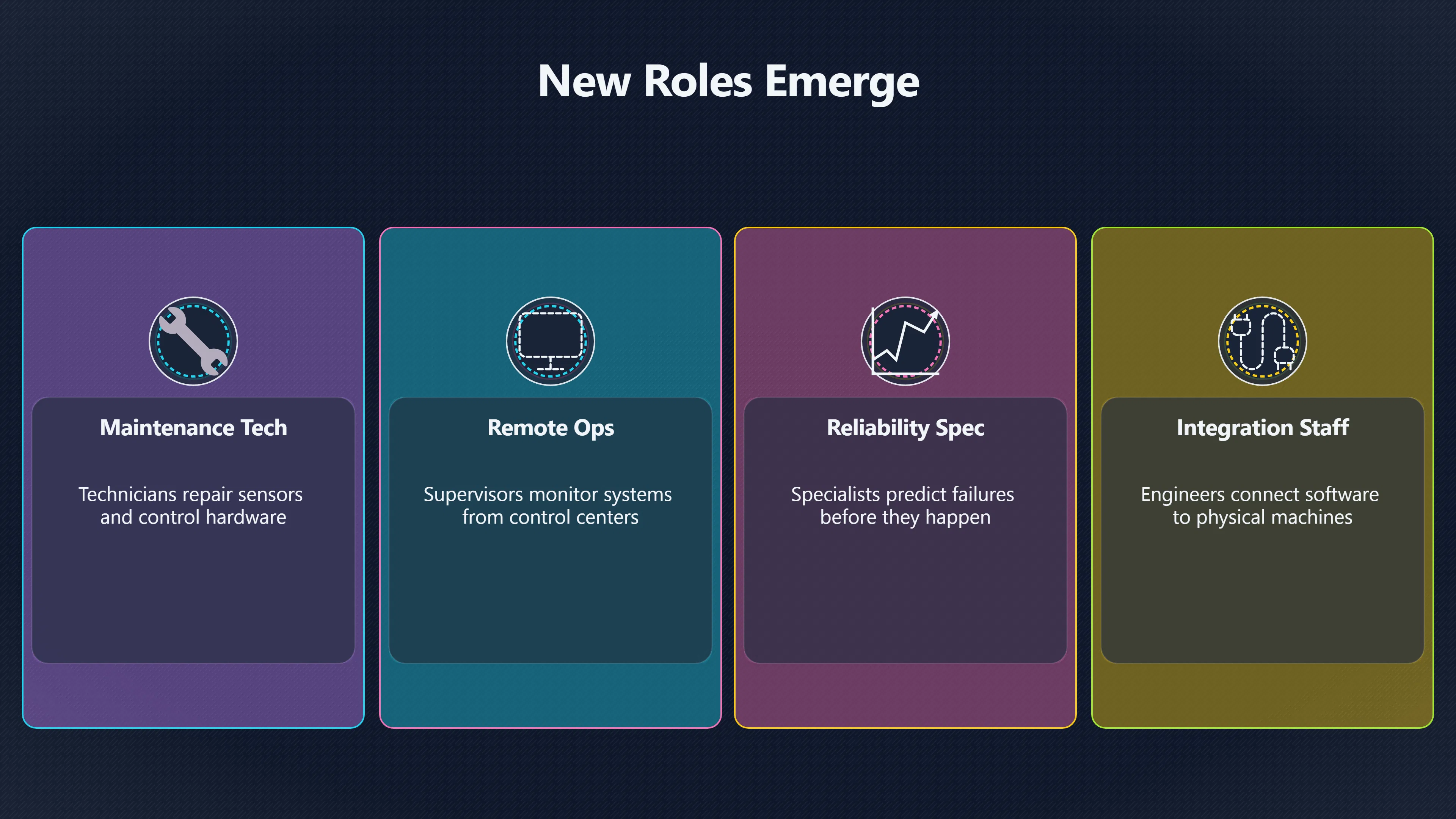
In sectors such as manufacturing, logistics, mining and energy, automation commonly generates demand for:
- Robotics maintenance technicians[staffingindustry.com]staffingindustry.comStaffing Industry AnalystsSkilled trades roles now take longer to hire than desk-…15 hours ago — Robotics technicians: up by approxima…
- Automation engineers
- Mechatronics specialists
- Industrial electricians
- Sensor and control-system technicians
- Remote operations supervisors
- Reliability and predictive-maintenance specialists
- Software and robotics integration staff
A modern warehouse robot, for example, still requires inspection, repair, calibration, software updates and troubleshooting. Autonomous mining vehicles need technicians who can maintain sensors, communications systems and control hardware. Construction robotics often require field engineers capable of diagnosing mechanical and software faults in difficult environments.
The growth of these roles is reflected in broader labour-market forecasts. The World Economic Forum’s Future of Jobs analysis projects continuing growth in technology-related and engineering occupations as AI and automation spread across industries. At the same time, employers consistently report skills shortages in technical maintenance and automation roles.[World Economic Forum]weforum.orgthe future of jobs report 2025World Economic Forum7 Jan 2025 — The Future of Jobs Report 2025 brings together the perspective of over 1,000 leading global employers—co…[World Economic Forum]weforum.orgthe future of jobs report 2025World Economic Forum7 Jan 2025 — The Future of Jobs Report 2025 brings together the perspective of over 1,000 leading global employers—co…
Importantly, many of these jobs sit between traditional trades and advanced software engineering. A robotics technician is often not an AI researcher. The role may instead combine mechanical repair, electrical systems knowledge, fault diagnosis and familiarity with industrial software. This creates a potential bridge for workers coming from industrial occupations rather than requiring everyone to become a machine-learning specialist.[developingexperts.com]developingexperts.comApprenticeships | Robotics Technicianrobots are used for repetitive tasks, precision operations, or hazardous environments. Your day-to-day could involve diagnosing mechanica…
Why displaced workers do not transition automatically
The existence of new jobs does not guarantee that workers who lose old ones will obtain them.
A common mistake in public discussion is to compare the number of jobs lost with the number of jobs created while ignoring the skills gap between them. A worker who spent twenty years operating heavy machinery, welding, loading freight or conducting manual inspections may possess valuable practical knowledge but still lack the certifications, electronics training or software experience required for robotics maintenance.
OECD research repeatedly highlights that workers differ greatly in their ability to benefit from technological change. Higher-skilled workers tend to gain more from AI adoption, while lower-skilled workers face greater risks of displacement and weaker wage gains. Retraining therefore becomes a central distribution question rather than a secondary policy issue.[OECD]oecd.orgSkill needs and policies in the age of artificial intelligenceJul 11, 2023 — Looking at firms that have adopted AI reveals that there…[OECD]oecd.orgthe impact of ai on the labour market 69793977Artificial Intelligence and the Labour Market in KoreaOct 27, 2025 — This report analyses the impact of AI on Korea's labour market f…
Several barriers appear repeatedly:
- Time costs: workers often cannot afford months or years without income while retraining.
- Geographic mismatch: new technical jobs may appear in different regions from displaced workers.
- Credential barriers: employers frequently demand formal qualifications even when workers possess relevant practical experience.
- Age concerns: mid-career workers may worry that training investments will not pay off before retirement.
- Educational gaps: some workers need foundational maths, digital literacy or technical skills before entering advanced programmes.
These obstacles help explain why technological progress can produce simultaneous labour shortages and unemployment. Companies report difficulties finding robotics and automation technicians even while workers in adjacent occupations worry about job security.[Staffing Industry Analysts]staffingindustry.comStaffing Industry AnalystsSkilled trades roles now take longer to hire than desk-…15 hours ago — Robotics technicians: up by approxima…
The result is that automation can either widen opportunity or deepen inequality depending on whether institutions successfully connect existing workers to emerging technical roles.
The practical advantage former frontline workers often have
The transition is not always as difficult as it first appears.
Workers coming from dangerous industries frequently possess forms of expertise that automation systems still need. A miner understands mining operations. A welder understands welding quality. A warehouse worker understands how materials move through a facility. These forms of operational knowledge can be highly valuable when maintaining or supervising robotic systems.
Research on industrial robotics increasingly emphasises that successful automation often depends on combining robotics knowledge with process knowledge. A technician who understands both the machine and the task being automated can frequently identify failures, inefficiencies and safety problems faster than someone trained only in software.[arXiv]arxiv.orgOffline robot programming assisted by task demonstration: an AutomationML interoperable solution for glass adhesive application and…
This is one reason many employers prefer retraining experienced workers rather than hiring entirely new teams. Existing employees already understand workplace procedures, safety requirements and production goals. The challenge is often adding technical capabilities rather than replacing all prior expertise.
In the strongest versions of the AI bloom vision, automation does not erase human knowledge. Instead, it allows practical experience accumulated through years of physical labour to be combined with more advanced tools and safer working conditions.
Apprenticeships matter more than short online courses
Political discussions about reskilling often imply that workers can simply complete a few online modules and move into technical careers. Real-world evidence suggests the transition usually requires much more structured support.
Robotics maintenance work commonly involves:
- Mechanical systems
- Electrical systems
- Industrial control software
- Safety procedures
- Fault diagnosis
- Sensor technologies
- Human-machine interfaces
These skills are difficult to acquire through brief training programmes alone.
Countries with stronger vocational education systems often have an advantage. Comparisons between Germany and the United States, for example, have highlighted how apprenticeship structures can make automation more complementary to workers. German manufacturers have frequently integrated robotics while continuing to rely on skilled technicians trained through vocational pathways.[WIRED]wired.comAutomation Isn't the Biggest Threat to US Factory JobsConcurrently, automation advanced rapidly, spurred by the shortage of workers and pandemic-related safety measures. Despite fears that au…
Many newer programmes attempt to replicate this model. Industrial automation apprenticeships increasingly combine paid work with formal instruction in robotics, controls engineering and maintenance. Programmes linked directly to employers can reduce the financial risk workers face when changing careers because trainees continue earning while learning.[Apprenticeship (UK]amazonapprenticeships.co.ukation, combining practical engineering experience with degree-level…Read more…
The broader lesson is that successful transitions are usually workplace-centred. Workers learn robotics maintenance most effectively when they spend substantial time working with actual equipment rather than studying automation in isolation.

What employers owe workers during automation transitions
A central disagreement in debates about AI and automation concerns responsibility.
Some firms treat retraining as primarily the worker’s responsibility. Others view it as part of the cost of technological change. The difference matters enormously for outcomes.
When companies automate dangerous tasks, several approaches can widen access to new opportunities:
- Offering retraining before displacement occurs
- Creating internal promotion routes into technical roles
- Paying workers while they train
- Recognising practical experience alongside formal credentials
- Designing automation systems that remain understandable to operators
- Partnering with vocational colleges and apprenticeship providers
Evidence from workforce-transition research suggests that firms often underinvest in retraining because the benefits can be difficult to capture. Employees may leave after gaining new skills, creating incentives for employers to minimise training spending. This is one reason governments frequently become involved through subsidies, apprenticeships and workforce-development programmes.[Axios]axios.comReport: Reskilling workers due to automation will cost $34 billionworkers at risk of job displacement due to automation will cost $34 billion. Most of this financial burden will fall on the government, a…
The political economy question is straightforward: if automation generates large productivity gains, who should finance the transition costs? Workers, firms, taxpayers or some combination of all three?
The answer affects whether automation becomes broadly shared progress or a source of social division.
The risk of creating a two-tier labour market
A future filled with robots is not automatically a future of widespread flourishing.
One possibility is a labour market split between a relatively small group of highly trained technical workers and a larger group facing unstable employment, lower bargaining power and repeated displacement. Some OECD research already suggests that workers with stronger educational backgrounds and digital skills are better positioned to benefit from AI-related change.[OECD]oecd.orgChanging skill needs in the labour marketHigh-skilled occupations continue to be less at risk of automation because they require skil…
This creates a challenge for the more ambitious abundance narrative associated with AI bloom.
If advanced automation makes production safer, cheaper and more efficient but only a minority gain access to the resulting opportunities, then technological progress may increase output without expanding human flourishing on a comparable scale.
Supporters of the optimistic vision therefore tend to emphasise:
- Universal access to technical education
- Lifelong learning systems
- Mid-career retraining support
- Portable credentials
- Regional investment in training infrastructure
- Strong labour-market matching systems
The key question is not whether robot maintenance jobs exist. It is whether former miners, warehouse staff, construction workers and factory employees can realistically reach them.

Retraining as a test of the wider AI bloom vision
The debate over robot maintenance jobs may seem narrow compared with discussions of superintelligence, scientific acceleration or post-scarcity economics. Yet it captures a fundamental question running through the broader AI bloom project.
Can advanced technology remove forms of human suffering while also expanding human capability?
Dangerous work automation provides an unusually concrete test case. The technology already exists. Robots can increasingly perform tasks that expose people to toxic substances, dangerous machinery, extreme environments and repetitive physical strain. The unresolved issue is whether workers are merely displaced from those roles or helped into safer and more capable forms of work.
If societies build strong pathways from hazardous labour into technical maintenance, supervision and engineering support roles, automation can become evidence that technological progress and human flourishing can advance together. If those pathways remain weak, then even successful automation may deepen insecurity and inequality.
The long-term promise of AI abundance therefore depends not only on building more capable machines, but on building institutions capable of helping people move alongside them.[World Economic Forum]weforum.orgthe future of jobs report 2025World Economic Forum7 Jan 2025 — The Future of Jobs Report 2025 brings together the perspective of over 1,000 leading global employers—co… [3OECD 3OECD]
Amazon book picks
Further Reading
Books and field guides related to Who gets the new robot jobs?. Use these as the next step if you want deeper reading beyond the article.
The Second Machine Age
Explains why workers need new skills as digital and robotic technologies spread.
Human + Machine
Focuses on new roles created around AI systems and how people can work alongside machines.
The Adaptation Advantage
Emphasises continuous learning and adaptation in technology-driven labour transitions.
Make It Stick
Useful for designing retraining and apprenticeships that produce durable technical skills.
eBay marketplace picks
Marketplace Samples
Example marketplace items related to this page. Use the search link to explore similar finds on eBay.


Endnotes
1.
Source: oecd.org
Title: artificial [intelligence]({{ ‘intelligence/’ | relative_url }}) and jobs no signs of slowing labour demand yet 5aebe670
Link:https://www.oecd.org/en/publications/oecd-employment-outlook-2023_08785bba-en/full-report/artificial-intelligence-and-jobs-no-signs-of-slowing-labour-demand-yet_5aebe670.html
Source snippet
Artificial intelligence and jobs: No signs of slowing labour...11 Jul 2023 — AI will displace some human labour (displacement effect...
2.
Source: oecd.org
Link:https://www.oecd.org/en/topics/ai-and-work.html
3.
Source: oecd.org
Link:https://www.oecd.org/en/publications/oecd-employment-outlook-2023_08785bba-en/full-report/skill-needs-and-policies-in-the-age-of-artificial-intelligence_fe530fbf.html
Source snippet
Skill needs and policies in the age of artificial intelligenceJul 11, 2023 — Looking at firms that have adopted AI reveals that there...
4.
Source: developingexperts.com
Title: Apprenticeships | Robotics Technician
Link:https://www.developingexperts.com/career-builder/1651/apprenticeships
Source snippet
robots are used for repetitive tasks, precision operations, or hazardous environments. Your day-to-day could involve diagnosing mechanica...
5.
Source: arxiv.org
Link:https://arxiv.org/abs/2405.13141
Source snippet
Offline robot programming assisted by task demonstration: an AutomationML interoperable solution for glass adhesive application and...
6.
Source: oecd.org
Title: the impact of ai on the labour market 69793977
Link:https://www.oecd.org/en/publications/artificial-intelligence-and-the-labour-market-in-korea_68ab1a5a-en/full-report/the-impact-of-ai-on-the-labour-market_69793977.html
Source snippet
Artificial Intelligence and the Labour Market in KoreaOct 27, 2025 — This report analyses the impact of AI on Korea's labour market f...
7.
Source: wired.com
Title: Automation Isn’t the Biggest Threat to US Factory Jobs
Link:https://www.wired.com/story/robots-automation-jobs-manufacturing-labor-germany-us
Source snippet
Concurrently, automation advanced rapidly, spurred by the shortage of workers and pandemic-related safety measures. Despite fears that au...
8.
Source: axios.com
Title: Report: Reskilling workers due to automation will cost $34 billion
Link:https://www.axios.com/2019/01/23/davos-report-reskilling-workers-automation-34-billion
Source snippet
workers at risk of job displacement due to automation will cost $34 billion. Most of this financial burden will fall on the government, a...
9.
Source: oecd.org
Link:https://www.oecd.org/en/topics/sub-issues/changing-skill-needs-in-the-labour-market.html
Source snippet
Changing skill needs in the labour marketHigh-skilled occupations continue to be less at risk of automation because they require skil...
10.
Source: oecd.org
Link:https://www.oecd.org/en/topics/policy-issues/future-of-work.html
Source snippet
Future of workOn average across OECD countries, occupations at highest risk of automation account for about 28% of jobs. Workers in occup...
11.
Source: oecd.org
Link:https://www.oecd.org/en.html
Source snippet
The Organisation for Economic Co-operation and...The OECD designs international standards and guidelines for development co-operat...
12.
Source: oecd.org
Link:https://www.oecd.org/en/topics/sub-issues/ai-and-work.html
Source snippet
AI and workIt draws on examples of workforce initiatives from various OECD countries, including AI training for different groups of staff...
13.
Source: oecd.org
Link:https://www.oecd.org/en/publications/artificial-intelligence-and-the-changing-demand-for-skills-in-the-labour-market_88684e36-en.html
Source snippet
The...Read...
14.
Source: oecd.org
Title: Adapting (to) Automation
Link:https://www.oecd.org/content/dam/oecd/en/publications/reports/2023/09/adapting-to-automation_fd689cc9/905fdc2c-en.pdf
Source snippet
robotics) or the building process for the enabling...Read more...
15.
Source: oecd.org
Link:https://www.oecd.org/en/publications/artificial-intelligence-and-the-labour-market-in-japan_b825563e-en/full-report/preparing-for-the-impact-of-ai-on-job-quantity-and-skills-needs_28862d25.html
Source snippet
Artificial Intelligence and the Labour Market in JapanNov 28, 2025 — However, it also highlights that this negative impact could be rever...
16.
Source: oecd.org
Link:https://www.oecd.org/en/topics/future-of-work.html
Source snippet
Future of workAs a result, AI can help automate non-routine activities, contrary to computers that need codified environments and could o...
17.
Source: weforum.org
Link:https://www.weforum.org/publications/the-future-of-jobs-report-2025/digest/
Source snippet
World Economic ForumThe Future of Jobs Report 2025 | World Economic Forum7 Jan 2025 — The Future of Jobs Report 2025 brings together the...
18.
Source: weforum.org
Link:https://www.weforum.org/stories/2025/01/future-of-jobs-report-2025-jobs-of-the-future-and-the-skills-you-need-to-get-them/
Source snippet
World Economic ForumFuture of Jobs Report 2025: The jobs of the futureJan 8, 2025 — About 170 million new jobs will be created this decad...
19.
Source: staffingindustry.com
Link:https://www.staffingindustry.com/news/global-daily-news/skilled-trades-roles-now-take-longer-to-hire-than-desk-based-workers
Source snippet
Staffing Industry AnalystsSkilled trades roles now take longer to hire than desk-...15 hours ago — Robotics technicians: up by approxima...
20.
Source: amazonapprenticeships.co.uk
Link:https://amazonapprenticeships.co.uk/automation
Source snippet
ation, combining practical engineering experience with degree-level...Read more...
21.
Source: Wikipedia
Link:https://en.wikipedia.org/wiki/Manufacturing
Source snippet
ManufacturingManufacturing is the creation or production of goods with the help of equipment, labor, machines, tools, and chemical or...
22.
Source: weforum.org
Title: the future of jobs report 2025
Link:https://www.weforum.org/publications/the-future-of-jobs-report-2025/
Source snippet
World Economic Forum7 Jan 2025 — The Future of Jobs Report 2025 brings together the perspective of over 1,000 leading global employers—co...
23.
Source: jobsandskills.gov.au
Link:https://www.jobsandskills.gov.au/data/occupation-and-industry-profiles/industries/manufacturing
Source snippet
7 Apr 2026 — Manufacturing is a large employing industry. Around 5.9% of workers have their main job in this industry. Manufacturing invo...
Additional References
24.
Source: businessinsider.com
Link:https://www.businessinsider.com/wef-sees-4-ai-futures-for-jobs-by-2030-only-one-limits-disruption
Source snippet
These range from fast AI progress outpacing workforce preparation, to unequal productivity benefits, to rapid innovation that still leads...
25.
Source: weforum.org
Link:https://www.weforum.org/press/2020/10/recession-and-automation-changes-our-future-of-work-but-there-are-jobs-coming-report-says-52c5162fce/
Source snippet
Recession and Automation Changes Our Future of Work...20 Oct 2020 — By 2025, automation and a new division of labour between humans and...
26.
Source: arminstitute.org
Link:https://arminstitute.org/projects/robotics-technician-apprenticeship-program/
27.
Source: weforum.org
Link:https://www.weforum.org/press/2025/01/future-of-jobs-report-2025-78-million-new-job-opportunities-by-2030-but-urgent-upskilling-needed-to-prepare-workforces/
Source snippet
Future of Jobs Report 2025: 78 Million New...Jan 7, 2025 — The Future of Jobs Report 2025, published today by the World Economic Forum...
28.
Source: reports.weforum.org
Link:https://reports.weforum.org/docs/WEF_Jobs_of_Tomorrow_Technology_and_the_Future_of_the_Worlds_Largest_Workforces_2025.pdf
Source snippet
and the Future of the World's Largest WorkforcesAccording to the World Economic Forum's Future of Jobs Report 2025, technology changes ar...
29.
Source: facebook.com
Title: the world economic forum wef estimates that by 2025 about 85 million jobs will b
Link:https://www.facebook.com/TheNationThailand/posts/the-world-economic-forum-wef-estimates-that-by-2025-about-85-million-jobs-will-b/997423295744338/
Source snippet
The World Economic Forum (WEF) estimates that by 2025...The World Economic Forum (WEF) estimates that by 2025, about 85 million jobs wi...
30.
Source: linkedin.com
Title: future work 2025 according wef part 2 key skills merino villagrasa zcoxf
Link:https://www.linkedin.com/pulse/future-work-2025-according-wef-part-2-key-skills-merino-villagrasa-zcoxf
Source snippet
The Future of Work 2025 According to WEF (Part 2)According to the World Economic Forum survey, analytical thinking (69%) and [resilience]({{ 'resilience/' | relative_url }})...
31.
Source: linkedin.com
Title: your job ready future how ai automation shape work wickramasinghe 1cxlf
Link:https://www.linkedin.com/pulse/your-job-ready-future-how-ai-automation-shape-work-wickramasinghe-1cxlf
Source snippet
Is Your Job Ready for the Future? How AI and Automation...According to the World Economic Forum's The Future of Jobs Report 2020, AI and...
32.
Source: linkedin.com
Title: ai driven agentification work impact jobs 20242030 poweredbywiti zbyfc
Link:https://www.linkedin.com/pulse/ai-driven-agentification-work-impact-jobs-20242030-poweredbywiti-zbyfc
Source snippet
AI-Driven Agentification of Work: Impact on Jobs (2024–...Job Gains: The World Economic Forum forecasts that by 2030, 92 million jobs wi...
33.
Source: digital-skills-jobs.europa.eu
Title: great skills reset wefs future jobs report 2025 catch 22 future work
Link:https://digital-skills-jobs.europa.eu/en/latest/news/great-skills-reset-wefs-future-jobs-report-2025-catch-22-future-work
Source snippet
europa.eu"The Great Skills Reset" in WEF's Future of Jobs Report 2025Feb 24, 2026 — High on the list of transformative aspects shaping th...
Topic Tree