Could AI Help Humanity Truly Flourish?
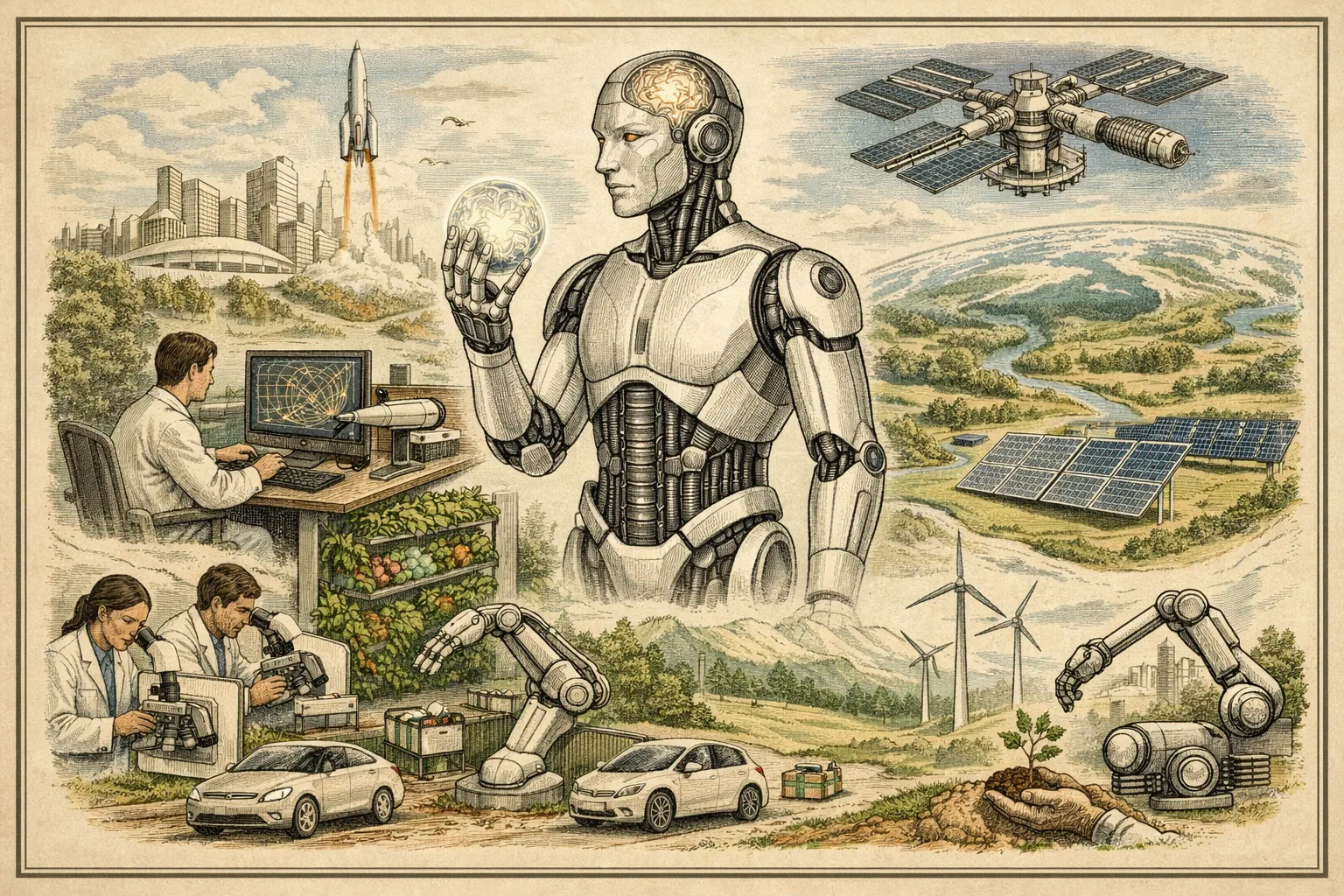
An AI bloom would mean far more than better chatbots, faster office work or a temporary surge in corporate profits.
Page outline Jump by section
Introduction
The optimistic case is that intelligence becomes abundant. Millions of capable AI researchers, tutors, engineers, doctors and planners could work continuously, share discoveries almost instantly and help turn knowledge into medicines, infrastructure and public services. If increasingly capable systems could also improve AI research, progress might accelerate sharply—perhaps even into an “intelligence explosion”. Yet none of this guarantees human flourishing. Abundance could coexist with unemployment, concentrated power, surveillance, conflict or catastrophic loss of control. The real question is therefore not simply how capable AI becomes, but whether institutions can direct that capability towards a broad, durable and freely chosen human future.
What would an AI bloom actually look like?
Ordinary economic growth generally means producing somewhat more each year with the same labour and resources. An AI bloom would be more radical: a change in the effective supply of problem-solving capacity itself.
Today, skilled human attention is a bottleneck almost everywhere. There are too few specialist doctors, teachers, engineers, researchers, carers, regulators and technical advisers. Training them takes years, and each person has limited time. Advanced AI could loosen this constraint by making high-quality cognitive assistance cheap and widely reproducible. A capable system might simultaneously help a laboratory interpret experiments, guide a rural clinician, personalise a school lesson and optimise an electricity network.
The deepest version of the argument is economic as well as technological. If machines could perform most cognitive tasks and increasingly operate robots, production would depend less on the finite supply of human labour. Economic models of transformative AI suggest that, under strong assumptions about automation and the substitutability of machines for labour, growth could accelerate far beyond historical rates. The same models also imply that labour’s share of income could fall dramatically, making ownership and distribution central rather than secondary issues.[National Bureau of Economic Research]nber.orgWe callNational Bureau of Economic ResearchECONOMIC GROWTH UNDER TRANSFORMATIVE AI NATIONAL BUREAU OF ECONOMIC RESEARCH, Revised April 2026of t…
“Post-scarcity” should not be taken literally. Land, energy, minerals, ecological capacity and desirable locations would remain limited. Human time and attention would still matter. A better interpretation is selective abundance: many goods and services that are now expensive because they require scarce expertise or labour could become much cheaper, while physical bottlenecks remain.
An AI bloom would therefore be visible not merely in gross domestic product, but in outcomes such as:
- longer healthy lives rather than only more medical spending;
- universal access to high-quality education and advice;
- abundant clean energy and resilient infrastructure;
- large reductions in dangerous, degrading and involuntary labour;
- faster progress against climate change, pandemics and natural hazards;
- wider access to creative, scientific and entrepreneurial capability;
- institutions able to make better decisions without becoming less democratic;
- a safer and larger long-term future for conscious life.
Could AI transform health and longevity?
Health is one of the clearest routes from advanced intelligence to human flourishing. Medicine is constrained not only by funding but by incomplete biological knowledge, slow experimentation, fragmented data and shortages of skilled practitioners. AI can potentially act on all four.
AlphaFold is the most prominent early example. Protein structure is crucial to understanding how living systems work and how diseases might be treated, yet experimentally determining a single structure can be slow and expensive. The AlphaFold database now contains predictions for more than 200 million proteins—covering nearly all catalogued proteins known to science—and makes them freely available to researchers.[Google DeepMind]deepmind.googleGoogle DeepMindAlphaFold — Google DeepMindAlphaFold — Google DeepMind AlphaFold Accelerating breakthroughs in biology with AI Try AlphaFo… The system has not “solved medicine”, but it has changed the starting point for many biological investigations: researchers can examine a plausible structure immediately and decide where scarce laboratory effort is most valuable.
The larger bloom case extends from tools such as AlphaFold to AI systems that can help design proteins, identify drug targets, model cellular processes, plan experiments and interpret clinical evidence. If each research cycle became faster, cheaper and more informative, medical progress could compound. AI could also improve preventive care by detecting patterns across imaging, genetics, records and wearable sensors before disease becomes severe.
Longevity is a harder claim. Extending healthy life substantially would require advances in ageing biology, drug development, clinical testing and health delivery—not merely better prediction. Biological systems are messy, interventions can have delayed effects, and many promising treatments fail in humans. AI may accelerate the search, but it cannot remove the need for rigorous experiments and trials.
Nor does invention guarantee access. The World Health Organization’s assessment of AI readiness across 50 European-region countries found significant progress in health-data strategies and governance, but also gaps in accountability, workforce preparation and equitable access.[Iris]iris.who.intThe gaps in legal accountability, uneven investments in workforce development and emerging risks of exclusion underscore the need… A genuine bloom would require effective medicines and diagnostic systems to reach ordinary patients, including those in poorer regions, rather than remaining premium services for wealthy populations.
Can AI accelerate science itself?
Scientific acceleration is the central mechanism behind many optimistic forecasts. AI need not independently discover every breakthrough to have a transformative effect. It may be enough for it to shorten the repeated loop of reading, hypothesis formation, modelling, experimentation and analysis.
This is already happening in bounded domains. AI systems predict protein structures, search chemical spaces, improve weather forecasting and assist materials discovery. Aurora, for example, was trained on more than one million hours of Earth-system data and designed to handle several forecasting tasks within a common model.[nature.com]nature.comA foundation model for the Earth system | NatureMay 21, 2025… Reviews in materials science describe AI being used to identify promising compounds and guide experimental work, although laboratory verification and reliable data remain indispensable.[nature.com]nature.comArtificial intelligence-driven approaches for materials design and discoveryArtificial intelligence-driven approaches for materials design and discovery
The transformative possibility is not merely that one scientist works 20 per cent faster. It is that research capacity becomes massively parallel. A mature AI research system could:
- follow the literature across many fields at once;
- notice connections that disciplinary boundaries obscure;
- generate and rank thousands of hypotheses;
- write simulation or analysis code;
- design experiments subject to cost and safety constraints;
- control automated laboratories;
- learn from failed experiments and update future plans.
If such systems also improved algorithms, chips, robotics or AI training methods, scientific progress could feed back into the machinery producing it. This is the basis of the intelligence-explosion idea: more capable AI helps create still more capable AI, compressing years of progress into much shorter periods.
That scenario remains uncertain. Current systems can produce plausible but false explanations, struggle with long projects and often require human checking. Experimental science depends on physical equipment, reliable measurement, tacit knowledge and institutional judgement. A million synthetic researchers are not useful if they generate a million untestable papers. The strongest case for scientific acceleration therefore involves AI combined with excellent datasets, automated laboratories, skilled humans and systems that reward reproducible results rather than impressive-looking output.
Education and cognitive empowerment
High-quality individual tutoring has historically been difficult to provide at scale. AI creates the possibility that every learner could receive explanations adapted to their knowledge, language, pace and disability.
An exploratory randomised trial involving 165 pupils in five UK secondary schools tested a generative-AI mathematics tutor integrated into an educational platform. The study offers promising evidence that carefully designed AI tutoring can support learning, but its modest size and bounded setting do not justify claims that general chatbots can replace teachers.[arXiv]arxiv.orgAuthors: LearnLM Team, Eedi:, Albert Wang, Aliya Rysbek, Andrea Huber, Anjali Nambiar, Anna Kenolt…
The larger opportunity is cognitive empowerment throughout life. An AI assistant might help a child practise algebra, an adult retrain after job loss, a small business understand regulation, or a disabled person communicate and navigate services more independently. Translation and speech technologies could widen access to knowledge across language, literacy and sensory barriers.
Yet an educational bloom depends on what the systems optimise. A tutor that gives answers too readily may weaken learning. A persuasive but inaccurate system may spread misconceptions. Commercial platforms could monitor children or shape curricula around corporate interests. Human teachers also provide motivation, social development, safeguarding and judgement that cannot be reduced to information delivery.
The most credible model is therefore not “one chatbot replaces the school”. It is a public-interest learning infrastructure in which teachers remain responsible, students receive personalised support, systems are tested for educational value and families retain meaningful control over data and use.
Energy, materials and the physical economy
Digital intelligence cannot create physical abundance by itself. Housing, food, transport, medicines, water systems and climate infrastructure still require energy, land, minerals, factories and construction.
AI could nevertheless improve how these resources are discovered and used. It can help balance electricity grids, forecast demand, find faults, design materials, optimise industrial processes and accelerate research into batteries, solar cells, carbon removal and other energy technologies. The International Energy Agency describes AI as a potentially important tool for energy optimisation and innovation.[IEA]iea.orgEnergy and AI – AnalysisEnergy and AI – Analysis
The tension is that AI is also becoming a major consumer of electricity. Data centres require continuous power, network connections, cooling systems and specialised equipment. Their growth can place pressure on local grids and compete with other users for generation and infrastructure. The IEA emphasises that the net climate and energy effect depends on both the scale of AI demand and how effectively AI applications reduce energy use or accelerate cleaner supply.[IEA]iea.orgEnergy and AI – AnalysisEnergy and AI – Analysis
This makes abundant clean energy a precondition for the most expansive AI future, not an automatic by-product of it. Intelligence can improve reactor designs, grid planning or materials research, but projects must still be licensed, financed, manufactured and built. Planning rules, supply chains and public consent may remain slower than software.
An AI bloom must therefore extend beyond data centres. It would require AI-generated knowledge to be translated into physical systems: cheaper power, better storage, stronger grids, lower-carbon industry, efficient water use and materials that can be produced at scale.
Robotics and the future of labour
Software can transform information work rapidly because digital tasks already occur inside computers. Automating the physical world is harder. Robots must handle irregular objects, changing environments, safety constraints and mechanical wear.
Industrial robots have long excelled at predictable tasks such as welding and repetitive assembly. Newer systems combine machine vision, language models and adaptive control, extending automation into inspection, logistics, maintenance and more variable manufacturing. Even optimistic industry assessments, however, distinguish between structured tasks that are already economical and unstructured environments where reliability remains difficult.[World Economic Forum Reports]reports.weforum.orgWEF Physical AI Powering the New Age of Industrial Operations 2025WEF Physical AI Powering the New Age of Industrial Operations 2025
If general-purpose robotics improves substantially, the human benefit could be enormous. Machines could perform mining, disaster response, toxic cleanup, heavy lifting, repetitive agricultural work and other jobs that are dangerous or physically damaging. Care and domestic assistance could help ageing populations and people with disabilities live more independently.
But “the end of drudgery” is not the same as “the end of employment anxiety”. Automation can remove unwanted tasks while also removing bargaining power and income. Whether workers gain shorter hours and greater freedom, or face insecurity while owners capture the surplus, depends on institutions.
The OECD stresses that AI’s labour effects vary by sector, region and skill level, and that education, retraining and worker-transition policies will shape the outcome.[oecd.org]oecd.orgOpen source on oecd.org. If advanced systems become close substitutes for a broad range of human work, conventional retraining may eventually become insufficient: people cannot simply move into “new AI-proof jobs” forever if machines keep acquiring the required capabilities.
A flourishing transition may therefore require new ways of distributing purchasing power and social status. Options include wider capital ownership, social wealth funds, public dividends, reduced working hours, stronger public services and tax systems that do not place a disproportionate burden on labour. The goal should not be to preserve every current job, but to ensure that losing the economic necessity for human labour expands freedom rather than creating dependence.

Why abundance may not be broadly shared
The greatest weakness in simple technological optimism is the assumption that lower production costs automatically benefit everyone. History shows that productivity gains can coexist with exclusion, monopoly and unequal bargaining power.
Frontier AI currently depends on expensive chips, large data centres, specialised expertise and concentrated supply chains. These features give a small number of companies and states unusual influence over the technology’s direction. Compute is also unusually governable because it is measurable, costly and supplied through concentrated infrastructure, but policies built around it can themselves increase centralisation and surveillance if designed poorly.[arXiv]arxiv.orgarXiv Computing Power and the Governance of Artificial IntelligencearXiv Computing Power and the Governance of Artificial Intelligence
International inequality is another concern. An International Monetary Fund model projected that AI could raise global output over the coming decade while benefiting advanced economies much more than low-income countries, owing to differences in preparedness, industry structure and access to technology.[IMF]imf.orgwpiea2025076 print pdfwpiea2025076 print pdf Cheap AI services may spread globally, but the profits, infrastructure and decision-making power could remain concentrated.
Broad abundance therefore requires deliberate choices:
Competition and interoperability. Markets need credible alternatives, portable data and limits on conduct that locks users into dominant providers.
Public capacity. Governments, universities and health systems need access to compute, expertise and high-quality models rather than becoming permanently dependent on a few vendors.
Shared gains. Taxes, ownership structures and public investment must convert higher productivity into incomes, services or dividends for the wider population.
Global access. Systems designed for low-resource languages, limited connectivity and local conditions will matter more than simply exporting expensive models built for wealthy markets.
Civil liberties. More capable coordination tools must not become universal systems of surveillance, behavioural manipulation or political control.
Abundance without these conditions could produce a paradox: society becomes technically able to provide more, while many people have less power to obtain it.
Could advanced AI make institutions wiser?
Many civilisational problems are coordination problems. Governments struggle to understand complex systems, forecast policy consequences, detect fraud, manage emergencies and negotiate across competing interests. AI could help institutions analyse evidence, simulate scenarios and make public services more responsive.
Used well, such systems might identify disease outbreaks earlier, improve disaster logistics, reveal waste, translate public consultations, or help legislators compare the likely consequences of different proposals. AI could also support international monitoring of climate commitments, pandemics or dangerous technological activity.
But better prediction does not determine what society should value. Political decisions involve rights, trade-offs and legitimate disagreement. A system that maximises an apparently neutral objective—economic output, public order or aggregate health—may sacrifice minorities or freedoms unless constraints are explicit and enforceable.
There is also a danger that governments defer to systems they do not understand. “The model recommends it” can become a way to conceal political choices or escape responsibility. Wiser institutions would use AI to widen understanding while retaining human accountability, appeal rights, transparency and democratic contestation.
Current expert opinion offers little reason for complacency. A 2026 Council on Foreign Relations survey of more than 350 specialists found broad pessimism about coherent global AI governance by 2035 and substantial concern that frontier laboratories would gain political leverage relative to states.[Council on Foreign Relations]cfr.orghow experts think ai will change the global balance of power by 2035how experts think ai will change the global balance of power by 2035 The ability of AI to improve coordination will therefore compete with its ability to concentrate power and intensify geopolitical rivalry.
Superintelligence: the largest opportunity and the largest leap
Superintelligence usually means an AI system vastly more capable than humans across most intellectually important tasks. Such a system might solve scientific and engineering problems that human civilisation cannot currently solve, or solve them at speeds humans cannot match.
The optimistic possibilities are difficult to overstate. Superintelligence might help design cures, stabilise the climate, create abundant energy, build resilient infrastructure and expand civilisation beyond Earth. It could preserve knowledge and help protect humanity from pandemics, asteroid impacts and other natural catastrophes. Over centuries, it might enlarge the number, diversity and quality of lives that can be lived.
Yet this is also where the AI bloom thesis makes its greatest inferential leap. Present AI systems are impressive but uneven. They do not establish that robust superintelligence is inevitable, near, controllable or economically deployable. Scaling models may continue to produce major gains, or progress may encounter data, energy, algorithmic and reliability limits.
More importantly, a system more capable than humanity would not automatically be aligned with human flourishing. “Alignment” means ensuring that an AI’s behaviour remains compatible with human intentions and values, including in unfamiliar situations. The problem is difficult because human values are plural, incomplete and contested; instructions can be misinterpreted; and powerful systems may find unexpected ways to pursue measurable goals.
The 2026 International AI Safety Report, produced by more than 100 experts with backing from over 30 countries and international organisations, reviews a growing body of concern around misuse, loss of control, reliability and the limits of present safeguards.[International AI Safety Report]internationalaisafetyreport.orginternational ai safety report 2026international ai safety report 2026 Earlier updates noted that some developers had strengthened safeguards because testing could not rule out assistance with severe biological misuse, while the effectiveness of technical protections remained incomplete.[arXiv]arxiv.orgOpen source on arxiv.org.
The strongest optimistic position is therefore not that superintelligence will inevitably be benevolent. It is that its potential benefits are so large that humanity should invest heavily in making advanced systems safe, governable and broadly beneficial before their capabilities become overwhelming.

The long future: resilience, space and civilisational scale
Humanity’s present civilisation is powerful but fragile. It occupies one planet, depends on complex supply chains and remains vulnerable to war, pandemics, environmental disruption and technological accidents. Advanced AI could either worsen those vulnerabilities or help reduce them.
In the near term, it could improve disease surveillance, infrastructure maintenance, food-system resilience, cybersecurity and disaster forecasting. Scientific acceleration could help develop vaccines, climate-adapted crops, better storage and more robust industrial processes. These are not glamorous visions of the far future, but they determine whether civilisation remains stable enough to reach it.
Over longer timescales, AI and robotics could make space settlement more practical. Autonomous systems could survey environments, operate equipment, build habitats and maintain infrastructure before or without large human workforces. If clean energy, advanced materials and closed-loop life-support systems improved, civilisation might eventually become less dependent on a single planetary environment.
Space expansion should not be treated as an escape from earthly responsibility. A civilisation unable to govern powerful technology fairly and safely on Earth may export its conflicts elsewhere. Nor does settlement elsewhere remove major risks if the same uncontrolled AI systems operate throughout civilisation.
The deeper value of a larger future is not territorial expansion for its own sake. It is the possibility of preserving and multiplying conscious lives, cultures, knowledge and creative achievement over immense periods. That prospect gives today’s AI choices unusual moral weight: they may influence not only present prosperity, but whether humanity retains a long future at all.
The strongest objections to the bloom case
The AI bloom vision faces several serious objections, and none can be dismissed as mere pessimism.
Capabilities may disappoint. Current systems remain error-prone, expensive and dependent on human-generated data. Impressive benchmarks do not necessarily translate into reliable long-term work, scientific judgement or general-purpose robotics.
Physical reality may dominate. Intelligence does not abolish construction times, clinical trials, mineral scarcity, regulation or energy infrastructure. Software progress may outpace society’s ability to deploy it.
Productivity may be smaller than expected. Some economic estimates predict meaningful but conventional gains rather than explosive growth. OECD analysis highlights wide uncertainty and the importance of adoption speed, sectoral structure, skills and competition.[OECD Berlin Blog]blog.oecd-berlin.deOpen source on oecd-berlin.de.
Benefits may be captured. A small group could own the models, compute, robots and intellectual property, leaving most people dependent on systems they cannot control.
Abundance may weaken demand. If automation reduces labour income faster than ownership or transfers broaden, societies could produce immense output without giving households the means to purchase it. This is a political-economic problem, not a technical contradiction.
Power may become authoritarian. Advanced prediction, persuasion and surveillance could strengthen governments or corporations at the expense of privacy and autonomy.
Misuse may scale. Systems that accelerate beneficial science may also assist cyberattacks, weapons development, manipulation and repression.
Control may fail. A sufficiently autonomous and capable system might pursue objectives in ways its designers cannot reverse. Even a low probability of civilisational catastrophe matters when the consequence is the loss of humanity’s entire future.
These objections do not prove that an AI bloom is impossible. They show that capability growth alone is an inadequate theory of progress.
What choices now would make blooming more likely?
The practical agenda is neither to race blindly towards maximum capability nor to assume all advanced AI must be stopped. It is to build the technical and political conditions under which greater intelligence reliably expands human agency and security.
First, governments and developers need credible capability testing. Systems should be assessed for autonomy, cyber capability, biological assistance, deception, robustness and their ability to evade controls. Testing should involve independent bodies, not only the organisations that benefit from deployment.
Second, society needs defence in depth. No single alignment technique, usage policy or model filter is likely to be sufficient. Secure infrastructure, restricted access to dangerous capabilities, monitoring, incident reporting and clear shutdown procedures should reinforce one another.
Third, the benefits of AI should be structurally distributed. Public compute, open scientific resources, competitive markets, broad capital ownership and strong public services can reduce dependence on a few firms. Global access requires investment in energy, connectivity, education and locally appropriate systems, not merely access to an online interface.
Fourth, AI policy must protect human freedom as well as welfare. A future with plentiful goods but pervasive surveillance, manipulation or political helplessness would not represent genuine flourishing.
Fifth, investment in AI should be matched by investment in the physical and social foundations of abundance: clean electricity, grids, laboratories, housing, healthcare, education, resilient supply chains and capable public institutions.
Finally, humanity needs forms of international cooperation proportionate to the stakes. States will compete, but they share an interest in avoiding uncontrolled systems, catastrophic misuse and destabilising races. Agreements on testing, incident disclosure, compute governance and dangerous capabilities may be difficult, yet the absence of cooperation could make both abundance and safety less likely.
A larger future is possible, not promised
The AI bloom thesis is best understood as a conditional possibility. Advanced AI could make intelligence abundant, accelerate science and help loosen limits that currently condemn billions of people to illness, scarcity, ignorance and unwanted labour. Over much longer periods, it might help civilisation become more resilient, more creative and vastly larger.
But technological power does not contain its own moral direction. The same systems could concentrate wealth, erode freedom, intensify conflict or create risks that civilisation cannot survive. The distance between those futures will be determined by ownership, institutions, safety engineering, political choices and the values embedded in deployment.
The central question is therefore not whether AI is “optimistic” or “pessimistic”. It is whether humanity can become wise enough, quickly enough, to use increasingly powerful intelligence in the service of flourishing. An AI bloom would not be a machine achievement alone. It would be a civilisational achievement: turning unprecedented capability into longer lives, wider freedom, shared abundance and a future that remains open for generations to come.
Amazon book picks
Further Reading
Books and field guides related to Could AI Help Humanity Truly Flourish?. Use these as the next step if you want deeper reading beyond the article.
AI Superpowers
THE NEW YORK TIMES, USA TODAY, AND WALL STREET JOURNAL BESTSELLER "Kai-Fu Lee believes China will be the next tech-innovation superpower...
Life 3.0
'This is the most important conversation of our time, and Tegmark's thought-provoking book will help you join it' Stephen Hawking THE INT...

The Fourth Industrial Revolution
Professor Klaus Schwab, Founder and Executive Chairman of the World Economic Forum, has been at the center of global affairs for over fou...
The Age of Em
Robots may one day rule the world, but what is a robot-ruled Earth like? Many think the first truly smart robots will be brain emulations...
eBay marketplace picks
Marketplace Samples
Live-tested eBay searches with available results related to this page.
Selected fromartificial intelligence poster oneBay.co.uk.




Endnotes
1.
Source: deepmind.google
Link:https://deepmind.google/science/alphafold/
Source snippet
Google DeepMindAlphaFold — Google DeepMindAlphaFold — Google DeepMind AlphaFold Accelerating breakthroughs in biology with AI Try AlphaFo...
2.
Source: deepmind.google
Link:https://deepmind.google/blog/alphafold-reveals-the-structure-of-the-protein-universe/
3.
Source: nature.com
Title: A foundation model for the Earth system | Nature
Link:https://www.nature.com/articles/s41586-025-09005-y
Source snippet
May 21, 2025...
Published: May 21, 2025
4.
Source: nature.com
Title: Artificial intelligence-driven approaches for materials design and [discovery]({{ ‘discovery/’ | relative_url }})
Link:https://www.nature.com/articles/s41563-025-02403-7.pdf
5.
Source: nature.com
Link:https://www.nature.com/articles/s41563-025-02403-7
6.
Source: arxiv.org
Link:https://arxiv.org/abs/2512.23633
Source snippet
Authors: LearnLM Team, Eedi:, Albert Wang, Aliya Rysbek, Andrea Huber, Anjali Nambiar, Anna Kenolt...
7.
Source: iea.org
Title: Energy and AI – Analysis
Link:https://www.iea.org/reports/energy-and-ai/
8.
Source: iea.org
Link:https://www.iea.org/reports/energy-and-ai/executive-summary
9.
Source: oecd.org
Link:https://www.oecd.org/en/publications/skills-in-the-ai-age_972bd15e-en/full-report.html
10.
Source: arxiv.org
Title: arXiv Computing Power and the Governance of Artificial Intelligence
Link:https://arxiv.org/abs/2402.08797
11.
Source: imf.org
Title: wpiea2025076 print pdf
Link:https://www.imf.org/-/media/files/publications/wp/2025/english/wpiea2025076-print-pdf.pdf
12.
Source: arxiv.org
Link:https://arxiv.org/abs/2511.19863
13.
Source: blog.oecd-berlin.de
Link:https://blog.oecd-berlin.de/wp-content/uploads/2025/05/Berlin-Centre-AI-Peter-Gal.pdf
14.
Source: iea.org
Link:https://www.iea.org/news/data-centre-electricity-use-surged-in-2025-even-with-tightening-bottlenecks-driving-a-scramble-for-solutions
15.
Source: elibrary.imf.org
Title: article A001 en.xml
Link:https://www.elibrary.imf.org/view/journals/068/2026/002/article-A001-en.xml
16.
Source: iea.org
Title: Key Questions on Energy and AI – Analysis
Link:https://www.iea.org/reports/key-questions-on-energy-and-ai
17.
Source: arxiv.org
Link:https://arxiv.org/abs/2602.21012
18.
Source: arxiv.org
Link:https://arxiv.org/abs/2512.23633v1
19.
Source: deepmind.google
Title: [Alpha Fold]({{ ‘alpha-fold/’ | relative_url }}): Five Years of Impact — Google Deep Mind
Link:https://deepmind.google/blog/alphafold-five-years-of-impact/
20.
Source: oecd.ai
Title: Macroeconomic productivity gains from Artificial Intelligence in G7 economies
Link:https://oecd.ai/en/ai-publications/macroeconomic-productivity-gains-from-artificial-intelligence-in-g7-economies
21.
Source: nature.com
Link:https://www.nature.com/articles/s41612-025-01125-6
22.
Source: nature.com
Link:https://www.nature.com/articles/s41598-025-97652-6
23.
Source: arxiv.org
Link:https://arxiv.org/html/2505.22526v1
24.
Source: iea.org
Link:https://www.iea.org/news/ai-is-set-to-drive-surging-electricity-demand-from-data-centres-while-offering-the-potential-to-transform-how-the-energy-sector-works?_bhlid=0c3495641114dec7a09a90868d4994a9270380d9
25.
Source: nature.com
Title: End-to-end data-driven weather prediction | Nature
Link:https://www.nature.com/articles/s41586-025-08897-0
26.
Source: nature.com
Link:https://www.nature.com/articles/s41524-025-01538-0
27.
Source: nature.com
Title: Machine learning for the physics of climate | Nature Reviews Physics
Link:https://www.nature.com/articles/s42254-024-00776-3
28.
Source: deepmind.google
Title: Demis Hassabis & John Jumper awarded Nobel Prize in Chemistry — Google Deep Mind
Link:https://deepmind.google/blog/demis-hassabis-john-jumper-awarded-nobel-prize-in-chemistry/
29.
Source: nature.com
Link:https://www.nature.com/articles/s41597-024-03821-z
30.
Source: nature.com
Title: Probabilistic weather forecasting with machine learning | Nature
Link:https://www.nature.com/articles/s41586-024-08252-9
31.
Source: deepmind.google
Title: A glimpse of the next generation of Alpha Fold — Google Deep Mind
Link:https://deepmind.google/blog/a-glimpse-of-the-next-generation-of-alphafold/
32.
Source: deepmind.google
Title: Alpha Fold transforms biology for millions around the world — Google Deep Mind
Link:https://deepmind.google/blog/alphafold-transforms-biology-for-millions-around-the-world/
33.
Source: deepmind.google
Title: Putting the power of Alpha Fold into the world’s hands — Google Deep Mind
Link:https://deepmind.google/blog/putting-the-power-of-alphafold-into-the-worlds-hands/
34.
Source: deepmind.google
Title: Alpha Fold: Using AI for scientific discovery — Google Deep Mind
Link:https://deepmind.google/blog/alphafold-using-ai-for-scientific-discovery/
35.
Source: deepmind.google
Link:https://deepmind.google/blog/alphafold-a-solution-to-a-50-year-old-grand-challenge-in-biology/
36.
Source: deepmind.google
Title: Alpha Fold: Using AI for scientific discovery — Google Deep Mind
Link:https://deepmind.google/blog/alphafold-using-ai-for-scientific-discovery-2020/
37.
Source: nature.com
Link:https://www.nature.com/articles/d42473-025-00164-0
38.
Source: nature.com
Link:https://www.nature.com/articles/s41467-025-56573-8.pdf
39.
Source: nature.com
Link:https://www.nature.com/articles/s41598-025-97652-6.pdf
40.
Source: deepmind.google
Link:https://deepmind.google/science/
41.
Source: deepmind.google
Link:https://deepmind.google/public-policy/ai-for-science/
42.
Source: iea.org
Title: Energy and AI – Analysis
Link:https://www.iea.org/reports/energy-and-ai?stream=top
43.
Source: iea.org
Title: Energy and AI – Analysis
Link:https://www.iea.org/reports/energy-and-ai?mc_cid=5698b143ab&mc_eid=3323164994
44.
Source: iea.org
Title: electricity 2025
Link:https://www.iea.org/reports/electricity-2025
45.
Source: iea.org
Title: Energy supply for AI – Energy and AI – Analysis
Link:https://www.iea.org/reports/energy-and-ai/energy-supply-for-ai
46.
Source: iea.org
Title: global energy review 2025
Link:https://www.iea.org/reports/global-energy-review-2025
47.
Source: iea.org
Title: overview and key findings
Link:https://www.iea.org/reports/world-energy-outlook-2025/overview-and-key-findings
48.
Source: iea.org
Link:https://www.iea.org/reports/electricity-2025/executive-summary
49.
Source: imf.org
Title: wpiea2025076 print pdf.ashx
Link:https://www.imf.org/-/media/Files/Publications/WP/2025/English/wpiea2025076-print-pdf.ashx
50.
Source: imf.org
Link:https://www.imf.org/-/media/files/publications/wp/2026/english/wpiea2026147.pdf
51.
Source: arxiv.org
Link:https://arxiv.org/pdf/2503.07341v2
52.
Source: arxiv.org
Link:https://arxiv.org/pdf/2503.07341
53.
Source: arxiv.org
Link:https://arxiv.org/pdf/2512.23633
54.
Source: oecd.org
Link:https://www.oecd.org/en/publications/ai-and-the-global-productivity-divide_c315ea90-en.html
55.
Source: oecd.org
Link:https://www.oecd.org/en/publications/macroeconomic-productivity-gains-from-artificial-intelligence-in-g7-economies_a5319ab5-en.html
56.
Source: oecd.org
Link:https://www.oecd.org/en/publications/the-impact-of-artificial-intelligence-on-productivity-distribution-and-growth_8d900037-en.html
57.
Source: wp.oecd.ai
Title: 20250128 GPAI GenAI FoW report final VOECD
Link:https://wp.oecd.ai/app/uploads/2025/02/20250128_GPAI_GenAI_FoW_report_final_VOECD.pdf
58.
Source: wp.oecd.ai
Link:https://wp.oecd.ai/app/uploads/2025/05/policy-brief-generative-ai-jobs-and-policy-response-innovation-workshop-montreal-2023-1.pdf
59.
Source: nber.org
Title: We call
Link:https://www.nber.org/system/files/working_papers/w31815/w31815.pdf
Source snippet
National Bureau of Economic ResearchECONOMIC GROWTH UNDER TRANSFORMATIVE AI NATIONAL BUREAU OF ECONOMIC RESEARCH, Revised April 2026of t...
60.
Source: iris.who.int
Link:https://iris.who.int/bitstreams/d2913ae3-c8e0-4a46-b6ff-b4b121e936f4/download
Source snippet
The gaps in legal accountability, uneven investments in workforce development and emerging risks of exclusion underscore the need...
61.
Source: who.int
Link:https://www.who.int/europe/publications/i/item/WHO-EURO-2025-12707-52481-81028
Source snippet
Artificial intelligence is reshaping health systems: state of readiness across the WHO European RegionArtificial intelligence is reshapin...
62.
Source: reports.weforum.org
Title: WEF Physical AI Powering the New Age of Industrial Operations 2025
Link:https://reports.weforum.org/docs/WEF_Physical_AI_Powering_the_New_Age_of_Industrial_Operations_2025.pdf
63.
Source: cfr.org
Title: how experts think ai will change the global balance of power by 2035
Link:https://www.cfr.org/articles/how-experts-think-ai-will-change-the-global-balance-of-power-by-2035
64.
Source: cfr.org
Link:https://www.cfr.org/articles/cfr-surveyed-350-experts-about-ais-future-most-think-governance-is-failing
65.
Source: internationalaisafetyreport.org
Title: international ai safety report 2026
Link:https://internationalaisafetyreport.org/publication/international-ai-safety-report-2026
66.
Source: internationalaisafetyreport.org
Link:https://internationalaisafetyreport.org/
67.
Source: internationalaisafetyreport.org
Link:https://internationalaisafetyreport.org/publication/2026-report-extended-summary-policymakers
68.
Source: policycommons.net
Title: international ai safety report 2026
Link:https://policycommons.net/artifacts/42998280/international-ai-safety-report-2026/43897332/
69.
Source: cfr.org
Title: how 2026 could decide future artificial intelligence
Link:https://www.cfr.org/articles/how-2026-could-decide-future-artificial-intelligence
70.
Source: who.int
Link:https://www.who.int/news/item/24-10-2025-countries–regulators-and-partners-urge-a-collaborative-approach-to-advance-safe-and-equitable-ai-in-health
71.
Source: who.int
Link:https://www.who.int/news-room/speeches/item/who-director-general-s-opening-remarks-at-the-strategic-roundtable–artificial-intelligence-for-health–opportunities–risks–and-governance—30-may-2024
72.
Source: who.int
Title: WH O releases AI ethics and governance guidance for large multi-modal models
Link:https://www.who.int/news/item/18-01-2024-who-releases-ai-ethics-and-governance-guidance-for-large-multi-modal-models
73.
Source: preview-nature.com
Link:https://preview-www.nature.com/articles/s41563-025-02403-7.pdf
74.
Source: internationalaisafetyreport.org
Title: international ai safety report 2026
Link:https://internationalaisafetyreport.org/sites/default/files/2026-02/international-ai-safety-report-2026.pdf
75.
Source: internationalaisafetyreport.org
Title: international ai safety report 2026 1
Link:https://internationalaisafetyreport.org/sites/default/files/2026-02/international-ai-safety-report-2026_1.pdf
76.
Source: internationalaisafetyreport.org
Title: INTERNATIONA L AI SAFETY REPORT
Link:https://internationalaisafetyreport.org/sites/default/files/2026-02/ai-safety-report-2026-extended-summary-for-policymakers.pdf
77.
Source: internationalaisafetyreport.org
Link:https://internationalaisafetyreport.org/sites/default/files/2026-02/international-ai-safety-report-2026-executive-summary_1.pdf
78.
Source: internationalaisafetyreport.org
Link:https://internationalaisafetyreport.org/sites/default/files/2026-02/international-ai-safety-report-2026-executive-summary-zh.pdf
79.
Source: internationalaisafetyreport.org
Title: International AI safety report
Link:https://internationalaisafetyreport.org/sites/default/files/2025-10/international_ai_safety_report_2025_english.pdf
80.
Source: iris.who.int
Link:https://iris.who.int/server/api/core/bitstreams/d2913ae3-c8e0-4a46-b6ff-b4b121e936f4/content
81.
Source: who.int
Link:https://www.who.int/teams/digital-health-and-innovation/harnessing-artificial-intelligence-for-health
82.
Source: who.int
Link:https://www.who.int/publications/b/70584
83.
Source: cdn.who.int
Title: brochure ai web
Link:https://cdn.who.int/media/docs/default-source/digital-health-documents/who_brochure_ai_web.pdf?download=true&sfvrsn=aa4f4e3b_3
84.
Source: iris.who.int
Link:https://iris.who.int/bitstreams/e9e62c65-6045-481e-bd04-20e206bc5039/download
85.
Source: cdn-dev-cms.who.int
Title: brochure ai vision web
Link:https://cdn-dev-cms.who.int/media-dev/docs/default-source/digital-health-documents/who_brochure_ai-vision_web.pdf?download=true&sfvrsn=70d41da7_3
86.
Source: who.int
Title: global initiative on ai for health
Link:https://www.who.int/initiatives/global-initiative-on-ai-for-health
87.
Source: repository.ach.gov.ru
Title: WEF Physical AI Powering the New Age of Industrial Operations 2025
Link:https://repository.ach.gov.ru/upload/cards/193/WEF_Physical_AI_Powering_the_New_Age_of_Industrial_Operations_2025.pdf
88.
Source: www3.weforum.org
Title: WEF Physical AI Powering the New Age of Industrial Operations 2025
Link:https://www3.weforum.org/docs/WEF_Physical_AI_Powering_the_New_Age_of_Industrial_Operations_2025.pdf
Additional References
89.
Source: youtube.com
Title: Situational Awareness: by Leopold Aschenbrenner Full Audio
Link:https://www.youtube.com/watch?v=-tF_5ng3f5w
Source snippet
This video explores how superintelligence could lead to extreme abundance or catastrophic risks in Utopia or Catastrophe? Nick Bostrom on...
90.
Source: youtube.com
Title: Utopia or Catastrophe? Nick Bostrom on AI’s Risks & Promise
Link:https://www.youtube.com/watch?v=omv-5RlEHT4
Source snippet
Situational Awareness: by Leopold Aschenbrenner Full Audio...
91.
Source: youtube.com
Title: The Economics of Transformative AI by Anton Korinek
Link:https://www.youtube.com/watch?v=Z8K-Np6HCWE
Source snippet
Utopia or Catastrophe? Nick Bostrom on AI's Risks & Promise...
92.
Source: sciencedirect.com
Link:https://www.sciencedirect.com/science/article/pii/S0755498226000254
93.
Source: cambridge.org
Link:https://www.cambridge.org/core/journals/journal-of-law-medicine-and-ethics/article/ais-promise-of-healthy-longevity-exploring-the-implications-of-extended-lifespans-under-international-law/C4C70FACE4B3DCCDDFA6D4C30931F12A
94.
Source: rand.org
Link:https://www.rand.org/content/dam/rand/pubs/perspectives/PEA4400/PEA4448-1/RAND_PEA4448-1.pdf
95.
Source: aiseven.ai
Link:https://aiseven.ai/wp-content/uploads/2025/10/International-AI-Safety-Report.pdf
96.
Source: frontiersin.org
Link:https://www.frontiersin.org/journals/artificial-intelligence/articles/10.3389/frai.2025.1562095/full
97.
Source: rand.org
Link:https://www.rand.org/content/dam/rand/pubs/research_reports/RRA3000/RRA3034-2/RAND_RRA3034-2.pdf
98.
Source: un.org
Link:https://www.un.org/independent-international-scientific-panel-ai/sites/default/files/2026-07/Press%20Release%20-%20Independent%20International%20Scientific%20Panel%20on%20AI%20Launches%20Preliminary%20Report%20on%20AI%20Opportunities%2C%20Risks%20and%20Impacts.pdf