Within Long Future
Who keeps a closed space habitat alive?
Long-term space homes will depend on tightly managed air, water, food and waste cycles that AI could help monitor and optimise.
On this page
- Why closed loop systems are hard
- Where AI could help control fragile ecosystems
- What failure would look like in practice
Page outline Jump by section
Introduction
A long-term space settlement cannot survive by simply storing supplies and waiting for resupply missions from Earth. Whether the habitat is on Mars, beneath the lunar surface, or inside a large rotating space station, it must continuously recycle air, water, nutrients and waste while keeping thousands of interacting processes within safe limits. The challenge is not merely engineering hardware. It is maintaining an artificial ecosystem that remains stable for years or generations despite equipment failures, biological changes, unexpected human behaviour and external shocks.
 This is where advanced AI becomes important. The optimistic case is not that AI magically solves life support, but that it could become the supervisory layer that watches millions of signals, predicts failures before humans notice them, coordinates recycling systems, manages food production and helps closed habitats operate with far less dependence on Earth. For advocates of a long-term human future in space, AI-managed life support is one of the key mechanisms that could turn fragile outposts into self-sustaining settlements. At the same time, it creates new questions about reliability, oversight and what happens when the system itself becomes difficult for humans to fully understand.[NASA]nasa.govenvironmental control and life support systems eclssEnvironmental Control and Life Support Systems (ECLSS)4 Apr 2025 — ECLSS is a life support system that provides or controls atmospher…[ScienceDirect]sciencedirect.comToward sustainable living in space: A review of…by A Raihan · 2026 · Cited by 1 — In the context of ECLSS, sustainability…
Why closed-loop systems are hard
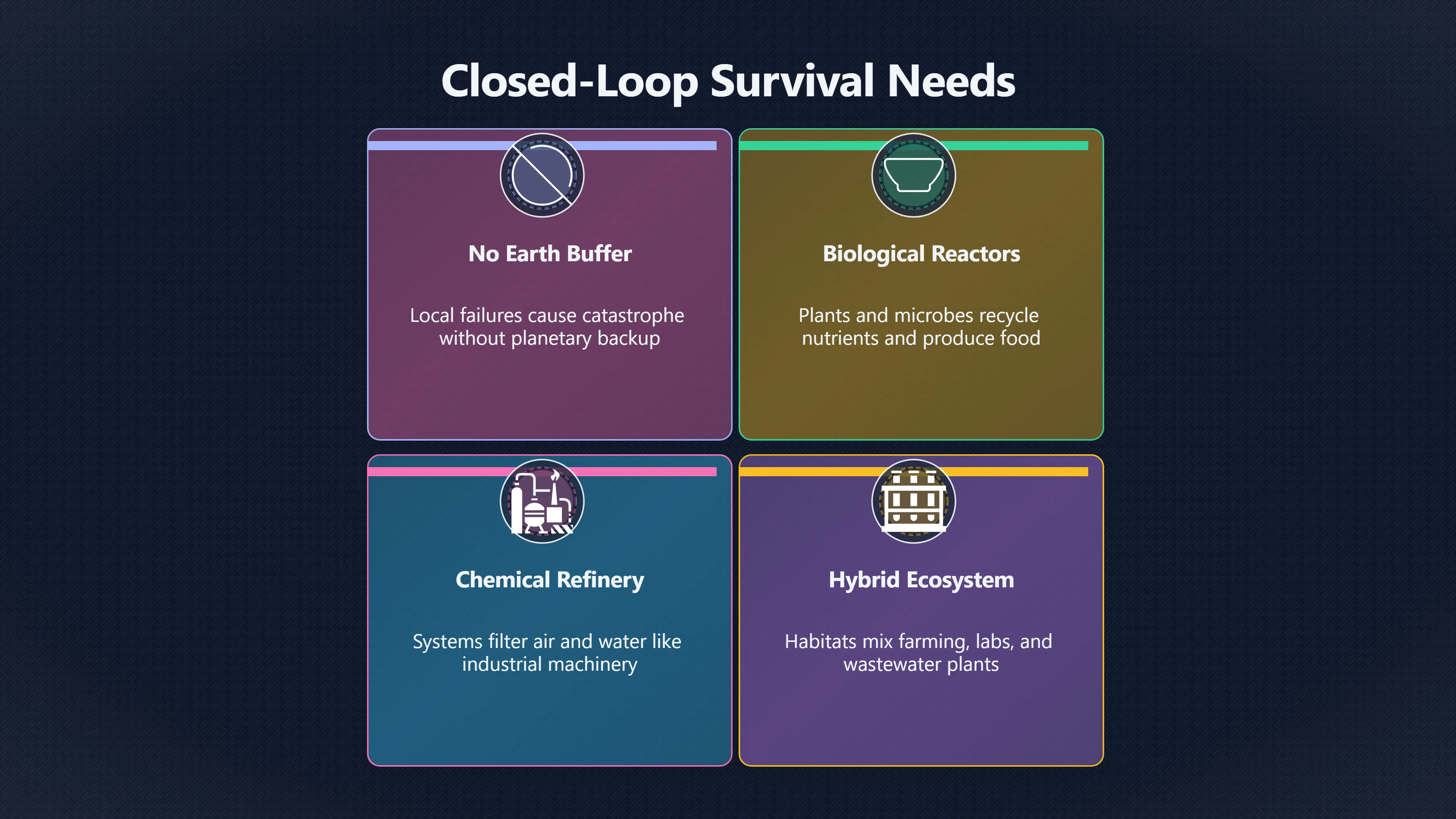
On Earth, humans rely on a vast planetary life-support system. Air, water, food production and waste processing happen across oceans, forests, soils and industrial networks so large that local failures are often absorbed without catastrophe.
A closed space habitat has no such buffer.
Every breath converts oxygen into carbon dioxide. Every meal creates waste. Every crop requires water, nutrients, light and atmospheric balance. A settlement must continually recycle these materials while preventing contaminants, microbial outbreaks, toxic accumulations or resource shortages. Even small inefficiencies become dangerous when there is no easy resupply route. NASA’s Environmental Control and Life Support Systems (ECLSS) already recycle water and manage atmospheric conditions aboard the International Space Station, but future settlements will need much higher levels of closure and autonomy. NASA[National Academies]nationalacademies.orgAdvanced Technology for Human Support in Space (1997)Closed-loop life support systems require an initial supply of resources but then pro…
The problem becomes even harder when biological systems are included. Plants, algae, bacteria and microbial reactors can regenerate oxygen, food and nutrients, but they are living systems rather than predictable machines. Their behaviour changes with temperature, radiation exposure, nutrient levels and population shifts. Europe’s long-running MELiSSA programme was created partly because understanding these interactions is essential before truly regenerative habitats become possible.[Webs UAB]webs.uab.catWebs UABMelissa: The European project of a closed life support systemAugust 14, 2011 — by C Lasseur · Cited by 199 — The MELiSSA (Micro-ecological life-support system) project is intended to be a tool to ga… PubMed A settlement may therefore resemble a hybrid ecosystem: part chemical refinery[esa.int]esa.intEuropean Space Agency ESAEuropean Space AgencyESA - Life supportA sensor developed by MELiSSA controls the fermentation and monitors biological processes. The sam…, part farm, part wastewater plant and part biological laboratory. Humans would depend on it every minute of every day.
Where AI could help control fragile ecosystems
The strongest case for AI is not replacing life-support hardware but managing complexity that increasingly exceeds direct human monitoring.
Modern habitats may contain tens of thousands of sensors measuring oxygen, carbon dioxide, humidity, water quality, nutrient concentrations, microbial activity, crop health, power consumption and equipment status. Human operators can review summaries, but an AI system could continuously analyse the entire network in real time.
Several areas stand out.
Predicting failures before they become emergencies
Traditional engineering often responds after alarms trigger. AI systems could instead look for subtle patterns that indicate a future failure.
A slight decline in water-purification efficiency, an unusual microbial signature in a bioreactor or an unexpected shift in atmospheric chemistry might not immediately threaten the crew. However, machine-learning systems trained on years of operational data could identify these anomalies early and recommend interventions before safety margins shrink. Research into digital twins—virtual replicas of life-support systems updated from live sensor data—aims to support exactly this kind of predictive management.[AIAA Journal]arc.aiaa.orgAIAA JournalDigital Twin Technologies for Autonomous Environmental…by N Gratius · 2024 · Cited by 30 — The “physical asset” is the ECL…
For a Mars settlement where expert engineers are months away, predictive maintenance may be more valuable than dramatic emergency responses.
Coordinating interconnected recycling loops
The hardest part of closed habitats is that every subsystem affects every other subsystem.
Food production influences oxygen generation. Waste processing affects nutrient availability. Water recovery influences humidity and thermal management. Small adjustments in one area can create unexpected consequences elsewhere.
An AI controller could model the habitat as a single integrated system rather than a collection of separate machines. Instead of optimising water recovery, agriculture or air revitalisation independently, it could optimise overall habitat stability. Recent work on autonomous habitat management increasingly focuses on these integrated approaches rather than isolated subsystems.[ScienceDirect]sciencedirect.comToward sustainable living in space: A review of…by A Raihan · 2026 · Cited by 1 — In the context of ECLSS, sustainability…[ScienceDirect]sciencedirect.comSpace habitation: Machine learning based evaluation and…by A Shafaghat · 2026 · Cited by 3 — The research provides a data…
Managing biological systems
Biological life support is attractive because it can regenerate resources rather than merely process them.
Plants can produce food and oxygen. Microbial reactors can break down waste and recycle nutrients. Algae may help with carbon capture and air revitalisation. Yet biological systems are notoriously difficult to control.
AI may help by monitoring growth rates, nutrient cycles, microbial populations and environmental conditions simultaneously. The MELiSSA project has already relied on advanced sensing and process control technologies to monitor biological processes inside experimental closed-loop systems. Future AI systems could extend this further, creating adaptive management that responds to changing ecosystem conditions rather than following fixed schedules.[European Space Agency]esa.intEuropean Space Agency ESAEuropean Space AgencyESA - Life supportA sensor developed by MELiSSA controls the fermentation and monitors biological processes. The sam…[Webs UAB]webs.uab.catWebs UABMelissa: The European project of a closed life support systemAugust 14, 2011 — by C Lasseur · Cited by 199 — The MELiSSA (Micro-ecological life-support system) project is intended to be a tool to ga…

Supporting settlement-scale autonomy
The International Space Station still depends heavily on ground controllers.
A permanent settlement on Mars, an asteroid or a free-space habitat may not have that luxury. Communication delays, population growth and operational complexity could make continuous Earth supervision impractical.
The long-term goal in many habitat studies is therefore increasing autonomy. AI systems could coordinate routine operations, diagnose faults, allocate resources, manage inventories and assist human crews in decision-making. Rather than requiring constant instructions from Earth, settlements might become capable of operating largely on local expertise and machine support.[ScienceDirect]sciencedirect.comToward sustainable living in space: A review of…by A Raihan · 2026 · Cited by 1 — In the context of ECLSS, sustainability…[AIAA Journal]arc.aiaa.orgAIAA JournalDigital Twin Technologies for Autonomous Environmental…by N Gratius · 2024 · Cited by 30 — The “physical asset” is the ECL…
The experiments that hint at the future
The basic idea of closed ecological life support is not new. Researchers have spent decades building partial versions of the systems future settlements may require.
The Soviet BIOS-3 experiments demonstrated that humans could survive for extended periods inside highly controlled closed environments supported partly by biological recycling systems. Later projects such as Biosphere 2 revealed how difficult ecosystem management becomes when many interacting biological processes operate simultaneously. Unexpected shifts in oxygen levels, soil chemistry and microbial activity exposed how much remains unknown about maintaining long-term ecological stability.[Wikipedia]WikipediaControlled ecological life-support systemControlled ecological life-support system
NASA’s Controlled Ecological Life Support System research programme and later regenerative life-support studies explored ways of integrating food production, waste recycling and atmosphere management into coherent systems. European researchers pursued similar goals through MELiSSA, which remains one of the most ambitious efforts to develop regenerative life support for future settlements.[NASA]ntrs.nasa.govTechnical Reports Server Controlled Ecological Life Support SystemTechnical Reports Server Controlled Ecological Life Support System Technical Reports Server[Webs UAB]webs.uab.catWebs UABMelissa: The European project of a closed life support systemAugust 14, 2011 — by C Lasseur · Cited by 199 — The MELiSSA (Micro-ecological life-support system) project is intended to be a tool to ga…
These projects suggest an important lesson: the challenge is not producing oxygen, recycling water or growing crops individually. The challenge is keeping the entire network stable when all of these processes interact continuously.
That is exactly the kind of systems-management problem for which advanced AI may prove unusually valuable.
What failure would look like in practice
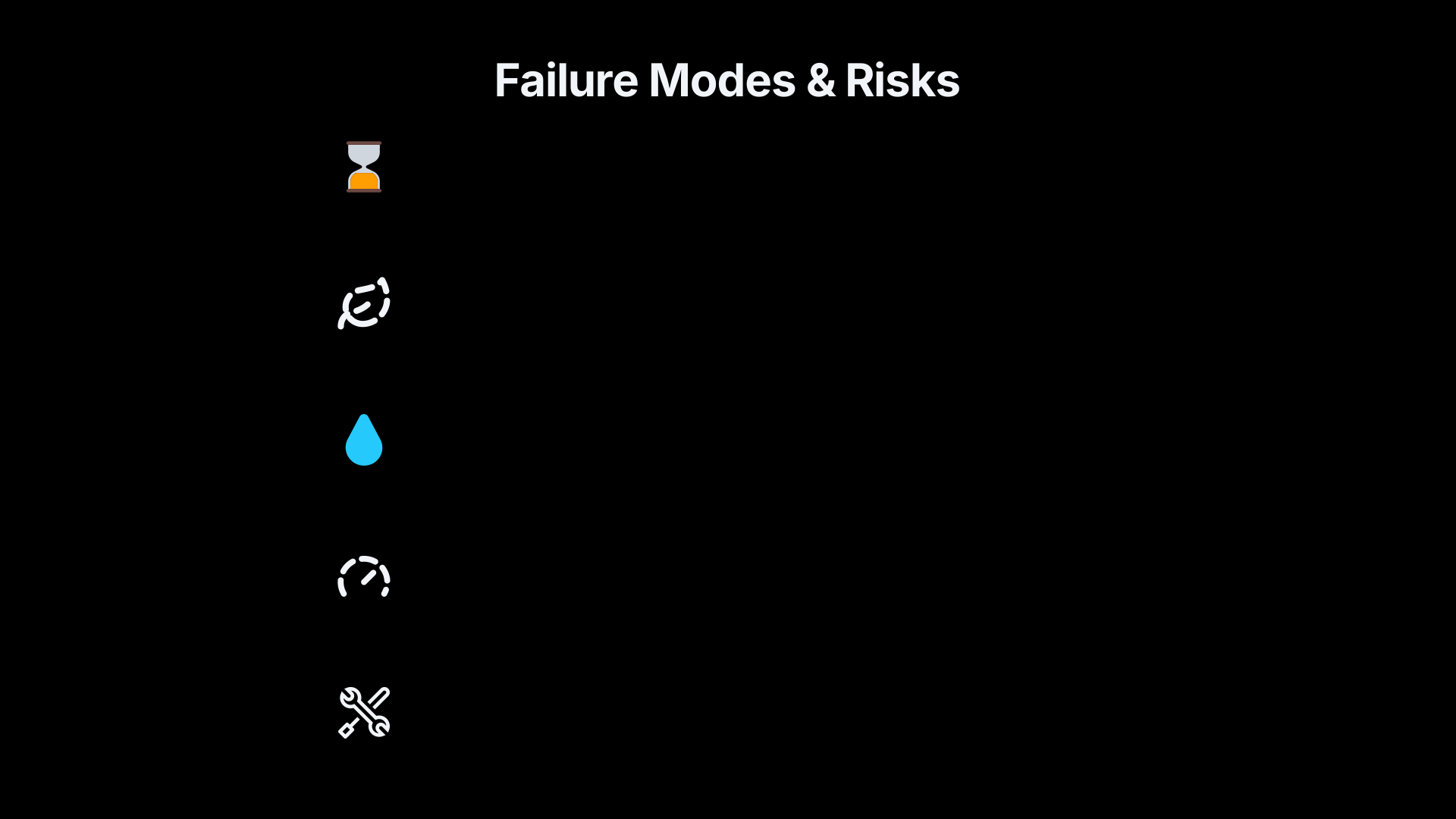
Space habitats are often imagined as engineering triumphs. Less attention is given to how they might fail.
The most dangerous failures may not be dramatic explosions. They may be slow, compounding problems that develop over weeks or months.
A crop disease could gradually reduce oxygen production. A microbial imbalance might contaminate water supplies. A faulty sensor could feed incorrect information into control systems. Waste-processing efficiency could decline without immediate detection. Each individual issue might appear manageable, yet together they could push the habitat beyond safe operating limits.[TTU Institutional Repository]ttu-ir.tdl.orgTTU Institutional RepositoryFunctionally Aligning Emergent Technologies for Self-…by D Klaus · 2022 · Cited by 12 — Although not the f…[ScienceDirect]sciencedirect.comImpact of dormancy on ECLSS design and operationby SP Eshima · 2024 · Cited by 4 — Results show that dormancy may have a larger impact on…
An AI supervisor might help detect these trends earlier than human operators. But it also introduces new failure modes.
If operators become overly dependent on automation, they may lose the skills needed to intervene manually. If machine-learning models are trained on incomplete data, unusual conditions could produce incorrect recommendations. If multiple systems rely on the same flawed assumptions, errors could propagate across the habitat rather than remaining isolated. NASA researchers have noted that life-support automation has historically faced scepticism partly because reliability remains more important than sophistication. A clever system that occasionally makes unpredictable decisions may be less useful than a simpler one whose behaviour is well understood.[NASA]ntrs.nasa.govTechnical Reports Server Controlled Ecological Life Support SystemTechnical Reports Server Controlled Ecological Life Support System
The practical solution may be layered control rather than full automation: AI handles monitoring, forecasting and optimisation, while humans retain authority over major decisions and emergency interventions.
Why this matters for humanity’s long future
In discussions of AI abundance and the long-term future, space settlement is often imagined through rockets, giant habitats and planetary engineering. Yet none of those ambitions matter if people cannot reliably stay alive once they arrive.
Life support is the hidden foundation underneath every larger vision.
A civilisation that spreads beyond Earth must learn how to create miniature biospheres that can function for decades without constant resupply. That requires understanding ecological complexity at a level humanity has never previously achieved. AI may become one of the tools that makes this possible—not because it replaces biology or engineering, but because it helps coordinate systems too complex for continuous human supervision alone. ScienceDirect[Webs UAB]webs.uab.catWebs UABMelissa: The European project of a closed life support systemAugust 14, 2011 — by C Lasseur · Cited by 199 — The MELiSSA (Micro-ecological life-support system) project is intended to be a tool to ga…
The broader AI bloom argument is that advanced intelligence could help humanity manage forms of complexity that currently exceed our capabilities. Closed space habitats are a concrete example. They demand continuous balancing of physical, chemical, biological and social systems in environments where mistakes can be fatal.
If future AI can reliably help keep those ecosystems stable, it would not merely improve a spacecraft. It would help create one of the essential conditions for a civilisation capable of surviving, flourishing and expanding far beyond a single planet.[ScienceDirect]sciencedirect.comToward sustainable living in space: A review of…by A Raihan · 2026 · Cited by 1 — In the context of ECLSS, sustainability…[TTU Institutional Repository]ttu-ir.tdl.orgTTU Institutional RepositoryFunctionally Aligning Emergent Technologies for Self-…by D Klaus · 2022 · Cited by 12 — Although not the f…
eBay marketplace picks
Marketplace Samples
Example marketplace items related to this page. Use the search link to explore similar finds on eBay.


Endnotes
1.
Source: nasa.gov
Title: environmental control and life support systems eclss
Link:https://www.nasa.gov/reference/environmental-control-and-life-support-systems-eclss/
Source snippet
Environmental Control and Life Support Systems (ECLSS)4 Apr 2025 — ECLSS is a life support system that provides or controls atmospher...
2.
Source: sciencedirect.com
Link:https://www.sciencedirect.com/science/article/pii/S2950616625000452
Source snippet
Toward sustainable living in space: A review of...by A Raihan · 2026 · Cited by 1 — In the context of ECLSS, sustainability...
3.
Source: ntrs.nasa.gov
Link:https://ntrs.nasa.gov/citations/20190027321
Source snippet
NASA Technical Reports ServerControls and Automation Research in Space Life Supportby HW Jones · 2019 · Cited by 10 — Since the ISS ECLSS...
4.
Source: ntrs.nasa.gov
Link:https://ntrs.nasa.gov/api/citations/20120008179/downloads/20120008179.pdf
Source snippet
NASA Technical Reports ServerDeep Space Habitat ECLSS Design Conceptby S Curley · 2012 · Cited by 27 — Specifically, ESM quantifies the l...
5.
Source: webs.uab.cat
Title: Webs UABMelissa: The European project of a closed life support system
Link:https://webs.uab.cat/melissapilotplant/wp-content/uploads/sites/397/2023/11/Melissa_The_European_project_of_a_closed_life_supp-1.pdf
Source snippet
August 14, 2011 — by C Lasseur · Cited by 199 — The MELiSSA (Micro-ecological life-support system) project is intended to be a tool to ga...
Published: August 14, 2011
6.
Source: arc.aiaa.org
Link:https://arc.aiaa.org/doi/10.2514/1.I011320
Source snippet
AIAA JournalDigital Twin Technologies for Autonomous Environmental...by N Gratius · 2024 · Cited by 30 — The “physical asset” is the ECL...
7.
Source: sciencedirect.com
Link:https://www.sciencedirect.com/science/article/pii/S2950616625000427
Source snippet
Space habitation: Machine learning based evaluation and...by A Shafaghat · 2026 · Cited by 3 — The research provides a data...
8.
Source: Wikipedia
Title: Controlled ecological life-support system
Link:https://en.wikipedia.org/wiki/Controlled_ecological_life-support_system
9.
Source: ntrs.nasa.gov
Title: Technical Reports Server Controlled Ecological Life Support System
Link:https://ntrs.nasa.gov/api/citations/19880004470/downloads/19880004470.pdf
10.
Source: sciencedirect.com
Link:https://www.sciencedirect.com/science/article/abs/pii/S0094576524003126
Source snippet
Impact of dormancy on ECLSS design and operationby SP Eshima · 2024 · Cited by 4 — Results show that dormancy may have a larger impact on...
11.
Source: arc.aiaa.org
Title: 6.1990 3729
Link:https://arc.aiaa.org/doi/pdfplus/10.2514/6.1990-3729
Source snippet
(feceslwipes and trash), but will collect, stabilize, and store these wastes for return to...Read more...
12.
Source: nationalacademies.org
Link:https://www.nationalacademies.org/read/5826/chapter/4
Source snippet
Advanced Technology for Human Support in Space (1997)Closed-loop life support systems require an initial supply of resources but then pro...
13.
Source: esa.int
Title: European Space Agency ESA
Link:https://www.esa.int/Science_Exploration/Human_and_Robotic_Exploration/Research/Life_support
Source snippet
European Space AgencyESA - Life supportA sensor developed by MELiSSA controls the fermentation and monitors biological processes. The sam...
14.
Source: ttu-ir.tdl.org
Link:https://ttu-ir.tdl.org/bitstreams/1421f010-251a-4b03-a179-4fcfc9c71a01/download
Source snippet
TTU Institutional RepositoryFunctionally Aligning Emergent Technologies for Self-...by D Klaus · 2022 · Cited by 12 — Although not the f...
15.
Source: ttu-ir.tdl.org
Link:https://ttu-ir.tdl.org/items/a103448c-5326-4302-913d-73d89d09779c
Source snippet
However, regenerable ECLSS...
Additional References
16.
Source: researchgate.net
Link:https://www.researchgate.net/publication/251166953_Closed_Ecological_Systems_Space_Life_Support_and_Biospherics
Source snippet
(PDF) Closed Ecological Systems, Space Life Support and...The chapter reviews the terminology of the field, the history and current work...
17.
Source: ui.adsabs.harvard.edu
Title: It is intended as a tool to gain understanding of closed life support
Link:https://ui.adsabs.harvard.edu/abs/2008cosp…37.1706L/abstract
Source snippet
Astrophysics Data SystemMelissa: The European project of a closed life support systemby C Lasseur · 2008 · Cited by 23 — The MELISSA (Mic...
18.
Source: researchgate.net
Link:https://www.researchgate.net/publication/394217008_Overview_of_Environmental_Control_and_Life_Support_Systems_in_Human_Space_Missions
Source snippet
(PDF) Overview of Environmental Control and Life Support...30 Jul 2025 — This review explores the essential role of Environmental Contro...
19.
Source: spacesettlementprogress.com
Link:https://spacesettlementprogress.com/stability-and-limitations-of-ecological-closed-life-support-systems-for-space-habitats/
Source snippet
Such a system needs to be reliably stable over long duration space missions.Read more...
20.
Source: nss.org
Link:https://nss.org/wp-content/uploads/2018/01/NSS-JOURNAL-Towards-Closed-ECLSS-for-Space-Habitats-Part-I.pdf
Source snippet
om airlocks will have to be replaced. Key words. Environmental...Read more...
21.
Source: pubmed.ncbi.nlm.nih.gov
Link:https://pubmed.ncbi.nlm.nih.gov/16431089/
Source snippet
ecology of the closed artificial ecosystem...by L Hendrickx · 2006 · Cited by 230 — MELiSSA is a bioregenerative life support system des...
22.
Source: youtube.com
Link:https://www.youtube.com/watch?v=TmcMoE3sFmU
Source snippet
2 AI for Space Exploration: Robots, Rovers, Satellites, and the Future of Humanity...
23.
Source: acceleron.org.in
Link:https://acceleron.org.in/index.php/aaj/article/download/230/194
Source snippet
Overview of Environmental Control and Life Support...by KT Saroja · 2025 — Abstract: This review explores the essential role of Environm...
24.
Source: youtube.com
Title: AI for Space Exploration: Robots, Rovers, Satellites, and the Future of Humanity
Link:https://www.youtube.com/watch?v=EAGw2UG5sK0
Source snippet
3 AI Moon Bases 2028: Self-Driving Habitats & Rovers...
25.
Source: youtube.com
Title: AI and Space Computing: From innovation to real-world impact
Link:https://www.youtube.com/watch?v=MDk_wjv0nw8
Source snippet
5 AI at NASA: Unlocking the Future of Exploration...
Topic Tree