Within Labour Impacts
When dangerous jobs move to control rooms
Robots can remove workers from danger while shifting many jobs towards control rooms, monitoring, judgement and emergency response.
On this page
- Which hazardous tasks can be operated remotely
- How monitoring changes skill, responsibility and risk
- Where remote work improves safety without hollowing out jobs
Page outline Jump by section
Introduction
When hazardous physical work is automated, the shift is often not from “job exists → job vanishes”, but from direct exposure to risk toward remote and supervisory roles. As robotics, artificial intelligence (AI) and connectivity become sophisticated, workers in mining, oil and gas, nuclear decommissioning, and other high‑risk sectors are increasingly moving out of harm’s way and into remote‑control, monitoring and exception‑handling jobs. This change reshapes the nature of labour without necessarily eliminating human contribution, offering safer work environments while also raising questions about skills, responsibility and job quality.
Which Hazardous Tasks Can Be Operated Remotely
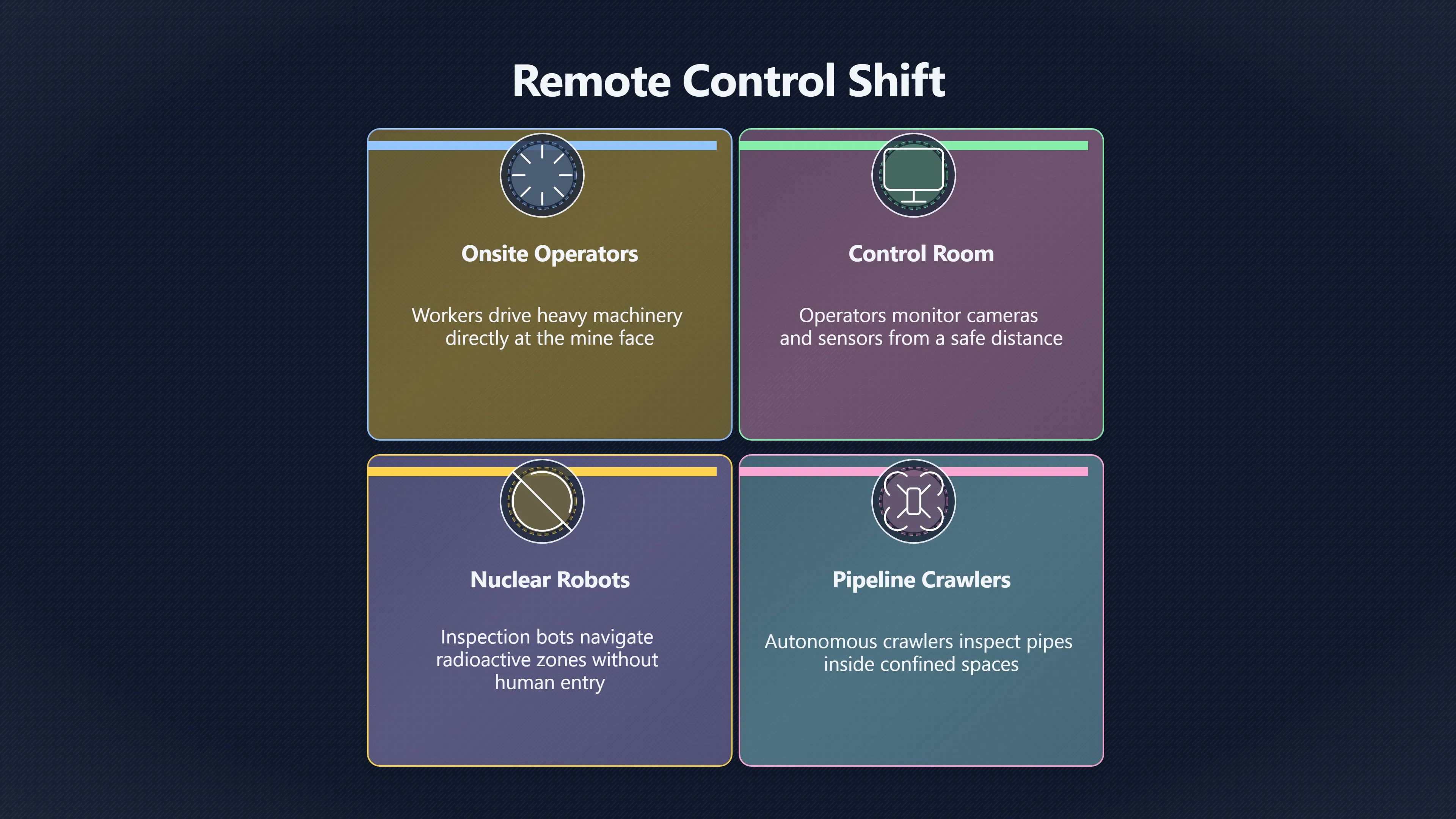
Automation in dangerous industries typically progresses from partial task automation to full remote operation rather than immediately replacing entire occupations. Mining illustrates this clearly: heavy machinery such as haul trucks, loaders and drill rigs historically required operators onsite under physically demanding and dangerous conditions. As remote control and teleoperation technologies have matured, operators now oversee these machines from control rooms – sometimes kilometres away from the mine face – using cameras, sensors and telemetry systems. This reduces exposure to rock falls, gas, dust and heavy equipment interactions.[AZoRobotics]azorobotics.comAZo Robotics Robots in Mining: Remote Control MiningRobots in Mining: Remote Control MiningApril 17, 2023…
Remote‑controlled robotics are also used in nuclear decommissioning and hazardous inspections. Trials at sites like Sellafield in the UK have demonstrated the feasibility of controlling inspection robots safely from off‑site locations, capturing data and performing tasks that once put workers at risk.[Manufacturing AUTOMATION]automationmag.comManufacturing AUTOMATIONSellafield And AtkinsRéalis Trial Remote Robot Operation - Manufacturing AUTOMATIONMarch 21, 2025…
Across oil, gas and construction, remote autonomous systems – including crawlers inside pipelines and drones above flare stacks – have taken over routine inspection and monitoring duties that once required specialist crews to enter confined, high‑risk spaces. These autonomous systems collect data and alert engineers without human entry into dangerous environments.[Petro Online]petro-online.comSource details in endnotes.
How Monitoring Changes Skill, Responsibility and Risk
Transitioning to remote control and monitoring changes what work feels like and what it demands from workers:
- From physical operation to oversight: Remote operators spend less time manipulating controls in hazardous settings and more on interpreting sensor data, supervising automated systems, and intervening when machines encounter anomalies. Control‑room work emphasises pattern recognition, situational awareness, and real‑time decision‑making rather than brute strength or on‑site presence.[Inspenet]inspenet.comAutonomous Mining: Connectivity for Remote OperationsAutonomous Mining: Connectivity for Remote Operations.May 24, 2026…
- Increased cognitive load and alertness: While remote roles remove immediate physical danger, they introduce new risks related to extended monitoring tasks, potential fatigue from long periods of vigilance, and the need to respond rapidly when autonomous systems flag issues or fail. Workers must integrate technical knowledge of robotics, software interfaces and safety systems into their judgement.[Platform Executive]platformexecutive.comPlatform Executive Underground Mining Safety InnovationsPlatform ExecutiveUnderground Mining Safety InnovationsNovember 5, 2025…
- Higher technical skills and training: As machines assume routine hazardous tasks, human tasks often shift toward diagnosing system issues, maintaining software and hardware, and coordinating across operational domains like geology, ventilation or safety protocols. Training programmes increasingly focus on digital literacy, control‑interface proficiency and even cybersecurity skills to manage connected automation systems.[Platform Executive]platformexecutive.comPlatform Executive Underground Mining Safety InnovationsPlatform ExecutiveUnderground Mining Safety InnovationsNovember 5, 2025…
These shifts illustrate a broader trend identified in automation research: tasks that are routine and hazardous get automated, while non‑routine oversight and judgement tasks grow in prominence. Although the exact balance differs by industry and technology level, automation often supplements rather than wholly replaces human roles, reshaping skill demands rather than purely eliminating jobs.[MDPI]

Where Remote Work Improves Safety Without Hollowing Out Jobs
Remote‑control roles can deliver clear safety benefits without simply hollowing out work if organisations manage the transition thoughtfully:
- Complementing automation with human judgement: In many operations, remote controllers are not mere button‑pushers but the critical fallback when autonomous systems encounter unexpected conditions, safety alarms or edge cases. Their role remains central to ensuring safe continuity of operations.[Inspenet]inspenet.comAutonomous Mining: Connectivity for Remote OperationsAutonomous Mining: Connectivity for Remote Operations.May 24, 2026…
- Creating new specialised roles: The move to remote operations can generate demand for systems engineers, maintenance technicians, data analysts and safety integrators, expanding career pathways beyond traditional hazard‑exposed roles. This diversification can boost job quality if accompanied by upskilling and clear progression routes.[Platform Executive]platformexecutive.comPlatform Executive Underground Mining Safety InnovationsPlatform ExecutiveUnderground Mining Safety InnovationsNovember 5, 2025…
- Reducing physical as well as cognitive risk: Removing workers from hazardous on‑site conditions cuts acute injury risks dramatically, while remote monitoring and AI‑assisted alerts can reduce the frequency or severity of incidents that still require human attention.[Deloitte]deloitte.comImproving Health and Safety in Mining with Automation, AI, and IoT | Deloitte US…
However, realising these benefits depends on work design, training investment and organisational support. If remote control roles are treated as low‑skill watch‑and‑wait jobs without investment in digital and analytical skills, they may undermine job quality despite safer environments. On the other hand, well‑structured remote roles – integrated into broader operational management, decision‑making and system maintenance – can be career‑enriching and safer alternatives to on‑site hazardous work.
Implications for Labour Markets and Human Flourishing
Within the broader context of automation and labour, the move toward remote control of hazardous tasks highlights a mechanism by which advanced technologies can reduce human exposure to danger while preserving human agency and economic participation. If remote‑control roles are supported by strong training, fair wages, and career pathways, they can exemplify a win‑win: safer working conditions and skilled jobs that contribute to productivity without displacing human contribution wholesale. This pattern aligns with optimistic visions of technological progress that emphasise expanded human capability and safety, not just efficiency.
Yet, without deliberate policy and organisational choices, there is a risk that remote roles become surveillance‑heavy, low‑engagement positions that neither fully reward nor utilise human expertise. The challenge for labour policy and corporate strategy is to ensure that remote control and monitoring roles are designed as skilled, meaningful work rather than residual tasks left over from automation.
In sum, remote‑control roles after hazardous task automation illustrate a precise mechanism by which technology can reduce physical risk while also reshaping labour towards monitoring, judgement, and systems integration – a pattern that, if well managed, could contribute to a safer, more capable and more flourishing future of work.

Amazon book picks
Further Reading
Books and field guides related to When dangerous jobs move to control rooms. Use these as the next step if you want deeper reading beyond the article.
The Glass Cage
Warns that remote and automated control can distance workers from embodied skill and situational awareness.
Human + Machine
Explains the shift from direct task performance to supervision, exception handling and human-machine teamwork.
Rise of the Robots
Places remote operation and supervisory roles inside the broader automation of work.
Rule of the Robots
Explores how advanced robotics changes human roles across industries.
eBay marketplace picks
Marketplace Samples
Example marketplace items related to this page. Use the search link to explore similar finds on eBay.


Endnotes
1.
Source: azorobotics.com
Title: AZo Robotics Robots in Mining: Remote Control Mining
Link:https://www.azorobotics.com/article.aspx?ArticleID=595
Source snippet
Robots in Mining: Remote Control MiningApril 17, 2023...
Published: April 17, 2023
2.
Source: automationmag.com
Link:https://www.automationmag.com/sellafield-and-atkinsrealis-trial-remote-robot-operation/
Source snippet
Manufacturing AUTOMATIONSellafield And AtkinsRéalis Trial Remote Robot Operation - Manufacturing AUTOMATIONMarch 21, 2025...
Published: March 21, 2025
3.
Source: petro-online.com
Link:https://www.petro-online.com/news/analytical-instrumentation/11/international-environmental-technology/how-remotenbspautonomous-system-will-redefine-routine-monitoring/64465
4.
Source: inspenet.com
Title: Autonomous Mining: Connectivity for Remote Operations
Link:https://inspenet.com/en/articles/autonomous-mining-advanced-connectivity/
Source snippet
Autonomous Mining: Connectivity for Remote Operations.May 24, 2026...
Published: May 24, 2026
5.
Source: mdpi.com
Link:https://www.mdpi.com/2673-6489/4/4/50
Source snippet
Eight Conditions That Will Change Mining Work in Mining 4.0 | MDPIOctober 24, 2024...
Published: October 24, 2024
6.
Source: deloitte.com
Link:https://www.deloitte.com/us/en/industries/[energy
Source snippet
Improving Health and Safety in Mining with Automation, AI, and IoT | Deloitte US...
7.
Source: mdpi.com
Title: Equipment and Operations Automation in Mining: A Review
Link:https://www.mdpi.com/2075-1702/12/10/713
Source snippet
CURRENT STATE OF MINING AUTOMATION: The mining industry, in most cases, utilizes a mechanized workforce. Miners operate mobile equipment...
8.
Source: platformexecutive.com
Title: Platform Executive Underground Mining Safety Innovations
Link:https://www.platformexecutive.com/journals/mining-journal/safety-innovations-in-underground-mining-robotics-and-remote-monitoring-systems/
Source snippet
Platform ExecutiveUnderground Mining Safety InnovationsNovember 5, 2025...
Published: November 5, 2025
Additional References
9.
Source: sciencedirect.com
Link:https://www.sciencedirect.com/science/article/pii/S0040162523001336
Source snippet
June 1, 2023 — TECHNOLOGICAL FORECASTING AND SOCIAL CHANGE Volume 191, June 2023, 122448 AUTOMATION TECHNOLOGIES AND THEIR I...
Published: June 1, 2023
10.
Source: econstor.eu
Link:https://www.econstor.eu/handle/10419/244574
Source snippet
Drivers of automation and consequences for jobs in engineering services: an agent-based modelling approachPlease use this ident...
11.
Source: roboticsandautomationnews.com
Link:https://roboticsandautomationnews.com/2026/03/29/emerging-trends-in-robotics-and-ai-for-high-risk-industries-construction-oil-and-gas-and-mining/100200/
Source snippet
March 29, 2026 — EMERGING TRENDS IN ROBOTICS AND AI FOR HIGH-RISK INDUSTRIES: CONSTRUCTION, OIL AND GAS, AND MINING March 29, 2026 by Sam...
Published: March 29, 2026
12.
Source: sciencedirect.com
Link:https://www.sciencedirect.com/science/article/pii/S0040162517314580
Source snippet
December 1, 2018 — TECHNOLOGICAL FORECASTING AND SOCIAL CHANGE Volume 137, December 2018, Pages 304-316 THE IMPACTS OF DIGIT...
Published: December 1, 2018
13.
Source: sciencedirect.com
Title: Automation and robotics in mining: Jobs, income and inequality implications
Link:https://www.sciencedirect.com/science/article/abs/pii/S2214790X21000046
Source snippet
THE EXTRACTIVE INDUSTRIES AND SOCIETY Volume 8, Issue 1, March 2021, Pages 189-193 Viewpoint Automation and robotics in mini...
Published: March 2021
14.
Source: sciencedirect.com
Title: Automation and robotics in mining: Jobs, income and inequality implications
Link:https://www.sciencedirect.com/science/article/pii/S2214790X21000046
Source snippet
"ScienceDirectMarch 1, 2021 — Viewpoint Automation and robotics in mining: Jobs, income and inequality implications [https://doi.org/10.101..."](https://doi.org/10.101...")...
Published: March 1, 2021
15.
Source: [discovery]({{ ‘discovery/’ | relative_url }}). ucl.ac.uk
Title: ucl.ac.uk Occupational mobility and automation: a data-driven network model
Link:https://discovery.ucl.ac.uk/id/eprint/10218123
Source snippet
mobility and automation: a data-driven network model - UCL DiscoveryOCCUPATIONAL MOBILITY AND AUTOMATION: A DATA-DRIVEN NETWORK MODEL Del...
16.
Source: ora.ox.ac.uk
Title: ox.ac.uk Occupational mobility and automation: A data-driven network model
Link:https://ora.ox.ac.uk/objects/uuid%3A6f3348bd-d558-4ada-96e8-75288fdfa838
Source snippet
mobility and automation: A data-driven network model - ORA - Oxford University Research ArchiveJanuary 20, 2021 — Image: Journal article...
Published: January 20, 2021
17.
Source: tandfonline.com
Link:https://www.tandfonline.com/doi/abs/10.1080/10301763.2024.2363573
Source snippet
Andreas CebullaAustralian Industrial Transformation Institute, College of Business, Government and Law, Flinders...
18.
Source: research.csiro.au
Title: au Rock-Breaker Automation – Robotics
Link:https://research.csiro.au/robotics/rock-breaker-automation/
Source snippet
csiro.auRock-Breaker Automation – RoboticsJuly 12, 2008 — ROCK-BREAKER AUTOMATION July 12th, 2008 Together with colleagues from across th...
Published: July 12, 2008
Topic Tree