Within Broad Access
Who gets to own abundant intelligence?
Cheap AI assistance depends on costly chips, data centres and cloud platforms that may concentrate control before benefits spread.
On this page
- Why compute is the new access bottleneck
- How concentrated infrastructure shapes prices and permissions
- What public interest compute could change
Page outline Jump by section
Introduction
If advanced AI eventually becomes a form of everyday cognitive infrastructure, the question is not only how powerful the systems become. It is who owns the machinery that makes them possible.
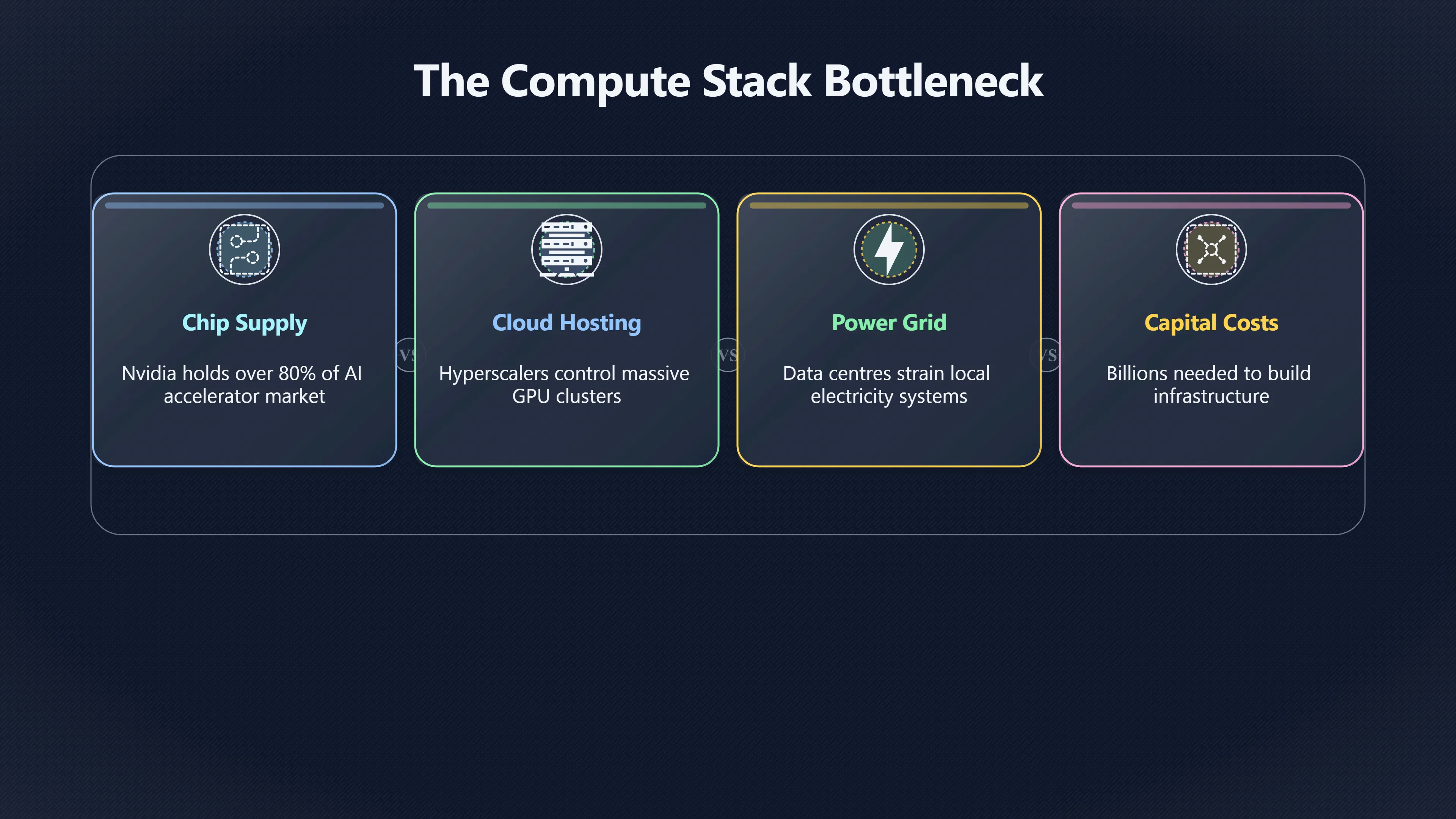
 Modern AI often appears weightless: a chatbot in a browser, an assistant on a phone, a research tool in a workplace. Yet behind that experience sits an unusually physical stack of infrastructure: specialised chips, vast data centres, electricity networks, cloud platforms, networking equipment and billions of pounds of capital. Access to useful AI may feel like access to software, but the supply of advanced AI depends on scarce industrial systems controlled by a relatively small number of companies and states.
This creates one of the central tensions in the broader AI bloom vision. AI could help make expertise, education, scientific assistance and problem-solving dramatically more available. At the same time, the infrastructure needed to provide that abundance may become one of the most concentrated forms of economic power in the world. Whether abundant intelligence becomes broadly available or tightly controlled may depend as much on compute governance as on model capability.[arXiv]arxiv.orgarXiv Computing Power and the Governance of Artificial IntelligenceComputing Power and the Governance of Artificial IntelligenceFebruary 13, 2024…
Why compute is the new access bottleneck
Many earlier digital technologies became cheaper because software could be copied at near-zero cost. Advanced AI is different. While models can be distributed digitally, creating and operating frontier systems requires enormous computing resources.
Training state-of-the-art models involves vast quantities of graphics processing units (GPUs), specialised processors originally designed for parallel computing. Running those models for millions of users also requires large-scale inference infrastructure: the servers and data centres that generate answers in real time. Google describes GPUs as essential because AI training depends on enormous numbers of simultaneous mathematical operations.[Google Cloud]cloud.google.comGoogle CloudWhat is a GPU & Its Importance for AIGPUs are used to train AI models by performing the complex mathematical operations that…
The result is that access to advanced AI increasingly depends on access to compute.
Researchers studying AI governance argue that compute has several unusual characteristics. Compared with data or algorithms, it is easier to measure, harder to hide, and produced through highly concentrated supply chains. That makes compute a strategic chokepoint. Whoever controls advanced compute can influence who builds powerful models, who gains access to them and under what conditions.[arXiv]arxiv.orgarXiv Computing Power and the Governance of Artificial IntelligenceComputing Power and the Governance of Artificial IntelligenceFebruary 13, 2024…
This is one reason governments have started treating AI infrastructure less like ordinary software and more like a strategic national asset, comparable to telecommunications networks, energy systems or semiconductor manufacturing capacity.[Digital Strategy]digital-strategy.ec.europa.euDigital StrategyEuropean approach to artificial intelligenceThe first European AI Strategy aimed at making the EU a world-class hub for A…
The stack is concentrated at almost every layer
The concentration problem is not limited to one company. It exists across multiple layers of the AI infrastructure stack.
Chips
The most obvious bottleneck is advanced AI hardware.
The Organisation for Economic Co-operation and Development (OECD) notes that the AI GPU market is highly concentrated, with Nvidia holding more than 80% of the market for AI-focused accelerators according to recent estimates.[OECD]oecd.orgOverview of the AI supply chain: Competition in artificial…14 Nov 2025 — As noted in Box 1, GPUs are currently the most used chips…
This matters because access to leading chips often determines who can train or serve advanced models economically. When demand surges, organisations without privileged relationships or deep capital reserves may struggle to obtain hardware at all.
The chip supply chain is even narrower than it first appears. Designing advanced processors, manufacturing them, packaging them and supplying the memory systems around them each depend on a small number of specialised firms. The practical consequence is that the world’s most advanced AI systems rely on infrastructure that cannot easily be reproduced by newcomers.[OECD]oecd.aipublic ai policies for democratic and sustainable ai infrastructuresPublic AI: Policies for democratic and sustainable AI…5 Dec 2025 — Public AI policies can support sustainable AI infrastructures throu…
Cloud providers
Owning chips is not enough. They must be housed, powered, cooled and connected.
This has strengthened the position of hyperscale cloud providers such as Amazon Web Services, Microsoft Azure and Google Cloud. These firms already controlled much of the world’s cloud infrastructure before the generative AI boom. AI demand has increased the importance of those platforms because they can deploy massive GPU clusters that few other organisations can afford.[AI Now Institute]ainowinstitute.orgcompute and aiAI Now InstituteComputational Power and AISep 27, 2023 — This concentration in compute also incentivizes cloud infrastructure providers t…
For many developers, startups, universities and governments, access to frontier AI effectively means renting capacity from a small group of cloud operators.
Data centres and power
The next bottleneck is increasingly physical rather than digital.
Building frontier AI infrastructure requires land, electricity, cooling systems, fibre connections and large capital expenditures. Investors and infrastructure firms increasingly treat data-centre capacity itself as a strategic asset. Reuters reported major new acquisitions and investments aimed specifically at expanding AI-serving infrastructure.[Reuters]reuters.comI Squared bets on AI inference with $225 million data center buy from CogentThis strategic move includes an additional $1 billion commitment for upgrades, expansion, and further acquisitions. The data centers, loc…
Recent research suggests that AI data centres are becoming geographically concentrated as well. One study projects that North America, Western Europe and parts of the Asia-Pacific region could account for more than 90% of future compute capacity, creating regional dependencies and pressure on local power systems.[arXiv]arxiv.orgarXiv Computing Power and the Governance of Artificial IntelligenceComputing Power and the Governance of Artificial IntelligenceFebruary 13, 2024…
This means the future distribution of intelligence may partly depend on the distribution of electricity, grid capacity and industrial infrastructure.
How concentrated infrastructure shapes prices and permissions
The most visible effect of concentration is price.
A model may appear publicly available while remaining expensive enough to exclude large parts of the world. Universities, researchers, schools, charities and smaller firms often face compute costs that large technology companies can absorb far more easily.
But concentration affects more than pricing.
The operators of cloud infrastructure can determine which models are hosted, what usage policies apply, which regions receive access first and what activities are permitted. AI services therefore do not merely involve technical capability. They involve governance decisions embedded inside infrastructure.
This is one reason AI researchers increasingly discuss “compute governance” rather than only model governance. The practical power often sits below the model layer, in the systems that allocate processing resources.[arXiv]arxiv.orgarXiv Computing Power and the Governance of Artificial IntelligenceComputing Power and the Governance of Artificial IntelligenceFebruary 13, 2024…
A useful comparison is electricity. Households generally do not own power stations. Yet societies developed rules, utilities, regulators and public obligations to ensure electricity became broadly available rather than remaining a luxury service for a small elite.
AI may face a similar transition. If advanced cognitive assistance becomes economically important, societies may increasingly ask whether access should depend solely on commercial pricing decisions.
Why frontier AI may naturally favour giant organisations
The economics of modern AI create powerful advantages for large actors.
Training frontier models can require investments measured in hundreds of millions or even billions of pounds. The companies competing at the frontier increasingly raise enormous sums specifically to finance infrastructure. Recent funding rounds have highlighted how closely model development and compute acquisition are now linked.[Reuters]reuters.comThis development intensifies the competition between the two AI giants for market dominance. Anthropic’s valuation has more than doubled…
The result is a feedback loop:
- Large firms obtain capital.
- Capital buys compute.
- Compute enables stronger models.
- Stronger models attract users and revenue.
- Revenue attracts more capital.
This dynamic can create winner-takes-most tendencies even if no single company achieves a formal monopoly.
Infrastructure ownership also encourages vertical integration. Firms increasingly seek control over chips, cloud services, model development and deployment simultaneously. Microsoft’s Maia programme, Google’s Tensor Processing Units (TPUs), Amazon’s Trainium chips and similar efforts reflect attempts to reduce dependence on external suppliers while strengthening control over the entire AI stack.[IT Pro]itpro.comIT Pro What is Microsoft Maia?Unveiled in November 2023, the Maia 100 is engineered to handle large-scale AI workloads, including training and inference for generative…
From a bloom perspective, the concern is not merely corporate success. It is whether access to advanced cognitive tools becomes structurally dependent on a handful of gatekeepers.

The risk is not only monopoly but dependency
Discussion of AI concentration sometimes focuses on antitrust concerns. Those matter, but dependency may be equally important.
A country, university system, healthcare network or scientific community can become dependent on infrastructure it does not meaningfully control.
That dependency can create several vulnerabilities:
- Sudden price increases.
- Access restrictions.
- Geopolitical pressure.
- Service disruptions.
- Limits on research independence.
- Reduced ability to inspect or modify systems.
These concerns become more significant if AI systems eventually play major roles in education, scientific research, medicine, administration or economic coordination.
A future in which most people rely on AI assistance while only a small number of organisations control the underlying infrastructure would resemble a highly centralised cognitive utility. That arrangement might still generate large benefits, but it raises questions about resilience, accountability and democratic oversight.
Open models do not automatically solve the problem
Open-source and open-weight AI projects are often presented as an answer to concentration.
They can help. Open models make it easier for researchers, startups and public institutions to inspect, modify and adapt systems. They reduce dependence on a single provider and can spread technical knowledge more broadly.
Yet open models face a major limitation: they still require compute.
Researchers have increasingly argued that open-source AI alone cannot guarantee broad access if the infrastructure needed to run advanced systems remains concentrated. A model can be publicly available while remaining practically inaccessible because operating it requires expensive hardware and cloud resources.[arXiv]arxiv.orgarXiv Computing Power and the Governance of Artificial IntelligenceComputing Power and the Governance of Artificial IntelligenceFebruary 13, 2024…
This creates a distinction between software openness and infrastructure openness.
A society may possess open models on paper while still depending on a narrow set of companies for the actual delivery of intelligence.
What public-interest compute could change
If compute concentration becomes a major constraint, one response is public-interest compute.
The idea is not necessarily that governments build complete alternatives to every commercial AI platform. Rather, it involves ensuring that researchers, universities, public institutions and smaller innovators have meaningful access to advanced computing resources.
Several emerging approaches include:
- National research compute facilities.[nsf.gov]nsf.govNational Science FoundationNational Artificial Intelligence Research ResourceThe National Artificial Intelligence Research Resource (NAIR…
- Shared academic AI clusters.
- Public cloud credits for research and education.
- Public-interest model hosting.[oecd.ai]oecd.aipublic ai policies for democratic and sustainable ai infrastructuresPublic AI: Policies for democratic and sustainable AI…5 Dec 2025 — Public AI policies can support sustainable AI infrastructures throu…
- International compute partnerships.
- Infrastructure tied to open-science programmes.
The United States’ National Artificial Intelligence Research Resource (NAIRR) is one example of an effort to create shared access to AI computing, models and data for researchers and educators rather than restricting cutting-edge resources to large private laboratories.[NSF - U.S. National Science Foundation]nsf.govNational Science FoundationNational Artificial Intelligence Research ResourceThe National Artificial Intelligence Research Resource (NAIR…
European policymakers have similarly framed AI infrastructure partly through the lens of technological sovereignty and public capacity rather than pure market competition.[Digital Strategy]digital-strategy.ec.europa.euDigital StrategyEuropean approach to artificial intelligenceThe first European AI Strategy aimed at making the EU a world-class hub for A…
Advocates of public AI argue that public compute can help narrow what they call the “compute divide”: the growing gap between organisations that can afford frontier infrastructure and those that cannot.[OECD.AI]oecd.aipublic ai policies for democratic and sustainable ai infrastructuresPublic AI: Policies for democratic and sustainable AI…5 Dec 2025 — Public AI policies can support sustainable AI infrastructures throu…
The strongest argument for concentration
There is also a serious counterargument.
Building and operating frontier AI infrastructure is genuinely difficult. Concentration may not simply be the result of market failure. It may reflect economies of scale.
Large firms can:
- Finance enormous capital expenditures.
- Build specialised engineering teams.
- Maintain global infrastructure.[marketsandmarkets.com]marketsandmarkets.comAI Infrastructure Market Size, Share and TrendsThe global AI Infrastructure Market in terms of revenue is estimated to be worth $135.81 b…
- Improve reliability and security.
- Absorb the risks of long-term research.
Some degree of concentration may therefore be unavoidable if the goal is pushing capability frontiers quickly.
Supporters of this view argue that the fastest path to scientific acceleration, advanced medical discovery and powerful AI tools may require precisely the kind of large-scale infrastructure investments now being made by major technology firms. The challenge is then not preventing concentration entirely but ensuring that the resulting capabilities diffuse outward.[KKR]kkr.comBeyond the Bubble: Why AI Infrastructure Will Compound…Will long-term AI infrastructure demand justify current activity? Explore th…
The key question becomes whether concentrated production can coexist with broad access.
The deeper bloom question
The long-term significance of compute governance is not mainly about today’s AI subscriptions. It is about the future distribution of intelligence itself.
If advanced AI becomes a general-purpose amplifier of learning, creativity, research and problem-solving, then access to AI may increasingly resemble access to education, electricity or the internet: a foundational condition for participation in modern society.
The optimistic AI bloom vision depends on more than creating powerful systems. It depends on making cognitive abundance genuinely available. That means the institutions controlling chips, cloud platforms, data centres and compute allocation may end up shaping the social consequences of AI as much as the model developers themselves.
A future of broad human flourishing is easier to imagine when intelligence becomes widely accessible infrastructure. It is harder to imagine if access to that infrastructure remains permanently scarce, expensive or dependent on a small number of gatekeepers. The struggle over compute is therefore not a side issue to abundant intelligence. It is one of the places where the future distribution of abundance may be decided.
Amazon book picks
Further Reading
Books and field guides related to Who gets to own abundant intelligence?. Use these as the next step if you want deeper reading beyond the article.
The Coming Wave
Discusses concentration and containment of powerful AI infrastructure.
eBay marketplace picks
Marketplace Samples
Example marketplace items related to this page. Use the search link to explore similar finds on eBay.


Endnotes
1.
Source: arxiv.org
Title: arXiv Computing Power and the Governance of Artificial Intelligence
Link:https://arxiv.org/abs/2402.08797
Source snippet
Computing Power and the Governance of Artificial IntelligenceFebruary 13, 2024...
Published: February 13, 2024
2.
Source: cloud.google.com
Link:https://cloud.google.com/discover/gpu-for-ai
Source snippet
Google CloudWhat is a GPU & Its Importance for AIGPUs are used to train AI models by performing the complex mathematical operations that...
3.
Source: oecd.org
Link:https://www.oecd.org/en/publications/competition-in-artificial-intelligence-infrastructure_623d1874-en/full-report/component-5.html
Source snippet
Overview of the AI supply chain: Competition in artificial...14 Nov 2025 — As noted in Box 1, GPUs are currently the most used chips...
4.
Source: reuters.com
Title: I Squared bets on AI inference with $225 million data center buy from Cogent
Link:https://www.reuters.com/business/media-telecom/i-squared-bets-ai-inference-with-225-million-data-center-buy-cogent-2026-05-26/
Source snippet
This strategic move includes an additional $1 billion commitment for upgrades, expansion, and further acquisitions. The data centers, loc...
5.
Source: arxiv.org
Link:https://arxiv.org/abs/2604.06198
Source snippet
Concentrated siting of AI data centers drives regional power-system stress under rising global compute demandMarch 13, 2026...
Published: March 13, 2026
6.
Source: reuters.com
Link:https://www.reuters.com/business/anthropic-raises-65-billion-now-valued-965-billion-2026-05-28/
Source snippet
This development intensifies the competition between the two AI giants for market dominance. Anthropic’s valuation has more than doubled...
7.
Source: arxiv.org
Title: arXiv If open source is to win, it must go public
Link:https://arxiv.org/abs/2507.09296
Source snippet
If open source is to win, it must go publicJuly 12, 2025...
Published: July 12, 2025
8.
Source: oecd.ai
Title: public ai policies for democratic and sustainable ai infrastructures
Link:https://oecd.ai/en/wonk/public-ai-policies-for-democratic-and-sustainable-ai-infrastructures
Source snippet
Public AI: Policies for democratic and sustainable AI...5 Dec 2025 — Public AI policies can support sustainable AI infrastructures throu...
9.
Source: nsf.gov
Link:https://www.nsf.gov/focus-areas/ai/nairr
Source snippet
National Science FoundationNational Artificial Intelligence Research ResourceThe National Artificial Intelligence Research Resource (NAIR...
10.
Source: kkr.com
Link:https://www.kkr.com/insights/ai-infrastructure
Source snippet
Beyond the Bubble: Why AI Infrastructure Will Compound...Will long-term AI infrastructure demand justify current activity? Explore th...
11.
Source: reuters.com
Title: marvell technology forecasts quarterly revenue above estimates 2026 05 27
Link:https://www.reuters.com/technology/marvell-technology-forecasts-quarterly-revenue-above-estimates-2026-05-27/
Source snippet
As hyperscalers expand AI data centers, demand for Marvell’s specialized and interconnect technologies continues to climb. The company pr...
12.
Source: oecd.org
Title: component 6
Link:https://www.oecd.org/en/publications/competition-in-artificial-intelligence-infrastructure_623d1874-en/full-report/component-6.html
Source snippet
Market features in AI infrastructure: Competition in artificial...Nov 14, 2025 — There are a range of different markets in the AI infras...
13.
Source: oecd.org
Link:https://www.oecd.org/en/topics/sub-issues/ai-principles.html
Source snippet
AI principlesValues-based principles. The OECD AI Principles promote use of AI that is innovative and trustworthy and that respects human...
14.
Source: arxiv.org
Link:https://arxiv.org/pdf/2412.05761
Source snippet
Interactions Between Artificial Intelligence and Digital...by S Nagar · 2024 · Cited by 7 — Artificial intelligence (AI) and digital pub...
15.
Source: arxiv.org
Link:https://arxiv.org/html/2504.16026v1
Source snippet
Trends in AI SupercomputersThis is consistent with NVIDIA's 2024 AI chip market share of about 70 - 95%. Chinese-designed chips make up l...
16.
Source: ainowinstitute.org
Title: compute and ai
Link:https://ainowinstitute.org/publications/compute-and-ai
Source snippet
AI Now InstituteComputational Power and AISep 27, 2023 — This concentration in compute also incentivizes cloud infrastructure providers t...
17.
Source: digital-strategy.ec.europa.eu
Link:https://digital-strategy.ec.europa.eu/en/policies/european-approach-artificial-intelligence
Source snippet
Digital StrategyEuropean approach to artificial intelligenceThe first European AI Strategy aimed at making the EU a world-class hub for A...
18.
Source: itpro.com
Title: IT Pro What is Microsoft Maia?
Link:https://www.itpro.com/infrastructure/what-is-microsoft-maia
Source snippet
Unveiled in November 2023, the Maia 100 is engineered to handle large-scale AI workloads, including training and inference for generative...
Published: November 2023
19.
Source: openfuture.eu
Link:https://openfuture.eu/our-work/ai-and-the-commons/
Source snippet
Public AIWe aim to demonstrate how more democratic, public interest oriented and purposeful systems can be designed, based on public AI p...
20.
Source: digital-strategy.ec.europa.eu
Link:https://digital-strategy.ec.europa.eu/en/policies/expert-group-ai
Source snippet
europa.euHigh-level expert group on artificial intelligenceBuilding on its first deliverable, the group put forward 33 recommendations to...
Additional References
21.
Source: marketsandmarkets.com
Link:https://www.marketsandmarkets.com/Market-Reports/ai-infrastructure-market-38254348.html
Source snippet
AI Infrastructure Market Size, Share and TrendsThe global AI Infrastructure Market in terms of revenue is estimated to be worth $135.81 b...
22.
Source: medium.com
Link:https://medium.com/%40gpuanalist/gpu-cloud-computing-an-honest-market-analysis-for-ai-applications-in-2026-6e150a69a7c0
Source snippet
GPU Cloud Computing: An Honest Market Analysis for AI...Key Market Statistics: Global Market Size (2025): ~$95 billion; Projected Growth...
23.
Source: onu.delegfrance.org
Link:https://onu.delegfrance.org/statement-on-inclusive-and-sustainable-artificial-intelligence-for-people-and
Source snippet
on Inclusive and Sustainable Artificial Intelligence...26 Dec 2025 — The [Public interest AI]({{ 'public-interest-ai/' | relative_url }}) Initiative will sustain and support digital...
24.
Source: opensource.org
Link:https://opensource.org/ai/webinars/a-data-pathway-to-building-public-ai
Source snippet
They represent: Community-based governance of data resources; Alternatives to proprietary ownership models...Read more...
25.
Source: industry.gov.au
Title: expectations data centres and ai infrastructure developers
Link:https://www.industry.gov.au/publications/expectations-data-centres-and-ai-infrastructure-developers
Source snippet
Expectations of data centres and AI infrastructure developers23 Mar 2026 — This document sets out the Australian Government's expectation...
26.
Source: visualcapitalist.com
Title: charted the battle for ai data center revenue 2021 2025
Link:https://www.visualcapitalist.com/charted-the-battle-for-ai-data-center-revenue-2021-2025/
Source snippet
Charted: The Battle for AI Data Center Revenue (2021–2025)21 Jan 2026 — As seen in the data table below, revenues have shifted significan...
27.
Source: un.org
Link:https://www.un.org/sites/un2.un.org/files/governing_ai_for_humanity_final_report_en.pdf
Source snippet
capacity among public officials and social entrepreneurs.Read more...
28.
Source: GOV.UK
Title: artificial intelligence sector study 2024
Link:https://www.gov.uk/government/publications/artificial-intelligence-sector-study-2024/artificial-intelligence-sector-study-2024
Source snippet
Intelligence sector study 20243 Sept 2025 — This 2024 AI Sector Study provides a comprehensive analysis of the UK's AI landscape and will...
29.
Source: precedenceresearch.com
Title: ai chips for data center and cloud market
Link:https://www.precedenceresearch.com/ai-chips-for-data-center-and-cloud-market
Source snippet
Size, Report...24 Dec 2025 — The AI chips for data centers and cloud market is shifting toward specialized, high-performance chips like...
30.
Source: linkedin.com
Link:https://www.linkedin.com/posts/kumar-priyadarshi-b0a2a7a2_4-major-companies-monopolising-ai-chip-supply-activity-7433354306311065600-Dea4
Source snippet
ud computing, Amazon Web Services (AWS) stands as...Read more...
Topic Tree