Within AI Tutors
Will Access Be Fair?
The promise of affordable tutoring depends on devices, connectivity, teacher training, supervision, and funding models as much as the software itself.
On this page
- Why software alone cannot close education gaps
- Lessons from underserved school pilots
- Public good or premium education layer
Page outline Jump by section
Introduction
AI tutoring could, in principle, bring something historically rare to poorer schools: regular personalised academic support at very low marginal cost. A capable AI system can explain ideas repeatedly, adapt to different reading levels, translate material, generate practice questions, and remain available outside school hours without requiring a new human tutor for every child. That matters because one-to-one attention has usually been reserved for wealthy families and elite schools.
 But the main barrier is no longer just software. Whether poorer schools benefit depends on electricity, internet access, device availability, teacher training, language support, public funding, and political priorities. The optimistic vision behind AI-enabled educational abundance is not simply that chatbots become clever. It is that intellectual support becomes as scalable as digital information itself. The harder reality is that unequal infrastructure could easily turn AI tutoring into another premium educational layer for already advantaged students. [World Bank]worldbank.orgWorld BankDigital Technologies in EducationFor low- and middle-income countries, AI presents a unique opportunity: If supported by founda… [World]worldbank.orgWorld BankDigital Technologies in EducationFor low- and middle-income countries, AI presents a unique opportunity: If supported by founda…
Why software alone cannot close education gaps
The strongest AI tutoring systems today are impressive partly because they mimic some features of human tutoring: immediate feedback, patient explanation, and conversational interaction. Yet poor schools often lack the conditions needed to use these systems reliably.
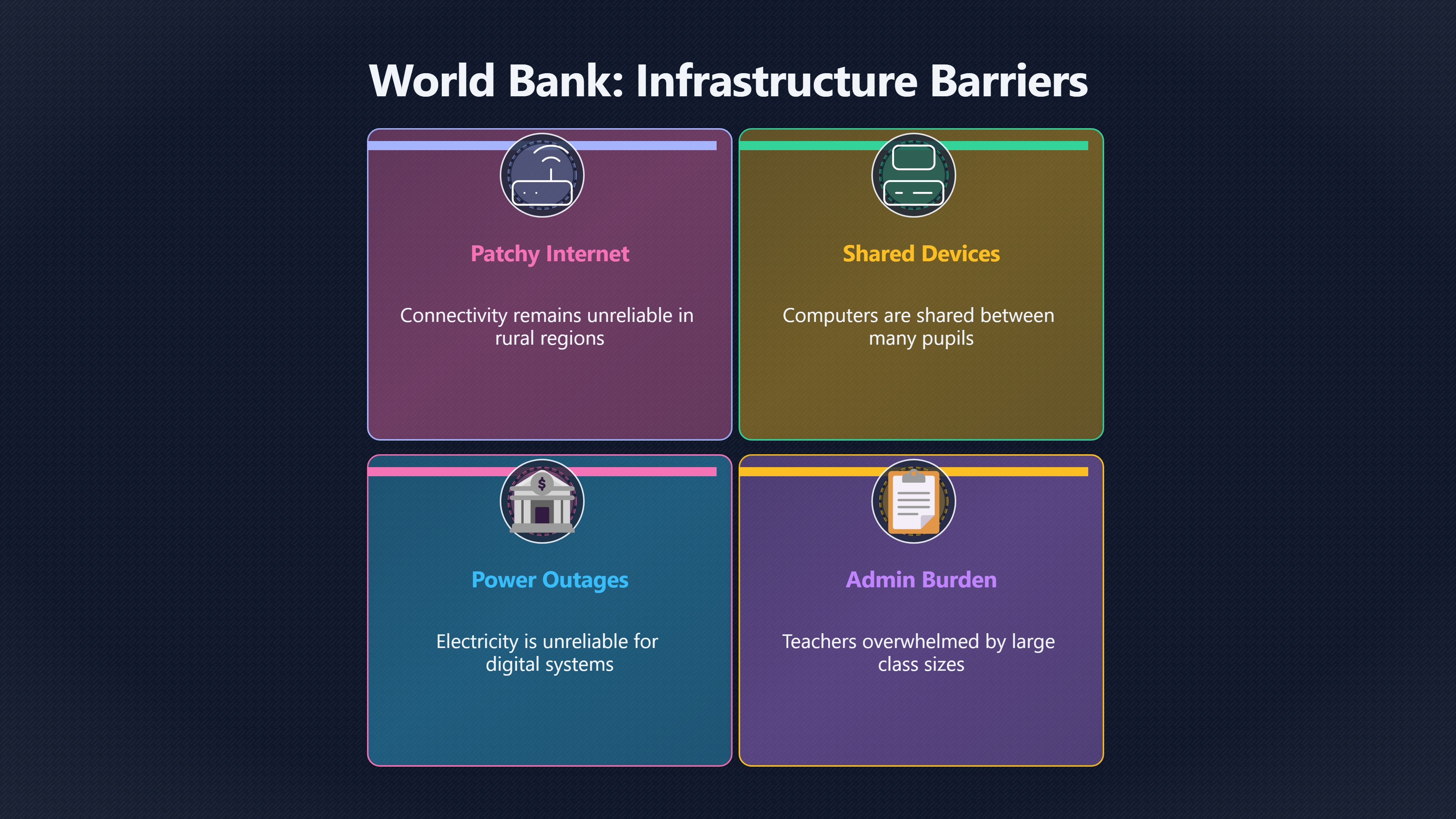
In many low-income and lower-middle-income regions, schools still struggle with basic digital infrastructure. Internet connectivity remains patchy, devices are shared between many pupils, electricity is unreliable, and teachers may already be overwhelmed by large class sizes and administrative burdens. The World Bank has repeatedly argued that AI in education depends on “foundational digital skills and connectivity” before more advanced systems can work at scale. [World Bank]worldbank.orgWorld BankDigital Technologies in EducationFor low- and middle-income countries, AI presents a unique opportunity: If supported by founda…
This creates a paradox. AI tutoring is often presented as a way to compensate for teacher shortages and unequal resources, but the schools with the greatest shortages are frequently the least prepared to deploy advanced digital systems. A wealthy urban school may be able to give every pupil a laptop, stable broadband, AI supervision policies, and trained staff. A rural school may have intermittent mobile data and one shared computer room.
Research on digital inequality increasingly stresses that access is not just about owning a device. Students also need:
- reliable bandwidth
- enough screen time for meaningful use
- digital literacy
- safe supervision
- support when systems fail
- teachers who know when AI advice is wrong or misleading
Without those layers, AI tutoring can become erratic or ineffective. [Frontiers]frontiersin.orgFrontiers AI and the digital divide in educationFrontiersAI and the digital divide in educationFebruary 5, 2026 — by MA Matjie · 2026 · Cited by 6 — The digital access and skills divide… [BERA]bera.ac.ukDigital equity in the age of generative AI30 May 2025 — Generative AI holds enormous potential to transform education, but its benefits w…
There is also a linguistic issue. Most frontier AI systems work best in English and a relatively small set of globally dominant languages. Schools serving minority-language populations or low-literacy communities may receive weaker outputs, less culturally relevant material, or fewer safety protections. UNESCO has warned that AI systems can reproduce existing inequalities if access, governance, and language inclusion are not treated as central design questions rather than afterthoughts. [UNESCO]unesco.orgwhat you need know about ai and right educationUNESCOWhat you need to know about AI and the right to education25 Sept 2025 — It analyses how AI and digital technologies impact access…
The economics are promising, but the deployment costs are real
The optimistic economic case for AI tutoring is still substantial. Once an AI model exists, the cost of serving one more learner is dramatically lower than hiring another human tutor. That matters because tutoring has historically been labour-intensive and expensive.
In theory, a public education system could eventually provide every student with some form of always-available academic assistant at a fraction of the cost of traditional tutoring markets. For countries facing severe teacher shortages, this possibility is especially attractive. The World Bank has argued that AI could help address learning crises in communities with high dropout rates and insufficient teaching capacity. [World Bank]worldbank.orgWorld BankDigital Technologies in EducationFor low- and middle-income countries, AI presents a unique opportunity: If supported by founda…
But “cheap software” does not mean “cheap system”. Schools still need:
- devices that survive daily classroom use
- cybersecurity and privacy protections
- maintenance budgets
- procurement systems
- teacher training
- monitoring against misuse
- technical support
- electricity and connectivity
These costs matter most in poorer districts because they compete with more urgent needs such as school meals, buildings, sanitation, and teacher salaries.
There is also the question of business models. Some leading AI tutors are attached to subscription systems or premium educational platforms. Khan Academy, for example, has tried to position Khanmigo as a guided educational assistant rather than a generic chatbot, while also acknowledging the need for funding and supervised deployment. [Khanmigo]khanmigo.aiKhanmigoMeet Khanmigo: Khan Academy's AI-powered teaching…Khanmigo, built by nonprofit Khan Academy, is a top-rated AI for education…
That creates a political question as much as a technical one: will AI tutoring become public infrastructure, like libraries and textbooks, or remain an enhancement mainly purchased by wealthier schools and parents?
Lessons from underserved-school pilots
Early deployments suggest that AI tutoring can help disadvantaged learners under the right conditions, but they also show how dependent outcomes are on surrounding human systems.
One important pattern is that structured school integration matters more than merely providing chatbot access. Programmes that combine AI tutoring with teacher oversight, classroom incentives, and guided assignments appear more promising than unrestricted use.
Research linked to Khanmigo and related tutoring programmes has found that student engagement improves when teachers actively orchestrate how the tool is used rather than leaving pupils alone with a chatbot. [Learning Engineering Virtual Institute]learning-engineering-virtual-institute.orgKhanmigo increases, demonstrating the critical synergy between AI technology and established school structures.Read more…
A related lesson comes from Sierra Leone, where researchers studying TheTeacher.AI explored how generative AI might support teachers in extremely resource-constrained schools. Rather than replacing teachers, the system was used for lesson planning, classroom management, and instructional support. The study suggested that AI could still provide value in very poor education systems, but only when adapted to local constraints and teacher workflows. [arXiv]arxiv.orgarXiv Are LLMs Useful in the Poorest Schools? The Teacher.AI in Sierra LeonearXivAre LLMs Useful in the Poorest Schools? TheTeacher.AI in Sierra LeoneOctober 4, 2023…
This distinction matters. In many poorer schools, AI may first succeed not as a fully autonomous “student tutor”, but as a teacher-amplification system:
- helping teachers prepare lessons faster
- generating exercises
- translating materials
- identifying struggling pupils
- supporting remedial learning
That route may prove more realistic than assuming every child will soon have a private AI tutor on demand.
Another lesson from pilots is that motivation and supervision remain difficult. Some studies show that students use AI systems to shortcut assignments rather than deepen understanding. A University of Pennsylvania study reported that students using generative AI for maths preparation often performed worse on tests despite improved practice completion, partly because they copied answers instead of reasoning through problems. [Axios]axios.comFindings from new AI tutor study could shape Bay Area classroomsThe study, involving nearly 1,000 students from grades 9 to 11 over four 90-minute sessions, found that while genAI can help with practic…
This problem could hit disadvantaged schools particularly hard. Wealthier schools are more likely to have smaller classes, stronger digital literacy, and parents who can supervise technology use outside school hours. If AI systems mainly reward already organised and well-supported learners, they could reinforce existing inequalities rather than reduce them.

Public good or premium education layer?
The long-term trajectory may depend less on raw AI capability than on governance and distribution.
Historically, many educational technologies first widened inequality before later becoming widespread. Early access to home computers, broadband internet, and private online tutoring disproportionately benefited affluent households. Over time, costs fell and access broadened, but the initial gains often compounded existing educational advantages.
AI tutoring may follow a similar pattern. Elite schools are already experimenting with sophisticated systems integrated into personalised curricula, teacher analytics, and advanced assessment tools. Meanwhile, poorer schools may still struggle to secure basic connectivity.
The World Bank’s 2026 World Development Report warns that AI could widen global inequality because advanced systems depend on concentrated computing power, data, and technical expertise. [World Bank]worldbank.orgWorld BankDigital Technologies in EducationFor low- and middle-income countries, AI presents a unique opportunity: If supported by founda…
There are several plausible futures:
A widening educational divide
In the pessimistic scenario:
- affluent students receive high-quality AI tutoring daily
- poor schools receive limited or outdated systems
- elite schools combine AI with strong human mentoring
- disadvantaged schools rely on unsupervised automation
- AI literacy becomes another inherited advantage
In that world, AI increases educational productivity overall while deepening inequality inside and between countries.
A public-utility model
In a more optimistic scenario, governments and nonprofits treat AI tutoring as a public good:
- national education ministries negotiate broad access
- open educational models reduce costs
- systems run on lower-cost hardware
- offline and low-bandwidth versions expand reach
- teachers receive structured AI training
- multilingual support improves rapidly
This path resembles how mass literacy, public schooling, and internet access gradually expanded beyond elites. It would not eliminate educational inequality, but it could dramatically reduce the scarcity of personalised academic help.
A hybrid future
The most likely outcome may be uneven and mixed. Some countries and school systems will integrate AI effectively; others will struggle with funding, governance, or infrastructure. Access gaps may narrow in some dimensions while widening in others.
A child in a low-income region might eventually gain access to a competent AI maths tutor on a cheap smartphone, yet still lack:
- quiet study space
- reliable electricity
- advanced coursework
- emotional support
- human mentorship
- pathways into elite institutions
AI tutoring can reduce some educational scarcities without solving all the social conditions surrounding learning.
The deeper question behind the access debate
The debate about poorer schools is really a debate about whether AI abundance can become socially broad rather than narrowly captured.
Education is one of the clearest tests of the wider “AI bloom” idea because intelligence itself is such a powerful multiplier. If advanced AI can help millions more people learn effectively, gain confidence, and access higher-skilled work, the long-run effects could extend far beyond exam scores. Educational improvement compounds across generations through productivity, health, scientific capacity, and civic participation.
But education is also where unequal access becomes painfully visible. A world in which affluent children receive near-unlimited cognitive support while poorer students receive thin, poorly supervised automation would undermine much of the optimistic case for AI-enabled human flourishing.
That is why the distribution question matters as much as the model question. The central issue is not whether AI tutors can exist. They already do in limited form. The harder issue is whether societies choose to build the infrastructure, institutions, and funding systems needed to make personalised learning genuinely widespread.
The history of education suggests both caution and hope. Public schooling itself was once a luxury for elites before becoming a mass institution across much of the world. AI tutoring could become another expansion in access to knowledge and intellectual support. But it will not happen automatically, and the schools most likely to be left behind are also the ones that could benefit most.
Endnotes
-
Source: bera.ac.uk
Link: https://www.bera.ac.uk/blog/digital-equity-in-the-age-of-generative-ai-bridging-the-divide-in-educational-technologySource snippet
Digital equity in the age of generative AI30 May 2025 — Generative AI holds enormous potential to transform education, but its benefits w...
Published: May 2025
-
Source: unesco.org
Title: what you need know about ai and right education
Link: https://www.unesco.org/en/articles/what-you-need-know-about-ai-and-right-educationSource snippet
UNESCOWhat you need to know about AI and the right to education25 Sept 2025 — It analyses how AI and digital technologies impact access...
-
Source: unesco.org
Link: https://www.unesco.org/en/digital-educationSource snippet
AI and technologies in educationThrough our digital and AI competency frameworks, UNESCO prioritizes human agency, critical thinking, and...
-
Source: khanmigo.ai
Link: https://www.khanmigo.ai/Source snippet
KhanmigoMeet Khanmigo: Khan Academy's AI-powered teaching...Khanmigo, built by nonprofit Khan Academy, is a top-rated AI for education...
-
Source: learning-engineering-virtual-institute.org
Link: https://learning-engineering-virtual-institute.org/the-5-problem-why-students-dont-engage-in-tutoring-enough-and-how-to-fix-it/Source snippet
Khanmigo increases, demonstrating the critical synergy between AI technology and established school structures.Read more...
-
Source: arxiv.org
Title: arXiv Are LLMs Useful in the Poorest Schools? The Teacher.AI in Sierra Leone
Link: https://arxiv.org/abs/2310.02982Source snippet
arXivAre LLMs Useful in the Poorest Schools? TheTeacher.AI in Sierra LeoneOctober 4, 2023...
Published: October 4, 2023
-
Source: axios.com
Title: Findings from new AI tutor study could shape Bay Area classrooms
Link: https://www.axios.com/local/san-francisco/2024/08/22/ai-tutor-bay-area-classroomsSource snippet
The study, involving nearly 1,000 students from grades 9 to 11 over four 90-minute sessions, found that while genAI can help with practic...
-
Source: arxiv.org
Link: https://arxiv.org/html/2503.02885v2Source snippet
“Would You Want an AI Tutor?” Understanding Stakeholder...9 Jun 2025 — We highlighted how the introduction of LLM-based tools, such as K...
-
Source: worldbank.org
Link: https://www.worldbank.org/ext/en/topic/education/digital-technologies-in-educationSource snippet
World BankDigital Technologies in EducationFor low- and middle-income countries, AI presents a unique opportunity: If supported by founda...
-
Source: worldbank.org
Link: https://www.worldbank.org/en/publication/wdr2026Source snippet
World BankWorld Development Report 2026: Artificial Intelligence for...AI could widen the gap between high- and lower-income countries b...
-
Source: worldbank.org
Link: https://www.worldbank.org/en/programs/educacion-america-latina-caribe/digital-transformationSource snippet
Digital EducationThrough the Connected Schools for All initiative, the World Bank and the IDB will develop plans to bridge the digital di...
-
Source: frontiersin.org
Title: Frontiers AI and the digital divide in education
Link: https://www.frontiersin.org/journals/computer-science/articles/10.3389/fcomp.2026.1759027/fullSource snippet
FrontiersAI and the digital divide in educationFebruary 5, 2026 — by MA Matjie · 2026 · Cited by 6 — The digital access and skills divide...
Published: February 5, 2026
-
Source: blogs.worldbank.org
Link: https://blogs.worldbank.org/en/developmenttalk/addressing-the-learning-crisis-with-generative-ai–lessons-from-Source snippet
World Bank BlogsAddressing the learning crisis with generative AI: lessons...25 Jun 2025 — The learning poverty rates, exacerbated by th...
-
Source: documents.worldbank.org
Link: https://documents.worldbank.org/curated/en/099112525160560758Source snippet
AI's Disruptive Promise for Education Systems in...The benefits of demographic change for economic growth are mediated by educational at...
-
Source: worldbank.org
Link: https://www.worldbank.org/en/topic/education/brief/country-learning-poverty-briefsSource snippet
Country Learning Poverty BriefsBelow you will find our Country Learning Poverty Briefs, which highlights learning poverty and its accompa...
-
Source: worldbank.org
Title: digital pathways education enabling learning impact
Link: https://www.worldbank.org/en/topic/edutech/publication/digital-pathways-education-enabling-learning-impactSource snippet
Digital Pathways for Education: Enabling Greater Impact...29 Jan 2025 — How can countries leverage digital solutions to build equitable...
-
Source: worldbank.org
Link: https://www.worldbank.org/ext/en/topic/digital-and-ai -
Source: openknowledge.worldbank.org
Link: https://openknowledge.worldbank.org/entities/publication/22a7fad5-b5ae-4fc3-90a7-d401183b8cf2Source snippet
Skills, Innovation, and Economic Transformation20 Aug 2025 — This study explores the link between digital skills, innovation, and economi...
-
Source: openknowledge.worldbank.org
Link: https://openknowledge.worldbank.org/bitstreams/bfdeb3d3-09d5-420a-aa9f-c7e157705306/downloadSource snippet
AI's Disruptive Promise for Education Systems in LowEducation accounts for half of total economic growth and two-thirds of real income ga...
-
Source: openknowledge.worldbank.org
Link: https://openknowledge.worldbank.org/entities/publication/9ccd4228-5eb8-55a4-b0b4-fb51e26cdf79Source snippet
worldbank.orgPublication: The Impact of School Infrastructure on LearningThis book focuses on how school facilities can affect children's...
-
Source: worldbank.org
Title: ai in schools opportunities challenges realities for the future of learning
Link: https://www.worldbank.org/en/programs/vienna-development-knowledge-center/brief/ai-in-schools-opportunities-challenges-realities-for-the-future-of-learningSource snippet
AI in Schools: Opportunities, Challenges & Realities for the...26 Jun 2025 — Titled “Leveraging AI to Improve Student Learning”, the wor...
-
Source: openknowledge.worldbank.org
Link: https://openknowledge.worldbank.org/entities/publication/4a11a37d-149a-44fb-a941-100065ff5eb8Source snippet
Exposure of Workers to Artificial Intelligence in Lowby G Demombynes · 2025 · Cited by 5 — This paper analyzes this issue using microdata...
-
Source: openknowledge.worldbank.org
Link: https://openknowledge.worldbank.org/entities/publication/3e925239-8d75-5d2b-a38f-1600311a4933Source snippet
worldbank.orgPublication: Effective Teacher Training in Low-Income CountriesAnd the global Net Enrollment Ratio (NER) has improved since...
-
Source: worldbank.org
Title: Its five institutions share a commitment
Link: https://www.worldbank.org/en/news/video/2025/08/19/ai-revolution-in-educationSource snippet
Artificial Intelligence Revolution in Education: What You Need...The World Bank is one of the world's largest sources of funding and kno...
-
Source: openknowledge.worldbank.org
Link: https://openknowledge.worldbank.org/entities/publication/2e40df91-909f-4cd2-888d-b9d3bf401f42Source snippet
in Developing Countries: A Review of the Evidenceby D Rodriguez-Segura · 2022 · Cited by 208 — In this paper, I review and synthesize all...
-
Source: openknowledge.worldbank.org
Link: https://openknowledge.worldbank.org/entities/publication/7211feb9-1a3a-4edd-96ae-04a89247a47eSource snippet
worldbank.orgPublication: Artificial Intelligence In Bulgarian School Educationby N Brief · 2024 — This World Bank report presents a comp...
-
Source: blogs.worldbank.org
Title: it time return learning
Link: https://blogs.worldbank.org/en/education/it-time-return-learningSource snippet
is time to return to learning24 Mar 2021 — That digital divide must be closed to provide connectivity to poor households. But learning co...
-
Source: openknowledge.worldbank.org
Link: https://openknowledge.worldbank.org/entities/publication/df09910b-a3d9-4630-b611-9aa7e862b35fSource snippet
worldbank.orgPublication: AI Revolution in Education: What You Need to Knowby E Molina · Cited by 3 — This World Bank report presents a c...
-
Source: openknowledge.worldbank.org
Link: https://openknowledge.worldbank.org/bitstreams/99474f35-6a0c-48c3-9104-7b693e04313e/downloadSource snippet
Progress and Trends Report 2025: Strengthening AI...20 Nov 2025 — Significant gaps in the supply of digital and AI skills exist in lower...
-
Source: assets.publishing.service.gov.uk
Title: publishing.service.gov.uk Generative AI in education
Link: [https://assets.publishing.service.gov.uk/media/65b8cd41b5cb6e000d8bb74e/DfE_GenAI_in_education_-Educator_and_expert_views_report.pdf](https://assets.publishing.service.gov.uk/media/65b8cd41b5cb6e000d8bb74e/DfE_GenAI_in_education-_Educator_and_expert_views_report.pdf)Source snippet
AI in education - Educator and expert viewsThis report contains insights from interviews with teachers and educators at 23 educational in...
-
Source: facebook.com
Link: https://www.facebook.com/worldbank/posts/%EF%B8%8F-the-new-world-bank-report-spotlights-%F0%9D%90%92%F0%9D%90%A6%F0%9D%90%9A%F0%9D%90%A5%F0%9D%90%A5-%F0%9D%90%80%F0%9D%90%AB%F0%9D%90%AD%F0%9D%90%A2%F0%9D%90%9F%F0%9D%90%A2%F0%9D%90%9C%F0%9D%90%A2%F0%9D%90%9A%F0%9D%90%A5-%F0%9D%90%88%F0%9D%90%A7%F0%9D%90%AD%F0%9D%90%9E%F0%9D%90%A5%F0%9D%90%A5%F0%9D%90%A2%F0%9D%90%A0%F0%9D%90%9E%F0%9D%90%A7%F0%9D%90%9C%F0%9D%90%9E-%F0%9D%90%80%F0%9D%90%88-low-cost/1320991243401849/Source snippet
World Bank GroupAre you interested in making a difference, creating more equity and fairness for people in low/middle income countries th...
-
Source: ieg.worldbankgroup.org
Title: chapter 3 world banks approach basic education and learning
Link: https://ieg.worldbankgroup.org/evaluations/confronting-learning-crisis/chapter-3-world-banks-approach-basic-education-and-learningSource snippet
It draws on evidence generated from a portfolio review analysis and 10 case studies...Read more...
Additional References
-
Source: oecd.org
Link: https://www.oecd.org/en/topics/sub-issues/digital-divide-in-education.htmlSource snippet
Digital divide in educationThe digital divide signifies unequal access to digital technologies, particularly concerning internet connecti...
-
Source: researchgate.net
Link: https://www.researchgate.net/publication/376699281_AI_Tutor_Solution_for_Chinas_Disadvantaged_and_Under-resourced_ChildrenSource snippet
(PDF) AI Tutor: Solution for Chinas Disadvantaged and...The paper introduces AI tutors, particularly ChatGPT-based Khanmigo, as innovati...
-
Source: facebook.com
Link: https://www.facebook.com/60minutes/posts/anderson-cooper-experiences-firsthand-how-ai-powered-tutor-khanmigo-could-shape-/945494777445906/Source snippet
60 MinutesMeet Khanmigo: The student tutor AI being tested in school... lower-income students were least likely to say their schools per...
-
Source: povertyactionlab.org
Link: https://www.povertyactionlab.org/initiative-project/ai-powered-tutoring-unleashing-full-potential-personalized-learning-khanmigoSource snippet
AI-Powered Tutoring: Unleashing the Full Potential of...The KWiK program will leverage Khanmigo, an AI-powered virtual assistant develop...
-
Source: building-evidence-in-education.org
Link: https://building-evidence-in-education.org/wp-content/uploads/2026/02/BE2-AI-Evidence-Synthesis-and-Use-Feb-26.pdfSource snippet
Artificial IntelligenceRealising AI's potential in education evidence ecosystems in low- and middle-income countries depends on an educat...
-
Source: gatesnotes.com
Link: https://www.gatesnotes.com/meet-bill/provide-quality-education/reader/my-trip-to-the-frontier-of-ai-educationSource snippet
This Newark school is already using AI | Bill GatesBill Gates writes about the day he spent at First Avenue School—where the AI-powered t...
-
Source: cecyt17.ipn.mx
Link: https://www.cecyt17.ipn.mx/assets/files/cecyt17/docs/inicio/unescoia.pdfSource snippet
and educationThe digital divide will only be bridged once connectivity is guaranteed, access to digital devices is ensured and digital sk...
-
Source: researchgate.net
Title: 379258768 Digital Inequality The Digital Divide and Educational Outcomes
Link: https://www.researchgate.net/publication/379258768_Digital_Inequality_The_Digital_Divide_and_Educational_OutcomesSource snippet
(PDF) Digital Inequality: The Digital Divide and Educational...25 Mar 2024 — This study aims to explore the impact of digital inequality...
-
Source: rickhess99.medium.com
Title: can an ai powered tutor produce meaningful results b67d7376cb51
Link: https://rickhess99.medium.com/can-an-ai-powered-tutor-produce-meaningful-results-b67d7376cb51Source snippet
an AI-Powered Tutor Produce Meaningful Results?Khanmigo has been described as a “personal tutor and teaching assistant” and is designed t...
-
Source: researchgate.net
Link: https://www.researchgate.net/publication/390048519_Digital_Divide_in_AI-Powered_Education_Challenges_and_Solutions_for_Equitable_LearningSource snippet
driven education, including technological infrastructure gaps, socio-economic...Read more...
Amazon book picks
Further Reading
Books and field guides related to Will Access Be Fair?. Use these as the next step if you want deeper reading beyond the article.

AI and the Future of Education
Clear away the fog surrounding AI in education—and regain your peace of mind Among teachers, there is a cloud of rumors, confusion, and f...

Education, Inequality and Social Class
Education, Inequality and Social Class provides a comprehensive discussion of the empirical evidence for persistent inequality in educati...
Empowering K-12 Education with AI
Thomas Chiu's book is one of the first to look at the impacts of artificial intelligence (AI) on K-12 education in two areas: AI educatio...

Measuring Education Inequality in Developing Countries
This book constructs a measure of education inequality using time-series cross-national data and utilizes real-world examples based on au...
Topic Tree