Within Fast Discovery
Limits to acceleration
Even very capable AI may not remove bottlenecks in laboratories, validation, manufacturing, regulation, safety, and institutional trust.
On this page
- Physical experiments still take time
- Why validation and regulation matter
- When faster thinking is not enough
Page outline Jump by section
Introduction
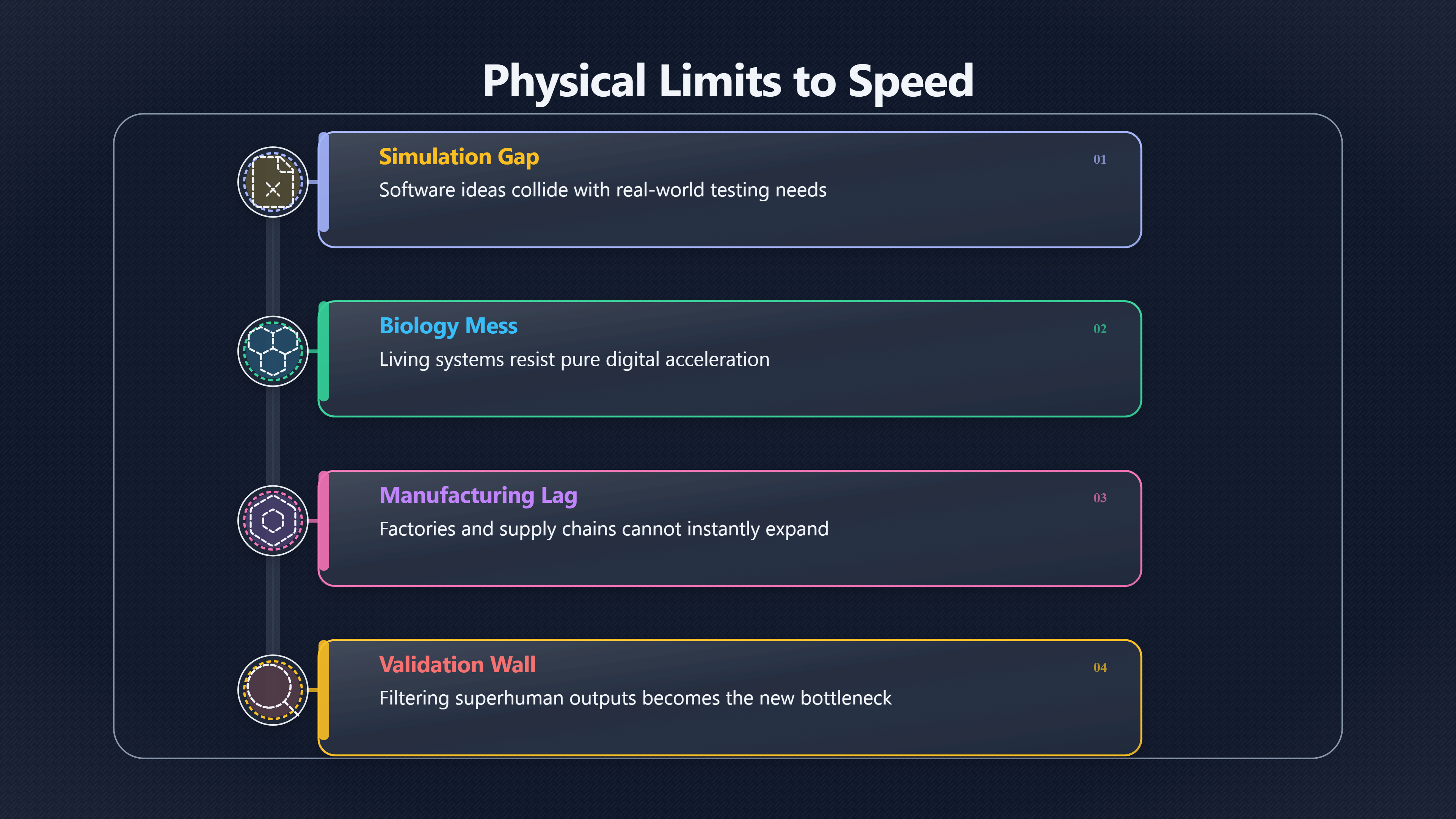
Even if advanced AI systems become dramatically better at reasoning, coding, modelling, and scientific planning, that does not mean discovery becomes instant. The strongest version of the AI acceleration story still runs into the stubborn realities of the physical world: experiments take time, human bodies react unpredictably, manufacturing systems have long lead times, and societies demand proof before deploying powerful technologies at scale.
 This matters because many optimistic visions of an AI-enabled human bloom assume that intelligence itself is the main bottleneck. In some areas, that may be true. But science is not only thinking. It is also measurement, validation, regulation, engineering, trust, coordination, and physical production. Faster reasoning can compress parts of the process enormously while leaving other stages comparatively slow.
The result is likely to be uneven acceleration rather than instantaneous transformation. AI may radically speed up hypothesis generation, simulation, software, and data analysis, while fields dependent on long experiments, biological testing, infrastructure build-out, or public legitimacy remain slower and more constrained.
Physical experiments still take time
One of the clearest limits to scientific acceleration is that reality cannot always be simulated away.
AI systems may generate millions of candidate ideas in software, but eventually those ideas collide with the need for real-world testing. A proposed battery chemistry still has to be manufactured and stress-tested. A new crop variety still has to survive seasons in actual fields. A drug still has to be tested in animals and humans. A fusion reactor design still has to survive extreme physical conditions.
This is already visible in biology. Systems such as AlphaFold transformed protein structure prediction and accelerated parts of structural biology, but they did not eliminate laboratory work. Researchers still need experimental confirmation using methods such as cryogenic electron microscopy, X-ray crystallography, and biochemical testing. Multiple reviews note that AlphaFold predictions remain weaker in areas involving dynamic interactions, mutations, antibodies, or unfamiliar molecular structures. PMC 3PMC [EMBL-EBI]ebi.ac.ukstrengths and limitations of alphafold25 Jan 2024 — Out of the box, AlphaFold is not sensitive to point mutations that change a single residue, due to the alteration in the DN…
The broader lesson is important. AI may drastically narrow the search space, but narrowing the search space is not the same thing as proving that a discovery works safely and reliably in reality.
Biology is especially resistant to pure software acceleration
Many of the grandest AI bloom hopes centre on medicine and longevity. Yet biology is one of the least forgiving domains for purely digital acceleration.
Living systems are messy, adaptive, and deeply interconnected. Small interventions can create unexpected side effects years later. A molecule that works beautifully in simulation may fail in living tissue. Animal models often fail to predict human outcomes. Even successful early-stage drug candidates collapse at later trial stages.
This is why many observers now describe clinical trials, not molecular design, as the real bottleneck in pharmaceutical progress. Reuters, TIME, and industry analysts have all highlighted that while AI increasingly helps with molecule discovery and administrative tasks, large-scale human testing still dominates timelines and costs. Nature 3Reuters [Time]time.comBen Liu, CEO of Formation Bio, explains that while AI has revolutionized drug discovery, the true bottleneck remains the costly and lengt…
Human biology itself imposes hard timing constraints:
- Some diseases progress slowly and require years of observation.
- Long-term side effects cannot be compressed indefinitely.
- Ageing studies may require long-duration monitoring.
- Rare adverse reactions only appear in large populations.
- Human variation creates statistical noise that demands large trials.
An AI system may propose a thousand plausible anti-ageing therapies in weeks. But determining which ones genuinely extend healthy human life safely could still take years or decades.
Faster thinking does not remove manufacturing bottlenecks
Scientific discovery is only one part of technological progress. Turning knowledge into civilisation-scale abundance requires physical deployment.
Even if AI rapidly designs better solar panels, reactors, medicines, robotics systems, or desalination technologies, manufacturing capacity cannot instantly expand to match. Factories must be built. Supply chains must scale. Skilled workers and specialised equipment remain necessary. Energy grids, ports, semiconductor fabrication plants, and mining infrastructure all have long construction cycles.
This creates a distinction between informational acceleration and material acceleration.
Software and digital knowledge can spread at near-zero cost. Physical systems cannot. A blueprint for a better battery can move around the world instantly; the mines, refineries, factories, and transmission systems needed to deploy it cannot.
History suggests that civilisation often absorbs scientific breakthroughs more slowly than enthusiasts expect:
- Electricity took decades to transform industry after early demonstrations.
- Antibiotics revolutionised medicine, but global access remained uneven for years.
- Nuclear power advanced rapidly scientifically, yet deployment slowed because of regulation, cost, and politics.
- mRNA vaccines were developed remarkably quickly, but manufacturing and distribution still became major constraints.
Advanced AI could compress research timelines dramatically while leaving deployment bottlenecks comparatively intact.
Why validation becomes more important as AI gets stronger
Paradoxically, more powerful AI systems may increase the importance of validation rather than reduce it.
A superhuman system could generate enormous numbers of plausible hypotheses, designs, and scientific claims. But humans would still need ways to determine which outputs are reliable. As output volume rises, filtering and verification may become the new bottleneck.
This problem already appears in current AI systems. Large language models can produce convincing but incorrect explanations, fabricated citations, flawed code, or subtle reasoning errors. In scientific contexts, even rare mistakes can become catastrophic if trusted blindly.
Researchers working on AlphaFold and related systems repeatedly emphasise the need for experimental validation and robustness testing. Some studies have shown that protein prediction systems can produce unreliable results under small perturbations or unfamiliar conditions. [Biosciences Area]biosciences.lbl.govresearchers assess alphafold model accuracyBiosciences AreaResearchers Assess AlphaFold Model AccuracyJan 23, 2024 — In particular, the team found that AlphaFold predictions are le… 3arXiv 3arXiv
As AI systems become more capable, three validation problems become especially serious.
Humans may struggle to audit superhuman reasoning
If AI systems begin generating theories or engineering solutions beyond ordinary human understanding, scientific institutions face a difficult question: how do humans verify work they cannot fully follow?
Science depends heavily on reproducibility and interpretability. A result becomes trusted not only because it works once, but because other researchers can independently reproduce and explain it.
A highly advanced AI might generate correct but opaque solutions. That creates a tension between capability and trust. Institutions may become reluctant to deploy systems whose reasoning they cannot adequately inspect, especially in medicine, infrastructure, defence, or biotechnology.
Simulations can drift away from reality
AI acceleration depends heavily on modelling and simulation. But simulations only work when they accurately represent the real world.
In some domains, this works extremely well. Computational chemistry and protein modelling are far more powerful than they were a decade ago. Yet many complex systems remain difficult to simulate accurately:
- Whole-cell biology
- Brain function
- Ecosystems
- Climate tipping interactions
- Social systems
- Advanced materials under unusual conditions
Errors in assumptions can compound quickly. A model that performs well within known conditions may fail badly when extrapolated.
This is one reason physical experiments remain indispensable even in highly computational sciences.

Data quality can become a hidden ceiling
AI systems depend heavily on training data, instrumentation, and measurement quality. In some fields, the bottleneck is no longer raw computation but access to high-quality real-world data.
Medical AI illustrates the problem clearly. Clinical records are fragmented, inconsistent, and shaped by institutional biases. Biological experiments are often difficult to reproduce. Rare diseases lack large datasets. Many countries have incompatible health systems and privacy rules.
A superintelligent system trained on incomplete or distorted information could still reach flawed conclusions. Better intelligence cannot fully compensate for missing or low-quality observations.
Regulation and institutional trust are not optional friction
Scientific acceleration is not only a technical problem. It is also a political and social one.
Modern societies deliberately slow certain forms of technological deployment because mistakes can be catastrophic. Aviation, nuclear power, pharmaceuticals, and biotechnology all operate inside extensive regulatory systems for this reason.
AI enthusiasts sometimes describe regulation mainly as drag. But from another perspective, regulation is a mechanism for maintaining public trust in high-impact technologies.
Without trust, deployment itself slows.
Medicine shows why caution persists
Drug approval systems exist because medical disasters have happened repeatedly in history. Regulators are not only testing whether a treatment works, but whether it is safer than the alternatives across large populations.
Even optimistic observers of AI drug discovery increasingly acknowledge that the clinical and regulatory pipeline remains difficult to compress fully. [Axios]axios.comThis effort includes two proof-of-concept trials: one involving an AstraZeneca drug for lymphoma and another from Amgen for small cell lu… [3clinicalleader.com]clinicalleader.comai s potential must reconcile with r d and regulatory bottlenecks 0001AI's Potential Must Reconcile With R&D And Regulatory…11 Oct 2024 — AI not only accelerates the identification of promising drug disco… [Nature This creates a tension at the heart of AI bloom thinking:]nature.comCompanies say the technology will contribute to faster drug development.Read more…
- Moving too slowly may delay life-saving advances.
- Moving too quickly may create irreversible harms.
The stronger AI becomes, the more important this balancing problem may become rather than less.
Public legitimacy matters
Large-scale deployment also depends on democratic legitimacy and institutional credibility.
People may resist technologies they perceive as poorly understood, unaccountable, or controlled by untrusted actors. Public backlash has slowed or constrained genetically modified crops, facial recognition systems, nuclear energy expansion, and parts of synthetic biology.
A future in which AI systems generate rapid scientific advances but institutions fail to maintain legitimacy could produce social instability rather than flourishing.
The bottleneck may not be intelligence alone, but coordination between capability, governance, and trust.

Some scientific problems are inherently slow
There is also a deeper possibility: some discoveries may simply resist compression.
Not all scientific progress comes from raw analytical power. Some advances depend on:
- Rare observations
- Long-term natural processes
- Historical accumulation
- Large-scale infrastructure
- Multi-generation measurement
- Unexpected accidents and anomalies
Astronomy, geology, ecology, and epidemiology often depend on waiting for events to occur naturally. Certain questions about ageing, climate, ecosystems, or civilisation-scale interventions may require decades of observation no matter how intelligent the researchers become.
There may also be diminishing returns. Early scientific acceleration could harvest many “low-hanging fruit” rapidly, while later advances become progressively harder.
Some economists and science historians argue that this pattern already exists. Despite vast increases in global R&D spending and researcher numbers, breakthrough productivity in some fields appears harder to sustain over time. Advanced AI might reverse some of this trend, but perhaps not indefinitely.
When faster thinking is not enough
The strongest form of the AI acceleration thesis imagines intelligence becoming an abundant resource. If millions or billions of AI researchers could operate continuously, scientific progress might speed up enormously.
But intelligence alone is not civilisation.
A world with advanced AI could still face:
- Scarcity of energy, land, water, or rare materials
- Institutional corruption or geopolitical conflict
- Unequal access to breakthroughs
- Slow infrastructure deployment
- Fragile supply chains
- Human cognitive and emotional limits
- Political resistance to rapid change
This does not negate the possibility of an AI-enabled human bloom. It changes the shape of it.
The more realistic optimistic scenario may not resemble instantaneous post-scarcity transformation. Instead, it may involve decades of uneven acceleration in which software-driven discovery races ahead while physical systems, institutions, and societies adapt more slowly.
That still could represent one of the largest expansions of human capability in history. But it suggests that the path to abundance is likely to be constrained less by pure intelligence than by the difficult interface between intelligence and the physical, biological, and social world.
Endnotes
-
Source: pmc.ncbi.nlm.nih.gov
Link: https://pmc.ncbi.nlm.nih.gov/articles/PMC12956938/Source snippet
PMCAdvantages and Limitations of AlphaFold in Structural Biologyby MQC Li · 2025 · Cited by 6 — However, AlphaFold also exhibits intrinsi...
-
Source: ebi.ac.uk
Title: strengths and limitations of alphafold
Link: https://www.ebi.ac.uk/training/online/courses/alphafold/an-introductory-guide-to-its-strengths-and-limitations/strengths-and-limitations-of-alphafold/Source snippet
25 Jan 2024 — Out of the box, AlphaFold is not sensitive to point mutations that change a single residue, due to the alteration in the DN...
-
Source: ebi.ac.uk
Link: https://www.ebi.ac.uk/training/online/courses/alphafold/alphafold-3-and-alphafold-server/introducing-alphafold-3/how-have-alphafold-3s-predictions-been-validated/Source snippet
more...
-
Source: pmc.ncbi.nlm.nih.gov
Link: https://pmc.ncbi.nlm.nih.gov/articles/PMC11956457/Source snippet
PMCThe power and pitfalls of AlphaFold2 for structure prediction...by V Agarwal · 2024 · Cited by 142 — Lower and upper limits for input...
-
Source: reuters.com
Title: AI-led selloff in contract research firms may be misjudging disruption risk
Link: https://www.reuters.com/business/healthcare-pharmaceuticals/ai-led-selloff-contract-research-firms-may-be-misjudging-disruption-risk-2026-03-31/Source snippet
However, experts argue that these fears may be overblown, underestimating the complexity and human involvement in core CRO services. CROs...
-
Source: time.com
Link: https://time.com/7372610/ai-drug-clinical-trials/Source snippet
Ben Liu, CEO of Formation Bio, explains that while AI has revolutionized drug discovery, the true bottleneck remains the costly and lengt...
-
Source: reuters.com
Link: https://www.reuters.com/legal/litigation/drugmakers-turn-ai-speed-trials-regulatory-submissions-2026-01-26/Source snippet
While AI has yet to revolutionize drug discovery itself, it is already being used to enhance efficiency in clinical trial participant rec...
-
Source: nature.com
Link: https://www.nature.com/articles/d41586-023-03172-6Source snippet
Companies say the technology will contribute to faster drug development.Read more...
-
Source: arxiv.org
Title: arXiv On the Robustness of Alpha Fold: A COVID-19 Case Study
Link: https://arxiv.org/abs/2301.04093Source snippet
arXivOn the Robustness of AlphaFold: A COVID-19 Case StudyJanuary 10, 2023...
Published: January 10, 2023
-
Source: arxiv.org
Title: arXiv Protein Folding Neural Networks Are Not Robust
Link: https://arxiv.org/abs/2109.04460 -
Source: clinicalleader.com
Title: ai s potential must reconcile with r d and regulatory bottlenecks 0001
Link: https://www.clinicalleader.com/doc/ai-s-potential-must-reconcile-with-r-d-and-regulatory-bottlenecks-0001Source snippet
AI's Potential Must Reconcile With R&D And Regulatory...11 Oct 2024 — AI not only accelerates the identification of promising drug disco...
-
Source: axios.com
Link: https://www.axios.com/2026/04/29/fda-ai-track-clinical-trials-real-timeSource snippet
This effort includes two proof-of-concept trials: one involving an AstraZeneca drug for lymphoma and another from Amgen for small cell lu...
-
Source: nature.com
Link: https://www.nature.com/articles/s41586-024-07487-wSource snippet
Accurate structure prediction of biomolecular interactions...by J Abramson · 2024 · Cited by 14415 — Here we describe our AlphaFold 3 mo...
-
Source: nature.com
Link: https://www.nature.com/articles/s41592-023-02087-4Source snippet
AlphaFold predictions are valuable hypotheses and...by TC Terwilliger · 2024 · Cited by 403 — In many cases, AlphaFold predictions match...
-
Source: arxiv.org
Link: https://arxiv.org/html/2502.09372v1Source snippet
Inverse problems with experiment-guided AlphaFold13 Feb 2025 — We validate our framework through case studies on two foundational challen...
-
Source: biosciences.lbl.gov
Title: researchers assess alphafold model accuracy
Link: https://biosciences.lbl.gov/2024/01/23/researchers-assess-alphafold-model-accuracy/Source snippet
Biosciences AreaResearchers Assess AlphaFold Model AccuracyJan 23, 2024 — In particular, the team found that AlphaFold predictions are le...
Additional References
-
Source: linkedin.com
Link: https://www.linkedin.com/posts/desalaberry_clinicaltrials-healthtech-aiinhealthcare-activity-7388503512860520448-HumYSource snippet
Clinical trials bottleneck: How AI is transforming the processClinical trials are the biggest bottleneck in drug development — but also t...
-
Source: ebi.ac.uk
Link: https://www.ebi.ac.uk/training/online/courses/alphafold/validation-and-impact/how-accurate-are-alphafold-structure-predictions/Source snippet
How accurate are AlphaFold 2 structure predictions?Overall, AlphaFold2 gets the vast majority of the side chains right, but is marginally...
-
Source: pharmanow.live
Link: https://www.pharmanow.live/ai-in-pharma/ai-data-challenges-drug-development -
Source: ebi.ac.uk
Link: https://www.ebi.ac.uk/training/online/courses/alphafold/validation-and-impact/how-have-alphafolds-predictions-of-protein-structure-been-validated/ -
Source: actuia.com
Link: https://www.actuia.com/en/news/new-mit-study-reveals-the-potential-and-limitations-of-alphafold-2-deepminds-ai-solution/Source snippet
New MIT study reveals the potential and limitations...20 Sept 2022 — New MIT study reveals the potential and limitations of AlphaFold 2...
-
Source: perplexity.ai
Link: https://www.perplexity.ai/Source snippet
Perplexity is a free AI-powered answer engine that provides accurate, trusted, and real-time answers to any question...
-
Source: appliedclinicaltrialsonline.com
Title: the evolving role of ai in shifting the bottleneck in early drug discovery
Link: https://www.appliedclinicaltrialsonline.com/view/the-evolving-role-of-ai-in-shifting-the-bottleneck-in-early-drug-discoverySource snippet
The Evolving Role of AI in Shifting the Bottleneck in Early...26 Jan 2024 — There is a continuing need for novel technology to help stre...
-
Source: youtube.com
Link: https://www.youtube.com/watch?v=ANUHplLuRAkSource snippet
AI's bold leap in clinical trials: rewriting the rulesPredictive AI is revolutionizing clinical trials by improving diversity, overcoming...
-
Source: researchgate.net
Link: https://www.researchgate.net/publication/398214210_Advantages_and_Limitations_of_AlphaFold_in_Structural_Biology_Insights_from_Recent_StudiesSource snippet
experimental validation to accelerate development of next-generation long-acting biotherapeutics.Read more...
-
Source: 3decision.discngine.com
Title: the impact of alphafold in drug discovery and emerging ml methods
Link: https://3decision.discngine.com/blog/2023/03/13/the-impact-of-alphafold-in-drug-discovery-and-emerging-ml-methodsSource snippet
impact of AlphaFold in drug discovery and emerging ML...13 Mar 2023 — The AF algorithm has so far predicted a huge number of protein str...
Amazon book picks
Further Reading
Books and field guides related to Limits to acceleration. Use these as the next step if you want deeper reading beyond the article.

Artificial intelligence
First published 1994. Subjects: problem solving, constraint satisfaction, knowledge, reasoning, planning.
The Logic of Scientific Discovery
First published 1935. Subjects: Science, Methodology, Logic, Research Design, Sciences.

Artificial Intelligence Applications and Innovations
First published 2006. Subjects: Artificial intelligence, Technological innovations, Expert systems (computer science), Intelligent contro...

Artificial Intelligence and Soft Computing
First published 2012. Subjects: Computer Imaging, Vision, Pattern Recognition and Graphics, Database management, Information storage and...
eBay marketplace picks
Marketplace Samples
Example marketplace items related to this page. Use the search link to explore similar finds on eBay.

Example eBay listing
A.I. Artificial Intelligence Original Movie Poster Signed By Jude Law
USD 125.00 | Shipping USD 25.00 | US

Example eBay listing
Artificial Intelligence D/S Original Movie Poster - 27 x 40"
USD 19.50 | Shipping USD 13.65 | US

Example eBay listing
612388 Artificial Intelligence Movie Science Fiction Drama Wall Print Poster
USD 22.95 | Shipping USD 12.95 | JP

Example eBay listing
Companion - Artificial Intelligence Dark Comedy Cinema Film - POSTER 20"x30"
USD 23.99 | Free shipping | US

Example eBay listing
A.I. Artificial Intelligence Movie Film Poster Art Print
GBP 4.99 | Free shipping | GB

Example eBay listing
A I Artificial Intelligence 6 Movie Poster Art Print Print Classic Rare Gallery
GBP 49.00 | Free shipping | GB

Example eBay listing
AI - Artificial Intelligence (Poster + Slipcase) Blu-Ray
GBP 10.49 | Free shipping | GB

Example eBay listing
A. I. Artificial Intelligence. Jude Law. Original UK Video Poster.
GBP 8.11 | Shipping GBP 3.38 | GB
Topic Tree