Within First Tasks
Patient Lifting Robots
Care robots may be most valuable when they lift, carry, and fetch, while leaving empathy and bedside judgement with people.
On this page
- Why care work causes hidden long term injury
- How robots can assist without replacing bedside care
- What good adoption would mean for patients and staff
Page outline Jump by section
Introduction
One of the strongest early cases for healthcare robotics is not replacing nurses, but protecting their bodies. Across hospitals, care homes, and home-care settings, workers repeatedly lift, reposition, steady, and transfer people who may be frail, unconscious, heavy, confused, or unable to move themselves. Over years, that strain accumulates into chronic back pain, shoulder injuries, lost careers, and staff shortages.
 This is exactly the kind of labour robotics may be best suited to automate first: physically punishing work that contributes little to the specifically human parts of care. A robot that helps move a patient from bed to chair does not remove empathy, reassurance, clinical judgement, or bedside presence. Instead, it may allow carers to keep doing those human tasks for longer without damaging their own health.
In the broader AI bloom vision, this matters because flourishing societies depend not only on more intelligence or economic output, but on reducing unnecessary human suffering and drudgery. Care work is among the clearest examples where machines may absorb dangerous physical burden while leaving human connection intact.
Why care work causes hidden long-term injury
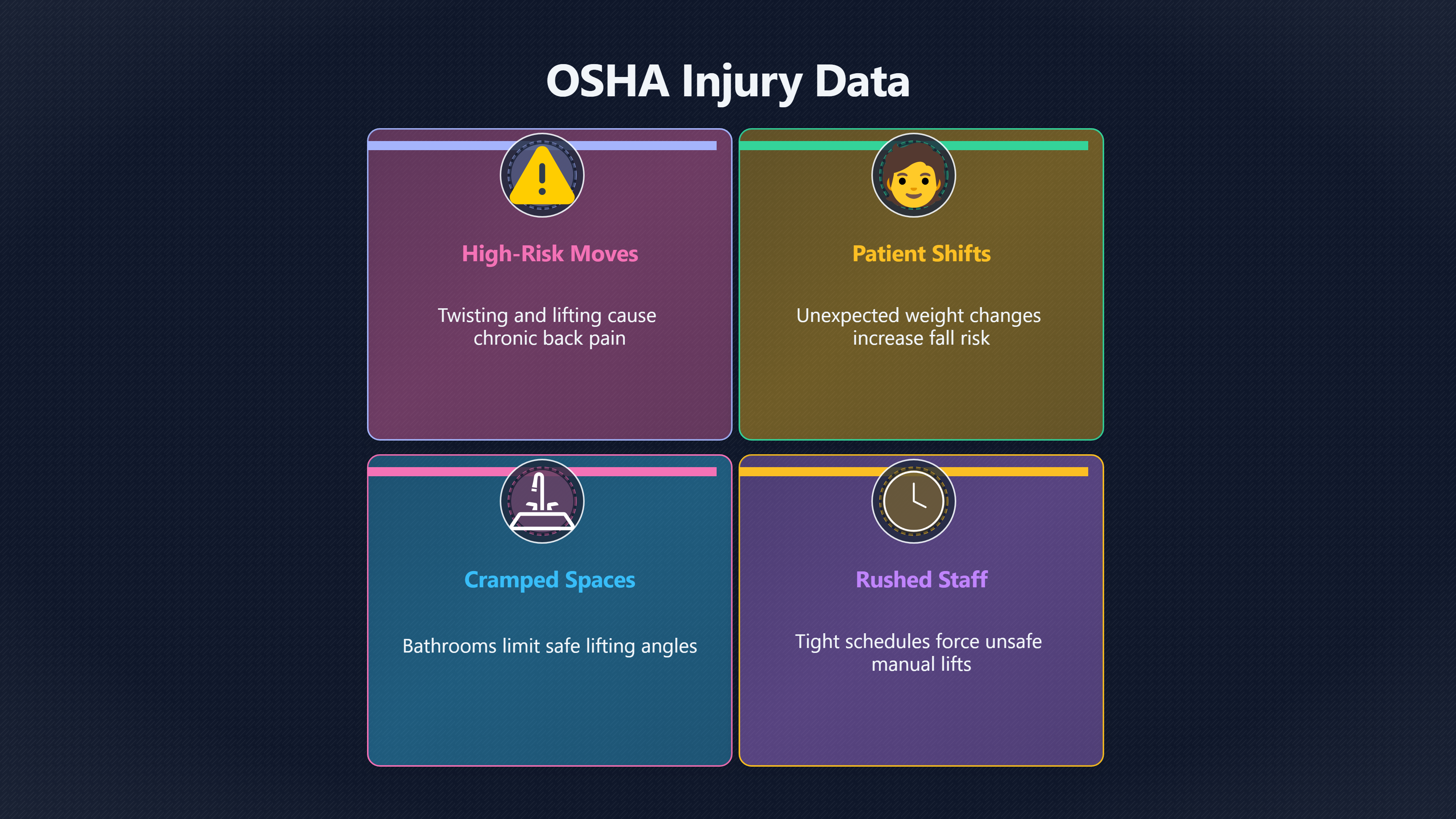
Healthcare is often imagined as emotionally exhausting, but it is also physically brutal. Nursing aides, hospital porters, rehabilitation staff, and carers routinely perform movements that ergonomics specialists classify as high-risk: twisting while supporting body weight, lifting from awkward angles, preventing falls, repositioning immobile patients, and pushing heavy equipment through constrained spaces.
The injury problem is not marginal. The US Occupational Safety and Health Administration says musculoskeletal disorders are one of the major sources of injury among healthcare workers, with nursing assistants experiencing extremely high injury rates from lifting and moving patients. [OSHA]osha.govOSHAHealthcare - Safe Patient HandlingStarting a Safe Patient Handling Program. One major source of injury to healthcare workers is muscu…
Research on safe patient handling repeatedly identifies manual patient transfer as a leading contributor to work-related musculoskeletal disorders in healthcare. ScienceDirect [PubMed The underlying problem is simple: humans are not well designed to repeatedly lift adult bodies in unpredictable environments.]myuplyft.comBenefits of Patient Lifts and Flaws with Existing TechnologiesPatient lifts can positively alter peoples' lives by helping provide them w…
Unlike lifting boxes in a warehouse, patient handling involves complications that make injury more likely:
- Patients shift weight unexpectedly. [slideshare.net]slideshare.netsafe patient handling and mobility (sphm)The revised NIOSH lifting equation (RNLE) provides limited guidance on safe lifting weights for…
- Some panic or resist movement.
- Beds and bathrooms create cramped angles.
- Workers often rush because staffing is tight.
- Many patients cannot assist with transfers.
- Obesity and ageing populations increase average load demands.
Even “proper lifting technique” only goes so far. NIOSH guidance notes that assistive lifting devices are often necessary because patient handling exceeds safe manual lifting limits. [CDC]cdc.govCDCAbout Safe Patient Handling and Mobility9 May 2024 — Safe patient handling and mobility (SPHM) technology involves using assistive lif…
This creates a hidden contradiction in healthcare systems. Societies ask carers to preserve the health and dignity of patients while often damaging the bodies of the people delivering that care.
Why lifting assistance is a better robotics target than bedside empathy
The debate around AI and automation often assumes the main question is whether machines can replace entire professions. Care work shows why task-level automation may matter more.
Patient lifting is unusually well suited to robotic assistance because the task is:
- Physically demanding
- Repetitive
- Ergonomically dangerous
- Technically structured
- Emotionally secondary to care itself
By contrast, many core nursing responsibilities remain deeply human:
- Calming frightened patients
- Interpreting discomfort
- Detecting subtle behavioural changes
- Coordinating families
- Exercising ethical judgement
- Building trust
A lifting robot does not need deep emotional intelligence to create value. It mainly needs reliable sensing, balance control, force management, and safe movement around fragile human bodies.
This distinction matters for the wider AI abundance argument. Some forms of automation threaten meaning, autonomy, or social connection. Others primarily remove injury and exhaustion. Patient handling falls far closer to the second category.
In practice, many healthcare workers already use partial mechanical assistance systems such as ceiling lifts, transfer slings, sit-to-stand devices, powered stretchers, and inflatable lateral transfer mats. Robotics extends this trajectory rather than replacing human care wholesale.
What the technology actually looks like
“Patient-lifting robots” does not usually mean humanoid robots carrying people in their arms. Most real systems are narrower and more practical.
Current and emerging systems include:
- Ceiling-mounted lift rails that transfer patients between bed, chair, toilet, and bath
- Mobile robotic floor lifts with powered manoeuvring assistance
- Smart transfer devices that stabilise falling patients
- Exoskeletons that reduce spinal loading on carers
- AI-assisted mobility systems that predict movement and optimise support
- Robotic rehabilitation aids that partially support body weight during walking therapy
Research suggests ceiling lifts and mechanical transfer systems substantially reduce biomechanical load on caregivers compared with manual handling. ScienceDirect [PMC]pmc.ncbi.nlm.nih.govPMCby M Fray · 2023 · Cited by 42 — Floor and ceiling lifts were found to be the most effective in reducing the biomechanical load on car…
One promising direction is collaborative robotics rather than fully autonomous machines. A 2022 study examining robotic assistance for nursing tasks found that collaborative systems could reduce physical strain during patient handling while still keeping nurses actively involved in care. [PMC]pmc.ncbi.nlm.nih.govPMCby M Fray · 2023 · Cited by 42 — Floor and ceiling lifts were found to be the most effective in reducing the biomechanical load on car…
Exoskeletons are another emerging approach. These wearable support systems redistribute force away from the lower back and shoulders during lifting and repositioning tasks. Reviews of nursing exoskeletons suggest they may reduce physical strain during transfers and repetitive handling, although evidence is still developing and real-world adoption remains limited. CDC Stacks [Springer The important point is that the frontier is not simply]link.springer.comtechnology in nursing practice: assessing…by A Vallée · 2024 · Cited by 36 — Exoskeletons have shown promising results in reducing phy…“robots replacing nurses”. It is increasingly about intelligent physical assistance systems embedded into care environments.
The economic case is not just efficiency
Healthcare systems across much of the world already face severe staffing pressure. Burnout and injury worsen retention problems. In some systems, experienced nurses leave bedside work early because their bodies cannot sustain the physical demands.
This creates a compounding crisis:
- Injuries reduce staffing. [sciencedirect.com]sciencedirect.com•. Ceiling lift availability alone did not enough to lower patient handling injuries…Read more…
- Lower staffing increases physical burden on remaining workers.
- Greater burden produces more injuries and burnout.
Safe patient handling programmes aim to interrupt this cycle. Reviews of these programmes generally find reductions in worker injuries when facilities adopt lifting equipment and eliminate routine manual lifting. [PMC]pmc.ncbi.nlm.nih.govPMCby M Fray · 2023 · Cited by 42 — Floor and ceiling lifts were found to be the most effective in reducing the biomechanical load on car… [ResearchGate From an AI bloom perspective]researchgate.netResearchGateA Review of Exoskeletons Considering NursesNurses, in hospitals and care homes, can benefit from the advances in exoskeleton…, this matters because labour shortages are not merely economic inconveniences. They constrain human flourishing directly.
Ageing societies increasingly need more care at exactly the moment fewer workers are available to provide it safely. Robotics may help decouple quality care from chronic caregiver injury.
That does not mean labour becomes unnecessary. It means the same workforce may be able to care for more people without equivalent physical destruction.
Good adoption protects both patients and workers
Healthcare workers are often sceptical of new technologies for good reason. Poorly implemented systems can slow workflows, create frustration, or introduce new safety risks.
The evidence suggests that simply purchasing lifting equipment is not enough.
A 2024 study on barriers to patient-lift use found that utilisation rates in some facilities remained surprisingly low despite equipment availability. [MDPI]mdpi.comMDPIBarriers and Facilitators for the Use of Patient Lifts by…by GM Khairallah · 2024 · Cited by 10 — Several studies confirmed that n…
Common problems include:
- Equipment stored too far away
- Insufficient staff training
- Time pressure discouraging use
- Devices difficult to manoeuvre
- Poor integration into room layouts
- Staff shortages making setup impractical
This is why implementation matters more than futuristic marketing.
Good adoption usually involves:
- Designing rooms around lifting systems from the start
- Training staff continuously
- Making equipment instantly accessible
- Integrating robotics into workflow rather than adding extra steps
- Treating injury prevention as a leadership priority
- Ensuring patients understand what devices are doing
Importantly, better systems may improve patient experience as well as worker safety.
Mechanical transfers are sometimes assumed to feel cold or impersonal, but unsafe manual lifting can also be frightening, painful, unstable, and undignified. Studies on ceiling lifts have reported advantages in comfort and acceptability compared with some manual or floor-lift approaches. [ScienceDirect]sciencedirect.comScienceDirectManual patient handling in the healthcare settingby K Johnson · 2023 · Cited by 27 — Manual patient handling is the most fre…
A calm, stable transfer performed by a trained nurse using supportive robotics may feel safer than hurried manual lifting by exhausted staff.
Why this fits the strongest version of the AI bloom argument
Some AI optimism relies on abstract claims about productivity growth or future economic expansion. Patient-lifting robotics shows a more grounded version of the same broader idea.
The gain is not merely “greater efficiency”. It is the reduction of chronic physical damage in one of society’s most socially necessary professions.
This matters because flourishing depends on more than GDP:
- Fewer workers leaving care due to injury
- Longer healthy careers
- Reduced chronic pain
- Better staffing stability
- More sustainable elder care [researchgate.net]researchgate.netResearchGateA Review of Exoskeletons Considering NursesNurses, in hospitals and care homes, can benefit from the advances in exoskeleton…
- Less exhaustion during long shifts
- More time and energy for emotionally meaningful care
In that sense, care robotics represents a useful test case for the wider future AI debate.
If advanced AI and robotics are eventually capable of automating large portions of physical labour, the morally strongest applications may be the ones that remove injury while preserving human agency and connection. Patient handling sits close to the centre of that category.
The long-term AI bloom vision imagines a civilisation where dangerous, degrading, and body-breaking labour becomes increasingly optional rather than economically unavoidable. Healthcare lifting robots are a modest but concrete early example of what that transition could look like in practice.

The remaining objections are real
None of this guarantees a positive outcome.
There are legitimate concerns around:
- Hospitals using automation mainly for cost-cutting
- Reduced staffing ratios justified by new equipment
- Surveillance of workers through sensor-heavy systems
- Poorly maintained devices causing accidents
- Loss of patient dignity if care becomes overly mechanised
- Unequal access between wealthy and poorer healthcare systems
There is also a broader political question. If AI-driven productivity gains primarily benefit healthcare corporations while frontline staff remain overworked, robotics alone will not produce flourishing.
The technology is therefore only part of the story. Governance, staffing policy, labour standards, and workplace culture matter just as much.
Research also shows that equipment alone cannot solve injury problems if staffing remains inadequate. A recent study found that lift availability by itself did not necessarily reduce injuries without broader organisational support and staffing conditions. [ScienceDirect]sciencedirect.comScienceDirectManual patient handling in the healthcare settingby K Johnson · 2023 · Cited by 27 — Manual patient handling is the most fre…
This is a recurring pattern across the wider AI future debate. Advanced tools can expand human capability, but whether that expansion becomes widely beneficial depends on institutional choices, incentives, and power distribution.
A glimpse of post-scarcity care infrastructure
Patient-lifting robotics may sound narrow compared with grander discussions of superintelligence or post-scarcity economics. But it points toward something larger.
A civilisation capable of abundant intelligent automation may eventually redesign entire categories of labour around human wellbeing rather than human physical sacrifice.
Care work is especially revealing because it combines two things:
- Tasks humans should not have to do manually forever
- Human relationships that most people still deeply value
That makes it a strong candidate for partial automation rather than total replacement.
The likely long-term direction is not hospitals without nurses. It is hospitals where fewer workers destroy their backs moving patients, where older carers can remain in the profession longer, where injury rates collapse, and where more human attention can go toward comfort, reassurance, and recovery rather than brute-force physical handling.
That is a smaller claim than fully automated luxury healthcare. But it is also more concrete, more defensible, and already partially visible today.
Endnotes
-
Source: osha.gov
Link: https://www.osha.gov/healthcare/safe-patient-handlingSource snippet
OSHAHealthcare - Safe Patient HandlingStarting a Safe Patient Handling Program. One major source of injury to healthcare workers is muscu...
-
Source: cdc.gov
Link: https://www.cdc.gov/niosh/healthcare/prevention/sphm.htmlSource snippet
CDCAbout Safe Patient Handling and Mobility9 May 2024 — Safe patient handling and mobility (SPHM) technology involves using assistive lif...
Published: May 2024
-
Source: sciencedirect.com
Link: https://www.sciencedirect.com/science/article/pii/S0031940623000317Source snippet
ScienceDirectManual patient handling in the healthcare settingby K Johnson · 2023 · Cited by 27 — Manual patient handling is the most fre...
-
Source: sciencedirect.com
Link: https://www.sciencedirect.com/science/article/abs/pii/S0020138308005408Source snippet
ScienceDirectEvaluation of ceiling lifts: Transfer time, patient comfort and...by H Alamgir · 2009 · Cited by 75 — There is evidence to...
-
Source: pmc.ncbi.nlm.nih.gov
Link: https://pmc.ncbi.nlm.nih.gov/articles/PMC11382441/Source snippet
PMCby M Fray · 2023 · Cited by 42 — Floor and ceiling lifts were found to be the most effective in reducing the biomechanical load on car...
-
Source: pmc.ncbi.nlm.nih.gov
Link: https://pmc.ncbi.nlm.nih.gov/articles/PMC9125974/Source snippet
PMCProviding physical relief for nurses by collaborative roboticsby A Brinkmann · 2022 · Cited by 30 — We evaluated the use of a robotic...
-
Source: stacks.cdc.gov
Link: https://stacks.cdc.gov/view/cdc/119968/cdc_119968_DS1.pdfSource snippet
CDC StacksCritical review on applications and roles of exoskeletons in...August 5, 2022 — by L Zheng · 2022 · Cited by 52 — As a review...
Published: August 5, 2022
-
Source: link.springer.com
Link: https://link.springer.com/article/10.1186/s12912-024-01821-3Source snippet
technology in nursing practice: assessing...by A Vallée · 2024 · Cited by 36 — Exoskeletons have shown promising results in reducing phy...
-
Source: researchgate.net
Link: https://www.researchgate.net/publication/363685228_A_Review_of_Exoskeletons_Considering_NursesSource snippet
ResearchGateA Review of Exoskeletons Considering NursesNurses, in hospitals and care homes, can benefit from the advances in exoskeleton...
-
Source: pmc.ncbi.nlm.nih.gov
Link: https://pmc.ncbi.nlm.nih.gov/articles/PMC6138450/Source snippet
PMCOutcomes of Safe Patient Handling and Mobilization Programsby E Teeple · 2017 · Cited by 80 — Our hypothesis was that safe patient han...
-
Source: researchgate.net
Link: https://www.researchgate.net/publication/279628598_A_Review_of_Patient_Lifting_Interventions_to_Reduce_Health_Care_Worker_InjuriesSource snippet
A Review of Patient Lifting Interventions to Reduce Health...Conclusion: The overall evidence indicates that interventions have a signif...
-
Source: mdpi.com
Link: https://www.mdpi.com/1660-4601/21/12/1659Source snippet
MDPIBarriers and Facilitators for the Use of Patient Lifts by...by GM Khairallah · 2024 · Cited by 10 — Several studies confirmed that n...
-
Source: sciencedirect.com
Link: https://www.sciencedirect.com/science/article/pii/S0022437526000563Source snippet
•. Ceiling lift availability alone did not enough to lower patient handling injuries...Read more...
-
Source: cdc.gov
Link: https://www.cdc.gov/niosh/index.htmlSource snippet
NIOSH eNews. Access the NIOSH monthly eNewsletter. New and Featured. OSHA/...
-
Source: researchgate.net
Link: https://www.researchgate.net/publication/394933927_Patient_Handling_Interventions_and_Their_Role_in_Reducing_Musculoskeletal_Disorders_Among_Healthcare_WorkersSource snippet
(PDF) Patient Handling Interventions and Their Role in...Aug 25, 2025 — Musculoskeletal disorders (MSDs) are prominent among healthcare...
Additional References
-
Source: myuplyft.com
Link: https://myuplyft.com/blog/benefits-of-patient-lifts-and-flaws-with-existing-technologies/Source snippet
Benefits of Patient Lifts and Flaws with Existing TechnologiesPatient lifts can positively alter peoples' lives by helping provide them w...
-
Source: restoredcdc.org
Link: https://restoredcdc.org/www.cdc.gov/niosh/ergonomics/index.htmlSource snippet
Ergonomics and Work-Related Musculoskeletal DisordersInformation and guidance for healthcare workers on safe patient handling and mobilit...
-
Source: pedagogyeducation.com
Link: https://pedagogyeducation.com/News/Safe-Patient-Handling-and-MobilitySource snippet
Safe Patient Handling and MobilityEvidence-based research has shown that safe patient handling interventions can significantly reduce ove...
-
Source: rehabnurse.org
Link: https://rehabnurse.org/about/position-statements/safe-patient-handlingSource snippet
Safe Patient Handling and MobilityNurses and patient assistive personnel are at high risk for musculoskeletal injuries related to routine...
-
Source: nursingworld.org
Link: https://www.nursingworld.org/globalassets/practiceandpolicy/work-environment/health–safety/ana-1650-sphm-infographic-updates_final.pdfSource snippet
Safe Patient Handling and MobilityThe goal of this publication is to establish a uniform national foundation for SPHM in order to prevent...
-
Source: orthonurse.org
Link: https://www.orthonurse.org/Portals/0/Safe%20Patient%20Handling%20and%20Mobility%20Position%20Statement.pdfSource snippet
Safe Patient Handling and Mobility in the Orthopaedic SettingNurses cannot rely on body mechanics to protect them from injury when liftin...
-
Source: slideshare.net
Link: https://www.slideshare.net/slideshow/cdc-safe-patient-handling-and-mobility-sphm-niosh-workplace-safety-and-health-topic/90788041Source snippet
safe patient handling and mobility (sphm)The revised NIOSH lifting equation (RNLE) provides limited guidance on safe lifting weights for...
-
Source: usa.gov
Link: https://www.usa.gov/agencies/national-institute-of-occupational-safety-and-healthSource snippet
esearch and makes recommendations for the prevention of work-related injury and...Read more...
-
Source: hmebc.com
Title: ceiling lifts in healthcare facilities enhancing safety and efficiency
Link: https://hmebc.com/ceiling-lifts-in-healthcare-facilities-enhancing-safety-and-efficiency/Source snippet
HME Medical DistributionCeiling Lifts in Healthcare: Improving Safety and Patient...11 Feb 2026 — Ceiling lifts allow caregivers to comp...
-
Source: arjo.com
Link: https://www.arjo.com/int/knowledge/arjo-blog/int/preventing-caregiver-injuries-how-floor-and-ceiling-lifts-can-help/Source snippet
such as Maxi Sky 2, require lower forces to operate than floor lifts, and that...Read more...
Amazon book picks
Further Reading
Books and field guides related to Patient Lifting Robots. Use these as the next step if you want deeper reading beyond the article.
AI for Healthcare Robotics
What is artificial intelligence (AI)? What is healthcare robotics? How can AI and healthcare robotics assist in contemporary medicine? Ro...
Medical and Healthcare Robotics
Medical and Healthcare Robotics: New Paradigms and Recent Advances provides an overview and exclusive insights into current trends, the m...
Robotics in Healthcare Revolutionizing Medicine with Robots
Explore the transformative power of robotics in healthcare with Robotics in Healthcare: Revolutionizing Medicine with Robots. This ground...
eBay marketplace picks
Marketplace Samples
Example marketplace items related to this page. Use the search link to explore similar finds on eBay.

Example eBay listing
Future AI Robot T-Shirt Sci Fi Graphic Tee Unisex Men Women
USD 22.49 | Free shipping | US

Example eBay listing
Funny AI Robot Takeover T-Shirt Retro Pop Art Comic Men Women Unisex T-Shirt
USD 14.99 | Free shipping | US

Example eBay listing
The Evolution of the AI Robot T-Shirt Heather Grey
USD 14.45 | Free shipping | US

Example eBay listing
Actual Intelligence AI Humor Non-Robot Software Developer T-Shirt
USD 17.99 | Shipping USD 5.99 | US

Example eBay listing
A.I. Artificial Intelligence Movie Film Poster Art Print
GBP 4.99 | Free shipping | GB

Example eBay listing
A I Artificial Intelligence 6 Movie Poster Art Print Print Classic Rare Gallery
GBP 49.00 | Free shipping | GB

Example eBay listing
Artificial intelligence is no a mat Framed Wall Art Poster Canvas Print Picture
GBP 14.99 | Shipping GBP 4.95 | GB

Example eBay listing
A.I. - Artificial Intelligence Movie/Film Poster Art PICTURE / PRINT 9" x 8"
GBP 2.49 | Shipping GBP 1.75 | GB
Topic Tree