Within Peace deals
Simulating peace trade offs
AI policy simulators could help negotiators test linked concessions before fragile compromises are offered in public.
On this page
- Why linked concessions overwhelm human teams
- How AI could explore acceptable compromise zones
- Why optimisation cannot replace legitimacy
Page outline Jump by section
Introduction
Peace deals rarely collapse because negotiators cannot imagine a single compromise. They collapse because every concession affects several others at once. A ceasefire may depend on sanctions relief; sanctions relief may depend on elections; elections may depend on security guarantees; security guarantees may depend on troop withdrawals or international monitoring. Human negotiators must juggle all of these moving parts while facing public pressure, military escalation, and limited time.
 This is where AI trade-off simulators may become useful. Rather than acting as “robot diplomats”, these systems aim to help mediation teams test combinations of concessions before proposals reach the negotiating table. They can explore thousands of linked scenarios, identify packages that satisfy minimum demands on multiple sides, and show where apparently impossible negotiations may contain narrow but real overlap. The ambition is modest but potentially important: improving humanity’s ability to coordinate in situations where coordination failure costs lives. At the same time, peace agreements remain political and moral choices, not optimisation problems. An AI system may identify a mathematically stable compromise that people still reject as unjust, humiliating, or illegitimate. HD [ResearchGate]researchgate.netResearch Gate(PDF) Machine Learning for Mediation in Armed ConflictsResearchGate(PDF) Machine Learning for Mediation in Armed ConflictsAugust 26, 2021 — 27 Aug 2021 — This study shows how machine-learning… [3wrap.warwick.ac.uk]wrap.warwick.ac.ukSupporting peace negotiations in the Yemen war through…by M Arana-Catania · 2022 · Cited by 14 — Using dialogue transcripts from peace…
Why linked concessions overwhelm human teams
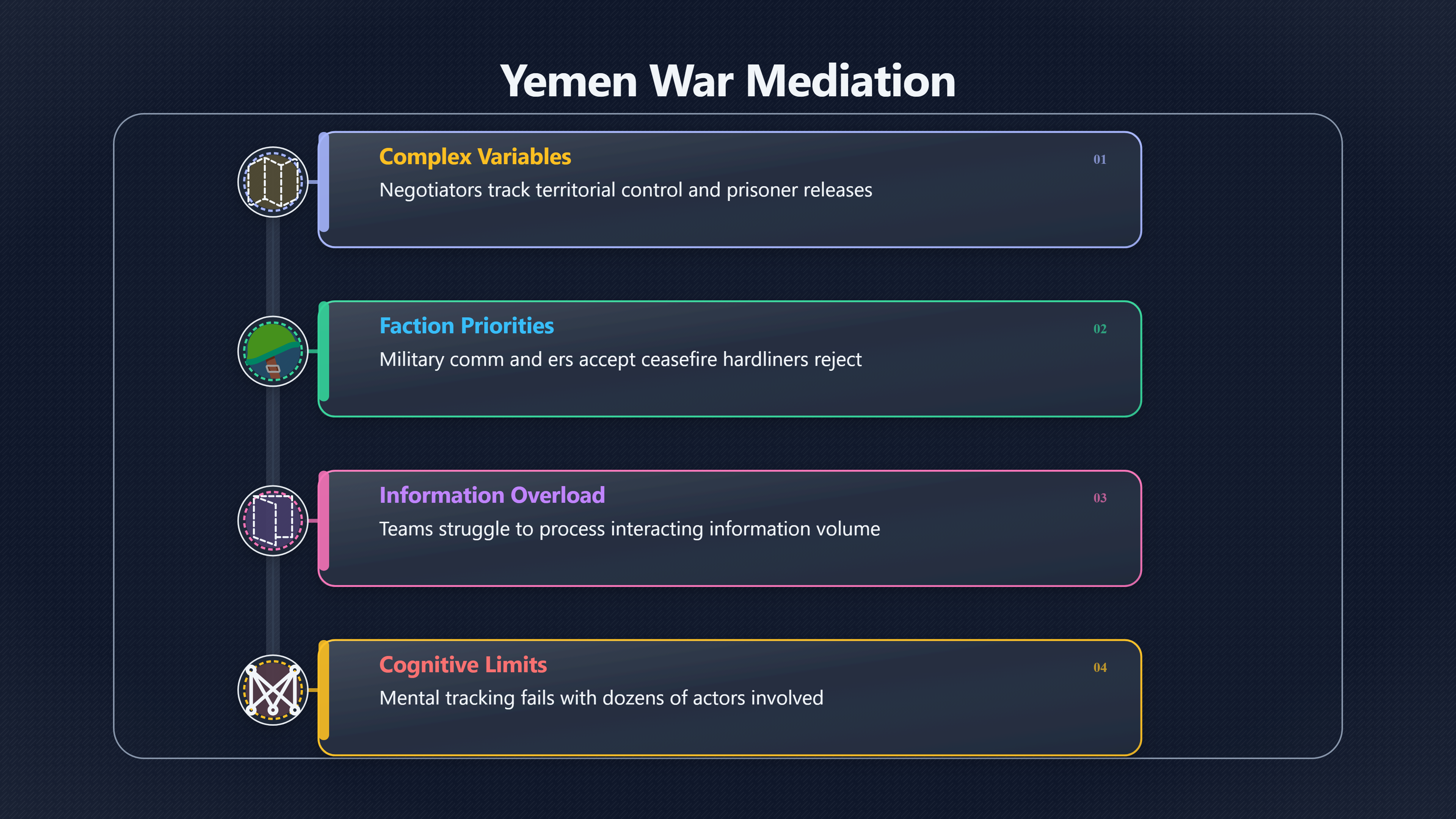
Most peace negotiations are not single-issue bargains. They are multi-variable systems in which every change produces ripple effects elsewhere.
A mediator working on a civil war settlement may need to track:
- Territorial control
- Constitutional reforms [c-r.org]c-r.orgAI and the future of mediationThis article contemplates the potential for AI to transform the realm of peace mediation, along with the as…
- Prisoner releases
- Foreign troop withdrawals
- Amnesty arrangements
- Resource-sharing agreements
- Refugee returns
- Economic reconstruction
- Sanctions relief
- Security guarantees
- Election sequencing
- Power-sharing formulas
Each side also contains factions with different priorities. A military commander may accept a ceasefire that political hardliners reject. Diaspora groups may oppose concessions tolerated by civilians exhausted by war. International sponsors may demand conditions local actors cannot publicly accept.
Researchers studying mediation in Yemen argued that modern conflicts are increasingly “complex, fluid and fragmented”, making it difficult for mediation teams to process the sheer quantity of interacting information involved. Their machine-learning experiments used negotiation transcripts to identify issue clusters, shifting political positions, and areas of convergence between parties. [ResearchGate]researchgate.netResearch Gate(PDF) Machine Learning for Mediation in Armed ConflictsResearchGate(PDF) Machine Learning for Mediation in Armed ConflictsAugust 26, 2021 — 27 Aug 2021 — This study shows how machine-learning… [2wrap.warwick.ac.uk]wrap.warwick.ac.ukSupporting peace negotiations in the Yemen war through…by M Arana-Catania · 2022 · Cited by 14 — Using dialogue transcripts from peace…
Human negotiators can reason about trade-offs, but only within cognitive limits. Once negotiations involve dozens of actors and hundreds of conditional links, important combinations become difficult to track mentally. This creates several recurring problems:
- Negotiators miss compromise packages because no one sees the full interaction map.
- Talks become trapped around symbolic headline issues while practical overlaps go unnoticed.
- Parties overestimate how incompatible their positions really are.
- Mediators cannot easily test “what if” combinations before floating risky proposals.
- Negotiation teams become dependent on fragmented institutional memory spread across years of meetings and staff turnover.
AI systems are unusually well suited to searching large possibility spaces. In principle, a negotiation simulator could model how changing one variable alters others and then identify “acceptable compromise zones” where multiple parties’ minimum conditions overlap.
That does not mean the system discovers peace automatically. It means it can help humans search a negotiation landscape too large for any single team to hold fully in mind.
How AI could explore acceptable compromise zones
The most plausible near-term use of AI in peace mediation is not autonomous negotiation but assisted scenario exploration.
A trade-off simulator would typically combine several layers of information:
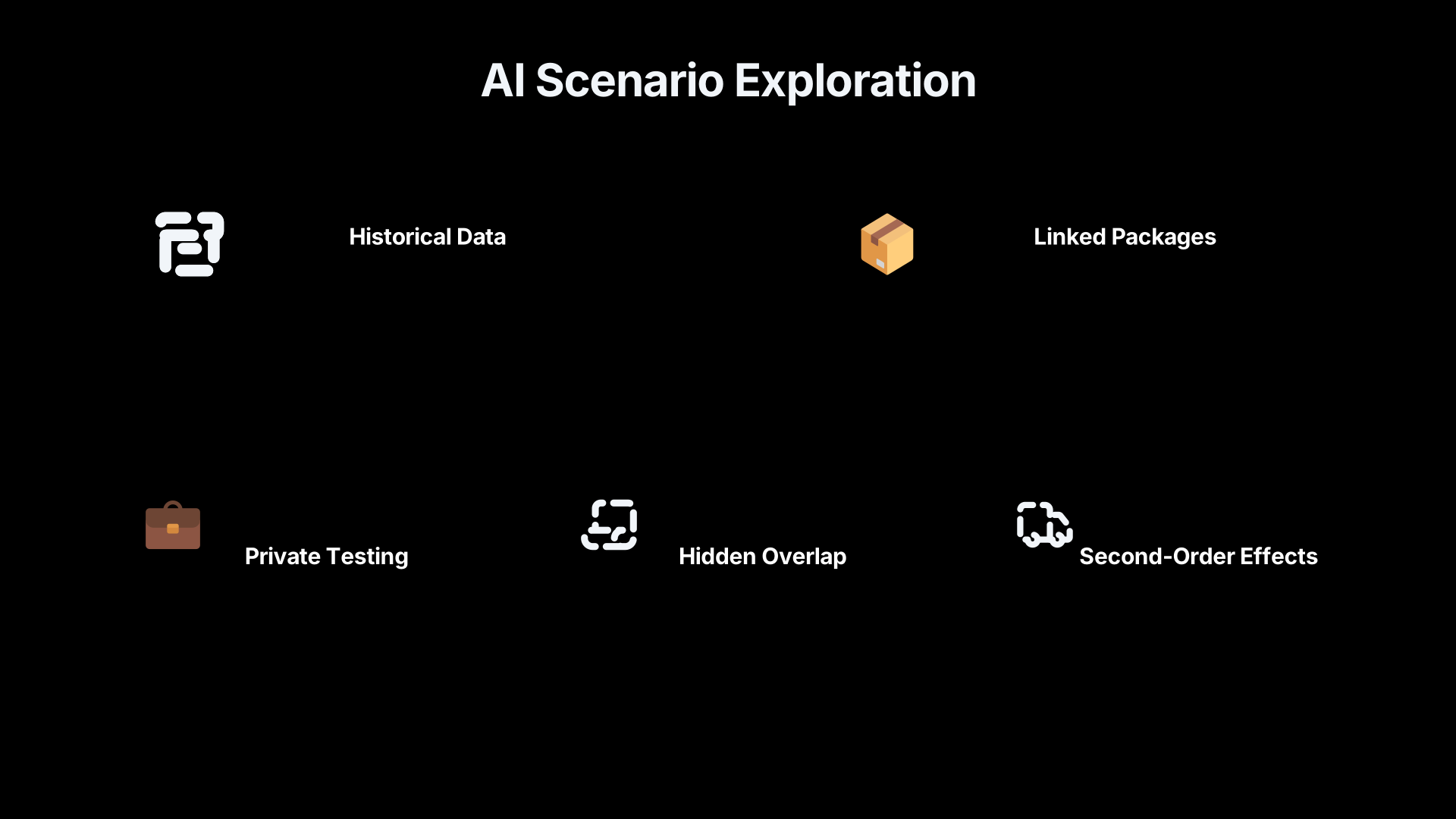
- Historical peace agreements
- Negotiation transcripts
- Public statements
- Intelligence assessments
- Economic and humanitarian data
- Security conditions on the ground
- Red lines identified by negotiators
- Polling or sentiment analysis
- Expert judgements from regional specialists
The system could then test linked packages rather than isolated concessions.
For example, instead of asking:
“Would side A accept territorial autonomy?”
the simulator might ask:
“Would side A accept territorial autonomy if it were paired with phased sanctions relief, international peacekeepers, guaranteed parliamentary seats, and external reconstruction funding?”
This matters because negotiators often reject individual concessions they would accept inside a broader package.
Researchers and policy analysts increasingly describe AI as a tool for generating alternative “pathways for peace” that can be simulated before formal proposals are introduced. Recent work from CSIS argued that AI systems could move beyond summarisation toward structured exploration of war termination scenarios, especially when trained on historical negotiation data and carefully sequenced mediation questions. [CSIS]csis.orgmachine learning meets war termination using ai explore peace scenarios ukraineCSISMachine Learning Meets War Termination: Using AI…27 Feb 2025 — AI moves beyond simple summarization to become a tool for systemati…
In practice, a mediator might use a simulator in several ways.
Testing fragile packages privately
Diplomats often avoid floating ideas publicly because failed proposals can harden positions or trigger domestic backlash.
An AI-assisted simulator could allow teams to privately test combinations before exposing them politically. Mediators could ask questions such as:
- Which concession combinations reduce rejection risk?
- Which sequencing orders appear least destabilising?
- Which actors become likely spoilers under each scenario?
- Which packages distribute political pain more evenly?
This could make negotiations less dependent on guesswork.
Mapping hidden overlap
Conflicts frequently appear binary in public rhetoric while private positions are more flexible.
Machine-learning systems analysing negotiation texts may detect patterns humans miss: recurring softening language, issue clusters that move together, or implicit priorities revealed through repeated emphasis. The Yemen mediation research found that NLP tools could help identify where parties were converging or diverging across negotiation topics. [ResearchGate]researchgate.netResearch Gate(PDF) Machine Learning for Mediation in Armed ConflictsResearchGate(PDF) Machine Learning for Mediation in Armed ConflictsAugust 26, 2021 — 27 Aug 2021 — This study shows how machine-learning…
A simulator might therefore reveal that two sides disagree intensely on sovereignty language while quietly converging on practical security arrangements.
Simulating second-order effects
Many peace deals fail not because the agreement itself is incoherent but because implementation creates new incentives.
A simulator could attempt to model downstream effects such as:
- Whether ceasefire lines create smuggling opportunities
- Whether election timing benefits armed spoilers
- Whether reconstruction aid shifts factional power balances
- Whether demobilisation schedules create temporary security vacuums
- Whether partial sanctions relief weakens compliance incentives
These models would remain imperfect, but even rough forecasting could outperform purely intuitive reasoning in highly complex negotiations.
Why this resembles economic and climate modelling
Peace-package simulators are conceptually similar to tools already used in other complex policy domains.
Governments already rely on computational models to estimate:
- Monetary policy effects
- Climate scenarios
- Epidemic spread
- Infrastructure demand
- Military logistics
- Energy-grid stability
None of these systems predicts the future with certainty. Instead, they help decision-makers explore structured possibilities under uncertainty.
Peace negotiations may increasingly adopt a similar approach. Instead of treating diplomacy as entirely improvisational, mediators could use computational tools to test the likely consequences of linked institutional arrangements.
The analogy matters for the broader AI bloom question because it points toward a larger possibility: advanced AI could expand humanity’s coordination capacity.
Many of civilisation’s hardest problems involve overwhelming complexity rather than simple ignorance. Climate governance, pandemic response, nuclear deterrence, migration policy, and war termination all involve large numbers of interacting incentives across many actors. If AI systems substantially improve humanity’s ability to reason about these systems, even incrementally, they could help societies avoid some forms of catastrophic coordination failure.
That remains speculative. But peace-process simulators offer a concrete example of what “better civilisational coordination tools” might actually look like in practice.
Where the data problem becomes dangerous
The biggest technical challenge is not raw computation. It is representation.
Peace negotiations depend heavily on information that is incomplete, strategic, emotional, or deliberately deceptive. Negotiators bluff. Public rhetoric differs from private constraints. Armed groups fragment. Leaders conceal their actual bottom lines from both enemies and allies.
An AI simulator can only model what enters the system.
That creates several major risks.
Historical bias
If models are trained mainly on past peace agreements, they may inherit old assumptions about whose interests matter.
Many historical settlements excluded women, minority groups, refugees, or local civil society. A simulator optimising around historical patterns could unintentionally reproduce those exclusions.
Policy researchers examining AI in African peace processes warn that bias in datasets and algorithms may distort negotiation support systems, especially where local political realities are poorly represented in international data. [CIGI]cigionline.orgCIGICan AI Enhance Peace Processes in Africa?January 14, 2026 — by J Temin — This policy brief explores how rapidly developing AI tools may be used in service of conflict resolution…
False precision
A polished dashboard can create an illusion of scientific certainty.
If a simulator states that one package has a “72% chance” of stabilising a ceasefire, negotiators may trust outputs that are actually based on fragile assumptions or poor-quality inputs.
This danger is particularly acute in diplomacy because many important variables — humiliation, fear, prestige, revenge, ideology — resist quantification.
Manipulated inputs
Conflict actors may intentionally feed false information into systems designed to model negotiation space.
If governments or armed groups understand how mediation tools operate, they may strategically exaggerate red lines or fabricate public sentiment in order to distort the simulator’s recommendations.
Security and confidentiality
Peace talks depend on secrecy at delicate moments.
A compromised negotiation simulator could expose confidential concessions, intelligence assessments, or internal divisions inside mediation teams. In geopolitical conflicts, this would create obvious espionage risks.
Why optimisation cannot replace legitimacy
Even a highly capable simulator would face a deeper problem: peace agreements are not engineering puzzles alone.
A package can appear “optimal” mathematically while remaining politically impossible.
For example:
- A population may reject territorially efficient borders because they violate historical identity.
- Victims may oppose amnesty provisions despite evidence that prosecutions could collapse negotiations.
- Religious or constitutional principles may block otherwise stable institutional arrangements.
- Citizens may reject agreements perceived as externally imposed by foreign powers or technocrats.
Peace depends not only on incentive compatibility but also on legitimacy.
This is why researchers working on AI mediation repeatedly stress that machine-learning systems should support, not replace, human judgement. The Yemen mediation studies explicitly warned against treating AI as a substitute for contextual political analysis in highly sensitive environments. [ResearchGate]researchgate.netResearch Gate(PDF) Machine Learning for Mediation in Armed ConflictsResearchGate(PDF) Machine Learning for Mediation in Armed ConflictsAugust 26, 2021 — 27 Aug 2021 — This study shows how machine-learning…
The danger is not merely technical failure. It is political alienation.
If populations come to believe that peace settlements are generated by opaque systems controlled by outside actors, agreements may lose democratic legitimacy even if they reduce violence temporarily.
In the long run, peace processes require moral acceptance, not only strategic equilibrium.
The realistic future: augmented mediators, not autonomous diplomacy
The most credible future for AI mediation tools is therefore narrow and hybrid.
Human mediators would still:
- Decide which goals matter
- Judge moral trade-offs
- Manage trust-building
- Interpret cultural meaning
- Handle symbolic politics
- Make final decisions
AI systems would instead function more like cognitive infrastructure:
- Organising huge information flows
- Mapping trade-off spaces
- Simulating linked concessions
- Stress-testing negotiation packages
- Identifying overlooked overlaps
- Warning about unstable implementation dynamics
This resembles a broader pattern emerging across advanced AI applications. The systems are often strongest not when replacing humans outright, but when expanding humanity’s ability to reason through complexity.
That possibility connects directly to the wider AI bloom question. A flourishing long-term civilisation may depend partly on whether humanity develops institutions capable of coordinating at scales larger and faster than current political systems manage comfortably. Peace-package simulators are a small but revealing example of this idea in practice: using computation not merely to automate labour, but to widen the range of cooperative outcomes humans can realistically discover. [Cadmus]cadmus.eui.euCadmusAI for peace: mitigating the risks and enhancing opportunitiesby M Giovanardi · 2024 · Cited by 23 — AI can also assist in drafting… [CSIS]csis.orgmachine learning meets war termination using ai explore peace scenarios ukraineCSISMachine Learning Meets War Termination: Using AI…27 Feb 2025 — AI moves beyond simple summarization to become a tool for systemati… [3c-r.org]c-r.orgAI and the future of mediationThis article contemplates the potential for AI to transform the realm of peace mediation, along with the as…
Endnotes
-
Source: researchgate.net
Title: Research Gate(PDF) Machine Learning for Mediation in Armed Conflicts
Link: https://www.researchgate.net/publication/354157815_Machine_Learning_for_Mediation_in_Armed_ConflictsSource snippet
ResearchGate(PDF) Machine Learning for Mediation in Armed ConflictsAugust 26, 2021 — 27 Aug 2021 — This study shows how machine-learning...
Published: August 26, 2021
-
Source: wrap.warwick.ac.uk
Link: https://wrap.warwick.ac.uk/id/eprint/167832/1/WRAP-Supporting-peace-negotiations-in-the-Yemen-war-through-machine-learning-Procter-22.pdfSource snippet
Supporting peace negotiations in the Yemen war through...by M Arana-Catania · 2022 · Cited by 14 — Using dialogue transcripts from peace...
-
Source: c-r.org
Link: https://www.c-r.org/accord/still-time-talk/ai-and-future-mediationSource snippet
AI and the future of mediationThis article contemplates the potential for AI to transform the realm of peace mediation, along with the as...
-
Source: csis.org
Title: machine learning meets war termination using ai explore peace scenarios ukraine
Link: https://www.csis.org/analysis/machine-learning-meets-war-termination-using-ai-explore-peace-scenarios-ukraineSource snippet
CSISMachine Learning Meets War Termination: Using AI...27 Feb 2025 — AI moves beyond simple summarization to become a tool for systemati...
-
Source: cigionline.org
Title: CIGICan AI Enhance Peace Processes in Africa?
Link: https://www.cigionline.org/documents/3688/no.219Temin.pdfSource snippet
January 14, 2026 — by J Temin — This policy brief explores how rapidly developing AI tools may be used in service of conflict resolution...
Published: January 14, 2026
-
Source: cadmus.eui.eu
Link: https://cadmus.eui.eu/server/api/core/bitstreams/a7b21f52-8e2c-57d9-91d2-0aca2a61dac5/contentSource snippet
CadmusAI for peace: mitigating the risks and enhancing opportunitiesby M Giovanardi · 2024 · Cited by 23 — AI can also assist in drafting...
Additional References
-
Source: linkedin.com
Link: https://www.linkedin.com/posts/benjensen42_ai-and-the-future-of-mediation-activity-7454926294489763840-6p_Y -
Source: linkedin.com
Link: https://www.linkedin.com/top-content/future-of-work/ai-in-conflict-management/ai-supported-peace-processes/Source snippet
AI-Supported Peace ProcessesAI-supported peace processes use artificial intelligence tools to help prevent, manage, and resolve conflicts...
-
Source: csis-website-prod.s3.amazonaws.com
Link: https://csis-website-prod.s3.amazonaws.com/s3fs-public/2026-04/260427_Atalan_AI_Mediation.pdf?VersionId=3D.V3PvB12av5LKaqUv0sQ18XVDjvnNfSource snippet
AI and the Future of MediationIn the pre- mediation phase, teams can use AI models to generate alternative pathways for peace that can be...
-
Source: peacetraining.eu
Link: https://www.peacetraining.eu/handbook/mediation-curriculum/ -
Source: arxiv.org
Title: arXiv Machine Learning for Mediation in Armed Conflicts
Link: https://arxiv.org/abs/2108.11942Source snippet
Machine Learning for Mediation in Armed Conflictsby M Arana-Catania · 2021 · Cited by 12 — This study shows how machine-learning tools ca...
-
Source: icip.cat
Link: https://www.icip.cat/perlapau/en/article/mediation-in-the-age-of-algorithms-risks-and-opportunities-for-peace-processes/Source snippet
In the Asia Pacific region, it has a particular place in enabling access to justice...Read more...
-
Source: weizenbaum-institut.de
Link: https://www.weizenbaum-institut.de/news/detail/can-ai-revolutionize-peacekeeping-and-prevent-conflicts-before-they-begin/Source snippet
Can AI revolutionize peacekeeping and prevent conflicts...23 Jan 2025 — AI has immense potential to transform diplomacy, peace operation...
-
Source: facebook.com
Link: https://www.facebook.com/TheEconomist/posts/advanced-ai-models-have-been-trained-to-map-out-a-peace-deal-based-on-four-rubri/1144398567718662/Source snippet
rics: territory and sovereignty; security arrangements; justice and...Read more...
-
Source: iai.it
Title: how technology can empower women peace mediators
Link: https://www.iai.it/en/publications/c05/how-technology-can-empower-women-peace-mediatorsSource snippet
30 Jan 2025 — AI-powered assistants can provide real-time negotiation support, improving decision-making and mediation outcomes. These ar...
-
Source: economist.com
Title: ai models could help negotiators secure peace deals
Link: https://www.economist.com/science-and-technology/2025/04/16/ai-models-could-help-negotiators-secure-peace-dealsSource snippet
16 Apr 2025 — AI models could help negotiators secure peace deals. Some are being developed to help end the war in Ukraine.Read more...
Amazon book picks
Further Reading
Books and field guides related to Simulating peace trade offs. Use these as the next step if you want deeper reading beyond the article.

Peace Negotiations and Time
This book discusses the role of time in peace negotiations and peace processes in the post-Cold War period, making reference to real-worl...

The Viet Nam Peace Negotiations
An account of the peace negotiations between the United States and Vietnam during the Vietnam War by the Special Assistant for Foreign to...

International conflict mediation
First published 2008. Subjects: International cooperation, Conflict management, Dispute resolution (law), International relations, World...

Mediation in the Conflict Resolution Process
Seminar paper from the year 2015 in the subject Politics - Topic: Peace and Conflict, Security, grade: 1, Uppsala University (Department...
eBay marketplace picks
Marketplace Samples
Example marketplace items related to this page. Use the search link to explore similar finds on eBay.

Example eBay listing
A.I. Artificial Intelligence Original Movie Poster Signed By Jude Law
USD 125.00 | Shipping USD 25.00 | US

Example eBay listing
Artificial Intelligence D/S Original Movie Poster - 27 x 40"
USD 19.50 | Shipping USD 13.65 | US

Example eBay listing
612388 Artificial Intelligence Movie Science Fiction Drama Wall Print Poster
USD 22.95 | Shipping USD 12.95 | JP

Example eBay listing
Companion - Artificial Intelligence Dark Comedy Cinema Film - POSTER 20"x30"
USD 23.99 | Free shipping | US

Example eBay listing
A.I. Artificial Intelligence Movie Film Poster Art Print
GBP 4.99 | Free shipping | GB

Example eBay listing
A I Artificial Intelligence 6 Movie Poster Art Print Print Classic Rare Gallery
GBP 49.00 | Free shipping | GB

Example eBay listing
AI - Artificial Intelligence (Poster + Slipcase) Blu-Ray
GBP 10.49 | Free shipping | GB

Example eBay listing
A. I. Artificial Intelligence. Jude Law. Original UK Video Poster.
GBP 8.11 | Shipping GBP 3.38 | GB
Topic Tree