Within Fast Discovery
AI research agents
Agentic AI could matter most if it moves beyond answers and starts planning experiments, writing code, running simulations, and revising results.
On this page
- From chatbot to research worker
- Tasks agents may automate
- Reliability failures and safeguards
Page outline Jump by section
Introduction
The strongest version of the “AI acceleration” argument is not that chatbots help researchers write faster emails or summarise papers. It is that advanced AI agents could eventually carry out large parts of the scientific process itself: reading literature, generating hypotheses, writing code, running simulations, planning experiments, analysing results, revising mistakes, and coordinating follow-up work across many specialised tools and laboratories.
 That possibility matters because modern science is increasingly constrained by complexity. Researchers spend large amounts of time searching literature, cleaning data, debugging software, waiting for experiments, and coordinating across disciplines. If AI systems could reliably handle more of those workflows, discovery might scale far faster than human research teams alone can manage. Some researchers see this as an early path toward “self-driving science” or partially automated laboratories. Others argue current systems remain too unreliable, too error-prone, and too weak at genuine scientific judgement for the more ambitious claims to hold up. [arXiv]arxiv.orgarXivAgentic AI for Scientific Discovery: A Survey of Progress…12 Mar 2025 — This survey provides a comprehensive overview of Agentic… 3arXiv [Google Research]research.googleaccelerating scientific breakthroughs with an ai co scientistGoogle ResearchAccelerating scientific breakthroughs with an AI co-scientistFeb 19, 2025 — A multi-agent AI system built with Gemini 2.0…
From chatbot to research worker
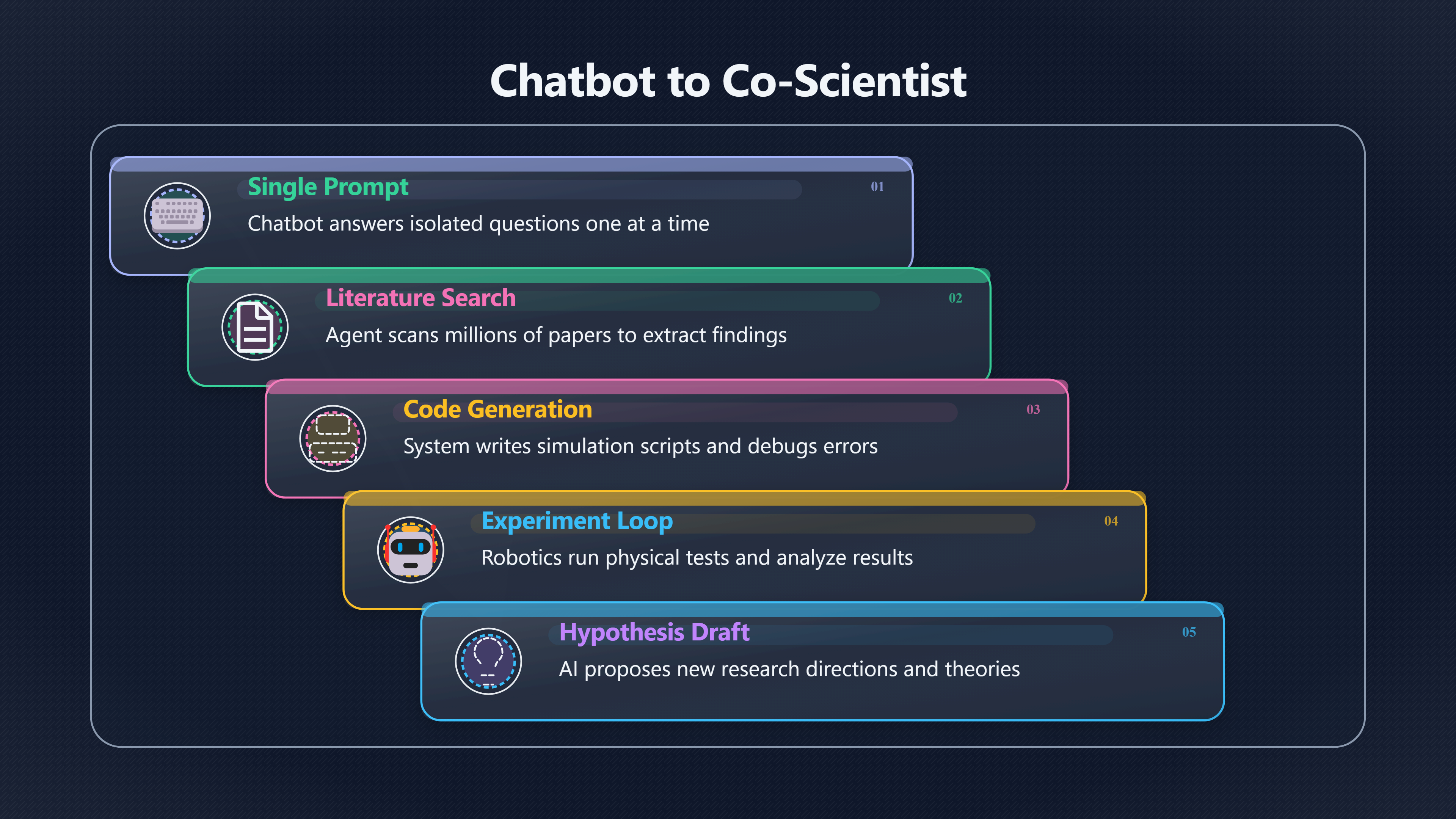
A normal chatbot answers one prompt at a time. A research agent attempts something more demanding: pursuing a long-term objective across many interconnected steps.
That distinction matters because scientific work is rarely a single question-and-answer exchange. A materials scientist, for example, may need to:
- Search prior literature.
- Compare competing theories.
- Generate candidate compounds.
- Write simulation code.
- Run and debug experiments.
- Analyse outcomes statistically.
- Decide which avenue is worth pursuing next.
- Produce figures, reports, and papers.
An agentic AI system tries to chain those steps together into an ongoing workflow. Instead of merely responding to instructions, it plans tasks, uses external tools, stores intermediate memory, checks results, and revises its own outputs.
This is why many research labs now describe AI systems less as assistants and more as “co-scientists” or “autonomous discovery systems”. Google’s AI co-scientist project, for instance, uses multiple specialised agents to generate hypotheses and research proposals collaboratively rather than through a single prompt-response interface. [Google Research]research.googleaccelerating scientific breakthroughs with an ai co scientistGoogle ResearchAccelerating scientific breakthroughs with an AI co-scientistFeb 19, 2025 — A multi-agent AI system built with Gemini 2.0…
The shift resembles the difference between a calculator and an employee. A calculator performs isolated operations. A worker manages sequences of decisions over time.
The optimistic case for AI-driven scientific acceleration depends far more on the second model than the first.
What parts of research agents may automate first
The near-term evidence does not suggest fully autonomous science across every field. It does suggest that many narrow but labour-intensive parts of research are increasingly automatable.
Literature review and knowledge synthesis
One of the most obvious uses is processing scientific literature at scales no human team can manage.
Modern researchers face an information overload problem. Millions of papers are published each year, often spread across disconnected disciplines and inconsistent formats. AI agents can already search papers, extract findings, identify methodological patterns, and build structured summaries from large corpora. [ScienceDirect]sciencedirect.comScienceDirectNavigating self-driving labs in chemical and material…by O Bayley · 2024 · Cited by 67 — Through the integration of AI, a… [PMC]pmc.ncbi.nlm.nih.govIntelligence agents for biological research: a surveyby C Qi · 2026 · Cited by 14 — This survey provides a systematic synthesis of recent…
This matters because major discoveries are sometimes delayed not by missing data, but by failures of coordination and attention. Important findings may exist in separate literatures that no single human researcher has time to connect.
Agentic systems may become especially useful in interdisciplinary work, where chemistry, biology, software, statistics, and engineering increasingly overlap.
Code writing and simulation
Scientific progress now depends heavily on software. Researchers routinely write code for simulations, data processing, modelling, and statistical analysis.
AI systems are already widely used for programming assistance. In research settings, agents can generate code, run tests, debug failures, revise pipelines, and automate repetitive analysis loops. [Nature]nature.comNatureTowards end-to-end automation of AI researchby C Lu · 2026 · Cited by 50 — We present The AI Scientist, which creates research idea…
That matters because scientific bottlenecks are often practical rather than conceptual. A researcher may know what experiment to run but lack the time or specialist programming expertise to execute it quickly.
In computational sciences, this creates the possibility of massively parallel experimentation. Thousands of AI instances could simultaneously test variations of models, parameters, or hypotheses.
Experiment planning and robotic laboratories
The most ambitious systems connect AI planning to physical automation.
So-called “self-driving labs” combine AI software with robotics systems capable of carrying out experiments automatically. These laboratories can plan experiments, operate instruments, analyse outcomes, and choose follow-up experiments without requiring continuous human intervention. [ScienceDirect]sciencedirect.comScienceDirectNavigating self-driving labs in chemical and material…by O Bayley · 2024 · Cited by 67 — Through the integration of AI, a… [American Chemical Society Publications]pubs.acs.orgAmerican Chemical Society PublicationsSelf-Driving Laboratories for Chemistry and Materials Scienceby G Tom · 2024 · Cited by 524 — Throu…
In materials science, the A-Lab system demonstrated an autonomous workflow for synthesising inorganic materials using machine learning, robotics, and active learning loops. [Nature]nature.comNatureAn autonomous laboratory for the accelerated synthesis of…29 Nov 2023 — We introduce the A-Lab, an autonomous laboratory for the…
The underlying idea is important for the broader AI bloom thesis. If scientific experimentation itself becomes partially automated, then research speed may stop scaling mainly with the number of trained humans available.
Instead, progress could become constrained more by compute, energy, laboratory hardware, and access to data.
Hypothesis generation
Some researchers believe AI may eventually contribute not just labour, but scientific creativity.
Systems such as Google’s AI co-scientist aim to generate novel hypotheses and propose new research directions. [Google Research]research.googleaccelerating scientific breakthroughs with an ai co scientistGoogle ResearchAccelerating scientific breakthroughs with an AI co-scientistFeb 19, 2025 — A multi-agent AI system built with Gemini 2.0…
This remains controversial. Pattern recognition is not the same as deep conceptual understanding. But there are early signs that AI systems can identify unusual relationships in large datasets that humans may overlook.
In fields such as drug discovery and materials science, the search spaces are so vast that brute-force exploration by humans is impossible. AI agents may therefore become valuable not because they “understand science like humans”, but because they can explore candidate possibilities at enormous scale. [ScienceDirect]sciencedirect.comScienceDirectNavigating self-driving labs in chemical and material…by O Bayley · 2024 · Cited by 67 — Through the integration of AI, a… [ScienceDirect]sciencedirect.comScienceDirectNavigating self-driving labs in chemical and material…by O Bayley · 2024 · Cited by 67 — Through the integration of AI, a…
Why multi-agent systems matter
Many developers increasingly believe that scientific automation will require teams of specialised AI agents rather than one giant general model.
A research workflow naturally decomposes into roles:
- One agent searches literature.
- Another generates code.
- Another critiques statistical methods.
- Another evaluates novelty claims.
- Another plans experiments.
- Another checks outputs for errors.
This mirrors how human laboratories operate.
The reason is partly practical. Large language models are unreliable over long chains of reasoning. Breaking workflows into smaller specialised components may reduce cascading failures. [arXiv]arxiv.orgarXivAgentic AI for Scientific Discovery: A Survey of Progress…12 Mar 2025 — This survey provides a comprehensive overview of Agentic… 2arXiv
Google’s AI co-scientist explicitly uses multiple collaborating agents, while many autonomous research frameworks use planning agents, execution agents, evaluation agents, and memory systems working together. [Google Research]research.googleaccelerating scientific breakthroughs with an ai co scientistGoogle ResearchAccelerating scientific breakthroughs with an AI co-scientistFeb 19, 2025 — A multi-agent AI system built with Gemini 2.0…
This architecture matters because scientific work requires different forms of reasoning simultaneously: creativity, criticism, bookkeeping, statistical checking, and tool use.
A single conversational model often performs these inconsistently. Distributed agent systems may scale more effectively.
The strongest evidence so far
The current evidence is mixed but significant enough that many scientists now take the idea seriously.
Several developments stand out.
End-to-end AI research systems
Sakana AI’s “AI Scientist” project attempted one of the clearest demonstrations of an automated research workflow. The system generated ideas, wrote code, ran experiments, analysed results, produced figures, and drafted scientific papers. Nature [Sakana AI]sakana.aiai scientistTowards Fully Automated Open-Ended Scientific DiscoveryAug 13, 2024 — The AI Scientist is a fully automated pipeline for end-to-end paper…
A later version reportedly produced a workshop paper that passed peer review thresholds at an AI conference workshop. [arXiv]arxiv.orgarXivAgentic AI for Scientific Discovery: A Survey of Progress…12 Mar 2025 — This survey provides a comprehensive overview of Agentic…
That does not mean the system performed frontier science independently. Workshop standards vary, and machine learning research is unusually compatible with automated experimentation because experiments are software-based. Still, the result would have seemed implausible only a few years earlier.
Autonomous materials discovery
Materials science has become one of the leading domains for autonomous workflows because experiments can often be standardised and looped through robotics systems.
Self-driving laboratories now exist that integrate machine learning, robotic handling, automated measurement, and adaptive experiment selection. [ScienceDirect]sciencedirect.comScienceDirectNavigating self-driving labs in chemical and material…by O Bayley · 2024 · Cited by 67 — Through the integration of AI, a… [American Chemical Society Publications]pubs.acs.orgAmerican Chemical Society PublicationsSelf-Driving Laboratories for Chemistry and Materials Scienceby G Tom · 2024 · Cited by 524 — Throu…
The long-term significance is not just faster science in one niche. It is the emergence of closed-loop discovery systems where AI models generate hypotheses, robotics systems test them, and results feed back automatically into the next cycle.
That resembles a primitive form of automated scientific iteration.
Drug discovery agents
Drug development is slow, expensive, and heavily dependent on large search spaces of molecules and biological interactions.
AI agents are increasingly used to automate parts of this workflow: target identification, molecule generation, simulation, literature synthesis, and experiment coordination. [ScienceDirect]sciencedirect.comScienceDirectNavigating self-driving labs in chemical and material…by O Bayley · 2024 · Cited by 67 — Through the integration of AI, a…
Optimists argue that this could eventually compress years of exploratory work into much shorter cycles, especially if combined with robotics and large-scale biological simulation.
Why reliability remains the central obstacle
The biggest limitation is not raw intelligence alone. It is reliability across long workflows.
Current AI systems frequently hallucinate sources, fabricate results, introduce coding errors, lose context, or fail silently during extended tasks. These problems become more dangerous as workflows become more autonomous. arXiv [IT Pro]itpro.comTheir analysis, using a tool called DELEGATE-25, revealed that even advanced LLMs—such as GPT-5.4, Claude Opus 4.6, and Gemini 3.1 Pro—co…
An isolated chatbot mistake may waste minutes. A mistaken research agent running hundreds of experiments could waste months of work or generate misleading scientific claims at scale.
Independent evaluations of systems such as Sakana’s AI Scientist found major weaknesses:
- flawed novelty claims,
- failed experiments,
- hallucinated numerical results,
- weak citation quality,
- placeholder text,
- and limited adaptability. [arXiv]arxiv.orgarXivAgentic AI for Scientific Discovery: A Survey of Progress…12 Mar 2025 — This survey provides a comprehensive overview of Agentic…
Microsoft researchers similarly warned that large language models remain “unreliable delegates” during extended workflows, with corruption and hallucination problems compounding over time. [IT Pro]itpro.comTheir analysis, using a tool called DELEGATE-25, revealed that even advanced LLMs—such as GPT-5.4, Claude Opus 4.6, and Gemini 3.1 Pro—co…
This creates a paradox at the centre of agentic science.
The more autonomy systems receive, the more valuable they could become. But the more autonomy they receive, the more catastrophic small reliability failures may become.
Science may accelerate unevenly
Not all sciences are equally automatable.
[Research agents currently work best where:]mindstudio.aiai agents research analysis9 AI Agents for Research and Analysis6 Feb 2026 — This guide covers nine AI agents built specifically for research and analysis work. Eac…
- data is digital,
- experiments are repeatable,
- feedback loops are fast,
- success metrics are measurable,
- and workflows can be simulated computationally.
This favours fields such as:
- machine learning,
- materials science,
- computational biology,
- chemistry,
- genomics,
- and some engineering domains.
Fields that rely heavily on tacit knowledge, ambiguous interpretation, difficult physical setups, or human subjects may prove much harder to automate.
A physics simulation can run thousands of times overnight. A decade-long public health study cannot.
This matters because some futuristic narratives imply uniform scientific acceleration across civilisation. In practice, progress may become highly uneven.

Could research itself become massively scalable?
The more radical possibility is not just faster science, but scalable scientific labour.
Human research capacity grows slowly because training scientists takes years. AI systems, by contrast, can potentially be copied and run in parallel at low marginal cost.
If one capable research agent can manage a workflow, then thousands or millions of copies could theoretically pursue different hypotheses simultaneously.
That possibility sits near the core of the “intelligence explosion” idea. If AI systems can improve software, algorithms, chip design, and AI research itself, scientific acceleration could become self-reinforcing.
Some researchers view this as the beginning of a transition where intelligence itself becomes an abundant industrial resource rather than a scarce human one. [Google Research]research.googleaccelerating scientific breakthroughs with an ai co scientistGoogle ResearchAccelerating scientific breakthroughs with an AI co-scientistFeb 19, 2025 — A multi-agent AI system built with Gemini 2.0…
But this remains highly speculative. Real-world science still depends on physical infrastructure, energy, funding, institutions, data access, and experimental validation. Faster reasoning alone does not automatically eliminate those bottlenecks.
The darker possibility: flooding science with noise
Automation could also damage science if incentives become distorted.
One warning sign is the rapid growth of AI-generated academic papers, low-quality submissions, and automated “paper mill” behaviour. Journal editors and reviewers already report increasing strain from plausible but unreliable AI-assisted manuscripts. [The Verge]theverge.comResearchers like Peter Degen and Matt Spick have uncovered a wave of low-quality, AI-generated studies using public datasets, which are o…
This creates a risk that AI systems increase the volume of scientific output faster than the scientific community can verify it.
Science depends heavily on trust, replication, and filtering mechanisms. If AI agents can generate thousands of superficially credible papers cheaply, the bottleneck may shift from producing ideas to distinguishing signal from noise.
In that world, scientific institutions could become overwhelmed rather than accelerated.
This is one reason many researchers argue that verification systems, reproducibility standards, provenance tracking, and automated checking tools will become as important as the agents themselves.
What would need to happen for research agents to matter civilisation-wide?
Several conditions would likely need to hold simultaneously before AI agents could genuinely compress decades of discovery.
Reliable long-horizon reasoning
Current systems still struggle with extended tasks involving many dependent steps. Agents would need much stronger consistency, memory, planning, and error correction.
Better verification systems
Scientific automation becomes dangerous without strong validation. Future systems may require formal verification, automated replication, adversarial checking, and human oversight layers.
Integration with physical infrastructure
Digital reasoning alone is insufficient. Real acceleration depends on laboratories, robotics, manufacturing systems, sensors, and experimental pipelines.
Broad diffusion rather than narrow concentration
If only a few corporations or states control advanced scientific agents, the benefits may remain concentrated. The optimistic “AI bloom” scenario assumes scientific capability spreads widely enough to improve medicine, energy, education, and living standards broadly rather than simply increasing strategic power for a small number of actors.
Institutions that can absorb faster discovery
Civilisation may also struggle to govern rapid scientific change. Regulatory systems, education, public trust, and international coordination all move more slowly than software.
That mismatch could become one of the defining tensions of an AI-accelerated century.
The likely near-term reality
The most plausible near-term outcome is probably neither fully autonomous super-science nor total failure.
Instead, research may become increasingly hybrid.
Human scientists may supervise fleets of specialised agents that:
- search literature continuously,
- draft analyses,
- generate code,
- monitor experiments,
- propose hypotheses,
- and coordinate robotic systems.
In that model, scientists become more like directors of cognitive infrastructure than solitary researchers.
Even modest improvements could matter enormously over time. If research productivity across medicine, energy, materials, agriculture, and engineering rises substantially for decades, the cumulative effects on human flourishing could be profound.
That possibility helps explain why research agents occupy such a central place in the broader argument about AI bloom. The optimistic case is not merely that AI answers questions faster. It is that intelligence itself may become scalable enough to transform the speed at which civilisation learns, invents, and adapts.
Endnotes
-
Source: arxiv.org
Link: https://arxiv.org/html/2503.08979v1Source snippet
arXivAgentic AI for Scientific Discovery: A Survey of Progress...12 Mar 2025 — This survey provides a comprehensive overview of Agentic...
-
Source: sciencedirect.com
Link: https://www.sciencedirect.com/science/article/pii/S2590238524003229Source snippet
ScienceDirectNavigating self-driving labs in chemical and material...by O Bayley · 2024 · Cited by 67 — Through the integration of AI, a...
-
Source: arxiv.org
Link: https://arxiv.org/abs/2502.14297Source snippet
arXivEvaluating Sakana's AI Scientist for Autonomous Research: Wishful Thinking or an Emerging Reality Towards 'Artificial Research Intel...
-
Source: sciencedirect.com
Link: https://www.sciencedirect.com/science/article/abs/pii/S0927025626000406Source snippet
ScienceDirectLLM-based AI agents for automated extraction of material...by S Ghosh · 2026 — We present a closed-loop, agentic large-lang...
-
Source: pmc.ncbi.nlm.nih.gov
Link: https://pmc.ncbi.nlm.nih.gov/articles/PMC12936789/Source snippet
Intelligence agents for biological research: a surveyby C Qi · 2026 · Cited by 14 — This survey provides a systematic synthesis of recent...
-
Source: nature.com
Link: https://www.nature.com/articles/s41586-026-10265-5Source snippet
NatureTowards end-to-end automation of AI researchby C Lu · 2026 · Cited by 50 — We present The AI Scientist, which creates research idea...
-
Source: nature.com
Link: https://www.nature.com/articles/s41586-023-06734-wSource snippet
NatureAn autonomous laboratory for the accelerated synthesis of...29 Nov 2023 — We introduce the A-Lab, an autonomous laboratory for the...
-
Source: sciencedirect.com
Link: https://www.sciencedirect.com/science/article/pii/S1359644626000553Source snippet
ScienceDirectAI agents in drug discovery: applications and case studiesby DL Huynh · 2026 · Cited by 3 — AI agents are emerging as transf...
-
Source: sciencedirect.com
Link: https://www.sciencedirect.com/science/article/pii/S2352940725003981Source snippet
Advancing materials discovery through artificial intelligenceby M Otyepka · 2025 · Cited by 8 — Artificial intelligence (AI) is transform...
-
Source: arxiv.org
Link: https://arxiv.org/abs/2601.12542Source snippet
arXivRethinking the AI Scientist: Interactive Multi-Agent Workflows for Scientific DiscoveryJanuary 18, 2026...
Published: January 18, 2026
-
Source: arxiv.org
Link: https://arxiv.org/abs/2603.03233 -
Source: sakana.ai
Title: ai scientist
Link: https://sakana.ai/ai-scientist/Source snippet
Towards Fully Automated Open-Ended Scientific DiscoveryAug 13, 2024 — The AI Scientist is a fully automated pipeline for end-to-end paper...
-
Source: arxiv.org
Link: https://arxiv.org/abs/2504.08066 -
Source: sakana.ai
Title: Credit: Artwork by CERTO, Inc. Sakana AI.Read more
Link: https://sakana.ai/ai-scientist-nature/Source snippet
The AI Scientist: Towards Fully Automated AI Research...Mar 26, 2026 — AI scientists autonomously explore a “tree” of possibilities to d...
-
Source: arxiv.org
Link: https://arxiv.org/html/2512.19458v1Source snippet
An Agentic Framework for Autonomous Materials...22 Dec 2025 — Recent advances integrate LLMs into agentic frameworks, enabling retrieval...
-
Source: arxiv.org
Link: https://arxiv.org/html/2502.14297v3Source snippet
Evaluating Sakana's AI Scientist for Autonomous ResearchOct 15, 2025 — Recently, Sakana.ai introduced the AI Scientist, a system claiming...
-
Source: nature.com
Link: https://www.nature.com/articles/s42004-026-01932-9Source snippet
The ADePT framework for assessing autonomous...by P Salazar-Villacis · 2026 · Cited by 1 — In materials science, a closed-loop laborator...
-
Source: research.google
Title: accelerating scientific breakthroughs with an ai co scientist
Link: https://research.google/blog/accelerating-scientific-breakthroughs-with-an-ai-co-scientist/Source snippet
Google ResearchAccelerating scientific breakthroughs with an AI co-scientistFeb 19, 2025 — A multi-agent AI system built with Gemini 2.0...
-
Source: pubs.acs.org
Link: https://pubs.acs.org/doi/10.1021/acs.chemrev.4c00055Source snippet
American Chemical Society PublicationsSelf-Driving Laboratories for Chemistry and Materials Scienceby G Tom · 2024 · Cited by 524 — Throu...
-
Source: itpro.com
Link: https://www.itpro.com/technology/artificial-intelligence/llms-are-unreliable-delegates-microsoft-researchers-say-you-probably-shouldnt-trust-ai-with-work-documentsSource snippet
Their analysis, using a tool called DELEGATE-25, revealed that even advanced LLMs—such as GPT-5.4, Claude Opus 4.6, and Gemini 3.1 Pro—co...
-
Source: theverge.com
Link: https://www.theverge.com/ai-artificial-intelligence/930522/ai-research-papers-slop-peer-review-problemSource snippet
Researchers like Peter Degen and Matt Spick have uncovered a wave of low-quality, AI-generated studies using public datasets, which are o...
-
Source: paperswithcode.co
Link: https://paperswithcode.co/tasks/agentsSource snippet
Papers with Code1 day ago — Agents. AI agents are autonomous software systems that use artificial intelligence to achieve goals and compl...
Additional References
-
Source: researchgate.net
Link: https://www.researchgate.net/publication/397550086_LLM-Based_Code_Generation_A_Systematic_Literature_Review_with_Technical_and_Demographic_InsightsSource snippet
LLM-Based Code Generation: A Systematic Literature...21 Mar 2026 — The rapid emergence of Large Language Models (LLMs) has significantly...
-
Source: salesforceairesearch.com
Link: https://www.salesforceairesearch.com/publicationsSource snippet
PublicationsWe introduce SCUBA, a realistic benchmark for evaluating computer-use agents on enterprise CRM workflows in Salesforce, compr...
-
Source: worldbench.github.io
Link: https://worldbench.github.io/awesome-ai-auto-researchSource snippet
AI for Auto-Research: A SurveyAI for Auto-Research — the first survey of AI across the complete research lifecycle, covering idea generat...
-
Source: techradar.com
Link: https://www.techradar.com/pro/even-the-most-advanced-ai-models-fail-more-often-than-you-think-on-structured-outputs-raising-doubts-about-the-effectiveness-of-coding-assistantsSource snippet
The research, which assessed 11 large language models across 44 tasks and 18 output formats, discovered a substantial failure rate—about...
-
Source: phys.org
Title: 2026 01 multi agent ai robots automate
Link: https://phys.org/news/2026-01-multi-agent-ai-robots-automate.htmlSource snippet
Multi-agent AI and robots automate materials discovery in...1 Feb 2026 — This study develops an integrated artificial intelligence (AI)...
-
Source: medium.com
Link: https://medium.com/%40abertina/vibe-research-instead-of-deep-research-ai-agents-and-the-future-of-scientific-discovery-4d561248f3e2Source snippet
an entire scientific study from start to finish.Read more...
-
Source: researchgate.net
Link: https://www.researchgate.net/figure/Autonomous-materials-discovery-workflow-in-the-A-Lab-integrating-DFT-analysis-and_fig10_397418780Source snippet
d machine learning models to identify...Read more...
-
Source: mindstudio.ai
Title: ai agents research analysis
Link: https://www.mindstudio.ai/blog/ai-agents-research-analysis/Source snippet
9 AI Agents for Research and Analysis6 Feb 2026 — This guide covers nine AI agents built specifically for research and analysis work. Eac...
-
Source: github.com
Link: https://github.com/sakanaai/ai-scientist-v2Source snippet
c Tree Search - SakanaAI/AI-Scientist-v2...
-
Source: github.com
Title: awesome ai agent papers
Link: https://github.com/VoltAgent/awesome-ai-agent-papersSource snippet
VoltAgent/awesome-ai-agent-papersA curated collection of AI agent research papers released in 2026, covering agent engineering, memory, e...
Amazon book picks
Further Reading
Books and field guides related to AI research agents. Use these as the next step if you want deeper reading beyond the article.
Artificial intelligence
First published 1994. Subjects: problem solving, constraint satisfaction, knowledge, reasoning, planning.

Artificial Intelligence and Soft Computing
First published 2012. Subjects: Computer Imaging, Vision, Pattern Recognition and Graphics, Database management, Information storage and...

Artificial Intelligence Applications and Innovations
First published 2006. Subjects: Artificial intelligence, Technological innovations, Expert systems (computer science), Intelligent contro...

The Logic of Scientific Discovery
First published 1935. Subjects: Science, Methodology, Logic, Research Design, Sciences.
eBay marketplace picks
Marketplace Samples
Example marketplace items related to this page. Use the search link to explore similar finds on eBay.
Example eBay listing
A.I. Artificial Intelligence Original Movie Poster Signed By Jude Law
USD 125.00 | Shipping USD 25.00 | US
Example eBay listing
Artificial Intelligence D/S Original Movie Poster - 27 x 40"
USD 19.50 | Shipping USD 13.65 | US

Example eBay listing
612388 Artificial Intelligence Movie Science Fiction Drama Wall Print Poster
USD 22.95 | Shipping USD 12.95 | JP

Example eBay listing
Companion - Artificial Intelligence Dark Comedy Cinema Film - POSTER 20"x30"
USD 23.99 | Free shipping | US
Topic Tree