Within AI Profits
AI data flywheels
When user data, compute and model quality reinforce each other, successful AI firms may become harder for rivals and public institutions to catch.
On this page
- How feedback loops improve models
- Why scale can become self reinforcing
- What winner takes most AI means for public access
Page outline Jump by section
Introduction
AI markets may become unusually concentrated because the same firms often control several reinforcing advantages at once: users, data, computing infrastructure, distribution channels, and capital. The more people use an AI system, the more interactions it can learn from; the better the model becomes, the more users it attracts; and the larger the user base, the easier it becomes to finance still larger models and data centres. Economists and regulators increasingly describe this as an AI “data flywheel” or “neural network effect”. [Institute for New Economic Thinking]ineteconomics.orgneural network effects scaling and market structure in artificial intelligenceInstitute for New Economic ThinkingNeural Network Effects: Scaling and Market Structure in…21 Oct 2024 — As artificial intelligence re… [GOV.UK]GOV.UKcma ai strategic update29 Apr 2024 — In 2022, our horizon scanning highlighted AI foundation models (FMs) as an important emerging technology and possible drive…
 This matters for the broader question of AI bloom because abundance alone does not guarantee broad access or shared power. Advanced AI could dramatically accelerate science, medicine, education, and automation while still leaving critical infrastructure concentrated in a handful of companies or states. If AI profits accumulate mainly through self-reinforcing monopolies, then the gains from superhuman systems may be distributed far more unevenly than the technological benefits themselves.
The key question is therefore not simply whether AI systems improve with scale. It is whether scale advantages become so strong that rivals, governments, universities, and smaller firms cannot realistically catch up.
How feedback loops improve models
The basic AI flywheel is straightforward.
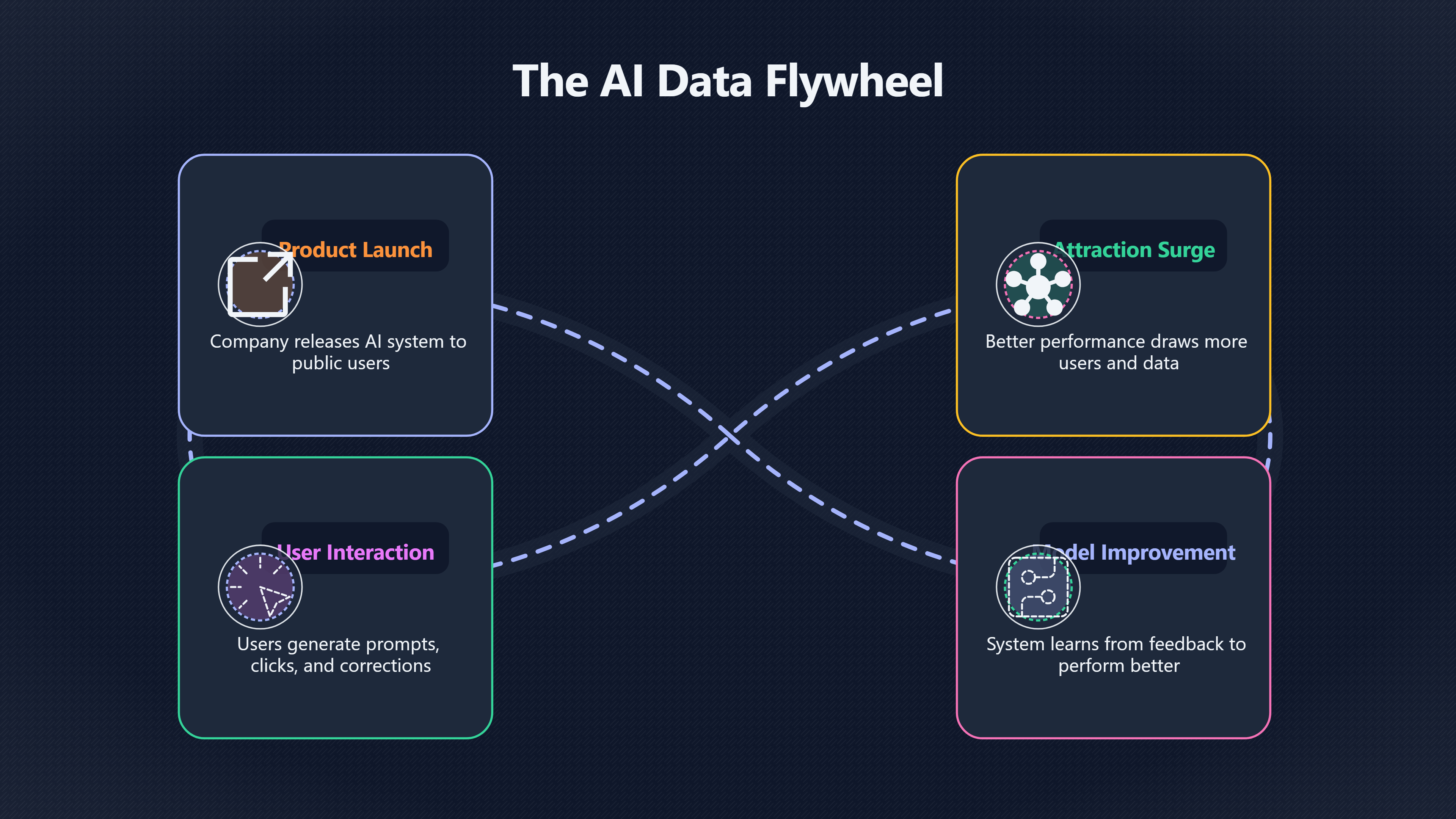
A company launches an AI product. Users generate prompts, clicks, ratings, corrections, purchases, conversations, code samples, images, or behavioural traces. The company uses that data to improve the model. Better performance attracts more users. More users create more data. More data improves the system further.
The loop resembles earlier digital platform effects seen in search engines, social networks, and online marketplaces, but AI adds an important twist: user interactions can directly improve the intelligence of the product itself.
Large language models already rely heavily on reinforcement learning from human feedback, usage telemetry, synthetic data generation, retrieval systems, and fine-tuning pipelines built from real-world interactions. Companies with hundreds of millions of users can observe vastly more edge cases, specialised queries, and failure modes than smaller rivals.
This is one reason why firms with large existing platforms may have structural advantages in AI. Search engines, operating systems, cloud suites, e-commerce platforms, office software, and social networks already collect enormous volumes of user behaviour. AI systems embedded into those ecosystems can improve rapidly because the ecosystem itself continuously produces training signals.
The UK Competition and Markets Authority (CMA) has repeatedly warned that foundation model markets could become concentrated because of control over “critical inputs”, including data, compute, and distribution channels. [Sourcing Speak]sourcingspeak.comuk cma ai foundation models 2024 updatesThe UK's CMA and AI Foundation Models – 2024 Updates10 Dec 2024 — Firms that control critical inputs for developing foundation models may…
Data alone is not enough
The monopoly concern is real, but the mechanism is more complicated than “more data always wins”.
Modern frontier models are not trained simply by hoarding raw internet information. Researchers increasingly use curated datasets, synthetic training data, specialised fine-tuning, reinforcement learning, and architectural improvements. In some domains, algorithmic advances matter as much as larger datasets.
This weakens simplistic claims that whoever owns the most data automatically controls AI forever. Some economists and technologists argue that “data network effects” are often overstated because many datasets become commoditised or reproducible over time. [International Center for Law & Economics]laweconcenter.orgInternational Center for Law & EconomicsFrom Data Myths to Data Reality: What Generative AI Can…23 Feb 2024 — Competition authorities…
But even if raw data advantages fade, the broader flywheel may still remain powerful because the real advantage comes from combining several reinforcing assets at once:
- Massive compute budgets
- Proprietary user interaction data
- Existing customer ecosystems
- Cloud infrastructure
- Distribution through default software platforms
- Access to capital markets
- Talent concentration
A smaller lab might replicate one ingredient. Replicating all of them simultaneously is far harder.
Why scale can become self-reinforcing
AI markets may favour “winner-takes-most” dynamics because frontier systems are extremely expensive to build and improve.
Training leading models can require billions of dollars in chips, data centres, energy infrastructure, and engineering talent. Once a company has already achieved scale, it often becomes easier for that company to attract investment, secure chip supply, sign enterprise contracts, and recruit researchers.
This creates a compounding process:
- Better models attract more users and developers.
- More usage generates more revenue and feedback data.
- More revenue finances larger training runs and infrastructure.
- Better infrastructure improves the next generation of models.
- Developers build applications around the dominant ecosystem.
- Switching costs rise.
Economists studying foundation models increasingly compare this to earlier platform monopolies, but potentially stronger because intelligence itself becomes the platform layer. Anton Korinek and Jai Vipra argue that the most capable foundation models may trend toward “natural monopoly” conditions due to scale economies and broad applicability across industries. [arXiv]arxiv.orgarXiv Market Concentration Implications of Foundation ModelsarXivMarket Concentration Implications of Foundation ModelsNovember 2, 2023…
The concern is not merely that one chatbot becomes popular. It is that a few firms could become central gateways for knowledge work, software creation, online search, digital assistants, robotics, scientific research, and automated business operations simultaneously.
Compute concentration may reinforce the flywheel
The flywheel is not only about data. Compute concentration matters just as much.
Training frontier AI systems depends heavily on advanced semiconductors, cloud infrastructure, and large-scale energy access. These markets are already concentrated. NVIDIA dominates high-end AI chips, while Amazon, Microsoft, and Google dominate cloud infrastructure in many regions. [ScienceDirect]sciencedirect.comScienceDirectAntitrust in artificial intelligence infrastructureby K Zheng · 2025 · Cited by 1 — Both the cloud computing service and AI…
This means the firms leading AI often also control the infrastructure needed to challenge them.
The CMA and OECD have both highlighted concerns that partnerships between cloud giants and AI developers could reinforce incumbency across the entire AI stack. [GOV.UK]GOV.UKcloud services market investigationservices market investigation28 January 2025: The CMA has published its provisional decision in its market investigation into the supply… [OECD]oecd.orgArtificial intelligence, data and competition (ENOECDArtificial intelligence, data and competition (EN)May 24, 2024 — Whether AI markets could trend towards concentration… Network and…
For example, if the same company controls:
- the cloud platform,
- the proprietary model,
- the consumer interface,
- the enterprise software ecosystem,
- and the distribution channel,
then competitors may struggle to reach users even if their models are technically strong.
This resembles earlier technology monopolies, but with deeper implications because AI systems may eventually automate large parts of the economy itself.
Why this matters for AI abundance
An AI-rich future could still produce extraordinary abundance even under concentrated ownership. Cheap intelligence might accelerate medicine, scientific discovery, logistics, materials science, education, and robotics regardless of who owns the frontier systems.
But monopoly power changes who captures the gains and who controls access.
If a handful of firms own the core models, compute infrastructure, and deployment ecosystems, they may gain enormous influence over:
- pricing,
- labour markets,
- scientific priorities,
- access to education tools,
- information flows,
- political lobbying,
- and even military capabilities.
This becomes especially important in scenarios involving advanced or superhuman AI systems. If highly capable systems dramatically increase economic output, then ownership of those systems may become more important than ownership of traditional industrial capital.
In that world, AI profits could dwarf ordinary wage income. The economic centre of gravity shifts from labour to infrastructure ownership.
That possibility sits directly inside the broader AI bloom debate. A civilisation with superabundant productive capacity could still become politically brittle or socially unequal if access to intelligence remains centralised.
What winner-takes-most AI could mean for public access
The optimistic case for AI bloom assumes that advanced intelligence eventually becomes broadly available: cheap tutors, universal medical guidance, accelerated science, abundant automation, and powerful creative tools for ordinary people.
Strong AI monopolies could slow or distort that diffusion.
Closed ecosystems may limit experimentation
When frontier systems are proprietary, outside researchers may have limited ability to inspect, audit, or adapt them. Universities, nonprofits, poorer countries, and small firms may become dependent on APIs controlled by a few corporations.
This can narrow who gets to shape the future of AI.
A highly concentrated market may also discourage open experimentation if dominant firms can absorb or outspend emerging competitors before they mature.
Prices may stay above marginal cost
Digital goods are often cheap to reproduce once created. In principle, advanced AI could eventually become extraordinarily inexpensive per use.
But monopolistic markets may keep prices higher than the underlying economics require. This does not necessarily prevent abundance, but it can delay widespread access.
The difference matters historically. Electricity, medicines, telecommunications, and internet access all became more socially transformative once they diffused broadly rather than remaining elite capabilities.

Public institutions may become dependent
Governments themselves may become reliant on private AI infrastructure for defence, administration, healthcare, education, and research.
That creates geopolitical concerns alongside economic ones. States without domestic AI capacity could become dependent on foreign firms or rival powers for core cognitive infrastructure.
The OECD has warned that concentration in AI inputs and ecosystems may widen divides between large and small firms, as well as between countries with different technological capacities. [OECD]oecd.orgArtificial intelligence, data and competitionOECDMay 24, 2024 — This paper discusses recent developments in Artificial Intelligence (AI), particularly generative AI, which could posi… [OECD]oecd.orgcomponent 6Market features in AI infrastructure: Competition in artificial…Nov 14, 2025 — In the context of AI infrastructure, such competition c…
Why monopolies are not inevitable
The strongest monopoly scenarios are plausible, but not guaranteed.
Technology markets sometimes look permanently concentrated until new technical shifts reset the field. Earlier internet giants displaced earlier incumbents. Open-source software repeatedly undermined proprietary advantages. AI itself may lower barriers to entry in some sectors by reducing labour and development costs.
Several counter-forces could weaken AI monopolies.
Open models can spread capabilities
Open-weight and open-source AI models reduce dependence on a small number of firms by allowing researchers and companies to run and adapt systems independently.
Models such as Meta’s Llama family, Mistral, DeepSeek, and other open ecosystems have already shown that frontier-level capabilities do not always remain exclusive to one company for long.
Open ecosystems also accelerate diffusion into universities, startups, nonprofits, and lower-income countries.
Synthetic data may reduce incumbency advantages
AI systems increasingly generate training data themselves. If synthetic data becomes highly effective, firms may depend less on unique proprietary datasets.
That could weaken classic data monopolies, though compute concentration may still remain powerful.
Regulation can target bottlenecks
Competition authorities are already investigating AI infrastructure markets, cloud concentration, and exclusive partnerships. [GOV.UK]GOV.UKcma ai strategic update29 Apr 2024 — In 2022, our horizon scanning highlighted AI foundation models (FMs) as an important emerging technology and possible drive… [GOV.UK]GOV.UKcloud services market investigationservices market investigation28 January 2025: The CMA has published its provisional decision in its market investigation into the supply…
[Potential policy responses include:]oecd.orgcomponent 7Potential competition policy responses in AI infrastructure14 Nov 2025 — The competition issues in the cloud were discussed in more detai…
- interoperability requirements,
- open standards,
- public compute infrastructure, [GOV.UK]GOV.UKcloud services market investigationservices market investigation28 January 2025: The CMA has published its provisional decision in its market investigation into the supply…
- restrictions on anti-competitive partnerships,
- portability of user data,
- support for open models, [oecd.ai]oecd.aipublic ai policies for democratic and sustainable ai infrastructuresPublic AI: Policies for democratic and sustainable…5 Dec 2025 — Public AI policies can support sustainable AI infrastructures through…
- and public-interest AI research.
Some researchers also advocate “public AI” infrastructure: publicly funded compute, open scientific models, and shared data resources designed to prevent extreme concentration. [oecd.ai]oecd.aipublic ai policies for democratic and sustainable ai infrastructuresPublic AI: Policies for democratic and sustainable…5 Dec 2025 — Public AI policies can support sustainable AI infrastructures through…
The deeper tension inside the AI bloom vision
The AI bloom idea contains a built-in political economy tension.
The same forces that could create extraordinary abundance may also strengthen centralisation. Advanced AI rewards scale because larger systems often perform better, require enormous capital investment, and improve through continual feedback loops.
That means the path to superabundant intelligence may naturally produce giant concentrations of economic power unless institutions deliberately counterbalance them.
This does not mean AI abundance is impossible. It means abundance and openness are separate questions.
Human flourishing at civilisation scale may depend not only on whether advanced AI works, but on whether its benefits diffuse widely enough that billions of people can participate in the expansion of knowledge, health, creativity, and freedom rather than merely consuming services controlled by a small number of dominant systems.
Endnotes
-
Source: GOV.UK
Title: cma ai strategic update
Link: https://www.gov.uk/government/publications/cma-ai-strategic-update/cma-ai-strategic-updateSource snippet
29 Apr 2024 — In 2022, our horizon scanning highlighted AI foundation models (FMs) as an important emerging technology and possible drive...
-
Source: oecd.org
Title: Artificial intelligence, data and competition (EN)
Link: https://www.oecd.org/content/dam/oecd/en/publications/reports/2024/05/artificial-intelligence-data-and-competition_9d0ac766/e7e88884-en.pdfSource snippet
OECDArtificial intelligence, data and competition (EN)May 24, 2024 — Whether AI markets could trend towards concentration... Network and...
Published: May 24, 2024
-
Source: assets.publishing.service.gov.uk
Title: UKA I Foundation Models
Link: https://assets.publishing.service.gov.uk/media/661e5a4c7469198185bd3d62/AI_Foundation_Models_technical_update_report.pdfSource snippet
Initial Report: Competition and Markets Authority (2023)...Read more...
-
Source: arxiv.org
Title: arXiv Market Concentration Implications of Foundation Models
Link: https://arxiv.org/abs/2311.01550Source snippet
arXivMarket Concentration Implications of Foundation ModelsNovember 2, 2023...
Published: November 2, 2023
-
Source: sciencedirect.com
Link: https://www.sciencedirect.com/science/article/pii/S2212473X25000835Source snippet
ScienceDirectAntitrust in artificial intelligence infrastructureby K Zheng · 2025 · Cited by 1 — Both the cloud computing service and AI...
-
Source: GOV.UK
Title: cloud services market investigation
Link: https://www.gov.uk/cma-cases/cloud-services-market-investigationSource snippet
services market investigation28 January 2025: The CMA has published its provisional decision in its market investigation into the supply...
Published: January 2025
-
Source: oecd.org
Title: Artificial intelligence, data and competition
Link: https://www.oecd.org/en/publications/artificial-intelligence-data-and-competition_e7e88884-en.htmlSource snippet
OECDMay 24, 2024 — This paper discusses recent developments in Artificial Intelligence (AI), particularly generative AI, which could posi...
Published: May 24, 2024
-
Source: oecd.org
Title: component 6
Link: https://www.oecd.org/en/publications/competition-in-artificial-intelligence-infrastructure_623d1874-en/full-report/component-6.htmlSource snippet
Market features in AI infrastructure: Competition in artificial...Nov 14, 2025 — In the context of AI infrastructure, such competition c...
-
Source: oecd.org
Title: is ai across the stack competitive or concentrated
Link: https://www.oecd.org/en/blogs/2026/03/is-ai-across-the-stack-competitive-or-concentrated.htmlSource snippet
OECDIs AI across the stack competitive or concentrated?4 Mar 2026 — The rapid pace of technological change, the concentration of key inpu...
-
Source: oecd.org
Title: 7376c776 en
Link: https://www.oecd.org/content/dam/oecd/en/publications/reports/2025/06/emerging-divides-in-the-transition-to-artificial-intelligence_eeb5e120/7376c776-en.pdfSource snippet
2023-24, with generative AI. Some places, sectors and firms have...Read more...
-
Source: oecd.org
Link: https://www.oecd.org/en/events/2025/12/artificial-intelligence-and-competitive-dynamics-in-downstream-markets.htmlSource snippet
models, it may also reinforce incumbency through foreclosure, vertical...Read more...
-
Source: oecd.ai
Title: public ai policies for democratic and sustainable ai infrastructures
Link: https://oecd.ai/en/wonk/public-ai-policies-for-democratic-and-sustainable-ai-infrastructuresSource snippet
Public AI: Policies for democratic and sustainable...5 Dec 2025 — Public AI policies can support sustainable AI infrastructures through...
-
Source: oecd.org
Title: component 6
Link: https://www.oecd.org/en/publications/artificial-intelligence-and-competitive-dynamics-in-downstream-markets_ccf0624a-en/full-report/component-6.htmlSource snippet
AI-related competition concerns in downstream marketsNov 14, 2025 — AI can potentially alter the basic dynamics of competition by increas...
-
Source: oecd.org
Title: component 4
Link: https://www.oecd.org/en/publications/artificial-intelligence-and-competitive-dynamics-in-downstream-markets_ccf0624a-en/full-report/component-4.htmlSource snippet
Artificial intelligence and competitive dynamics in...Nov 14, 2025 — This paper examines how the adoption of artificial intelligence (AI...
-
Source: oecd.org
Link: https://www.oecd.org/en.htmlSource snippet
OECD: The Organisation for Economic Co-operation and...The OECD designs international standards and guidelines for development co-operat...
-
Source: one.oecd.org
Link: https://one.oecd.org/document/DAF/COMP/M%282024%292/ANN1/FINAL/en/pdfSource snippet
of the Hearing on Artificial intelligence, data and...Jun 3, 2025 — Current AI governance frequently identifies market concentration...
-
Source: oecd.org
Title: 9302bf46 en
Link: https://www.oecd.org/content/dam/oecd/en/publications/reports/2025/06/developments-in-artificial-intelligence-markets-new-indicators-based-on-model-characteristics-prices-and-providers_75e50b2a/9302bf46-en.pdfSource snippet
Developments in Artificial Intelligence marketsby C André · 2025 · Cited by 3 — Given AI's potential to generate productivity and welfare...
-
Source: oecd.org
Title: component 5
Link: https://www.oecd.org/en/publications/artificial-intelligence-and-competitive-dynamics-in-downstream-markets_ccf0624a-en/full-report/component-5.htmlSource snippet
The impact of AI adoption on market dynamicsNov 14, 2025 — This paper examines how the adoption of artificial intelligence (AI), particul...
-
Source: one.oecd.org
Link: https://one.oecd.org/document/DAF/COMP%282024%292/en/pdfSource snippet
intelligence, data and competition6 May 2024 — Several firms have launched foundation models, ranging from existing firms active in adjac...
Published: May 2024
-
Source: oecd.org
Title: ccf0624a en
Link: https://www.oecd.org/content/dam/oecd/en/publications/reports/2025/11/artificial-intelligence-and-competitive-dynamics-in-downstream-markets_c6e81d0e/ccf0624a-en.pdfSource snippet
Artificial intelligence and competitive dynamics in...Accordingly, the pro-competitive effect of AI may depend on broad, affordable and...
-
Source: oecd.org
Title: component 7
Link: https://www.oecd.org/en/publications/competition-in-artificial-intelligence-infrastructure_623d1874-en/full-report/component-7.htmlSource snippet
Potential competition policy responses in AI infrastructure14 Nov 2025 — The competition issues in the cloud were discussed in more detai...
-
Source: linkedin.com
Title: The OECD
Link: https://www.linkedin.com/posts/sumitsagar07_ai-market-report-activity-7391451710466166784-oe84Source snippet
OECD report: AI market dynamics, competition, and future...Nov 4, 2025 — When AI prices drop faster than crypto in a bear market, you kn...
-
Source: sciencedirect.com
Link: https://www.sciencedirect.com/science/article/pii/S0167718725000013Source snippet
Artificial intelligence and competition policyby A Hagiu · 2025 · Cited by 36 — These services cater to firms ranging from AI-focused com...
-
Source: ineteconomics.org
Title: neural network effects scaling and market structure in artificial intelligence
Link: https://www.ineteconomics.org/perspectives/blog/neural-network-effects-scaling-and-market-structure-in-artificial-intelligenceSource snippet
Institute for New Economic ThinkingNeural Network Effects: Scaling and Market Structure in...21 Oct 2024 — As artificial intelligence re...
-
Source: sourcingspeak.com
Title: uk cma ai foundation models 2024 updates
Link: https://www.sourcingspeak.com/uk-cma-ai-foundation-models-2024-updates/Source snippet
The UK's CMA and AI Foundation Models – 2024 Updates10 Dec 2024 — Firms that control critical inputs for developing foundation models may...
-
Source: laweconcenter.org
Link: https://laweconcenter.org/resources/from-data-myths-to-data-reality-what-generative-ai-can-tell-us-about-competition-policy-and-vice-versa/Source snippet
International Center for Law & EconomicsFrom Data Myths to Data Reality: What Generative AI Can...23 Feb 2024 — Competition authorities...
-
Source: Wikipedia
Link: https://en.wikipedia.org/wiki/OECDSource snippet
OECDIt is a forum whose member countries describe themselves as committed to democracy and the market economy, providing a platform to...
-
Source: linkedin.com
Link: https://www.linkedin.com/posts/oecd-ai_artificialintelligence-markets-competition-activity-7343586473222266880-iCYKSource snippet
OECD.AI's PostJun 25, 2025 — Developments in Artificial Intelligence markets: New evidence on model characteristics, prices and providers...
-
Source: tutor2u.net
Link: https://www.tutor2u.net/economics/topics/network-effects?srsltid=AfmBOorpui6CmBsY7cOxFkGfnpa6JYLT5BH-yL4lsimtzv1uvLo9H1T2Source snippet
Network Effects | Topics | EconomicsNetwork effects refer to the phenomenon in which the value of a product or service increases with the...
Additional References
-
Source: linkedin.com
Link: https://www.linkedin.com/pulse/ai-tech-monopolies-new-digital-oligarchy-shaping-our-andre-up5xeSource snippet
AI and Tech Monopolies: The New Digital Oligarchy...Capital requirements for frontier AI continue increasing; network effects and data a...
-
Source: copenhageneconomics.com
Link: https://copenhageneconomics.com/wp-content/uploads/2024/03/Copenhagen-Economics-Generative-Artificial-Intelligence-The-Competitive-Landscape.pdfSource snippet
Generative Artificial Intelligence: The Competitive LandscapeThe lack of signs of market power at the level of foundation models indicate...
-
Source: nortonrosefulbright.com
Link: https://www.nortonrosefulbright.com/en/knowledge/publications/8ca8f277/the-uk-cmas-ai-foundation-models-initial-reportSource snippet
The UK CMA's review of AI Foundation ModelsThe CMA published its Initial Report (Initial Report) on AI Foundation Models (FM), supplement...
-
Source: networklawreview.org
Link: https://www.networklawreview.org/veer-bostoen-generative-ai/ -
Source: bruegel.org
Title: why artificial intelligence creating fundamental challenges competition policy
Link: https://www.bruegel.org/policy-brief/why-artificial-intelligence-creating-fundamental-challenges-competition-policySource snippet
Why artificial intelligence is creating fundamental...by B Martens — The AI Index Report (Maslej et al, 2024) lists more than five hundr...
-
Source: federalreserve.gov
Title: the state of ai competition in advanced economies 20251006
Link: https://www.federalreserve.gov/econres/notes/feds-notes/the-state-of-ai-competition-in-advanced-economies-20251006.htmlSource snippet
The State of AI Competition in Advanced Economiesby A Haag · 2025 · Cited by 3 — The United States dominates cumulative AI supercomputer...
-
Source: businessatoecd.org
Title: Artificial Intelligence, Data, and Competition
Link: https://www.businessatoecd.org/hubfs/Artificial%20Intelligence%2C%20Data%2C%20and%20Competition.pdf?hsLang=enSource snippet
Jun 12, 2024 — Most of the potential competitive concerns identified by competition authorities are based on conglomerate effects, either...
-
Source: laweconcenter.org
Title: icle comments to autorite de la concurrence on conversational agents
Link: https://laweconcenter.org/resources/icle-comments-to-autorite-de-la-concurrence-on-conversational-agents/Source snippet
ICLE Comments to Autorité de la Concurrence on...Mar 5, 2026 — Network effects appear weaker than in traditional platforms, data advanta...
-
Source: concurrences.com
Title: The OECD issues a report on artificial intelligence and competitive
Link: https://www.concurrences.com/en/bulletin/news-issues/november-2025/the-oecd-issues-a-report-on-artificial-intelligence-and-competitive-dynamics-inSource snippet
November 14, 2025 — This paper examines how the adoption of artificial intelligence (AI), particularly generative and agentic systems, is...
Published: November 14, 2025
-
Source: clearygottlieb.com
Link: https://www.clearygottlieb.com/-/media/files/alert-memos-2023/cma-publishes-initial-report-on-ai-foundation-models-and-guiding-principles-for-firms.pdfSource snippet
Markets Authority (“CMA”) published an initial report on AI foundation models (“FMs”). The...Read more...
Amazon book picks
Further Reading
Books and field guides related to AI data flywheels. Use these as the next step if you want deeper reading beyond the article.
Datafied Democracies & AI Economics Unplugged
This book explores how AI Economics, innovation systems and policies, data cooperatives, and data sovereignty are redefining democracy, g...

Platform Capitalism
First published 2016. Subjects: Big Data, Accelerationism, Politics, Internet, Data.

The Fight Against Platform Capitalism
So far, platform work has been an important laboratory for capital. Management techniques, like the use of algorithms, are being tested w...

eBay marketplace picks
Marketplace Samples
Example marketplace items related to this page. Use the search link to explore similar finds on eBay.

Example eBay listing
A.I. Artificial Intelligence Original Movie Poster Signed By Jude Law
USD 125.00 | Shipping USD 25.00 | US

Example eBay listing
Artificial Intelligence D/S Original Movie Poster - 27 x 40"
USD 19.50 | Shipping USD 13.65 | US

Example eBay listing
612388 Artificial Intelligence Movie Science Fiction Drama Wall Print Poster
USD 22.95 | Shipping USD 12.95 | JP

Example eBay listing
Companion - Artificial Intelligence Dark Comedy Cinema Film - POSTER 20"x30"
USD 23.99 | Free shipping | US
Topic Tree