Within Access Gaps
Language gaps
When AI systems work best in English and high-resource languages, whole communities may receive weaker education, healthcare, and public services.
On this page
- Why low resource languages get weaker AI support
- Education, healthcare, and government service risks
- What local language AI would need

Page outline Jump by section
Introduction
If advanced AI is supposed to make knowledge more abundant, language may determine who actually benefits. Many leading AI systems work best in English and a small number of other high-resource languages with vast digital archives, large online populations, and strong commercial demand. That creates a risk that AI becomes a new layer of global knowledge inequality: powerful tutoring, medical guidance, legal help, and productivity tools for some populations, while others receive weaker, less accurate, or culturally mismatched systems.
This matters far beyond convenience. In an AI-shaped economy, language quality can influence who gets reliable education support, who can navigate digital government services, whose businesses can participate in global markets, and whose knowledge is preserved online. The optimistic “AI bloom” vision depends partly on intelligence becoming broadly accessible. If language gaps remain severe, AI could amplify existing inequalities between rich and poor regions rather than reducing them.
Why low-resource languages get weaker AI support
Large language models learn patterns from enormous collections of text, audio, images, and conversations. English dominates much of the public internet, scientific publishing, software development, and digitised archives. Many other languages do not have enough clean, labelled, machine-readable data to train equally capable systems.
Researchers often describe these as “low-resource languages”: languages with limited digital material, fewer annotated datasets, weaker translation infrastructure, and less commercial investment. The imbalance is extreme. Some languages spoken by tens of millions of people occupy only tiny fractions of major AI training datasets. Research on African languages found that leading models still perform substantially worse outside high-resource languages, especially for translation, summarisation, and question answering. [arXiv]arxiv.orgarXiv How good are Large Language Models on African Languages?arXivHow good are Large Language Models on African Languages?November 14, 2023…
The problem is not simply the number of speakers. Bengali has hundreds of millions of speakers yet receives less AI attention than English because less of its knowledge infrastructure is digitised and commercially prioritised. Many Indigenous languages, regional dialects, and oral languages are even more excluded.
Several technical and economic forces reinforce the gap:
- Companies optimise for the largest profitable markets first.
- Training multilingual systems across thousands of languages is computationally expensive.
- Many languages lack standardised spelling, digitised archives, or large online communities.
- Speech recognition systems need extensive labelled audio data, which is scarce for many regions.
- AI evaluation benchmarks overwhelmingly focus on English or a handful of major languages.
- Local researchers and universities often lack the computing resources needed to build alternatives.
The result is a compounding cycle. Languages with strong digital representation get better AI tools, which generate more digital content, which then improves future systems again. Languages with weak representation risk falling further behind.
The OECD has warned that AI language models raise broad socio-economic and policy concerns around unequal access, bias, and exclusion. [OECD]oecd.orgai language modelsOECDai language models - technological, socio-economic and…5 Apr 2023 — method allows for the development of AI language models for lo… [OECD]oecd.orgAI language modelsThis report offers an overview of the AI language model and NLP landscape with current and emerging policy responses fr… UNESCO has similarly argued that the world risks a new form of digital inequality in which language diversity erodes as AI systems standardise around dominant linguistic patterns. [UNESCO]unesco.orgai and great linguistic flatteningUNESCOAI and the great linguistic flattening27 Oct 2025 — Default language patterns in AI-generated text raise concerns about authenticit… [UNESCO]unesco.orgglobal roadmap multilingualismGlobal Roadmap for Multilingualism in the Digital Era13 Feb 2026 — Artificial intelligence and other emerging technologies are reshaping…
Knowledge inequality is not only about translation
A common assumption is that automatic translation will eventually solve the problem. Translation helps, but language inequality in AI runs deeper than converting words from one script into another.
Local context often disappears
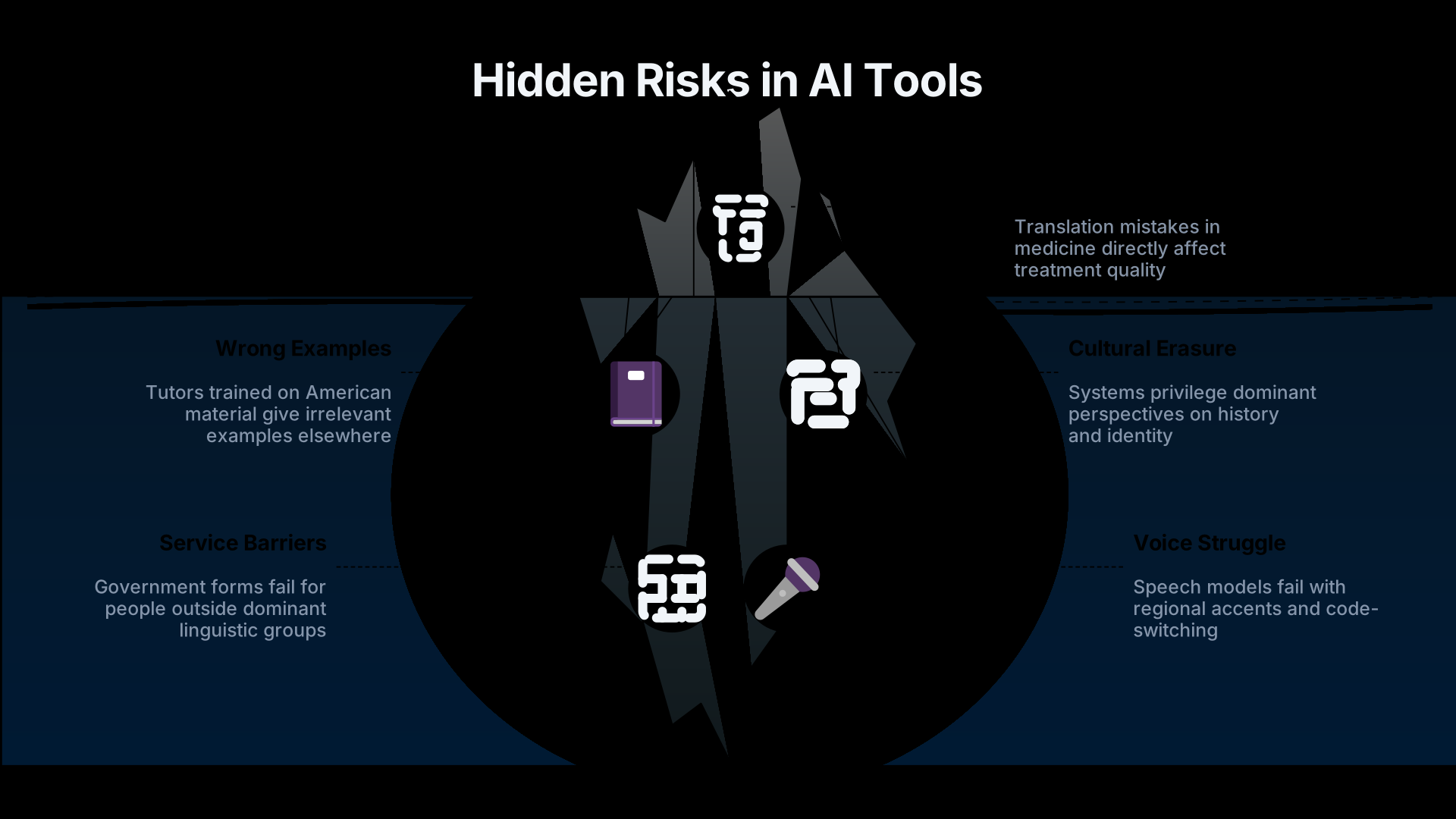
An English-language medical chatbot may technically translate into another language while still misunderstanding local diets, healthcare systems, environmental conditions, or cultural norms. Legal systems, land rights, family structures, and educational practices vary enormously across societies.
An AI tutor trained mainly on American educational material may provide irrelevant examples or inaccurate assumptions when helping a student in rural India, northern Nigeria, or Peru. Even subtle failures matter when systems become widely used for learning and decision-making.
Dialects and mixed-language use confuse models
Many people naturally mix languages, dialects, slang, and regional expressions. Research has shown that models often perform poorly when prompts combine English with lower-resource languages. [economist.com]economist.comTop AI models underperform in languages other than English18 Mar 2026 — Models prompted with a mixture of English and Swahili perform mar…
This matters because real-world communication is messy. A government chatbot that only works with formal standard language may fail for the people most in need of assistance.
Cultural knowledge can be erased
AI systems do not merely retrieve information; they increasingly shape what information becomes visible. If knowledge in minority languages is poorly represented online, AI may gradually privilege dominant-language perspectives on history, medicine, law, religion, or identity.
UNESCO has warned that thousands of languages are already endangered, and that digital systems can accelerate cultural disappearance if linguistic diversity is not actively protected. [UNESCO]unesco.organd g20 promote linguistic diversity digital ageUNESCOUNESCO and G20 promote Linguistic Diversity in Digital AgeNov 21, 2025 — Nearly half of the world's 7,000 languages are now at risk…
This creates a deeper civilisational question. If AI becomes humanity’s main interface to stored knowledge, whose knowledge survives in accessible form?
Education, healthcare, and government service risks
Language gaps become especially serious when AI moves from entertainment into core public services.
Education systems may split by language quality
AI tutoring is often presented as one of the strongest arguments for AI-driven human flourishing. In principle, personalised tutors could provide near-universal educational support at low cost.
But the quality of tutoring may differ dramatically across languages.
Students using strong English-language systems may receive:
- Better explanations
- More accurate feedback
- Richer educational materials
- Faster updates
- Better reasoning performance
- More interactive tools [linkedin.com]linkedin.comIt offers powerful tools for preserving endangered languages through documentation, education, and translation.Read more…
Students in under-supported languages may receive simplistic, error-prone, or culturally awkward systems instead.
That risks creating a new educational hierarchy where language access becomes cognitive access. The world’s best educational AI may technically exist, but only some populations can fully use it.
UNESCO has stressed that inclusive AI literacy and multilingual educational materials are necessary to avoid widening educational divides. [UNESCO]unesco.orgwhat you need know about ai and right educationUNESCOWhat you need to know about AI and the right to education25 Sept 2025 — Since 2024, UNESCO has supported 58 countries in designing… [UNESCO]unesco.orgUNESCOAI literacy and the new Digital Divide - A Global Call for…Aug 6, 2024 — Inclusive Education: Ensure that AI literacy programs a…
Healthcare systems could inherit dangerous biases
Medical AI systems trained mostly on English-language medical literature and patient interactions may underperform in regions with different disease environments, communication styles, or healthcare infrastructure.
Translation errors in medicine are not minor inconveniences. Poor symptom interpretation, misunderstood instructions, or weak speech recognition can directly affect treatment quality.
Voice-based healthcare systems are particularly vulnerable. Speech models often struggle with regional accents, code-switching, and underrepresented languages. Communities with low literacy levels may depend most heavily on voice interfaces while simultaneously receiving the weakest performance.
The risk is not simply lower convenience. It is unequal reliability in systems increasingly used for triage, advice, documentation, and navigation of healthcare systems.
Public services may become less accessible
Governments are beginning to use AI for forms, citizen support, benefit systems, legal guidance, and translation. If these systems primarily work in dominant national or colonial languages, people outside those linguistic groups may face higher barriers to essential services.
This is especially sensitive in multilingual countries where official-language fluency already maps onto class, ethnicity, or urban-rural inequality.
Researchers and digital rights advocates increasingly argue that linguistic inequity should be treated as a governance and democratic issue, not merely a technical limitation. [Tech Policy Press]Tech Policy PressTech Policy Press The Multilingual AI Gap Is Not ClosingIt Is Being Rebranded.10 Apr 2026 — The gap between adding a language to a model and including the community that speaks it in governance…
The political economy behind the language gap
The multilingual AI problem is partly technical, but also political and economic.
AI firms naturally prioritise languages that maximise returns. English-speaking professional markets generate enormous commercial value. A company can spend heavily improving English-language coding assistants or business tools because wealthy users and firms will pay for them.
Smaller language communities often cannot generate comparable revenue, even if the social value of support would be enormous.
This creates a familiar pattern from earlier waves of technology:
- profitable regions receive advanced infrastructure first;
- poorer regions receive cheaper, weaker versions later;
- local dependency on foreign platforms increases.
Language inequality also intersects with older histories of colonialism and global power. In many regions, official education and government systems already privilege colonial languages over local ones. AI can unintentionally reinforce those hierarchies by making dominant languages even more economically useful.
Some researchers describe this as “linguistic flattening”: pressure toward standardised global language patterns shaped by the internet’s largest markets. [UNESCO]unesco.orgAI and technologies in educationThrough our digital and AI competency frameworks, UNESCO prioritizes human agency, critical thinking, and…
The concern is not merely sentimental preservation of languages. Language carries local expertise, oral history, ecological knowledge, social trust, humour, identity, and cultural memory. Losing practical digital relevance can accelerate broader social decline.
Signs the gap could narrow
The picture is not entirely pessimistic. Multilingual AI has improved rapidly in recent years.
Several developments matter:
- Cross-lingual learning allows models to transfer knowledge between related languages.
- Open-weight models make local fine-tuning cheaper.
- Synthetic data generation can partly compensate for limited training corpora.
- Community-led datasets are expanding language coverage.
- Smaller specialised models can outperform giant general-purpose systems in some languages.
- Speech technology is improving for previously neglected languages.
Projects such as Aya, BLOOM, and regional African-language initiatives aim to broaden access beyond English-dominated systems. [Axios]axios.comNew AI polyglot launched to help fill massive language gap in fieldAya was developed by pre-training a base model with diverse language data and then fine-tuning it for the same languages. This initiative…
Research communities such as Masakhane, focused on African natural language processing, have also demonstrated that local researchers and language communities can build valuable datasets and evaluation systems themselves rather than waiting for large Western firms to act. [arXiv]arxiv.orgarXiv How good are Large Language Models on African Languages?arXivHow good are Large Language Models on African Languages?November 14, 2023…
There are also early signs that frontier systems are improving more quickly in some lower-resource languages than many researchers expected. [TechRadar]techradar.comGoogle’s Gemini Pro model, for instance, scored over 4.5 out of 5 in Kinyarwanda, a language spoken by around 12 million people in East A… But performance gains remain uneven, and benchmark success does not necessarily translate into reliable real-world use.
What local-language AI would need
If AI is to support broad human flourishing rather than deepen knowledge inequality, multilingual capability cannot remain an afterthought.
Several conditions appear especially important.
Public investment in language infrastructure
Many low-resource languages lack the basic digital foundations AI systems need:
- digitised books and archives;
- labelled speech data;
- educational corpora;
- translation datasets;
- open dictionaries and grammar resources.
Governments, universities, libraries, and nonprofits may need to treat language datasets as public infrastructure, similar to roads or electricity.
Local participation in AI development
Communities need influence over how their languages are represented, standardised, and evaluated. Otherwise, AI systems may reflect outside assumptions while missing local realities.
This is partly a governance issue. A language can be “supported” technically while its speakers still lack meaningful control over how systems are designed and deployed.
Procurement rules for public AI systems
Governments could require multilingual performance standards before adopting AI in healthcare, education, or public administration.
A chatbot that works brilliantly in English but poorly in local languages may not be genuinely universal public infrastructure.
Open and adaptable models
Open-weight and smaller regional models may matter disproportionately for linguistic inclusion. Local institutions can sometimes adapt these systems more effectively than relying entirely on proprietary global platforms.
The alternative is a world where a handful of firms mediate most digital knowledge flows across thousands of cultures and languages.
Better evaluation standards
Many multilingual systems are labelled “supported” in languages where actual performance remains weak. Independent benchmarks, local testing, and public transparency matter because AI failures are often invisible to outsiders who do not speak the language.
A system can appear globally capable while quietly failing millions of users.
Why this matters to the larger AI bloom vision
The strongest versions of the AI bloom argument imagine intelligence becoming abundant enough to expand education, scientific understanding, creativity, health, and opportunity across humanity.
Language determines whether that abundance is broadly shared.
If multilingual AI succeeds, people currently excluded from much of the global knowledge economy could gain far greater access to expertise, education, markets, and scientific information in their own languages. AI could help preserve endangered languages, translate scientific knowledge at unprecedented scale, and reduce barriers that have historically isolated communities from global learning.
But if language inequality persists, AI could harden a different future: a world where the highest-quality machine intelligence primarily serves populations already dominant in digital systems, while weaker tools are distributed elsewhere.
That would not only be a fairness problem. It would also shrink humanity’s collective intellectual future. A civilisation-scale increase in intelligence loses much of its promise if large parts of humanity remain poorly connected to it, unable to contribute fully in their own languages, experiences, and cultural frameworks.
Endnotes
-
Source: arxiv.org
Title: arXiv How good are Large Language Models on African Languages?
Link: https://arxiv.org/abs/2311.07978Source snippet
arXivHow good are Large Language Models on African Languages?November 14, 2023...
Published: November 14, 2023
-
Source: arxiv.org
Title: arXiv Where Are We? Evaluating LLM Performance on African Languages
Link: https://arxiv.org/abs/2502.19582 -
Source: arxiv.org
Link: https://arxiv.org/abs/2506.02280 -
Source: oecd.org
Title: ai language models
Link: https://www.oecd.org/content/dam/oecd/en/publications/reports/2023/04/ai-language-models_46d9d9b4/13d38f92-en.pdfSource snippet
OECDai language models - technological, socio-economic and...5 Apr 2023 — method allows for the development of AI language models for lo...
-
Source: oecd.org
Link: https://www.oecd.org/en/publications/ai-language-models_13d38f92-en.htmlSource snippet
AI language modelsThis report offers an overview of the AI language model and NLP landscape with current and emerging policy responses fr...
-
Source: oecd.ai
Title: language models policy implications
Link: https://oecd.ai/en/wonk/language-models-policy-implicationsSource snippet
As language models and generative AI take the world by...Apr 13, 2023 — The report puts forward policy considerations associated with AI...
-
Source: unesco.org
Title: ai and great linguistic flattening
Link: https://www.unesco.org/en/articles/ai-and-great-linguistic-flatteningSource snippet
UNESCOAI and the great linguistic flattening27 Oct 2025 — Default language patterns in AI-generated text raise concerns about authenticit...
-
Source: unesco.org
Title: global roadmap multilingualism
Link: https://www.unesco.org/en/global-roadmap-multilingualismSource snippet
Global Roadmap for Multilingualism in the Digital Era13 Feb 2026 — Artificial intelligence and other emerging technologies are reshaping...
-
Source: unesco.org
Title: and g20 promote linguistic diversity digital age
Link: https://www.unesco.org/en/articles/unesco-and-g20-promote-linguistic-diversity-digital-ageSource snippet
UNESCOUNESCO and G20 promote Linguistic Diversity in Digital AgeNov 21, 2025 — Nearly half of the world's 7,000 languages are now at risk...
-
Source: economist.com
Link: https://www.economist.com/science-and-technology/2026/03/18/top-ai-models-underperform-in-languages-other-than-englishSource snippet
Top AI models underperform in languages other than English18 Mar 2026 — Models prompted with a mixture of English and Swahili perform mar...
-
Source: unesco.org
Title: what you need know about ai and right education
Link: https://www.unesco.org/en/articles/what-you-need-know-about-ai-and-right-educationSource snippet
UNESCOWhat you need to know about AI and the right to education25 Sept 2025 — Since 2024, UNESCO has supported 58 countries in designing...
-
Source: unesco.org
Link: https://www.unesco.org/ethics-ai/en/articles/ai-literacy-and-new-digital-divide-global-call-actionSource snippet
UNESCOAI literacy and the new Digital Divide - A Global Call for...Aug 6, 2024 — Inclusive Education: Ensure that AI literacy programs a...
-
Source: unesco.org
Link: https://www.unesco.org/en/digital-educationSource snippet
AI and technologies in educationThrough our digital and AI competency frameworks, UNESCO prioritizes human agency, critical thinking, and...
-
Source: axios.com
Title: New AI polyglot launched to help fill massive language gap in field
Link: https://www.axios.com/2024/02/13/open-source-ai-languagesSource snippet
Aya was developed by pre-training a base model with diverse language data and then fine-tuning it for the same languages. This initiative...
-
Source: techradar.com
Link: https://www.techradar.com/pro/a-transformative-moment-research-shows-ai-could-become-the-king-of-babel-as-llms-master-rare-obscure-languagesSource snippet
Google’s Gemini Pro model, for instance, scored over 4.5 out of 5 in Kinyarwanda, a language spoken by around 12 million people in East A...
-
Source: unesco.org
Title: The Organization
Link: https://www.unesco.org/enSource snippet
UNESCO: Building Peace through Education, Science and...UNESCO is the United Nations organization that promotes cooperation in educatio...
-
Source: unesco.org
Link: https://www.unesco.org/ -
Source: whc.unesco.org
Link: https://whc.unesco.org/en/Source snippet
World Heritage CentreThe World Heritage emblem represents the interdependence of the world's natural and cultural diversity. It is used t...
-
Source: unesco.org
Title: launches online english kiswahili ai dictionary world kiswahili language day
Link: https://www.unesco.org/en/articles/unesco-launches-online-english-kiswahili-ai-dictionary-world-kiswahili-language-daySource snippet
Following consultations with AI experts and linguists...Read more...
-
Source: unesco.org
Title: how youth bridging digital knowledge divide course ai and human rights
Link: https://www.unesco.org/en/articles/how-youth-bridging-digital-knowledge-divide-course-ai-and-human-rightsSource snippet
Course on AI and Human Rights20 Apr 2023 — Global literacy efforts related to Artificial Intelligence, particularly those translated into...
-
Source: oecd.ai
Link: https://oecd.ai/en/catalogue/metrics/bilingual-evaluation-understudy-bleuSource snippet
been machine-translated from one natural language to another...
-
Source: oecd.org
Link: https://www.oecd.org/en.htmlSource snippet
OECD: The Organisation for Economic Co-operation and...The OECD designs international standards and guidelines for development co-operat...
-
Source: oecd.org
Link: https://www.oecd.org/en/topics/generative-ai.htmlSource snippet
Generative AIGenerative AI (GenAI) is a category of AI that can create new content such as text, images, videos and music. It gained glob...
-
Source: oecd.org
Title: algorithmic bias the state of the situation and policy recommendations a0b7cec1
Link: https://www.oecd.org/en/publications/oecd-digital-education-outlook-2023_c74f03de-en/full-report/algorithmic-bias-the-state-of-the-situation-and-policy-recommendations_a0b7cec1.htmlSource snippet
Algorithmic bias: the state of the situation and policy...Dec 13, 2023 — The overwhelming majority of work on algorithmic bias in educat...
-
Source: oecd.org
Link: https://www.oecd.org/content/dam/oecd/en/publications/reports/2025/06/emerging-divides-in-the-transition-to-artificial-intelligence_eeb5e120/7376c776-en.pdfSource snippet
Emerging divides in the transition to artificial intelligenceby S Kergroach · 2025 · Cited by 32 — The diffusion of artificial intelligen...
-
Source: oecd.org
Link: https://www.oecd.org/en/topics/ai-principles.htmlSource snippet
AI principlesGenerative AI (GenAI) is a category of AI that can create new content such as text, images, videos, and music. It gained glo...
-
Source: oecd.org
Title: full report
Link: https://www.oecd.org/en/publications/how-do-people-experience-new-technologies-and-generative-ai_49b8d10e-en/full-report.htmlSource snippet
How do people experience new technologies...Dec 4, 2025 — This policy brief provides new insights into how people experience the role of...
-
Source: oecd.org
Link: https://www.oecd.org/en/topics/policy-issues/artificial-intelligence.htmlSource snippet
Artificial intelligenceGenerative AI. Generative AI (GenAI) is a category of AI that can create new content such as text, images, videos...
-
Source: oecd.org
Link: https://www.oecd.org/en/publications/artificial-intelligence-in-science_a8d820bd-en/full-report/elicit-language-models-as-research-tools_fec8a6ab.htmlSource snippet
e (AI) research assistant that uses language models to help researchers search...Read more...
-
Source: arxiv.org
Link: https://arxiv.org/html/2404.11988v3Source snippet
The Emerging Generative Artificial Intelligence Divide in...18 Apr 2025 — We leverage a large-scale search query database to characteriz...
-
Source: arxiv.org
Link: https://arxiv.org/html/2512.01557v1Source snippet
Evaluating Language Usage and AI Performance...1 Dec 2025 — Our analysis reveals significant patterns in the digital representation of Y...
-
Source: Tech Policy Press
Title: Tech Policy Press The Multilingual AI Gap Is Not Closing
Link: https://techpolicy.press/the-multilingual-ai-gap-is-not-closing-it-is-being-rebrandedSource snippet
It Is Being Rebranded.10 Apr 2026 — The gap between adding a language to a model and including the community that speaks it in governance...
-
Source: maize.io
Link: https://www.maize.io/cultural-factory/is-the-english-language-hindering-collective-intelligence/Source snippet
Is the English language hindering collective intelligence?2 May 2024 — For non-European languages, this linguistic divide threatens their...
Published: May 2024
Additional References
-
Source: linkedin.com
Link: https://www.linkedin.com/posts/bashaerkilani_introducing-the-oecd-ai-capability-indicators-activity-7376276468106076160-7zeHSource snippet
OECD study on AI abilities: strengths and weaknessesA recent OECD study maps AI progress across nine abilities such as language, creativi...
-
Source: cohere.com
Link: https://cohere.com/research/papers/the-ai-language-gap.pdfSource snippet
The AI Language GapThe language gap in AI means that speakers of low-resource languages face a growing divide in the availability of high...
-
Source: linkedin.com
Link: https://www.linkedin.com/pulse/ais-dual-impact-language-diversity-preserving-endangered-ahmed-guikfSource snippet
It offers powerful tools for preserving endangered languages through documentation, education, and translation.Read more...
-
Source: intralinea.org
Link: https://www.intralinea.org/current/article/the_hegemony_of_english_language_in_the_digital_eraSource snippet
globalization process, has led to the dominance of a few major languages - most notably English - in...Read more...
-
Source: digital-skills-jobs.europa.eu
Title: accelerated increase use ai individuals oecd member countries oecd data
Link: https://digital-skills-jobs.europa.eu/en/latest/news/accelerated-increase-use-ai-individuals-oecd-member-countries-oecd-dataSource snippet
increase in the use of AI by individuals in OECD...Feb 12, 2026 — According to OECD data, three-quarters of students aged 16 and over re...
-
Source: Wikipedia
Title: Organização das Nações Unidas para a Educação, a Ciência e a Cultura
Link: https://pt.wikipedia.org/wiki/Organiza%C3%A7%C3%A3o_das_Na%C3%A7%C3%B5es_Unidas_para_a_Educa%C3%A7%C3%A3o%2C_a_Ci%C3%AAncia_e_a_CulturaSource snippet
anização das Nações Unidas para a Educação...Projetos patrocinados pela UNESCO incluem programas de alfabetização, técnicos e de...
-
Source: datajungleadventures.com
Link: https://datajungleadventures.com/2025/06/04/the-great-language-divide-how-unequal-distribution-in-ai-training-data-shapes-our-digital-future/Source snippet
Low-resource languages face particularly acute challenges in the current AI training ecosystem.Read more...
-
Source: news.stanford.edu
Title: digital divide ai llms exclusion non english speakers research
Link: https://news.stanford.edu/stories/2025/05/digital-divide-ai-llms-exclusion-non-english-speakers-researchSource snippet
AI is leaving non-English speakers behind19 May 2025 — New research explores the communities and cultures being excluded from AI tools, l...
Published: May 2025
-
Source: smartling.com
Title: african languages lab empowers low resource languages with ai
Link: https://www.smartling.com/blog/african-languages-lab-empowers-low-resource-languages-with-aiSource snippet
How the African Languages Lab empowers low-resource...2 Dec 2024 — Research and model development: We conduct research to build AI model...
-
Source: imminent.translated.com
Title: winning the language divide with ai
Link: https://imminent.translated.com/winning-the-language-divide-with-aiSource snippet
the Language Divide with AI - Imminent - Translated'sHow AI can help preserve low-resource languages at risk of digital extinction—insigh...
Amazon book picks
Further Reading
Books and field guides related to Language gaps. Use these as the next step if you want deeper reading beyond the article.

Artificial Intelligence in Education
This work reports on research into intelligent systems, models, and architectures for educational computing applications. It covers a wid...

Intelligent Tutoring Systems
ITS 2000 is the fifth international conference on Intelligent Tutoring Systems. The preceding conferences were organized in Montreal in 1...

Artificial Intelligence in Economics and Finance Theories
As Artificial Intelligence (AI) seizes all aspects of human life, there is a fundamental shift in the way in which humans are thinking of...
Teaching and learning with technology
First published 2002. Subjects: Audio-visual materials, Computer network resources, Computer-assisted instruction, Educational technology...
Topic Tree