Within Grid Strain
AI Load Swings
AI data centres can create grid risks not only by using huge amounts of power, but by changing demand abruptly at industrial scale.
On this page
- Why data centre demand differs from ordinary electricity use
- How simultaneous disconnections can shock a regional grid
- What utilities may need to monitor or require from large AI loads
Page outline Jump by section
Introduction
AI data centres do not only strain electricity grids because they use huge amounts of power. They can also destabilise grids because their demand can change extremely quickly at industrial scale. A cluster of AI servers may suddenly disconnect from the grid, switch to backup systems, or ramp computing loads up and down far faster than utilities are used to managing. In some regions, operators are beginning to treat these facilities less like ordinary commercial buildings and more like heavy industrial infrastructure with unusual electrical behaviour.
 This matters because modern electricity grids are balanced systems. Supply and demand must stay closely matched every second. If a large AI load suddenly disappears or rapidly changes consumption, the effect can ripple across substations, transmission lines and generators. In extreme cases, abrupt swings can contribute to voltage instability, frequency disturbances or cascading outages. As AI infrastructure expands toward gigawatt scale, utilities are increasingly worried not just about total electricity demand, but about the dynamic behaviour of AI loads during disturbances. [DataCenterKnowledge]datacenterknowledge.comData Center Knowledge From Capacity to Chaos: How AI Data Centers ChallengeDataCenterKnowledgeFrom Capacity to Chaos: How AI Data Centers Challenge…May 8, 2026 — AI data centers challenge the grid with unpredi… [NERC]nerc.comNERCCharacteristics and Risks of Emerging Large LoadsThe following large load categories are based on the function or activity of the fac…
Why AI data-centre demand behaves differently
Traditional electricity demand is relatively predictable. Homes peak in the evening. Offices rise during working hours. Factories often follow regular industrial schedules. Utilities have decades of data showing how these patterns evolve.
Large AI facilities behave differently for several reasons:
- they concentrate enormous computing loads in one place
- they rely heavily on power electronics and GPU clusters
- they often run continuously at high utilisation
- they use automated protection systems designed to preserve uptime
- they can shift between grid power, batteries and backup generation almost instantly
A hyperscale AI campus may consume hundreds of megawatts continuously, comparable to a steel mill or a major city district. But unlike many older industrial facilities, AI clusters are built around sensitive electronic systems protected by fast-acting controls. Those controls may disconnect parts of the facility during even short voltage disturbances. [NERC]nerc.comNERCCharacteristics and Risks of Emerging Large LoadsThe following large load categories are based on the function or activity of the fac… [Azure Blob Storage]eepublicdownloads.blob.core.windows.netAzure Blob Storage ENTSO-E | Data centres and the power systemSupply, but also to a change in the.Read more…
This creates a paradox. Data centres are designed to maximise reliability for their own customers, but their defensive reactions can destabilise the wider grid around them.
Researchers studying emerging “large loads” increasingly describe AI data centres as a new category of grid challenge because their electrical behaviour differs from both conventional industry and ordinary commercial demand. [GridLab]gridlab.orgGrid Lab Practical Guidance and Considerations for Large LoadGridLabPractical Guidance and Considerations for Large Load…March 6, 2025 — Data centers are among the most significant large load int…
How simultaneous disconnections can shock a regional grid
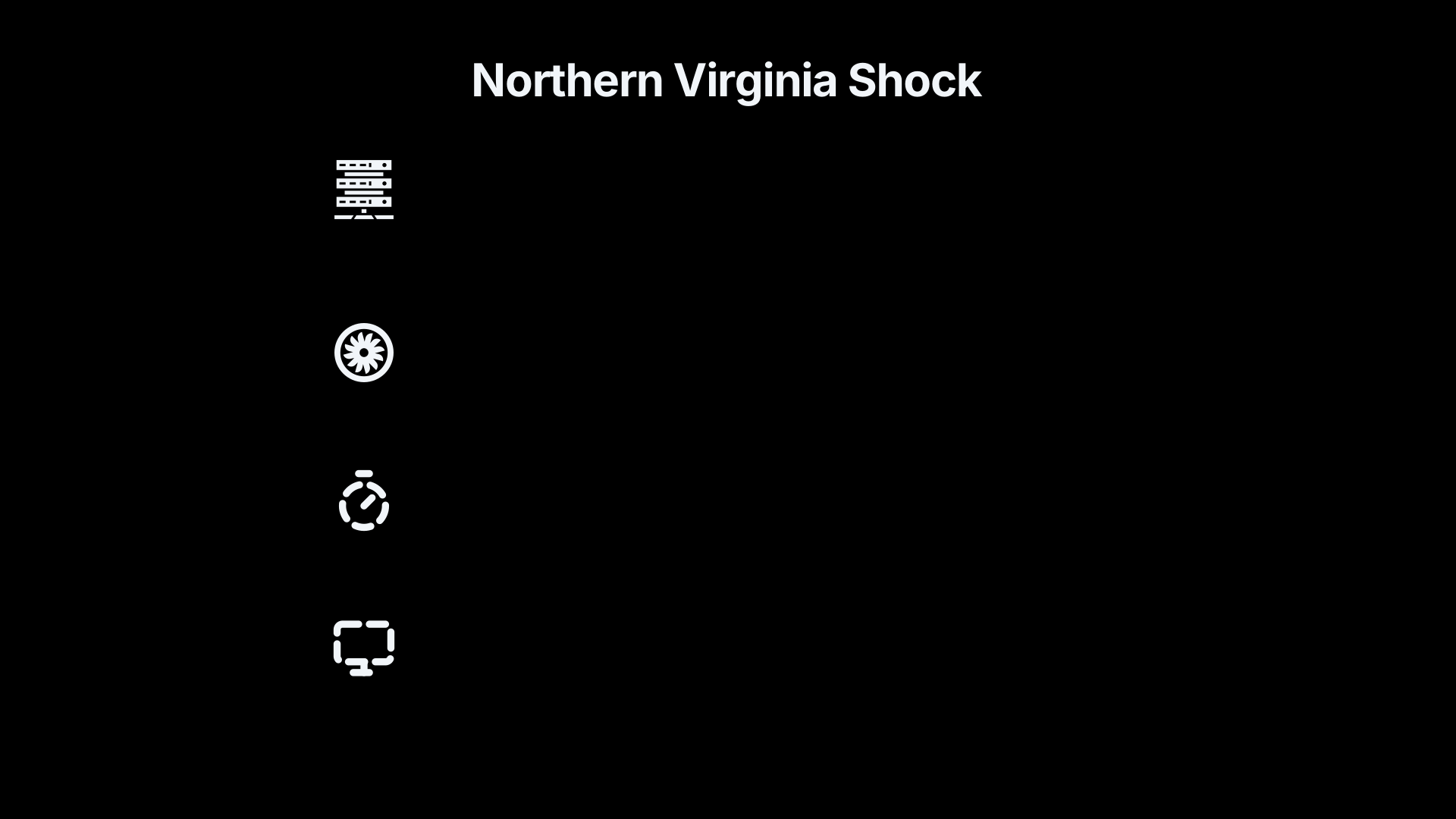
The clearest example so far came in Northern Virginia, the world’s largest concentration of data centres.
In July 2024, a transmission disturbance triggered a chain reaction in which roughly 60 data centres disconnected from the grid almost simultaneously, dropping about 1,500 megawatts of demand within seconds. Grid operators reportedly had to intervene rapidly to prevent wider instability and possible blackouts. [DataCenterDynamics]datacenterdynamics.comDataCenterDynamicsVirginia narrowly avoided power cuts when 60 data centers…20 Mar 2025 — Sixty data centers in Northern Virginia usin… [Grid Status]blog.gridstatus.iobyte blackouts large data center loads new issues pjmGrid Status ExportsByte Blackouts: How large data center loads are surfacing…18 Apr 2025 — These rapid voltage drops led to nearly 1,5…
At first glance, losing electricity demand may sound harmless. Many people intuitively think blackouts happen because demand rises too high. But power systems become unstable whenever supply and demand suddenly diverge in either direction.
If a giant load disappears instantly:
- generators may briefly produce too much power relative to demand
- grid frequency can rise unexpectedly
- transmission flows can shift abruptly
- voltage behaviour can change across neighbouring regions
- protective systems may trigger further automatic reactions
Electric grids operate close to synchronisation limits. Small imbalances happen constantly, but sudden swings at gigawatt scale are unusual. Historically, most utilities worried more about losing large generators than losing large consumers. AI data centres are beginning to reverse that assumption. [DataCenterKnowledge]datacenterknowledge.comData Center Knowledge From Capacity to Chaos: How AI Data Centers ChallengeDataCenterKnowledgeFrom Capacity to Chaos: How AI Data Centers Challenge…May 8, 2026 — AI data centers challenge the grid with unpredi… [LinkedIn Some engineers now describe hyperscale AI campuses as]linkedin.comLinkedInData Centers Disrupt Grid with Sudden DisconnectsWhen thousands of megawatts of artificial intelligence load drop in sub-seconds…“grid events” in their own right because their collective behaviour can materially affect regional stability. [LinkedIn]linkedin.comLinkedInData Centers Disrupt Grid with Sudden DisconnectsWhen thousands of megawatts of artificial intelligence load drop in sub-seconds…
The role of power electronics and protective systems
One reason these swings happen so quickly is that modern AI infrastructure relies heavily on power-electronics-based systems.
Traditional industrial machinery often changes demand gradually because it depends on large mechanical equipment. AI facilities instead use:
- uninterruptible power supply systems (UPS)
- inverter-based power conversion
- battery systems
- high-density GPU clusters
- automated fault-protection controls
These systems react in milliseconds rather than minutes.
During a voltage dip or transmission fault, many data centres are programmed to protect internal hardware by disconnecting from the grid or shifting temporarily onto batteries and generators. That makes sense from the perspective of the operator: even brief interruptions can corrupt data or disrupt expensive AI training runs.
The problem emerges when many facilities respond in the same way at the same time.
Australian grid operators have warned that large concentrations of AI-related data centres could create “cascading” risks if multiple facilities disconnect simultaneously during disturbances. Regulators there are now considering new “ride-through” requirements intended to stop hyperscale facilities from dropping off the grid too aggressively during short faults. [The Australian]theaustralian.com.auTransgrid and other energy stakeholders have raised alarms about the potential for cascading outages due to the simultaneous disconnectio…
This issue resembles earlier problems seen with some renewable-energy systems. Solar and wind facilities connected through inverters sometimes disconnected too readily during disturbances, unexpectedly worsening grid instability. Utilities now worry that AI campuses may repeat a similar pattern on the demand side of the grid. [The Australian]theaustralian.com.auTransgrid and other energy stakeholders have raised alarms about the potential for cascading outages due to the simultaneous disconnectio…
Why AI workloads may create fast internal power swings
Even when data centres stay connected, AI workloads themselves can create rapid changes in electricity demand.
Large language model training involves thousands of GPUs communicating continuously. Demand can fluctuate depending on:
- synchronisation cycles between processors
- changes in workload intensity
- inference surges from public AI services
- cooling-system responses
- shifting compute allocation inside clusters
Some researchers argue these fluctuations are more dynamic than older cloud-computing loads. [arXiv]arxiv.orgarXiv Wide-Area Power System Oscillations from Large-Scale AI WorkloadsarXivWide-Area Power System Oscillations from Large-Scale AI WorkloadsAugust 22, 2025…
There is still debate about how large these swings are in real-world operations. Utilities and grid researchers are only beginning to collect detailed measurements from AI facilities. But several studies warn that gigawatt-scale AI clusters may produce oscillatory demand patterns capable of interacting with wider grid dynamics. [arXiv]arxiv.orgarXiv Wide-Area Power System Oscillations from Large-Scale AI WorkloadsarXivWide-Area Power System Oscillations from Large-Scale AI WorkloadsAugust 22, 2025…
This does not mean AI servers are constantly causing blackouts. Most of the time, grids absorb fluctuations successfully. The concern is that the combination of:
- larger AI campuses
- tighter reserve margins
- more inverter-based grids [nerc.com]nerc.comNERCCharacteristics and Risks of Emerging Large LoadsThe following large load categories are based on the function or activity of the fac…
- slower transmission expansion
- simultaneous automated responses
could create instability during already stressed conditions.
Why utilities are changing their assumptions
Utilities traditionally planned around gradual demand growth. A new housing estate or industrial site might take years to reach full load.
AI infrastructure compresses these timelines dramatically. Large facilities can appear within a few years and may request enormous grid connections immediately. More importantly, utilities increasingly realise they cannot treat these loads as passive electricity consumers.
North American reliability authorities now explicitly classify large data centres as “emerging large loads” requiring specialised interconnection studies and stability analysis. [NERC]nerc.comNERCCharacteristics and Risks of Emerging Large LoadsThe following large load categories are based on the function or activity of the fac…
Utilities are beginning to ask new questions:
- How quickly can a facility ramp demand?
- What happens during a transmission fault?
- Will the site disconnect automatically?
- How should reconnection be managed?
- Can the facility provide stabilising services instead?
One major concern is “flapping”: repeated cycles where a large AI load disconnects and reconnects while the grid is still recovering from a disturbance. Researchers warn that poorly timed reconnections can worsen frequency swings and electromechanical oscillations. [arXiv]arxiv.orgarXiv Wide-Area Power System Oscillations from Large-Scale AI WorkloadsarXivWide-Area Power System Oscillations from Large-Scale AI WorkloadsAugust 22, 2025…
This is changing the relationship between utilities and hyperscalers. Data-centre operators increasingly face pressure to behave more like active grid participants rather than simple electricity customers.

What utilities may require from large AI loads
Utilities and regulators are now exploring technical rules intended to make hyperscale AI facilities more “grid friendly”.
Possible requirements include:
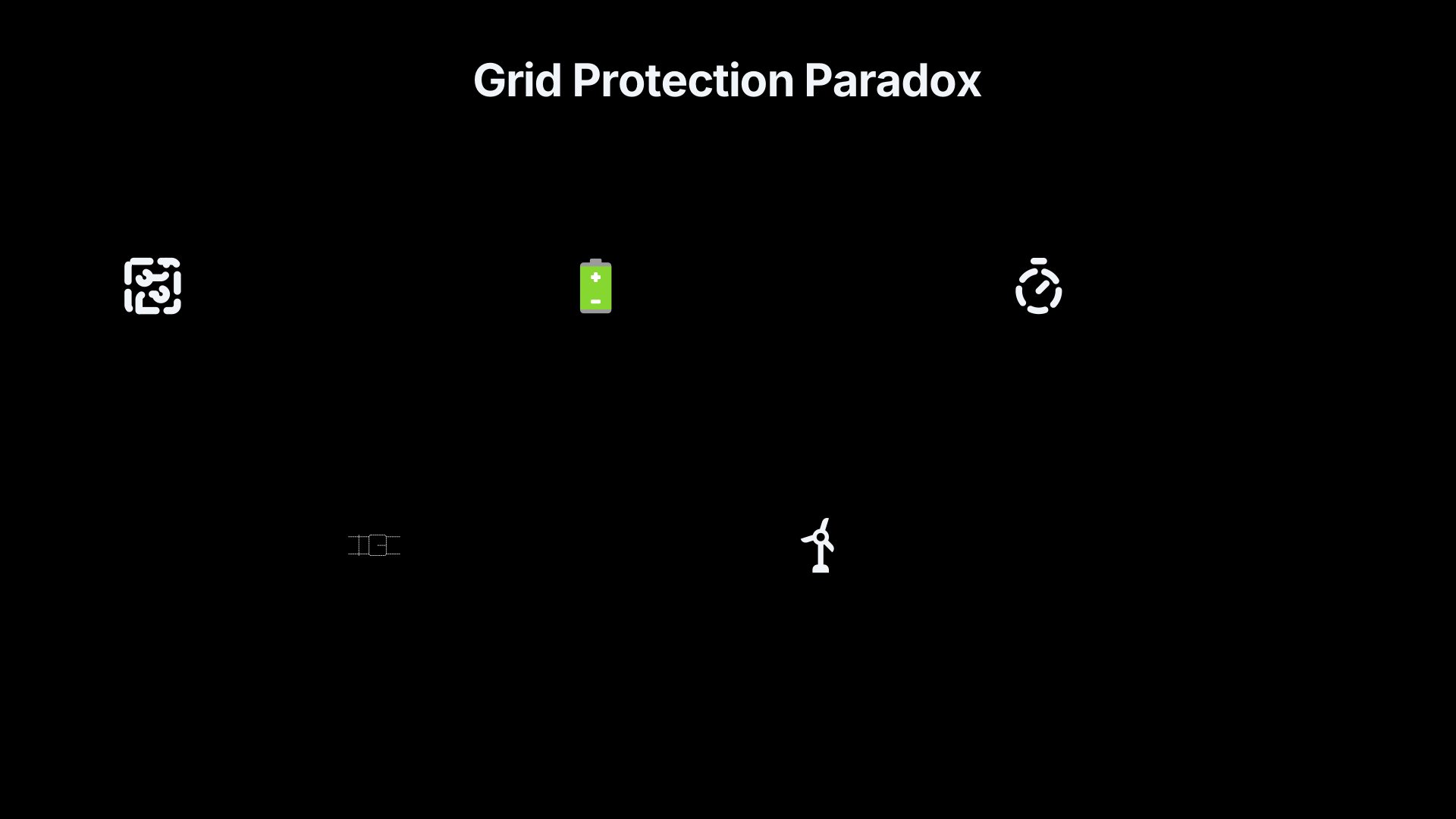
- Fault ride-through capability: keeping facilities connected during short disturbances rather than disconnecting immediately
- Controlled reconnection timing: staggering reconnection after outages to avoid sudden demand spikes
- Ramp-rate limits: restricting how quickly facilities can change load
- On-site batteries: smoothing abrupt swings internally before they affect the grid
- Demand flexibility agreements: allowing utilities to curtail some computing loads during emergencies
- Advanced monitoring: requiring real-time visibility into large AI load behaviour
Some operators are also exploring dedicated generation and microgrids for AI campuses, including gas turbines, nuclear partnerships and large battery systems. [Hanwha Data Centers]hanwhadatacenters.comHanwha Data Centers On-Site Power for Data Centers: The Future of HyperscaleHanwha Data CentersOn-Site Power for Data Centers: The Future of HyperscaleFebruary 20, 2026 — 20 Feb 2026 — On-site power for data cente…
The broader goal is not simply to limit AI growth. Much of the optimistic vision around AI abundance assumes vast computational infrastructure powering scientific discovery, automation and accelerated innovation. But that future depends on electrical systems remaining stable enough to support it.
In practice, this means the future of AI may depend partly on making AI loads more cooperative with the grid itself.
The larger tension behind AI abundance
The instability issue reveals a deeper tension inside the broader AI bloom story.
Advanced AI could eventually help design better batteries, optimise grids, accelerate fusion research and coordinate energy systems more intelligently. In the long run, AI may contribute to a world with far more abundant clean energy and dramatically improved infrastructure management.
But in the near term, AI is arriving faster than many physical systems can adapt.
Electric grids were built around assumptions developed over decades:
- demand changes gradually
- large consumers are relatively predictable
- industrial loads respond slowly
- stability threats mainly come from generator failures
Hyperscale AI infrastructure challenges all four assumptions simultaneously.
That does not mean the optimistic long-term vision fails. It means the transition period matters. A civilisation attempting to build intelligence at unprecedented scale may first need to redesign parts of the physical infrastructure supporting that intelligence, including transmission networks, interconnection standards, grid controls and electricity markets themselves.
Endnotes
-
Source: datacenterknowledge.com
Title: Data Center Knowledge From Capacity to Chaos: How AI Data Centers Challenge
Link: https://www.datacenterknowledge.com/uptime/from-capacity-to-chaos-how-ai-data-centers-challenge-the-gridSource snippet
DataCenterKnowledgeFrom Capacity to Chaos: How AI Data Centers Challenge...May 8, 2026 — AI data centers challenge the grid with unpredi...
Published: May 8, 2026
-
Source: nerc.com
Link: https://www.nerc.com/globalassets/who-we-are/standing-committees/rstc/whitepaper-characteristics-and-risks-of-emerging-large-loads.pdfSource snippet
NERCCharacteristics and Risks of Emerging Large LoadsThe following large load categories are based on the function or activity of the fac...
-
Source: gridlab.org
Title: Grid Lab Practical Guidance and Considerations for Large Load
Link: https://gridlab.org/wp-content/uploads/2025/03/GridLab-Report-Large-Loads-Interim-Report.pdfSource snippet
GridLabPractical Guidance and Considerations for Large Load...March 6, 2025 — Data centers are among the most significant large load int...
Published: March 6, 2025
-
Source: datacenterdynamics.com
Link: https://www.datacenterdynamics.com/en/news/virginia-narrowly-avoided-power-cuts-when-60-data-centers-dropped-off-the-grid-at-once/Source snippet
DataCenterDynamicsVirginia narrowly avoided power cuts when 60 data centers...20 Mar 2025 — Sixty data centers in Northern Virginia usin...
-
Source: linkedin.com
Link: https://www.linkedin.com/posts/daxkepshire_exclusive-a-new-threat-to-power-grids-activity-7434236352059158529-MyfLSource snippet
LinkedInData Centers Disrupt Grid with Sudden DisconnectsWhen thousands of megawatts of artificial intelligence load drop in sub-seconds...
-
Source: linkedin.com
Link: https://www.linkedin.com/posts/shane-snider-1727755_from-capacity-to-chaos-how-ai-data-centers-activity-7458469110981722112-7EQxSource snippet
Data Centers Expose Power Grid to UnpredictabilityAI data centers are exposing a new problem for the power grid: unpredictability. The ch...
-
Source: arxiv.org
Title: arXiv Wide-Area Power System Oscillations from Large-Scale AI Workloads
Link: https://arxiv.org/abs/2508.16457Source snippet
arXivWide-Area Power System Oscillations from Large-Scale AI WorkloadsAugust 22, 2025...
Published: August 22, 2025
-
Source: arxiv.org
Link: https://arxiv.org/abs/2510.05437 -
Source: arxiv.org
Link: https://arxiv.org/abs/2604.24009Source snippet
arXivSafe Reconnection Time for Large-Scale Data Center Loads: An Analytical Framework for Transient Stability AssessmentApril 27, 2026...
Published: April 27, 2026
-
Source: arxiv.org
Link: https://arxiv.org/html/2509.07218v1Source snippet
Electricity Demand and Grid Impacts of AI Data Centers8 Sept 2025 — The rapid growth of artificial intelligence (AI) is driving an unprec...
-
Source: arxiv.org
Link: https://arxiv.org/html/2509.07218v3Source snippet
Electricity Demand and Grid Impacts of AI Data Centers29 Sept 2025 — The rapid growth of artificial intelligence (AI) is driving an unpre...
-
Source: eepublicdownloads.blob.core.windows.net
Title: Azure Blob Storage ENTSO-E | Data centres and the power system
Link: https://eepublicdownloads.blob.core.windows.net/public-cdn-container/clean-documents/Reports/2026/FINAL_ENTSO-E_Data_Centres_260430.pdfSource snippet
Supply, but also to a change in the.Read more...
-
Source: blog.gridstatus.io
Title: byte blackouts large data center loads new issues pjm
Link: https://blog.gridstatus.io/byte-blackouts-large-data-center-loads-new-issues-pjm/Source snippet
Grid Status ExportsByte Blackouts: How large data center loads are surfacing...18 Apr 2025 — These rapid voltage drops led to nearly 1,5...
-
Source: theaustralian.com.au
Link: https://www.theaustralian.com.au/business/power-firms-warn-data-centre-rush-creates-material-risk-to-national-grid/news-story/c515857ad5c0ce915ddcd5b7d1e4dcd1Source snippet
Transgrid and other energy stakeholders have raised alarms about the potential for cascading outages due to the simultaneous disconnectio...
-
Source: hanwhadatacenters.com
Title: Hanwha Data Centers On-Site Power for Data Centers: The Future of Hyperscale
Link: https://www.hanwhadatacenters.com/blog/on-site-power-for-data-centers-the-future-of-hyperscale/Source snippet
Hanwha Data CentersOn-Site Power for Data Centers: The Future of HyperscaleFebruary 20, 2026 — 20 Feb 2026 — On-site power for data cente...
Published: February 20, 2026
Additional References
-
Source: inl.gov
Link: https://inl.gov/content/uploads/2023/07/Characterizing-Large-Loads-A-Taxonomy-to-Support-Large-Load-Integration.pdfSource snippet
Idaho National LaboratoryCharacterizing Large LoadsThis taxonomy gives utilities a reference from which to approach requirements for diff...
-
Source: researchgate.net
Link: https://www.researchgate.net/publication/386461930_Impact_of_Large_Load_Disconnection_on_System_Stability_2024_Grid_of_the_Future_Symposium_1Source snippet
(PDF) Impact of Large Load Disconnection on System...5 Dec 2024 — This paper specifically explores the effects of fault ride-through beh...
-
Source: facebook.com
Link: https://www.facebook.com/groups/2865698143633908/posts/3007405369463184/Source snippet
Data center load losses impact on power gridSudden Data Center Load Losses. This happens when data center loads are on line taking electr...
-
Source: keentelengineering.com
Link: https://www.keentelengineering.com/ercot-interconnection-surge-ai-loadSource snippet
ERCOT Data Center Boom: Large Load & Grid ReliabilityERCOT faces a surge in large load interconnections driven by AI data centers. Explor...
-
Source: eaton.com
Link: https://www.eaton.com/us/en-us/markets/data-centers/impact-of-ai-data-center-infrastructure/grid-connection-challenges-ai-data-centers.htmlSource snippet
EatonGrid connection and resilience challenges for AI data centersAI data centers are pushing electrical grids to their limits, causing l...
-
Source: tomshardware.com
Link: https://www.tomshardware.com/tech-industry/tesla-targets-ai-data-centers-with-megapack-as-grid-strain-fears-growSource snippet
These centers experience load swings of up to 90% during GPU-driven AI training processes, which can destabilize the power grid. In respo...
-
Source: euci.com
Link: https://www.euci.com/event_post/data-centers-load/Source snippet
Utility Strategies to Meet Data Centers LoadThe rapid growth of hyperscale data centers and artificial intelligence workloads is reshapin...
-
Source: newsletter.semianalysis.com
Title: Semi Analysis AI Training Load Fluctuations at Gigawatt-scale
Link: https://newsletter.semianalysis.com/p/ai-training-load-fluctuations-at-gigawatt-scale-risk-of-power-grid-blackoutSource snippet
Training Load Fluctuations at Gigawatt-scale - Risk of...25 Jun 2025 — The chart below makes it easy to understand: more than 108GW of “...
-
Source: facebook.com
Title: ais explosive growth could trigger an electricity crisis as the adoption of gene
Link: https://www.facebook.com/SchneiderElectric/posts/ais-explosive-growth-could-trigger-an-electricity-crisis-as-the-adoption-of-gene/1322954999841768/Source snippet
Risa Sindel ▻ AW Area [Community]({{ 'ai-bloom-abun/ai-bloom-abun-98d3a6-long-future-b-29cc56-abundant-know-ca00d9-community-hea-3d87fb/' | relative_url }}) Response Awareness Group (AW...Read more...
-
Source: keentelengineering.com
Title: large load interconnections western grid risks
Link: https://www.keentelengineering.com/large-load-interconnections-western-grid-risksSource snippet
Grid Risks of Large Load Interconnections in the Western...21 Apr 2025 — AI-driven data centers and similar facilities often exhibit rap...
Amazon book picks
Further Reading
Books and field guides related to AI Load Swings. Use these as the next step if you want deeper reading beyond the article.

Artificial intelligence
First published 1994. Subjects: problem solving, constraint satisfaction, knowledge, reasoning, planning.
Understanding Electric Power Systems
The Enron scandal notwithstanding, it is important for professionals in the electric power industry and related positions gain a solid un...
Renewable and efficient electric power systems
First published 2004. Subjects: Electric losses, Electric power systems, Energy conservation, Energy consumption, Renewable energy sources.
Electric power systems
First published 2006. Subjects: Electric power systems, Engineering, Nonfiction, Technology.
eBay marketplace picks
Marketplace Samples
Example marketplace items related to this page. Use the search link to explore similar finds on eBay.

Example eBay listing
A.I. Artificial Intelligence Original Movie Poster Signed By Jude Law
USD 125.00 | Shipping USD 25.00 | US

Example eBay listing
Artificial Intelligence D/S Original Movie Poster - 27 x 40"
USD 19.50 | Shipping USD 13.65 | US

Example eBay listing
612388 Artificial Intelligence Movie Science Fiction Drama Wall Print Poster
USD 22.95 | Shipping USD 12.95 | JP

Example eBay listing
Companion - Artificial Intelligence Dark Comedy Cinema Film - POSTER 20"x30"
USD 23.99 | Free shipping | US
Topic Tree