Within Public Compute
NAIRR and research access
The U.S.
On this page
- Why academic AI research needs shared compute
- What the NAIRR pilot actually provides
- What would count as success or failure
Page outline Jump by section
Introduction
If advanced AI becomes central to scientific discovery, medicine, engineering, and economic growth, universities face a simple problem: they may no longer be able to afford meaningful participation. Frontier AI research increasingly depends on massive computing clusters, expensive graphics processing units (GPUs), specialist cloud infrastructure, and access to large datasets. The National AI Research Resource, or NAIRR, is the United States’ attempt to stop academic AI research being squeezed out by a handful of giant technology firms.
 The question matters well beyond university budgets. The broader AI bloom vision imagines AI accelerating science and expanding human capability on a civilisational scale. But that future looks very different if only a few corporations control the infrastructure needed to build and study advanced systems. NAIRR is therefore not just a research grant programme. It is an early experiment in whether advanced AI capability can remain at least partly a public good rather than becoming a permanently privatised toll road for intelligence itself. NSF - U.S. National Science Foundation [Brookings]brookings.eduHow the National Artificial Intelligence Research Resource…9 Jul 2024 — The NAIRR is a proposed national initiative that aims to addre…
Why academic AI research needs shared compute
For much of modern computing history, universities could compete near the frontier. Graduate students built influential systems with modest budgets, and academic labs regularly drove major breakthroughs. That model is breaking down in frontier AI.
Training leading models now requires enormous quantities of compute. The cost is not just chips themselves, but networking, storage, cooling, electricity, engineering expertise, and software infrastructure. Large commercial AI companies can spread these costs across cloud businesses worth hundreds of billions of dollars. Universities generally cannot.
This creates several problems at once.
First, academic researchers may lose the ability to reproduce or independently evaluate frontier systems. If only private firms can train large models, outside scrutiny becomes harder. Questions about safety, bias, reliability, misuse, and societal impact increasingly depend on access to systems that outsiders cannot realistically build or inspect.
Second, research agendas can become distorted by commercial incentives. Companies understandably prioritise profitable applications, competitive advantage, and product integration. Public-interest work such as transparency research, alignment methods, accessibility tools, civic applications, or low-profit scientific domains may receive less attention.
Third, talent concentration accelerates. Researchers who want access to frontier infrastructure often migrate from universities into industry labs. That risks hollowing out the academic ecosystem that historically trained future scientists and maintained a degree of openness in computing research.
The concern is not hypothetical. Analysts comparing the NAIRR pilot’s total compute to major frontier training runs concluded that even a nationally coordinated public programme only roughly approaches the scale of some commercial efforts. Georgetown’s Center for Security and Emerging Technology estimated that training GPT-4-class systems on the pilot’s full compute allocation would still take months and depend on near-perfect utilisation. [CSET]cset.georgetown.eduCSETThe NAIRR Pilot: Estimating ComputeMay 8, 2024 — 8 May 2024 — This suggests that the total NAIRR compute, if fully utilized, is roughly equivalent to the compute used by th…
That comparison reveals the scale of the challenge. Even wealthy governments are struggling to match the infrastructure concentration already emerging around major cloud providers and AI firms.
Within the wider AI bloom debate, this matters because scientific acceleration may itself become compute-constrained. If AI can genuinely accelerate biology, materials science, energy systems, medicine, or robotics, then whoever controls access to advanced compute may shape the direction of human progress itself.
What the NAIRR pilot actually provides
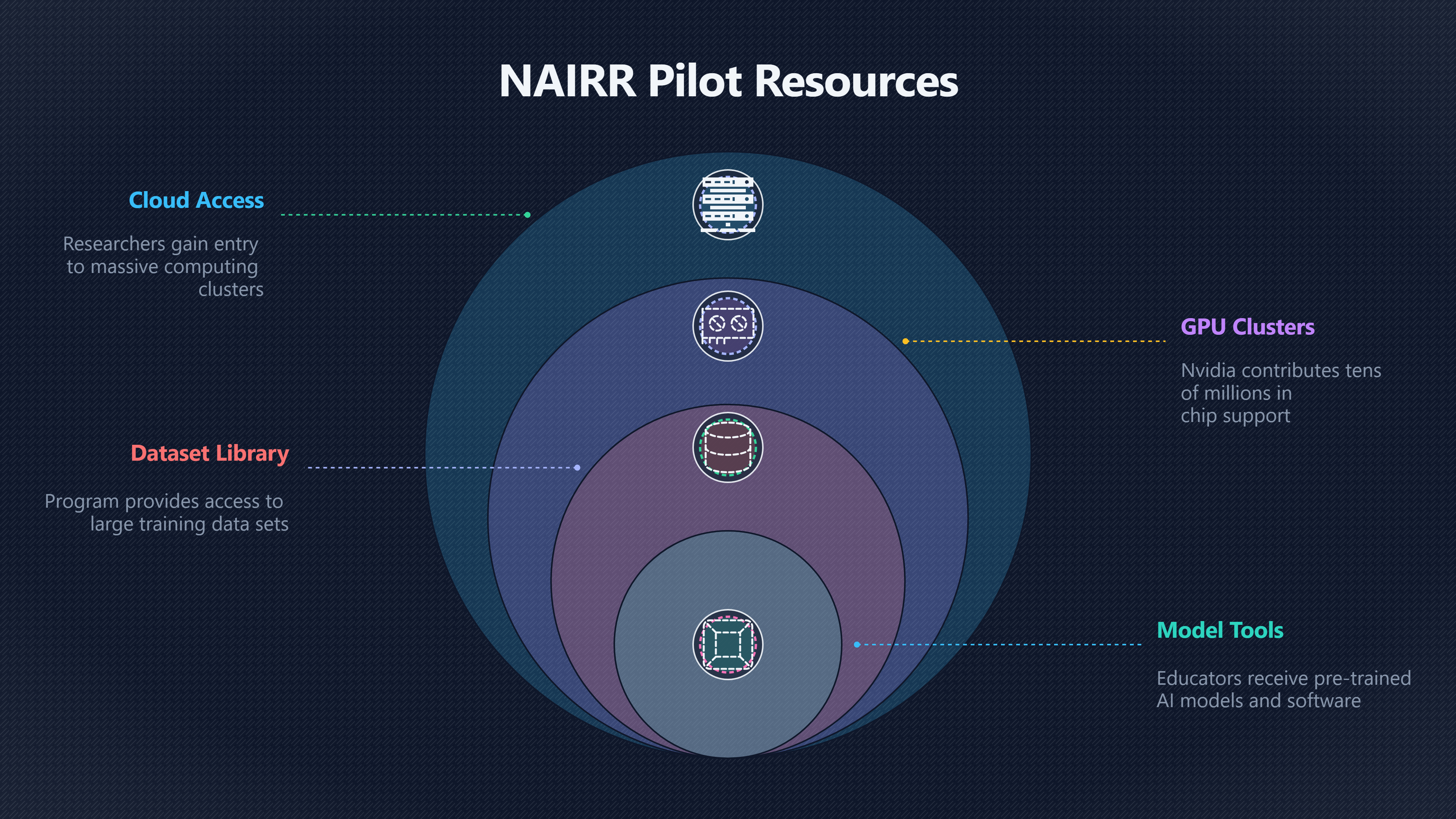
The NAIRR pilot launched in January 2024 under the U.S. National Science Foundation with support from federal agencies, universities, non-profits, and major technology companies. Its purpose is practical rather than symbolic: provide researchers and educators with access to AI infrastructure they could not otherwise afford. [NSF - U.S. National Science Foundation]nsf.govNational Science FoundationNational Artificial Intelligence Research ResourceVisit nairrpilot.org to explore opportunities for researcher… [NSF - U.S. National Science Foundation]nsf.govNational Science FoundationNational Artificial Intelligence Research ResourceVisit nairrpilot.org to explore opportunities for researcher…
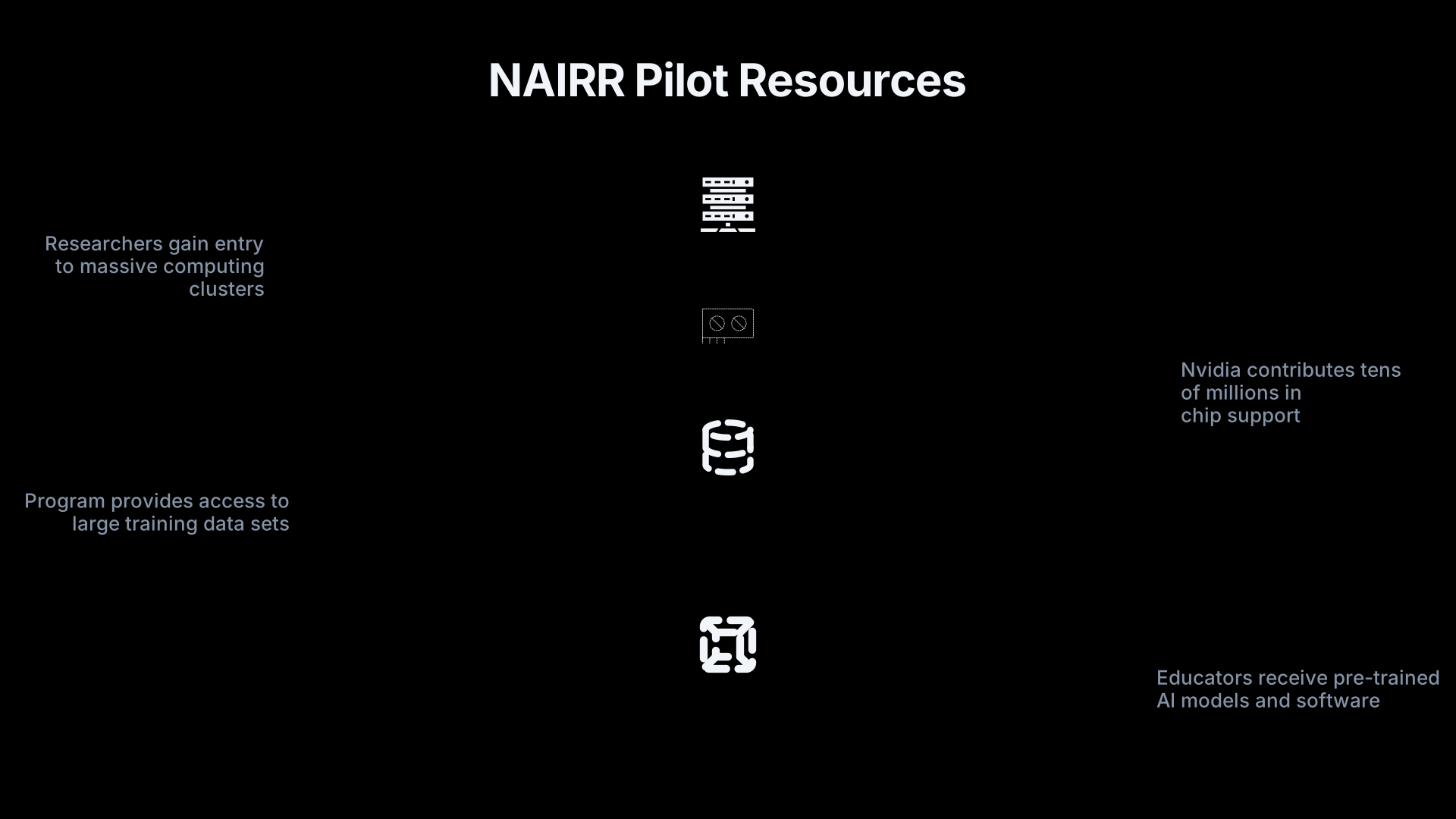
The pilot combines several different kinds of resources:
- Cloud computing access [brookings.edu]brookings.eduHow the National Artificial Intelligence Research Resource…9 Jul 2024 — The NAIRR is a proposed national initiative that aims to addre…
- GPU clusters
- Datasets
- Pre-trained AI models
- Software tools
- Technical support
- Educational resources
Importantly, it is not only a government supercomputer project. The model is heavily partnership-based. Companies including Nvidia and Microsoft contributed cloud credits, infrastructure, and tools. Nvidia alone announced tens of millions of dollars in computing and software support for the pilot. [Time]time.comThe U.SJust Made a Crucial Step Toward Democratizing…26 Jan 2024 — The National Artificial Intelligence Research Resource (NAIRR) pilot aims…
The structure reflects political and economic reality. The U.S. government does not currently own enough frontier AI infrastructure to operate independently at commercial scale. NAIRR therefore attempts a hybrid approach: public coordination layered on top of private-sector compute capacity.
The pilot also tries to widen participation geographically and institutionally. Early rounds funded projects across many U.S. states and research areas rather than concentrating only on elite AI labs. The programme explicitly targets researchers, educators, and students who lack access to large-scale AI resources. [NSF - U.S. National Science Foundation]nsf.govNational Science FoundationNational Artificial Intelligence Research ResourceVisit nairrpilot.org to explore opportunities for researcher… [The Department of Energy's Energy.gov]energy.govnational ai research resource pilot awards first round access 35 projectsThe Department of Energy's Energy.govNational AI Research Resource Pilot Awards First Round…6 May 2024 — The first 35 projects that wi…
That matters because the barrier is not merely technical capability. Many universities outside the wealthiest institutions simply cannot absorb the cost of large-scale AI experimentation. Shared infrastructure can therefore function as a kind of scientific equaliser.
The programme’s open-science expectations are also significant. Projects receiving NAIRR resources are generally expected to publish results openly and share outputs where possible. [Columbia University]cuit.columbia.eduprogram eligibility and requirements for Classroom/Educator and Research projects…Read more…
In principle, this preserves one of academia’s traditional strengths: turning discoveries into broadly available knowledge rather than proprietary assets.
Why NAIRR matters beyond universities
At first glance, the programme may look like a niche research subsidy. In practice, it touches a much larger question: who gets to shape advanced AI.
A world where only giant corporations can afford serious AI research may still produce powerful systems. But it risks narrowing the range of institutions capable of steering AI development toward public goals.
Shared public compute could support several broader functions:
Independent safety and alignment research
If advanced AI systems become extremely capable, outside scrutiny becomes more important, not less. Universities and public-interest labs may investigate questions commercial firms are less incentivised to prioritise, including robustness, interpretability, systemic risks, or long-term alignment with human values.
Without compute access, that work risks becoming dependent on corporate permission.
Scientific uses that are commercially weak but socially valuable
AI for rare diseases, climate modelling, public health, accessibility, education, or basic science may not generate venture-scale profits quickly enough to dominate private investment. Shared infrastructure can help keep these domains active.
This links directly to the AI bloom idea that the largest gains from AI may come through scientific acceleration rather than consumer products alone.
Training future researchers
Academic ecosystems matter because they produce future expertise. If frontier AI becomes inaccessible in universities, students increasingly learn only through corporate platforms and proprietary systems.
That could reshape the culture of the field itself, reducing openness and narrowing intellectual diversity.
Preventing permanent dependency
NAIRR’s supporters often frame the issue less as beating industry and more as avoiding complete dependence on it. The goal is not necessarily to outspend hyperscale cloud providers, but to preserve an independent research ecosystem capable of asking different questions and pursuing different objectives.
The strongest criticism: the frontier may already be too expensive
The central objection to NAIRR is blunt: the economics of frontier AI may already favour concentration so strongly that public programmes cannot realistically keep pace.
Commercial firms spend extraordinary sums on infrastructure. Training runs increasingly involve tens or hundreds of thousands of advanced chips. Data-centre expansion requires access to energy supplies, specialised networking hardware, and global supply chains.
Against that backdrop, even ambitious public programmes can look small.
Critics therefore argue that NAIRR risks becoming useful mainly for second-tier research rather than genuine frontier capability. Universities may gain enough compute for fine-tuning models, running experiments, or teaching students, but not enough to compete with top commercial labs.
There is also concern about dependence within the programme itself. Because much of the pilot relies on contributions from major technology firms, the public infrastructure remains partly downstream of private incentives. If cloud companies ultimately control the underlying hardware, public access may still exist only at their discretion.
Another challenge is bureaucracy. Academic allocation systems are often slower and more procedural than commercial research environments. Frontier AI development moves quickly. Researchers sometimes worry that proposal cycles, review processes, and compliance requirements could make public compute too cumbersome for cutting-edge experimentation.
Some analysts also question whether compute access alone is enough. Frontier AI increasingly depends on integrated ecosystems: elite engineering teams, proprietary datasets, reinforcement learning pipelines, specialised software tooling, and operational experience running giant distributed systems. Public compute may help, but not fully solve the broader concentration problem.
These objections do not necessarily imply NAIRR is pointless. They suggest instead that preserving academic relevance may require sustained and expanding investment rather than a one-off pilot.

What would count as success or failure?
NAIRR does not need to “beat” OpenAI, Google, Anthropic, or other major firms to matter. The more realistic question is whether it can preserve a meaningful public sphere in advanced AI research.
Success would probably look like several things happening simultaneously.
Academic researchers would still be able to conduct serious work on advanced systems rather than being confined to small-scale experiments. Universities would remain capable of training students on relevant infrastructure. Independent safety and evaluation research would continue outside corporate walls. Scientific fields beyond consumer AI would gain access to powerful computational tools.
A successful NAIRR would also broaden participation geographically and institutionally. One goal is preventing frontier AI capability from concentrating entirely inside a few coastal firms and elite universities.
Longer term, success could mean creating durable public infrastructure analogous to earlier scientific investments. Modern science already depends on publicly supported facilities that no individual university could build alone: particle accelerators, genome databases, space telescopes, and national laboratories. NAIRR supporters argue advanced AI infrastructure may need to become part of that same category.
Failure would look different.
The pessimistic scenario is not merely that NAIRR underperforms. It is that academic AI gradually becomes incapable of meaningful frontier participation altogether. Universities would then function mainly as talent pipelines feeding corporate labs, while independent research, replication, and oversight weaken.
In that world, the broader AI bloom vision could still produce enormous wealth and technological power. But the governance of that future would become highly concentrated. Humanity might gain extraordinary AI capabilities while losing broad participation in shaping them.
Can public compute really stop AI becoming a private toll road?
Probably not on its own.
The economics of advanced AI currently favour scale, concentration, and integration with giant cloud providers. Public compute initiatives are unlikely to erase those pressures entirely.
But the more important question may be whether they can preserve alternatives before concentration becomes irreversible.
NAIRR’s significance lies partly in what it represents: the idea that access to advanced intelligence infrastructure may be too important to leave entirely to market dynamics. If AI eventually accelerates science, medicine, engineering, and civilisation-scale problem-solving, then broad participation in AI research becomes a question about the distribution of future human capability itself.
The pilot remains small relative to the frontier. Yet it also marks a shift in political thinking. Governments increasingly recognise that compute access is not just a technical detail. It is becoming a foundational issue for who gets to contribute to the next phase of scientific and economic development.
Within the wider AI bloom debate, that distinction matters enormously. A future of abundant machine intelligence could still emerge through highly centralised systems. The open question is whether societies can build institutions that spread at least some of that capability widely enough for universities, public researchers, and civil society to remain active participants in shaping humanity’s long-term future.
Endnotes
-
Source: nsf.gov
Link: https://www.nsf.gov/focus-areas/ai/nairrSource snippet
National Science FoundationNational Artificial Intelligence Research ResourceVisit nairrpilot.org to explore opportunities for researcher...
-
Source: brookings.edu
Link: https://www.brookings.edu/articles/how-the-national-artificial-intelligence-research-resource-can-pilot-inclusive-ai/Source snippet
How the National Artificial Intelligence Research Resource...9 Jul 2024 — The NAIRR is a proposed national initiative that aims to addre...
-
Source: time.com
Title: The U.S
Link: https://time.com/6589134/nairr-ai-resource-access/Source snippet
Just Made a Crucial Step Toward Democratizing...26 Jan 2024 — The National Artificial Intelligence Research Resource (NAIRR) pilot aims...
-
Source: cset.georgetown.edu
Title: CSETThe NAIRR Pilot: Estimating Compute
Link: https://cset.georgetown.edu/article/the-nairr-pilot-estimating-compute/Source snippet
May 8, 2024 — 8 May 2024 — This suggests that the total NAIRR compute, if fully utilized, is roughly equivalent to the compute used by th...
Published: May 8, 2024
-
Source: nsf.gov
Title: us nairr pilot brings cutting edge ai resources researchers
Link: https://www.nsf.gov/science-matters/us-nairr-pilot-brings-cutting-edge-ai-resources-researchersSource snippet
National Science FoundationU.S. NAIRR pilot brings cutting-edge AI resources to...16 Oct 2024 — The NAIRR pilot partners have been worki...
-
Source: microsoft.com
Link: https://www.microsoft.com/en-us/research/project/national-ai-research-resource-nairr-pilot/Source snippet
National AI Research Resource (NAIRR) PilotThe mission of the NAIRR pilot aligns with our commitment to broaden AI research and spur inno...
-
Source: energy.gov
Title: national ai research resource pilot awards first round access 35 projects
Link: https://www.energy.gov/science/articles/national-ai-research-resource-pilot-awards-first-round-access-35-projectsSource snippet
The Department of Energy's Energy.govNational AI Research Resource Pilot Awards First Round...6 May 2024 — The first 35 projects that wi...
Published: May 2024
-
Source: cuit.columbia.edu
Link: https://www.cuit.columbia.edu/national-hpc-access/nairrSource snippet
program eligibility and requirements for Classroom/Educator and Research projects...Read more...
-
Source: dictionary.cambridge.org
Link: https://dictionary.cambridge.org/us/dictionary/english/nationalSource snippet
| definition in the Cambridge English Dictionaryrelating to all parts of a nation or to a nation as a whole rather than to any part of it...
-
Source: openmined.org
Link: https://openmined.org/programs/nairr/Source snippet
Program ⬩ OpenMinedPartner with OpenMined through the NAIRR pilot to access privacy-preserving AI research tools and 1000x more data. Joi...
-
Source: submit-nairr.xras.org
Link: https://submit-nairr.xras.org/resourcesSource snippet
Submit: Resource CatalogThe Partnership to Advance Throughput Computing (PATh) is an NSF-funded project that provides services and capabi...
-
Source: frontiersin.org
Link: https://www.frontiersin.org/journals/research-metrics-and-analytics/articles/10.3389/frma.2025.1595824/fullSource snippet
NAIRR pilot exemplifies this direction, demonstrating potential through lowering access barriers to computing resources and datasets. How...
Additional References
-
Source: weather.gov
Link: https://www.weather.gov/Source snippet
National Weather ServiceFire Weather Concerns in the Southern Plains and Southeast; Thunderstorms in the Southeast and Mid-Atlantic · Bri...
-
Source: nps.gov
Link: https://www.nps.gov/Source snippet
Homepage (U.S. National Park Service)Discover America's stories. Plan your visit and explore the diverse landscapes, national parks, and...
-
Source: merriam-webster.com
Link: https://www.merriam-webster.com/dictionary/nationalSource snippet
NATIONAL Definition & Meaning5 days ago — 1. of or relating to a nation; national boundaries; the national flag. 2. nationalist. 3. compr...
-
Source: nationalgeographic.com
Link: https://www.nationalgeographic.com/ -
Source: nationalgridus.com
Link: https://www.nationalgridus.com/Source snippet
National Grid: Natural Gas & ElectricityWelcome to National Grid, providing New York and Massachusetts with natural gas and electricity f...
-
Source: instagram.com
Link: https://www.instagram.com/thenational/Source snippet
The National (@thenational) • Instagram photos and videosOver 25 years since first making their mark on the New York indie-rock club scen...
-
Source: nationaljournal.com
Link: https://www.nationaljournal.com/ -
Source: voltagepark.com
Link: https://www.voltagepark.com/blog/5-ways-the-nairr-pilot-is-expanding-access-to-ai-research-resourcesSource snippet
5 Ways the NAIRR Pilot is Expanding Access to AI...Access top-tier compute, and a scalable public-private model for AI research project...
-
Source: oecd.ai
Title: national artificial intelligence research resource pilot 1037
Link: https://oecd.ai/en/dashboards/policy-initiatives/national-artificial-intelligence-research-resource-pilot-1037Source snippet
National Artificial Intelligence Research Resource Pilot31 Dec 2025 — The NAIRR pilot brings together computational, data, software, mode...
-
Source: govtech.com
Link: https://www.govtech.com/education/higher-ed/2-years-into-nairr-pilot-shared-infrastructure-boosts-ai-innovationSource snippet
2 Years Into NAIRR Pilot, Shared Infrastructure Boosts AI...9 Dec 2025 — 2 Years Into NAIRR Pilot, Shared Infrastructure Boosts AI Innov...
Amazon book picks
Further Reading
Books and field guides related to NAIRR and research access. Use these as the next step if you want deeper reading beyond the article.

The Oxford Handbook of AI Governance
As the capabilities of Artificial Intelligence (AI) have increased over recent years, so have the challenges of how to govern its usage....

Technology and the Public Interest
First published 2022. Subjects: Technology, Public opinion, Social aspects, Technological innovations, Technology and law.

Foundational Principles of AI Governance and Policy
This edited volume provides a structured analysis of AI governance principles, challenges, and implementation strategies. Drawing on inte...

Architectures of Global AI Governance
The impacts of artificial intelligence (AI) are often framed as an uncontrollable wave of technological change. But AI's trajectory is no...
eBay marketplace picks
Marketplace Samples
Example marketplace items related to this page. Use the search link to explore similar finds on eBay.

Example eBay listing
A.I. Artificial Intelligence Original Movie Poster Signed By Jude Law
USD 125.00 | Shipping USD 25.00 | US

Example eBay listing
Artificial Intelligence D/S Original Movie Poster - 27 x 40"
USD 19.50 | Shipping USD 13.65 | US

Example eBay listing
612388 Artificial Intelligence Movie Science Fiction Drama Wall Print Poster
USD 22.95 | Shipping USD 12.95 | JP

Example eBay listing
Companion - Artificial Intelligence Dark Comedy Cinema Film - POSTER 20"x30"
USD 23.99 | Free shipping | US

Example eBay listing
A.I. Artificial Intelligence Movie Film Poster Art Print
GBP 4.99 | Free shipping | GB

Example eBay listing
A I Artificial Intelligence 6 Movie Poster Art Print Print Classic Rare Gallery
GBP 49.00 | Free shipping | GB

Example eBay listing
AI - Artificial Intelligence (Poster + Slipcase) Blu-Ray
GBP 10.49 | Free shipping | GB

Example eBay listing
A. I. Artificial Intelligence. Jude Law. Original UK Video Poster.
GBP 8.11 | Shipping GBP 3.38 | GB
Topic Tree