Within Peace deals
Ceasefire monitoring risks
AI-assisted monitoring may reduce uncertainty after a deal, but bad data, surveillance fears and contested evidence can also damage trust.
On this page
- How AI could verify ceasefire compliance
- Why better evidence can make promises more credible
- Surveillance, bias and false alarm risks
Page outline Jump by section
Introduction
AI systems may eventually help mediators monitor ceasefires more effectively by reducing uncertainty about what is happening on the ground. Satellite imagery, drones, acoustic sensors, machine learning systems and large-scale data analysis can sometimes detect troop movements, shelling, damaged infrastructure or unusual mobilisation faster than traditional monitoring teams alone. In theory, better evidence could make peace agreements more credible because each side has fewer opportunities to deny obvious violations or spread false claims. Monitored ceasefires are already associated with greater durability than unmonitored ones. [RC Services Assets]rc-services-assets.s3.eu-west-1.amazonaws.comRC Services Assets Ceasefire monitoring: Developments and complexitiesRC Services AssetsCeasefire monitoring: Developments and complexitiesJune 2, 2021 — Ceasefire mediation practitioners tend to adopt a mor…
 But ceasefire monitoring is also one of the clearest examples of why AI governance and trust matter as much as technical capability. A monitoring system only stabilises a peace process if all major parties believe it is fair, accurate and politically legitimate. Bad data, biased interpretation, manipulated imagery, false alarms or intrusive surveillance can instead deepen paranoia and accelerate collapse. The same technologies that make monitoring easier can also make populations feel watched, profiled or targeted.
The result is a tension that runs through much of the broader AI bloom debate. Advanced AI could help humanity coordinate more effectively in high-stakes situations, including war termination and peace implementation. Yet coordination systems become dangerous if they centralise power, generate contested “truth”, or replace fragile political trust with opaque technical authority.
How AI could verify ceasefire compliance
Traditional ceasefire monitoring is labour-intensive and often slow. Human observers may struggle to access dangerous territory, verify contradictory claims, or monitor large front lines continuously. Modern conflicts also produce enormous volumes of information: mobile phone footage, satellite images, radio traffic, social media claims, refugee reports and sensor data.
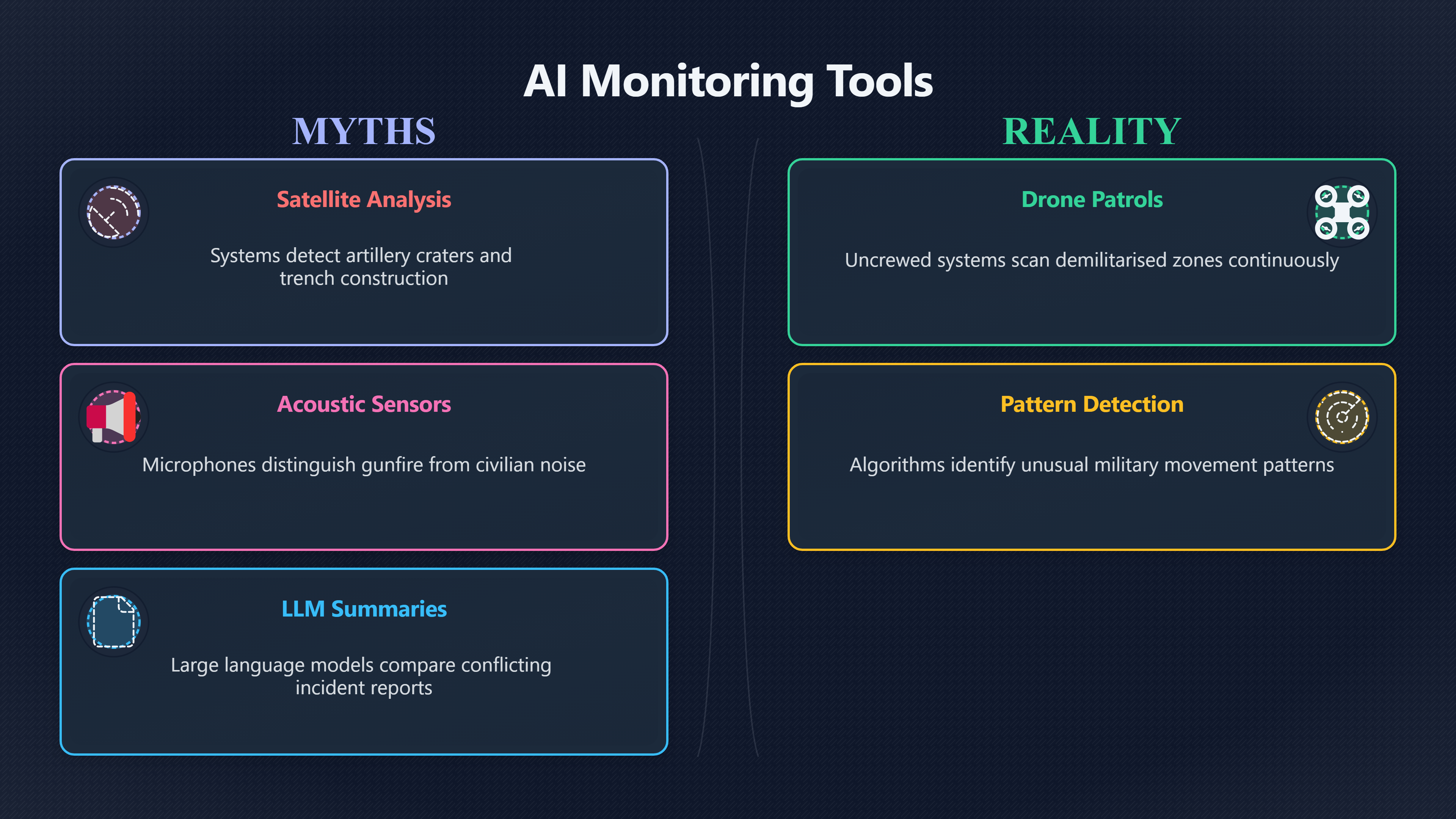
AI systems are increasingly being explored as tools to process this flood of information more quickly. Current proposals and pilot systems include:
- Automated analysis of satellite imagery to identify artillery craters, trench construction or vehicle concentrations.
- Drone-based monitoring of demilitarised zones.
- Acoustic systems that distinguish gunfire from civilian noise.
- Pattern-detection tools that identify unusual military movement.
- Large language models that summarise incident reports and compare competing claims.
- Cross-referencing systems that combine open-source intelligence with official observer reports.
Researchers and practitioners argue that these tools could reduce some of the classic information problems that undermine ceasefires. The Geneva Centre for Security Policy, for example, has explored how digital monitoring technologies might support future ceasefire verification arrangements in conflicts such as Ukraine. [Geneva Centre for Security Policy]gcsp.chGeneva Centre for Security PolicyEnabling Peace:A consideration throughout this report is that technology can be a key enabler for monito…
Remote sensing technologies may also help where physical access is impossible. A 2023 review of remote monitoring research noted that satellite imagery and related sensing tools can sometimes observe violence in areas too dangerous for human monitors to enter safely. [PMC]pmc.ncbi.nlm.nih.govPMCToward the remote monitoring of armed conflictsPMC - NIHby V Sticher · 2023 · Cited by 54 — This article assesses the state of the research working toward the remote monitoring of arme…
The attraction is obvious. Ceasefires frequently fail because both sides suspect hidden mobilisation or covert attacks. If reliable monitoring lowers uncertainty, it may become easier for negotiators to sustain restraint long enough for wider political talks to continue.
Why better evidence can make promises more credible
The optimistic case for AI-assisted monitoring is not that algorithms create peace by themselves. It is that peace agreements become easier to sustain when violations are harder to hide and rumours are easier to test.
Ceasefires are unusually vulnerable to fear spirals. A small local clash can rapidly escalate if commanders interpret it as evidence that the other side is preparing a wider offensive. In fragmented conflicts involving militias and irregular groups, leaders may not even fully control all fighters under their nominal authority.
Better monitoring can help separate:
- deliberate strategic offensives,
- localised violations,
- rogue actors,
- misunderstandings,
- accidental clashes,
- and fabricated allegations.
Research on ceasefire violations shows that interpretation matters almost as much as the violation itself. Parties often try to infer intent from incomplete evidence. A transparent monitoring process can therefore reduce escalation pressure by clarifying what actually happened and how serious it was. [OUP Academic]academic.oup.comOUP AcademicCeasefire Violations: Why They Occur and How They Relate…by V Sticher · 2022 · Cited by 9 — A case study of a major ceasef…
This is one reason monitored ceasefires are generally more durable than unmonitored ones. Independent verification changes incentives. If violations are likely to be observed and documented, parties may become less willing to gamble on covert escalation. [RC Services Assets]rc-services-assets.s3.eu-west-1.amazonaws.comRC Services Assets Ceasefire monitoring: Developments and complexitiesRC Services AssetsCeasefire monitoring: Developments and complexitiesJune 2, 2021 — Ceasefire mediation practitioners tend to adopt a mor…
AI may strengthen this effect if it enables near real-time analysis across large geographic areas. In 2025, UN peacekeeping officials argued that ceasefire monitoring increasingly requires “real-time observation” capabilities because older methods based mainly on physical presence are no longer sufficient in many conflicts. [UN Press]press.un.orgUN PressCeasefire Monitoring 'Can No Longer Be Just about Being…7 Apr 2025 — Ceasefire Monitoring 'Can No Longer Be Just about Being P…
From the wider AI bloom perspective, this matters because peace itself is a coordination technology. Scientific progress, economic development, education, infrastructure and long-term flourishing depend heavily on societies avoiding repeated violent collapse. Even small improvements in humanity’s ability to maintain credible agreements could have outsized civilisational effects over decades.
The problem of contested evidence
The strongest objections begin with a simple point: evidence only builds trust if the parties trust the evidence-producing system.
This is far from guaranteed in war.
Even before generative AI, ceasefire monitoring frequently produced disputes over interpretation. A satellite image may show damaged buildings without proving who attacked first. Sensor systems may misclassify explosions. Troop movement may be defensive rather than offensive. Raw data rarely interprets itself.
AI systems add another layer of opacity. Machine learning models often produce conclusions through statistical processes that outsiders cannot easily audit or explain. If one side believes the system is biased, manipulated or trained on distorted data, the monitoring process itself can become politically toxic.
This risk is especially acute in asymmetric conflicts where weaker parties already fear surveillance domination by stronger states. A technologically sophisticated monitoring architecture may appear neutral to outside observers while feeling coercive to local actors.
Researchers studying “hybrid peacemaking” and digital mediation have repeatedly warned that technological systems are never politically neutral. The design choices embedded in data collection, classification and verification systems influence whose experiences become visible and whose claims are discounted. [Graduate Institute Repository]repository.graduateinstitute.chiner article p94 5Graduate Institute RepositoryTowards a Research Agenda on Hybrid Peacemaking…by AT Hirblinger · 2023 · Cited by 26 — The growing use o…
A peace process can therefore fail not because the monitoring system lacks technical sophistication, but because participants reject its legitimacy.
Surveillance fears and the politics of visibility
There is also a deeper political concern. Technologies designed for ceasefire monitoring can overlap with systems used for military targeting, intelligence gathering and domestic surveillance.
Drones, persistent imaging systems, biometric databases and large-scale behavioural analysis may help detect ceasefire violations. They may also create fears that humanitarian or mediation mechanisms are being used to map populations for future coercion.
This is not merely theoretical. In several conflicts, international monitoring missions have faced accusations of espionage or political manipulation. The Organization for Security and Co-operation in Europe (OSCE) Special Monitoring Mission in Ukraine encountered disputes over technology use, restricted access and political contestation around monitoring data even before the full-scale 2022 invasion. [Wiley Online Library]onlinelibrary.wiley.com1758 5899.13123Wiley Online LibraryCeasefire monitoring under fire: The OSCE, technology…by A Verjee · 2022 · Cited by 13 — This Policy Insight discu…
The core problem is that visibility changes power relationships. The actor controlling the monitoring infrastructure may gain strategic advantages unavailable to others.
This creates several difficult questions:
- Who owns the monitoring data?
- Which governments or organisations can access raw feeds?
- Can local communities challenge incorrect classifications?
- Are AI models independently auditable?
- What protections exist against mission creep?
- Could systems introduced for ceasefire verification later become permanent surveillance infrastructure?
For readers interested in AI and humanity’s long-term future, these questions connect to a broader governance dilemma. The same AI systems that could improve coordination and reduce violence may also enable unprecedented concentration of informational power.
False alarms can destabilise fragile peace
One underappreciated risk is that AI monitoring systems may destabilise negotiations precisely because they generate too much information.
Human mediation sometimes depends on ambiguity. Minor incidents are occasionally handled quietly because all sides prefer de-escalation. A hyper-sensitive monitoring system that publicly flags every anomaly may instead increase political pressure for retaliation.
False positives are especially dangerous in tense environments.
A wrongly classified troop movement, misidentified explosion or manipulated image could trigger:
- retaliatory mobilisation,
- collapse of negotiations,
- domestic political backlash,
- or renewed violence.
Researchers studying AI and armed conflict warn that over-reliance on algorithmic analysis can encourage flawed or overconfident decision-making, particularly when humans assume machine-generated outputs are objective. [International Review of the Red Cross]international-review.icrc.orgInternational Review of the Red CrossArtificial intelligence and machine learning in armed conflictMarch 16, 2021 — AI and machine learni…
This problem becomes even more severe in the age of synthetic media. Deepfakes, manipulated satellite imagery and AI-generated propaganda may make it harder to establish shared factual reality during conflicts. Ironically, technologies intended to improve verification may coincide with a wider collapse in trust about what counts as authentic evidence.
The result could be a paradoxical world where there is vastly more monitoring data but less agreement about truth.

Human judgement still matters
Most serious proposals for AI-assisted ceasefire monitoring therefore keep humans at the centre of interpretation and enforcement.
The more realistic near-term model is not autonomous peacekeeping software. It is decision-support infrastructure that helps human mediators and monitors process information more effectively while retaining political judgement and accountability.
This distinction matters because ceasefires are ultimately social and political agreements, not engineering systems.
Human monitors can:
- interpret local context,
- recognise symbolic gestures,
- understand cultural signals,
- assess intent,
- and negotiate informal de-escalation.
Algorithms are much weaker at these tasks.
Several studies on machine learning in mediation stress the importance of participatory and context-sensitive design rather than purely technical optimisation. [arXiv]arxiv.orgarXiv Machine Learning for Mediation in Armed ConflictsarXivMachine Learning for Mediation in Armed ConflictsAugust 26, 2021…
In practice, successful monitoring systems may depend less on advanced AI capability than on institutional trust:
- transparent governance,
- shared access to evidence,
- independent auditing,
- agreed verification standards,
- and clear dispute-resolution mechanisms.
Without these, more powerful monitoring may simply intensify existing fears.
What this reveals about AI and human flourishing
Ceasefire monitoring is a small but revealing example of the wider AI bloom argument.
The optimistic vision of advanced AI often assumes that better intelligence leads naturally to better coordination. If societies can process information more accurately and at greater scale, perhaps they can avoid catastrophic misunderstandings, manage conflicts more peacefully and sustain cooperation across larger populations.
There is some evidence for this possibility. Better monitoring can reduce uncertainty. Better evidence can discourage opportunistic cheating. Faster analysis can help mediators respond before local violence escalates into strategic collapse.
But ceasefire monitoring also exposes the limits of purely technical solutions to human conflict.
Peace agreements depend on legitimacy, dignity, reciprocity and political consent as much as factual accuracy. A technically sophisticated monitoring system that one side experiences as humiliating or coercive may fail even if its underlying analysis is correct.
This tension may generalise far beyond war termination. Many proposed AI systems for governing future civilisation — from economic coordination to biosurveillance to automated regulation — face the same challenge. Human flourishing requires not only capability, but trusted institutions capable of using capability fairly.
AI may eventually help humanity coordinate more effectively under conditions of high complexity and mistrust. Yet the ceasefire case suggests that the hardest part is not building systems that can see more. It is building systems that rival groups believe they can safely live under.
Endnotes
-
Source: pmc.ncbi.nlm.nih.gov
Title: PMCToward the remote monitoring of armed conflicts
Link: https://pmc.ncbi.nlm.nih.gov/articles/PMC10291284/Source snippet
PMC - NIHby V Sticher · 2023 · Cited by 54 — This article assesses the state of the research working toward the remote monitoring of arme...
-
Source: academic.oup.com
Link: https://academic.oup.com/isr/article/24/4/viac046/6701908Source snippet
OUP AcademicCeasefire Violations: Why They Occur and How They Relate...by V Sticher · 2022 · Cited by 9 — A case study of a major ceasef...
-
Source: onlinelibrary.wiley.com
Title: 1758 5899.13123
Link: https://onlinelibrary.wiley.com/doi/full/10.1111/1758-5899.13123Source snippet
Wiley Online LibraryCeasefire monitoring under fire: The OSCE, technology...by A Verjee · 2022 · Cited by 13 — This Policy Insight discu...
-
Source: arxiv.org
Title: arXiv Machine Learning for Mediation in Armed Conflicts
Link: https://arxiv.org/abs/2108.11942Source snippet
arXivMachine Learning for Mediation in Armed ConflictsAugust 26, 2021...
Published: August 26, 2021
-
Source: arxiv.org
Title: arXiv Supporting peace negotiations in the Yemen war through machine learning
Link: https://arxiv.org/abs/2207.11528 -
Source: academic.oup.com
Link: https://academic.oup.com/isr/article/25/3/viad039/7264254Source snippet
V Sticher · 2023 · Cited by 13 — In many conflicts, international ceasefire monitors are deployed to mitigate future violence...
-
Source: rc-services-assets.s3.eu-west-1.amazonaws.com
Title: RC Services Assets Ceasefire monitoring: Developments and complexities
Link: https://rc-services-assets.s3.eu-west-1.amazonaws.com/s3fs-public/Ceasefire_monitoring_Developments_and_complexities.pdfSource snippet
RC Services AssetsCeasefire monitoring: Developments and complexitiesJune 2, 2021 — Ceasefire mediation practitioners tend to adopt a mor...
Published: June 2, 2021
-
Source: gcsp.ch
Link: https://www.gcsp.ch/sites/default/files/2026-01/GCSP_CF-Monitoring_2026%3Bdigital.pdfSource snippet
Geneva Centre for Security PolicyEnabling Peace:A consideration throughout this report is that technology can be a key enabler for monito...
-
Source: press.un.org
Link: https://press.un.org/en/2025/sc16039.doc.htmSource snippet
UN PressCeasefire Monitoring 'Can No Longer Be Just about Being...7 Apr 2025 — Ceasefire Monitoring 'Can No Longer Be Just about Being P...
-
Source: repository.graduateinstitute.ch
Title: iner article p94 5
Link: https://repository.graduateinstitute.ch/record/300568/files/iner-article-p94_5.pdfSource snippet
Graduate Institute RepositoryTowards a Research Agenda on Hybrid Peacemaking...by AT Hirblinger · 2023 · Cited by 26 — The growing use o...
-
Source: international-review.icrc.org
Link: https://international-review.icrc.org/sites/default/files/reviews-pdf/2021-03/ai-and-machine-learning-in-armed-conflict-a-human-centred-approach-913.pdfSource snippet
International Review of the Red CrossArtificial intelligence and machine learning in armed conflictMarch 16, 2021 — AI and machine learni...
Published: March 16, 2021
Additional References
-
Source: quillbot.com
Link: https://quillbot.com/ai-chatSource snippet
AI ChatUnlock your potential with Quillbot's free AI chat! Brainstorm, draft content, get instant research & overcome writer's block. Try...
-
Source: sas.com
Link: https://www.sas.com/en_us/insights/analytics/what-is-artificial-intelligence.htmlSource snippet
Artificial Intelligence (AI): What it is and why it mattersArtificial intelligence (AI) makes it possible for machines to learn from expe...
-
Source: ouci.dntb.gov.ua
Link: https://ouci.dntb.gov.ua/en/works/9ZPdw82b/Source snippet
mediation as an instrument of peaceful settlement...Its application enhances trust between conflicting parties, facilitates the early de...
-
Source: csis.org
Title: machine learning meets war termination using ai explore peace scenarios ukraine
Link: https://www.csis.org/analysis/machine-learning-meets-war-termination-using-ai-explore-peace-scenarios-ukraineSource snippet
Machine Learning Meets War Termination: Using AI...27 Feb 2025 — AI moves beyond simple summarization to become a tool for systematicall...
-
Source: unidir.org
Link: https://unidir.org/wp-content/uploads/2023/05/UNIDIR-Exploring_Use_Technology_Remote_Ceasefire_Monitoring_Verification.pdfSource snippet
collaboration between the conflict parties and avoid prohibited behaviours from...Read more...
-
Source: researchgate.net
Title: 354157815 Machine Learning for Mediation in Armed Conflicts
Link: https://www.researchgate.net/publication/354157815_Machine_Learning_for_Mediation_in_Armed_ConflictsSource snippet
(PDF) Machine Learning for Mediation in Armed Conflicts27 Aug 2021 — This study shows how machine-learning tools can effectively support...
-
Source: reliefweb.int
Title: Ceasefires: Integrating Emerging Technologies
Link: https://reliefweb.int/report/world/ceasefires-integrating-emerging-technologiesSource snippet
World31 Mar 2026 — Modern ceasefires increasingly need provisions for monitoring uncrewed systems, preventing cyberattacks on civilian in...
-
Source: europeanleadershipnetwork.org
Link: https://europeanleadershipnetwork.org/wp-content/uploads/2025/10/25_10_ceasefire-pb-1.pdfSource snippet
Widening the ceasefire toolkit: The promise of geophysical...25 Oct 2025 — Some scholars have questioned the utility of tech-heavy cease...
-
Source: ibm.com
Link: https://www.ibm.com/think/topics/artificial-intelligenceSource snippet
rning, comprehension, problem solving, decision-making...
-
Source: Wikipedia
Title: Artificial intelligence
Link: https://en.wikipedia.org/wiki/Artificial_intelligenceSource snippet
Artificial intelligenceArtificial intelligence (AI) is the capability of computational systems to perform tasks typically associated w...
Amazon book picks
Further Reading
Books and field guides related to Ceasefire monitoring risks. Use these as the next step if you want deeper reading beyond the article.

Human Rights Functions of United Nations Peacekeeping Operations
The United Nations peacekeeping has evolved as a practical measure for preserving international peace and security. Recent peacekeeping h...

The Oxford Handbook of United Nations Peacekeeping Operations
This volume presents an authoritative and accessible examination and critique of UN peacekeeping operations.

Reforming 21st Century Peacekeeping Operations
This book considers contemporary international interventions with a specific focus on analyzing the frameworks that have guided recent pe...

Unintended consequences of peacekeeping operations
First published 2007. Subjects: United Nations, Peacekeeping forces, Armed Forces, United nations, armed forces, International police.
eBay marketplace picks
Marketplace Samples
Example marketplace items related to this page. Use the search link to explore similar finds on eBay.

Example eBay listing
A.I. Artificial Intelligence Original Movie Poster Signed By Jude Law
USD 125.00 | Shipping USD 25.00 | US

Example eBay listing
Artificial Intelligence D/S Original Movie Poster - 27 x 40"
USD 19.50 | Shipping USD 13.65 | US

Example eBay listing
612388 Artificial Intelligence Movie Science Fiction Drama Wall Print Poster
USD 22.95 | Shipping USD 12.95 | JP

Example eBay listing
Companion - Artificial Intelligence Dark Comedy Cinema Film - POSTER 20"x30"
USD 23.99 | Free shipping | US
Topic Tree